Category Archives: Paddy's Writing

Relaunch of Ill Met by Moonlight website to mark 70th anniversary

Capture

Ironically I was away in Munich when Tim Todd posted this comment on the Your Paddy Thoughts page. It has been 70 years since the kidnap and there are a number of events and publications associated with it. Both of Billy Moss’ books are being republished (more to follow), and, as has been already mentioned on here, a version of Paddy’s own account is due later this year.

Tim Todd is probably the leading authority on the kidnap and the route used during the evasion phase. He works very closely with Chris White on this project which never seems to be short of new aspects or details to investigate. The Ill Met by Moonlight website is very well worth visiting. Here is Tim’s update about his reworked site and a cautionary tale about retracing the route.

Well, today, Saturday 26th April 2014, is the 70th anniversary of the abduction of General Kreipe by Paddy, Billy and their Cretan colleagues.

To mark the occasion may I draw attention to my relaunched website and in particular to a transcription of Paddy’s own short report on the abduction. It is the first of a number of his reports that will be appearing on the illmetbymoonlight.info website now that I am free of another commitment that had taken up a lot of time.This report, one of nine by Paddy, can be found here.

Interest in his Cretan adventures remains as great as ever and I have just heard back from one party who did the full route in the last few weeks, from Dermati to Rodakino in a remarkable 7 days and three hours – and pushed himself to the point of exhaustion in the process. Aspiring route followers should not, under any circumstances, consider this a realistic target though as the parties concerned were not your average walkers by a long way. The report came back accompanied by a warning about map accuracy, not the first, and the recommendation is always to seek local guidance for the more remote locations and not to rely on GPS coordinates.

Baron Pips von Schey

Originally posted as a comment on the Your Paddy Thoughts page, I thought this too good to be left buried deep in that page. My thanks to Brian Human who posted it here.

One of the most significant of the characters that inhabit Paddy’s pre-war world is Baron Philipps (Pips) von Schey. Paddy’s stay with Pips at the Schey country house at Kovecses enlivens the later pages of A Time of Gifts. This episode gets an unexpected reference in Edmund de Waal’s sparkling biography The Hare with Amber Eyes (p. 177 of the illustrated edition, Chatto & Windus, 2010) due to an important family connection.

In 1899 Baroness Emmy Schey von Koromla married de Waal’s great grandfather, banker Viktor von Ephrussi. Pips was her younger brother and Kovecses becomes a recurring presence in the lives of the Ephrussi family.

In The Hare Kovecses is described as ‘a very large and very plain eighteenth century house (“a large square box such as children draw”…) set in a flat landscape of fields with belts of willows, birch forests and streams. A great river, the Vah, swept past, forming one of the boundaries of the estate…There was a swimming lake with fretted Moorish changing huts, lots of stables and lots of dogs.’ Trains stopped ‘at the tiny halt on the estate.’ The Hare includes several pictures of Kovecses.

Pips is pictured in a pen-and-ink drawing playing Wagner at the piano. He had been educated by tutors and had ‘a wide circle of friends in the arts and the theatre, is a man around town in several capitals and is impeccably dressed…’. A further sign of his high profile: ‘Pips appears as the protagonist of a highly successful novel of the time by the German Jewish novelist Jakob Wassermann…Our aesthetic hero is a pal of archdukes…He is erudite about incunabula and Renaissance art…’. Kovecses became a retreat for the Ephrussi family, a refuge from the banking hothouse of Vienna for games, music and plays, for swimming, walking riding and shooting in the years before 1914.

With the advent of war, ‘Uncle Pips is called up, handsome in his uniform with its astrakhan collar, to fight against his French and English cousins’. In 1915 he ‘is serving as an imperial liaison officer with the German high command in Berlin, where he is instrumental in helping Rilke get a desk job away from the Front.’ Wartime shortages beset the Ephrussies in Vienna and in 1916 they go to ‘…Kovecses for the whole long holiday. This means that at least they can eat properly. There is roast hare, game pies and plum dumplings…’. By August 1918, ‘There are only two old man to tend the gardens and the roses on the long veranda are unkempt’ at Kovecse.

After the war Pips maintains his friendship with Rilke and gives his niece, Elizabeth, de Waal’s grandmother, an introduction to the poet. She sends him her poems and they correspond, though they never meet.

By the early 1930s and with the ascendancy of fascism and anti Semitism life became increasing difficult for the Ephrussies. In 1934 (the year of Paddy’s visit) ‘Viktor and Emmy holiday together at Kovecses, but since the death of her parents it is a strangely diminished place, with only a couple of horses in the stables and fewer gamekeepers and no great weekend shoots any more…The swimming lake has been let go. Its edges are susurrating reeds.’ Following the Anschluss in 1938 Viktor and Emmy flee Vienna for the relative safety of Kovecses. ‘In the summer of 1938 Kovecses looks much the same as it has done, a jumble of grand and informal…[but] The roses are more unkempt…The house is much emptier.’ The safety is only relative: ‘The borders are under review and Czechoslovakia is fissile. And Kovecses is just too close to danger.’ Germany occupied the Sudetenland; Emmy died at Kovecses on 12th October 1938 and was buried in the churchyard of the nearby hamlet. In early March Viktor got permission to leave for Britain, where he died in 1945.

The war and its aftermath wreaked their havoc on Kovecses and the Schey family, though happily Pips survived and Paddy records that he died in Normandy in 1957.

I have found that you can read The Hare with Amber Eyes on-line here.

A Walk Through Time

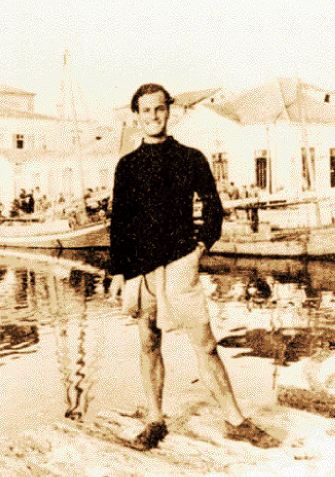
young paddyIn the winter of 1933, an 18-year-old named Patrick Leigh Fermor set out from the Hook of Holland to cross Europe on foot. His goal was Istanbul, which he bookishly insisted on calling Constantinople. He had little more in his rucksack than a volume of Horace and a few blank notebooks. He also had a bad reputation: The masters who expelled him from school — for a flirtation with a local girl — saw only “a dangerous mixture of sophistication and recklessness.” He spent the next year charming his way through a doomed prewar landscape of landed aristocrats, feudal peasants and benevolent monks, sleeping alternately in schlosses and hayricks. It was a journey that would become legendary, not so much for the extraordinary things he saw and recorded as for his prose — an utterly unique, hybrid vehicle that combines youthful exuberance with a dense, dauntingly erudite display of verbal artifice. Unlike most authors of travel literature (a rattlebag genre that doesn’t really do him justice) Leigh Fermor does not confine his role to that of camera obscura. He builds dense whorls of wordplay to echo the carvings in an old church door; he slips into baroque historical fantasias, scattering a shrapnel of words like “gabions,” “hydromel,” “eyot” and “swingle­trees” at the unsuspecting reader. In between salvos, there are moments of ferocious humor and quiet, lyrical beauty.

By Robert F. Worth

First published in the New York Times, 7 March 2014

In part, this richness is a measure of the extraordinary gap between the experience and its narration. Leigh Fermor did not begin writing the first book about his journey, “A Time of Gifts,” until the 1970s. In the intervening decades, he had written several other books, becoming a fiercely learned autodidact and adventurer. His exploits during and after World War II — when he helped to kidnap the Nazi commandant in Crete and deliver him to a waiting British submarine — are said to have helped inspire his friend Ian Fleming, the author of the James Bond novels. As a result, the travel narratives are a kind of palimpsest in which his younger and older selves exist in counterpoint. He initially considered naming the first book “Parallax,” to reflect this split perspective.

Few books have been as keenly or lengthily anticipated as the third and final volume of Leigh Fermor’s youthful travels. (A second installment, “Between the Woods and the Water,” was published in 1986.) It never appeared; burdened by writer’s block and frailty, Leigh Fermor was still working on it when he died in 2011 at age 96. But he did leave a manuscript. His biographer, Artemis Cooper, and the British travel writer Colin Thubron chose to tidy it up and publish it as “The Broken Road,” a reference to the abrupt narrative halt before the author reaches Istanbul.

“The Broken Road” narrates Leigh Fermor’s travels in Bulgaria, Romania and Greece, a more tribal and violent world than Northern Europe. It does not always have the gemlike polish of the first two volumes. But it is an unforgettable book, full of strange encounters with a prewar Balkan cast of counts, prostitutes, peasants, priests and castrati. The greatest pleasure of all, as usual, is Leigh Fermor’s own infectious, Rabelaisian hunger for knowledge of almost every kind. His memory seems eidetic; his eyes miss nothing. He seems to carry within himself a whole troupe of sharp-eyed geographers, art historians, ethnologists and multilingual poets. For anyone who has tried to document a journey, reading him is a humbling and thoroughly inspiring experience.

“The Broken Road” is also full of his signature verbal architecture: The Orthodox bishops “in copes as stiff and brilliant as beetles’ wings, and the higher clergy, coiffed with globular gold mitres the size of pumpkins and glistening with gems, leaned on croziers topped with twin coiling snakes.” Or the Virgilian evocation of a passing flock of storks in the Balkan mountains, which goes on for pages: “All at once we were under a high shifting roof of wings, a flotilla that was thickening into an armada, until our ears were full of the sound of rustling and rushing with a flutter now and then when a bird changed position in a slow wingbeat or two, and of the strange massed creaking, as of many delicate hinges, of a myriad slender joints. They benighted the air.”

In some respects this book is even more satisfying than its predecessors because it is less guarded; the narrator emerges as an angrier, more troubled and more persuasive character. One of my few quarrels with “A Time of Gifts” is the dogged high-mindedness of Leigh Fermor’s youthful self. Where is the lust? Where is the rage? This man is 18 years old, for God’s sake. He never gives way to the curse-spitting xenophobia that overcomes most travelers (certainly me) at some point in their journeys. He runs into plenty of jams, and meets plenty of pretty young girls; but there is something a little too noble about him, too much of the innocent abroad.

This time things are different, and the young man seems to break free of his older narrator. At one point, lying on the damp earthen floor of a Bulgarian peasant’s hut, he gives way to revulsion at the “noisily hibernating rustics swathed all over this stifling hellhole.” He is overcome by self-hatred and yearns for the comfort and status of his school-bound peers. Elsewhere, he meets a spirited Bulgarian girl named Nadejda and falls in love with her; their romance, though apparently unconsummated, reeks of the adolescent emotional frailty that seemed absent in the earlier books.

One of the most vivid passages in “The Broken Road” takes place in Bucharest, where young Paddy (as all his friends called him) checks into what he takes for a modest hotel, the Savoy-Ritz, giving his bags to a baffled patronne. He returns late that night and discovers that it is not a hotel but a brothel. The laughing madam ushers him into the kitchen, where four attractive young prostitutes are eating a late supper: “I was given a chair and a glass of wine, and the girls on either side cut off bits of chicken breast and offered them on their forks with friendly solicitude.” The women, charmed by his youth and innocence, feed and fuss over him for several days, telling him stories about their clients and themselves, though he remains discreetly silent about whether he got anything for free.

“The Broken Road” ends in midsentence, and the editors have chosen to follow it with excerpts from the diary Leigh Fermor wrote in early 1935, mostly at Mt. Athos in Greece. These are fascinating precisely because they are so ordinary: Suddenly we see how lucky we are that Leigh Fermor chose to wait four decades before starting. Young men have strong legs and eyes, but it is the older narrator, with his multilayered perspective, who knows how to turn memory into art.

History also played a role. “The Broken Road” is strewn with ominous, proleptic hints about the future that only we — and the older narrator — are privy to. In “A Time of Gifts,” the Nazis were a constant presence, crass and often ludicrous, waiting to inherit Europe. In this book, it is both the Soviet boot and the Balkan breakup that lurk throughout, as young Paddy listens to his Bulgarian and Romanian friends spew hatred of one another. But he also evokes a quiet, starlit world where countless eccentricities of folk art and culture bloomed in isolated villages and persisted for centuries, untouched by the glare of television and the Internet. Much of this is gone now. We can be grateful he was there to record it.

THE BROKEN ROAD

From the Iron Gates to Mount Athos

By Patrick Leigh Fermor

Edited by Colin Thubron and Artemis Cooper

362 pp. New York Review Books. $30.

A new book by Patrick Leigh Fermor- Abducting a General – to be published in October

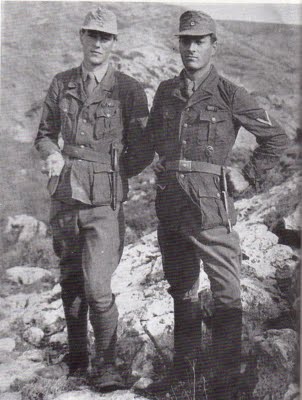
'Billy' Moss and Paddy Leigh Fermor

‘Billy’ Moss and Paddy Leigh Fermor

I have just learned that we can look forward to a new book by Paddy relating the events of the Kreipe kidnap. Based upon his own account called Abducting a General, the book is due to be published by John Murray in October 2014. A pity it misses the precise date of the 70th anniversary, but welcome nonetheless.

We will be blessed with a lot of new material about the abduction and its key players this year. We have already had the new book by Wes Davis, The Ariadne Objective, which contains a lot of new material after painstaking research, and ‘Billy’ Moss’ account of his time in SOE after the exploits on Crete, A War of Shadows, is also due for republication in April.

The John Murray website tells us this:

A daring behind-enemy-lines mission from the author of A Time of Gifts and The Broken Road.

One of the greatest feats in Patrick Leigh Fermor’s remarkable life was the kidnapping of General Kreipe, the German commander in Crete, on 26 April 1944. He and Captain Billy Moss hatched a daring plan to abduct the general, while ensuring that no reprisals were taken against the Cretan population. Dressed as German military police, they stopped and took control of Kreipe’s car, drove through twenty-two German checkpoints, then succeeded in hiding from the German army before finally being picked up on a beach in the south of the island and transported to safety in Egypt on 14 May.

Abducting a General is Leigh Fermor’s own account of the kidnap, published for the first time. Written in his inimitable prose, and introduced by acclaimed SOE historian Professor Roderick Bailey, it is a glorious first-hand account of one of the great adventures of the Second World War. Also included in this book are Leigh Fermor’s intelligence reports, sent from caves deep within Crete yet still retaining his remarkable prose skills, which bring the immediacy of SOE operations vividly alive, as well as the peril which the SOE and Resistance were operating under; and a guide to the journey that Kreipe was taken on from the abandonment of his car to the embarkation site so that the modern visitor can relive this extraordinary event.

The publication date for Abducting a General is set for 9 October.

Bringing Bond to book

bondWe continue our series of articles looking at the work of Ian Fleming who was a friend of Paddy. Fleming was influenced by Paddy’s exploits and he used the Traveller’s Tree in particular as a source for Live and Let Die.

By Matthew Woodcock

This article first appeared in the print edition of The Spectator magazine, dated 14 December 2013

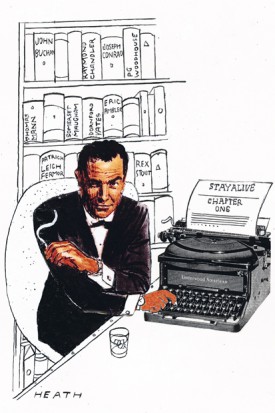
There is one last James Bond book from the late 1950s that remains unpublished. We will not find the typescript lurking in the archives, nor hidden amongst the papers held by Ian Fleming’s estate, for this book is not about James Bond but written by Bond himself. It is from Fleming’s 1959 novel Goldfinger that we learn that 007 spends his hours on night duty at the Secret Service compiling a manual on unarmed combat called Stay Alive!, containing the best that had been written on the subject by his peers in intelligence agencies around the world. Bond is more industrious in the field than at the typewriter and no more is heard about this great unfinished work once his thoughts drift back to his previous assignment and time spent enjoying the company of the ill-fated Jill Masterson.

It should come as no surprise that Fleming’s hero has writerly pretensions. Yet again, Bond and his creator have interests or characteristics in common, along with their shared dash of Scottish ancestry and background in naval intelligence, and a similar penchant for custom-made Morlands cigarettes. During his twenties, Fleming read widely in French and German literature — Thomas Mann’s The Magic Mountain was a particular favourite — and he subscribed to all the avant garde literary magazines of the day. He experimented briefly with poetry, collected first editions for a while, and launched the Book Collector magazine. Ultimately, through his friend and later editor, the poet and novelist William Plomer, he entered the literary world of postwar London, met T.S. Eliot and befriended Edith Sitwell. But to what extent did these kind of literary and bibliographic interests shape or influence Fleming’s work when he began writing the Bond books?

Bond too is, of course, a man of books. Fleming took the name of his hero from the spine of a trusted ornithological guide to the West Indies. And the seemingly effortless, spontaneous genesis of the first Bond novel, Casino Royale, published in 1953, drew as much upon the author’s reading of Dornford Yates, John Buchan and ‘Sapper’ (creator of Bulldog Drummond) as it did on his wartime experiences.

The clubland stalwarts were formative influences on Fleming, but they are — at best — literature spelt with a very small ‘l’. Bond himself has bookish impulses: the book-lined sitting-room glimpsed briefly in Moonraker is a valuable resource, used in preparations for forthcoming missions, furnishing him in this instance with a volume on card-sharping by John Scarne. Researching details of voodoo rites in Live and Let Die, Bond consults The Traveller’s Tree by Fleming’s friend Patrick Leigh Fermor. Appropriately enough, 007 also likes a good thriller and purchases the latest Raymond Chandler at the close of Goldfinger, and in On Her Majesty’s Secret Service displays a ready familiarity with the Nero Wolfe series, written by the equally well-read Rex Stout. It turns out that M too knows of Wolfe. En route to Istanbul in From Russia with Love, Bond enjoys a literary busman’s holiday by reading Eric Ambler’s The Mask of Dimitrios.

One might pause to consider just how do spies respond to fictional rehearsals of their trade? Did 007 snort in derision at Ambler’s accidental hero — himself a crime writer — or nod in recognition at his frustrations and disillusionment? Would he compare the quality of Ambler’s villains with those that he himself routinely faced in the field? Fleming’s villains themselves also appreciate a good book. At the start of From Russia with Love we discover that SMERSH’s chief executioner, Red Grant, likes to unwind by reading P.G. Wodehouse, and no one in the organisation would dare question such a choice.

Literary references and analogies frequently run through Bond’s mind: an allusion to Paradise Lost appears in the short story ‘Risico’, where he is disguised, naturally, as a writer; a line from Ralph Waldo Emerson strikes him in Diamonds are Forever, when he realises that he is sharing a ship with two of the Spangled Mob’s henchmen; he even attempts composing a haiku in You Only Live Twice.

None of the above, read in context, would have found a receptive audience with the likes of Eliot and Sitwell, or indeed among the literary pals of Fleming’s wife Ann. Fleming’s at times uneasy proximity to such circles never influenced the Bond books’ plot or structure, nor determined his initial choice of genre, but it did shape the author’s conception of the ‘literary’ and his recognition of how appreciation of ‘fine’ writing and the ‘right’ kind of books might be used for rhetorical effect, to engender the desired impression of his central character. The literary references in the Bond books are comparable to the furnishing of technical details about cars, dining, drinks, gambling and the like that the author employs to ground his fantastic plots in a recognisable reality — what Kingsley Amis identified as ‘the Fleming effect’. They help to build up Bond’s characterisation in deft, if brief, brushstrokes.

It could be suggested that the spy thriller itself — certainly after Somerset Maugham’s 1928 Ashenden — became the perfect genre with which to explore so many of the anxieties about identity and its representation to which the modernist greats gave expression. Like Eliot’s Prufrock, Bond and his peers are for-ever preparing ‘a face to meet the faces’ that they meet, always working with that lurking uncertainty as to whether they are the hero or the anti-hero of their own life’s narrative. Joseph Conrad had earlier delved into similar territory in his thriller The Secret Agent.

Had Fleming lived to tell of 007’s eventual retirement from the Secret Service we would undoubtedly have witnessed Bond swap his Walther for a pen and become a writer, thus following the career path of previous agents turned authors, W. Somerset Maugham, Graham Greene, John le Carré, Stella Rimington and, of course, Fleming himself. He might even have completed Stay Alive!

Related article:

Paddy’s eye for detail: Ian Fleming, Bondage, James Bond and Pol Roger

The Long Journey of Patrick Leigh Fermor

fermor.broken road.jacket.inddA very nice and well balanced review from across The Pond. Slate magazine has provided some good quality material for this blog in the past. I don’t have the time myself to get stuck into it, but for some of you it may be worth signing up for their newsletters. I still don’t get that cover they chose for the US edition.

By Jenny Hendrix

First published in The Slate Book Review 3 March 2014.

Patrick Leigh Fermor, one of travel literature’s most colorful, beguiling pedestrians, famously decided to walk across Europe when he was 18. Why not? He’d failed out of every school he’d gone to, after all, had given up on joining the army, and was living a somewhat-too-dissipated life in London among the aging remnant of the Bright Young Things. So, in the winter of 1933, equipped with a rucksack, walking stick, military greatcoat, puttees, and the Oxford Book of English Verse, he hopped on a boat to Rotterdam, Netherlands, pointing his hobnailed boots in the direction of what he’d always call Constantinople (not Istanbul), where he’d arrive in just over a year.

Eighty years later, we finally have the complete account of that trip. But it was a long road getting there—a kind of parallel journey. In 1962, Holiday magazine asked Fermor to write an article on “The Pleasures of Walking,” which he took as a chance to revisit the “Great Trudge” of his youth. He managed to cover the first two-thirds of the trip in a mere 70 pages, but the conclusion ballooned into a book of its own. Fermor wanted to call it Parallax, to underline the dual vantage of adolescence and middle age. His long-suffering publisher suggested A Youthful Journey instead. As it happened, it became neither as, busy building a house in the Peloponnese, Fermor abandoned the project altogether. By the time he took it up again, 10 or so years later on, he’d decided to start from the beginning again and write not one book but three. A Time of Gifts, which covers his walk from Holland to the middle Danube, was published in 1977. Between the Woods and the Water followed nine years later, taking him as far as the Iron Gates separating the Balkan and Carpathian mountains and ending with the words “TO BE CONCLUDED.” With the posthumous publication of The Broken Road: From the Iron Gates to Mount Athos, it kind of is.

The Broken Road is something of a stand-in for the long, long awaited third volume that Fermor planned to write. Assembled by his biographer Artemis Cooper and British writer Colin Thubron, it’s basically the manuscript of A Youthful Journey polished up a bit, though Cooper and Thubron claim that “scarcely a phrase” in it is theirs. Why Fermor couldn’t complete the trilogy himself is unclear. He was, by all accounts, a slow writer, working and reworking each sentence so diligently that a friend, according to Cooper, once accused him of “Penelope-izing”—unraveling the day’s work every night like Odysseus’s wife. But by the time he died, in 2011 at the age of 96—a real feat for someone who, by his own accounting, smoked 80 cigarettes a day for most of his life—“Volume III” had been in the works for more than half a century. Perhaps in his later years, as Cooper suggests in her biography Patrick Leigh Fermor: An Adventure, the author may have felt that “the whole subject was beginning to feel stale, barren, written out, and he feared he no longer had the strength to bring it back to life.”

Fermor’s torment may also have been a case of writerly perfectionism gone awry, as The Broken Road will seem, by most standards, plenty alive. Fermor’s deeply layered narrative, as before, intersperses fetishistically beautiful descriptions with historical tidbits, personal asides, and fanciful imaginings. He remains endlessly fascinated by local costume, folklore, genealogy, songs, and the doings of monks and muezzins, bouncing happily from peasant village to aristocratic schloss, from student digs on the Black Sea to Romanian country villa. He meets a girl (“half captured Circassian princess, half Byronic heroine”), stomps grapes, smokes hash, witnesses a celebratory riot in a Bulgarian café when it’s announced that someone’s murdered the Yugoslavian king, downs countless glasses of raki and slivo, investigates the Hasidim, theorizes on the breeding of mermaids, and sings German songs backwards to entertain a Bulgarian maid. Arriving in Bucharest, he accidentally checks into a brothel, thinking it’s a hotel, to the great entertainment of all, then charms his way into Romanian high society—opera, heaps of caviar, an excess of brandy—and passes out on the floor of an artist’s flat. He reads The Brothers Karamazov and Don Juan, and somehow always manages to find a bed for the night, usually a free one.

Still, this is a different Europe than that of the first two books—one toward which Fermor seems more ambivalent than the Mitteleuropean splendor he’s passed. Out of the old Holy Roman Empire and the familiar shadow of Western Christendom, he’d entered the strange oriental world of the Balkans—a region so recently free of the Ottoman yoke that it remained steeped in both Turkish culture and oppression’s palpable effects. There are fewer castles and a great many more huts. There’s more racial hatred too—Jewish/Romanian, Romanian/Bulgarian, Bulgarian/everyone but Russians—a legacy of the region’s violent past. Of course, Fermor’s zestful catalogue of certain Balkan cruelties—like the blinding, by Basil the Bulgar-Slayer, of a thousand-man army, leaving one of every hundred soldiers an eye “so that the rest might grope their way home to the czar” —reveal that, for a 19-year-old at least, bloodthirstiness was part of the region’s romance.

Fermor takes obvious delight in language, picking up words as one might souvenirs: In Romania, for instance, “the best word I had ever heard for irretrievable gloom: zbucium, pronounced zboochoum, a desperate spondee of utter dejection, those Moldowallachian blues.” The Broken Road positively drips with exotic names, ethnic designations, and obscure vocabularies. A dog is “passant, sejant then couchant,” and beekeepers go about “their Georgic business…mobled in muslin, calm-browed comb-setters and swarm-handlers of the scattered thorps.” Thorps! Fermor’s linguistic revelry also results in descriptive passages that verge on the purple, with images layered one over the other in a positive conflagration of sense: “Cauliflowers sailing overhead, towing their shadows twisted and bent by the ravines, like ships’ anchors, across the whale-shaped undulations, or hovering in the high mountain passes as lightly as ostrich feathers, or sliding along the horizons in pampas plumes. The setting sun turned each of these into the tail of a giant retriever.” The passage, in case there’s any doubt, describes clouds.

Actually though, hard as it is to believe, A Broken Road is a great deal less “written” than the previous two books—it was essentially a draft, unspangled with the oodles of adjectives that customarily embellish Fermor’s Byzantine prose. A representative description of a building from Volume I, by comparison, displays his gifts at full polish: “From the massed upward thrust of its buttresses to the stickle-back ridge of its high-pitched roof it was spiked with a forest of perpendiculars. Up the corner of the transepts, stairs in fretted polygonal cylinders spiralled and counter-spiralled, and flying buttresses enmeshed the whole fabric in a radiating web of slants.” This sort of thing might seem a bit steroidal to some, but the verbal fireworks go a long way toward recapturing the rapturous enthusiasm with which the young Fermor seems to have shone. “I was unboreable, like an unsinkable battleship,” the author reflects in The Broken Road. “My mouth was as unexactingly agape as the seal’s to the flung bloater. … I might, judging by my response to phenomena for most of these thousands of miles, have been a serious drug addict.” The tumultuous rush of his prose mimics the drug-like thrill that reality had for him then, and this—getting the reader as high on his words as he was on life—was what Fermor saw as his greatest challenge, 30 years on. The Broken Road tends more toward introspection than euphoria at times, frankly discussing the periodic bouts of depression that were euphoria’s flip side and Fermor’s doubt in his memories. “Were the domes tiled or were they sheeted in steel or lead –or both, as I boldly set down a moment ago? Or is it the intervening years that have tiled and leaded and metalled them so arbitrarily?”

Often the older writer admits to recalling little or nothing about a particular time, and often he confesses to being “almost irresistibly tempted to slip in one or two balloons from a later date.” One such “balloon” intrudes during Fermor’s walk south along the Black Sea coast from Varna, Bulgaria. The unknown coastline had proved rockier and less passable than anticipated, the night was dark, and both he and his flashlight had just fallen into a pool, the latter irretrievably. Bleeding from his forehead, Fermor found himself, as he writes, “sliding, crawling on all fours, climbing up ledges draped with popping and slippery ribbons of bladderwrack,” and close to despair. Rounding a cliff, he stumbles at last into a cave, where he finds a group of shepherds and fisherman cozied up for the night with a campfire and a bunch of goats. What follows is one of the most exhilarating set pieces to be found in travel writing anywhere: Having been fed, dried, and liquored up, Fermor joins his hosts in a night of ribald fun, in which a fisherman performs a rebtiko, an ancient dance that’s like a history of the Balkans writ small: “All the artifice, the passion for complexity, the hair-splitting, the sophistication, the dejection, the sudden renaissances, the flaunting challenge, the resignation, the feeling of the enemy closing in, the abandonment by all who should have been friends, the ineluctability of the approaching doom and the determination to perish, when the time came, with style,” Fermor writes, is sublimated in movement, offering “consolation and an anodyne in individual calamity.” It’s a thrilling insight in a linguistic whirl of a scene.

It also, apparently, never happened. As Cooper reports, the scene is more or less a conflation of a night Fermor spent in a fisherman’s hut on the Black Sea and an evening lost along the coast of Mount Athos, in Greece, some weeks later. It’s reputedly not the only incidence of this sort of thing: According to Cooper, a vaunted trip on horseback across Hungary seems not to have happened either. Fermor told her he feared “the reader might be getting bored of me just plodding along” and so put himself on a horse. Such fictional accents, Cooper gently suggests, were part of Fermor’s “making a novel of his life”: He didn’t invent, per se, but created “new memories” shaded by imagination. A more convincing explanation is that by the time Fermor sat down to write about the walk, not only was it 30 years in the past, but he had lost all of his journals from the time—the first stolen, the rest left unclaimed in storage after the war—and had just memories, real or not, for reference.

The distance between living and writing is responsible too for the shadow European history cast over Fermor as he sat down to write his Trudge books. Fermor was in Germany in December 1933: Hitler was in power, and the rise of nationalism was apparent in the streets, where heil-ing stormtroopers would “become performing seals for a second … as though the place were full of slightly sinister boy scouts.” In Vienna, in February 1934, he arrived in the middle of the riots between the country’s anti-communist militia and Social Democrats, the beginning of a political shift that would culminate in the Anschluss some years on. But the young Fermor, having little interest in politics, didn’t notice at all. “I wasn’t a political observer,” he yells at a Bulgarian friend who’s rebuked him for wanting to visit the hated Romania. “Races, language, what people were like, that was what I was after: churches, songs, books, what they wore and ate and looked like, what the hell!” If the young Fermor, busy with parties, drinking, smoking, sex (only delicately implied of course—he’s British), failed to foresee the consequences of Nazism’s rise, the older one certainly does. “I am maddened,” he wrote in 1963, “by not having seen, written, looked, heard.”

And so despite the author’s obvious attempts to preserve, somewhat, the innocence of his youthful self, the books are haunted by the knowledge of what was about to transpire—the fact that, as Fermor writes in The Broken Road, “Nearly all the people in this book, as it turned out, were attached to trails of powder which were already invisibly burning, to explode during the next decade and a half, in unhappy endings.” His accounts of the colorful ways of gypsies and Jews in particular can’t help but have a foreboding, even elegiac tang, no matter how they are written, and the same is true, in The Broken Road, of the landscape itself. Returning to Bulgaria and Rumania in 1990, Cooper reports, Fermor was “utterly crushed,” refusing even to talk about what he had seen: not just poverty and hunger, but picturesque villages replaced by concrete farm-workers blocks, Bulgaria’s Turkish culture completely gone, hulking Soviet towers rising from what had once been pristine wilderness.

It is no surprise then that Fermor, toward the end of his life, despaired of recapturing the innocent joy with which he’d crossed this vanished landscape and eventually gave up trying. A Youthful Journey ends quite abruptly—in midsentence, in fact—a few days before the journey reached its ultimate goal. For whatever reason, Fermor failed to take many notes at all in Constantinople. The few he did make are included here, to represent, I guess, the “broken road” of the title: “Slept till six o’clock in the evening, then, waking up, thought it was only the dawn, having overslept twelve hours, so turned over and slept again till Jan 2nd morning,” he writes of the day he arrived. Eleven days later, he was in Greece, where The Broken Road concludes, with a coda of sorts to the official account: Fermor’s perambulation through the Orthodox monasteries of Mount Athos. (As a side note, this monastic peninsula, unlike most of the places Fermor visited, seems largely unchanged. It remains, among other things, forbidden to females of all species, with the notable exception of cats.)

The text of this part comes from Fermor’s so-called Green Diary, the sole survivor of the heap of near-talismanic journals he carted about on his walk. This one he left in Romania with his first great love, the Princess Balasha Cantacuzène, who, despite years under fascism and behind the Iron Curtain, took care of it, returning it to Fermor during a secret visit in 1965. It’s a useful document, if only for the purpose of comparing the unfiltered prose of Fermor’s teenage years with the polished, many-fretted sentences that he’d produce later on. The episode of walking along the cliffs and falling into the sea, recast so brilliantly some 150-pages back as a microcosm of Balkan life, appears here just another night really, drinking with some woodsmen in a hut. One gets the feeling that Fermor would have objected to the diary’s inclusion, but in a way it’s a perfectly appropriate end. Here, lonely, tired, and somewhat fed up with the “unilluminated literalness” of Balkan life, the boy first encounters a country that he would come to love above all. Two years later, after a charmed period of rest in Romania and Greece, he’d join the intelligence services and serve in Crete as a liaison to the native partisans, eventually masterminding a hussar-ish plan to kidnap the Nazi general in charge of the occupying forces and transporting him, by mule, over the mountains, and then to Cairo by boat. He would write two books on Greece and settle permanently there in 1964 with his wife Joan, in a small fishing village in the Peloponnese. There, as a mature perfectionist fighting a losing battle against his exuberantly prolix younger self, he’d try to write what would eventually become The Broken Road. In some ways, though, the 20-year-old Paddy we leave at Mount Athos would end up outliving him.

Patrick Leigh Fermor: journey’s end book cover

plfhome2_0A short article from the Creative Review about the book covers for Paddy’s work.  A must read as it is full of beautiful pictures of Craxton book covers. Best seen on on a big computer screen.

by Mark Sinclair

The final part of Patrick Leigh Fermor’s triology documenting his walk across Europe in the 1930s was published in September. Its cover by Ed Kluz, shown left, fulfilled an interesting brief – to offer something new but to keep in mind the tradition of Fermor’s illustrated covers, designed since the 1950s by the late John Craxton…

Read the article on the CR blogsite here.

Last leg of a joyous, erudite journey

Paddy by Patrick Kidd

Paddy by Patrick Kidd

‘The Broken Road’ is brimful of the author’s characteristic exuberance, charm and erudition, with all his stylish and inimitable prose flourishes in place.

By Patricia Craig.

First published in The Irish Times, 26 October 2013.

Towards the end of her admirable biography of Patrick Leigh Fermor, from 2012, Artemis Cooper relates an anecdote. After the stupendous success of the first two-thirds of his proposed trilogy – A Time of Gifts (1977) and Between the Woods and the Water (1986) – expectations were high for the final section. But something of a writer’s block had overtaken the author. Despite encouragement from every source – friends, wife, publisher, his eager readers – he found himself unable to complete the undertaking.

Then, after spending weeks in his study engrossed in some form of composition, he emerged one day clutching a sheaf of paper. “I knew it could be done!” he exclaimed to his overjoyed wife. But, alas, he went on, “I knew PG Wodehouse would translate into Greek.”

But all was not lost. The history of The Broken Road is complicated. It completes the story begun when the author, aged 18, in 1934, embarked on a tremendous journey. His aim, which he fulfilled, was to walk from the Hook of Holland to Constantinople. Years later, when Patrick Leigh Fermor sat down to make another journey backwards in time, he conceived the project as a three-volume account of his travels across Europe during those heady years of the mid 1930s. What resulted was an extraordinary feat of recollection and evocation, which placed the author among the outstanding travel writers of the 20th century. But it stopped short at the Iron Gates in Romania (the ending of volume two).

As the painstaking editors of The Broken Road recount, however, Leigh Fermor had actually written the current text as far back as the early 1960s. It, or a version of it, was lost, retrieved, abandoned, reclaimed and subjected to intermittent revision. Indeed, the author was still working on it until a few months before his death, in 2011, at 96 (PG Wodehouse notwithstanding). And, the editors say, “there is scarcely a phrase here, let alone a sentence, that is not his.”

If Leigh Fermor never brought the manuscript to a state that caused him to rejoice, it is nevertheless hard to see what there was about it that engendered so much angst. It is brimful of the author’s characteristic exuberance, charm and erudition, with all his stylish and inimitable prose flourishes in place.

The final part of The Broken Road is rather different, though, as it consists of entries from Leigh Fermor’s only surviving diary (January-February 1935), which he kept while going from monastery to monastery on Mount Athos. Immediacy rather than retrospection is the keynote here. No felicitous reflections imposed over the rough jottings, but rather a sense of the young traveller sitting down in one of his whitewashed cells each evening to write up the day’s events, the different types of monks encountered (“a surprisingly cultivated man”; “a funny little creature with a hump, very small, his frock discarded for chopping wood”), the scenery reminiscent of the Garden of Gethsemane, the hazardous walks up rocky paths through melting snow, the cypresses and orange trees and tranquil Aegean Sea.

We have the diaries and, in the middle of chapter seven, we have a short autobiographical interlude – “My childhood was spent in London, in my mother’s very exciting company” – sparked off by two letters, one from his mother and one from his father in India, which he collected from a post office on the way to Varna. Otherwise, The Broken Road is a scintillating continuation of the prodigious walk that took the young Leigh Fermor right into the heart of magically different prewar Europe and beyond, through places “teeming with history and with natural wonders”. Eleven dolphins leaping and gambolling in a bay; a wild boar in an autumn forest; black-cloaked and hooded herdsmen of a nomadic Balkan tribe. The “strange, rather sad, rather beguiling spell [that] haunted the cobbled lanes of this twinkling, twilight little town of Mesembria”.

Leigh Fermor had some considerable assets to aid him on his journey. He had a knack of falling on his feet, of getting out of scrapes and overcoming setbacks. He had high spirits, hardihood and luck on his side. Whether in the streets of some unfamiliar town or halfway up a bleak mountain with darkness closing in, he rarely failed to encounter kindness and hospitality. His gift for languages enabled him to communicate even with rough Bulgarian shepherds or Greek fishermen in a cave on the Black Sea coast.

It was a time of contrasts, all of which he took in his stride: if he’s not immersed in the social life of Bucharest (for example), living it up while staying in a diplomat’s flat (after an inadvertent sojourn in a brothel), he is sleeping under the sky or in rough-and-ready peasant accommodation.

He is, by turns, gregarious – drinking, singing and dancing half the night – and of a solitary, introspective bent. The first was of inestimable benefit to him along the road, while the second came into play once he’d started retracing his own footsteps, recalling with gusto the pungency of the past, conjuring up bygone scenes, moods, crucial encounters, histories, classical comparisons, lights and shades, exotic experiences, flights of fancy, all replete with the exhilaration of travel, of setting out. From the moment he stepped ashore on the snow-covered soil of the Netherlands, back in 1934, he was in his element.

Now, although The Broken Road peters out in the middle of a sentence, his journey is complete, his worldly task accomplished, with the whole undertaking “as thick in marvels as Aladdin’s cave”.

Ada Kaleh and the mosque controversy

An very interesting piece by Dr Dorel Bondoc, expert on Archaeology from Oltenia Museum, Craiova, Romania, about the history and archaeology of the submerged island in the middle of the Danube. It refutes Paddy’s claim in BTTW that the mosque was moved.

by Dr Dorel Bondoc

Published on the Alexis Project website.

At the beginning of the 15th century, the island was occupied by Turks, who understood its remarkable strategical importance for the development of the river trade on the Danube, after the exit from Kazan region. In 1718, as a result of the treaty from Passarowitz (Pojarevat), the northern Serbia, Banat and Oltenia became possessions of the Austrians, as was also the case of Ada-Kaleh island which then bore the name New Orsova.

The Austrians built a strong fortification of “Vauban” type on the island. In 1739, after the treaty from Belgrad, Austria returned Serbia and Oltenia to Turkey. As a result the island was occupied again by Turks, who gave it the name Ada-Kaleh, which may be translated as “the island of the fortress.” The toponym can also be found in the documents of that time as: Ada Kale, Ada Cale, Adakaleh, Ada Kaleh or Adacale.

Read more here.

Related article:

Ada Kaleh: the lost island of the Danube

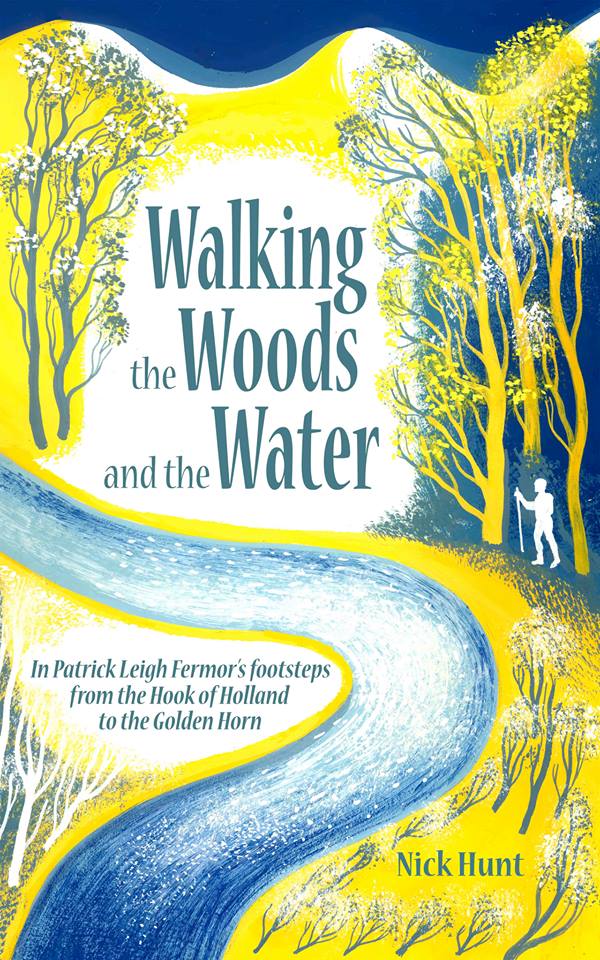
Walking the Woods and the Water – Nick’s book cover revealed

Walking the Woods and the Water

Walking the Woods and the Water

After a lot of labour, a change of publisher and book title, Nick’s book is finally to be published by Nicholas Brealey Publishing in March. Many of you will remember that two years ago Nick walked Paddy’s great trans-European walk, taking about the same time, using only Paddy’s books as a guide, and visiting many of the houses he stayed in en route.

Nick wrote to me saying “The cover has been designed and I’m very pleased to tell you it’s by Ed Kluz, the same artist who did The Broken Road. Looks very different of course, and not (as I was worried it might) overly derivative of the style of Paddy’s books. But a nice continuity.”

It will be interesting to see what you all think about that. As soon as I have further news I will update you. I do know that Nick will be giving some talks to support the publication and I will pass on these details as soon as I have them.

Ignore the xenophobic hysteria and welcome our EU neighbours

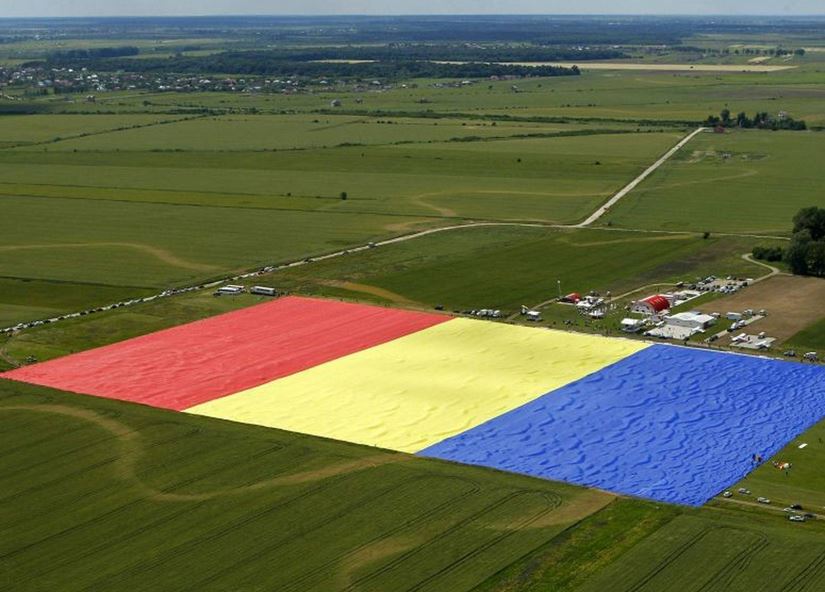
Villagers in Clinceni, Romania cover a field with what they claim is the world's biggest ever flag

Villagers in Clinceni, Romania cover a field with what they claim is the world’s biggest ever flag

Britain is in the Orwellian middle not of a Two-Minute Hate, but a Two-Year Hate.

By Boyd Tonkin.

First published in the Independent, 27 December 2013.

This may surprise alarmed observers in Sofia and Bucharest – or even in Westminster. But one of the best-loved British books of 2013 takes the form of a fervent and heartfelt tribute to the peoples of Bulgaria and Romania. War hero, writer and traveller Patrick Leigh Fermor died in 2011 before he could publish the third volume of memoirs about his “Great Trudge” though Europe in the mid-1930s. The Broken Road, which appeared posthumously in the autumn, takes the young literary vagabond from the “Iron Gates” on the Danube across both countries to the Black Sea coast.

Everywhere he walks, Leigh Fermor relishes the landscapes and the languages. He admires the culture and the customs. Above all, he comes to love the people of the Balkan peaks and plains: always hospitable and welcoming, forever willing even in the poorest backwater to greet this penniless young Englishman with unstinting generosity, feed him, shelter him and send him on his way with blessings – and with lunch.

Now, what would happen to a late-teenage Bulgarian or Romanian, without lodging, employment or any ready cash, who started to walk, say, from Dover to Glasgow in the spring of 2014? On the evidence of British public life just now, the result would not be a glorious trek across a land of smiles, fondly remembered from a ripe old age.

The Economist magazine has already issued its number-crunched fiat in their favour. Still, this column may count as an early squeak in the almost inaudible chorus of welcome for visitors or migrants to the UK from Bulgaria and Romania. More than a few of us belong to the open-hearted country of Paddy Leigh Fermor rather than the tight little island of Godfrey Bloom. If you wish to, fellow EU citizens, I hope that you will come. Should you choose, quite legitimately, to seek work here, then I hope that you prosper for as long as you stay. And most of all, I hope against hope that our morally bankrupt political class and ruthlessly cynical media will one day start to address the underlying reasons for home-grown fears: the living-standards crisis, deep-seated job insecurity, yawning chasms in wealth and opportunity, the greed and arrogance of a pampered “super-class”, and a chronic lack of decent homes for non-millionaires. Instead, they have set out on yet another sordid scapegoat hunt. Patrick Leigh Fermor Patrick Leigh Fermor

The grievances are genuine. But the actual culprits have got clean away. A useful watchword for 2014 might run: lay the blame where it belongs. August Bebel, a wise German social democrat at the turn of the 20th century, popularised the idea that “anti-Semitism is the socialism of fools”. A century on, the quarry may have changed, but not the toxic rhetoric, nor the squalid logic of victimisation. As all the 28 million people in the so-called “A2” accession countries of the EU must understand, this lather of dread has been whipped into a perfect storm by the confluence of cannily inflammatory media and the blind funk of a shaky governing party. As a result, if you’re looking for fraudulent crystal-ball predictions, outrageously deceitful hucksterism and a brisk trade in ideological scrap and junk, there’s no need to visit some mythical gypsy encampment. You can find all that and more via any visit to Westminster, TV studios and newsrooms – plus a detour, of course, to the Ukip HQ.

Crashing rollers of anti-immigrant vitriol break day after day, loud as an end-of-year storm surge, and just as implacable. Anyone who resists this tide – who says without any niggling proviso that all legal incomers from European Union member states, as from -everywhere else, presumptively deserve trust, goodwill, courtesy and fair dealing – may feel just now like the enemy within. The tone of paranoia, suspicion and targeted hatred has made British political discourse through

2013 resemble propaganda-fuelled dictatorships such as – well, let’s start with Nicolae Ceausescu’s Romania and Todor Zhivkov’s Bulgaria. As regards the citizens of those states, Britain is in the Orwellian middle not of a Two-Minute Hate, but a Two-Year Hate.

Plenty of the worried who fear this as-yet-phantom army of immigrants will have spent Christmas paying lip service at least to the festival’s religious roots. Presumably – and this, I’m afraid, is a rhetorical device shamelessly nicked from the works of Charles Dickens – their edition of the Bible fails to include the exhortation from Deuteronomy that insists “Love ye therefore the stranger, for ye were strangers in the land of Egypt”, the lines from Matthew’s gospel that run “For I was hungry, and ye gave me meat: I was thirsty, and ye gave me drink: I was a stranger, and ye took me in”, still less the advice of the Letter to the Hebrews: “Be not forgetful to entertain strangers, for thereby some have entertained angels unawares”. A few weeks ago, Nigel Farage commented: “We need a much more muscular defence of our Judaeo-Christian heritage.” To which one might reply: precisely.

Sentimental? Impractical? Airy-fairy? No more so that than the speculative pseudo-statistics that bedevil this “debate”. As to the likely numbers involved, absolute confusion reigns. An even-handed House of Commons briefing paper recently noted that the Foreign Office’s own inquiry into probable figures (commissioned from the National Institute of Economic and Social Research) had concluded that “it is not possible to predict the scale of future migration from Bulgaria and Romania to the UK numerically”. The Commons paper, by the way, also shows why the often-quoted Migration Watch prediction of circa 50,000 net arrivals per annum from Bulgaria and Romania is skewed. The numbers rest on an untested forward projection from events after the 2004 EU entry of Poland and its neighbours (the so-called “A8” countries) on to a wholly different set of circumstances.

Among the factors that suggest “low levels of migration”, the Commons researchers cite the obvious fact that “all remaining transitional controls will expire in all EU countries at the same time”. Among factors that may pull the numbers upwards are “high unemployment rates … in those EU countries that have so far been the preferred destinations for A2 nationals”, mainly Italy and Spain. In short, we don’t yet know. Maybe the invading wave will be crested by some of the estimated 14,000 doctors and 50,000 nurses who have left Romania since it joined the EU in 2007. If so, then our steam-driven pundits should on principle refuse treatment when their apoplectic xenophobia lands them in A&E.

Even if the feared influx of low-skill job-seekers does occur, and does put pressure on underfunded services in certain areas, then public figures still have a choice to make. Some of the windier press invective that craven politicians have done nothing to deflate – especially against Roma people – pretty much amounts to incitement to racial violence.

Whoever wins the dismal numbers game in 2014, a failure to condemn that sort of hate speech opens the door to further barbarism in political life.

We have been here, many times, before. Back in 1517, Londoners rioted on “Evil May Day” against foreign workers. According to legend, the mob was calmed by the then under-sheriff of London, Sir Thomas More. About 75 years later, the event was dramatised in a multi-authored play about the life of More – the kind of stage “biopic” common in the Elizabethan theatre. In the second act, when he faces down the racist rioters of London, the play’s language suddenly leaps into life. More’s great speech makes the case against anti-immigrant agitation with a moral force that still sings out today.

“Grant them removed,” says More about the detested foreigners. “Imagine that you see the wretched strangers,/ Their babies at their backs and their poor luggage,/ Plodding to the ports and costs for transportation.” “What had you got?” he asks the mob. “I’ll tell you. You had taught/ How insolence and strong hand should prevail.” In other words, mob rule – of the kind that, these days, tries to smash international treaties and tear up EU agreements. And what if the lawless migrant-bashers had to move abroad themselves, “to anywhere that not adheres to England”? In exile, “Would you be pleased/ To find a nation of such barbarous temper,/ That, breaking out in hideous violence,/ Would not afford you an abode on earth?” Just put yourselves in the foreigner’s shoes, More counsels: “What would you think/ To be thus used? This is the strangers’ case;/ And this your mountainish inhumanity.”

There used to be almost as much heated argument around the authorship of this passage (in a script known as “Hand D”) as about the imminent levels of migration from “A2” states. Now, a kind of scholarly consensus prevails. That scene was most probably written by William Shakespeare. Across the political mountains of inhumanity, let’s hope that the latest torrent, or quite possibly, trickle of “strangers” can locate and enjoy Shakespeare’s country.

Culture aside, a well-sourced report released this week by the Centre for Economic and Business Research argues that Britain will over the coming years overtake Germany as the strongest economy in Europe. And which ace do we hold up our sleeve as the Old Continent grows even older, less productive and more state-dependent? Why, “positive demographics with continuing immigration”. On which note, we should wish even the frostiest of Europhobes Chestita Nova Godina and Un An Nou Fericit!

Horace: The Odes, Book One, IX, translated by John Dryden

Following on from the article by Llewelyn Morgan about Horace, I thought it would be good to share Dryden’s translation.

by Carol Rumens

First published in The Guardian, 30 July 2012.

“For this last half-year I have been troubled with the disease (as I may call it) of translation … ” Thus John Dryden begins the preface to his volume, Sylvae, or the Second Part of Poetical Miscellanies (1685). It marks his emergence, relatively late in life, as a translator, containing work by various Greek and Latin authors: Theocritus, Lucretius, Horace, Ovid among them. Despite that “disease”, encompassing a nagging “un-ease” about the fidelity of his method, Dryden enjoyed translating Horace – and it shows. See, for example, the magnificent Ode 29 from Book Three presented by Dryden as his own imitation of “Pindarique Verse”. Its famous eighth stanza (“Happy the man, and happy he alone, / He who can call today his own … “) is treasured by readers still – as poetry and as advice on living. For this week’s poem, however, I’ve picked a smaller jewel: the wonderfully elegant version of Ode Nine, Book One.

Dryden described his method as paraphrase. The original author’s words were not as “strictly followed as his sense”. The sense could be amplified, and even altered. This was a practical and, in some ways, obvious technique. Horace’s word-order, for example, has to be altered to make sense in a non-inflected language. In taking further liberties, the justification is that the translator is himself making a poem. Dryden tried to create a work the author could have produced “if he were living and an Englishman”. He sets the standard for poetry translation as fidelity to the receiving language, and sets a further standard: he is honest with the reader about his strategies.

Horace didn’t think of these verses as Odes. The Renaissance gave them that title. To the author, they were songs, or “carmina”. Ode one/nine is written in Alcaics, a four-lined, largely dactylic strophe named after the Greek poet Alcaeus: it’s the commonest verse-form in the Odes, a flexible form-for-all-seasons. Using iambic tetrameter chiefly, with the rhyme-scheme A B A B C C (C), Dryden expands the quatrain, in the first four stanzas to six lines and in the last two to seven. The bold move works. The statelier English verse occupies its space comfortably. There’s no padding, no rigidity.

Dryden’s poem sometimes generalises, of course. He loses the address to Thaliarchus, master of the feast. He doesn’t mention Mount Soracte or name the trees. In the last stanza, there’s no reference to the girl’s ring. Yet he avoids dull exegesis or moralising. Like Horace, he balances his showing and telling.

Dryden enjoys some subtly brilliant word-play. In the first stanza, the mountains of line one are elevated in the next by “mounts of snow”, a linguistic effect and a snapshot revealing the snow itself as mountainous. There’s a wonderful gravitational pull in the rest of the stanza, from the “labouring woods” (suggesting more tonnage of snow on the trees) to the stream, imagined as a prisoner, fettered, benumbed, “cramp’d to solid ground”. The ensuing indoors scene introduces a contrasting glow and vivacity, with the heaped logs replacing the snow-heaps outside. The mood is merry and defiant, a mixture of Epicurean and stoic. It’s tempting to imagine the Restoration (1660) as Dryden’s political subtext here.

God now comes on stage in a somewhat Jovian manner, playful, not wholly reliable. He will provide, “if ’tis worth His care”, but there’s no knowing what so stormy, windy and capricious a deity might do next (think 17th-century politics again, perhaps?). The scene is set perfectly for that sound, pragmatic advice to seize the moment – “Nor love, nor love’s delights, disdain … ” Dryden works Horace into some sharp-suited epigrams, as in the final couplet of this stanza and the last line of the next (fifth): “The best is but in season best.”

It’s such a cohesive, tight little ship of a poem, yet the tone is relaxed. There is an ease of movement in the argument, so it never seems heavy-handed. All the stanzas work separately, and all work together in forming an overall architecture. There’s a satisfying balance of concrete and abstract. Dryden leaves out some of Horace’s specific details, but compensates with a focus on language.

In the wonderful last stanza, notice how appropriately he picks up the tercet’s rhyme-sounds (“feign/again/ordain”) from the fourth stanza’s couplet about the delights of love (“disdain/gain”). That extra room now allows him to present the courtship drama as a complete narrative-in-miniature. The faint sexual frisson is judged to perfection, and not a word is misplaced. Horace’s brevity is magical, here, but Dryden’s amplification works in another way. He closes with a line of hexameter, straightforward and serious: “These, these are joys the gods for youth ordain.” Do we hear the regretful tone of middle-age? Perhaps, and this may be another reason why Dryden’s English lives. He’s true to his own feelings.

Dryden was a great literary all-rounder. He is “the father of modern criticism” and a glorious prose-stylist. He’s no longer remembered as a playwright, perhaps unfairly. I recently read one of his comedies (An Evening’s Love), dipping my toe for the first time, and found it a highly entertaining piece of Spanish sitcom. But Dryden himself feared he had wasted his energies among “the steaming ordures of the stage”.

In 1685, of course, he was still to produce his great allegorical poems and the brilliant satires such as Mac Flecknoe (1682), and still to tackle his translation masterpiece, Virgil’s Aeneid. The Sylvae represent no less an achievement, showing Dryden in a perhaps unusual light – that of graceful poetic lyricist.

Horace’s original, with an interesting modern American translation and helpful commentary by William Harris, is here.

Horace: The Odes, Book One, IX, translated by John Dryden

Behold yon mountain’s hoary height
Made higher with new mounts of snow:
Again behold the winter’s weight
Oppress the labouring woods below’
And streams with icy fetters bound
Benumbed and cramped to solid ground.

With well-heaped logs dissolve the cold
And feed the genial hearth with fires;
Produce the wine that makes us bold,
And spritely wit and love inspires;
For what hereafter shall betide
God (if ’tis worth His care) provide.

Let Him alone with what He made,
To toss and turn the world below;
At His command the storms invade,
The winds by His commission blow;
Till with a nod He bids them cease
And then the calm returns and all is peace.

Tomorrow and its works defy;
Lay hold upon the present hour,
And snatch the pleasures passing by
To put them out of Fortune’s power;
Nor love nor love’s delights disdain –
Whate’er thou getts’t today, is gain.

Secure those golden early joys
That youth unsoured with sorrow bears,
Ere with’ring time the taste destroys
With sickness and unwieldy years.
For active sports, for pleasing rest.
This is the time to be posesst;
The best is but in season best.

Th’appointed hour of promised bliss,
The pleasing whisper in the dark,
The half-unwilling willing kiss,
The laugh that guides thee to the mark,
When the kind nymph would coyness feign
And hides but to be found again –
These, these are joys the gods for youth ordain.

Related article:

An Ode for the Road

Patrick Leigh Fermor profile: ‘Glitteringly told, impossibly romantic, unrepeatable today…’

As the long-awaited final volume of Patrick Leigh Fermor’s memoirs is published, Jonathan Lorie celebrates the brilliant travel writer.

By Jonathan Lorie

First published in The Independent, Saturday 14 September 2013.

“This is the Byron Room,” murmured John Murray the seventh, ushering me into the Regency drawing room of his publishing house in Piccadilly, where marble busts perched on carved bookcases under a white rococo ceiling. “And that fireplace is where they burned Lord Byron’s papers after he died.” He smiled sheepishly, for it was his own ancestor, John Murray the second, who committed one of the great vandalisms of literary history – burning the poet’s scandalous memoirs instead of publishing them. “And here,” he said with some relief, “is Paddy.”

Paddy, as Patrick Leigh Fermor was always known to friends, was a great crag of a man, scowling at a wooden desk, where a page of lopsided writing in black ink was refusing to do his bidding. “It’s no good,” he raised his tousled head and glowered at us, a handsome man with dark, mischievous eyes. Then he burst out laughing. “It’s a poem in medieval French I want to send to the Spanish ambassador, but I can’t remember the end of it!”

Leigh Fermor strode briskly over, despite his 89 years, shook my hand and launched into an unstoppable reminiscence of tramping across Europe in 1933. “I borrowed £15 from somebody and caught a boat to the Hook of Holland, heading for Constantinople. I got somebody to give me a letter to a very nice baron in Bavaria and I went to stay with him … And then I borrowed a horse off somebody and crossed the whole of the great Hungarian plain on this horse – it was the right way to see it – it was totally unspoilt then … At the Iron Gates I caught a ship for about 50 miles, then stayed with a very nice consul in Sofia …” And he rattled off the names of places and people that must have vanished long before I was born, in a lost world of feudal Europe, as though it were all just yesterday.

Patrick Leigh Fermor in later life

Patrick Leigh Fermor in later life

That epic journey and the power of his storytelling will be in many people’s thoughts this weekend, as Leigh Fermor’s final book of travel memoirs is published. Fans have been waiting three decades for this. The Broken Road is the last, missing volume in a trilogy that many thought would never be completed. It concludes the story he told that day in the Byron Room, of a youthful trek from London to Istanbul in 1933, catching the last echoes of an older order before the Second World War changed everything.

Across this vanished world Leigh Fermor had walked aged 19, meeting monocled aristocrats and ragged chimney sweeps, sleeping in cowsheds or in castles, dodging gypsy encampments, cadging lifts on cargo boats, falling for pretty girls, dancing and drinking and talking his way to the heart and soul of central Europe. The journey was enchanting, the writing rich and vivid.

But he never finished the trilogy. The two previous volumes – A Time of Gifts and Between the Woods and the Water – appeared in 1978 and 1986 to huge acclaim. They prompted Jan Morris to hail him as “the greatest of living travel writers”. Then the words stopped, 500 miles from Istanbul. For years, friends and fans pestered him to finish it. He never did. Perhaps it was the failing powers of old age, perhaps it was the pressure of living up to expectations, perhaps – like that medieval French poem – he could no longer recall enough of the ending. When he died in 2011 – seven years after our meeting in Piccadilly – it seemed another great loss to literature.

But three years before his death, his biographer Artemis Cooper had stumbled across a 45-year-old typescript filed at John Murray’s office. It was called “A Youthful Journey”, and it was Leigh Fermor’s early attempt to describe the post-Danube part of the route. Her interest rekindled his, and slowly he began to sift his way through this fading text, revisiting the great journey, reworking the words, a man in his nineties taking one last shot.

He never finished. The final manuscript was a mass of revisions and expansions that petered out just days from Istanbul. But Cooper and the travel writer Colin Thubron took it upon themselves to sort it into best order and present it to the world. It was perhaps a homage to their friend as much as a literary laying to rest. And John Murray published it, a posthumous memoir saved from oblivion at last.

The result is The Broken Road. It’s as charming as its predecessors, a fascinating glimpse of a vanished era. Leigh Fermor drifts through the pre-war Balkans, meeting White Russian officers, dancing at diplomats’ parties, falling in love with a French-speaking student, drinking slivovitz with coachmen and concierges. On a moonless night by the Black Sea he nearly drowns, but stumbles his way into a cave where a ragged gang of fishermen and sailors sitting around a fire take him in for a night of wild drinking and traditional dances. It is perhaps the emotional heart of this book – a moment from an ancient myth, which his derring-do and joie de vivre have brought to life – glitteringly told, impossibly romantic, unrepeatable today.

The book is also a little rougher in parts than its predecessors. I asked the editors about this. “What we were dealing with was very much a first draft, by his standards,” says Colin Thubron. “Neither we nor anyone else could finish the trilogy as Paddy would have wanted. It is, inevitably, less uniformly polished – or ‘buffed up’ , as Paddy might have said – than the previous two books. But there are passages as fine as anything he wrote, and it also reveals a certain, rather charming, youthful vulnerability.”

“It is much rougher in texture,” agrees Cooper, “but it is also unmistakeably Paddy. As a writer he is quite unique. That fusion of memory and imagination and landscape, nobody has ever achieved that with such immediacy.”

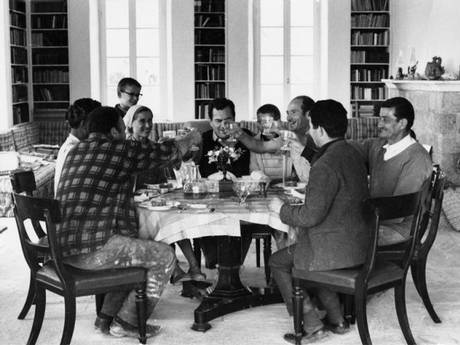
Patrick Leigh Femor sharing lunch with friends in Kardamyli

Patrick Leigh Femor sharing lunch with friends in Kardamyli

Quite how far he fused memory and imagination is an interesting question. All three of these books were written decades after the fact, with only a tattered map as aide-memoire. He had lost all but one of his diaries – some on the road, some in a neglected storeroom at Harrods. Like that other fine travel memoirist of the 1970s, Laurie Lee, you can’t help wondering how much of this actually happened.

Cooper has a theory: “Paddy once told me that everything that ever happened to him from the ages of five to 21 was etched on his mind, and to a certain extent that was true. But memory is not a CCTV camera in your head – it changes, develops, shrinks or expands or becomes more elaborate – especially if you write about it.”

Thubron agrees: “I think the vividness of his memory merged seamlessly with the richness of his imagination.”

It was an imagination fed by the life that he chose to live. What other travel writer can claim to have ridden in a cavalry charge across a castle drawbridge with sabres drawn, as he did during a Balkan rebellion? Or lived in a manor house with a Romanian princess, who he met on reaching Istanbul? Or kidnapped an enemy general and driven his staff car through 22 enemy checkpoints, as he did in wartime Crete?

The latter was his most famous exploit, and you can visit the place where it happened – a remote stretch of road beside an olive grove where Leigh Fermor lay in wait with a band of Cretan partisans. The episode was made into a book and film, Ill Met By Moonlight, starring Dirk Bogarde as Leigh Fermor. For years afterwards, Leigh Fermor was fêted throughout Greece for his wartime service with the partisans, when he had lived for months in mountain caves, organising resistance to the German occupation.

The war left him with a profound attachment to Greece and its people, and in the 1950s he and his wife Joan built a house there, on the Mani peninsula. It was famed for its elegance and its house guests. John Betjeman described the library, which looked over the sea, as “one of the rooms of the world”. The travel writer Bruce Chatwin chose to have his ashes scattered on the hills above, by Leigh Fermor.

Here he wrote two luminous books on Greece – Mani and Roumeli – and slowly began the trilogy which has now, finally, been completed. He nicknamed this work “The Great Trudge” – a view understood by his editors.

“It feels wonderful to have completed the trilogy,” says Cooper. “Paddy always felt a huge regret that he did not finish this book. But by the end of his life I think he knew that we would see it was published. Perhaps, on some level, he was able to leave the world knowing that it would see the light of day.”

“There is, in the end, nobody like him,” concludes Thubron. “A famous raconteur and polymath. Generous, life-loving and good-hearted to a fault. Enormously good company, but touched by well-camouflaged insecurities. I would rank him very highly. ‘The finest travel writer of his generation’ is a fair assessment.”

Pure Paddy – The last book, finally

Among worldly travellers any description of improbable exploits in foreign places, ending on a note of hilarity, used to be met with the phrase “Pure Paddy!” This referred to Sir Patrick Leigh Fermor, writer, war hero and raconteur, who died two years ago at the age of 96, leaving a long hoped-for final volume of his early memoirs still unpublished.

First published in the Economist, 14 September 2013.

In the 1930s, at the age of 18, Sir Patrick set out to walk from the Hook of Holland to Constantinople (his preferred name for Istanbul). “A Time of Gifts”, his account of the first section of the walk was a masterpiece of wit and erudition. A good deal of time was taken up being passed between schlosses and castles by the crumbling remnants of the German and Austro- Hungarian aristocracy, while in the background, the Nazis loomed. In the mid- 1980s a second volume, “Between the Woods and the Water”, covered his 1934 walk through Hungary and Transylvania, where he was as much at home in hayricks as in the hovels of gypsies.

“The Broken Road”, Sir Patrick’s final posthumous volume, has now been edited by his literary executors: Artemis Cooper, his biographer, and Colin Thubron, a fellow travel writer and president of the Royal Society of Literature. It takes the author from the Danube’s Iron Gates to Mount Athos and Constantinople. It remained unfinished while he lived for several years with a Romanian princess, and then the second world war intervened. Sir Patrick’s exploits there were indeed legendary: with some friends he kidnapped a German general in Crete and drove him through numerous Nazi checkpoints before spiriting him off to Egypt.

The book brings together two texts: a detailed diary of his time on Mount Athos and a description of the journey there. This last was written up from memory in the 1960s as some of Sir Patrick’s contemporary notes had been stolen in Munich and the remainder were lodged in the Harrods Depository during the war and later destroyed, unclaimed. The pages are filled with brilliant evocations of his life on the road, none richer than the time he spent in a Romanian brothel. A flavour of the “Pure Paddy” style is his description of the high-pitched Russians who drive carriages around Bucharest. It turns out they are an obscure sect of eunuchs who believe that Empress Catherine the Great’s murdered son will one day return as the Messiah. A final notebook was handed back to Sir Patrick in 1965 by his princess, but he chose not to elide or collate it with his then written account.

The only part republished here is the full contemporary account of his time at Mount Athos. The book is occasionally interrupted with later asides by the author on the fate of particular places or people, which drain a portion of the magic out of the account. Sir Patrick’s entire life was a Boy’s Own adventure, but he was an important footnote to the literary genre of English travel writing, which began in its modern form in 1844 with “Eothen”, a hilarious account of Alexander Kinglake’s adventures from Belgrade to Cairo.

“The Broken Road” has an elegiac tone. None of the people described survives and the countries visited have undergone wars and revolutions, leaving them virtually unrecognisable. It is a fitting epilogue to 20th-century travel-writing and essential reading for devotees of Sir Patrick’s other works—though eclipsed by his earlier books and the world they conjured.

NYRB review – The Broken Road: From the Iron Gates to Mount Athos

The US cover?

In the winter of 1933, eighteen-year-old Patrick (“Paddy”) Leigh Fermor set out to walk across Europe, starting in Holland and ending in Constantinople, a trip that took him almost a year. Decades later, Leigh Fermor told the story of that life-changing journey in A Time of Gifts and Between the Woods and the Water, two books now celebrated as among the most vivid, absorbing, and beautifully-written travel books of all time.

First published in the New York Review of Books.

The Broken Road is the long awaited account of the final leg of his youthful adventure that Leigh Fermor promised but was unable to finish before his death in 2011. Assembled from Leigh Fermor’s manuscripts by his prize-winning biographer Artemis Cooper and the travel writer Colin Thubron, this is perhaps the most personal of all Leigh Fermor’s books, catching up with young Paddy in the fall of 1934 and following him through Bulgaria and Romania to the coast of the Black Sea. Days and nights on the road, spectacular landscapes and uncanny cities, friendships lost and found, leading the high life in Bucharest or camping out with fishermen and shepherds: in the The Broken Road such incidents and escapades are described with all the linguistic bravura, odd and astonishing learning, and overflowing exuberance that Leigh Fermor is famous for, but also with a melancholy awareness of the passage of time, especially when he meditates on the scarred history of the Balkans or on his troubled relations with his father. The book ends, perfectly, with Paddy’s arrival in Greece, the country he would fall in love with and fight for. Throughout it we can still hear the ringing voice of an irrepressible young man embarking on a life of adventure.

Quotes

By any standards, this is a major work. It confirms that Leigh Fermor was, along with Robert Byron, the greatest travel writer of his generation, and this final volume assures the place of the trilogy as one of the masterpieces of the genre, indeed one of the masterworks of postwar English non-fiction.
—William Dalrymple, The Guardian

Praise for Patrick Leigh Fermor:

One of the greatest travel writers of all time.
–The Sunday Times

A unique mixture of hero, historian, traveler and writer; the last and the greatest of a generation whose like we won’t see again.
—Geographical

The finest traveling companion we could ever have … His head is stocked with enough cultural lore and poetic fancy to make every league an adventure.
–Evening Standard

If all Europe were laid waste tomorrow, one might do worse than attempt to recreate it, or at least to preserve some sense of historical splendor and variety, by immersing oneself in the travel books of Patrick Leigh Fermor.
—Ben Downing, The Paris Review

Praise for A Time of Gifts and Between the Woods and the Water, the first two volumes in the trilogy:

This is a glorious feast, the account of a walk in 1934 from the Hook of Holland to what was then Constantinople. The 18-year-old Fermor began by sleeping in barns but, after meeting some landowners early on, got occasional introductions to castles. So he experienced life from both sides, and with all the senses, absorbing everything: flora and fauna, art and architecture, geography, clothing, music, foods, religions, languages. Writing the book decades after the fact, in a baroque style that is always rigorous, never flowery, he was able to inject historical depth while still retaining the feeling of boyish enthusiasm and boundless curiosity. This is the first of a still uncompleted trilogy; the second volume, Between the Woods and the Water, takes him through Hungary and Romania; together they capture better than any books I know the remedial, intoxicating joy of travel.
— Thomas Swick, South Florida Sun-Sentinel

Recovers the innocence and the excitement of youth, when everything was possible and the world seemed luminescent with promise. …Even more magical…through Hungary, its lost province of Transylvania, and into Romania… sampling the tail end of a languid, urbane and anglophile way of life that would soon be swept away forever.
—Jeremy Lewis, Literary Review

A book so good you resent finishing it.
—Norman Stone

The greatest of living travel writers…an amazingly complex and subtle evocation of a place that is no more.
— Jan Morris

In these two volumes of extraordinary lyrical beauty and discursive, staggering erudition, Leigh Fermor recounted his first great excursion… They’re partially about an older author’s encounter with his young self, but they’re mostly an evocation of a lost Mitteleuropa of wild horses and dark forests, of ancient synagogues and vivacious Jewish coffeehouses, of Hussars and Uhlans, and of high-spirited and deeply eccentric patricians with vast libraries (such as the Transylvanian count who was a famous entomologist specializing in Far Eastern moths and who spoke perfect English, though with a heavy Scottish accent, thanks to his Highland nanny). These books amply display Leigh Fermor’s keen eye and preternatural ear for languages, but what sets them apart, besides the utterly engaging persona of their narrator, is his historical imagination and intricate sense of historical linkage…Few writers are as alive to the persistence of the past (he’s ever alert to the historical forces that account for the shifts in custom, language, architecture, and costume that he discerns), and I’ve read none who are so sensitive to the layers of invasion that define the part of Europe he depicts here. The unusual vantage point of these books lends them great poignancy, for we and the author know what the youthful Leigh Fermor cannot: that the war will tear the scenery and shatter the buildings he evokes; that German and Soviet occupation will uproot the beguiling world of those Tolstoyan nobles; and that in fact very few people who became his friends on this marvelous and sunny journey will survive the coming catastrophe.
— Benjamin Schwarz, The Atlantic

Those for whom Paddy’s prose is still an undiscovered country are to be envied for what lies ahead-hours with one of the most buoyant and curious personalities one can find in English.
—The New York Sun

Mr. Fermor…is a peerless companion, unbound by timetable or convention, relentless in his high spirits and curiosity.
— The New York Times

We are aware at every step that his adventure can never be duplicated: only this extraordinary person at this pivotal time could have experienced and recorded many of these sights. Distant lightening from events in Germany weirdly illuminates the trail of this free spirit.
—The New York Times

The young Fermor appears to have been as delightful a traveling companion as the much older Fermor a raconteur.
—The Houston Chronicle

[A Time of Gifts, Between the Woods and the Water] are absolutely delightful volumes, both for those who want to better understand what was lost in the violence of Europe’s 20th-century divisions and for those who appreciate the beauty and thrill of travel writing at its best.
—The Houston Chronicle

Leigh Fermor is recognizably that figure many writers of the past century have yearned to be, the man of action.
— The Guardian

He was, and remains, an Englishman, with so much living to his credit that the lives conducted by the rest of us seem barely sentient-pinched and paltry things, laughably provincial in their scope, and no more fruitful than sleepwalks. We fret about our kids’ S.A.T. scores, whereas this man, when he was barely more than a kid himself, shouldered a rucksack and walked from Rotterdam to Istanbul.
— Anthony Lane, The New Yorker

“Now That the Time of Gifts Is Gone”: Poetry In Patrick Leigh Fermor’s Books

The following article was written by Clarissa Aykroyd on her blog, The Stone and the Star. There is something for everyone in Paddy’s books, and here Clarissa discusses his references to poetry.

By Clarissa Aykroyd

First published on The Stone and the Star, 12 August 1013.

In December 1933, a young man named Patrick Leigh Fermor left England to travel on foot across Europe. Alternately sleeping in barns and in stately homes, he travelled from the Hook of Holland to Constantinople (he always calls it Constantinople, although it was Istanbul by then.) He wandered in a leisurely manner through what now seem to be the dreamscapes of Mitteleuropa before World War II. Decades later he wrote about his travels in A Time of Gifts and Between the Woods and the Water. Leigh Fermor died at an advanced age in 2011, but the final book, The Broken Road, is being edited posthumously and will appear later this year.

A great deal has been written and said about Leigh Fermor. He had an incredibly adventurous life which included the capture of a leading German commander in Crete during World War II. With a remarkable personal charm and magnetism, Leigh Fermor seems to have been a sort of cross between Casanova and James Bond.

I have just been re-reading A Time of Gifts and Between the Woods and the Water. It is not so surprising that Leigh Fermor spent decades crafting these books – there really isn’t a word out of place. The prose is like crystalline mosaics or frescos, hovering on the edge of the unbelievable and fairytale-like, but still believable. It’s entirely possible that Leigh Fermor embroidered after the fact, but his tales of mountainscapes, of dream cities and kind eccentrics are so beautiful that I don’t really mind either way. The books certainly conjure up a world that disappeared – Leigh Fermor repeatedly comments on how, particularly with the rich and titled families who gave him hospitality, the people he met disappeared into darkness during the war and only sometimes emerged. It is true that this is also a world which is rather class-ridden and occasionally interspersed with casual racism, not to speak of the terrible looming shadow of Nazism in Germany. But so much of the books’ poignancy comes from the awareness of the awful storm that was to sweep over Europe, leaving so many scars and in many cases total destruction.

I wanted to write a little about the presence of poetry in these books. In some ways this, too, evokes a world that has disappeared or at least altered beyond recognition. A Time of Gifts is named after a line from a poem by Louis MacNeice, ‘Twelfth Night’:

For now that the time of gifts is gone –
O boys that grow, O snows that melt,
O bathos that the years must fill –
Here is dull earth to build upon
Undecorated […]

In A Time of Gifts, Leigh Fermor writes at some length (several pages) about his “private anthology” of poetry that he had memorized and would recite to himself while alone and walking. “The range is fairly predictable,” he says, “and all too revealing of the scope, the enthusiasms and the limitations, examined at the eighteenth milestone, of a particular kind of growing up.” The “private anthology” included Shakespeare as well as bits and pieces of Keats, Tennyson, Browning, Coleridge, Wordsworth, Hopkins, Kipling, Wyatt, Marvell, Carroll and Lear, among others. “No Yeats later than the Ronsard paraphrase and Innisfree and Down by the Salley Gardens; but this belonged more to singing than reciting.” He then mentions that he wasn’t interested in Pound or Eliot but enjoyed Edith Sitwell. From other languages and cultures, he mentions a little Baudelaire and Verlaine, and Romans such as Virgil, Catullus and Horace.

Particularly in Between the Woods and the Water, in Hungary and Romania, poetry and poets dog his footsteps. In Hungary he mentions “the southern parts of the Cuman region celebrated by [Sandor] Petőfi – it is strange how the names of Hungarian poets cropped up the whole time in conversation and books!” He later mentions Ferenc Békássy, who studied at Cambridge and was “a friend of Rupert Brooke and James Strachey and especially Maynard Keynes” – this young poet died in battle in Bukovina in 1915. Later, in Romania, he comes across the oldest poem in Romanian, the traditional epic Mioritza. At the Baths of Hercules, an “ornate and incongruous watering-place” in a wild Romanian valley, he meets a young woman who quotes Kipling’s ‘If’.

All of this struck me, not just because my ears are pricked for poetry, but because it all seemed so much of another time. What young man (or woman) would now set out to travel across Europe with a memorised library of poetry to call upon, let alone all the multitude of cultural references that Leigh Fermor seemed to have at his fingertips even as a teenager? It just wouldn’t happen – even a poetry lover probably wouldn’t have more with them than a poetry app on their smartphone. Then, too, there were so many young poets who were also soldiers and who were destroyed in the wars. It seems to me that what started to be broken in World War I was irretrievably broken (in so many ways) in World War II, and this might include the idea of poetry as a sort of force for salvation.

On a more personal note, re-reading these books made me want to go back to Vienna, no small feat because it’s not one of my favourite cities. They also set up in me a longing to go back to Germany, to Prague, and to travel more extensively in Hungary and Romania particularly. I also had a strange experience while reading A Time of Gifts. Leigh Fermor praises the beauty of the German city of Regensburg, and writes about one of its sons, Albrecht Altdorfer. When he wrote about Altdorfer’s famous painting The Battle of Alexander at Issus, something swept over me – I had almost forgotten that I owned a small copy of it, from the gallery in Munich where it hangs. It is a remarkable painting and I think the feeling I had (and still have) for it ties into my fascination with certain types of fantasy landscapes – the first edition I owned of The Lord of the Rings featured cover art which now looks very Altdorfer-esque to me. Writing about the landscape depicted, Leigh Fermor said:

It was the valley of the Danube in the throes of one of its hundreds of battles. It must have been. But, on this first visit, how could I have realized it? The battle in the painted canyon is fought out under a lurid October sunset and the rival armies, like windswept cornfields bristling with lances and poppied with banners, collide in an autumnal light. Whereas the battlefield on my first encounter was dulled with snow, with all contours muffled and fanfares hushed. (from A Time of Gifts)

Here is Yeats’s The Lake Isle of Innisfree, cited as part of the “personal anthology”, and perhaps also appropriate for its final lines.

THE LAKE ISLE OF INNISFREE (William Butler Yeats)

I will arise and go now, and go to Innisfree,
And a small cabin build there, of clay and wattles made;
Nine bean-rows will I have there, a hive for the honey-bee,
And live alone in the bee-loud glade.

And I shall have some peace there, for peace comes dropping slow,
Dropping from the veils of the morning to where the cricket sings;
There midnight’s all a glimmer, and noon a purple glow,
And evening full of the linnet’s wings.

I will arise and go now, for always night and day
I hear lake water lapping with low sounds by the shore;
While I stand on the roadway, or on the pavements grey,
I hear it in the deep heart’s core.

The Broken Road by Patrick Leigh Fermor – Observer review

The late, great travel writer’s trilogy is finally complete, with a helping hand from admirers.

by Anthony Sattin

First published in The Observer, Sunday 15 September 2013.

The final volume of Patrick Leigh Fermor’s trilogy is almost as hard to review as it was to write. By the time he died, in 2011, 96-year-old Leigh Fermor had acquired near legendary status. In the second world war, he assisted in a partisan mission to kidnap a Nazi general on Crete. Before that, at 18, he walked across Europe from the Hook of Holland to Istanbul (which he still called Constantinople). And he kept notes as he walked. “My whole life had seemed to revolve around those stiff-covered exercise books,” he said. “Keeping them up to date had acquired the charm and mystery of a secret religion, solemnized daily.” The books came later… much later.

In 1962, a US magazine asked him to write about walking – a 5,000-word commission that spawned a trilogy. A Time of Gifts was published in 1977. Between the Woods and the Water, which appeared in 1986, ended with the promise that the story would be continued. Rumours as to whether Leigh Fermor had managed to complete his trilogy, or whether he had even started the conclusion, have circulated for the past couple of decades.

It turns out there was a manuscript and it picks up where the previous one ended – at the water, the Danube, and the Iron Gates, a gorge at the Romanian-Bulgarian border. It takes Leigh Fermor not to Istanbul, the intended final destination of what he called “the Great Trudge”, but to Burgas, 50 miles from the Turkish border.

Although Leigh Fermor was still rewriting the manuscript shortly before his death, the work was problematic, for reasons Artemis Cooper makes clear in her brilliant recent biography of the man. Now she and the travel writer and novelist Colin Thubron have prepared the work for publication. This, clearly, has involved more than spell-checking, although they claim that “there is scarcely a phrase that is not his”.

The first two volumes were a joy to read, not least for Leigh Fermor’s ability to recapture in later life the intense excitement of being a young man lighting out. The latest book offers similar joys. His allowance of £1 a week – bank notes arriving like manna at post offices along the way – was enough to live modestly. Travelling mostly on foot, in leather jacket, knee breeches and puttees, with backpack, Hungarian walking stick and “uncompromising” boots, carrying two books of verse in the backpack and a head full of literature and history, he has his fair share of luck and adventure in a continent that was still a mystery. There are nights in shepherds’ huts, down-at-heel hotels, palaces, and a brothel he mistook for an inn. And while his older self clearly enjoyed writing about the nights of revelry around campfires with belly-dancing Greek fishermen and other wild characters, he was also happy to laugh at the young Leigh Fermor – for not realising that the woman who welcomed him so warmly into the brothel expected more from him than his head on a pillow.

Also evident are another of the joys of the earlier books – the pyrotechnics of his writing. Exuberance is expressed in heightened suggestions: a cat is panther-like, a silence falls “like angels flying overhead” and swifts make a sound like scissors in a barber shop. The descriptions of waking in unfamiliar places are so seductive that even the most home-hugging reader will long to wake somewhere unknown. And some of the evocations of landscapes and views will live long in the memory, including one of a muezzin calling from a mosque and another of the town of Tirnovo, with its “winged insurrection of houses plumed by belfries and trees”.

The first two books were written without the help of original notes, which had been lost; The Broken Road is based partly on a diary that was returned to Leigh Fermor in 1965. So instead of writing what the editors call “memory-spurred recreations”, we see the older man trying to guess what his younger self did or why he did it. There is also retrospective comment on Europe between the wars from an author who knows that the rise of the Nazis and the coming cold war are about to transform the lives of most people he meets.

Leigh Fermor completed his physical journey in Istanbul on the last day of 1934, then continued to the monasteries of Mount Athos in Greece. The literary journey concludes without reaching its goal, hence the book’s title. The editors have included sketchy diary entries for Istanbul and more fully written descriptions of Mount Athos, although Leigh Fermor was not convinced about putting them in his story, and with good reason.

The bulk of The Broken Road was written 30 years after the journey. I am reading it 50 years after it was first put down. While it is not the literary masterpiece it might have been had Leigh Fermor been able to work his magic, it captures the joy of the open road, the fresh view he gives of Europe as it began to show the stresses that led to world war, and the glimpses of a long-lost life and innocence.

The Scotsman review of The Broken Road

In December 1933 the engaging 18-year-old drop-out Paddy Leigh Fermor set off to walk from the Hook of Holland to the city which, as a lifelong philhellene, he would always call Constantinople.

First published in The Scotsman.

With many diversions and congenial breaks in the company of woodcutters and aristocrats, the journey took him a year. Decades later it became apparent to Leigh Fermor and others that he had not only crossed the continent on foot; he had traversed a Europe which was on the brink of irreversible social and political change.

It nonetheless took him a while to write about it. Patrick Leigh Fermor’s literary career was delayed by his characteristically flamboyant wartime activities with the Special Operations Executive. After the Second World War he spent time in the Caribbean. He published his first book, The Traveller’s Tree, about the West Indies in 1950, when he was 35 years old.

Leigh Fermor settled in Greece and his next two books of serious note, Mani and Roumeli, were gorgeously articulated expressions of his love affair with his adopted country.

They also took an ominously long time to write. Mani was published in 1958 and Roumeli in 1966. That was partly due to Leigh Fermor’s painstaking search for stylistic excellence – Melvyn Bragg would later suggest that he was “trying to write the perfect book”. It was also because the author was at least as interested in living the perfect life, which involved heroic quantities of wine, women and song.

A further 11 years lapsed before he considered his account of the first third of his pre-war walk to be fit for print. A Time of Gifts took him from Holland through the simmering early months of Nazi Germany to the border between Czechoslovakia and Hungary. The second volume, which walked from Czechoslovakia to the Danube’s Iron Gates gorge between Serbia and Romania, was titled Between the Woods and the Water and published in 1986.

The exuberance, off-the-wall scholarship, characterisation and teenaged derring-do of those two books initiated and rode the high wave of the 1980s travel writing boom. Patrick Leigh Fermor was garlanded with praise and internationally recognised as one of the greatest of 20th century authors.

The world, not least that part of the world occupied by his publisher John Murray, held its breath and waited for the third and final volume. Leigh Fermor was 71 years old in 1986. But he enjoyed robust good health in his Peloponnesian retreat and he had written on the last page of Between the Woods and the Water the three promising words “To be Concluded”.

There seemed at first no reason not to hope. Only slowly did it become apparent that one of the saddest cases of writer’s block in recent times had descended on that villa in the Mani. Patrick Leigh Fermor had a towering pile of notes and draft manuscript covering his passage from the Iron Gates to Constantinople, but he was unable to convert them into the book which satisfied his own unique standards.

John Murray persuaded his author to publish collections of letters and essays. As the years passed it became clear that those were pale substitutes for the completion of what would have been an immortal trilogy. Patrick Leigh Fermor died in June 2011 at the age of 96 years. He left no third volume. He did leave the pile of notes and first-copy manuscript.

They have been worked up by his friend and biographer Artemis Cooper and his friend and fellow travel writer Colin Thubron and published as The Broken Road: From the Iron Gates to Mount Athos.

The editors’ title, an acknowledgement that Leigh Fermor’s literary journey was unfinished, is perfect. In their introduction Thubron and Cooper are honest to the point of apology in admitting that this story cannot reasonably compare to the finished product of Patrick Leigh Fermor in midseason form.

The sentences are almost all Leigh Fermor’s, and usually recognisably so. But as Cooper pointed out in her biography, part of the brilliance of the first two volumes lay in the fact that Leigh Fermor novelised his travels. That is not to say that he made much up. It is to say that he constructed and polished his narrative; he expertly conflated characters and relocated incidents. From the fertile ground of his own irrepressible self and his glorious adventures he cultivated an astonishing Bildungsroman in a world so lost that it may as well be fictional.

The Broken Word, on the other hand, remains a draft, albeit a draft edited by skilled and sympathetic hands. It is also a Patrick Leigh Fermor draft, which makes it superior to the finished work of most other writers. The youthful joy shines through, and the deep cultural learning that was superimposed in later years is there in sufficient quantity to lend wonder to this fragmented tale.

The book is rarely less than invigorating. At times, as when our hero finds himself riotously overnighting by the Black Sea with a congregation of Bulgarian shepherds and Greek fishermen, The Broken Road has all the verve of the finished article.

It strides towards an ideal conclusion – not in Constantinople, of which Leigh Fermor mysteriously left few accounts, but on Mount Athos. There we find the boy who would come to know Greece better than most Greeks first grasping with delight the modern vernacular and the traditional ways of a land that never ceased to captivate him, and through him, his readers.

This will be the last full book by Patrick Leigh Fermor to appear in print. Anybody who loved its two preceding volumes will fall upon it hungrily. Anybody who has not read the two preceding volumes should do so without delay.

An Ode for the Road

Llewelyn Morgan describes himself, rightly as “a Classicist, lucky enough to work at Brasenose College, Oxford. I specialise in Roman literature, but I’ve got a persistent side-interest in Afghanistan, particularly the scholars and spies and scholar-spies who visited the country in the nineteenth century.” We all know so much about Paddy’s tale of the Horace Ode with General Kreipe. This piece from Morgan’s blog goes into a little more detail; essential for those of us not to have had a thorough classical education. My thanks to Peter Golden for passing this to me.

By Llewelyn Morgan

First published on Lugubelinus, 15 October 2013

For reasons that will emerge, I’m intrigued by the practice of travelling with a copy of your favourite classical author in your pocket; and I’m struck by the fact that Horace seems to be the most commonly chosen travelling companion. In Horace’s fifth satire, when he describes setting off on a journey with Heliodorus, there’s a theory that Heliodorus is a book (it was the name of the author of a book called The Wonders of Italy, or possibly The Wonders of Medicine) rather than a flesh-and-blood companion, so that’s kind of appropriate for starters.

It isn’t always Horace. The Polish journalist Ryszard Kapuściński did all his foreign reporting accompanied by a gift from his editor, “a thick book with a stiff cover of yellow cloth. On the front, stamped in gold letters, was Herodotus, THE HISTORIES.” Europeans trudging through Afghanistan in the nineteenth century cited chapter and verse on Alexander’s itinerary with such accuracy that I can’t help but suspect they had copies of Quintus Curtius Rufus’ Histories of Alexander the Great secreted somewhere about their persons.

Virgil is another favourite, and with him the unhealthier aspects of this practice come to the fore. Abraham Cowley was the author, among other things, of an epic, The Civil War, which he wrote as the English Civil War unfolded in the 1640s (and which mutates from an epic into a satire as Cowley’s favoured side, the Royalists, lose ground.) According to John Aubrey he “alwaies had a Virgil in his pocket”, and his reverence for the Aeneid is very obvious in The Civil War: he even imitates Virgil’s “half-lines”, lines left unfinished by Virgil at his death (he died before the Aeneid was completely finished), but which Cowley thought were deliberate, and expressive.

But Cowley’s devotion to Virgil didn’t stop at the odd half-line.  Aubrey recounts a story of Cowley using his pocket Virgil to consult the “Virgilian lots” (sortes Vergilianae) with the future Charles II, opening the pages of the Aeneid at random as a way of predicting the future. And predictably enough, Cowley and the prince happen on Dido’s curse of Aeneas at the end of Aeneid 4, where the queen of Carthage prays that Aeneas will see his friends fall before his eyes, make peace on unjust terms, and die before his time: Virgil was telling them what would happen to the prince’s father Charles I.

That is a story with many variants, and it doesn’t always involve Cowley. But we can establish that Cowley had a habit of consulting the sortes Vergilianae. Dr Johnson quotes a letter written by Cowley in which he discusses the prospects for an alliance with the Scots. Cowley is confident of a positive outcome to negotiations: “The Scotch will moderate something of the rigour of their demands; the mutual necessity of an accord is visible; the king is persuaded of it. And to tell the truth (which I take to be an argument above all the rest) Virgil has told me something to that purpose.” Virgil has told meThe text in the pocket has become the intimacy of a direct word in the ear.

Well, Virgil can play with people’s heads: Cowley’s consultation of the Virgil in his pocket is a bit like Jackson Knight’s consultation of a medium (supposedly channelling Virgil himself) when he was writing his Penguin translation of the Aeneid (just in case anyone thought Morrissey’s inclusion in the Penguin Classics was the maddest thing to happen to that series).

Chaps with Horace in their pockets are a more stable bunch all round, I like to think. But if that’s true, it has a lot to do with the focus of Horace’s poetry. His most famous and quoted poems are the Odes, and the concerns of these short lyric poems weren’t the profound mysteries of existence delved by Virgil (a figure further amplified by the strange mythology that built up around him after his death). Horace is all about the demands of this life we’re living, the inevitability of aging and death, the pleasure of the present moment. His genius is to give incomparable expression to simple principles of living. Carpe diem, etc.

As he set off to travel on foot to Constantinople in 1933 Paddy Leigh Fermor packed an Oxford Book of English Verse and, a gift from his mother, “the Loeb Horace, Vol. I”, containing the Epodes and Odes; and as he walked across Europe he memorised his favourite odes. That special relationship with Horace featured in Leigh Fermor’s most famous exploit, when he captured the German General Karl Kreipe, commander on Crete, and had him smuggled out to Cairo. As they climbed Mount Ida, Kreipe muttered the first line of Horace’s ninth ode, Vides ut alta stet niue candidum Soracte, “You see how Mt Soracte stands white with deep snow,” and Leigh Fermor responded with the rest of the poem:

The general’s blue eyes had swiveled away from the mountain top to mine – and when I’d finished, after a long silence, he said: “Ach so, Herr Major!” “Ah, yes, Major!” It was very strange. As though, for a long moment, the war had ceased to exist. We had both drunk at the same fountains long before; and things were different between us for the rest of our time together.

Horace, whom both Germans and British had managed to convince themselves was the perfect encapsulation of their respective gentlemanly codes, established a mutual understanding between these two officers. Between them, for example, they managed to piece together the superb conclusion to the Regulus Ode (3.5), where the Roman general Regulus, heroically insisting on going to meet his death at the hands of the Carthaginians, leaves Rome as nonchalantly as a man heading off for a relaxing weekend at his country house. Continue reading

Independent review: The Broken Road, By Patrick Leigh Fermor

A road trip that is as illuminating as it is incomplete made by a traveller, warrior, and jewelled stylist.

by Boyd Tonkin.

First published in the Independent, 13 Septembet 2013.

By then almost as mythical as the heroes of his beloved Greece, Paddy Leigh Fermor – traveller, writer, warrior and scholar – died rich in years and honours in 2011. He left behind, as an unfinished manuscript, a third volume of the memoirs that recreate his youthful “Great Trudge” across Europe between late 1933 and early 1935.

As recounted in A Time of Gifts and Between the Woods and the Water, this idyllic journey enshrines for countless readers two lost worlds: that of picturesque, romantic Europe before the Nazi and then Communist catastrophes, and of literary travel-writing at its most sensuous, mesmeric and iridescent – a prose equivalent of those Byzantine ikons and frescoes that he would come to love.

The Broken Road – named in token of its incompleteness by editors Colin Thubron and Artemis Cooper, PLF’s outstanding biographer – itself arrives in print after a path as rocky, faint and winding as the upland Balkan tracks across which the author strides. He had lost, forsaken or otherwise parted company with almost all his original journals. Thus every book in this (now) trilogy counts as a “jigsaw of memory”, with some pieces forever gone astray, and a “private archaeology” in which layers of pristine preservation alternate with random rubble and silt.

In fact, PLF wrote much of this final stretch of the long walk first. It covers his, as always, circuitous trek through Bulgaria and southern Romania, breaking off at Burgas on the Black Sea (not far from his final destination, Istanbul). He began it in the early 1960s; then recollection hit a wall. Other books supervened, and only after 2008, in frail old age, did he return to edit this leg. As an appendix, the editors print a diary that has survived, of his winter sojourn among the monks of a snowbound Mount Athos. Its blend of near-adolescent naivety with glimpses of a jewelled stylist in embryo confirm that the mature PLF fashioned as much as he reported.

From the “Iron Gates” on the Danube, he sweeps down through the highland “wolf and bear world” of Bulgaria to Plovdiv, where a (so we assume) chaste romance with spirited, madcap Nadejda catches the trip’s recurrent mood of sudden affection that flares for a few days and then drops into the darkness of “minor valedictions” or even “shattering deracinations”.

An autumnal tinge, historical as well as seasonal, colours the walk: many of the bewitching Balkan folk he meets were “attached to trails of powder” that would consume them during the looming totalitarian decades. The young Englishman, with his vagabond charm and bubbling curiosity, seems to enchant everyone from Bucharest toffs to Pontic shepherds in a sea-girt cave. Women and men alike fall under his sway (a later page expands on Balkan and Levantine tolerance of homoerotic friendship); but did 19-year-old Paddy, who provokes operetta-like outbursts of devotion and then sulkiness in some male companions, know how much of a flirt and a tease he might have seemed?

Along the way, the “starter’s gun” of his lifelong passions fires: for Byzantine art and culture, and the Greek world in general; for ruggedly sublime scenery and (in contrast) the aristocratic suavity that he laps up, a pampered stray, in Bucharest. Above all, the book lopes from one hallucinatory set-piece to another: the look and feel of a hillside Bulgarian town, its lanes “crisscrossed by buckled and twisted tiger-stripes of sunlight”; the thick airborne carpet of storks on their autumn migration, “a sliding pavilion of feathers overhead”; the “holy and enchanted” ruined mosque where (overcoming his usual anti-Ottoman tilt) he lingers by moonlight accompanied by an equally fabulous black dog.

If his name-dropping immersion in Romanian high society begins to grate, then even the ball-and-salon scenes will be lit by some Proustian lightning-bolt, as when he recalls the “faint and scarcely discernible warp” of the parquet floor at the Palais Stirbey in Bucharest. That shimmering warp of memory and artfully distorting hindsight – “balloons” of afterthought” – reaches a culmination in that coastal cave, after a solitary swing down the deserted combes, slopes and crests of the Black Sea coast.

In a lamplit frenzy of mystic dance and song, among Homeric fisherfolk and swains, young Paddy discovers the underground ecstasies of rebetika in all its “quintessence of fatalism”. Glimpsed from the future, he sets a course for the Greece that would keep his prose dancing ever after.

The Last Hurrah

Sound the trumpets. Let rip the Byzantine chorus of clattering bells and gongs, the thunder of cannons, drums and flashing Greek fire. Raid cellars and let champagne corks fly. Eighty years after Patrick Leigh Fermor’s epic trudge across Europe, 20 years after the death of his long-suffering publisher Jock Murray, ten years after the passing of his wife Joan, and two years after his own death, the elusive third volume that so tormented him is published at last. The travel trilogy is complete. It is, as John Murray reminds us, the literary event of the year. But for those who admire Paddy’s densely beautiful prose, can this awkward, unformed orphan live up to its billing?

By Justin Marrozi

First published in The Spectator, 7 September 2013.

There is no need to rehearse the extraordinary genesis and gestation of its predecessors, A Time of Gifts, published in 1977, the small matter of four decades after the walk, and Between the Woods and the Water (1986), both classics of 20th-century travel writing. ‘To be concluded,’ were the final words of the second volume. Ever since, silence.

Fans of Paddy wondered what was happening in his sunlit writing-room in Kardamyli in the southern Peloponnese. ‘When might the final volume see the light of day?’, I asked him there in 2006. He was 91, and the question was unfair. It was ‘all a bit grim,’ he said. Writing was ‘rather difficult’.No wonder. He was suffering from tunnel vision, was unable to type, disliked dictation and had no assistant. Strangely, the early draft of this last leg of the walk, which he started to write in 1962 and was still editing a few months before his death, predated the first two books.

How to reconcile the parallel journeys of an 18-year-old walking from the Hook of Holland to Constantinople (never Istanbul) in 1933 and the later literary travels of a much older man setting this great walk to prose? This was always the challenge — and a prodigious test of memory, for the notebooks had been lost. In the end it proved too much for him. It is odd to think that a man who reached the grand old age of 96 was outlived by the great walk of his youth.

The Broken Road finds Paddy, last seen at the Iron Gates on the Romanian Danube, tramping south east across the Bulgarian plains. Reassuringly dazzling set pieces abound. There are dreamy days exploring monasteries and forests with the frowning beauty Nadjeda, ‘a ravishing hybrid vision, half captured Circassian princess, half Byronic heroine’. And a charming cameo of the black dog that trots beside Paddy in the Great Balkan mountains, barking furiously at an enormous full moon (dog-lovers will appreciate the diminutive black quadruped adorning the handsome cover, designed by Ed Kluz in the style of John Craxton’s artwork for Paddy’s earlier books).

With Constantinople finally in reach to the south after almost a year on the road, Paddy suddenly embarks instead on a great northerly loop into Romania. After slogging up mountains and sleeping in swineherds’ huts and forest clearings, sophisticated, high-society Bucharest has him agog. He throws himself into it con brio, with ‘the zest of a barbarian padding wild-eyed with longing for luxury and corruption through the palaces and fountained courtyards of Diocletian, or of a Parthian in Antioch’. This is, after all, a man who proclaimed himself unboreable during the trans-Europe pilgrimage. ‘My mouth was as unexactingly agape as the seal’s to the flung bloater.’

This is vintage — and nascent — Paddy. Here is the fascination with foreign languages, folklore, history, genealogy, sartorial styles and, of course, pretty girls. Costumes of hook-nosed crones, dishevelled army officers, rain-soused shepherds, raki-soaked fishermen and buttoned-up diplomats are painted in technicolour splendour. Bishops and archimandrites officiate in copes ‘as stiff and brilliant as beetles’ wings’. The constitutional objection to almost all things Turkish is undimmed. Paddy reads his first Dostoevsky in these pages and takes his first steps into Greece, a country that would help define him in subsequent decades, not least after kidnapping a German general on Crete in 1944 and making his home in the Peloponnese in the 1960s.

The facility for procuring a bed for the night was always remarkable. ‘How often I ended up under some friendly roof scot free!’, writes the Anglo-Irish charmer, who seduced aristocrats, platonically and otherwise, the length and breadth of Europe.

Overshadowing all these pictures of pastoral happiness is the spectre of the forthcoming war and the knowledge that the Iron Curtain would separate him — and at the time of writing already had — from dear friends, many of whom were later annihilated.

Paddy was not given to much personal reflection and introspection in his books. It is an unexpected pleasure to find rather more of the man in The Broken Road. Perhaps later polishing would have culled these unusually revealing sections. There are frank passages on the black depressions that would recur during his life. The on-the-page wrestling with memory, confronting the distressing blanks that inevitably surge up from distant decades, exposes the tortured inner workings of the creative process. How is it, he wonders, that memory can obscure the most important aspects of a life-changing encounter but preserve crystalline irrelevances: ‘Daysprings veiled and epiphanies in plain clothes.’

The journey ends not in Constantinople but in mid-sentence. Hence The Broken Road. Bizarrely. Paddy never managed to write up the longed-for object of his pilgrimage. Did it not live up to expectations? The final section, altogether different in tone, is the unworked diary from 1935, rich in innocence and intellectual discovery among the monasteries of Mount Athos.

How fitting, for a man so young at heart, with such a boundless appetite for life, that his last published words should be those of a wide-eyed 20-year-old, embarking on what will be a lifelong love affair with Greece. His editors, Colin Thubron and Artemis Cooper, have put this book to bed with skill and sensitivity. Friends and fans, acolytes, devotees and disciples can all rest easy. It was worth the wait.

The Broken Road: retracing the steps of a wild adventure

Walking in the footsteps of Patrick Leigh Fermor from Rotterdam to Constantinople, Nick Hunt found that, 78 years later, everything and nothing has changed.

Interview by Adrian Bridge

First published in the Telegraph, 12 Sep 2013

Walking through the continent, Nick saw the scenic beauty of Transylvania

This month the last volume was published of Patrick Leigh Fermor’s epic walk from Rotterdam to Constantinople, a journey he undertook in 1933/34. But how much has changed since Leigh Fermor’s day? Nick Hunt, a modern-day adventurer, is in a good position to say because he has recently retraced Leigh Fermor’s footsteps. This is what he found:

Why did you want to undertake this journey?

I was given A Time of Gifts when I was 18, the same age as Leigh Fermor when he set off on his journey. He was describing exactly what I wanted to do, which was to go out and have adventures and explore the world. I decided I’d do that journey one day: and 12 years later, at the age of 30, I did.

What was it about the route itself that appealed?

The books conveyed a great sense of freedom and wildness, mystery and wonder. The Europe of those books is a very magical place and I wanted to see if that magic still existed. These days we assume that Europe has become homogenised and dull; that it is a very tame continent. People go away to the other side of the world – that’s what I did as well – seeking this wonder out there somewhere, and I really wanted to see whether it is still possible to find it in Europe.

And is it?

Yes. I was amazed by how quickly things changed across borders: borders that are unmanned and unguarded. The most amazing crossing was at the border between Austria and Slovakia, when immediately everything was different: people smelled different, looked different; roads were different and buildings were different. For 50 years this was the crossroads between East and West, and it is still the place where you move between the Germanic and Slavic worlds.

Paddy’s first passport photo

How long did it take you and what did it cost?

I set off on December 9, 2011 – exactly 78 years to the day after Leigh Fermor did – but whereas it took him 13 months, I completed the walk in seven. I gave myself a budget of £50 a week – the equivalent of the £1 a week Paddy allowed himself back in 1933. In total I walked some 2,500 miles through eight countries: Holland, Germany, Austria, Slovakia, Hungary, Romania, Bulgaria and Turkey.

So initially you were walking in the winter?

I wanted to walk through Germany and Bavaria in snow – that seemed to be the truest manifestation of that kind of fairy tale. Walking on dry snow is quite pleasant, and you don’t get too hot and sweaty. Of course it got dark early and night times were hard.

Were people you met aware of the Leigh Fermor books and still interested in them?

Before I left I was shocked to discover how well known he was. People from all over the world wrote to offer support and encouragement. Many said they had dreamed of doing something similar: there was a lot of vicarious enthusiasm for what I was doing. Once I was on the road, people were very curious about this account of their village written by an English writer who came through it nearly 80 years ago. One of the things I enjoyed most was showing people the passage in the book where their village was mentioned and reading it aloud.

What did you find that chimed most with Leigh Fermor’s account?

There was a lot more continuity with Paddy’s journey than I expected, especially in terms of how kind and generous people were. There was also continuity in the landscape. Even in Germany, walking along the Rhine is still quite special. There may be a big road running alongside it now, but it is still possible to see this older, wilder Europe.

The Rhine

I was also amazed by how little people’s prejudices had changed, especially in the east. Some of the things Slovaks were saying about Hungarians, Hungarians about everyone, Romanians about Hungarians, Romanians about Bulgarians – it could have been cut and pasted from the pages of the books. People have long memories.

Were you, like Paddy, entertained by counts?

No, but I did experience extraordinary hospitality. For the early part of my journey I stayed on people’s couches (arranged through the couch-surfing website). I was constantly amazed at people’s generosity, and the farther east I went the friendlier they became: in the latter stages of the journey it became common for people to say, “I’ve got friends in the next village, I’ll give them a call,” so I started staying with friends of friends rather than booking.

I had a tent with me, and once the weather turned warmer I began to camp out. Towards the end I struggled to spend my £50 a week: transport was covered, I hardly ever had to pay for accommodation; it was just food and occasional chocolate treats.

What was most different from what Leigh Fermor experienced?

Right away you see the impact of the war, especially in Holland and Germany. Rotterdam was flattened – one of many cities whose medieval hearts had been wiped out and turned into corporate, commercial hubs full of the same shops you can see in London.

Rotterdam

Farther along the route the hydroelectric dams on the Danube summed up for me the process of industrialisation that has tamed so many of the wilder parts of the continent’s rivers. Also, although I didn’t stay with a count, I did meet one of the descendants of one of the families that hosted Paddy. Their country home, once a place of dinners and dances, had been nationalised after the war and turned into a psychiatric hospital. That spoke volumes.

What were your favourite parts of the journey?

Walking through Transylvania and the Carpathian Mountains: the culture was warm and generous and I loved the fact that people still have time for old-fashioned courtesies. I was amazed at how little impact Ceausescu’s attempts to remodel that society had. It was in the Carpathians, too, that I felt completely alone. I was quite high, above the snow line, and not altogether sure about what I was doing. In terms of the adventure, that was pretty wonderful. Earlier on in the journey I had fantasised about the baths of Budapest: they didn’t disappoint.

And the not-so-good bits?

I didn’t enjoy trekking through miles of suburbs. Or walking on tarmac. In the southern German city of Ulm I had to stop for three weeks because of an Achilles tendon injury. On the plus side, I discovered the wonder of the German health service, but it was frustrating. Getting attacked by stray dogs in Romania was pretty hairy – as was coming face to face with a wild boar.

I can’t say I liked the “Sunny Beach” in Bulgaria between Varna and Burgas. Paddy described this stretch of coastline as one of the most delightful – offering solitude and peace, space and silence. Today it is just a long strip of concrete: one hotel after another.

Is walking the best way to go?

Absolutely. When you walk you are exposed to everything. You feel everything – the weather, you absorb all the atmosphere of the place around you – and you notice things that in a car would just be a blur. That said, much of the route I took was not pretty.

Paddy on horseback in Moldova

My advice to anyone doing a trip of this kind would be to try to find interest in everything you see. When I was in Budapest and said I was heading for the Great Hungarian Plain I was told to prepare for the 10 most boring days of my life. It is true the plain is no longer the wild place that Paddy described. But I found it quite extraordinary just having this space and silence, huge empty horizons, dust and heat. It felt a bit like walking through a desert. I’d advise avoiding tarmac (even walking through leaves and mud is preferable). And I’d advise taking a very good pair of boots.

What was the most important thing you learnt from your walk?

That the woods are not full of axe murderers and that people are generally quite kind and helpful and hospitable. That was heart-warming, and that was what I had wanted to believe. I also learnt how to slow down. At the beginning I got frustrated at how slowly I was travelling. It took a while to shake off the mentality of having to get somewhere quickly and to realise that I wasn’t trying to get anywhere in a hurry: that the destination was much less important than the getting there.

Are we going to have to wait 80 years for a full account of your walk to appear in print?

No. The book will be out next spring.

* ‘Walking the Woods and the Water: in Patrick Leigh Fermor’s footsteps from the Hook of Holland to the Golden Horn’ by Nick Hunt (Nicholas Brealey Publishing) is due out in spring 2014.

Patrick Leigh Fermor celebrated author of one of greatest travel books ever written

By Michael Dirda.

First published in the Washington Post, 23 October 2013.

In the annals of armchair adventure, nothing can rival a travel classic by a good-looking, sandy-haired young Englishman — or Englishwoman. If you’re planning ahead for some ideal winter’s reading, you can’t go wrong with any of the following:

  •  A.W. Kinglake’s “Eothen.”
  •  Peter Fleming’s “Brazilian Adventure.”
  •  Freya Stark’s “The Valleys of the Assassins.”
  •  Robert Byron’s “The Road to Oxiana.”
  •  Apsley Cherry-Garrard’s “The Worst Journey in the World.”
  •  Sybille Bedford’s “A Visit to Don Otavio.”
  •  Wilfred Thesiger’s “Arabian Sands.”
  •  Eric Newby’s “A Short Walk in the Hindu Kush.”
  •  Bruce Chatwin’s “In Patagonia.”

All of these are wondrous. Still, the most beautifully written of modern “travel books” — an awkward term — may well be Patrick Leigh Fermor’s “A Time of Gifts” (1977) closely followed by its sequel “Between the Woods and the Water” (1986). These two volumes lyrically memorialize a youthful walk across Europe in 1933-34, starting from the Hook of Holland and passing through Germany and much of Eastern Europe. A never-completed final volume — drafts of which will be published in March (in the US) as “The Broken Road” — would have followed its boyish hero to Constantinople and Mount Athos.

While most of Leigh Fermor’s work is highly personal, his various books — and these include one about the Caribbean, “The Traveller’s Tree” (1950), and two about Greece, “Mani” (1958) and “Roumeli” (1966) — offer only carefully chosen glimpses of his long and astonishing life (he died at age 96 in 2011). Artemis Cooper’s excellent biography, “Patrick Leigh Fermor: An Adventure,” fills in the details, corrects errors and makes clear that Paddy — as he was always known — often conflated incidents or fudged details in his writing, sometimes for reasons of art, sometimes to protect a friend or a woman’s reputation.

When Paddy began his European rambles, he was not quite 19. Up until then he had been an indifferent student, although passionate about reading and gifted with a phenomenal memory. Paddy also possessed, along with good looks, daring and boundless curiosity and a seemingly irresistible charm. He originally expected to doss down in haystacks and barns as he trudged along; in fact, he regularly smiled his way into country houses, consulates and baronial manors — and sometimes into the beds of young women and lonely divorcees. Letters of introduction then eased his way into other homes. As he cheerfully sauntered along, he would belt out each region’s folk songs.

At the end of his journey, Paddy met Princess Balasha Cantacuzene, a scion of one of the great dynasties of Moldavia and Wallachia. She was 16 years his senior, but the two fell in love and the young Englishman passed four idyllic years living on her family estate at Baleni in what was then known as Rumania. During these years he read voraciously — history, reference works, Mallarmé, Apollinaire, Gide, Proust, Tolstoy and much else. To his personal magnetism and general sexiness, the magpielike Paddy soon added a mind filled with poetry and out-of-the-way knowledge.

When Britain declared war on Germany, the stylish young adventurer immediately left Baleni to enlist. He was, at this point, all of 24. But Paddy already knew much of Europe intimately, had made friends everywhere, and could speak French, German, Romanian and Greek. He was a natural for the Intelligence Corps.

Lieutenant, later Major Leigh Fermor spent much of the war behind the lines in Crete, helping to coordinate its resistance to the Germans. Periodically, though, he would be pulled out for R&R in Cairo, where he partied all night, slept in the arms of exotic girlfriends and drank champagne with King Farouk. During one particularly orgiastic revel, the young intelligence officer came up with a plan to kidnap the commanding German general in his area of Crete. It would give a boost to the partisans’ morale. He eventually recruited his admiring friend William Stanley Moss to join him in this crazy exploit.

The two actually brought it off. Dressed as German border patrolmen, Paddy and Moss stopped General Heinrich Kreipe’s car, which was immediately surrounded by Cretan guerrillas. For more than two weeks, the ambushers and their victim eluded capture until they were able to rendezvous with their escape boat. In her biography, Cooper provides the most detailed account available of this “hussar stunt,” the highlight of which occurred on a morning when the raiding party was hiding in a cave:

“No one slept well that night, and as dawn broke and the sun illuminated the great snow-streaked hump of Mount Ida, the General murmured a line in Latin: ‘Vides ut alta stet nive candidum Soracte.’ ”

As it happened, this was not only a poem that Paddy had once translated — the line from Horace means, in his schoolboy version, “See Soracte’s mighty peak stands deep in virgin snow” — but one that he knew by heart. Taking up where Kreipe had paused, the youthful British major went on to recite the entire poem.

Cooper then quotes Paddy’s own account of what happened next:

“The General’s blue eyes swivelled away from the mountain-top to mine — and when I’d finished, after a long silence, he said, ‘Ach so, Herr Major!’ It was very strange. ‘Ja, Herr General.’ As though, for a long moment, the war had ceased to exist. We had both drunk at the same fountain long before; and things were different between us for the rest of our time together.”

This whole adventure was later chronicled in W. Stanley Moss’s minor classic “Ill Met By Moonlight.”

After the war, Paddy — now all of 30 — found work at the British Institute in Athens, where his colleagues included the historian of the Crusades Steven Runciman and the translator and novelist Rex Warner. But, despite all his gifts or because of them, Paddy couldn’t hold a 9-to-5 job. He was too free-spirited, too feckless, in some ways, too spoiled. For years he would rely on, sometimes live on, the generosity of rich and aristocratic friends and lovers.

And there were many. When he finally returned to England, Paddy cemented his connections with the aging members of the Brideshead Generation. The second half of Cooper’s biography is packed with the usual names: critic Cyril Connolly, the famous beauty Diana Cooper (the biographer’s grandmother), the Duchess of Devonshire (nee Deborah Mitford), Ann Fleming (wife of Ian), poet John Betjeman and many others. With Joan Rayner, whom he had first met in Cairo, Paddy would settle into a permanent, if extremely open relationship. By the time the two finally married in 1968, they had already bought property in Kardamyli, Greece, and built their ideal house (marble, open air, lots of books, cats), where they would welcome celebrated friends, former Cretan partisans and numerous admirers of Paddy’s books.

Easily distracted and as much a perfectionist as Flaubert, Sir Patrick Leigh Fermor — as he eventually became — always found writing difficult. His descriptions are like tapestries, rich in color and intricate design; his bravura diction often requires a dictionary close at hand; and sometimes his weaker pages are clotted and overwrought. Yet “A Time of Gifts” marvelously evokes an ancient Mitteleuropa now almost wholly vanished. If you’ve never read it, do; and if you have, you’ll certainly want to follow up with this fine biography of its adventurous and romantic author.

Dirda reviews books for The Washington Post every Thursday.

 Artemis Cooper will be at Politics and Prose, 5015 Connecticut Ave NW, at 6 p.m. Nov. 2. Call 202-364-1919.

Patrick Leigh Fermor: his final journey

Artemis Cooper and Colin Thubron on PLF walkColin Thubron introduces an exclusive extract from Patrick Leigh Fermor’s ‘The Broken Road’, the concluding part of his account of his teenage walk across Europe.

By Colin Thubron with Patrick Leigh Fermor

First published in the Telegraph 1 September 2013.

Patrick Leigh Fermor never quite completed the long-awaited third volume of his youthful journey across Europe. He was 18 when he set out to walk from Holland to Turkey in 1933, but the first two magnificent books recording this epic – A Time of Gifts and Between the Woods and the Water were published only in 1977 and 1986 respectively. The second ended with the implacable words “To be Concluded”, and for years expectations ran high that a final book would follow, carrying its hero from the Iron Gates, on the Romanian-Bulgarian border, to Constantinople.

But for Paddy (as friends and fans called him) a long ice age set in: a writer’s block that dogged him for the rest of his life. On completion of the second volume he was already in his seventies, and the pressure of expectation, the demands of his highly wrought style and his own perfectionism were overwhelming.

Yet ironically a near-complete draft of the third volume – written in pen on stiff sheets of paper – had been lying for years on a shelf in his study, in three black ring binders, all but forgotten. It had been composed following a request from Holiday magazine in 1962 that he record his whole trek in a 5,000-word essay. Paddy abandoned this essay when it reached the Iron Gates, but then launched into a full-scale retrieval of his trek’s last stretch: a work he eventually gave the stopgap title of A Youthful Journey. Then this, in turn, was abandoned, with the realisation that he must start all over again, and describe his walk from its beginning.

The initial two volumes were written virtually from memory: a prodigious feat of recall coupled with a rich imagination. His first diary of the journey was stolen in a Munich youth hostel in 1934. His later diaries went missing during the Second World War. But a final one, covering the last stretch of his trek, was preserved by his first great love, the Romanian princess Balasha Cantacuzène, who hurled it into her suitcase in the few minutes allowed her by communist officials when she was ejected from her estate in 1949.

Patrick Leigh Fermor at the Rila monastery, Bulgaria, autumn 1934

Patrick Leigh Fermor at the Rila monastery, Bulgaria, autumn 1934

Yet this diary, recovered from Balasha in Romania during a clandestine visit by Paddy in 1965, did nothing to cure his writer’s block.

Perhaps its callow text conflicted with the more mature writing of A Youthful Journey; or perhaps the factual discrepancies in the two versions troubled him. Only in 2008, when already in his nineties, did he seriously begin, painfully and intermittently, to revise the Great Trudge, as he called it. But by now he was suffering from tunnel vision, and his stamina was failing. He died in 2011 at the age of 96, still working on the narrative in a fragile hand.

So it fell to two of his three literary executors, his biographer Artemis Cooper and myself, to prepare the text for publication.

A Youthful Journey was largely written between 1963 and 1964, in prolix bursts of enthusiasm, and its grammar, punctuation and even its style were far from what Paddy considered finished. In our revision we laboured to preserve his inimitable style, while clarifying and refining the text in a process as close as we could get to his exacting practice. There is not a sentence that is not his.

But The Broken Road is our own title. It acknowledges not only that Paddy never, in the end, continued his written journey to Constantinople – it stops 50 miles short of the Turkish frontier – but also that this is not the exuberantly polished volume that he would have most desired. Yet it includes passages perhaps as fine as any he wrote. Its editing was aided by our sense of Paddy’s previous work, of course, by our knowledge of the man himself, and by his few hints and tentative suggestions. And here his journey must rest.

Map accompanying The Broken Road

Map accompanying The Broken Road

Extracts from Patrick Leigh Fermor’s ‘The Broken Road’

“The party went with a bhang”

The lights of Tirnovo were beginning to twinkle in every window, the sun had set, and the prospect of my St Jerome-like hermitage loomed rather bleakly, especially compared to the gleaming interior of the grocer’s: the barrels of anchovies, the hanging flitches, the lamplight refracting a battery of bottles, the dried figs impaled on skewers of bamboo, the kegs and crates and jars and the pyramids of wares from Germany and Austria, the scarlet bacon slicer with its flashing disc of blade, the huge cheeses and the cubistic mounds of halva. It glowed like Aladdin’s cave.

But the shop was empty. A boy of about my own age who had been sitting reading a book on the doorstep got up and followed me in. Where was I from? Whither bound?

Cheerful alacrity and a friendly glance accompanied these questions. We were soon perched on the edge of barrels, clinking slivo glasses and exchanging autobiographies. Gatcho was the grocer’s son, and he was looking after the shop while his father was at some ex-officers’ anniversary celebration, a reunion of old comrades from the Balkan wars.

This particular season, once more, seemed to be crowded with holidays and parties and religious feasts, which kept us up late and beset the mornings with headaches. Gatcho demonstrated a way of finding out if the next day was going to be a feast day, by a method about as reliable as predicting a stranger’s arrival by tea leaves. He found my sheepskin kalpack among the heaped-up chattels on my bed. He pounced on it with glee, crying, “Let’s see whether tomorrow is a prazdnik” – a feast – then lifted it above his head and flung it on the floor, which it struck with a dull thud. His brows knitted with vexation. He repeated it several times. If the hat hit the boards fair and square, he explained, it would give a loud report like the explosion of a paper bag. “There we are,” he said. “All’s well. Prazdnik tomorrow.” And so it was.

In the small hours of one of these celebrations, we found ourselves with half a dozen of the blades of Tirnovo in a hut on the outskirts of the town, smoking hashish. The dried and powdered leaves were packed into the tube of a cigarette paper from which deft fingers had laboriously prodded the tobacco. Lit, and then solemnly passed from hand to hand until the clouds of smoke enveloped us with a sweetish vegetable reek, it brought on a faint dizziness and a gregarious onslaught of helpless laughter.

Bulgaria, it appeared, was one of the richest natural hashish gardens in the world. Cannabis indica thrives in embarrassing abundance. Its cultivation, which is scarcely necessary, and its smoking, my companions explained between puffs, were strictly forbidden: “Mnogo zabraneno. Ha! Ha! Ha!” But the ban seemed about as effective as legislation against cow parsley or nettles. I longed for the opportunity to say “the party went with a bhang!” The lack of opportunity to say so, however, didn’t stop me saying it, and dissolving in transports of hilarity at my own wit.

“A soul in hell”

The following days were raining off and on the whole time, soaking the lowlands and an ever-thickening crop of villages. I stuck to the main road, watching occasional cars pass, and, more temptingly, buses, with PYCCE plastered across the front – Russe, the Bulgarian name for [the city of] Rustchuk. On one of these drizzly stretches, I fell in with a fellow wayfarer heading north like me, a young barber from Pazardjik called Ivancho, threadbare and urban and with a face like a hare’s. Where was I from? Anglitchanin? Tchudesno! – “Wonderful!” This revelation was followed by a burst of talk that needed no answer. It was uttered at such speed that I could scarcely understand a word – at the same time eager, confidential and ear­piercing, and without the faintest trace of punctuation, accompanied by many gestures and with a fixed smile and those hare’s eyes projecting and rolling, as though loose in their sockets.

It continued for mile after mile till my head began to swim and ache. I tried to detach myself and draw on inner resources, merely muttering Da or Nè when a pause occurred. But these were not always the right answers and my companion would begin again, catching me by the elbow and prodding me with his forefinger with redoubled urgency and a crablike veer of his fast and tripping gait that always edged me across the road and nearly into the field, till I darted round the other side and into the middle again, only to be seized once more and harangued off the road on the other side with the same smiling urgency and with eyes peering mesmerically so that it seemed impossible to deflect them. Sometimes he was walking backwards in front, almost dancing along the road in reverse, the unstaunchable flow gushing unbroken from his smiling and gabbling lips. Once I turned round in a circle and he danced briskly round in a wider circle still talking faster and faster.

I tried to counter-attack by resolutely bawling Stormy Weather, but it was too slow. He dived in between the bars, so I shifted to The Lincolnshire Poacher, Lillibulero, On a Friday Morn When we Set Sail, and Maurice Chevalier’s Valentine, over and over again. My head was splitting and I sighed for the tomb and the silence of eternity. People had often teased me for gasbag tendencies, especially when a bit drunk. If only they could see this retribution!

There was only one hope. Ivancho belonged to some kind of pan-Bulgarian barbers’ guild – he had showed me a dog-eared card with a snapshot glued to it – and in two nearby villages that we had passed before I realised how it worked, he had entered a barber’s shop, displayed his card and emerged with a handful of leva. In the next village we came to, I took discreetly to my heels and ran full tilt along the road. Looking back, I saw him emerge, catch sight of my diminishing figure, and set off in pursuit. But I had a good start and the distance widened. I pounded on like a stag with a lightening heart and finally, when the road stretched bare behind me, slowed down, free at last. But a few minutes later a northward-bound car slowed down and Ivancho, with a forefinger wagging in playful admonition, leapt from the running-board.

There was nothing for it. All the evening, and all through dinner, the torment continued till at last I lurched to bed, but not to sleep for any time. Fortunately, though, owing to lack of room, different roofs were sheltering us. After a few nightmare-ridden hours, I got up in the dark, paid, and slipped out before breakfast, and away. But I had not gone a furlong before a waiting shadow detached itself from a tree. A cheerful voice, refreshed by sleep, wished me good morning, and a friendly hand fluttered to my shoulder. Day broke slowly.

Stunned and battered, I saw my chance early in the afternoon. We were sheltering from the rain, drinking Russian tea an inch deep in sugar in the kretchma of a large village. A battered bus was drawn up outside, and the driver-­conductor was drinking with some cronies at another table. I left the table with the excuse of the lavatory, and, outside, made a pleading gesture towards the conductor through the glass top of a door. He joined me, and I haltingly explained my case. He had heard and seen the social amenities rattling about my table; perhaps he could tell from my eyes that he was talking to a soul in hell.

Back in the main room I made the treacherous suggestion to Ivancho that we should take the bus to Rustchuk and get out of the rain: I would pay for the journey. Would he please buy the tickets, I said, handing over the money, as my Bulgarian was so bad? He assented eagerly and volubly. There was a hitch at the bus door: he insisted I should get in first. We struggled and the driver shouted impatiently. I managed to shove him in and the driver pulled the lever that slammed the door, and moved off. I could see Ivancho gesticulating and shouting but all in vain. He shot me a harrowing glance from his hare-eyes, I waved, and the rain swallowed them up. In a few minutes, I took a side-path through a field of damp sunflowers. Taking no chances, I followed a wide loop far from the dangers of the main road. The guilt implanted by Ivancho’s reproachful glance almost managed to mar the ensuing feelings of relief and liberation, but not quite. Not even the bitter wind from the east, as steady as an express train, could do that.

The Broken Road book cover

The Broken Road book cover

The book is available to pre-order from Amazon, just click here The Broken Road: From the Iron Gates to Mount Athos

Artemis Cooper on Patrick Leigh Fermor’s ‘Broken Road’ at King’s Place Festival

Artemis will be discussing The Broken Road at the King’s Place Festival in London’s King’s Cross on 15 September 2013.

The blurb fails to mention that Colin Thubron jointly edited Paddy’s manuscript with Artemis.

Booking detals can be found here.

The book is available to pre-order from Amazon, just click here The Broken Road: From the Iron Gates to Mount Athos

Preview copy of The Broken Road

The Broken Road book cover

The Broken Road book cover

Not only did I have a lovely meal last night with friends, and awoke to a beautiful English summer’s morning, but my preview copy of The Broken Road was delivered this morning. It looks as beautiful as you would expect and I was pleased to see that Colin Thubron is given “lead billing” as editor; Colin has sometimes been overlooked but this is very much a joint project with Artemis Cooper.

I am looking forward to reading it in my lunch break today!!

The book is available to pre-order from Amazon, just click here The Broken Road: From the Iron Gates to Mount Athos

Bradt Travel Guides’ revised version of Greece:The Peloponnese by Andrew Bostock

Bradt Guide to the Peloponnese by Andrew Bostock

Bradt Guide to the Peloponnese by Andrew Bostock

Continuing the Peloponnese travel theme it would be remiss of me not to mention that the nice people at Bradt have let Andrew Bostock update his excellent guide to the Peloponnese just in time for your 2013 excursion. And rather like the paperback of An Adventure it shows a certain house. I think that Andy may have had some influence on this choice of cover!

Andy also gets in touch with me quite often, and it was he, working in close collaboration with that other Karmayli expert, John Chapman, who first picked up on the filming of the movie Before Midnight at Paddy’s house. Andy has lived in the area with his family so he is no fly-by-night travel guide author. I have a copy. I know the Peloponnese pretty well having holidayed there on three occasions. There is a lot to see and it is by no means all about the Mani, or Paddy. There is so much more. If you would like to get in touch directly with Andy about travel to the area his details are here.

Andrew Bostock: +44 7961 061 052 (cell)
Twitter: @andybostock

You can buy Greece: The Peloponnese (Bradt Travel Guides) at this link, and the blurb tells us this:
The Peloponnese contains a huge diversity of landscape, everything from the classic image of Greece – white sand beaches and sleepy white-washed villages through to the ancient sites of Olympia and Mycenae, Byzantine churches and medieval fortresses; towering mountains for hiking and skiing, olive groves which produce the finest fruit, and mountains covered in flowers.

In recent months Greece has undergone a well-publicized economic meltdown. However cheaper prices and the expense of long-haul tourism has actually led to an increase in visitor numbers. The government is keen to invest in tourism as a way to reinvigorate the country. Specific examples of this are the new year-round flights from Athens to Kalamata and a major new international spa / golf resort in Messinia.

Greece is no longer an ‘easy’ travel destination and there as been an increase in the trend towards independent travel, away from package tourism. The new edition reflects this with reviews of the plentiful new accommodation, details of independent tours and activities as well as excellent coverage of off-the-beaten-track sites and attractions.

Greek expert, Andrew Bostock leads travellers to hidden villages, sophisticated towns, and to other top attractions – one of Europe’s most spectacular train journeys and the tower houses of the famed Mani. He explores the lesser-known sites and attractions, including details of places not covered anywhere else. The guide is packed with information on agritourism spots, eco-conscious boutique hotels, camping under the stars, rustic tavernas and locally grown produce. Traditionally the tourist season in Greece is the summer, but this is fast changing, with savvy travelers discovering the wild flowers of spring, the joys of the olive harvest in late autumn, and skiing opportunities during the winter. Bird life and marine life are also a huge attraction for visitors to the Peloponnese. The guide also focuses on the colourful life of the traditional ‘paneyiri’ and those who still embrace the Greek spirit of ‘philoxenia’.

Related article:

The movie Before Midnight, featuring a certain house in a starring role

Wartime escapades by Patrick Leigh Fermor

The Times Literary Supplement describes this as “The last Renaissance man’s account – until now available only in Greek – of how German bombs wrecked his boat but not his spirit”. Enjoy.

Translated by Adrian Bartlett.

First published in The Times Literary Supplement, 5 June 2013.

Since 1976 my family has been to a small town in the eastern Peloponnese nearly every year. Early on we heard, from the local bus driver and others, how the Germans had sunk an escaping Englishman’s boat in the local harbour in 1941. The Englishman in question was Patrick Leigh Fermor. Later we made friends with Stratis Kounias, a man from the town, a distinguished academic who also returned there every summer. Stratis had embarked on writing a wartime history of the area and on hearing that we knew “Paddy” he asked for an introduction. Leigh Fermor agreed to write an account of the event. I am quite sure he had written and talked about it many times before – some of the phrases are repeated in the biography by Artemis Cooper (reviewed in the TLS, November 16, 2012); but this time he recounted it in Greek for the benefit of Stratis Kounias, although Stratis speaks perfect English. The following is my translation.– Adrian Bartlett

And now over to Paddy …

A BRIEF ACCOUNT OF MY ESCAPE

I had arrived in Greece as a lieutenant in the Intelligence Corps in November 1940. We were a branch of the Allied Military Mission. After Christmas we drove to Albania and were based at Koritsa as liaison officers to the 80th regiment led by Lieutenant-General [Georgios] Tsolakoglou.

I went along the whole front – Pogradec, Krystallopigi, Argirocastro, Tepeleniou, Leskovik, Ioannina and so on. I stayed two months there and after the German invasion I was asked to come down to Athens with the personnel intelligence unit, under the regiment commander Peter Smith-Dorrien (son of General Sir Horace Smith-Dorrien who fought in the First World War).

After the slow retreat from Perdika, Ptolemaida and so on we were for a time as if in the pass at Thermopylae, but eventually got to barracks in Athens. With the rapid advance of the Germans, Field Marshal Maitland-Wilson gave the order to prepare a second escape route from Greece, if a somewhat unorthodox one.

The Greek authorities had requisitioned for us a lovely sailing caïque. She was called Ayia Barbara, anchored at Sounion and belonging to Paulo Mela. She had a renowned captain in Michaelis Mistho from the Demon of Sparta. Apart from myself and P. Smith-Dorrien there was a wireless-operating sergeant, a very nice corporal who I think was called Costas Varthis, and six soldiers.

Our orders were to take possession of the caïque and proceed to a meeting with Field Marshal Wilson at Mili, on the east coast of the Peloponnese. We left Sounion on the afternoon of the April 24, 1941, the sergeant and I having previously destroyed our truck by pushing it into a gully at Sounion. We went past Hydra and moored off the island of Dokos.

In the morning there were many enemy aircraft, the thud of bombing, and trails of smoke in the direction of Nauplion. Later we heard they had set on fire the English ship the Ulster Prince; many British were either killed or captured. We waited till late afternoon to weigh anchor and it was night when we moored at the quay at Mili. It was very crowded there, hundreds of trucks and Greek and British soldiers in retreat. I called out repeatedly the name of the motorcyclist, Matthew, who was to wait for me there and take me to the Field Marshal, whom I finally found.

He had come from Athens with Prince Peter who was liaison officer to our mission, Field Marshal Wilson having come in another car. Also there was the government Deputy President, Vice-Admiral Sakellariou. These were going to Crete in a Sunderland aircraft. Our own aim in our present circumstances was to work our way south along the coast of the Peloponnese, to help other British and Greek military stragglers who wanted to get to Crete and had missed a ship.

Admiral Baillie-Grohman and Brigadier General Galloway joined the Ayia Barbara, and also some more men. We weighed anchor and headed south. After half an hour we pulled alongside an English battle cruiser, the HMS Bahram [Edit: Should HMS Bahram read HMS Barham which was lost at sea on the 25th November 1941?], which took all these men on board. We, with our original company from Sounion, P. Smith-Dorrien, Lieutenant Philip Scott, consul to Field Marshal Wilson, and six soldiers stayed on the Ayia Barbara and we set off at 1.30 am. Smith-Dorrien appointed Philip Scott responsible for the British personnel and me for the Greeks as I knew Greek fairly well, having travelled a lot around Greece before the war.

On the way we had some engine trouble, a blade of the propeller broke which compelled us to reach shore before sunrise. Our intention had been to head for Ieraka and hide the caïque, but in the morning of April 27, at 5.30, we arrived at Leonidion and moored at the quay in Plaka.

We hid the radio under some olive trees, took our weapons, had some breakfast. Our orders were to let no one board the caïqe during the day. Soon we would be taking up our headquarters in Crete.

At 1.30 pm a reconnaissance Fiesler-Stork plane flew over, at 2 another came and dropped four aerial torpedoes on the beach and did little damage, and then came some bursts of machine gun fire. At 2.15 they dropped another bomb close to the quay and at 2.30 a depth charge fell beside the Ayia Barbara, breaching her below decks and sinking her, with just half the mast showing above water. Luckily our boat had saved some important documents.

From then until 7pm the bombardment and dive bombing didn’t stop. One of the bombs fell close to us and wounded Captain Michaelis in the leg and damaged the radio, but to our surprise we repaired it enough to take with us, but not sufficiently to send our news to headquarters.

Some local people appeared, with bread, eggs, one or two chickens, wine and so on, and showed us much kindness, although it had been a terrible day.

P. Smith-Dorrien and I tried to buy one of the other small caïques in the harbour, but all had been damaged in the bombardment and were not fit for sea. We tried mules but failed again. We hoped to find a caïque further south. We passed the night there, in two convenient caves at the end of the beach. We went very early into Leonidion for provisions. The enemy were firing all around, but stopped at midday. I tried to salvage some things from the sunken caïque but without success. At 7 pm the Leonidion police brought and placed at our disposal a boat from a nearby village. It belonged to Panayioti Nikos Moschoviti, or Tsana, from Poulithra. The crew was the son of Nikos and another four of his relations. We agreed that they would take us to Kyparissia. Whether or not we could find a way to make progress, we had taken a decision to go for it, come what may. The local people were very keen to help us. We all boarded the boat, twenty-three of us together with the six crew, packed in like sardines, and we set off south under oar. Meanwhile the Greek crew of the Ayia Barbara set off to their respective homes while we stayed with Captain Michaelis, without whom we would have perished, Smith-Dorrien said.

The crew rowed for about six hours and at 5.30 am on April 29 we arrived at Kyparissia, coming to a dry river bed, 3–4 kilometres from the village. P. Smith-Dorrien and I tried to buy a caïque and in the evening we found one: Ayio Nikolao, 40 tons, which belonged to Pericles Meneksi, for 300,000 drachmas. After a moment we heard that the Germans had reached the village, and as luck would have it, eleven New Zealanders arrived by rowing from Porto Heli.

Many British troops had arrived in Kalamata by road in trucks and armoured vehicles. Many went to Crete on the Greek warships which were there, the others who stayed put up a fierce resistance to the advancing Germans, making an assault with bayonets, and many died or were taken prisoner. This year they are erecting a memorial in Kalamata in their honour.

The eleven New Zealanders were in a bad state of fatigue; we took them into our company and all left together at 9 pm. On April 30, we arrived at Velanidion and all had a day on the beach to recover. At 9 pm we tried to set off to Crete but the engine wouldn’t go into forward drive and broke down. P. Smith-Dorrien, Captain Michaelis and I made the steep climb to the high village, hoping to find someone to mend the engine or to find another caïque, without any success.

Meanwhile we learnt that the Germans had reached Monemvasia, Neapoli and Kalamata. The New Zealanders wanted to put to sea immediately but Smith-Dorrien forbade it. Then five more New Zealanders arrived and an Australian. A good mechanic from Velanidion, Nikolaos Kostakos, a relation of Captain Michaelis, patched up the damaged engine after many hours. We also found three Cretan soldiers who were trying to find a way to get home so we took these too. At 9 pm we set off for Cape Spatha on the north of Crete with the mechanic, N. Kostakos.

On May 2 we had extremely strong headwinds and violent storms. We were losing oil and a bearing was overheating; the engine died. We did the unthinkable and turned back with an improvised rig for the sails and got to Antikythera at 12. Smith-Dorrien, Captain Michaelis and I went to the village of Potamos and found there a very large caïque, the Despina, which belonged to Captain Nikolaos Manika from Chios and it was agreed that he would take us to Crete in exchange for 45,000 drachmas. He took all of us, leaving the following night, another four Australians having arrived there by various means. We now had 150 men, British and Greek, of all ranks. There was another caïque there which went to Crete with us. N. Kostakos stayed with the Ayio Nikolao in order to take care of the repairs and then take it on to Crete.

We weighed our anchors at 10.30 pm on May the 3rd and arrived on the 4th, mooring at Kastelli Kissamou at 5.30 am, where we organized a wonderful feast in a taverna. We were all quite ravenous, and then found a truck to take us to Chania.

P. Smith-Dorrien wrote warmly of Philip Scott and with much praise for Captain Michaelis Mistho, who later played a role in the secret transport of caïques in the Middle East, and I met him later in the war. Also we had the finest impressions of Corporal Costas Varthis and the wireless operators, always willing and with good humour in difficult moments. Lastly we felt grateful to all the Greeks who took care of us and helped us warm-heartedly in difficult times.

After sixteen days the war came to Crete in one part or another. A few months later Philip Scott was killed in battle in a western invasion, and Smith-Dorrien was killed towards the end of the war by a bomb falling on the King David Hotel in Jerusalem.

***

These notes are based on my own recollections, much helped by the account written by P. Smith-Dorrien on our eventual arrival at Chania in Crete. Following the death of Philip Scott, his father Sir Samuel Scott collected his letters and published them as a small book. One letter describes our flight and it is around this that I have written. About the night we left Leonidion he writes: “We all got into the boat, eleven English, six Greeks and the others that stayed on after the loss of the Ayia Barbara. The Greeks rowed for six hours with hardly a break. They were absolutely wonderful. We covered 15 miles and arrived at a fishing village further south”.

On our turning back after our first attempt to reach Crete, he writes:

“The caïque travelled badly and the mainsail was torn.”

He was about 20 years old, I was 26 and Smith-Dorrien between 30 and 40.

I love Leonidion and the whole of Tsakonia.

Patrick Leigh Fermor
Kardamili, August 2, 1995

Remote places and landscapes in Greece – Walks in the footsteps of Patrick Leigh Fermor: Part 10

The last of Christian Peter’s walks. In my view you can’t go wrong if your walk involves visiting a monastery. I would like to thank Christian for all the work he put into this series. I am sure that he would welcome your feedback and comments in the Comments section below.

10  . Patmos

One of the most impressive and intense places in Greece for me is the atrium of the Monastery Agios Ioannis o Theologos in Patmos . The Monastery of St. John the Divine is a fortified Orthodox monastery dominating the highest part of the Chora of the island. It was and continues to be one of the most important monasteries in Greece.  Its interior is like a  muli-leveled building complex with  interior courtyards, colonnades and narrow corridors. From time to time Paddy used to live in monasteries for a while. In the introduction of his monastery-book “A Time to Keep Silence“ (1957) he describes longer visits to Wandrille de Fontanelle, La Grande Trappe and the monasteries of Cappadocia, but also mentions that he has visited all the important monasteries of the Greek word. You can about his visits to Mount Athos and monasteries of Meteora, and I am pretty sure he has been to Patmos.

Summer reading – The Transylvanian Trilogy by Miklós Bánffy

New BanffyMore Miklós Bánffy propaganda to make you go out and buy these fantastic books! They have recently been republished by Everyman’s Library.

You can buy them here. They were counted.The Transylvania Trilogy. Vol 1.

And of course, Elisabeth Jelen Salnikoff,  the elder granddaughter of Miklós Banffy will be speaking about her grandfather, his life and work at the exciting Transylvanian Book Festival 5-9 September; see you there!

by Julian Glover

First published in The Guardian , 5 August 2011

A few years ago a friend sent me three very large paperback novels – a trilogy about Hungary before the first world war – which he said I should read.

The Writing on the Wall, as the books are known (better than “the Transylvanian Trilogy”, the inadequate English alternative), did not look promising. Their covers were relatively austere and their author was a dead Hungarian aristocrat of whom I then knew nothing. They sat ignored until, by chance, I took the first of them to Spain one summer and, having nothing else to read, opened it.

Since then their author, Miklós Bánffy, has never been far from my mind. The elegiac wisdom of his writing makes him one of those people whose life you wish could have ended in something other than calamity. His three great novels, which are really one and should be read as such, are significant and addictive works. Word of their excellence is spread largely by private recommendation. I know no one who, having begun them, has not charged through to the end.

The three books – They Were Counted, They Were Found Wanting and They Were Divided – are at one level a sort of Austro-Hungarian Trollope, with sleigh rides in place of fox hunts and the Budapest parliament instead of the House of Commons. So far, so dull, you might think – except that Bánffy was a great storyteller (his factual account, in his book The Phoenix Land, of the 1916 coronation of the last Hungarian monarch is spellbinding), and wrote as a member of a class and the citizen of a country that had both been brought to ruin.

Bánffy published his books in Hungarian between 1934 and 1940. By then, the pre-first world war aristocratic tradition he describes was dead; or at least the political part of it, for the trappings lingered on – not least at Bánffy’s own great family castle of Bonchida, by then in Romania and destined to be partly destroyed by the Germans in 1944.

Bánffy died in 1950, his papers burned, his books out of print. One of the connected delights of this trilogy is that his daughter was one of the joint translators, and Bonchida (thinly disguised as Denestornya in the novels) is being brought back from a roofless ruin.

That will not return to us the Hungary of which it was once a part, and only a third of which remained in Hungarian hands after the 1920 Treaty of Trianon (an ill-deserved robbery). As Bánffy describes, some of this disaster was his fellow citizens’ fault – the product of their incestuous politics, their semi-subservience to the emperor in Vienna, and above all the closed nature of Hungarian society, which did not know how to deal with the continent beyond its borders. That remains true today: there is something mysterious about Hungary, and not only because of its isolated language.

If I have made these sound sour books, or purely political ones, then I have misled you. More than anything, they are human, and beautiful, and descriptive, and rooted in a land and its natural environment that are both gone forever and less far away than we might think. “The radiant afternoon sunlight of early September was so brilliant that it still seemed like summer,” the trilogy begins. This summer I urge you to read on …

Related articles:

Read more about Miklós Bánffy on the blog by clicking this link.