Category Archives: A Time of Gifts

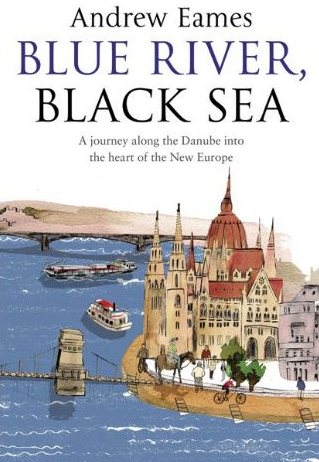
Blue River, Black Sea: A Journey Along the Danube Into the Heart of the New Europe

The following is a piece by Dimiter Kenarov from The Nation which contrasts the journey of Paddy along the banks of the Danube with the more recent account of Andrew Eames, recounted in Blue River, Black Sea. It is clear that if we were to try to follow the foosteps of Paddy that much has changed – I guess that much we knew – but that also the pace of change means that if we are to encounter the last feeble remnants of that post-Austro-Hungarian world, we had better move very fast. This is worth the read.

From Black to Black, a review of Blue River, Black Sea: A Journey Along the Danube Into the Heart of the New Europe
By Andrew Eames.

Every day, at three in the afternoon, I make a trip down the Danube. To travel from Germany’s Black Forest to Romania’s Black Sea takes a matter of minutes, so I try to enjoy myself as much as possible. I sink into a cushy armchair, rev up the stereo and embark on an epic voyage. “Information on the water levels of the Danube River, in centimeters,” the familiar voice on Horizont, the Bulgarian National Radio, announces with the deepest solemnity before reading out the relevant hydrographical values, first in Bulgarian and then in Russian and French. Vienna: 310 (+3); Mohács: 415 (+7); Novi Sad: 162 (-13); Vidin: 380 (+40); Giurgiu: 220 (0).

The captains of river vessels can easily map a course on the Internet, but the daily radio bulletin has remained a fixture in my life. For many years, listening to the fluctuations in the water levels of the Danube was the closest I could get to traveling abroad. Regensburg, Passau, Linz, Vienna: these names mesmerized me. Even places like Bratislava and Budapest, comrades in arms against the decadent West, had the ring of myth to a boy growing up in Bulgaria. Remembering his childhood in the Bulgarian river port of Ruschuk (now Ruse), Elias Canetti wrote, “There, the rest of the world was known as ‘Europe,’ and if someone sailed up the Danube to Vienna, people said he was going to Europe.” If people in Canetti’s immediate circle, at the beginning of the twentieth century, still had the occasional opportunity to waltz up to the palaces of the Habsburgs and back, however, the “Europe” I imagined in the 1980s existed only in a galaxy far, far away. To travel up the river as a tourist during the cold war required visas, special permissions, bureaucratic ballast. To swim across it, a negligible distance of a few hundred meters, was to risk both drowning and the bullets of border guards. For nearly fifty years the Danube was a demolished bridge, a liquid roadblock. The wall may have been in Berlin, but the truly impassable one was an invisible dam on the Danube, somewhere between Vienna and Bratislava.

The Danube—or Ister, as the ancient Greeks called it—is a natural highway of nearly 3,000 kilometers. “The greatest of all the rivers which we know,” declared Herodotus. “A path for the spirit to follow,” wrote Hölderlin, following the footfalls of the Greeks in his hymn “The Ister.” Human tribes traveled west against the current, colonizing the core of the continent, gradually shaping it. Before the Americas, there was Europe. The Romans made a few feeble attempts to bring traffic under control by turning the river into the fortified frontier, or limes, of their empire, but without much success. South of the Danube civilization cowered; in the north, the barbarians bided their time.

There is probably no other geographical element of Europe that has absorbed more political weather than the Danube. Unlike the Russian Volga and the Franco-German Rhine, it has served many masters, as a shield or a spear. In 1683, by the walls of Vienna, John III Sobieski and Charles of Lorraine routed the armies of Kara Mustafa, marking the beginning of the end of the Ottoman Empire. Not long thereafter, in 1704, the Duke of Marlborough and Prince Eugene of Savoy vanquished the Franco-Bavarian alliance at the Battle of Blenheim, an important event in the War of the Spanish Succession. Near the river town of Ulm, Napoleon forced the Austrians to surrender with barely a fight. And Hitler’s Drang nach Osten—yearning for the East—had a strong Danubian stink. “Do not forget,” the elderly Heinrich Heine wrote to the young Karl Marx, “the difference between water and a river is that the latter has a memory, a past, a history.”

It has taken twenty years of European integration for the memories of the cold war to seep away. Quietly meandering across ten countries—Germany, Austria, Slovakia, Hungary, Croatia, Serbia, Bulgaria, Romania, Moldova and Ukraine—and running softly past more than fifty-five towns and cities, including four capitals, the Danube is once again a major route for trade and tourism, diluting national and political borders and linking numerous shoreline communities into a single organism. The Rhine-Main-Danube Canal, completed in 1992, allows ships to navigate passage from the North Sea to the Black, chugging through the heart of the continent. The river’s delta, with its sprawling network of lagoons and marshes, is a Unesco World Heritage Site and an important bird sanctuary—with its own environmental problems, of course. Today, to sail along the Danube is to see the new face of Europe, old as it is. And, luckily for me perhaps, the daily radio bulletins on Horizont are no longer my only means of travel.

Traveling the Danube became a fad in 1829. That was the year two Englishmen, John Andrews and Joseph Pritchard, founded the First Danube Steamship Company, which lured scores of elated pleasure seekers. “A motley crowd on board, such perhaps as never met together on the deck of a steam-boat before,” wrote the Irish journalist and literary editor Michael Quin about one of those early voyages. Standing among Austrians, Moldavians, Jews, Hungarian nobles and Tyrolean emigrants, he traveled in style down the river from Pest (Budapest) to the Ottoman town of Ruschuk. It was a thrilling but perilous undertaking. Unlike the well-trodden path of the Grand Tour, with its picturesque Parisian streetscapes and Florentine galleries, the Danube offered a wilder ride for people with money and a taste for adventure. Although its waters flowed across half the continent, knowledge of the river was scarce and scattered, especially when it came to portions under Ottoman control. Europe was split in two long before the cold war, and the Danube was the main gateway into its eastern, darker territories. The course of “civilization” had gradually reversed directions.

William Beattie, another of those early steamboat passengers, portrayed that division with typical Victorian bigotry. East of Budapest, he wrote in his 1844 travelogue The Danube, the tourist “feels as if he were taking farewell of civilization, and entering upon a vast primeval desert, where man is still a semi-barbarian; and where the arts by which he converts to his use the natural products of the earth are still in their infancy, or wholly unknown.” As far as Beattie was concerned, Eastern Europe might as well have been an island in the middle of the Pacific. Quin was similarly dismayed by the seemingly crude ways of life he encountered but a little bit more optimistic in his vision of the future. He praised “the miracles of the age of steam” and then blithely prophesied, “Those countries, which have hitherto seemed scarcely to belong to Europe, will be rapidly brought within the pale of civilization…and new combinations…will be created, which may give birth to important changes in the distribution of political power on the continent.” He was right, of course: steam did alter the political landscape of Eastern Europe. (Could it be that James Watt was personally responsible for the fall of the Ottoman Empire and the whole contemporary history of the continent?) However, Quin’s journey down the Danube was also a reassertion of his cultural identity and his sunny view about technological progress. As the historian Larry Wolff pointed out in his seminal work Inventing Eastern Europe, “It was Western Europe that invented Eastern Europe as its complementary other half.” And the Danube was the road most inventors took.

So many writers have traveled the Danube that their tributary ink, if channeled into a single stream, would turn the water black. From the Italian naturalist and geographer Luigi Ferdinando Marsigli, who professed to have mastered “the anatomy of the river” and then published in 1726 his magisterial six-volume Opus Danubiale, to the contemporary Hungarian writer Péter Esterházy, with his playful travelogue The Glance of Countess Hahn-Hahn (Down the Danube), published in 1991, the outflow of words has been endless. To look for the authentic Danube would be futile, for nobody can describe the same river twice. “It is I who will say what the Danube is,” Esterházy’s protagonist, the Traveler, insists, as so many others before him have: Germans and Austrians, Hungarians and Russians, as well as the odd Serbian, Romanian and Bulgarian. For some reason, however, it was the British and a few American explorers, outsiders with ever-roving empirical eyes and an insatiable appetite for the foreign, who frequently attempted to distill the Danube’s essence. Some, like Quin and Beattie, were deeply prejudiced against the world they were about to encounter. Others, like the American painter Francis Davis Millet, who paddled downriver in a canoe in 1891, wrote about the local people and their environs with sympathy and understanding. Then there were those who transcended the ranks of mere travelers to join the great writers.

Patrick Leigh Fermor is the best of the lot. In the winter of 1933, at 18, he set out on foot from Rotterdam toward Istanbul—or Constantinople, as his romantic imagination insisted. With just a rucksack on his back and two books in hand—The Oxford Book of English Verse and the poems of Horace—he traversed the better part of the pre-war continent “like a tramp or a pilgrim or a wandering scholar.” His trek along the Danube made up only one leg of his amazing odyssey, but it was the most remarkable one. Poring over his maps and trying to decide whether to head for sunny Venice or press farther east, he writes, “Just in time, the windings of the Middle and the Lower Danube began to reassert their claims and the Carpathians and the Great Hungarian Plain and the Balkan ranges and all these mysterious regions which lay between the Vienna Woods and the Black Sea brought their rival magnetisms into play. Was I really about to trudge through this almost mythical territory?” Continue reading

Where in the world have you come across Patrick Leigh Fermor?

Between the Woods and the Water

I have just returned from Montenegro where I had a holiday with my family. It is a place that is not at the top of the list for most people I guess, but it does attract many Serbians and Russians, particularly to its spectacular coast.

We were attracted because it was different, has spectacular scenery dominated by huge mountains, is relatively unknown, and it also enabled us to visit some very famous Serbian Orthodox monasteries as my wife and I are also very interested in Byzantium and its art (see MyByzantine blog).

On our first night, as I casually flicked through the books left in our villa by the owner and previous visitors, I was surprised to come across a paperback copy of Between the Woods and the Water. It had been read and was in good condition. This gave me the excuse to encourage Kim to read it as she happened to be coming to the end of A Time of Gifts which she was enjoying.

It made me think that many of you who read the blog may have come across Paddy’s work in unusual circumstances, and in faraway places. It would be interesting to hear more; why not paste a comment below or email me (tsawford[at]btinternet.com)? Let’s see who has the most interesting tale to tell!

On the Same Steps as Patrick Leigh Fermor

On the same steps as Paddy

“In the heart of them stood a massive building; my objective, the Hofbräuhaus. A heavy arched door was pouring a raucous and lurching party of Brownshirts onto the trampled snow.

I was back in beer territory. Halfway up the vaulted stairs a groaning Brownshirt, propped against the wall on a swastika’d arm, was unloosing, in a stanchless gush down the steps, the intake of hours. Love’s labour lost.”

Those of you well versed in Paddy’s writing will by now have realised that the above is not my own feeble prose but an excerpt from the passage in A Time of Gifts when Paddy enters Munich’s Hofbräuhaus in January 1934.

When I entered that vast temple to beer, sausage and sauerkraut at the end of June, I instantly felt like I had been there before, and indeed I had when I read Paddy’s finest work. Instantly I wanted to visit the chamber bursting with SA men singing Lore, lore, lore, and overweight young German burghers ‘as wide as casks ’ who were ‘… nimbly, packing in forkload on forkload of ham, salami, frankfurter, krenwurst, and blutwurst’ lifting stone tankards ‘for long swallows of liquid which sprang out again instantaneously on cheek and brow.’ Had it not been for the fact that this was midday instead of night I am sure I would have found it barely changed, save for the SA men, whose children and grandchildren (all aged now) have taken up residency.

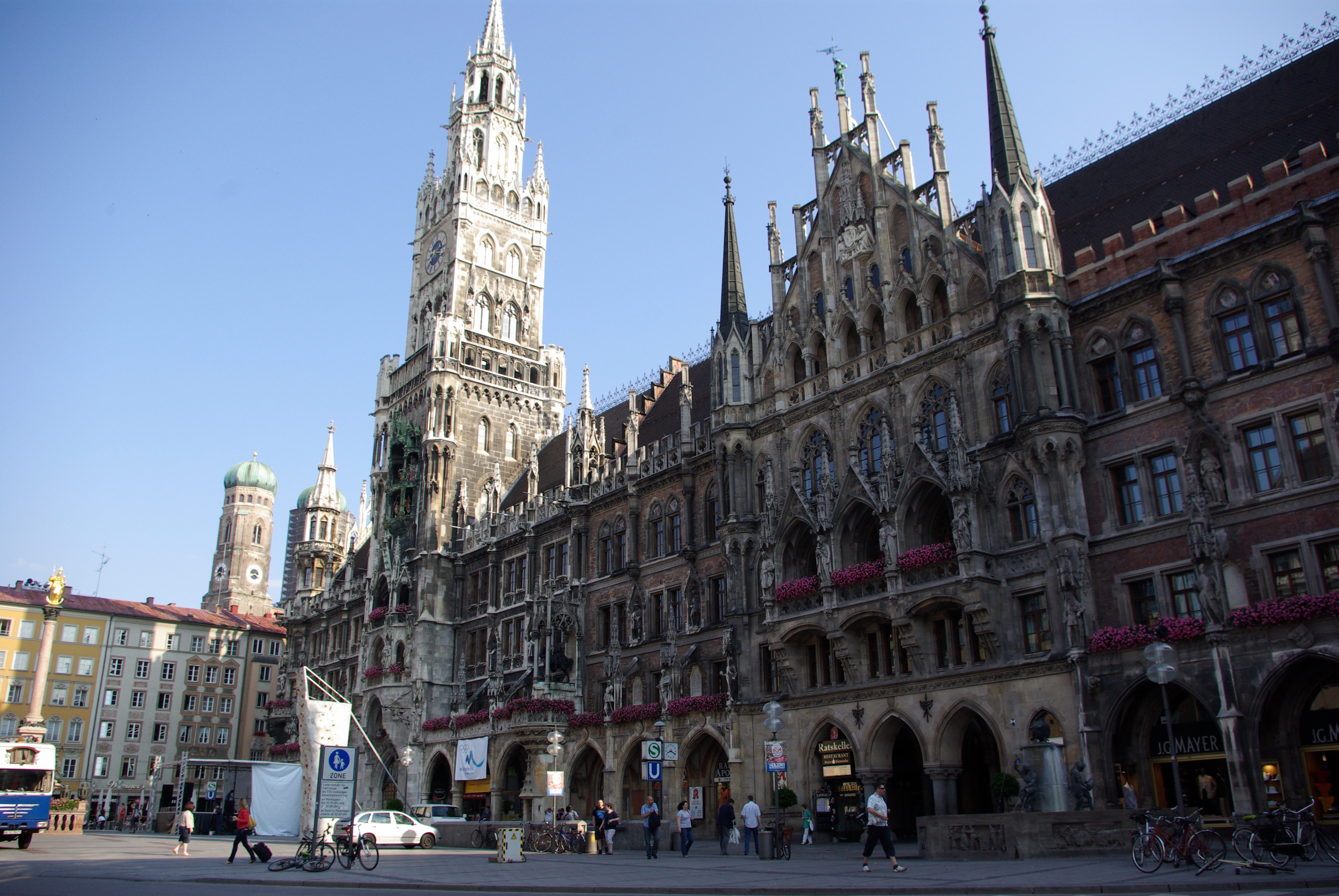
The Rathaus Munich

My wife and I were in Munich after taking the overnight sleeper from Paris Est to Munich on our journey to see the Passion Play (Passionspiele) at Oberammergau. We had arrived at the relatively ungodly hour of seven o’clock in the morning and had seen Munich come to life on a Saturday morning.

At the time the Alt Stadt was almost exclusively ours apart from some stall holders preparing their wares of ripe and juicy, brightly coloured fruit and vegetables for the Saturday market; two young men demonstrating their ability on MX bikes beside a fountain; and a couple of drunks who had obviously made the most of the warm Friday evening and had now belatedly discovered that the party was over.

During the war Munich was severely bombed by the Americans. When on a NATO course at the German Pioneerschule in the 1980’s I remember a particularly loud American officer asking in all seriousness, whilst we were on a tour of the city, when seeing the massive towers and basilica of the Dom, “How the hell did we miss that?”. Well, of course they did not miss it. Seventy per cent of Munich was destroyed by the bombing and after the war there was a serious proposal to abandon the city and rebuild nearby. Fortunately for the Hofbräuhaus (which sustained minor damage) and for us it was decided to rebuild the city. Many of the older buildings, as with so many German cities, were painstakingly restored. The Dom and the Hofbräuhaus were amongst these.

Following a morning of strolling around the centre, visiting some of the sights, drinking känchen’s of schokolade and eating cinnamon flavoured kuchen I was desperate to find the Hofbräuhaus. I was determined not to make the same mistake as Paddy and end up two miles away; although the prospect of doing so and having a couple of himbergeist to see us on our way was not so unappealing!

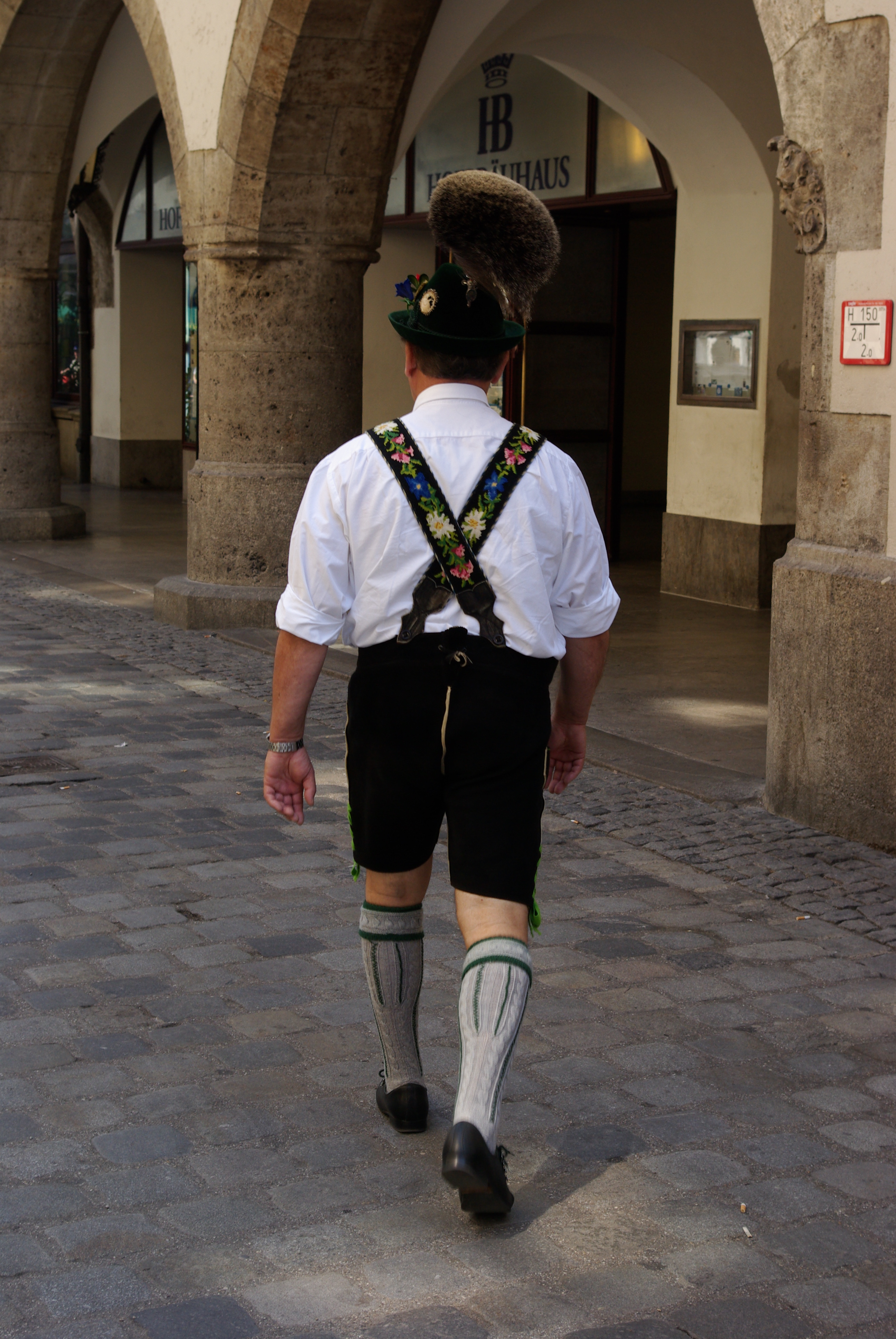
We followed a lederhosen clad gentleman ...

Inadvertently we had somehow attached ourselves to an American tour party and listened patiently whilst the bored German tour guide briefed them all on practical logistics like not entering their PIN number more than twice in those mysterious German cash machines, and what they might see on their one hour of ‘freedom from the group’ until it was time to meet up again, climb into their coach and visit yet another city. When it came to question time I asked where I might find the Hofbräuhaus. The guide looked quizzically at me, thinking I must have some obscure mid-western American accent and told me in all seriousness that eleven o’clock in the morning was rather too early to make such a visit and drink beer. I persisted and reluctantly she gave me the directions.

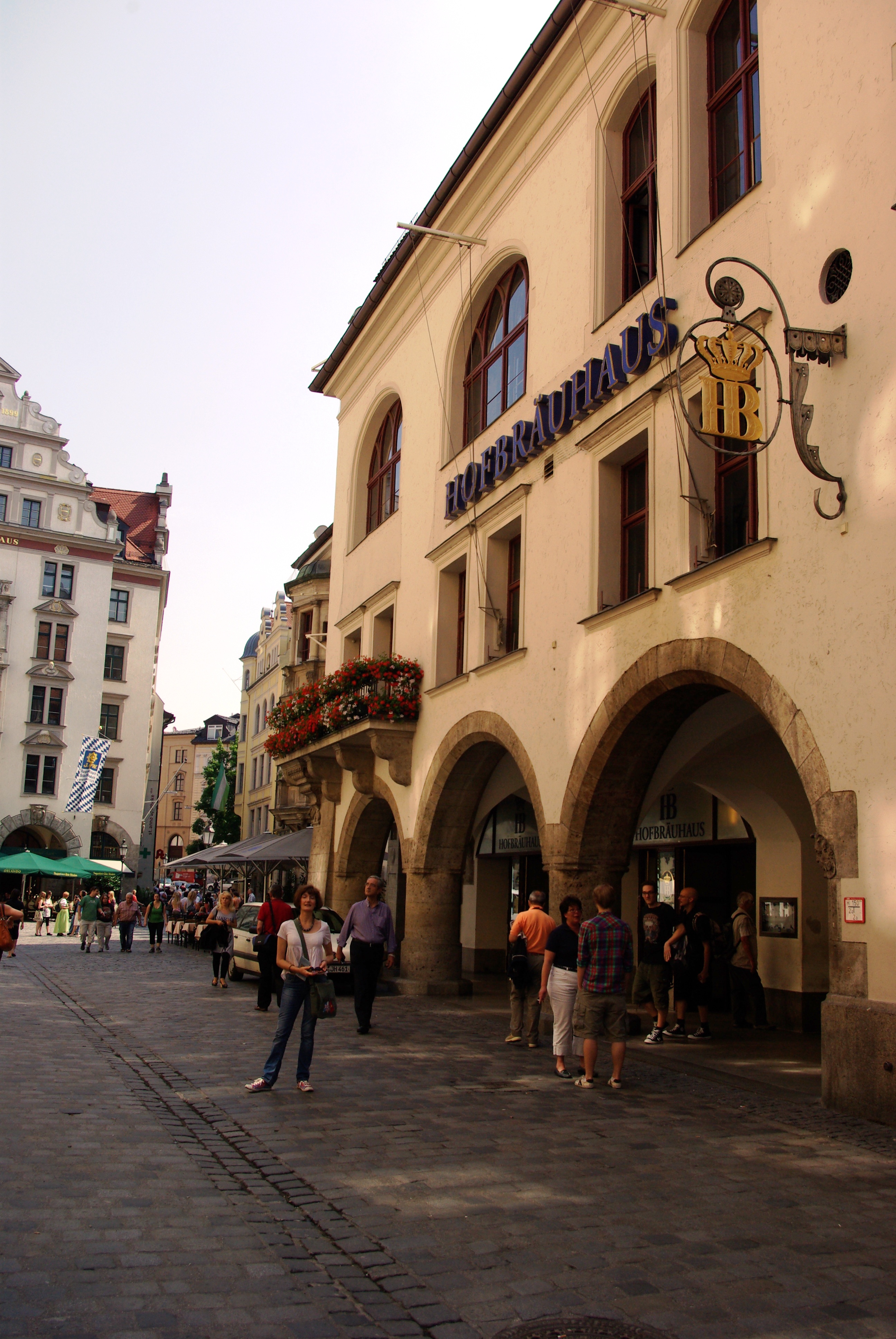
Hofbrauhaus exterior

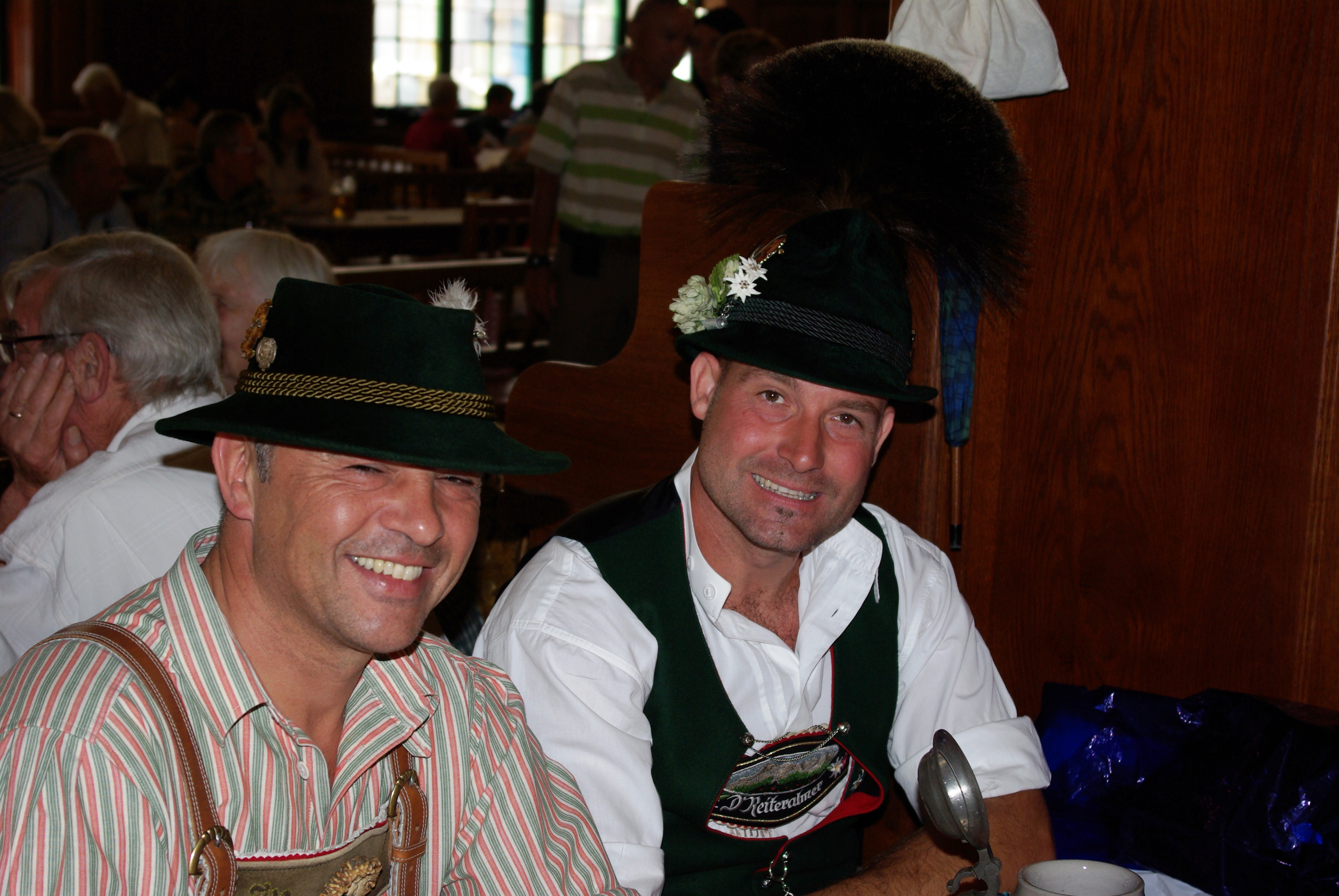
We walked in the sunshine past the old schloss and down a lane to the ‘slanting piazza’ but I do not recall the Virgin on a column presiding over all she surveyed. We followed a lederhosen clad gentleman wearing a traditional Bavarian felt hat which was adorned by the most amazing plume, reminding me of something that may have been worn by a Roman first spear centurion to enable his men to identify him in the midst of battle.

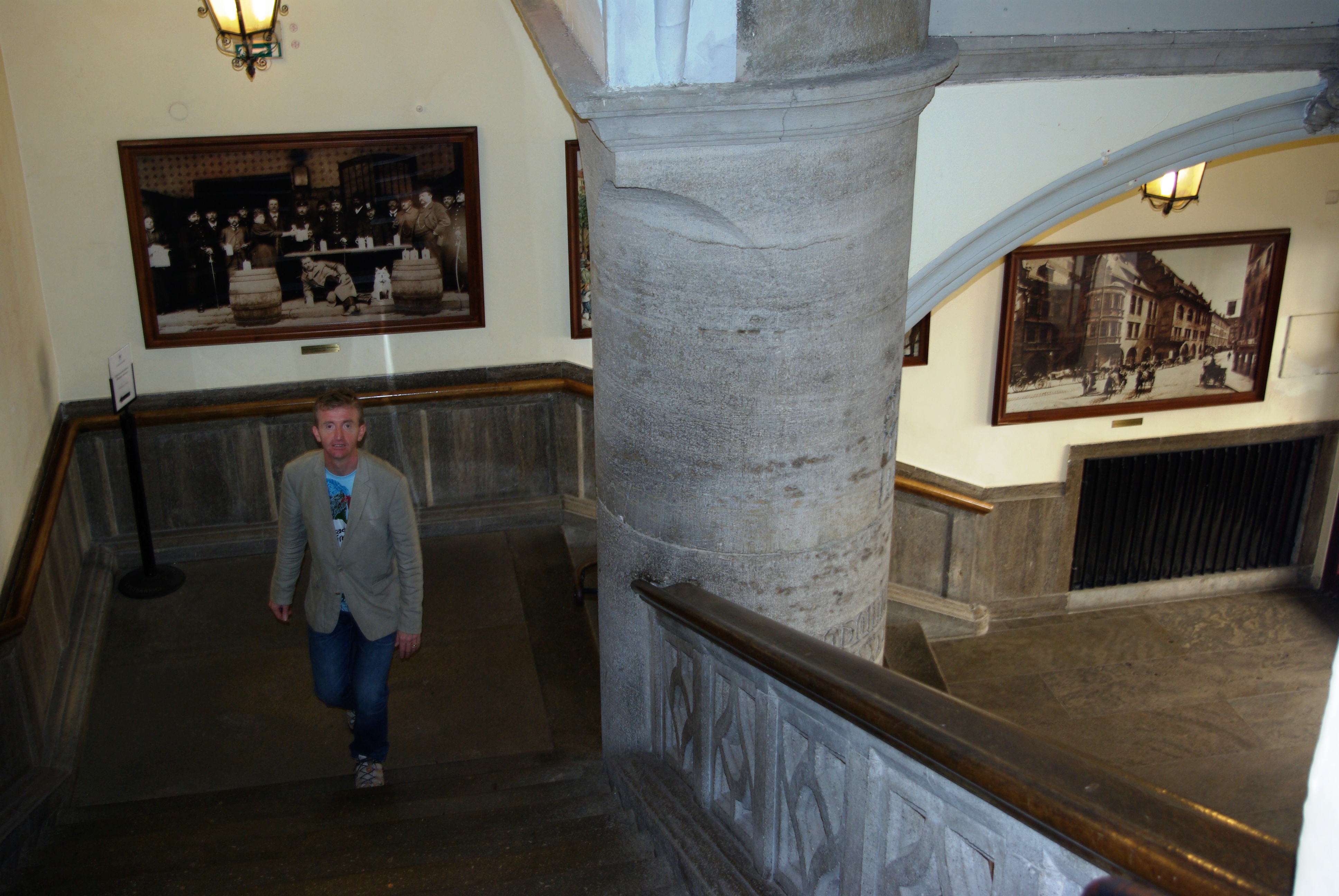
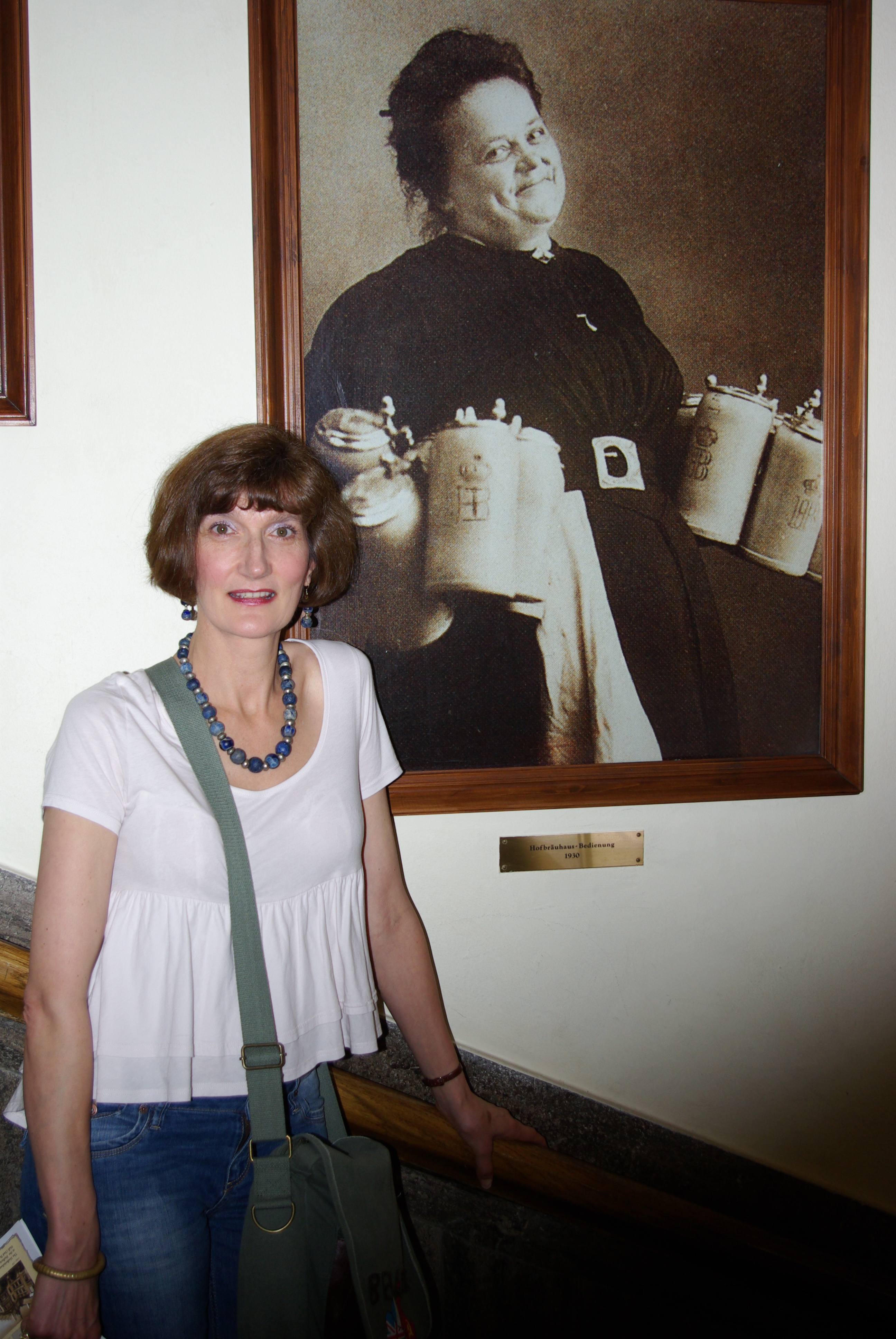
There before us was our goal. Gothic and grand just as Paddy described it, we entered through wide doors underneath Gothic arches and walked up those vaulted stairs which survived the damage of the war. It was here in January 1934 that Paddy encountered his Brownshirt. The steps are now lined with photographs, one of a maternal looking frau holding eight heavy steins full of the cool, golden Hofbräuhaus beer. Perhaps she had served Paddy on that famous, alcohol fuelled night?

Kim considers joining the waitressing team

The Hofbräuhaus has four floors devoted to the adoration of beer, sausage and pretzels. We visited each one. They were all decorated in a different style with a large communal drinking hall, and a number of smaller private function rooms (which are for hire). It is one of these higher floors that Paddy stumbled into when full of SS officers, Gruppen and Sturmbannfuhrers, black from their lightening-flash-collars to the forest of tall boots underneath the table.

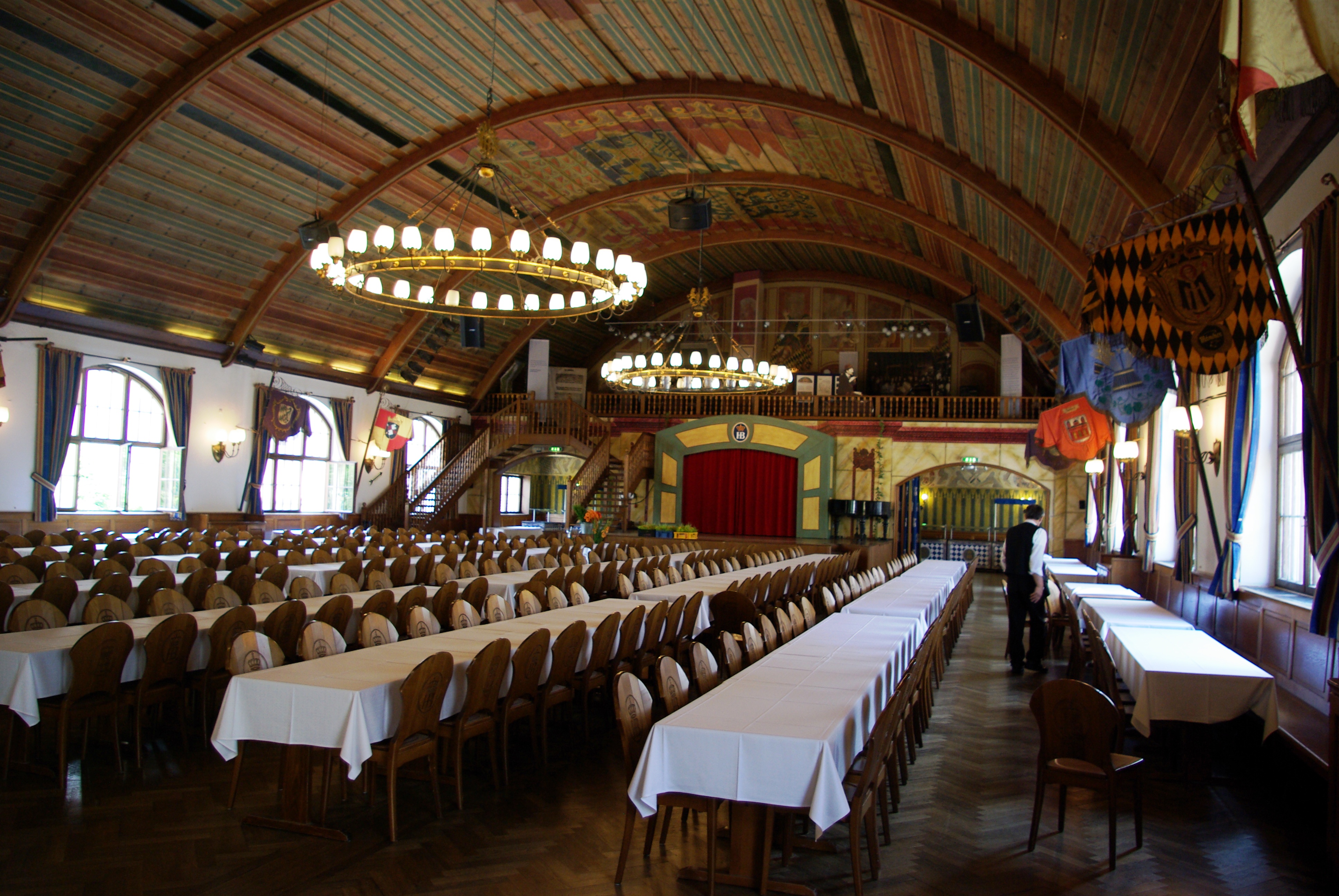
The highest floor is dominated by a large parquet floored room with a vaulted ceiling colourfully decorated with its predominantly pink and blue frescos of Bavarian coats of arms. The Festival Hall was built in 1589. It is light and airy with windows on each side, large chandeliers and dominated by a small stage with heavy, theatrically red velvet curtains. The Hall can seat over 900 on its long tables arrayed in neat rows before the stage, and gives the impression of being eternally ready for a party. Indeed on the occasion of our visit, it was being prepared for the post- Abitur celebration for a very lucky young girl. The mood darkens somewhat when you know that it was in this very room, standing on that very stage that the ambitious politician Adolf Hitler addressed his followers in the early days of the National Socialist Party in the late 1920’s and early 1930’s.

Hofbrauhaus Festival Hall

Given the passage of time this ceased to have any sinister effect, but it is a sobering thought and brought to life a period of history, and its aftermath, that has come to dominate my generation, and certainly those preceding us.

Did Adolf visit here?

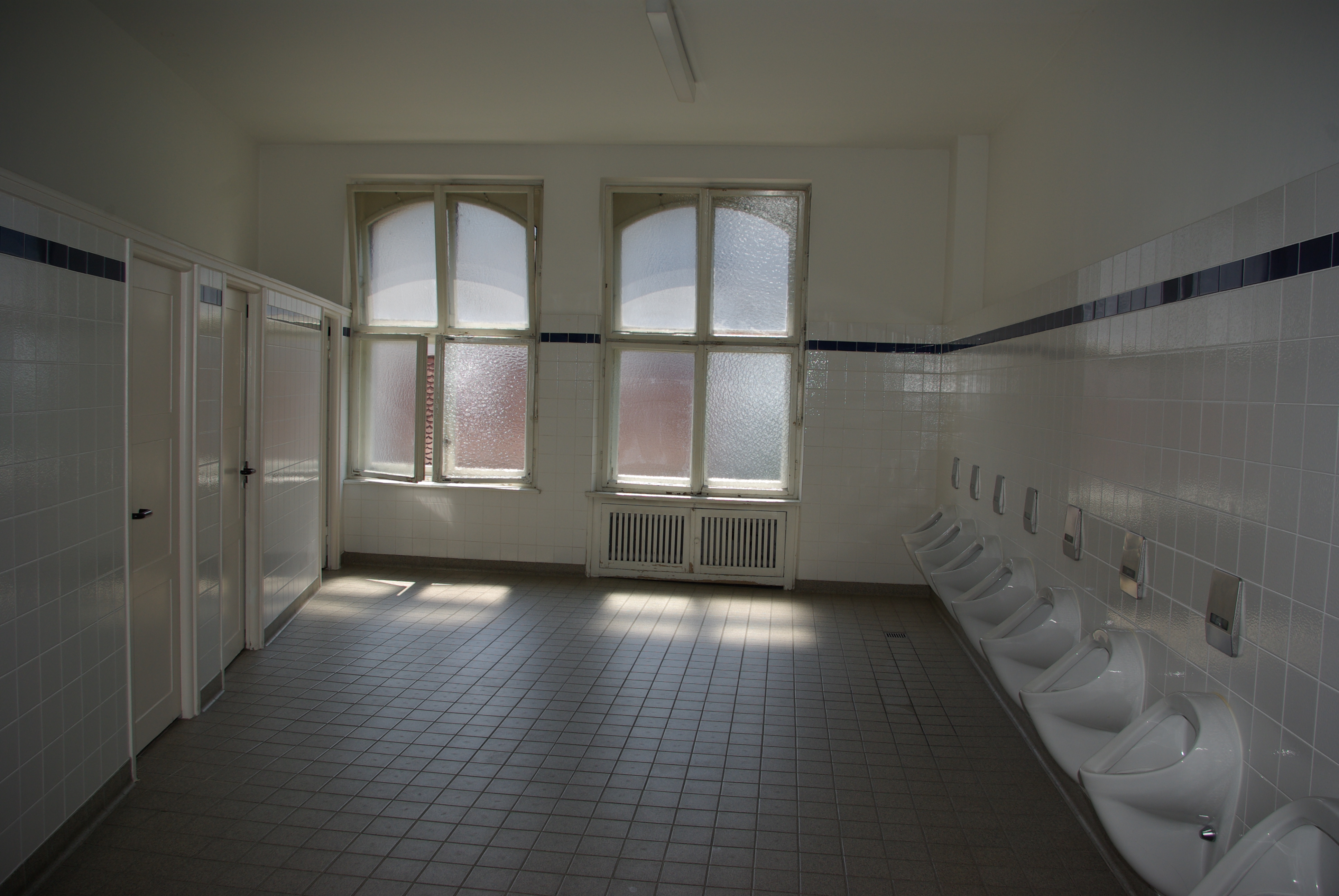
It was about this time that I needed to answer the call of nature. Kim and I were virtually alone and I sought out a gentleman’s lavatory. Finding one at the end of a corridor leading from this function room, I hypothesised that perhaps Hitler had, on more than one occasion, made this same trip, perhaps accompanied by colleagues such as Herman Goering, and discussed the finer points of how to grab political power, and achieve revenge on all those who had sought to so humiliate Germany via the Treaty of Versailles.

Like Paddy we were now guided right down to the bottom of the stairs, out of the doors and back in another, larger door on the ground floor. After passing the obligatory ‘Hofbräuhaus shopping experience’ we entered a new hall where the vaults of the great chamber did not fade into infinity through blue strata of smoke as this was, unbelievably, 21st century smoke-free Germany.

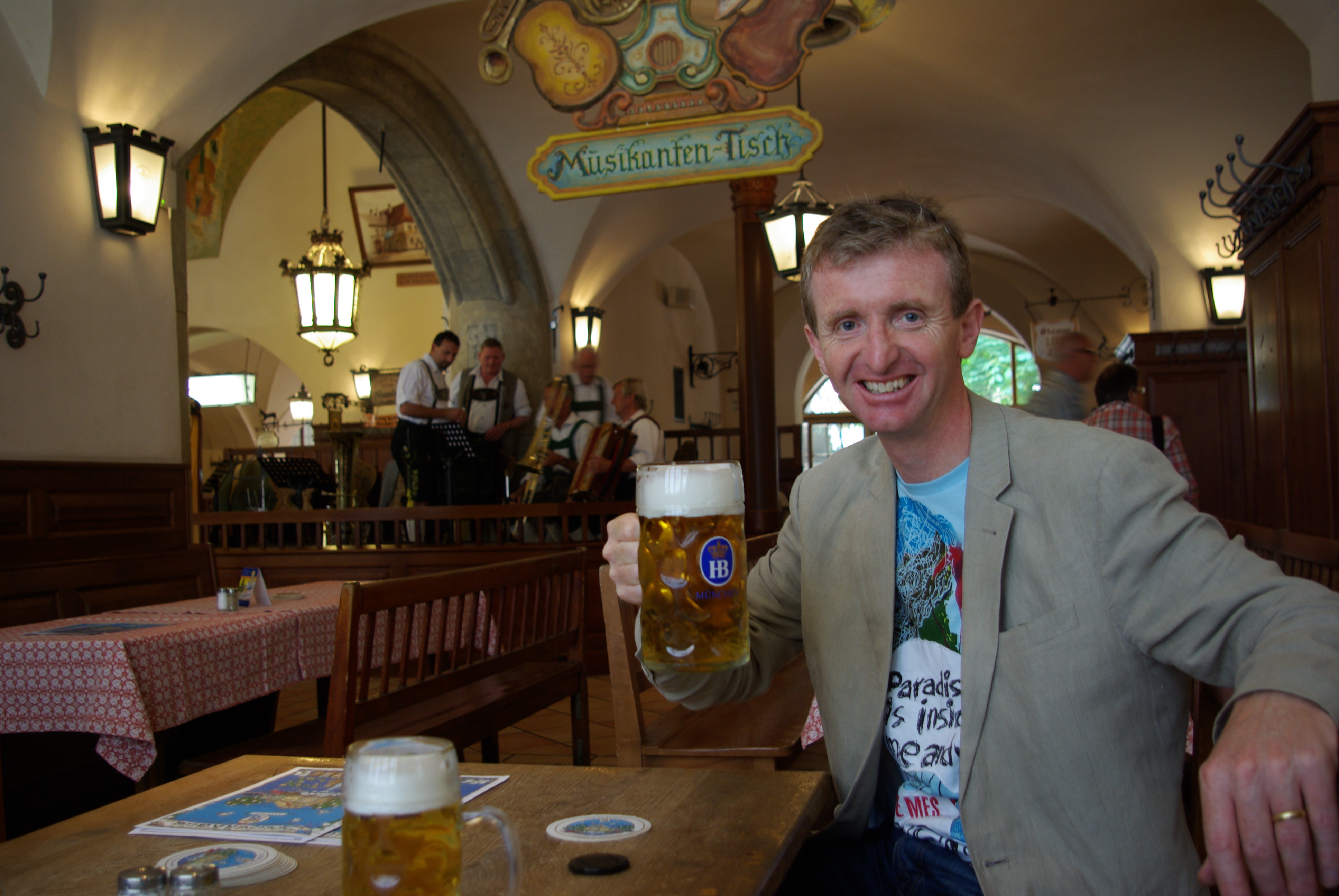
Drinking cool beer in The Schwemme

It was here that Paddy found the part of the Bastille he was seeking. The Schwemme is a huge, richly frescoed hall that wound this way and that, past huge stone pillars, toward the altar of Hofbrau beer where an army of male and female waiters attend upon the fountain of beer pouring litre upon litre of the marvelous nectar. And it did not stop there. What Paddy would have missed on a dark, cold, snowy night in 1934 was the courtyard beer garden which by now was filling with locals and tourists all keen to bathe in the unique Hofbräuhaus atmosphere.

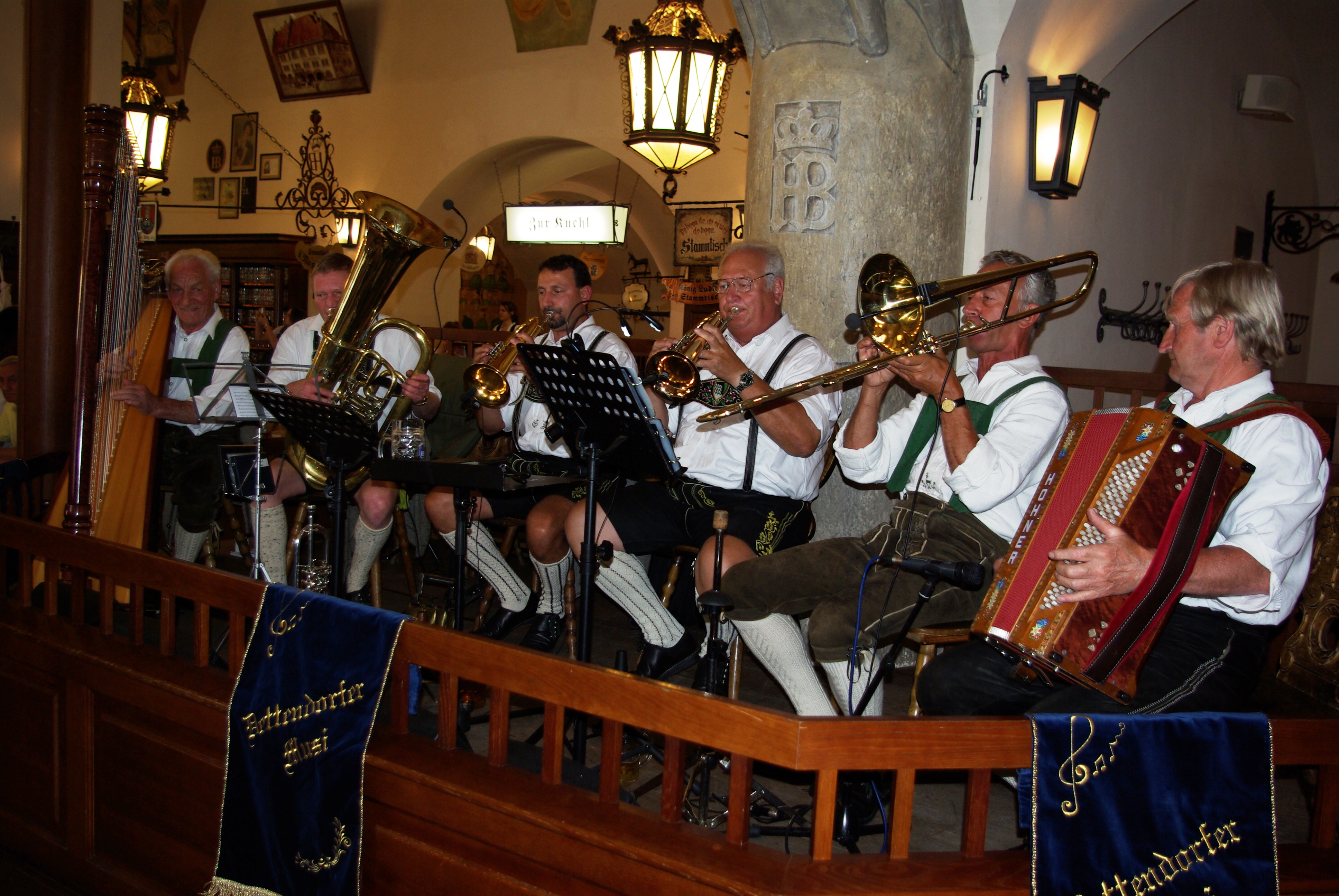
If you visit the website of the Hofbräuhaus you will see it includes a list of ‘regulars’; those who attend services on a regular basis, with the specific visit days recorded. They have reserved seats and for larger groups, or even families, whole tables are kept for them so that they can indulge and worship whilst listening to the suitably attired Bavarian band that have a dedicated stage in the centre of the hall.

Hofbrauhaus Regulars

The band plays on

We had arrived early, at around 11.00 am and had spent forty-five minutes or so making our tour of the building. It was quiet, with just a few other like minded souls and the staff getting ready for the rush ahead. By midday we had chosen a table and ordered our first refreshing beer, a Würstlplatte for me and Spanferkel for Kim (read the menu in English here). The Schwemme was now filling with crowds of locals and tourists alike and the band had struck up. If you want to visit the Hofbräuhaus to look around, as we did, I would recommend going early, and you also need to be there pretty early to find a table.

It was a wonderful visit, and one that was brought to life even more as we imagined that young man avoiding Brownshirts and knocking back beer with the farming folk he found in the Schwemme. One thing that has not changed is the hospitality and friendliness of the Bavarian people, and it was with some reluctance that we walked out of the Hofbräuhaus into bright sunshine to catch our train to Oberammergau.

Now, where did I leave my rucksack?

Walking Paddy’s Route in Mitelleuropa: Frugal Europe, on Foot

It’s time to be honest now: who amongst the regular readers of this blog, or even those that stumble across us because they have read ‘A Time of Gifts’ or ‘Between the Woods and the Water’, has not thought about following Paddy’s 1930’s route? For myself it is a definite goal. It is an ambition; probably a passion. I had come across the following article but have been inspired to re-produce it by Blog reader Matt who says he first got into Paddy’s work when stationed in Baghdad:

Tom, The New York Times travel writer, Matt Gross, just did an article on PLF. He walked the Vienna to Budapest stretch recently … I first read PLF while stationed in Baghdad four years ago and revisit him often. Living in Heidelberg, I’ve been able to visit some of the places he mentioned specifically and have recommended A Time For Gifts to many of my fellow Americans living here or travelling to Europe. As I’m in the process of moving back to the States, it will be a few years before I’m able to pick up the thread of his travels. I’m not sure if you’re in contact with PLF, but pass him the respects of this Yankee officer. Matt

Frugal Europe, on Foot

First published in the New York Times,  May 23, 2010

The article is written by New York Times’ Frugal Traveler columnist Matt Gross who attempted to follow in the footsteps of Patrick Leigh Fermor. Like all good stories it begins ….

ONCE upon a time, a young man went for a walk. It was December 1933, and an 18-year-old Englishman named Patrick Leigh Fermor put on a pair of hobnail boots and a secondhand greatcoat, gathered up his rucksack and left London on a ship bound for Rotterdam, where he planned to travel 1,400 miles to Istanbul [Ed: Constantinople!] — on foot. He had virtually no money; at best, he’d arrive in, say, Munich to find his mother had sent him £5. But what he did have was an outgoing nature, a sense of adventure, an affinity for languages and a broad network of friends of friends.

 “If I lived on bread and cheese and apples,” he later wrote, “jogging along on fifty pounds a year like Lord Durham with a few noughts knocked off, there would even be some cash left over for papers and pencils and an occasional mug of beer. A new life! Freedom! Something to write about!”

 Something to write about indeed! The books he produced from the yearlong journey — “A Time of Gifts” and “Between the Woods and the Water” — are gorgeously rendered classics that have led many to call Mr. Leigh Fermor, now 95, Britain’s greatest living travel writer. But to my mind, he’s always had another title: the original Frugal Traveler — the embodiment of that idea that, though a wanderer may be penniless, he doesn’t have to suffer.

 And Mr. Leigh Fermor never suffered, thanks to the miracle of human generosity. Peasants gave him baskets of eggs and swigs of raspberry schnapps. Small-town mayors found him beds. The lingering nobility of Europe put him up in their castles, invited him to balls and lent him their horses. When Mr. Leigh Fermor did sleep rough — in hayricks and barns or on the banks of his beloved Danube — he did it by choice, not because (or not merely because) poverty required it. He knew, even at 18, that the world is an experience to be savored in all its multifarious incarnations.
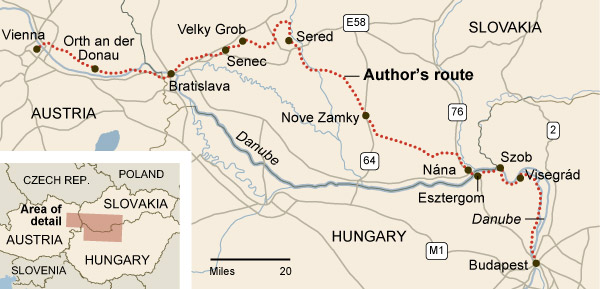
Matt Gross' route

Could a young person (is 35 still young?) with strong legs and little money find the same spirit of hospitality that Mr. Leigh Fermor encountered some 76 years ago? At the end of March, I set out to find the answer. With only two weeks free, my plan was to walk from Vienna to Budapest, a 180-mile route that would connect the old poles of the Austro-Hungarian Empire and track Mr. Leigh Fermor’s trail as closely as possible, taking me along the Danube to Bratislava, the Slovakian capital, and across the plains of Slovakia south to Hungary — through three countries whose languages, cultures and histories could not be more different, or more intertwined.

It was tempting, the day I arrived in Vienna, to just walk east from the airport, but I couldn’t completely skip the Austrian capital, where Mr. Leigh Fermor had spent three weeks among the “crooked lanes” and “facades of broken pediment and tiered shutter.” And so I followed his lead, going into the imperial crypt, where the grandest members of the Hapsburg family lay entombed in elaborate sarcophagi, and into the museums, although I shied away from the most famous in favor of oddities like the International Esperanto Museum. And I luxuriated in storied places like Cafe Alt Wien and Cafe Bendl.

But after two nights in Vienna, I was restless. So I crossed the Danube, put on my 45-pound pack and took off down the Donauradweg, a well-kept biking trail that runs from the river’s source to its mouth at the Black Sea. To my right, the Danube, more green than blue, sparkled in the cool sunlight, and I encountered fishermen tending their rods, elderly sunbathers, nordic hikers poling along and cyclists speeding in both directions.

This first day, I figured, I’d take it easy and do only 15 miles. Ideally, I’d need to hit 18 miles a day — about six hours of walking — to reach my goal. It seemed reasonable, especially with the terrain so uniformly flat. The path, sometimes dirt, sometimes paved, would often stretch so far and straight that I couldn’t imagine I’d ever reach the end, and then I’d finally hit a slight turn and face the same thing: an art-school lesson in perspective, complete with the first low foothills of the Carpathians at the vanishing point — and a scampering rabbit to remind me this was no still life.

Even with such straightforward terrain, there were snags. An attempted shortcut through a fuel depot left me with minor scratches and an extra three miles. But such mistakes have a way of turning out for the best. Had I stayed on the trail, I would have never crossed paths, two hours later, at the edge of Donau-Auen National Park, with Jean-Marc and Marie, newlywed French cyclists who stopped to say hello when they saw a lone hiker in the middle of nowhere. They were taking an extended honeymoon: a two-year bicycle journey from their home in Paris — to Japan!

“Do you know where you’re staying tonight?” I asked. They didn’t. I told them to meet me at Orth an der Donau, a small Austrian town a couple of miles farther down the Danube, where I had arranged for a place to stay via CouchSurfing.org. Maybe, I said, my host could find them somewhere to pitch their tent.

THE host, Roland Hauser, whom we met in front of Orth’s impressive castle, did better than that. He invited them home to his dreamland of soft beds and hot showers. Roland, 26, had traveled from California to Southeast Asia to New Zealand, and his German-accented English was peppered with words like “sí” and “bueno.” That evening, we cooked spaghetti Bolognese, nibbled Südtirolean ham and drank big bottles of beer. I went to sleep marveling at our extraordinary, Fermorian luck.

In the morning, after coffee, I threw out my underwear. This was a strategy to lighten my load — bring old undies and get rid of them day by day. Frankly, I should have done that with everything, as the pack was needlessly heavy. Along with two weeks’ worth of shirts, I had an ultralight down jacket, a waterproof shell and rain pants. A tent and sleeping bag. One pair of jeans and lightweight canvas shoes to change into at day’s end; nothing worse than walking 20 miles and spending the evening in the same clothes. And I packed Mr. Leigh Fermor’s books and Claudio Magris’s “Danube,” which I never had time to read. And my computer and camera gear — work necessities, alas.

When I set off, I was wearing my typical walking outfit: khaki pants by a company in Portland, Ore., called Nau; waterproof running sneakers by Lafuma; good socks (as important as good shoes); and a long-sleeved cotton shirt.

The walk began well. My feet were tender, but the flatness of the Marchfelddamm, a high berm that doubled as biking path and flood deterrent, ensured that I wasn’t struggling. This was the heart of the Donau-Auen National Park: forests of thin trees broken by occasional streams flowing to the Danube. At first, I appreciated the play of light on the water and between the trunks, but hour after plodding hour of unchanging scenery soon became mind-numbing, and I simply marched, putting one foot in front of the other and watching for kilometer markers. It would be 13 miles before I could stop for lunch, and another 10 before I reached my day’s goal: Bratislava.

But there’s a funny thing about long walks. With patience, all those steps add up, and by 2 p.m., I’d crossed a bridge over the Danube and settled into a cafe in the stately town of Hainburg, where an open-faced baguette pizza and glass of beer gave me the courage to face the miles ahead. And soon I found myself trudging along the shoulder of the small highway with cars flying past — and missing the monotonous near-silence of the forest.

Not far off, I could see Bratislava’s hilltop castle — in Mr. Leigh Fermor’s era, a burned-out wreck worked by prostitutes but in the 1950s rebuilt as a stately white-and-red palace — and it teased me with its apparent nearness. Still, I had far to go, past a derelict border post, and through three miles of snaking bike paths, before I crossed the Danube again and was in the heart of Bratislava’s old town, all cobblestones and tile roofs and sidewalk cafes.

After checking into the Hotel Kyjev — a 1970s tower turned budget boutique — I checked myself out: I wasn’t sore, out of breath or even tired. I did have blisters on my feet, but they were easily treated: puncture, drain, clean, bandage. My ankles, however, were terribly swollen, the peroneal tendons in particular, a result (I think) of how my body mechanics had altered with the weight on my back. I popped some ibuprofren, took a shower, then hobbled outside for dinner.

It was the Friday during Passover, and like any wandering Jew, I wanted a Sabbath meal. And thanks to Chabad, the Hasidic Jewish outreach organization, I got one, at the home of the transplanted American rabbi Baruch Myers. He was only too willing to share his food (cucumber salad, gefilte fish), his friendship and his family, including a battalion of adorable children who cheerily walked me through the Passover story.

It wasn’t just this heartfelt welcome that got to me; it was the very existence of a Jewish community in Bratislava. Back in his day, Mr. Leigh Fermor wrote, the Jews “were numerous enough to give a pronounced character to the town.” No longer. The Holocaust had reduced the Jewish population to, in Rabbi Myers’s estimate, 1,000 people. There was a synagogue, a few kosher restaurants, a Jewish museum and even a pension, but few visitors today would see in Bratislava a Jewish-inflected city.

On Saturday, partly inspired by the rabbi and partly because of my feet, I rested and contemplated the future. I had walked 40 miles so far, and if my ankles were any indication, there was no way I’d make the remaining 140. Unless … If I took a train a short way — say, 15 miles northeast — I could certainly walk another 10 miles. I’d be breaking my rules, but those rules were arbitrary. Continue reading

Philhellene’s progress: The writing of Patrick Leigh Fermor

As you know I trawl the net for Paddy related material to create the best online source of information about PLF and his friends and associates. Some of you may have come across this essay that attempts to analyse Paddy’s style and his literary achievement. In my view it is just one of many that emphasise how great the man is and how unequalled is his prose.

First published in New Criterion, Jan, 2001 by Ben Downing

I have carried the soldier’s musket, the traveler’s stick, the pilgrim’s staff. –Chateaubriand (what a great quote for Paddy!)

The captive must have been exhausted and afraid, but when, on the fourth day of his grueling forced march across Crete, he saw dawn break behind Mount Ida, the sight was so beautiful that it brought to his lips the opening of Horace’s Ode I.ix: “Vides ut alta stet nive candidum/ Soracte,”(1) he murmured. Then, just as he trailed off, one of his captors came in to take the poem over, reciting the rest of its six stanzas. At this, the captive’s startled eyes slanted down from the peak to meet those of his enemy, and, after a long thoughtful silence, he pronounced, “Ach so, Herr Major.” For the captive was a German soldier–the commander of the island’s garrison, no less. General Karl Kreipe (to give him his name) had been abducted on April 26, 1944 by a band of Greek guerrillas led by two English commandos. Over the next three weeks, the kidnappers picked their way across Crete, eluding the thousands of Nazi troops who hunted them, until eventually they were met by a British boat and whisked to Cairo, where Kreipe was handed over and the two commandos promptly awarded the D.S.O. One of these men was W. Stanley Moss, who in 1950 published a riveting account of the escapade, Ill-Met by Moonlight, later filmed by Michael Powell. The other was a certain Patrick Leigh Fermor. Disguised as a shepherd and (like Zeus in his Cretan boyhood) living largely in caves, he had spent much of the previous two years on the island organizing the resistance. Leigh Fermor it was who finished the quotation.

But where had he, who’d never completed high school, learned Horace so well? Had Kreipe asked him this, Leigh Fermor could have answered, savoring the irony, that he’d committed the odes to memory during his teenage Wanderjahr a decade earlier, when, just after Hitler’s rise to power, he’d walked clear across Germany (among other countries) with a volume of Horace for his vade mecum, often reciting the poems to himself as he tramped. About that experience he’d not yet written a public word, and would not do so for many more years. Similarly he held off recounting his aubade with Kreipe. At last, however, in the 1970s, he broached the subjects of his continental traverse and, in an aside to that account, of his fleeting bond with Kreipe. Some things are best waited for: the book in which Leigh Fermor set these matters down, A Time of Gifts (1977), along with its sequel, Between the Woods and the Water (1986), represent not only the capstone of his career but, in my opinion, the finest travel books in the language and a pinnacle of modern English prose, resplendent as Soracte or Ida in deep snow.

The deplorable fact that most Americans, even well-read ones, have never even heard, as I also had not until recently, of a figure who in Britain (to say nothing of Greece, where he lives to this day) is revered and beloved as war hero, author, and bon vivant; who is, in Jan Morris’s words, “beyond cavil the greatest of living travel writers”; and who, in those of the historian John Julius Norwich, “writes English as well as anyone alive”–all this spurs me to correct our oversight of the sublime, the peerless Patrick Leigh Fermor.

His turbulent early life is recounted in the introduction to A Time of Gifts. Shortly after his birth in 1915, his mother and sister went to join his father in India, while he was left behind “so that one of us might survive if the ship were sunk by a submarine.” For four years he was billeted with a Northamptonshire farming family, an experience that proved “the opposite of the ordeal Kipling describes in Baa Baa Black Sheep.” A halcyon period, this, but the taste for boisterous freedom he acquired in the fields made for trouble later on: “Those marvelously lawless years, it seems, had unfitted me for the faintest shadow of constraint.” Especially intolerable to him were academic strictures of any kind, and there ensued a long series of dust-ups and expulsions, hilariously related. At ten he was sent to “a school for difficult children,” among which misfits he lists

the millionaire’s nephew who chased motorcars along country lanes with a stick, the admiral’s pretty and slightly kleptomaniac daughter, the pursuivant’s son with nightmares and an infectious inherited passion for heraldry, the backward, the somnambulists … and, finally, the small bad hats like me who were merely very naughty. Continue reading

The Long Walk – song about Patrick Leigh Fermor

A personal tribute to PLF from a fan. A song about Paddy’s long walk to Constantinople in “A Time of Gifts” and “Between the Woods and the Water”.

Easter 1934 – Paddy reaches the Hungarian border at Esztergom

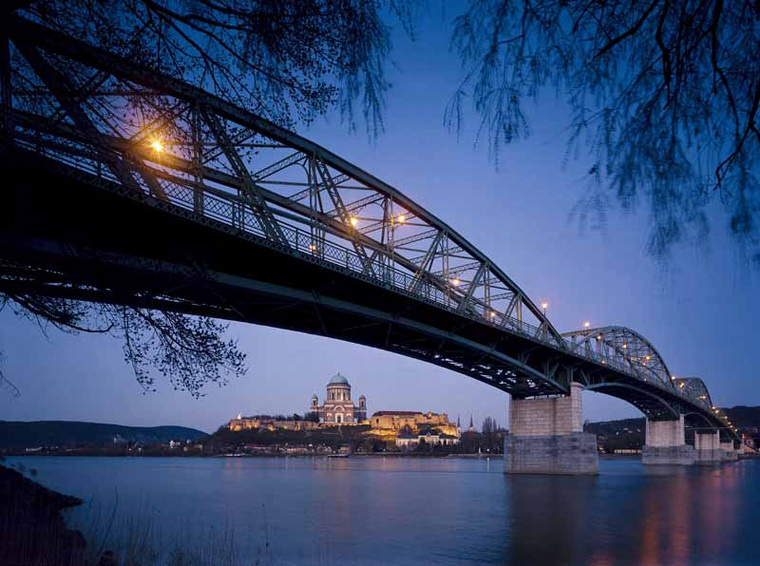
After what must have seemed an amazing four months to a young man of eighteen, Paddy arrives at the Czechoslovak-Hungarian border at Esztergom, which as he says (p 276 A Time of Gifts) contained ‘the Metropolitan Cathedral of all Hungary’. It is these last closing pages of his first volume that he describes the colourful preparations for an Easter service as he watches from no-man’s land in the middle of the bridge spanning the Danube. It is from this point that he picks up the story in volume two ‘Between the Woods an the Water’.

Wikipedia tells us: Esztergom (Hungarian pronunciation: [ˈɛstɛrɡom], also known by alternative names), is a city in northern Hungary, about 50 km north-west of the capital Budapest. It lies in Komárom-Esztergom county, on the right bank of the river Danube, which forms the border with Slovakia there.

Esztergom was the capital of Hungary from the 10th till the mid-13th century when King Béla IV of Hungary moved the royal seat to Buda.

Esztergom is the seat of the prímás (see Primate) of the Roman Catholic Church in Hungary. It’s also the official seat of the Constitutional Court of Hungary. The city has the Keresztény Múzeum, the largest ecclesiastical collection in Hungary. Its cathedral, Esztergom Basilica is the largest church in Hungary.

Imagine Paddy standing in the middle of this bridge looking at the cathedral