Category Archives: Paddy’s Friends

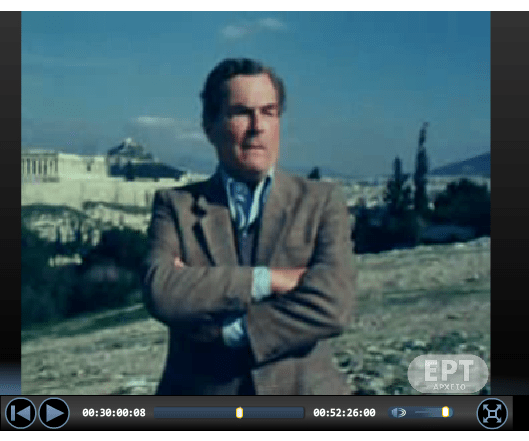
George Katsimbalis documentary Part 2 – Paddy sings about Greek debt!

The second clip of Paddy in a Greek TV documentary about his friend George Katsimbalis. Towards the end of this excerpt Paddy is chanting a 1935 Greek song about the 1932 Greek debt crisis; how appropriate.

My thanks again to Nicolas Paissios for sending me this and the two previous clips.

Click the image to play.

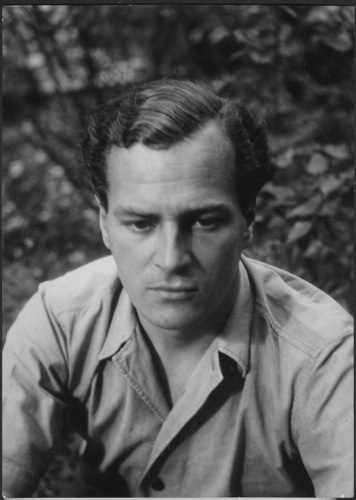
A Prince of the Road by Colin Thubron

This is a major essay about Paddy by his good friend Colin Thubron. Perhaps worth printing and reading at your leisure.

Use the Print Friendly facility. Print Friendly and PDF

by Colin Thubron

First published in the New York Review of Books, January 17 2008.

To suggest that Patrick Leigh Fermor is the greatest travel writer alive is to omit a great deal. In Britain and Greece he is a near legend, celebrated not only for his books but for his wartime exploits as a guerrilla leader in occupied Crete, where his abduction of a German general has passed into folklore. He is, perhaps, the last of a breed of writer-travelers whose reputation has an aura of genuine action and courage.

The qualities suited to the travel writer’s trade have always been contradictory. The mental (and physical) robustness necessary for ambitious travel often excludes the sensitivity to record it, and vice versa. So there are travelers who write, and writers who travel—and they rarely converge in the same person.

In Leigh Fermor, they do. The richness of his prose, his polymathic exuberance, and his cultural allusiveness render him less immediately accessible than some of his contemporaries, such as Peter Fleming or Norman Lewis. But his six travel books—one for each decade of his adult life—have secured him a readership drawn to a voice that is omnivorous in its tastes and curiosity, learned without condescension, cultivated but never effete, curiously innocent, occasionally swanky, infectiously joyous. If he is less known in the United States than he is in Britain, it is because Leigh Fermor is deeply European.

His reputation rests, above all, on two pairs of books—about his youthful walk across pre-war Europe, published in 1977 and 1986—and about Greece, published in 1958 and 1966. But then there is A Time to Keep Silence. In the oeuvre of a traveler whose books are full of worldly curiosity, this short reflection on the monastic life sits like a troubled question mark. First published in Britain in 1953, it now appears in the US for the first time. In less than a hundred pages it records the author’s stay in the ancient French monasteries of St. Wandrille, Solesmes, and La Grande Trappe, with a brief excursion to the deserted Byzantine chapels of Cappadocian Turkey.

Yet there are readers for whom A Time to Keep Silence is Leigh Fermor’s finest—if most uncharacteristically elusive—book. In her introduction, the religious historian (and ex-nun) Karen Armstrong writes:

The monks’ monotonous way of life has been deliberately designed to protect them from the distractions of, and the lust for, novelty: they do the same things day after day; they dress alike and shun individuality and personal style. They keep almost perpetual silence….

Nothing could be more antipathetic to everything that Leigh Fermor’s books project and embrace. His persona as a writer brims with “individuality and personal style.” So, of course, does his prose. He is famously gregarious, and a dazzling raconteur. For a traveler so tough, his books are rich in pleasures: in leisure, in wine, in company. History and landscape bring a visceral exhilaration.

In 1952, aged thirty-seven, Leigh Fermor arrived at the Benedictine abbey of St. Wandrille de Fontenelle, near Rouen, in quest not of religious retreat but of somewhere cheap and quiet in which to write his first book, on the Caribbean. The regimen of the monastery—the bloodless gloom of Vespers, the sepulchral mealtime recitations while the monks ate in silence—filled him at first with revulsion:

As I sat at Vespers watching them, now cowled, now uncovered, according to the progress of the liturgy, they appeared preternaturally pale, some of them nearly green. The bone-structure of their faces lay nearly always close beneath the surface. But, though a deep hollow often accentuated the shadow under the cheekbone, their faces were virtually without a wrinkle, and it was this creaseless haggardness that made their faces so distinct from any others. How different, I thought, from the fierce, whiskered, brigand-faces of the Greek monks of Athos or the Meteora, whose eyes smoulder and flash and twinkle under brows that are always tied up in knots of rage or laughter or concentration or suddenly relaxed into bland, Olympian benevolence.

There is no doubt about where Leigh Fermor’s sympathies lay. As for writing, he retired to his cell on the first day in the quiet, and picked up his pen:

But an hour passed, and nothing happened. It began to rain over the woods outside, and a mood of depression and of unspeakable loneliness suddenly felled me like a hammer-stroke.

For three or four days, little changed. He was prey to insomnia and a flat depression. Then he started to sleep. He slept until a few meals and church services a day were his only lucid moments. Then the pattern changed again. His lassitude dwindled away and was succeeded by a “limpid freshness.” He now slept only five hours in twenty-four. It was as if a profound tiredness, rooted in the outside world with its demands on nervous libido and instant response, had overswept him, then receded in this quietude to release a flood of unimpeded energy. “Even the major causes of guilt and anxiety had slid away.”

From the monastery’s library—a magnificent repository of the sacred and secular—he was able to borrow even those heretical books placed on the index or locked in the depository (named the Enfer) as destructive of monastic calm. And as he grew to know them, the monks became, to his charitable and indulgent mind, almost uniformly attractive.

Moving on, he was delayed only two weeks by the abbey of Solesmes, guardian of early Church music, before he reached the great Cistercian monastery of La Grande Trappe in southern Normandy. Among this grimly disciplined and silent order, the cycle that Leigh Fermor had experienced in St. Wandrille—the same tension between tenderness and revulsion—repeated itself more gently. Here the Benedictine dedication to the efficacy of prayer was reinforced by a notion of ferocious penance:

A Trappist monk rises at one or two in the morning according to the season. Seven hours of his day are spent in church, singing the offices, kneeling or standing in silent meditation, often in the dark…. There are no cells. All, from the Abbot downwards, sleep in cubicles in a dormitory on palliasses of straw stretched out on bare planks. Heating does not exist…. A special deaf and dumb language for cases of necessity has been evolved and codified, and the entire lifetime of a lay-brother, who does not participate in the singing of the offices, may pass without the uttering of a word beyond the confessional or his spiritual consultations with the Abbot. A monk on the point of death is removed from his infirmary bed and laid across a bed of straw which is scattered over a cross of ashes. There, after the last ghostly comforts in the presence of the assembled monks, he expires. His body is exposed for a while in the church. No coffin is used at his burial; his face is covered by his hood, and he is lowered into his grave with his habit folded about him.

A Time to Keep Silence evolved, sometimes word for word, from the letters written to Leigh Fermor’s future wife from these brief sojourns in monastic cells. They are touched by the unease of the doubter or atheist (he is never specific) who has intruded into the midst of pious conviction, and by his subsequent gratitude for the monks’ discretion which allowed him to escape any awkward challenge.

But for all the revolution in his feelings—and his brief excursions into the nature of prayer or temptation—it is less the inner journey than Leigh Fermor’s descriptions of monastic life that linger in the memory. He is a master of externals. The somber glamour of ritual and the drama of architecture rise naturally to his pen. In Roumeli, his book on northern Greece, he celebrates the pinnacle monasteries of Meteora with a gusto more immediate to him than the arcane inner lives of the sober monks of Normandy. His brief chapter on the rock chapels of Cappadocia, with which A Time to Keep Silence ends, relaxes into descriptive ease as it portrays a hermit city redolent of the dawn of monastic Christendom, whose human inhabitants have long gone.

Leigh Fermor’s sumptuous and sometimes complicated style has won him many admirers, barely one successful imitator, and a handful of disgruntled critics. When he writes that the quietude of St. Wandrille and his limited contact with the monks “compelled me again and again to seek my parallels in painting,” it sounds less like a limitation than a joyful release. The memory of Old Masters is never far away. In the muted light by which they worship, the monks evoke the canvases of Zurbarán and El Greco. The towering pinnacles of Solesmes remind him of the Rhenish castles of Gustave Doré and Victor Hugo. The wintry landscapes around La Trappe blend with those of Breughel and Bosch.

Sound itself turns visual. Leigh Fermor, in an act of nostalgic remembrance, conjures the ruined English abbeys lifting up their broken arches and emptied rose-windows “as though some tremendous Gregorian chant had been interrupted hundreds of years ago to hang there petrified at its climax ever since”; and the complex chanting of the conventual High Mass elicits an image of the Gregorian notation—with its comet tails and arabesques—printed in the monks’ missals.

These stylistic flourishes would be woeful in lesser hands. But with Leigh Fermor they rarely fail. His early models include Alexander William Kinglake and Norman Douglas, but most potent perhaps was the influence of his precocious near-contemporary, Robert Byron, who died at sea in 1941, and who in The Road to Oxiana, an account of travel in Persia and Afghanistan, interleaved humorous vignettes with some of the most precise and beautiful architectural descriptions in the language. Continue reading

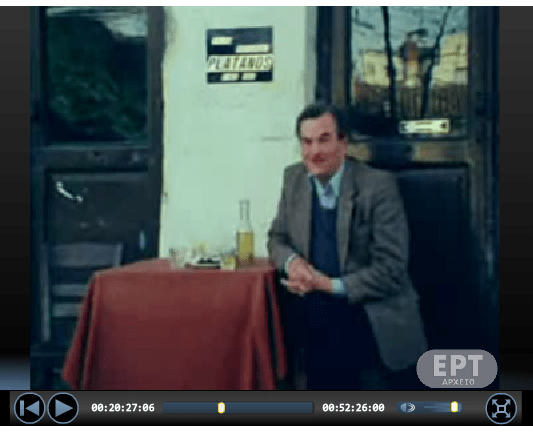
George Katsimbalis documentary Part 1 – by the Acropolis and at the bar

Paddy in a Greek TV documentary about his friend George Katsimbalis. Paddy visits a bar and sings a French song.

My thanks again to Nicolas Paissios for sending me this – and there is one more to come 🙂

Click the image to play.

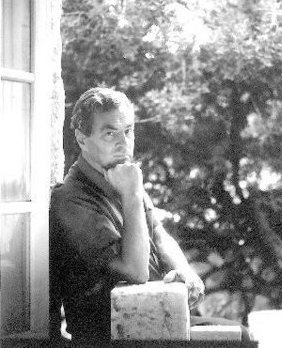
Patrick Leigh Fermor: A Personal Memoir

One of the downsides of getting older – I am now 62 – is that one’s friends die. Friday, it was the turn of Patrick Leigh Fermor, aged ninety-six, and I am having trouble accepting that he is gone.

By Paul A. Rahe

First published in Ricochet on 12 June 2011.

I first met Paddy in the summer of 1983. I was working then – oddly enough, as I am working right now – on a book on classical Sparta, and I had a grant and a hunch. The Spartan way of life was based on something like slave labor. The Spartans ruled the southernmost two-fifths of the Peloponnesus and drew their livelihood from farms worked by their helots (the word in Greek means captives), who reportedly outnumbered them seven-to-one. In their realm, there were and are two river valleys – one in Laconia and the other in Messenia – divided by a mountain range named Taygetus, and there was and is mountainous terrain elsewhere in Messenia. I had read extensively about the history of slavery, and I was persuaded that there must have been gangs of runaway helots in the hills of Messenia, as there later were in early modern Jamaica and in other locales where servile labor was the norm and there was wilderness nearby. I knew that the Greek resistance during the Second World War had operated in the mountainous country of northern Greece, but I knew little about their operations in the Peloponnesus. A fellow ancient historian who had lived in Greece for some years and had tried to make it as a novelist said to me, when he heard of my hunch, “You ought to talk to Paddy Leigh Fermor. He lives down there, and he fought with the resistance on Crete. He lives in Kardamyle. You should look him up.”

And that is precisely what I did. With the grant I had been given, I bought a plane ticket, and I spent some weeks in the company of a former student who hailed from Thessalonica, exploring the Peloponnesus – by boat, in a rental car, and on foot. Kardamyle was in the Mani – the southernmost prong of the Taygetus range, and it was one of the towns that Agamemnon had offered Achilles in an attempt to get him to take the girl back. When we got there, however, Paddy was away. So I mailed him a brief note and moved on. When we returned, I telephoned him – and he immediately invited the two of us to lunch.

Leyla, who had long been their cook, produced a sumptuous feast. We ate, and we drank, and then we drank some more – and the next thing we knew it was 5 p.m. Paddy and Joan, fearful that we were too intoxicated to successfully traverse the half-mile on foot back to Kardamyle, offered us beds. It was one of the most delightful afternoons that I have ever spent. The historian and journalist Max Hasting has observed that Paddy was “perhaps the most brilliant conversationalist of his time.” Never have I encountered anyone as entertaining.

Paddy was – there is no other word for it – a hero. He lived the strenuous life. There was in him an exuberance that could not be contained. Christopher Marlowe, who was of a similar temperament, managed to make it through the King’s School in Canterbury, but Paddy did not. There was some hanky-panky with the daughter of a greengrocer, but that cannot have been the whole story. “He is a dangerous mixture of sophistication and recklessness,” his housemaster wrote in an official report, “which makes one anxious about his influence on other boys.” I would have been anxious myself.

Not long thereafter, with the support of his mother, who mailed him a fiver from time to time, Paddy set out in December, 1933 by ship for the Hook of Holland – and walked from there to Constantinople and on to Mount Athos and its monasteries. It took him more a year, and you can read about his adventures in two of the books that he later published – A Time of Gifts (1978) and Between the Woods and the Water (1986) – which together constitute what the Germans call a Bildungsroman. In those volumes, you will encounter a world of peasants and aristocrats, of socialists and fascists that no longer exists.

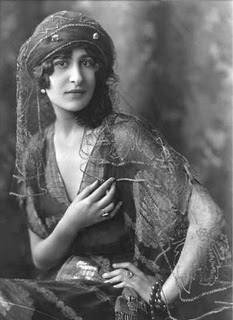
Balasha Cantacuzene

On that journey, Paddy met an older woman. He was nineteen. She was married and thirty-one. You can find a description of the beginning their affair in the second of the two volumes mentioned above. Her name was Bălaşa Cantacuzino, and she was a Romanian princess descended from the Byzantine royal house. When his trip was over, they settled down together, oscillating between Athens and at her country house in Moldavia. Then came the Second World War, and he volunteered for the British army. The two would not meet again until after the fall of Nicolae Ceaușescu in 1989.

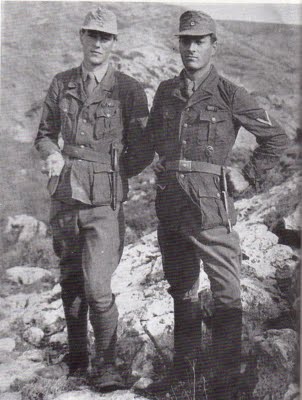
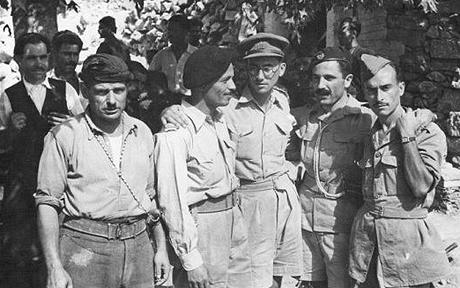
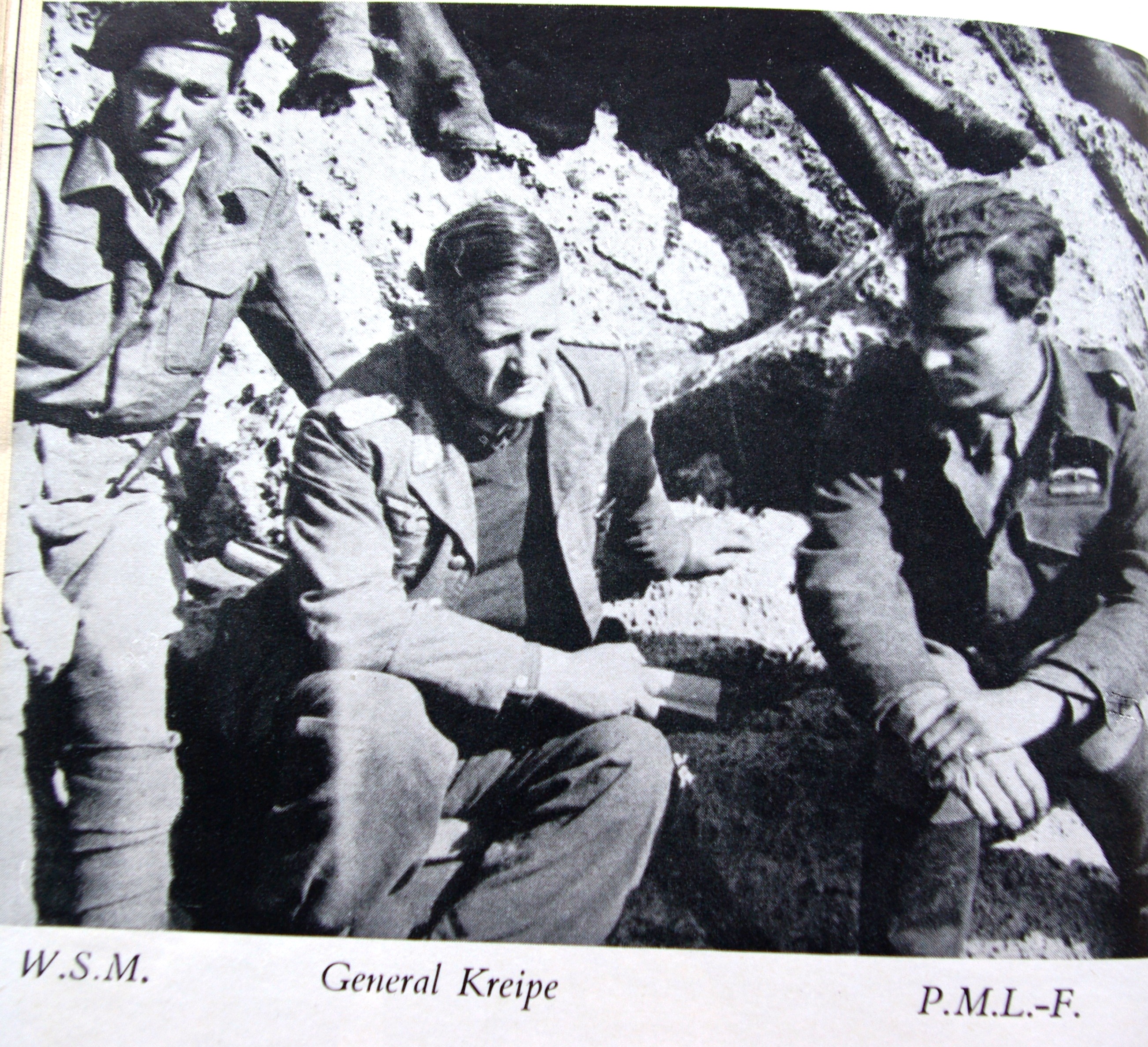
During the war, Paddy fought in Albania, Greece, and on Crete. After being evacuated to Cairo, he joined the Special Operations Executive and spent much of the remainder of the war running guerrilla operations in the mountains of Crete. He left the island in May, 1944 under truly exceptional circumstances. On 26 April 1944, on a bet made with friends back in Cairo, Paddy, W. Stanley Moss, and a group of Cretan shepherds kidnapped General Karl Heinrich Georg Ferdinand Kreipe, the German commander on the island.

The two Englishmen dressed up as German police corporals and stopped Kreipe’s car as he was making his way back one evening to his villa near Knossos. Having eliminated the chauffeur, Paddy put on the general’s hat, and Billy Moss drove the car. Kreipe was hidden beneath the back seat – on which three hefty Cretan andartes sat. They then bluffed their way through Heraklion and an addition twenty-two checkpoints before ditching the car and hiking into the mountains – where, for three weeks, they evaded German search parties before being picked up by a British motor launch on the south coast.

At one point, as they neared the top of Mount Ida at the break of dawn, Kreipe quoted the first line of Horace’s ode Ad Thaliarchum – “Vides ut alta stet nive candidum Soracte” (See how Soracte stands white with snow on high), and Paddy finished the poem to its end. “At least,” the general remarked, “I am in the hands of gentlemen.” In the days that followed, before they were evacuated to Cairo, the two discussed Greek tragedy and Latin poetry. In 1972, they would meet again in Athens to tape a television show. Afterwards, Paddy once told me, they went out to dinner and sang old German drinking songs. Well before that time, however, Billy Moss had published a book on the incident entitled Ill Met by Moonlight, and Michael Powell had made a movie with the same name in which Dirke Bogarde was cast as Paddy.

Before the war, Paddy had begun his literary career with a translation of of CP Rodocanachi’s novel Forever Ulysses (1938). Afterwards, he began to write books of his own. The first of these was a travel book, focused on the West Indies and entitled The Traveller’s Tree (1950). It won the Heinemann Foundation Prize for Literature. Soon thereafter he published a novel set in Martinique entitled The Violins of Saint-Jacques (1953), which was turned into an opera by Malcolm Williamson; a meditation on monasticism entitled A Time to Keep Silence (1957); and two travel books focused on two of the wilder regions of Greece: Mani (1958) and Roumeli (1966). That all of these remain in print is no surprise. Five years ago, Paddy was described to me by an Oxford don as the greatest living master of English prose.

In 1984, I was offered by the Institute of Current World Affairs a fellowship two years in length, which would take me to Greece, Turkey, and Cyprus, and I jumped at the chance to situate myself in Istanbul (where I lived in the neighborhood in which Claire Berlinski now resides) and to explore the landscape and experience the seasons in the world within which the ancient Greeks had made their home. I spent most of my time in Turkey, exploring its nooks and crannies and writing long newsletters about contemporary affairs. From time to time, however, I hopped a plane to Greece, interviewed various figures in Athens, and partied with some journalists I knew (Robert Kaplan was based in Athens in those days).

On those occasions, I always took a bus to Kardamyle and spent a few days with Paddy and Joan. Their house, which Paddy had designed himself, was built out of stone and situated on a bluff overlooking the sea. We rose when we chose, ate breakfast separately, and Paddy put pen to paper while Joan saw to the management of the establishment – and I read a novel, a travel book, or something pertinent to the composition of my first book Republics Ancient and Modern (which Paddy would later review for the Christmas books section of The Spectator).

After lunch, where we drank a considerable amount of wine, we would nap. Then, we would go back to work, and, at about 5 p.m., Paddy and I would head off for an extended walk in the mountains. He was about seventy at the time, but he was astonishingly vigorous. Every day he would go for a long swim, disappearing into the drink and reappearing a half hour later. On his seventieth birthday, he swam the Hellespont – something that very few men half that age could manage. (I know. I watched from a motor launch once while a thirty-something friend gave it a try).

Before dinner, there were drinks. “C’est le moment,” Paddy would say, quoting Victor Hugo, “quand les lions vont boire.” Dinner itself was a feast, and it often ended with the singing of songs. Paddy taught me The Foggy, Foggy Dew, and I taught him They Call the Wind Maria. After a week or so, I would take the bus back to Athens and head on to Greek Cyprus or back to Istanbul. On one such occasion, I carried to the British embassy the manuscript of Between the Woods and the Water. From there, I gather, it was sent on by diplomatic pouch to Paddy’s publisher in London. He had served his country well, and his compatriots took good care of him. He was offered a knighthood in 1991 and finally accepted one in 2004.

In the 1990s, when I came to Greece in the summer, I would fly in to the Athens international airport, and then I would generally take a bus across to the domestic airport, go up to the counter, look over the available flights, and book a ticket for an island that I had never visited. Then, after a week or so on, say, Paros, I would go down to the harbor and catch whatever boat there happened to be – for Lemnos or Andros or some other unfamiliar spot. Eventually, after having spent three or four weeks exploring, I would return to Athens and go down to the Mani to see Paddy and Joan. The routine in Kardamyle was the same – except that, towards the end of the millennium, Paddy was less able to hike in the mountains.

After I got married, there was less traveling. In 2003, however, I did manage to see Paddy in England at their country house in Gloucestershire (Joan was the daughter of a Viscount). Ours was a subdued lunch. Joan had died at the age of ninety-one in Kardamyle hardly more than a week before. I last saw him in Kardamyle in March, 2006. I had spent Michaelmas and Hilary Terms as a Visiting Fellow at All Souls College, Oxford, and I was about to take up a similar fellowship at the American Academy in Berlin. There were, however, two weeks in which we had no place to call our own. So my wife, our daughters, and I flew to Greece, rented a car, and, after a brief visit to Athens, headed to Delphi and on from there to the Peloponnesus – where we stopped at Olympia, the Apollo Temple at Vassae, Mycenae, and other sights. I tried to call Paddy, but the Greeks had added a digit to the old number, and I could not figure it out. So we drove to Kardamyle and then out to his house on the outskirts of town, and I rang the bell.

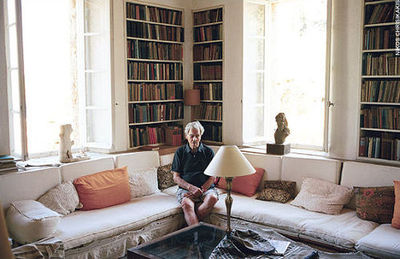
Paddy at home

And there he was – older, quite a bit slower in his gait, but very much himself. “Paul Rahe,” he said. “I don’t believe my eyes. Come in, my dear boy.” And when I mentioned my family, his response was immediate: “Bring them in. You can all stay here.” And so we did. That night we took him to dinner at the restaurant in town that Leyla now runs, and we sat up late talking and drinking. His eyesight was not good. He had glaucoma and in the candlelight at one point was not sure that we were still there. He had had a heart attack and had a pacemaker. He could hardly walk up the drive to the highway. But there was still a twinkle in his eye, and he was as alive as ever.

He was also writing, and in his nineties, after decades of resistance, he had actually learned how to type (no one could read his handwriting). A Time of Gifts and Between the Woods and the Water were intended to be the first two parts of a trilogy. With the third part, he had had a terrible time. After 1989, he had returned to Roumania and Bulgaria to retrace his steps, and it was not as he remembered it. When I visited in the 1990s, I would ask about the third volume, and Joan would pull me aside and tell me not to mention it. “He is having trouble with it. He is very frustrated. That trip back to review his path robbed him of the confidence he had in his memory,” she once said.

When I saw Paddy in 2006, however, he was halfway done with the manuscript, and he was going over it to look for things that could be cut. I gather that somewhere in the house at Kardamyle there is a manuscript and that on the cover it reads “Volume Three.” I wonder what he called it. That last night just over five years ago, he, my wife, and I tried to come up with a title, and we could not think of anything satisfactory.

If and when the third volume of his trilogy does come out, I will buy a copy. Reading it will, I am confident, bring back the man. His other books do. I doubt, however, whether I will ever meet the like again – and that I very much regret. Perhaps the biography that Artemis Cooper is writing will relieve my gloom.

Tales of a literary traveller: Sir Patrick Leigh Fermor

I have been amiss and I should have published this earlier. I was contacted by John Stathatos who is a Greek photographer and knows Paddy. He emailed me back in January which was during my ‘down time’ on the blog.
Dear Tom,
While chasing up references to Costa, I discovered that the Robin Hanbury-Tenison piece on your site (“The Friendly Isles: in the Footsteps of Patrick Leigh Fermor“) is actually based on an earlier and more wide-ranging article entitled “Tales of a Literary Traveller”, first published in the Geographical magazine in 2004. You can find the earlier one here: Why this should be available on a site called CBS MoneyWatch is entirely beyond me, but that’s the Internet for you…
All the best,
John

Tales of a literary traveller: Sir Patrick Leigh Fermor DSO, OBE is widely considered to be our greatest living travel writer, and was knighted earlier this year for, as he put it, just writing a few books. Robin Hanbury-Tenison, who has known ‘Paddy’ for 50 years, explains why the great man’s writing is as powerful and important today as it has ever been

First published in the Geographical August 2004

by  Robin Hanbury-Tenison

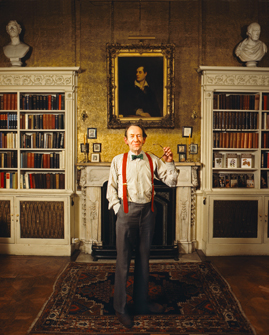
Robin Hanbury-Tenison

Patrick Leigh Fermor is a unique mixture of hero, historian, traveller and writer: the last and the greatest of a generation whose like we won’t see again. Bringing the landscape alive as no other writer can, he uses his profound and eclectic understanding of cultures and peoples, their origins and current place in the world, to paint vivid pictures–nobody has illuminated the geography of Europe better through literature. Everything is grist to his mill; nothing is ever banal. He expects much of his readers and we’re kept on our toes, constantly reaching for the dictionary or Brewer’s. In return for these achievements, he was finally knighted this year at the age of 88. He had modestly refused this honour previously on the grounds that all he had done was “write a few books”.

I first met Paddy (as he has always been known) in Athens in 1954 when I was a callow 18-year-old travelling through Greece. I remember sitting at a cafe in Metaxas Square while waves of witty erudition washed back and forth between him and my older travelling companion, and being humbled into awed silence. Paddy has always appeared larger than life, both in his personality and in his relatively rare and carefully honed writing. We corresponded from time to time over the years and eventually met again when he and his wife Joan had my wife and me to lunch at their house in Greece, where we were made to feel instantly at home.

Since Joan’s death, Paddy has spent more time in England, which gives us all more opportunity to see him. In May this year, a dinner was held for him by the Travellers Club, at which he was presented with a specially commissioned map of the route that he followed through Europe during the early 1930s and that he later wrote about so vividly. He spoke at the dinner and, now 89, held us all spellbound with some classic tales. One of the club waitresses was from Sofia and, to her delight and the amazement of all around, he launched into apparently fluent Bulgarian as she served him.

The bare details of his life, too, delight and amaze. The son of Sir Lewis Leigh Ferrnor, the director of the Geological Survey of India, Paddy was sacked at 17 from King’s School, Canterbury (for the terrible crime of “holding hands with the greengrocer’s daughter”), and spent the next 18 months walking to Constantinople, a journey that he wrote about with apparent total recall some 40 years later in A Time of Gifts, the first volume of a trilogy. It was followed by Between the Woods and the Water. We still await the final volume.

In the Second World War, Paddy served with the Special Operations Executive–the precursor of the SAS–and, because he spoke Greek, was parachuted into Crete behind enemy lines to help organise resistance against the Germans. In April 1944, having already spent more than a year living there, he pulled off one of the most dramatic exploits of the war.

Dressed as Feldpolizei corporals, Paddy and Captain Billy Moss–who subsequently wrote the book on which the film Ill Met by Moonlight was based–stopped the car in which General Heinrich Kreipe, the recently arrived commander of the German occupation forces, was being driven by his chauffeur. The driver was removed and handed over to members of the Cretan Resistance, while Paddy put on the general’s hat and proceeded to drive on through 22 control posts. The car was then abandoned, and the two soldiers marched their prisoner through that night and the next day to a cave high in the mountains.

In order to avoid reprisals against the Cretans, leaflets were to be dropped all over Crete, containing a message that the BBC also broadcast: that the general was safe, and would be treated with the respect due his rank; that the operation had been carried out by British officers; and that they were all on their way to Cairo by submarine. Two days later, they woke among some rocks near the summit of Mount Ida, just as dawn was breaking. Half to himself, General Kreipe recited in Latin the opening line of a Horace ode. As Paddy subsequently described in his report to the Imperial War Museum: “He was in luck. It is the opening line of one of the few odes of Horace I know by heart–Ad Thaliarchum, I.ix” and he went on to recite the remaining five stanzas. “The general’s blue eyes swivelled away from the mountain-top to mine–and when I’d finished, after a long silence, he said: ‘Ach so, Herr Major!’ It was very strange. ‘Ja, Herr General.’ As though, for a long moment, the war had ceased to exist. We had both drunk at the same fountains long before; and things were different between us for the rest of our time together.”

After the war, Paddy spent six months travelling through the Caribbean with Joan Eyres-Monsell–the woman who, 20 years later, was to become his wife–and Costa, the great Greek photographer. The result was his first book, The Traveller’s Tree, which brought the Caribbean to the notice of post-war Britain. Back then, the many islands they visited were thoroughly run down. The great buildings–of church, state and planters’ wealth–were mostly ruined and rotten. In the depressed economic climate immediately following the war, the future looked bleak; indeed, ‘King Sugar’ was about to die, this time as a victim of sugar beet and the macropolitics being played out between the USA and Europe.

Yet Paddy still managed to reveal the archipelago’s romance and magic, and The Traveller’s Tree was hailed as a masterpiece and won the Heinemann Prize. Paddy’s portrayal of the islands could be said to have jump-started the tourism industry upon which the Caribbean has since largely depended.

It was the Caribbean, too, that provided the backdrop to Paddy’s only novel, The Violins of Saint-Jacques, which brings alive the glamour and the passions of the planters in their heyday. This tale of a rich island being destroyed by a volcanic eruption in the middle of a splendid planters’ ball is based on the true story of the annihilation in 1902 of St-Pierre, the old capital of Martinique. There, 26,000 people died instantly in the New World’s Pompeii. The sole survivor was the town drunk, who was incarcerated in a cell below ground. He spent the rest of his life as an exhibit in Barnum and Bailey’s Circus.

Paddy eventually returned to Greece, where, during the 1960s, he built a wonderful house above a private cove near the fishing village of Kardamili in the southern Peloponnese. There, in a large room that John Betjeman, an early visitor, called “one of the rooms in the world”, he and Joan entertained a string of artists and writers with copious quantities of retsina, and Paddy wrote.

His greatest book, Mani, was about a journey through that little-known and, at the time, archaic region; the book has been in print ever since. Paddy travelled simply, staying with fishermen and farmers, which enabled him to capture the essence of the region, as this extract reveals:

Beyond the bars of my window the towers descended, their walls blazoned with diagonals of light and shade; and, through a wide gap, castellated villages were poised above the sea on coils of terraces. Through another gap our host’s second daughter, wide hatted and perched on the back of a wooden sledge and grasping three reins, was sliding round a threshing floor behind a horse, a mule and a cow–the first cow I had seen in the Mani–all of them linked in a triple yoke. On a bank above this busy stone disc, the rest of the family were flinging wooden shovelfuls of wheat in the air for the grain to fall on outstretched coloured blankets while the husks drifted away. Others shook large sieves. The sun which climbed behind them outlined this group with a rim of gold and each time a winnower sent up his great fan, for long seconds the floating chaff embowered him in a golden mist.

Almost every page has its own literary tour de force, often with intimidating displays of learning and research mixed with fantasy, imagination and acute descriptions of the scene itself. In his next book, Roumeli, about the minority communities of northern Greece, Paddy becomes fascinated by the last true nomads of the region, the Sarakatsans. His description of their wanderings is, for me, the best sort of literary geography lesson, and has even more geopolitical relevance now than when he wrote it:

The sudden cage of frontiers which sprang up after the Balkan Wars failed to confine them and they fanned out in autumn all over southern Albania and across the lower marches of Serbia as far as Montenegro and Herzogovina and Bosnia and into Bulgaria to the foothills of the Great Balkan. Those who thought of the Rhodope mountains as their home–the very ones, indeed, in the highlands that loom above the Thracian plains–were particularly bold in the extent of their winter wanderings. Not only did they strike northwards, like those I saw by the Black Sea, but, before the Hebrus river became an inviolable barrier, their caravans reached Constantinople and up went their wigwams under the walls of Theodosius. Others settled along the shores of the Sea of Marmara and spread over the rich green hills of the Dardanelles. Many crossed the Hellespont to pitch camp on the plain of Troy. Bold nomads would continue to the meadows of Bythinia and winter among the poplar trees or push on into Cappadocia and scatter their flocks across the volcanic wildernesses round the rock monasteries of Urgub. The boldest even reached Iconium, the home of Jellalludin and the metropolis of the whirling dervishes. They never looked on these enormous journeys as expatriation: until the deracination of the 1920s, much of Asia Minor was part of the Greek world; and even beyond its confines there were ancient Greek colonies.

Those attempting today to sort out the chaos in what was, for a while, southern Yugoslavia could learn a lot from reading Paddy’s books.

One of the main criticisms of Paddy’s writing is that there simply isn’t enough of it. But very few 20th-century writers, with perhaps the exception of Graham Greene, have managed to be prolific while maintaining consistent quality of this kind. The relatively small number of books (much boosted by the release of the paperback of Words of Mercury this mouth) is the work, to quote Anthony Sattin in the Sunday Times, of “one of the greatest travel writers of all time”, a heartfelt wanderer truly involved in mankind.

New editions of both Mani and Roumeli will be published by John Murray near the end of this year. A Time of Gifts and Between the Woods and the Water were reissued by John Murray in March. Words of Mercury is out now in paperback.

Early inspiration: Following Paddy around the Caribbean

Though Patrick Leigh Fermor’s most famous works recount his European travels, it was the Caribbean that inspired his first book. Fifty years later, Robin Hanbury-Tenison and his wife retraced Paddy’s steps:

We hired horses and rode, as Paddy did, between tall forest giants, listening to the jungle buzz and background twitterings. Suddenly, a beautiful, melodious note rang out. This was followed after o moment by three more notes of startling clarity and sweetness and the theme, a bit like the opening bars of Beethoven’s Fifth, was repeated every few minutes. It was a rufous-throated solitaire, which Leigh Fermor describes as making “a noise so melancholy that it seemed the perfect emanation of these sad and beautiful forests. It haunts the high woods of Dominica and nowhere else in the world.”

How does everything about a place change in 50 years, and yet the place itself remain the same? It is because of that unique mixture of cultures that is the Caribbean–and no-one has captured and evoked the extraordinary differences between the islands better than Paddy did in The Traveller’s Tree. Ash says: “Each island is a distinct and idiosyncratic entity, a civilisation, or the reverse, fortuitous in its origins and empirical in its development. “And then again, quoting an old Jamaican: “We’re always going somewhere. But we never get there.”

Patrick Leigh Fermor, however, not only travelled but also arrived. And those of us who read his dispatches home–those calm, intelligent tales of lives lived elsewhere–are in his debt.

Obituary: Jock Murray

Jock Murray in 1983 (Mercer photography)

by Patrick Leigh Fermor

First published in The Independent 24 July 1993

John Arnaud Robin Grey (Jock Murray), publisher: born 23 September 1908; MBE 1945, CBE 1975; Senior Director, John Murray 1968-93; married 1939 Diana James (two sons, two daughters); died London 22 July 1993.

JOCK MURRAY took such trouble about his authors, and in so many ways, and so unobtrusively, that perhaps they – or we , for I am one of them – were inclined to take it for granted, writes Patrick Leigh Fermor. But not quite: other publishers at home or abroad – not that I know much about them as I have only had one – would remind us now and then of our luck and our spoiled and privileged estate. This was because of Jock’s passionate interest in the work of his authors, his great kindness, and his gift for friendship. Nobody, in the Doctor Johnson sense, kept his friendships in a state of better repair.

It is hard to think of a more apt setting for him than No 50 Albemarle Street, with its beautiful rooms, and portraits and books and cases of mementoes, and its mixture of archaic style and informality, of activity and unhurried leisure. The traditions of Byron’s friendship with Jock Murray’s ancestor played a great part in the life of No 50, and the poet’s spirit seems to pervade those rooms. Looking through typescript, then galleys then page proofs there with Jock was a great delight. Especially when they were tossed aside to make room for tea or sherry or whisky and soda, and Osbert Lancaster on the way back from drawing his daily caricature would wander in full of marvellous gossip; or Kenneth Clark with an armful of illustrations or John Betjeman with news of a new Early English discovery in some remote Fenland parish – could they talk about it with John Piper? (Betjeman and Jock shared an expert knowledge of campanology.)

Cannon Lodge, halfway between Hampstead Heath and a slender steeple, with its Keats’-eye view of all London, had a similar uncontemporary charm. At the end of a day of last- minute corrections, under one of the tall trees, or by a blazing fire, any of the above might come to dinner, or Freya Strak fresh from Asia Minor, Ruth Jhabvala from Rajasthan or Dervla Murphy from the Andes and, very often, Jock and Diana’s favourite neighbour, Peggy Ashcroft.

Jock and Diana came several times to Greece and it was a great surprise to discover that Jock was an accomplished tree surgeon: one glance at an ailing growth would send him shinning up into the branches and putting things most knowledgeably to right with saw, twine, bast and tar.

Five weeks ago we were talking about the ravages of time that we noticed in ourselves and he said, halfway between a sigh and a laugh, ‘Yes. Old age is not for sissies.’ He confronted his own with great Stoicism, and leaves us all diminished.

Crete, Greece: Ghostly soldiers on the Battle of Crete anniversary

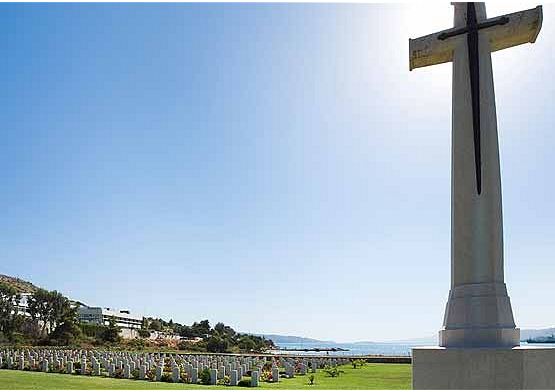
The Commonwealth War Cemetery at Souda Bay in Crete where the main anniversary commemorations will take place

It was sunny but cold, last month in Crete – what the locals call “ilios me dontia”, sun with teeth. I sat on the beach at Sfakia on the south coast of the island. Around me a toddler played among the stones while taverna owners were applying final licks of paint in preparation for the new tourist season.

My late father sat on the same beach in May 1941. Around him there was chaos and despair. Evelyn Waugh, who was there too, later captured the scene in the novel Officers and Gentlemen: “The ghosts of an army teemed everywhere. Some were quite apathetic, too weary to eat; others were smashing their rifles on the stones, taking a fierce relish in this symbolic farewell to their arms.”

This tiny harbour is the finish to the story of the Battle of Crete, which started 70 years ago on Friday, May 20 — a significant anniversary that will be commemorated across the island. There are few veterans left now, but strands of the narrative may still be picked up among the rocks and wild flowers of the beautiful western end of Crete.

I had long meant to do this journey, to discover what my father – and thousands of others – went through. He himself hadn’t been the best source as he wouldn’t say much about it. And then he died, with the story largely untold.
Related Articles

To help me uncover it, I enlisted the services of a Briton who has been a resident of Crete for 25 years and offers guided tours of the key sites. For Tim Powell, tourist guide, musician and lover of all things Cretan, the Battle of Crete was characterised by the heroic resistance of the civilian population. “This ‘insurgency’ led to a declaration that for every German soldier killed, 10 Cretans would be executed — which of course did nothing to stop them,” he said.

He started the story at the end, the Commonwealth War Cemetery at Souda Bay where the main anniversary commemorations will take place. The 1,500 headstones memorialise some colourful characters, none more vivid than John Pendlebury, an archaeologist with a glass eye who was operating in Crete as a secret agent when he was killed on May 22 1941.

The battle and its aftermath of guerrilla resistance threw up a cast of such chaps — suave British secret agents, brave Cretan warriors, even a monocle-wearing German aristocrat — whose deeds are recorded in some compelling accounts. Ill Met by Moonlight, for example, recounts the kidnap of the German General Heinrich Kreipe in 1944, masterminded by the secret agent (and future travel writer) Patrick Leigh Fermor.

But the Crete campaign also included many ordinary soldiers and civilians whose names and actions remain unrecorded and for whom the experience was far from glamorous. One of them was my father, a lance sergeant in the Northumberland Hussars, who was evacuated to Crete from Athens towards the end of April 1941 after mainland Greece fell to the Nazis.

He dug in with a force of about 21,000 combat-ready British, Australian, New Zealand and Cretan soldiers to defend the island. The Germans launched their attack on May 20 in wave after wave of paratroop drops by parachute and glider. What followed was a series of military blunders on both sides in which the Allies managed to snatch defeat from the jaws of victory.

The key fighting took place around the airfield at Maleme, and Hill 107 above it, to the west of Chania. Since 1974 Hill 107 has been the site of the German War Cemetery on Crete, the last resting place of 4,465 soldiers of whom nearly 2,000 were killed on that first day.

Many fell not to soldiers but to civilians. “The Germans had never seen something like this in Europe,” explained George Bikoyiannakis, the owner of the Café Plateia in the village of Galatas near Chania, the site of fierce fighting. “These people were fighting with farming tools. Even broomsticks. They would tie kitchen knives to them and use them as spears.”

George runs a little museum next to the church that commemorates the heroic efforts of locals and New Zealanders to defend the village. The Kiwis are remembered in the name of a street, Neozilandon Polemiston, which means “Road of the New Zealand Warriors”. Down a narrow alley, a garden gate has been fashioned from an old piece of British Matilda tank.

The civilian resistance — by women and priests and as well as men young and old — offended the Nazis’ sense of how war should be waged and their commander, General Kurt Student, ordered reprisals to be carried out “with exemplary terror”. The sites of these massacres are marked by monuments across the island, some of them displaying the skulls and bones of victims behind glass.

At Alikianos a marble column and canopy bear witness to one of the bravest feats of the Battle of Crete, in which 850 lads of the locally recruited 8th Greek Regiment held out for a week against German onslaught. More than 200 villagers, ranging in age from 14 to 80, were subsequently shot in reprisal.

“The Germans were surprised because the women didn’t turn away,” said Powell. “They watched their husbands and sons being executed.” The significance of the action at Alikianos is that it bought the Allies time to organise the evacuation of Crete. On May 27, realising the island was lost, the Allied commander, Major General Bernard Freyberg, ordered his forces to retreat south across the Levka Ori, the mountains that form the snowy spine of Crete, to an embarkation point on the southern coast.

My father and his fellow Geordies abandoned the ground they held around Chania and joined the exodus. The route they took, with little or no food, in rotting boots, under frequent attack from Stuka dive bombers, was nicknamed the Via Dolorosa. Today you can drive it in your little Nissan or Peugeot hire car.

In 1941 it was a dirt track that ended in the five-mile-long Imbros Gorge. A Stuka was shot down as it came in for the attack here. Its propeller is one of the prize exhibits in the war museum at Askifou, which lies on the Via Dolorosa. Walking the gorge myself, I tried to imagine the Stuka screech my father once remarked on, but all I could hear was goat bells.

His reward for reaching Sfakia, where Royal Navy ships evacuated 16,000 men over four nights, was to be told there was no room for him. He would have to stay behind and wait to be captured. All told, 5,000 Allied troops didn’t make it off Crete. None of those left behind was above the rank of lieutenant colonel.

One eyewitness talked of the “damnable and disgraceful scramble for priority, a claim to the privilege of escape based on rank and seniority”. Evelyn Waugh thought it a shameful episode. My father didn’t mention it.

After sitting on the beach at Sfakia I sat down for lunch at one of those spruced-up tavernas and ordered a plate of gigantes, butterbeans in tomato sauce. Then I remembered that butterbeans were my father’s favourite thing to eat. He would have appreciated a plateful as he sat twiddling his thumbs just a few feet away, waiting to be captured.

He spent the next four years, from the ages of 20 to 24, in various POW camps in Germany, but he took it all on the chin. The only bit I can remember him grumbling about was having to march the 50 miles back over the mountains, along the Via Dolorosa, after being taken prisoner. He said he could have done without that.

By Nigel Richardson – First published in The Telegraph

Related articles:

A Meeting between Paddy and George Psychoundakis the “Cretan Runner”

Ride of the Valkyries: The Vichy perspective on the German invasion of Crete

Patrick Leigh Fermor recounts the kidnap of General Kreipe on video

Crete: 11th Day Movie with Paddy

Debbo on CBC’s Sunday Edition Programme

If you can’t get enough of this most amazing woman, here is an interview conducted by Michael Enright, an accomplished journalist and broadcaster. He reveals that he once posted a letter to Debbo as a favour to her sister Decca. We may have heard some of the anecdotes before, but there are some new ones including the story of Lady Redesdale visiting Diana Mosley when she spent time at His Majesty’s pleasure in Holloway prison.


Nothing about Paddy in this one. Click on the image to play. The interview starts at minute 24 and 30 seconds. Once the programme loads drag the cursor to that point and it should bufffer very quickly.

The Duchess of Devonshire talks about Patrick Leigh Fermor

The Dowager Duchess of Devonshire, the youngest of the legendary Mitford sisters reminisces about her life and her correspondence with the charismatic Sir Patrick Leigh Fermor, considered to be the finest English travel writer of his generation. An evening filled with wit, eccentric characters, and a celebration of courage and friendship. Charlotte Mosley, her niece and editor, joins the Dowager Duchess in conversation.

This was filmed on November 10 2010 at the Frick Collection in New York to mark the US publication of In Tearing Haste and her new memoire, Wait for Me

Paddy is mentioned at the start and she discusses her friendship with him from minute 35

Lawrence Durrell and Patrick Leigh Fermor by Thos Henley

Some of you may recall an article I published by a young wandering minstrel, Thos Henley, about his visit to Paddy’s house (see here). Thos is a hard-working and aspiring musician who seems to have a happy life, perhaps somewhere on the Left Bank in Paris, entertaining the Parisians with his music and DJ talents. Recently Thos has completed a piece for the blog which contain excerpts about Lawrence Durrell and his meetings with Paddy.

by Thos Henley

These are all excerpts concerning Paddy from the book “Lawrence Durrell: A Biography” by Ian MacNiven about the life of Durrell the writer best known for his travel books and the infamous and epic romantic “Alexandrian Quartet”

After Lawrence Durrell is welcomed into Walter Smart’s social circle in Cairo he meets Paddy for the first time:

“Under tree in the Smarts’ garden in 1942 Larry met Patrick Leigh Fermor, and officer with the SOE who as a youth had walked from Holland to Romania, and the two talked far into the night.”

Now in living in Alexandria, Lawrence or Larry Durrell, who had recently published his first major novel ‘The Black Book’; would often have to travel into Cairo where he once again met up with Paddy and Xan:

“Closer to Larry’s old flat in Zamalek, Xan Fielding, transformed into an agent with the SOE, now camped intermittently at ‘Tara’, a mansion on Sharia Abou el Feda at the north end of Gezira Island. Patrick Leigh Fermor and William Stanley Moss had established Tara as the unofficial Cairo rest house of the SOE. Xan and Paddy had spent many months together ‘in caves and goat-folds’ on occupied Crete, and Xan had told Paddy about The Black Book and had regaled him with anecdotes about Larry  in Athens…

The men of Tara passed most of their time incognito in Crete, Greece, France or elsewhere, but when they hit Tara it was with months of back pay and a great deal of pent-up exuberance to spend. For a few weeks at least they could forget the German reprisals on Crete, the civil war that was shaping up in Greece, or the coming conflict between Tito’s Partisans and the royalists in Yugoslavia. Tara had many bedrooms, a grand ballroom with a parquet floor, and a piano borrowed from the Egyptian Officers’ Club. The resident spirit was the young Countess Sophie Tarnowska, separated from her husband. Among Larry’s familiars who were often found there were Ines Walter, remembered by Moss as ‘enormously décolletée, happy in the role of a Hungarian peasant’, and Alexis Ladas, ‘singing Phillidem’ and recovering from and appendectomy. Against heavy competition, Tara was arguably the site of the wildest parties held in the wartime Cairo. At one of these, Countess Tarnowska’s Polish friends shot out all the light-bulbs; at others, everything from gold balls to sofas were thrown from the windows; once King Farouk appeared with a case of champagne. Such happenings became almost the norm in wartime Egypt.

Paradoxically, Tara was also a place where some of the best literary conversation in Cairo was available. Paddy had been translating Villon, and the books that he and moss were later to take along on their seemingly suicidal but successful mission to kidnap General Kreipe, the Divisional Commander of Crete, indicate the range of their interests: Cellini, Donne, Sir Thomas Browne, Tolstoy, Marco Polo, Les Fleurs du Mal, Alice in Wonderland, Shakespeare.”

We catch up with Paddy and moss later on as Larry soaks up and contemplates the city of Alexandria, the two men are in Crete (McNiven also mentions Xan Fieldings capture and the help he received from the Polish SOE agent, Krystyna Skarbek):

“While Larry was experiencing the little death of Alexandria, his friend Paddy Leigh Fermor, together with William Stanley Moss, were confronting real death on Crete. Paddy had been parachuted into Crete on 4 February 1944, and Moss had followed him two months later. With the help of several bans of andartes, Cretan guerilla fighters, they kidnapped General Kriepe, the commander of the Germain garrison, and kept him hidden on the island for eighteen days while the entire German Force frantically combed the island. Finally a rendezvous was made with a fast patrol boat sent from Egypt. Then shortly after the Normandy invasion Xan Fielding was dropped into southern France, where he was captured by the Gestapo. He was due to be shot, but was rescued through the courage of a woman accomplice.”

After the war, Larry wrote an account of his pre-war life on Corfu and then found himself indulged in the two best years of his life in the idyllic and reforming island of Rhodes:

“In the late Summer of 1946 several old friends showed up for a week of rollicking days of exploration and nights of talk and song around the baobab tree. Xan Fielding, Paddy Leigh Fermor and ‘the Corn Goddess’, as Larry called Paddy’s wife Joan Eyres Monsell, burst upon the scene. During that ‘first miraculous summer’ after the war, Paddy had read Prospero’s Cell on Corfu, and the trio had resolved the visit Larry. For Larry it was and orgy of talk about books: “We sat up in my churchyard till three every morning reading aloud,’ until the Mufti rattled his shutters in protest. Paddy had a vast repertoire of songs in at least five languages and Larry pronounced him ‘quite the most enchanting maniac I’ve ever met’. With full daylight they would plunge into the turquoise sea, pack some food and wine, and set off. Larry took them one day to the ruins of Cameirus, where ‘wine-sprung curiousity’ sent them into the vast network of the ancient plumbing, ‘crawling on hands and knees through the bat-infested warren of underground water-conduits’, to emerge covered with cobwebs and droppings. At one point they came upon a sacrificial stone, and nothing would suffice but a re-enactment of an ancient ritual, with Paddy as the subject for a circumcision, Xan brandishing a large knife in one hand while extending the victim’s member with the forefinger and thumb of the other , Larry the officiating prest, and Joan recording the scene on film. The climactic point at Cameirus came when Xan, inexplicably naked, leapt a couple of wards from a wall to the top of a column, which rocked sickeningly for some moments while the others froze. The column steadied and Xan posed, ‘like a flying stylite’. Never had they all felt so immortal, so invincible.”

Paddy is non-existent in the book except for a few dedications in Larry’s books to him and Xan until 1953 when Larry is teaching English and living in the villa Bellapix on Cyprus, a period that would be remembered in his masterpiece ‘Bitter Lemons’:

“Larry seemed to embrace interruptions. Paddy Leigh Fermor came to stay with him for a week in mid-November, and they went on long rambles across hills where the seasonal rains had brought out the greyish leaves of the asphodels, the bright splashes of crocuses and celandines. Back at Bellapix, they celebrated the predictable riotous evenings. Once they went through Paddy’s vast repertoire of Greek songs far into the night, the lane outside the house filled with quiet neighbours, among them the usually boisterous Frangos, who told Larry, “Never have I heard Englishmen singing Greek songs like this!’”

Related article:

I knew Patrick Leigh Fermor through his words, and he will know me by mine

Lawrence Durrell and Patrick Leigh Fermor

Well Met By Sunlight

This is from an excellent website devoted to Powell and Pressburger the producers of Ill Met by Moonlight, and recalls the  Fielding’s first meeting with Dirk Bogarde.

By Daphne Fielding (wife of Technical Advisor and SOE agent on Crete, Xan Fielding)
From her book  The Nearest Way Home (London: Eyre & Spottiswoode, 1970)

Daphne writes in her chapter, “Well Met by Sunlight”…

Xan and Daphne Fielding with Dirk Bogarde

Long before leaving England, long before our journey along the Barbary Coast, long before our marriage in fact, Xan had been asked by the film director Michael Powell to act as technical adviser on the production of Ill Met by Moonlight, the story of the abduction of the German General Kreipe by Paddy Leigh Fermor in enemy-occupied Crete. Afterwards the project had been postponed until Xan had almost forgotten it. Now, five years later, he was summoned by telegram to the south of France where work on the film was due to begin in a few days’ time.

… Xan agreed to take Salote [one of their dogs] with him, leaving me to follow with Sunflower [the other dog] as soon as I had arranged with a newspaper to write a series of articles on the making of the film, which would give me a valid reason for joining the unit.

Xan wrote to me a few days later from Nice to say that in spite of the urgency of his summons there was no sign of Michael Powell or of any film unit in the vicinity. Meanwhile he was enjoying the luxury of the Hotel Negresco, where rooms had been booked for him …

I arrived just in time. On the very next morning a car turned up at the Negresco to take us to Draguignan, which had been chosen as the unit headquarters. Here we learnt that the actor cast for the role of Paddy was Dirk Bogarde. He was not staying at Draguignan, however–there was no proper place for a star in a little market town already overcrowded with the production staff, camera crews, sound engineers … but in St. Raphael, on the coast, where Xan was to meet him before shooting started.

Though I looked forward to meeting him too, I was rather nervous about it, for in spite of my newspaper commission I still felt like an interloper. I was almost relieved when our repeated attempts to reach him were in vain: Mr. Bogarde was busy, had just gone out, was not available. Eventually, in the bar of his hotel, we ran to earth his manager Tony Forwood, whose blue eyes sized us up in a wary glance, then suddenly twinkled. “So you’re the Fieldings, are you?” he said. “Dirk’s upstairs in his room. I’ll go and fetch him.”

When he reappeared with him a few minutes late they both seemed to be enjoying some private joke, which added to my confusion, especially as I happened at that moment to be trying to extricate myself from the dogs’ leads which had wound themselves round my legs. Dirk’s smile turned to a broad grin as he watched my antics. “Just how many legs have you got?” he asked.

After the ice was broken, at ease with him, I said, “You seemed to be avoiding us on purpose.”

“I was”, he admitted. “Mickey had told me about Xan’s war record and I’d conjured up a dreadful picture of you both — ‘The Major and his Wife’, a sort of Osbert Lancaster cartoon. I couldn’t bear the idea of meeting you. If it hadn’t been for Tony …”

… “Yes”, said Tony. “I told him Xan didn’t have a clipped moustache and you weren’t wearing a regimental brooch, so we took the plunge.”

“Anyway, now we’re met”, Dirk concluded.

“Well Met by Sunlight”, I said to myself.

Two days later, after the cast had assembled, there was a final reading of the script followed by a wardrobe meeting. Though some of the costumes did not meet with Xan’s approval — “they look more Ruritanian than Cretan”, I heard him complain — Dirk at least could not have been dressed more authentically, for I lent him my Cretan guerrilla’s cloak, and Xan had brought with him a black silk headkerchief which had been part of his own wartime disguise and which he now taught Dirk to bind over his brow in the proper Cretan fashion.

Dirk was rather alarmed by this unfamiliar headgear. “What on earth do I look like?” he asked.

“The genuine article”, Xan truthfully assured him. “Very dashing. Just like Paddy.”

Next morning the whole unit was up before dawn, ready to move off for the first day’s shooting and, as the sun rose, the long convoy of char-a-bancs, headed by the director’s yellow Land Rover, was on its way to the chosen location up in the hills.

I had been slightly worried about my unofficial position. Was I entitled to a seat on one of the buses? And was about Sunflower and Salote [her dogs]? With characteristic thoughtfulness, Dirk solved the problem for me. “There’s plenty of room in my car”, he said, “for you and Xan and the two dogs. I’ll call for you.” And so we set off, in undeservedly grand style, in the star’s Bentley.

This was to be our daily programme for several weeks and I never tired of it … The locations had of course been chosen for their suitability, but to me they seemed to have been specially selected for their beauty and variety …

It was also fascinating to watch the various members of the cast at such close quarters, to see each one’s interpretation of his role. For the first time I realised what an exacting and exhausting job film-acting must be, especially for anyone as meticulous as Dirk Bogarde. Before each take he would sit by himself, so withdrawn that his nervous tension was contagious. Throughout working hours he remained apart and abstracted, hardly reverting to his own character even when off the set. But once the strain was over — during the luncheon break, for instance, or when packing up for the day — he resumed his normal personality and the relief from his intense concentration would lead to an outburst of high spirits and gaiety which usually took the form of teasing me.

Knowing that I was in awe of the director, and knowing too that shyness makes me clumsier than usual, he would score off me by suddenly saying, “Look out, Daphne, those dogs of yours are eating Mickey’s sandwiches”, or, “I didn’t like to tell you at the time, but during that last take one of your six legs was almost in shot.” I became so apprehensive lest Salote or Sunflower, or indeed myself, might unconsciously stray within the range of the camera … I took exaggerated measures of precaution … and would almost take to my heels at the sight of Michael Powell for fear of a reprimand.

During the last stages of the production we all moved from Draguignan up to Peira Cava, a skiing resort close to the Italian border, and here Paddy Leigh Fermor joined us for a few days.

Paddy’s impending visit had been dreaded by Dirk as much as the prospect of meeting Xan and me. I sympathised with him, realising how awkward it must be for an actor to play a living character when that character is watching him at it. Xan tried to reassure him:

“Don’t worry, Paddy’s not a typical army officer or guerilla leader. He’s not a typical anything, he’s himself, a romantic figure, in the Byron tradition. Very erudite, a sort of Gypsy Scholar, with an inexhaustible fund of incidental knowledge. He can talk to you for hours about hagiography or heraldry or …”

“He sounds too damned intellectual for me.”

But Paddy’s charm and adroitness immediately overcame Dirk’s prejudices, in spite of an incident on the night of his arrival which might have affected their future friendship.

One of Paddy’s wartime henchmen, Ciahali Akoumianakis, who had played a leading part in the abduction of the general, was also attached to the unit as a technical adviser and had brought with him from Crete a demijohn of tsikoudia, the potent local spirit, which he had been saving for just such as occasion as this. “We’ll have a proper Cretan glendi”, he said but, since no other member of the unit would touch the stuff, it remained for Paddy, Xan and myself to help him celebrate in the appropriate fashion — with some trepidation on my part, for I knew from personal experience that a glendi involves a great deal of noisy singing and dancing and is likely to last all night.

By midnight, long after everyone else in the hotel had gone to bed, the tsikoudia was beginning to take effect, and Paddy and Xan had broken into song. Soon the bar, empty but for the four of us, was resounding with matinades punctuated by the thump of feet performing the pentozali.

“Please stop it”, I begged them. “You’re keeping everyone awake.”

“But we’ve only just begun”, they objected, “and the bottle’s still half-full.”

“In that case I’m going to bed”, I announced, foreseeing, as I fled, an irate Michael Powell appearing in the bar like Christ in the temple.

Even from upstairs the sound of revelry, though not quite so deafening, continued for some time, unabated. I was on the point of going back to make one last attempt at stopping it, when it came to an end. A few minutes later Xan stumbled in.

“Dirk came down”, he announced.

“No wonder. Was he furious?”

“He looked a bit angry. But all he said was, ‘Some people have to work in the morning and want to get to sleep.’ He’s right of course. I don’t blame him. Anyway, Paddy and I have just slipped a note under his door to say we’re sorry.”

In the morning Dirk did not even mention the matter, nor did anyone else in the unit. But Paddy did. At breakfast he casually remarked to Michael Powell: “Who the devil was making that fiendish din last night? I couldn’t sleep a wink.”

Such frivolity and exuberance endeared him to everyone, though these qualities did not accord with the preconceived idea of him which some members of the unit had formed. “I just can’t see him capturing a German general”, Dirk’s dresser said. “He’s not the strong, silent type at all.”

“What about Major Fielding?” Dirk asked.

“Major Field? Oh, yes. He looks like a f…..g little killer.”

Whether this was meant as a compliment or not, from then on Xan was referred to on the set as F.L.K.

[At the conclusion of the film, the Fieldings drove with Dirk to Paris to catch a flight and en route stayed in the Hermitage in Digne “one of Dirk’s favourite hotels in France.”]

For Xan, however, Digne had other associations. It was here, while working as a secret agent during the occupation, that he had been arrested by the Gestapo and sentenced to death. In fact the house in which he had been imprisoned was next door and we could see it from our bedroom window. Dirk was extremely upset when Xan mentioned this to him over dinner.

“You should have told me at once”, he said. “We could easily have stayed somewhere else. We’ll move out now if you like, it must be horrid for you …’

“Not at all”, Xan told him. “I don’t mind a bit. In fact I’m glad to be back here in such different circumstances. After all this time. Twelve years … Good heavens, it’s twelve years exactly, to the very day!”

“This calls for a bottle of champagne”, said Dirk.

Debo speaks

A twenty minute interview with Debo obviously recorded in November. She talks a lot about her famous sisters, and of course the interviewer wants her to talk about the time when she had tea with Hitler. The fascination continues.

Click here and then on the image to start the video.

A Traveler’s Tale: On Patrick Leigh Fermor

by Wes Davis

First published in The Nation, December 2010

At a Chelsea-to-Richmond boating party held sometime in the early 1950s, the Duchess of Devonshire, then a beautiful young woman of 30, met a dashing man, some five years her senior, who was dressed as a Roman gladiator and armed with a net and trident. It was a look she thought suited him.

The fancy-dress gladiator was Patrick Leigh Fermor, a former officer in Britain’s Special Operations Executive (SOE), a covert unit that aided resistance movements throughout occupied Europe, and an up-and-coming writer best known at the time for kidnapping a German general during the war. He had crossed paths with the duchess before and remembered her clearly from a regimental ball in 1940, when she was still Deborah Mitford—the youngest of the soon-to-be-famous Mitford sisters. She was then engaged to Andrew Cavendish, a tall naval officer and younger son of the Tenth Duke of Devonshire who had no expectation of inheriting his father’s title until the war took his older brother’s life four years later. Leigh Fermor had watched the couple dance their way through the evening, “utterly rapt, eyes shut, as though in a trance.” Mitford had not noticed him.

But when they met again—as duchess and gladiator—Deborah Devonshire and Patrick Leigh Fermor struck up a friendship that has endured for more than half a century. In Tearing Haste, a collection of their letters newly available in this country, gives the impression that the conversation that started at a boating party so many summers ago has never stopped. Spanning 1954 to 2007, the volume reads like an accidental memoir of a disappearing world stretching from the manor houses of the English aristocracy to the olive groves of Greece, its people and places rendered with a kind of care that’s becoming scarce in our age of helter-skelter communication. At the same time, the book’s title, a phrase deriving from Leigh Fermor’s habit of dashing off messages “with a foot in the stirrup,” captures the vigor and bustle of the lives that nourished the correspondence. I once happened upon the manuscript of a chatty letter Leigh Fermor had written in 1944 to an Englishwoman stationed in Cairo. Amusingly composed and illustrated with a witty hand-drawn cartoon, it closed with Leigh Fermor mentioning offhand that he was in hiding on occupied Crete and that an undercover runner was waiting outside to receive the communication.

In Tearing Haste is engaging from start to finish. There isn’t a dull letter among Charlotte Mosley’s selections. Even her annotations, often incorporating information from the book’s two correspondents, are as surprising as they are informative. One biographical note on the painter Augustus John includes Deborah Devonshire’s recollection of meeting him in London: “He looked me up and down and said, ‘Have you got children?’ ‘Yes.’ Another long look. ‘Did you suckle them?'” More than anything else, the collection is important as an addition to Leigh Fermor’s body of work, both because his letters constitute a larger portion of the volume and because the writing in them harmonizes with the books that established his literary reputation. But let it be said that the Duchess of Devonshire is no slouch either. Her letters, though generally shorter and less frequent than Leigh Fermor’s, share his wit and many of his interests—a fascination with language, for example, or with the byways of English and European history. She puts a charming twist on these topics while adding a few bright threads of her own to the correspondence.

Deborah Devonshire’s books—beginning with The House (1982) and The Estate (1990)—focus largely on the management of Chatsworth, the massive estate in Derbyshire that she and her husband put into charitable trust and opened to the public in 1981. (The house was a stand-in for Mr. Darcy’s Pemberley in a film adaptation of Pride and Prejudice, and throughout the letters Leigh Fermor refers to it as “Dingley Dell,” after Mr. Wardle’s house in The Pickwick Papers.) As a writer, she is best when describing the seasonal rhythms of country life (the arrival of the year’s pullets, say) or assessing the gamut of rural arts (from drystone walling to mushroom gathering) and tilling their linguistic soil. In Counting My Chickens, a collection of notes and essays published in 2001, she remembers leaving Leigh Fermor “stumped” by the meaning of words gleaned from the glossary of a pamphlet about sheep. “One sheep disease,” she recalls, “has regional names of intriguing diversity: Sturfy, bleb, turnstick, paterish, goggles, dunt, and pedro all are gid.” On the same page she can be found rhapsodizing over “the glorious language of the 1662 prayer book, with its messages of mystery and imagination.”

She takes any opportunity to undercut the preconceived notions one might have about a duchess’s likes and dislikes. “I buy most of my clothes at agricultural shows,” she says in Counting My Chickens, “and good stout things they are.” For the playwright Tom Stoppard, who contributed an introduction to the book, this was one of her most characteristic revelations. For me, a close runner-up is her discussion of flower gardening on a grand estate, where she admits, “I prefer vegetables.” Many of her stories turn on a similar blend of unexpected rusticity and unflagging old-school civility. In an essay about the life the Mitfords led for a time on the island of Inchkenneth in the Hebrides, she describes traveling by train in the company of a goat, a whippet and a Labrador back to her sister Nancy’s house in Oxfordshire when the war broke out. “I milked the goat in the first-class waiting room,” she confesses, “which I should not have done, as I only had a third-class ticket.”

For all her modesty, the duchess isn’t embarrassed to mention boldface names that have sailed in and out of her social circle. (They range from Fred Astaire to the Queen Mother, the latter called “Cake” when she appears in the letters.) The humor in one anecdote depends on knowing that John F. Kennedy was intimate enough with the duchess to employ her nickname. This caused some confusion when her uncle Harold Macmillan, then prime minister, found himself involved in a telephone conversation with the American president about matters involving Castro, SEATO and NATO. It took him a moment to switch tracks when Kennedy asked, “And how’s Debo?” (Evelyn Waugh, a friend of hers, might well have written the scene.) In the letters, Kennedy is counted among the “bodies to be worshipped,” and several entries describe the friendship that developed between JFK and the duchess in the years between his inauguration and his death.

Her relationship with Leigh Fermor has many dimensions, its ardor fueled by humor, charisma and delight in a good tale. The revealing joke that runs through In Tearing Haste is that Devonshire is not a reader and that despite her lively correspondence with Leigh Fermor, she can’t manage to read his books. She praises one of his letters not for its vivid language but because it has instructions about which parts to skip. Leigh Fermor takes revenge in another letter, marking a set of passages with notes “don’t skip” and “ditto.” The bit he wants her to see—a foray into history by way of language—might well have been lifted from one of the books that made him famous: “The inhabitants are Koutzovlachs who speak a v. queer Latin dialect akin both to Rumanian and Italian. Some say they are Rumanian nomad shepherds who wandered here centuries ago with their flocks and never found their way home again. Others, more plausibly, say they are the descendants of Roman legionaries, speaking a corrupt camp Latin, stationed here to guard the high passes of the Pindus, miles from anywhere.” Continue reading

The Duchess of Devonshire: ‘When you are very old, you cry over some things, but not a lot’

A young and beautiful Debo

First published in The Guardian 12 September 2010

By Stephen Moss

The 90-year-old Duchess of Devonshire talks about her famous Mitford sisters, meeting Hitler, Patrick Leigh Fermor, and why she doesn’t like change.

‘Oh, you’re punctual – how very unusual,” says Deborah Cavendish (AKA the Dowager Duchess of Devonshire) as she enters the drawing room. I’m not sure whether I’m being congratulated or castigated; either way, I feel she has the advantage, one she never loses. I was already nervous about this encounter. The duchess has just published her memoirs, and journalists are not spared. She describes how, after she had talked about the deaths of four close friends in the second world war, a particularly dumb interviewer asked her, “So, did the war change you?” She also says in the book that you should never believe anything you read in newspapers. As well as representing the dodgy fourth estate, I’m also wondering whether I’m supposed to call her Your Grace.

The duchess says she embarked on her memoirs because she felt her family, and her parents in particular, had been portrayed unfairly in the media, with journalists working from ancient press cuttings. At 90, she wanted to put her version of her upbringing on record. And what an upbringing it was. Debo, as she is called by people who eschew titled formalities, is the last surviving member of the six Mitford sisters, an afterthought (or so she implies in the book), dismissed because her parents had wanted a second son, patronised by her glittering sister Nancy, overshadowed by the fame (or notoriety) of Jessica, Diana and Unity. Her memoir – called Wait For Me! because she says she was always running to catch up with her older, longer-legged siblings – is a touching, funny memorial to a vanished age of debutantes, balls and young men with fancy titles making the ultimate sacrifice on the battlefield. She only started to write in her 60s – first about the ancestral seat of Chatsworth, then more generally – but belatedly she is catching her writerly sisters up.

Her life has been remarkable, and only her languid, laconic, matter-of-fact style allows her to shoehorn it into 370 pages. There is enough here for a dozen books. She must be one of the few people to have met both Adolf Hitler and John Kennedy, has been a familiar of the Queen for her entire reign, and was related by marriage to Harold Macmillan and used to go shooting with him. “When he became prime minister [in 1957, having previously been chancellor],” she tells me apropos of nothing in particular, “he told me it was wonderful because at last he had time to read.” She laughs. Her sense of humour and recognition of the absurdities of life are apparent throughout both her book and our conversation, bearing out her friend Alan Bennett’s remark: “Deborah Devonshire is not someone to whom one can say, ‘Joking apart . . .’ Joking never is apart: with her it’s of the essence, even at the most serious and indeed saddest moments.”

She may have deemed my punctuality worthy of remark because she lives in the middle of nowhere, in a hamlet called Edensor on the Chatsworth estate in Derbyshire. The duchess occupied Chatsworth itself, perhaps England’s finest country house, until the death of the 11th duke in 2004. Soon afterwards she moved about a mile away, to a vicarage on the edge of the estate, far enough from the house to give her son Stoker (nicknames are important in these circles – his real name is Peregrine), the 12th duke, and his wife Amanda, the new duchess, room to breathe. Dowagers have to know their place, and recognise their moment in the sun has passed. Nothing, she emphasises, belongs to the person; it all goes with the title. “I’ve lived in furnished rooms all my life since I was married.”

The duchess with her beloved chickens at Chatsworth in the 1990s. Photograph: Christopher Simon Sykes/Getty Images

Her final set of rooms are in the Old Vicarage at Edensor, which she occupies with her butler Henry, who has been with the Devonshires for almost 50 years, an ultra-efficient secretary called Helen, who has been with her for almost 25, and large numbers of chickens, pictured on the cover of her book. She enumerates the several breeds she keeps, and seems a little disappointed that I am unaware of the differences. Another dumb journalist who will probably confuse a Derbyshire redcap with a Scots dumpy.

We talk in the drawing room, silent save for the ticking of the clock on the mantelpiece. Her piercing blue eyes unnerve me, though she tells me towards the end that, because of macular degeneration, she can barely make out my face. That also makes reading virtually impossible, and it is remarkable that she has managed to write this book, scribbled in bed early in the mornings (“I wake up very early – I love the shipping forecast at 5.20”), with Helen typing it up. Her hair is steely grey and voluminous; she is elegantly dressed in high-necked blouse, lemon cardigan and sensible skirt; on her left wrist, beside her watch, she has a band with a small red disc that I mistake for a bracelet; she tells me it is an alarm in case she has a fall, but that she likes to pretend the red button she has to activate is a ruby.

I begin by asking her to recount her meeting with Hitler in 1937, when she, her mother and her sister Unity (who was besotted with the Führer) took tea with him in Munich. In the book she recalls him noticing they were “grubby” after a journey from Vienna, and showing them to the bathroom, where he had brushes inscribed “AH”. She has a passion – and a talent – for details. “I didn’t know Hitler,” she tells me. “I only went to tea with him once. He was very fond of my sister Unity.” She starts recounting the meeting Continue reading

Independent Obituary – Maurice Cardiff

Maurice Cardiff worked in the SOE and headed-up the British Council in Athens after the War which is where he first met Paddy. It was the start of a life-long friendship. In 1997 he published   “Friends Abroad: Memories of Patrick Leigh-Fermor, Lawrence Durrell, Peggy Gugenheim, Freya Stark and Others” which is an first class read.

First published in The Independent May 20, 2006

by  Artemis Cooper

Maurice Cardiff combined long service with the British Council with a parallel career as a writer. As “John Lincoln” he was the author of books including One Man’s Mexico (1967 – modestly subtitled “A Record of Travels and Encounters”), which was described by Graham Greene as “the best book on Mexico this century”. Cardiff worked for the British Council from 1946 to 1973, during which time he was posted to Greece, Italy,Cyprus, Mexico, Belgium, Thailand and France. For a compulsive traveller, endowed with infinite curiosity and acute observation, it was the perfect job. As Cultural Attach to the British Council he enjoyed the advantages of both diplomatic and academic life, without the formal restrictions of either.The youngest son of an army officer, he had been brought up in Herefordshire and educated at Eton, then Worcester College, Oxford. He fell in love with a young actress called Leonora Freeman, and since his parents disapproved of the match they eloped to Gretna Green and were married in April 1939. He was 23. They spent their honeymoon in Greece, where he began to learn Greek. When war broke out, he joined his two elder brothers in the Scots Guards.

Cardiff’s knowledge of Greek brought him to the attention of SOE (the Special Operations Executive). He was attached to the Political Warfare Executive in Cairo in 1943, and he spent the last months of the Second World War working with the Communist resistance in the Aegean Islands.

When the Greek army retook control, Cardiff was told to report to Athens, where Colonel Kenneth Johnston wanted to see him. He had known Johnston while training in Cairo, but was not prepared for what followed. As Johnston emptied his desk, he briefed Cardiff on the aims and management of the British Council. At the end of an hour Johnston got into a car and drove away. Cardiff was left in sole charge of the British Council’s branch in Athens.

The “British Committee for Relations with Other Countries” had been established in 1934. Two years later it was renamed the British Council and in 1938 it set up its first overseas operations in Egypt and Portugal. Its purpose was asserted in its Royal Charter of 1940 as promoting a wider knowledge of Our United Kingdom of Great Britain and Northern Ireland and the English language abroad and developing closer cultural relations between [the UK] and other countries for the purpose of benefiting the British Commonwealth of Nations.

Cardiff’s first task was to find a building to house the council’s activities, and make it ready for the staff who arrived a few months later. Among them was the young Patrick Leigh Fermor: still unknown as a writer, but idolised as a war hero throughout Greece. They remained friends for the rest of their lives, and Cardiff’s memories of Fermor appear in his last book, Friends Abroad (1997).

All his working life, Cardiff spent as little time as possible with the ex-pat community that orbited round embassies and country clubs, preferring to forge links among the writers and journalists, musicians, artists and teachers of whatever country he was in. He took great satisfaction in promoting young talent, and helping them organise courses of study, concerts or exhibitions in England. His favourite postings were the farthest-flung, those that gave him a degree of freedom. He was not so happy in Brussels or Paris, where the social round was relentless – in Brussels he even became a vegetarian for a while, to spare his overworked digestion.

It was also his job to welcome and entertain British artists passing through – though they weren’t always British. On one occasion, Cardiff discovered that Louis Armstrong was coming to Italy, and nothing had been laid on to welcome or celebrate his arrival. He immediately arranged a party of Italy’s finest musicians, all eager to meet the great man – who even sang a few songs towards the end of the evening.

When not in his office or entertaining Cardiff travelled as widely as he could, as often as possible. He never kept diaries as such, but into a succession of notebooks and poems he poured the full range of his interests, his curiosity and his observations. The notes became books. Heaven for Horses (1957) was a novel about post-war Italy’ he described his wartime experience in the Aegean in Achilles and the Tortoise(1958).

All the books he wrote in the course of his professional career were published under the pseudonym of John Lincoln. Only the later Friends Abroad, subtitled “Memories of Lawrence Durrell, Freya Stark, Patrick Leigh Fermor, Peggy Guggenheim and others”, appeared under his own name. There he recalls how the art collector Peggy Guggenheim – although fabulously rich – appreciated the scrupulous equality that he brought to their friendship. Cardiff insisted on paying his way, and often had her to stay (though he did have qualms about her sharing their bathroom in Cyprus with his three small boys).

Perhaps his most successful portrait is of Lawrence Durrell. He was a genial man, and excellent company’ but Cardiff saw a destructive streak in the way he treated his wife Eve’ over time it alienated Durrell from most of his friends and family, and eventually destroyed him.

In retirement, Cardiff and his wife settled in Oxfordshire. They continued to travel, but not to their old posts – they preferred new ground, which included Tibet, India and Ceylon. Cardiff had had a keen interest in Buddhism since his friend Osbert Moore rejected the world and retired to a Buddhist monastery -a strange, uneasy story that makes up the last chapter of Friends Abroad. Leonora died in 1997, and, six years later, Cardiff had to suffer the death from leukaemia of his middle son, David, a media historian, who shared his father’s love of poetry. In Maurice Cardiff’s last months he moved to London, to Highgate, where, despite increasing illness, he remained independent and self-reliant till the end.

A photograph of Xan and Daphne Fielding with Dirk Bogarde

Xan and Daphne Fielding with Dirk Bogarde on the set of Ill Met by Moonlight


Related category:

Ill Met by Moonlight

A Meeting between Paddy and George Psychoundakis the “Cretan Runner”


George Psychoundakis in 2004(?)

A bond deeper than blood. The friendship forged in wartime Crete between Patrick Leigh Fermor and shepherd George Psychoundakis was commemorated in George’s memoir about the Resistance, The Cretan Runner. With the book republished, it was time to meet again.

by Allison Pearson

First published in The Daily Telegraph, Saturday 13th June 1998

Two old men sitting at a table talking about the war. A Cretan and an Englishman. A voluble eye-popping tenor and a growly teddy-bear bass. “Remember the sick doctor we disguised as an old woman and carried for miles to get help?” “Yes, and remember when you dressed up as a general and kidnapped a real one!”

They interrupt each other. They sigh for the dead. They laugh for dear life, knowing exactly how much it can cost. Although one of the men speaks only Greek, I think I can detect a rhythm to their reminiscing: the Cretan talks everything up and the Englishman plays it right back down again. The sudden memory of one “bad Greek” acts on the Cretan’s weathered face like a drawstring, pulling it taut to a scowling walnut. But the Englishman, all silky diplomacy, jumps in and offers a more optimistic assessment of the fiend in question: “I think he just lost his head a bit.”

Later, when the Cretan mentions the Englishman’s name in the course of what sounds like a pretty fulsome tribute, his friend stops translating for me altogether. What did he say? “He was more than kind about me.” Yes, but what did he say? “Oh, I couldn’t possibly repeat it.”

The bashful Briton is Patrick “Paddy” Leigh Fermor, traveller, scholar- gypsy, war hero and writer of genius. His fiery friend is George Psychoundakis, author of The Cretan Runner, an extraordinary account of the anti- Nazi Resistance on the island, which was translated by Leigh Fermor and is now republished.
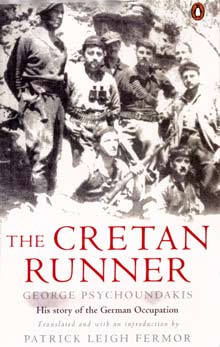
The Cretan Runner

There have been other memoirs of wartime Crete, such as Xan Fielding’s Hide and Seek and Ill Met by Moonlight, W Stanley Moss’s record of the kidnapping of General Kreipe (later made into a movie, with Dirk Bogarde assigned to fill Leigh Fermor’s dashing boots). But those were visitors’ books. George’s story, as Leigh Fermor points out in the introduction, is unique. It is no longer the locals who are colourful aliens, but the Allied officers and their wireless operators – good sorts and good sports in the main but, none the less, foreigners with some very dodgy customs. “A most peculiar man,” George says of one buffer. “He had pyjamas and a washbasin.”

Even more baffling for the Cretans, who think Nature is a place where you go and shoot things, the buffer turned out to be an amateur botanist and geologist: “He was not only in love with different kinds of weeds but with stones as well.”

Paddy and I have been sitting in the front room of George’s small vine-clad house, outside Khania in western Crete, for more than two hours now. At least one of us is reeling under the bombardment of Cretan hospitality. Celestial cheese tarts made by Sofia, George’s wife, have given way to nuts, glistening sweetmeats and, as if that weren’t enough, shots of tsikoudia, a spirit so lethal it feels less like drinking a liquid than sipping scalded air. After three of these, I am not entirely sure whether the spools on my tape recorder are going round: after four, I don’t care.

George – one eye sleepy, the other coal black with embers of mischief – is joking about whether he should have given lessons in sheep stealing (a local speciality) to one of the wireless operators. “So when he got back to Scotland he could have organised sheep rustling.” Paddy pretends, unconvincingly, to be shocked.

Through the window behind them, you can see the White Mountains – a range so towering and snowy, even on this May day, that it is hard to tell where rock stops and cloud begins. More than half a century ago, those slopes were Paddy and George’s stamping-ground. “George’s life was dangerous and absolutely exhausting,” explains Paddy. But George is having none of it: “I felt as if I were flying. Running all the way from the top of the White Mountains to Mount Ida. So light and easy – just like drinking a cup of coffee.”

George has difficulty walking now – at 78 he leans on a stick as gnarled as himself – but his mind can leap from memory to memory, as if he were still flying. I ask George what he thought the British had learnt from the Cretans and vice versa. “What they learnt, because there was very little to eat, was to drink a lot and to dance and to shoot for joy in the air. We saw how much they loved our country and it made us love it still more. The fact that they loved Crete so much gave us even greater courage.”

The first time George Psychoundakis met Patrick Leigh Fermor he thought he was very tall. The young Cretan had just crawled on all fours through thick bushes into the heap of boulders where the officer was hiding. In fact, the Englishman was not especially lofty (a touch over 5ft 9in, according to his passport). It was the Greek who was tiny. “As fine-boned as an Indian,” recalls Leigh Fermor. “Lithe and agile and full of nervous energy.”

Anyway, height didn’t matter much back then. It was the July of 1942 in occupied Crete and the stature of men was not measured in inches, rather in a bewildering range of abilities. These included: keeping cool when a member of the Gestapo approaches your mule while it is carrying a combustible load of wheat and wireless; keeping warm in a cave-bed with a canopy of stalactites; and finding the courage to tuck into a dinner of local produce – grass cooked with snails. “We took the grass blade by blade, picked off the broken shells and ate it with much laughter,” recalls George.

Psychoundakis was a runner for the Resistance – a vertical postman, he delivered messages and equipment at barely credible speed. On a map, Crete doesn’t look too daunting – a sirloin steak beaten to a succulent sliver by a butcher. But it rises so sharply into such broken-toothed cragginess that it is pointless to measure it in miles: the islanders calculate distances in the time taken to smoke cigarettes. George’s wartime business was mainly conducted at eagle-height, or as he felt his way down the vertebrae of his homeland towards some hiding place where even goats didn’t dare.

He was 21 years old when he first met the 27-year-old Leigh Fermor. George addressed Paddy as Michali (all the Allied soldiers had Greek nicknames) or sometimes Mr Michali in half-amused respect (irreverence being the key to the Psychoundakis psyche). Paddy, meanwhile, code- named George either the Clown or the Changeling, for his cockeyed wit, his impish insubordination and a magical ability to spirit himself out of trouble.

Patrick Paddy Leigh Fermor and Billy Moss

The two men were not just worlds apart: a glance at their biographies suggests you would need to hire a time machine to bring them together. Born in Asi Gonia, a village with a long history of giving invaders a hard time (asi is Arabic for uncommandable), George lived the kind of peasant life that had not changed for centuries. His family slept together in a single room with a beaten earth floor. After a scratchy education at the local primary school, he followed his father on to the mountains as a shepherd. By the time German parachutes blotted out the sky in May 1941, he had visited only two of Crete’s towns and had never seen the capital, Heraklion.

By contrast, Leigh Fermor was born into a smart Anglo-Irish family and educated at prep school and King’s, Canterbury. [Just like someone else we know] By 1939, he had walked across every country between London and Constantinople – a stroll commemorated in his two dazzling volumes, A Time of Gifts and Between the Woods and the Water – and also appeared to have drunk in most of their national literatures.

Scrape through what Leigh Fermor called his “Fauntleroy veneer”, though, and you find a rougher grain. With his parents abroad for the first four years of his life, Paddy was entrusted to the family of a small farmer and, left uncultivated, he ran wild. The experience, he later wrote, “unfitted me for the faintest shadow of constraint”. His behaviour at a flurry of schools led to his being sent to two psychiatrists, although it is unlikely that either rivalled Paddy’s clinical diagnosis of himself as “a very naughty boy”. He was finally expelled from King’s for crimes that included “trying to be funny” and holding the hand of a greengrocer’s daughter. His housemaster’s report noted: “He is a dangrous mixture of sophistication and recklessness, which makes one anxious about his influence on other boys.”

Almost 70 years later, I find it hard to improve on that verdict, save to replace the word dangerous with delightful. As it turned out, his influence on other boys was all to the good, and the most remarkable boy of all was George Psychoundakis.

While Paddy was in Kent writing “bad and imitative verse” and lapping up ancient Greek because it was a passport to a world of heroes, George was scavenging books from the village priest and the doctor, and occupying the long woolly hours by the sheepfold composing patriotic poems and beady skits on local life. (An early effort entitled Ode to an Inkspot on a Schoolmistress’s Skirt sounds distinctly Paddy-like in its high- flown cheekiness).

Although George’s father, Nicolas, was illiterate, he could recite by heart the whole of the Erotocritos, the 17th-century Cretan epic poem that comprises 10,000 lines of rhyming couplets. And the rhythm lodged in the son’s head and on his tongue: poetry to these people was not the object of solemn study but a spur to the spinning of legends and the cue for a bloody good song.
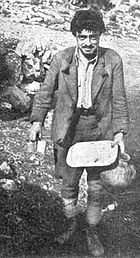
George Psychoundakis during the Resistance

Which is to say that when the ragged and practically barefoot Cretan wriggled into the hiding-place of the Englishman in 1942, they had more in common than an enemy. George spoke only one perfect sentence of English – “I steal grapes every day” – but Paddy soon extended his repertoire. On long marches to the coast to meet supply vessels or during the dark hours awaiting a parachute drop, the Britons taught the Greeks folk-songs and the Greeks taught them mantinadas – waspish local couplets with a sting in the tail.

On their first trek together, Paddy recalls how George recited a poem he had written on the unambitious theme of The Second World War So Far. “It covered the invasion of Poland, the fall of France, the German invasion of Greece and Rommel’s final advance. It lasted more than two hours and finished on a note of triumphant optimism and presage of vengeance, which he emphasised by borrowing my pistol and firing it into the sky with the remark that we would soon be eating the cuckolds alive.”

Leigh Fermor, meanwhile, attempted to satisfy Psychoundakis’s ravenous curiosity about the world. What was Churchill like? Why do the Scots wear kilts? How about astronomy, religion, trains? How many sheep does the average Englishman own?

The task of the British Special Operations Executive in Crete was to assist the local Resistance. Having spent centuries in revolt against the Venetians and the Turks, the islanders didn’t actually need much encouragement. During the airborne invasion in 1941, when many young Cretans were away on active service, descending parachutists were met by old men, women and children – by anyone, in fact, who could point upwards and shoot. “Aim for the legs and you’ll get them in the heart,” ran the local wisdom. Four thousand Germans died. Those who survived took swift revenge. Reprisals, read one Wehrmacht memo, “must be carried through with exemplary terror”. Between May and September of that year, 1,135 Cretans were executed.

The Cretan Runner begins with the invasion. “Out of the sky the winged devils of Hitler were falling everywhere … the aeroplanes came and went like bees in a bee-garden.” One grounded plane is set upon by furious locals till it resembles “a bit of bread thrown on to an ant-hill”. From the opening pages, you get a pungent impression of the Psychoundakis style – a vertiginous mix of the epic and the demotic, the Homeric and the homely. Of the enemy, George writes: “They reached to our very bowels and provoked a storm in the soul of the race like the hiss of a poisonous snake about to strike.” No British account of the battle of Crete could contain a sentence like that. Too purple. Too embarrassing, frankly. But it feels utterly true to George and the hot-blooded rhetoric of his race.

Perhaps the greatest surprise of a book that documents the burning of villages, the casual slaughter of comrades and a life of mesmerising danger is how often it makes you smile. No stranger to hardship anyway, George embraces discomfort as though it were a shy friend with a lot to offer. We see George at the end of a knackering three-day trek using pieces of wood to mime someone hobbling. We hear him enthusing over yet another dank hiding-place as though he were writing for some actionable travel brochure: “The cave was perfect. We collected our drinking and washing water from stalactites. We arranged luxurious couches for ourselves from the branches of various shrubs that were better than the softest mattress!”

Best of all, there is George richly enjoying his British friends, not least their congenital inability to walk over the rocky landscape. (In one incident, Leigh Fermor threw himself pluckily at a high stone wall in emulation of local bravado, only to fall off backwards: the Cretans in the party walked around the side of the wall, shaking their heads and laughing.)

SOE officer Ralph Stockbridge (centre, in the spectacles) with some of his comrades in Crete

“It was plain that George was enraptured with the excitement of our secret life,” says Paddy. The same could be said of all of them, I think. As a boy Leigh Fermor confessed to being guilty of “a bookish attempt to coerce life into a closer resemblance to literature”. In this case, the literature was Greek. The Cretans, for their part, seemed all too willing to live up to the legends the Englishmen had imbibed at school. Most battles look romantic only in retrospect, if then: Crete was different. It seems to have struck its leading men as touched with an air of romance, even as the drama was unfolding. As they approached by boat on a moonless night, the first the soldiers knew of the island was perfume, the scent of wild thyme that wafts miles out to sea.

Once on shore, they changed into local costume – breeches, black bandanas, embroidered waistcoats and spiffy jackboots. There were lessons in how to curl their new moustaches. They were an extraordinary bunch – poets, archaeologists, free spirits thirsty for adventure. SOE chose them because they had some knowledge of ancient Greek. But, as Leigh Fermor explains, since Greek was no longer compulsory at school, those who opted for it had already marked themselves out as “a perverse and eccentric minority”.

I cannot get enough of the photographs of the Resistance taken through those years in the mountains. Remember, these are snapshots captured at a time when to have a likeness of yourself in existence was itself a threat to that existence. There is the legendary Xan “Aleko” Fielding, looking uncannily like the young Hemingway. Gimlet-eyed and bare- chested, he regards the lens with Olympian amusement. And there is Yanni Tsangarakis, one of the bravest and most trusted guides, slightly woebegone behind a Zebedee moustache, and the redoubtable Manoli Paterakis, whose unforgettable profile suggests he may have been the love-child of Montgomery of Alamein and a peregrine falcon. [I think he’s trying to say he was nasally overendowed]

Looking at the smiley countenance of Tom Dunbabin – a fellow of All Souls in peacetime – you can see why he inspired such love; ditto the gaunt saintly faces of Aleko Kokonas, the schoolmaster of Yerakari, and his wife, Kyria Maria. And then, of course, there are Paddy and George: the first as debonair and unfeasibly handsome as Errol Flynn casting about for a galleon to capture; the second apparently auditioning for the role of Puck.

In Louis de Bernieres’s novel Captain Corelli’s Mandolin, set in wartime Cephalonia, there is a posh Englishman who lives in a cave and comes out declaiming ancient Greek. He is a bit of a joke. And, to be sure, there is something potentially laughable about the Boy’s Own aspect of all this dressing up and blowing stuff up. What redeems it from absurdity, what transforms it into real rather than fantastical heroism, is the nagging presence of death, which circled above these lives like a hawk. There was nothing comic-book about Anton Zoidakis, captured by German soldiers, tied to their vehicle and dragged along the road until his face and his life were wiped away. And even George’s account of merry scrapes is pulled up short when 20 Gestapo visit Asi Gonia: “They said I was wanted for interrogation and if didn’t go to Retimo before January 17 they would set fire to the whole village.”

Three of George’s fellow runners were executed, two after what the Wehrmacht would probably have considered exemplary torture. In his superb book Crete: The Battle and the Resistance, Antony Beevor points out that the penalty for a shepherd caught whistling to warn of the approach of a German patrol was death.

War had transformed George Psychoundakis’s life. In February 1943, it enabled the former shepherd boy to travel abroad for the first time. He was spirited off to SOE headquarters in Egypt, where he was knocked sideways by wonders, not least the grass in the Gezira gardens: “Fat, short grass like green velvet carpet.” As for the zoo, “I could almost have deemed that I was in the middle of paradise”. The most misguided character in the whole of The Cretan Runner is the soldier who advised George not to climb up the Pyramids because it was “very tiring and tricky”. A short hop later, the Cretan runner got out his stiletto and “cut my name and fatherland” into a stone at the top.
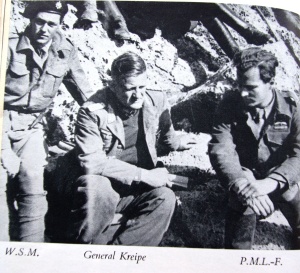
Moss, Kreipe and Paddy

On the day the war was over, a “high-spirited Mr Leigh Fermor” bought a dubious Mr Psychoundakis a lot of drinks. “If I drink all that I’ll be drunk,” protested George. “But my child, what is drink meant for? It’s no use for anything else,” replied Paddy.

Soon after, in a school where a whole village was gathered together, George recited a heart-stopping poem he had written on the lovely village of Yerakari, now destroyed, where once “white houses lay like doves asleep along the sill of heaven”. He had survived, but for a while it was hard to see what for.

Fortune, who had smiled on George in a time of insane adversity, appeared to doze off once the shooting stopped. Because of missing documents and in spite of his British Empire Medal (awarded in 1945), he was arrested as a deserter and imprisoned for several months. One can scarcely imagine the wound inflicted on his pride. Over three days, that great shaggy helmet of hair all fell out. Subsequently, he had to do two more years of fighting in the civil war. Returning at last to Asi Gonia, George found all the sheep stolen and his family in gruesome poverty. The Changeling had run out of magic.

George took a job as a navvy working on a road. At night, he sheltered once more in a cave and by the light of an oil lamp began to fill notebook after notebook with a furious, cramped hand. “I think he undertook this task as a kind of exorcism of the gloom of his circumstances, ” says Paddy. When they met up again in 1951, George gave his friend the completed work: Pictures of Our Life During the Occupation. Better known as The Cretan Runner.

Leigh Fermor, now living on the Greek mainland, took the precious grime-covered manuscript home to translate. George, meanwhile, was working to help his old friend, too. In 1943, with a German patrol approaching, Paddy, who was checking what he thought was an empty rifle, accidentally shot Yanni Tzangarakis in the leg. He died soon afterwards, but not before absolving his friend of all blame. Paddy was devastated: imagine killing the proud son of a country for which you were willing to lay down your own life.

This wretchedness was deepened by foolish rumours that eventually led to a vendetta being declared by some of Yanni’s relatives. This was only laid to rest after years of delicate negotiation by George, who found a very Cretan solution to the Englishman’s impasse: Paddy Leigh Fermor became godfather to Yanni’s great-niece. In Greek society, this bond is deeper than blood.

Two old men sitting at a table talking about the war. A Cretan and an Englishman. “We’d better censor that, George, it’s libellous,” says Paddy, trying to sound stern. As usual, he fails.

George goes off into the bedroom and comes back with a rifle. It is nearly as tall as he is, and its working parts are in similarly creaky order. As George poses with the gun, the photographer asks him to smile. George scowls and spits out a guttural retort. “Oh dear, oh dear,” says Paddy, shaking his head and laughing. What did George just say? “He said he won’t smile because he’s killing Germans.”

At the front of A Time of Gifts, Leigh Fermor quotes from Louis MacNeice’s great poem:

For now the time of gifts is gone
O boys that grow,
O snows that melt,
O bathos that the years must fill.

Since the war, both men have found satisfactions. Leigh Fermor, though unfairly saddled with the label of travel writer, has become one of the greatest exponents of English prose.

Psychoundakis, meanwhile, has translated both the Odyssey and the Iliad into Cretan and been honoured by the Academy of Athens. Still, I can’t help wondering whether the time since their great adventure had been an anti-climax.

“To some extent all our lives were in those years,” admits Paddy. “Of course, one went on to do interesting things, but … ” George has come up now and stretches out his fingertips to reach the shoulders of his friend, the tall Englishman. “Ah, George says to tell you that those years up in the mountains were the best years of his life. He’ll never forget it. Never. And that’s why he wanted to commemorate our days together.”

Just as we are getting ready to leave, George gives Paddy a photograph. It is of George himself and Xan Fielding, taken somewhere in the mountains. You can just make them out. The emulsion is breaking up and great snowy specks of it are blizzarding them into oblivion. Yet looking back at the Cretan resisters, we see only a thrilling clarity. Their existence was both mortally serious and a great wheeze – perhaps a definition of the best kind of life you can hope to lead.

Years after the war ended, George Psychoundakis sang for his friend Patrick Leigh Fermor a mantinada. This is what it said:
With patience first and patience last, and doggedness all through,
A man can think the wildest thoughts and make them all come true.

Related articles:

The obituary of George Psychoundakis aka The Cretan Runner

General’s long trip home

Related category:

Ill Met by Moonlight

GAGINONANUS SPEAKS

After a long, indolent summer chasing dragonflies, and an extended sojourn in the south of France courtesy of ‘Les Sans Coulottes’, the time has come for the winner of our OPRIG GAGINONANUS challenge, Marion Worsley to collect her prize. A full report will follow!

To celebrate this forthcoming event I thought we should enjoy the poem that the marvellous John Wells wrote and sent to Paddy after he too received a copy of Paddy’s drawings.

GAGINONANUS SPEAKS

By John Wells

Before the earliest burning light
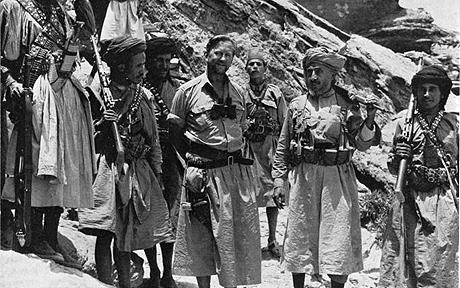
Before the world that once was his
Hung turning the day to turning night
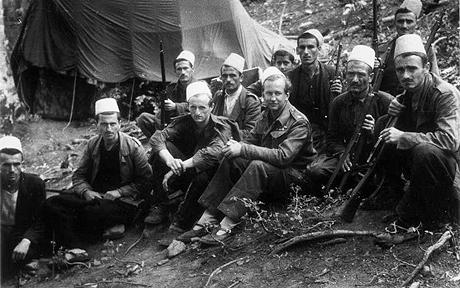
Gaginonanus was and is

Gaginonanus, mightiest Lord,
Whom all the Seven Kings obey,
At whose high uncreated word
Preadamites were prone to pray

Great God of Gods, all nature’s grail,
The inward soul of every thing
Behind the Maya’s rainbow veil
Withdrawn, within, inhabiting

New gods and false as empires rise
Are worshipped, spires fall and climb,
All-seeing and with placid eyes
Gaginonanus bides his time

Like leaves the centuries are born
Like leaves are born to bud and die.
Gaginonanus smiles to scorn
The drifting aeons as they fly

Ignored, unknown, forgotten still
Gaginonanus sees their play,
The awful working of His Will
Until His dreadful Judgement Day

*

But now, O Prig! O Lax! O Loose!
That hour is come! O sunk in crime!
Your garages in constant use,
You dare not park at any time

His awful Name is manifest!
No cloud-etched letters skyward burn
The Blessed Ones who love Him best
Know their Great God will soon return

Winning entrant Marion Worsley in Market Mews

Behold, in those condemned last days,
Gaginonanus, Lord of All!
As saints and sages dumbly gaze
His Name is written on the Wall.

Related article:

OPRIG GAGINONANUS

OPRIG GAGINONANUS – a winner!

My first edition of Hide and Seek by Xan Fielding

It may not look like much but today I managed to bag a first edition of the very rare Hide and Seek by Xan Fielding.

I am pleased with myself as I let the last one slip by on an eBay auction during the first election debate in April.

Hide and Seek – Xan Fielding 1st Ed. 1954

Title: Hide and Seek – The Story of a War-time Agent

Author: Xan Fielding

Publisher: Secker & Warburg, London

Pages: 255

Condition:  Good.  Tight copy, pages slightly foxed, in rubbed and marked boards.  No dust-wrapper.
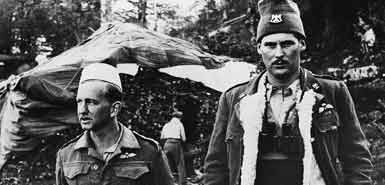
Synopsis:  Illustrated with black-and-white plates, and maps on endpapers.  First Edition (1954).

Never Marry a Mitford

The title is taken from a sweater that Andrew Cavendish, 11th Duke of Devonshire used to wear around his Chatsworth estate in Derbyshire. However, just like us he must have been fascinated by the Mitford sisters. In this lengthy article entitled Elvis, Chatsworth, JFK and me, Deborah Cavendish, The Dowager Duchess of Devonshire, and the last of the Mitford sisters, talks about her extraordinary life.

By Jessamy Calkin

First published in the Telegraph 12 Sep 2010

The Dowager Duchess of Devonshire Photo: Emma Hardy/East Photographic

If you give the Dowager Duchess of Devonshire a fiver, she’ll show you round her house, an old vicarage in Edensor, Derbyshire. It would be tempting to think that she pocketed the money, but it goes towards the church roof fund. The occasion is the annual village fete.

‘It’s true,’ she says mildly. ‘What people love is the shoe cupboards and the lavatories and all that. And sometimes they say, “You’re very brave to do this,” and I say, “You’re very brave to come,” because there’s always a queue. So funny.’

Debo, as everyone calls her, was 90 this year. Having greeted me in her pretty garden, shaking my hand and looking me directly in the eye, she leads me into the apple-green-walled and flagstone-floored hall – ‘Do put your bags down, no burglars here’ – and shows me into her sitting-room, which has an extraordinarily nice atmosphere, and we take to the floral sofa, where she positively lounges, looking at me brightly, waiting to be amused.

There have been countless books about the Mitfords, both biographical and autobiographical, and now her own memoirs, Wait for Me!, are about to be published. (She has written several books, mostly about Chatsworth, her former home.)

Debo says she was motivated to write about her life because she had offers from other people to do it for her, and she didn’t really want them ‘to fiddle about with it’. She was appalled by some of the books about her sisters – in particular David Pryce-Jones’s book about Unity, and the books about Diana, who married the fascist Oswald Mosley. ‘They are so full of inaccuracies,’ she says. ‘No one ever really got my sister Diana, and she was such an incredible person. It was always a delight for me to see somebody who was prejudiced against her sitting by her on the sofa like you and I are now and… melting, absolutely melting.’
Debo became close to Diana, who was 10 years older, only later in her life, but now, she says, ‘hardly a day goes by when I don’t say to myself, “Oh I wish I could tell Diana that, she’d laugh so much.”’

It wasn’t an easy book to write; it has taken her four years. Debo suffers from the eye condition macular degeneration and can’t read at all, but she can write; she says it’s because she knows the shape of the words. She does all of her writing in bed, early in the mornings (‘My sheets are covered in ink’) and then her assistant, Helen Marchant, reads it back to her. ‘And you feel guilty asking someone to read it back three or four times but that is what I had to do to try and get it right. Helen in her genius way can translate it into ordinary English, because I don’t know grammar and she knows grammar.’

The book is full of stirring anecdotes, such as when a wounded soldier repatriated from Italy during the war brought home a lemon. ‘Such a luxury had not been seen in the shops for a long time and it caused a minor sensation when he put it on the post office counter at Ashford-in-the-Water and charged tuppence a smell – proceeds to the Red Cross.’ Or the dinner at Calke Abbey, where lived the Harpur Crewes. ‘The dining-room table was set with candles – the only light in that high-ceilinged room, which I imagine had not been used for years. The first course was melon; it was followed by cold beef; then melon for pudding.’ Her host, Airmyne, whose best friend was a goose, then took her up to meet ‘Nanny’ who, they said, used to be the Kaiser’s nanny, a tiny, ancient creature who was fast asleep in bed. It was the strangest evening she had ever had. ‘The Harpur Crewe siblings,’ she writes, ‘were the only true eccentrics I have ever met.’

Can this be true, I ask her. I imagined her life must be full of eccentrics. ‘Well, if you don’t count all my sisters, but I never thought of them as eccentric. I suppose my father was a bit outlandish; he was the source of all jokes in our family.’

The Mitford family

The Mitfords – there were six sisters and one brother – were a defining family of their time; Debo says now that they always thought they were ordinary, but their celebrity and influence has endured. Extreme behaviour seemed to run in the family. David Freeman-Mitford (Farve), later Lord Redesdale, married Sydney Bowles (Muv) in 1904.

Their eldest child, Nancy, wrote several historical biographies and eight novels, the most famous of which, The Pursuit of Love, was, in her own words, ‘an exact portrait of my family’. There was Pam, the least well-known sister, described by John Betjeman as ‘the most rural Mitford’. There was Tom, who used to pay his sisters a shilling an hour to argue with him and went on to become a barrister, but was killed in the war in 1945.

Diana married young, then left her husband for the British Union of Fascists leader Oswald Mosley, and was put in prison for three years for her beliefs; she was also one of the few people who knew both Churchill and Hitler. There was Unity, who moved to Germany in 1934 at the age of 19 and became devoted to Hitler, whom she got to know well; her dual loyalties to the Führer and her country caused her to attempt suicide by shooting herself in the head at the outbreak of war. Continue reading

A Woman’s Hour special: ‘Debo’ – the Dowager Duchess of Devonshire

Woman’s Hour devoted a whole programme to an  interview with Deborah Cavendish, or as we know her ‘Debo’ – the Dowager Duchess of Devonshire in 2010.

Deborah Cavendish

You can listen to the podcast here!

Related article:

Deborah Cavendish is 90 years old and has witnessed the 20th century up close. She has met anybody who’s anybody – Churchill, Hitler, JFK. She is also the last survivor of a remarkable set of women – the Mitford sisters: Nancy, who became a writer, Jessica who became a Communist, Unity who became a Fascist – and Diana who married one. In a special edition of Woman’s Hour Jenni talks to ‘Debo’ – the Dowager Duchess of Devonshire about her life, and the times she lived through. In her autobiography ‘Wait for Me’ she also talks about her own personal challenges; her husband, the Duke, had a long battle with alcohol and three of her children died within hours of their birth. She’s also credited with helping to save one of Britain’s great country houses, Chatsworth, which is enjoyed by thousands of visitors each year.

A Review of In Tearing Haste: Letters between Deborah Devonshire and Patrick Leigh Fermor from the Spectator

Related category:

‘In Tearing Haste’ Category

Paddy’s eye for detail: Ian Fleming, Bondage, James Bond and Pol Roger

Sean Connery and Ian Fleming

As background to the Imperial War Museum’s 2008-09 exhibition For Your Eyes Only: Ian Fleming and James BondThe New York Review of Books  featured a discussion of the merits of Ian Flemings’s work by Geoffrey Wheatcroft. Entitled ‘Bondage’ it is a wide-ranging review, and for shock factor it intially does tend to focus on Fleming’s penchant for what Wheatcroft calls ‘schoolboy sexual fantasies’. One critic found Fleming’s ‘sex distasteful—male brutality and female submission, or what Bond himself called “the sweet tang of rape”—he lamented Fleming’s “vulgarity and display” and his love of luxury goods.’

Well, that all makes for good reading but two things caught my eye. First of all there is some mild criticism for the overrated Sebastian Faulks and his 2008 attempt at writing a Bond story Devil May Care; more on Mr Faulks at a later date. Not only do I not particularly rate his writing (and I doubt he cares) but he is also a critic of Paddy’s.

The second was a letter that Paddy wrote to Ian Fleming picking him up on a point about Pol Roger champagne. Fleming was probably the first proponent of what would now be called ‘brand placement‘. As anyone who has read a Bond book or seen a film cannot fail to have missed, Bond does not get by with ‘Tesco Value’ when he can obtain a top brand alternative, presumably on Her Majesty’s expenses.

Paddy and Joan were friends of the Flemings, but, along with Debo Devonshire, were particularly close to Anne Fleming, and supported her through the difficult times following Ian’s death and his failure to get his estate in order. Read In Tearing Haste for more on this.

The particular part of the NYRB article that caught my attention is below, and shows Paddy’s excellent eye for detail, which we see constantly in his own work:

“While Devil May Care is short on sex and sadism, it does begin with one unfortunate having his tongue torn out; but then Faulks’s own tongue is a little too obviously in his cheek. We get Gorner, an impossibly horrible villain, a brutal enforcer called Chagrin (nice touch), a glamorous heroine with whom James is far too diffident—and a distinctly autumnal flavour. The book is set in 1967, when Fleming not only didn’t write it but could not have written it, and 007, as he admits, is showing his age. Now and again the writing flags. Bond has been in Tehran a few days when he lunches alone on caviar and martinis, before spreading out “some maps he had bought from the hotel shop…. The country was between Turkey to the west and Afghanistan to the east. Its southern frontier was the Persian Gulf, its northern limit the Caspian Sea.” Well, yes.

There are a few other lapses which it would be tedious to list, including a tennis match that is not only implausible in itself but whose scoring goes awry. We all make mistakes, including the originator. After Fleming published On Her Majesty’s Secret Service, that worldly sophisticate was mortified to receive a magisterial rebuke from his friend Patrick Leigh Fermor: Ian surely knew that Pol Roger is the only champagne never sold in half bottles.”

You can read the full article from the NYRB here. I will publish it at some later date for the archive.

Obituary: Daphne Fielding

The obituary of Xan’s first wife of whom Paddy was very fond. She once said of him: “Do you know Paddy? He’s such a good friend. He should be turned into pills so that you can take him when you feel low.”

by Hugo Vickers

First published in the Independent Wednesday, 17 December 1997.

Daphne Winifred Louise Vivian, writer: born 11 July 1904; married 1926 Viscount Weymouth (succeeded 1946 as sixth Marquess of Bath, died 1992; two sons, and two sons and one daughter deceased; marriage dissolved 1953), 1953 Xan Fielding (died 1991; marriage dissolved 1978); died 5 December 1997.

Daphne Fielding was a society author in the decades between 1950 and 1980. Having been a part of the world of Bright Young Things in the 1920s, she was well known in society as the Marchioness of Bath, and following her marriage to Xan Fielding she produced a stream of books of easy charm which achieved great popularity. Good-looking when young, in later life she was a tall, handsome figure, and could have been mistaken for a distinguished actress.

Daphne was the daughter of the fourth Lord Vivian and his wife, Barbara, a former Gaiety Girl, who was to marry three further times. The family was eccentric; many years later, her brother the fifth Lord Vivian (who died in 1991), variously a farm labourer in Canada, a publicity manager in San Francisco and a partner of the impresario C.B. Cochran, had the misfortune to be shot in the stomach in 1954 by his mistress Mavis Wheeler, the former wife of Sir Mortimer Wheeler, the archaeologist, a drama which occupied the headlines for many days.

Daphne emerged from a childhood which was a mixture of hilarity and insecurity, later described with relish in her memoirs, Mercury Presides (though Evelyn Waugh declared these as “marred by discretion and good taste”). She passed through Queen’s College in London, and St James’s, Malvern, and gravitated, through her friends the Lygon sisters, to the stimulating world of Oxford in the 1920s, and to that set dominated by Harold Acton, Evelyn Waugh and Brian Howard. The friends she made then were friends for life, a group that gave each other unswerving loyalty despite infidelities and political differences, everlastingly self-protecting; and a group through which she met Viscount Weymouth, heir to the Marquess of Bath.

There was parental opposition to their union, Henry Weymouth’s father declaring that he needed “a steady wife” and finding that Daphne did not fit this category. Weighing in, her father announced that he thought Weymouth an unsuitable husband. They were married in secret at St Paul’s, Knightsbridge, in 1926, and then again considerably more publicly at St Martin-in-the Fields in 1927, the bride dressed by Norman Hartnell. (When eventually they were divorced, there was a prolonged court case before three judges to dissolve that earlier marriage, and regularise the unusual situation.)

Old Lord Bath in 1928 handed the running of the Wiltshire family seat, Longleat, to his son (not without certain misgivings about his capacity for work) and he and Daphne threw themselves wholeheartedly into the management of the estate. They employed Russell Page to redo the gardens and were involved in extensive forestry work. To supplement her income, Daphne wrote articles for newspapers and magazines, which brought her under the protective care of Lord Beaverbrook.

They had four sons and a daughter. The eldest boy died in 1930, just before his first birthday, and the youngest, Lord Valentine Thynne, died after hanging himself in 1979. Her daughter Caroline predeceased her, and she is survived by two sons, the present Marquess and his brother, Lord Christopher, who are on notoriously bad terms. (There was a rumour that at Lord Christopher’s wedding to Antonia Palmer in 1968 the cake was laced with LSD. The Queen was a guest.)

Henry Weymouth spent much of the Second World War as a prisoner of the Germans, which did not help the marriage. In 1946 he succeeded his father as Marquess of Bath. Forced by crippling death duties he opened Longleat to the public in 1949, with an entrance fee of half a crown a head. By 1953 he had added a tearoom and tennis court, laid out a putting green, and floated pedalos for hire on the lake. But the marriage was over and the Baths were divorced in May 1953.

Daphne wrote the first guidebook to Longleat, a lively history of the Thynne family from 1566 to 1949, which she researched and wrote in three weeks. This she followed with Before the Sunset Fades (1953), a slim 30- page book about life above and below stairs at Long- leat, decorated, appropriately, by her old friend and Wiltshire neighbour Cecil Beaton.

In 1953 she married the war hero and travel writer Xan Fielding, a man 14 years her junior, a happy marriage which lasted until 1978. During these years they lived variously in Cornwall, Morocco, Portugal and Uzes, where they settled for some years, surrounded by a variety of pets and visited by their many friends.

While married to Fielding, she wrote her books Mercury Presides (1954) and its sequel, The Nearest Way Home (1970), and a novel, The Adonis Garden (1961), of which Evelyn Waugh wrote that she had “squandered six books in one”, adding, “You have used almost everything that has happened in the last twelve years.”

The Duchess of Jermyn Street, a life of Rosa Lewis of the Cavendish Hotel subsequently serialised on television, was to have been written with the help of George Kinnaird (a writer who also used to help Baroness de Stoekl with her books), but he gave up while going through a divorce. It was published in 1964 and Evelyn Waugh described it as “jolly good but I think full of inaccuracies”.

She wrote a joint life of Lady Cunard and her daughter Nancy, Emerald and Nancy (1968), which her friend Dirk Bogarde judged “light on the intellect”, fearing that Fielding had whitewashed these two monsters on the grounds that “she couldn’t be beastly to chums”; and a portrait of Iris Tree, The Rainbow Picnic (1974).

Raleigh Trevelyan, of Hamish Hamilton, then commissioned her to write a life of Gladys Deacon, the 93-year-old Duchess of Marlborough, whom he had come across while researching his book about the Whitakers of Sicily, Princes Under the Volcano (1972). This was not her usual milieu, since the duchess belonged to the belle epoque and intellectual world of Paris of a generation older than Daphne Fielding. Nevertheless she was able to tap her wide circle of loyal friends for anecdotes. To her surprise a man wrongly described as “a young intellectual” proved to have embarked on the same research. However, her friends closed ranks around her, and a word from Lady Diana Cooper to her biographer, Philip Ziegler, caused him to drop the rival’s incipient Collins contract like a hot potato.

I know this, for I was that rival. Both books were in due course published, hers under the title The Face on the Sphinx (1978). But the story had a happy ending, for those same friends helped me with my life of Cecil Beaton, and Diana Cooper, in her more usual role as peacemaker, effected a successful rapprochement between us. I enjoyed a number of meetings with Daphne in New York in 1981, during which she chatted amicably about our experiences and regaled me with Cecil Beaton stories. I always remember her line about Patrick Leigh Fermor: “Do you know Paddy? He’s such a good friend. He should be turned into pills so that you can take him when you feel low.”

Her friend Robert Heber-Percy averred that Daphne Fielding was a better conversationalist and letter-writer than author of books.

In 1978 Xan Fielding left Daphne for a lady described by her friends as “an older woman”. Bereft but brave, she was lucky to meet once more an old Oxford friend, Ben Kittridge, an American millionaire, with whom she went to live in Arizona until his death in 1981. Thereafter she returned to England and settled in the Old Laundry in the shadow of Badminton, where for two years the fox-hunting 10th Duke of Beaufort (“Master”) lived on, and where, until her death from cancer in 1995, her daughter Caroline lived as the next Duchess of Beaufort.

Daphne Fielding’s last years were spent there. At the famous Horse Trials she could be seen driving about in a tiny self- propelled vehicle and every Sunday she lunched with her son-in-law, where she was a by no means unnoticed figure at the table.

Related article:

Xan Fielding Obituary

To print this article or create a pdf do the following:

1. Copy the url of the article from your browser above

2. Click on the Print Friendly button below – you will be taken to the Print Friendly page

3. Paste your url into box that appears and hey presto you will get a previewed page to print or pdf!

Print

Colonel David Smiley: Blues officer and MC recipient

The Times’ Obituary of David Smiley. Times’ content is now subscription only so no link I am afraid. Paddy was a friend and wrote the foreward to Smiley’s book Albanian Assignment.

First published in The Times January 2009.

When Lieutenant David Smiley was ordered to Palestine with the 1st Cavalry Division in January 1940 his immediate concern was how to dispose of his private aeroplane, two racehorses and Bentley. The next five years were to bring him more exacting problems, but he completed the war as a three-times decorated lieutenant-colonel.

The Life Guards and Smiley’s regiment, the Royal Horse Guards (The Blues), each provided two squadrons to make up the 1st Household Cavalry Regiment (HCR), which, together with two other horsed cavalry regiments already in Palestine and several mobilised Yeomanry regiments, provided the 1st Cavalry Division with the capability to relieve an infantry division in Palestine for service in the Western Desert. Smiley found Palestine interesting but, seeking more active duty, he volunteered to join No 52 (Middle East) Commando under training at Geneifa, Egypt, in November 1940. Continue reading

Bruce Chatwin: letters from a fallen angel (or, A Woman Scorned)

I had no great intention to continue delving into the life and work of Bruce Chatwin, but I found the following article in this week’s London Evening Standard absolutely fascinating. The forthcoming book of letters edited by his biographer Nicholas Shakespeare, with commentary by his long suffering wife is sure to prove quite explosive.

As I have said before I don’t know much about the man, but to be frank, from what I have read I don’t see him as much of a hero as some others clearly do. However good he may have been as a writer, he was clearly incapable of any form of loyalty, and seemingly indulged himself in fulfilling his bi-sexual fantasies during his extended journeys, where he clearly had many opportunities.  As Miranda Rothschild, told his biographer: “Sexually, Bruce was a polymorphous pervert … He’s out to seduce everybody, it doesn’t matter if you are male, female, an ocelot or a tea cosy.”

He seems to have carried over this trait into his writing; he does not appear to have been particularly honest with his readers, and in the forthcoming book of letters his wife demolishes many of the myths that have grown up around Chatwin. Elizabeth Chatwin has waited a long time to put over her own point of view and it seems that she has not held back. Beware a woman scorned.

Bruce Chatwin: letters from a fallen angel

by David Sexton

First published in The Evening Standard 25.08.10

Bruce Chatwin died in hospital in Nice in January 1989, suffering from Aids, aged just 48. His last days were all the more terrible for the fact that he had never been able to admit to himself or to others the nature of his illness or his sexuality.

Creator of his own myth: Bruce Chatwin died of Aids in 1989, aged 48. He had never been able to admit to himself or to others the nature of his illness or his sexuality

For Chatwin had spent his entire life turning himself into a fantastic story, a prize rarity, a human anecdote, and it continued right until the end. He gave various delusive accounts of his illness to his friends. He told Loulou de la Falaise that he had eaten a rotten thousand-year-old egg. He told George Ortiz it had come from bat’s faeces. To his mother-in-law he wrote, on first becoming ill: “Trust me to pick up a disease never recorded among Europeans. The fungus that has attacked my bone marrow has been recorded among 10 Chinese peasants (China is presumably where I got it), a few Thais and a killer whale cast up on the shores of Arabia.”

Among those who bought in to the Chatwin myth most eagerly during his lifetime was his friend, the novelist and literary journalist Nicholas Shakespeare, who loved to repeat such exotic stories about Chatwin as that “he once wore a live python as a bow-tie” or that “he once sold all he had, including a collection of 6th-century BC marble buttocks, and painted his flat the colour of a Nubian hut”. In a tribute published the week of Chatwin’s death, Shakespeare sentimentally proclaimed: “He was so inquisitive about all aspects of life, it is easy to believe he might have stumbled on its secret. That’s probably why the gods took him early.”

It is greatly to Shakespeare’s credit that, when he came to write the authorised biography of Bruce Chatwin, published in 1999, he steadily faced up to the often disappointing truth about his hero and produced such an excellent book. He researched deeply and he did not censor what he discovered, filling in the humdrum facts that Chatwin had excluded to make a more dashing effect. Famously, Chatwin once told Paul Theroux: “I don’t believe in coming clean.” Shakespeare did it for him, posthumously. Perhaps this very truthfulness has damaged Chatwin’s mystique and standing as a writer, which depended so much upon not being thus exposed.

Introducing Under The Sun: The Letters of Bruce Chatwin, shortly to be published, Shakespeare admits that Chatwin’s reputation is not what it was and that many — such as Barry Humphries — who used to admire him, no longer do. But he defends Chatwin nonetheless, hopefully maintaining that he was “less economical with the truth than spendthrift. He tells not a half-truth but a truth and a half”.

Chatwin’s biographer and editor of his letters, Nicholas Shakespeare was a lifelong friend

Salman Rushdie, Chatwin’s most perceptive critic, puts it differently. He has argued that Chatwin’s whole style as a writer resulted from the way he so persistently avoided the truth about himself and in particular his sexuality. “That’s the creature at the perimeter prowling around. All this fantastic entertainment and language and originality and erudition and display is a kind of hedge against letting in the truth.”

The great diarist James Lees-Milne, a Gloucestershire neighbour, was clear-headed and sceptical about Chatwin too. “I have seldom met a human being who exudes so much sex appeal with so comparatively little niceness.” He called him a “fallen angel” and, after his death, remembered himself nearly going to bed with him one night. “He admitted that he would never decline to sleep with any male or female if pressed, but only once. Nonce with me.”

In his memoir City Boy, published last year, Edmund White described his turn with Chatwin, which happened the moment they met. “Bruce … instantly groped me while we were still standing just inside the door, and a few minutes later we’d shed our clothes and were still standing. We had sex in the most efficient way, we put our clothes back on, and we never repeated the experience …”

Another of Chatwin’s once-and-once-only lovers, Miranda Rothschild, told his biographer: “Sexually, Bruce was a polymorphous pervert … He’s out to seduce everybody, it doesn’t matter if you are male, female, an ocelot or a tea cosy.” The act itself distressed her. “He was lust personified. It had nothing to do with anything else … I was lacerated as if by a Bengal tiger.” Continue reading

Colonel David Smiley

We have come across David Smiley before. He was one of the occupants of Tara, worked with “Billy” McLean in Albania, and it seems he rearmed and led Japanese troops against the Vietminh. There cannot be many British officers who have led Japanese soldiers! Paddy was a friend and wrote the foreward to Smiley’s 1984 book, Albanian Assignment. One has to wonder, when reading the stories of these amazing characters, whether the British could ever find such people again. I hope so.

First published in the Telegraph 9 Jan 2009.

Special forces and intelligence officer renowned for cloak-and-dagger operations behind enemy lines on many fronts.

Colonel David Smiley, who died on January 9 aged 92, was one of the most celebrated cloak-and-dagger agents of the Second World War, serving behind enemy lines in Albania, Greece, Abyssinia and Japanese-controlled eastern Thailand.

After the war he organised secret operations against the Russians and their allies in Albania and Poland, among other places. Later, as Britain’s era of domination in the Arabian peninsula drew to a close, he commanded the Sultan of Oman’s armed forces in a highly successful counter-insurgency.

After his assignment in Oman, he organised – with the British intelligence service, MI6 – royalist guerrilla resistance against a Soviet-backed Nasserite regime in Yemen. Smiley’s efforts helped force the eventual withdrawal of the Egyptians and their Soviet mentors, paved the way for the emergence of a less anti-Western Yemeni government, and confirmed his reputation as one of Britain’s leading post-war military Arabists.

In more conventional style, while commanding the Royal Horse Guards (the Blues), Smiley rode alongside the Queen as commander of her escort at the Coronation in 1953.

During the Second World War he was parachuted four times behind enemy lines. On one occasion he was obliged to escape from Albania in a rowing boat. On another mission, in Japanese-controlled eastern Thailand, he was stretchered for three days through the jungle with severe burns after a booby-trap meant for a senior Japanese officer exploded prematurely.

Though a regular soldier, Smiley was frequently seconded to MI6. As an assistant military attaché in Poland after the war, when the Soviet-controlled Communists were tightening their grip, he was beaten up and expelled as a spy, after an operation he was running had incriminated a member of the politburo.

After that he headed the British side of a secret Anglo-American venture to subvert the newly-installed Communist regime in Albania led by the ruthless Enver Hoxha. But Kim Philby, who was secretly working for the Russians, was the liaison between the British and Americans; almost all the 100 or so agents dropped by parachute or landed by boat were betrayed, and nearly all were tortured and shot. This failure haunted Smiley for the rest of his life.

Smiley’s exploits led some to suggest that he was, along with several other candidates, a model for James Bond. It was also widely mooted that John le Carré, albeit unconsciously, had taken the name of his hero from the real-life Smiley.

David Smiley with el Hassan and bodyguard in Yemen

Born on April 11 1916, David de Crespigny Smiley was the youngest son of Major Sir John Smiley, 2nd Bt, and Valerie, youngest daughter of Sir Claude Champion de Crespigny, 4th Bt, a noted jockey, balloonist, all-round sportsman and adventurer, also famed for his feats of derring-do.

After the Pangbourne Nautical College, where he excelled in sport, David went to Sandhurst in 1934. He served in the Blues from 1936 to 1939, based mainly at Windsor, leading the life of a debonair man-about-town, owning a Bentley and a Whitney Straight aircraft. Before the outbreak of war, he won seven races under National Hunt rules. In his first point-to-point with the Garth Hunt, he crashed into a tree, suffering serious injuries. Over the years Smiley was to break more than 80 bones, mainly as a result of sport; on two occasions he broke his skull, once in a steeplechase and once when he dived at night into an almost-empty swimming pool in Thailand.

After the war, he held the record for the most falls in one season on the Cresta Run in St Moritz; bizarrely, he represented Kenya (where he owned a farm) in the Commonwealth Winter Games of 1960.

After war broke out, the Blues sailed for Palestine, where one of Smiley’s first jobs, as a lieutenant, was to shoot his troop of 40 horses when it became clear they were of no use in modern combat. His introduction to warfare was against Vichy French forces in Syria. For his nocturnal reconnaissance work in ruins near Palmyra he was mentioned in despatches.

Later in 1940 Smiley joined the Somaliland Camel Corps, arriving at Berbera the very day it was decided to evacuate British Somaliland. Returning in frustration to Egypt, he persuaded General Wavell, a family friend, to recommend him for the newly-formed commandos, in which he became a company commander with the rank of captain. Sneaking from Sudan into Abyssinia, Smiley operated for the first of many times behind enemy (in this case Italian) lines.

In 1941 he returned to his regiment to command a squadron of armoured vehicles being sent from Palestine to raise the siege of Habbaniya, 60 miles west of Baghdad in Iraq, where the king and regent had been overthrown in a pro-German coup led by Rashid Ali. Under Colonel John Glubb, he led a charge alongside Bedouin levies in full cry (they were known to Smiley as “Glubb’s girls”, because of their long black locks). After helping to capture Baghdad, Smiley’s squadron was sent to Mosul with the task, among other things, of capturing the German ambassador, who escaped.

His squadron then moved east, to capture the Persian capital, Tehran, followed by “two weeks’ celebration with plenty of vodka, caviar and women”. After a spell in Palestine, Smiley led a Blues squadron of dummy tanks into the Western Desert pretending first to be British Crusaders and then, on a further foray, American General Grants, which were repeatedly attacked by Stukas. When Rommel broke through, they withdrew to Cairo. Three months later Smiley commanded a squadron of armoured cars at the battle of El Alamein – his last bout of conventional warfare.

After training at a school for secret agents in Haifa and taking a parachuting course with his friend David Stirling and his Special Air Service (SAS) near the Suez Canal, Smiley joined the Special Operations Executive (SOE), the organisation set up at Churchill’s instigation to “set Europe ablaze” by helping local partisans sabotage the Nazis’ infrastructure. He was parachuted with his life-long friend Neil (Billy) McLean into the mountains of Albania, then occupied by the Italians (and later by the Germans). For eight months he organised the fractious partisans in a series of ambushes and acts of sabotage (bridge demolition, sometimes by climbing under them at night while German troops were patrolling above, became a Smiley trademark). He was awarded an immediate MC. In early 1944 he was again parachuted into Albania, with McLean and Julian (later Lord) Amery, to liaise with the royalist guerrillas loyal to King Zog.

Colonel David Smiley, front 3rd right and band of Albanian fighters

Colonel David Smiley (left) in Albania

After leaving Albania, where his activities brought Smiley a Bar to his MC, he was transferred to the Siamese section of SOE, known in the Far East as Force 136, where he liaised with guerrillas operating against the Japanese who ruled the country through a proxy government. It was then that he was injured by the premature explosion of a booby-trap meant for a Japanese officer.

After recovering in Government House in Calcutta, where he consorted with both Nehru and Gandhi, he was parachuted behind enemy lines into eastern Siam, shortly before the dropping of the atomic bombs and the surrender of Japan, whereupon he organised the liberation of several prisoner-of-war camps, including the one on which the film The Bridge on the River Kwai was based. Though only a major, he personally took the surrender of the 22nd Division of the Imperial Japanese Army.

On Lord Mountbatten’s orders, Smiley re-armed a Japanese company and led them against the Communists of the fledgling Vietminh (who later became the Vietcong) in French Indo-China. Among other exploits, he freed 120 French women and children who had been taken hostage by the Communists. The only British officer in an area the size of Wales, he then took the surrender of Vientiane, Laos’s capital, from another Japanese general. For his activities in Siam and Indo-China Smiley was awarded a military OBE.

He later ruefully noted that, at that time, the Vietminh were backed by the American OSS (the CIA’s forerunner); Smiley was wary of what he considered to be America’s naïve enthusiasm for proclaimed democrats and its hostility to the British and French empires.

After his early post-war exploits in Poland and then his efforts to roll back communism in Albania were betrayed by Philby, Smiley returned to more conventional duties in Germany and thence to command his regiment, the Blues, at Windsor.

In 1955 he was appointed military attaché in Sweden, from where he made surveillance trips with his young family along the Russian border with Finland and Norway. But the pinnacle of Smiley’s post-war career was his three-year tenure as commander of the Sultan of Muscat and Oman’s armed forces during a civil war which threatened to bring down one of Britain’s more reactionary allies in the Gulf.

By now in his early forties, Smiley ran a gruelling counter-insurgency which gradually drove the guerrillas back from the scorching plains into their mountain retreat, the 10,000ft high Jebel Akhdar, which had never been successfully assaulted. With two squadrons of the SAS under his command, Smiley planned and led a classic dawn attack on the mountain fastness, finally crushing the enemy.

After leaving Oman in 1961, Smiley was offered the command of the SAS, but chose to retire from the British Army and file occasional reports for Raymond Postgate’s Good Food Guide.

He was not able to relax for long. Within two years he had been persuaded to help bolster royalist forces in Yemen. Liaising with King Faisal of Saudi Arabia and MI6, who arranged for former SAS and other mercenaries to accompany him, Smiley made 13 trips to Yemen between 1963 and 1968.

Often disguised as a local, Smiley travelled on foot or by donkey for weeks at a time across Arabia’s most rugged terrain. He won the admiration of his colleagues, both Arab and British, for his toughness, bluntness, and shrewdness as an adviser. King Faisal, whom Smiley greatly admired, personally expressed his appreciation.

After ending his Arabian career, Smiley moved to Spain, where, for 19 years, he grew olives, carobs and almonds, and continued to advise Albania’s surviving anti-Communists, by now all in exile, before returning to live in Somerset and then Earl’s Court.

To Smiley’s delight, he was welcomed back to Albania in 1990, as the Communist regime, which had sentenced him to death in absentia, began to collapse. He forged a friendship with the country’s first post-Communist leader, Sali Berisha.

Smiley was appointed LVO, and Knight Commander of the Order of the Sword in Sweden and Grand Cordon of the Order of Skanderbeg in Albania.

In 1947 he married Moyra, daughter of Lord Francis Scott KCMG, DSO, the 6th Duke of Buccleuch’s youngest son. He is survived by his wife, two sons, a stepson and a stepdaughter.

Related articles:

One Man’s Great Game: Lieutenant Colonel “Billy” McLean

Sophie Moss Obituary from Daily Telegraph

Related category:

Other SOE Obituaries

Bruce Chatwin’s Journey to Mount Athos

I will readily admit to knowing next to nothing about Bruce Chatwin. However, he seems to have a loyal following, has been flatteringly compared with Paddy as a writer, and of course Paddy was a friend and mentor to him. Chatwin’s ashes are scattered around a Byzantine church near to Paddy’s home in the Peloponnese.

This feature from the Telegraph last Sunday is very interesting. It focuses on Chatwin’s journey to find God and the path he was taking towards Orthodoxy  just prior to his death. Apparently he had made arrangements for his baptism on the Holy Mountain of Athos. Paddy would have been a good person to talk to about this but according to Paddy “There was never, not a word talked about God,” during his five month stay.

Paddy is mentioned a couple of times and I recommend this article to you all (note we have a blog link to a Chatwin website – see links).

Nicholas Shakespeare, the acclaimed biographer of Bruce Chatwin, follows the great travel writer on his final mysterious journey – to Mount Athos, a monastery overlooking the Aegean Sea

By Nicholas Shakespeare

First published in The Telegraph 16 Aug 2010

Bruce Chatwin

A strange osmosis takes place when you write the life of another person. After Bruce Chatwin died, his widow Elizabeth gave me the maté gourd that he had taken with him on his travels, together with its silver bombilla – the metal straw through which he sucked his addictive tea, like any Argentine farmhand. At times over the next seven years, I had the sudden deep conviction that I was absorbing the world through his perforated silver straw.

In the course of following Chatwin’s songline, I met his family and friends – some of whom became my friends. In Birmingham, I had tea with the charlady responsible for dusting the contents of his grandmother’s cabinet, including the scrap of giant sloth that had formed the genesis for In Patagonia. “It used to put the creeps up on me, an old bit of blacky, browny bristly stuff as didn’t look very nice at all… I thought it was only monkey fur.” In 1991, I drove with Elizabeth from Buenos Aires to Tierra del Fuego, to the cave on Last Hope Sound from where Chatwin’s cousin had salvaged the original hide – believed by the infant Chatwin to be a piece of brontosaurus.

In Sydney, I poked my nose into Ken’s Karate Club, a “sex on premises” venue designed in imitation of a fantasy Roman baths, with horned satyrs and concrete putti (from a garden supply shop). Near Alice Springs, I camped under the stars with the man on whom Chatwin had modelled Arkady, the protagonist of The Songlines. And so on, through 27 countries.

My biography of Chatwin was published in 1999, 10 years after he died of Aids. But in all the travels I had undertaken, there was one significant journey I overlooked.

In 1985, following his second visit to Australia, where he had picked up a mysterious illness, Chatwin was in Greece, grinding out another draft of The Songlines, when he interrupted his work to make a pilgrimage to Mount Athos. Before leaving, he wrote breezily to the Australian novelist Murray Bail: “Athos is obviously another atavistic wonder.”

Up until that moment Chatwin had not impressed friends as religious. “There was never, not a word talked about God,” says Patrick Leigh Fermor, his host in Greece, reflecting on their conversations over five months. Elizabeth was, and remains, a practising Catholic. In preparation for their wedding, Chatwin had taken religious instruction from a Jesuit in London. “Nearly became a Catholic,” he wrote in his notebook. Then, just before they were married, Elizabeth’s parish priest in New York State gave her a leaflet explaining why she should not marry a non-Catholic. “That put Bruce off forever,” says Elizabeth. Thereafter, his religious faith became subsumed in his nomadic theory: he believed that movement made religion redundant and only when people settled did they need it.

Since his illness, there were signs of a sea change. One entry in his notebooks reads: “The search for nomads is a search for God.” Another: “Religion is a technique for arriving at the moment of death at the right time.” While recuperating with Elizabeth in Nepal, his thoughts had turned to a man’s athos “in the Greek sense of abode or dwelling place – the root of all his behaviour for good or bad, his character, everything that pertained to him.” Continue reading

OPRIG GAGINONANUS

Here is something completely ridiculous, a challenge for you all that recalls Paddy’s late night walk through Shepherd Market, London in early October 1992.

In a letter to Debo Devonshire dated 6 November 1992 (see page 293 of In Tearing Haste), Paddy writes to tell her of a strange experience just before he left for a trip to Antibes to collect a French literary prize for A Time of Gifts. Paddy and Joan had dinner with Magouche Fielding (Xan’s second wife). Joan left early and Paddy decided to walk home … “through Shepherd Market – my old haunt when young * – and into Market Mews. I had only gone a few paces when, on a wide black surface on the left side, I saw a strange message in huge letters in White:

‘OPRIG’, it said,

And underneath,

‘GAGINONANUS’

What could it portend? It looked simultaneously insulting, enigmatic and vaguely improper, especially the message below.”

Paddy enclosed a sketch.

Paddy's first sketch - OPRIG

It was only when he stood four square in front that all was revealed – click here to see the picture.

The challenge therefore is for those of you who live in London, or who are visiting this month, to see if you can find GAGINONANUS. There are enough geographic clues, and to add to this Paddy further writes to Debo, “If on leaving your front door, passing the Curzon Cinema, and turning right into the Mews, you’ll [see it].”

Let’s hope that like for Paddy the concertina doors will be ajar so that you can see it just as Paddy did. Perhaps they have been painted over? Do they still exist?

If you find GAGINONANUS then send me a photograph (tsawford[at]btinternet.com) with a brief retelling of your search. Special merit if you can include a cat in the picture!

The prize? Well, the satisfaction of ‘being there and having done it’ and a first edition copy of Words of Mercury for the first person to send a picture.

I shall personally resist the temptation to find it until the end of August. If we have had no responses by then, I shall go on a search myself.

* Paddy had lived at 43 Market Street before he departed on his journey in 1934

Where d’you get them bird-like ways recruit Leigh-Fermor?

I am currently reading my first edition of A War of Shadows, William Stanley Moss’ sequel to Ill Met by Moonlight. It covers Moss’ wartime activities from the point after he and Paddy arrived back in Cairo with the captured General Kreipe.

Moss returned to Crete to attempt a repeat of the first escapade but was frustrated in this by much increased levels of security and constant betrayal by the Communist ELAS andartes. He was then posted to (Greek) Macedonia and finally to the Far East where he saw out the war.

Paddy was unable to accompany Moss to Crete as he had been brought down with a very severe attack of rheumatic fever after the rigours of the Kreipe kidnap, and the harsh conditions they experienced whilst on the run. As we know Paddy did recover and returned to Crete. It is perhaps a little ironic that whilst Paddy was described as being somewhat less physically strong, it is Paddy who has outlived virtually all of his contemporaries and, as far as we know, still swims even to this day.

There is one little piece that amused me and I would like to share it with you. Whilst Moss was waiting upon his expected return to Crete after the failure of his second kidnap mission (he never made it back, being sent to Macedonia instead), he joined Paddy in Beirut where he was convalescing at the home of the commander of the British legation. Moss and Paddy were sitting on a patio enjoying whisky and soda, recounting stories and Moss relates the following (p 68):

Though a little thin in the face, Paddy looked surprisingly well; and it was only when he walked that one could have guessed that he had just recovered from so dangerous an illness. “But I manage to crack along,” he said, “—like some strange bird.”

We laughed at the recollection of an incident at the Guards’ Depot during the early days of the war, when Paddy had been a recruit in the Irish Guards. “Recruit Leigh-Fermor!” the drill sergeant had bawled across the parade ground. ”Why’re you walkin’ about like some strange bird? Where d’you get them bird-like ways? Put ‘im in the book, Corporal Driscoll. For walkin’ about like some strange birrrd!”

Having been on the wrong end of Guards sergeant-major’s humorous put-downs I can sympathise! Perhaps my fondest memory is of an Irish Guards Sergeant-Major ordering us to get sorted out before an orienteering event at Sandhurst: “Get into your t’ree groups … A, B, C, and D!”

Xan Fielding’s Obituary from The Times

The following obituary of Xan Fielding was sent to me by blog correspondent Yvonne Carts-Powell to whom I am very grateful. It is from The Times and dated August 21, 1991. Times content is now subscription only so there is no point in putting up a link.

Xan Fielding, DSO, wartime secret agent and author, died in Paris on August 19 aged 72. He was born in India on November 26, 1918.

In his temperament, talents and physical courage Xan Fielding was well equipped to have made a mark in many spheres of life. Crete in the aftermath of the German invasion in May 1941 provided a theatre in which his individuality was able to blossom. Guerrilla warfare was particularly congenial to one of his character. He cherished the amateur’s view of war which saw it as a clash between the prowess of individuals and not as a contest between technologies backed by armaments industries and reserves of manpower. In addition to an innate romanticism, he possessed in abundance the classical Greek quality of arete (that excellence in thought and performance so often imperfectly translated as “virtue” in school texts) and revelled to the point of exultation in the exercise of his own initiative. Yet at the same time, through his mastery of the language and his psychological insight, he extended a discerning admiration to the often contrary and ferocious Cretan andarte groups which his efforts were designed, at least in part, to serve.

Regimental soldiering was anathema to him and the sharpest barbs of his wit were always reserved for the staff. But his exploits went far beyond being of mere nuisance value to the allied cause. In two remarkable years following the fall of Crete the efforts of Fielding and that other like-minded spirit, Patrick Leigh Fermor, built up a guerrilla network in the occupied island, facilitated the escape of many Australian and New Zealand soldiers who had remained in hiding and, most important, built up an intelligence network which provided invaluable information to the allies in North Africa on the movement of Axis materiel through this most important staging post.

Alas for the hopes of these romantics, who would have loved to have fulfilled the dream of the guerrillas and to have led an avenging descent out of the mountains to drive the German invader into the sea, such a moment was never to come. After the allied decision to invade Sicily and pursue the Italian option Crete was left to wither on the vine as a fruit to be plucked when a convenient moment should arrive. Guerrilla operations there were relegated to a sideshow and Fielding felt there was nothing more he could usefully do. More drama awaited him. Transferred to the Western European theatre, he was parachuted into France, captured by the Gestapo and escaped execution only thanks to the courage and resourcefulness of the ill-starred Christine Granville, to whom he later dedicated his book Hide and Seek (1954).

Alexander Wallace Fielding was born at Ootcamund, India, into a military family which had given long service in the subcontinent. His father was a major in the 50th Sikhs. After the death of his mother he was brought up in the South of France where her family had property and thus acquired fluent French. Sent to school in England at Charterhouse, he added the classics to his linguistic and cultural arsenal and acquired a profound knowledge of German through later studies at Bonn, Munich and Freiburg universities. This German sojourn gave him a thorough understanding of the nature of the Nazi threat to civilised values at a time when the British government under Chamberlain was temporising on the road to disaster. In a spirit of more than mild disillusionment Fielding wandered about Europe eventually gravitating to Cyprus. There after a short and unsuccessful flirtation with journalism on the Cyprus Times he ran a bar with not appreciably greater success. He simply could not comprehend the inability and unwillingness of his colonial compatriots to understand the island they administered while the automatic disdain which was extended to the governed populace was utterly odious to him. None of these attitudes endeared him to his British contemporaries and consequently made him a less than popular mine host in a colonial ethos. His determination to master Greek also made him an object of suspicion to the authorities, most of whom had neither the wit nor inclination to come to terms with the language. When war broke out Fielding went briefly to Greece, dreading the thought of being drafted into the forces in Cyprus and being forced to live by the dictates of the mess and the parade ground. But after Dunkirk, when Britain stood alone, this course came to seem a somewhat dishonourable one and he returned to Cyprus where he found a not totally uncongenial berth in army intelligence. Even this provided a somewhat circumscribed field for the exercise of his talents and it was not until after the German invasion of Crete that he was able to come into his own when he volunteered for service with the Special Operations Executive (SOE).

Put ashore on Crete from a submarine with a load of explosives and weapons, Fielding quickly linked up with local resistance leaders and adopted the protective camouflage of a Greek peasant. Nowhere in occupied Europe was resistance organised so quickly and effectively as it was in Crete. Clandestine operations took shape almost in the very chaos of evacuation. Fielding was lucky to team up with that other great linguist, philhellene and guerrilla leader, Patrick Leigh Fermor, and the mental kinship between the two men, who complemented each other in spite of their different temperaments, was instrumental in putting Cretan resistance operations on a sane and sound footing. Fielding realised at the outset that the task must be limited to building up an intelligence network and developing his guerrilla force with an eye to its use in the future, rather than wasting it in futile heroics which would certainly have drawn down ferocious reprisals on the unprotected civilian population. With great boldness he established an HQ not far from Crete’s northern coast from which he often sortied forth with impunity in his persona as a local to the town of Canea to visit the mayor who was astonished at the audacity with which the resistance leader virtually brushed shoulders with Wehrmacht officers on these calls.

With the battle for North Africa in full swing Crete had become a major staging post for the supply of Rommel’s forces and the intelligence Fielding was able to pass to the allies was invaluable. One of his most resounding successes was to be able to signal the precise air movements at Maleme airfield, thus enabling the RAF to intercept German supply aircraft on their way to the North African littoral.

After a spell in Egypt to rest and recuperate Fielding returned to Crete in 1942. In this second period one of his most remarkable feats was to engineer, in November 1943, a pact between the two main groups of andarte, the communist-led EAM-ELAS and the EOK, the national organisation of Crete.

But as the dream of liberating Crete faded Fielding felt more and more frustrated and early in 1944 he volunteered to join the French operations of SOE. Soon after being parachuted into the south of France, however, he and a French officer and another agent were stopped at a road block at Digne where minor discrepancies in papers, which had otherwise been forged with scrupulous care, led to their arrest and imprisonment by the Gestapo. Totally resigned to being shot, they were in fact rescued by the nerve and feminine guile of the SOE courier “Pauline”, Christine Granville, formerly a Polish countess. “Pauline” who had already been arrested herself but escaped after convincing her captors that she was a French peasant girl arrived at the prison at Digne and through a mixture of bribery and by telling the agents’ captors that the Americans had already landed on the French riviera, secured their release three hours before they were due to have been shot. Indeed Fielding was convinced that he was being marched from the prison to have precisely that sentence carried out on him and was astonished when he was, instead, bundled into “Pauline’s” car and driven off.

Fielding, who had already been awarded the DSO was given the Croix de Guerre by the French later in 1944 and did subsequently return briefly to Crete. But in the meantime Leigh Fermor had carried out his legendary abduction of the German general Kreipe later filmed as Ill Met By Moonlight, starring Dirk Bogarde as Leigh Fermor and with no decisive further action in prospect the atmosphere there was something of an anti-climax for Fielding. He was sent briefly to the Far East by SOE but here, too, the war was coming to an end. After witnessing the winding down of operations in Indo-China Fielding made a journey to Tibet on his own account.

After the war he wrote a number of books. Besides his account of SOE’s Cretan operations he published The Stronghold which combined the experience of his days as a kapetan of the resistance with a scholarly knowledge and love of the island, its history and culture, all of which shone through in his account. Among his other books were Corsair Country, an account of a journey overland along the Barbary coast from Tangier to Tripoli, and The Money Spinner, an elegantly constructed history of the Monte Carlo casino. At one time Fielding’s linguistic abilities gave him a useful income as a translator and he was also a technical adviser on Ill Met By Moonlight. He had, in spite of illness, been able, recently, to attend Greek celebrations of the 50th anniversary of the battle for Crete, and was among allied officers awarded the the commemorative medal of the resistance on that occasion.

He was twice married, first, in 1953, to Daphne Bath, nee Vivian. The marriage was dissolved and he married, secondly, in 1978, Agnes (“Magouche”) Phillips, daughter of Admiral John H. Magruder of the US navy.

Related post:

Xan Fielding Obituary (from The Telegraph)

Related category:

Obituaries

Paddy’s Friends