
 I never knew until now that there was a Kardamyli Festival! I came across this article recently and have taken the liberty of sharing it with you. It was published in The Critic, a magazine with an irreverant and subtly critical style that challenges the views of those who believe that their opinions, on almost anything, are universal truths that must be accepted and imposed on the majority.
By Toby Guise
First published in The Critic
We should not drown the memory of authors in bourgeois babble.
Kardamyli, wrote Patrick Leigh-Fermor about the Peloponnesian village which became his home, “is too inaccessible and there is too little to do there, fortunately, for it ever to be seriously endangered by tourism”. Now, though, the village hosts an international literary festival of 400 attendees largely dedicated to his memory.
Such a thing was perhaps inevitable. Leigh-Fermor occupies a position in British letters so vertiginous that it might even surprise the man himself. Yet it was a well-managed ascent, the dividends of which he enjoyed as European society fell at his feet. His final act was to turn his Kardamyli home over to the Athens-based Benaki Museum as a place of study — and a shrine to his memory.
The Kardamyli Festival’s opening party takes place among the terraces and olive groves of this “loose-limbed monastery” (in its creator’s words). It attracts a well-heeled Anglophone crowd, many returning annually. Anecdotes about “Paddy” abound. Precedence is granted to those with fewer degrees of separation from the great man — not least given his own weakness for myth-making. Did he really swim around that island every morning? Our reminisces are underpinned by a nagging suspicion that the world takes him much more seriously than he took himself. The reverence attached to his name certainly contrasts sharply with his own irreverence. You could almost hear bemused laughter coming from the heaven whose existence he regarded so ambivalently.
Indeed, the contradictions of Leigh-Fermor’s life — as a Western herald of Byzantine culture, who stopped short of fully embracing its metaphysics — were paralleled by the event set up in his memory. The event’s programme unquestioningly reflected the current nostrums of the liberal consensus: Ukraine, Climate Change, the untrustworthiness of the tech sector, the self-evident stupidity of President Trump. Many of these views are shared in Greece: shared and greatly amplified. But the original tone of Greek thought — discursive, embodied, non-partisan — was absent. As the philosopher Angie Hobbs pointed out in her presentation on Plato, his method was intentionally non-didactic, cultivating debate for its own sake. Yet the festival preferred to serve up a more absolute and deterministic treatment of human affairs. Plato’s brilliant insight that “the last act of a tyrant is to turn on his base” was reproduced as a comment on Trump — ignoring that it perfectly encapsulates the attitude of the Labour Party to its own historic voters.
Plato also insisted that the health of the polis was only the sum of the health of the individual psyches of its members. Yet the vagaries of the human psyche only really surfaced in a spellbinding account by Oxford don Henry Power of the downstream life of Homer’s epics — a narrative framed by the appearances of his ghost to generations of Western writers. This, at least, was self-consciously an exercise in “reception studies” — namely, the examination of classical culture via the prism of later responses to it. A useful brake on the idea that we can know the past too well was provided by Ian McEwan discussing his novel What We Can Know (in which a researcher from a post-apocalyptic Twenty-Second Century attempts to delve back into our own time).
As for the Platonic method, an honourable mention should go to Rachel Dobbs of The Economist, whose presentation of the intersection of AI and Climate Change was refreshingly empirical, as befits that newspaper’s founding mandate. Misha Glenny interviewed former Ukrainian Foreign Minister Dmytro Kuleba; and spy-writer Gordon Corera spoke about the inheritance of the paranoid culture of Chekism in the Russian intelligence services. Both these events found an unwelcome objective correlative in a large Putinist “Z” — the insignia of the Ukraine invasion — graffitoed on the walking route to the festival site. Its presence, and questions arising, were overlooked by the cheery attendees but reminded others that Greece is a place where Western certainties can soon unravel.
Greece was given space to breathe on her own terms in two literary lunches offered as add-ons to the main programme. Josh Barley is a young British writer and translator who is emerging as a kind of Till Eugenspiegel to the sometimes hazy reaches of second-millennium Greek culture. Before the modern Greek state re-clothed itself in the mantle of Hellenism, its inhabitants lived as Romoi — East-Romans — under the Turkish occupation. It was this Oriental world of lotus-eaters, dervishes and ney players that Barley evoked in a reading from his translated collection, Athens Tales. The following day, the architect Eleni Tsigarida gave us a bracing tour of the Mani of brigands, tower houses, and warring families — heir to the bellicose Spartans and crucible to the Greek Revolution itself. The locals used to express care for foreign dinner guests by persuading them to divest of all their valuables before leaving, lest they should fall into the wrong hands.
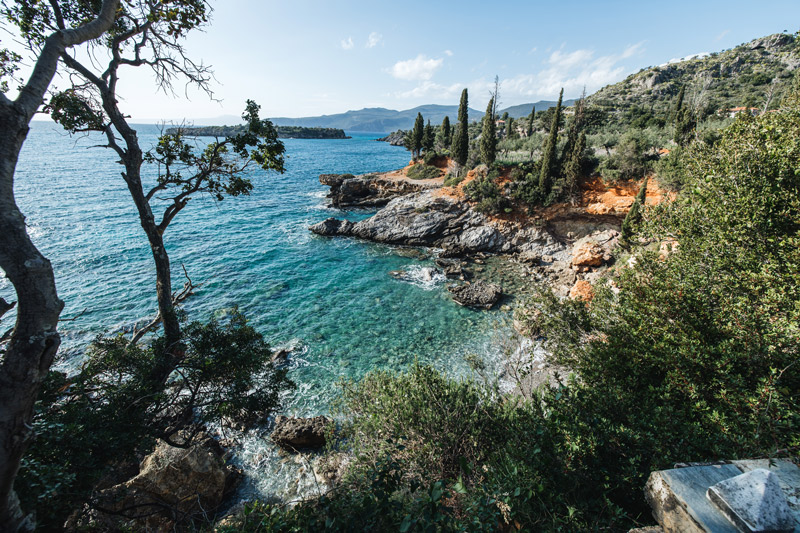
But the main star of the festival is surely the Mani peninsular itself. Just south of Kardamlyi, you pass from the shadow of Patrick Leigh-Fermor into that of an even taller ghost: Nikos Kazantzakis, nine-times Nobel nominee and author of Zorba The Greek. The novel is based on his local attempt to re-open a lignite mine with the somewhat uneven assistance of the eponymous George Zorbas; an experience later fictionalized and relocated to the writer’s native Crete. Kazantzakis was already a published writer with a taste for showmanship. While in Mani, he took to working in a sea cave, which has since borne his name. It is tantalizing to speculate whether Patrick Leigh-Fermor came to the area partly drawn by the legend of Kazantzakis, just as others now come drawn by his legend. But even the most skeptical visitor must bow to the chance of listening to Zorba’s Dance on the very beach where the two men caroused.
If that isn’t enough for literary pilgrims, there is yet a third ghost abroad in the hills of the Mani. The ashes of Bruce Chatwin are scattered in the grounds of a small hillside church close to the Leigh-Fermor house. The two men spent extended periods of time together: both while Chatwin wrote The Songlines and later as his illness advanced. Despite obvious differences in lifestyle, their peregrine natures and ambiguous spiritual appetites made them fellow-travelers. And the literary bloodlines show no sign of weakening: one attendee and previous speaker at the Kardamyli Festival, the long-distance walker and painter Jacques Grégoire, has now retraced the journeys of both Leigh-Fermor and Chatwin. Beat that for a tribute.
In The Conversation of Authors, Hazlitt wrote that writers are “too refined for the vulgar, too clownish for the fashionable.” Yet literary success means society ossifying that very impishness into the one thing most antithetical to it: a sacred cow. Disagreement is the purpose of writing. The Kardamyli Festival’s only moment of naughtiness was Ian McEwan being teased from the floor about the apparent distance between his 2010 climate-change satire Solar and last year’s What We Can Know. He relished returning the blow — but not before a sharp intake of breath had crossed the tent. Lets hope they never get hold of The Cement Garden.

