Tag Archives: Kardamyli

Gone for a walk in Greece

“YOU had better look out if you are going up to Anavriti.” The familiar words sound wonderful when spoken aloud in this cavernous, haunted and as yet sunless gorge. I repeat them, savouring their powerful energy.

Suddenly, I picture the streets of “roasting Sparta” and the Greek barber who, encouraged by his colourful customers, issued the warning as he clipped the dusty hair of a man now regarded as one of the world’s finest travel writers.

The barber’s words subsequently provided the opening salvo of what many believe is the best book in English about Greece.

by Ian Robert Smith

First published in The Australian 30 July 2011

Published in 1958, Patrick Leigh Fermor’s Mani: Travels in the Southern Peloponnese is a dense, erudite and hugely entertaining account of the author’s peregrinations in a region that, at the time, was remote, untamed and singularly archaic. Mani is also, more broadly, an affectionate portrait of a rural Greece where centuries-old customs were fast disappearing — “hammered to powder . . . between the butt of a Coca-Cola bottle and the Iron Curtain” — and for which today’s traveller hunts in vain.

I, too, am going up to Anavriti. And like Leigh Fermor when he came this way with his partner (later wife) Joan in the mid-1950s, I intend to use the village, perched on a spur of the Taygetos range, as a stepping stone into the Mani.

A battered copy of Leigh Fermor’s book resides in the top flap of my rucksack, both talisman and inspiration. Handily within reach in the side pocket is the Anavasi map of the region. Its bundled contours, crossed by the black-dotted lines of footpaths, reflect the momentous regions that await overhead.

Rich in myth and history, the Taygetos dominates the Spartan plain over which it looms like an impenetrable barrier. The northern foothills rise in the wilds of Arcadia. They shoot upwards into a vast, serrated ridge that culminates in the peak of Mt Profitis Ilias — at 2407m, the highest point in the Peloponnese — before dropping away through the Mani Peninsula.

Foothills clad in oak, hornbeam and black pine and daubed with villages buttress the eastern slopes. But the west is wild. Ancient gorges provide means of egress into this planetary world.

Some say this gorge is where the ancient Spartans left unwanted children to die. The rumble of plunging water resounds along its length.

In a large cave, a frescoed chapel, painted ox-blood red, crouches among icons and vases of the white Madonna lilies that grow wild on the slopes. Climbing further, past a sudden and terrifying drop, a curious sound wafts towards me; incoherent initially, it develops into an ethereal chanting that, echoing off the cliffs, sounds strange and beautiful in this wilderness. Bewilderment turns to rapt appreciation as I recognise the monks at Faneromeni Monastery, high above, conducting a Sunday morning service.

Beyond the monastery and a couple of antique threshing floors, Anavriti appears. Dwarfed by the glittering and snow-streaked Taygetos, several belfries and a cluster of stone houses adorn a hillside plumed with walnut, plane and cherry trees.

Not so long ago Anavriti had a thriving tanning and leather-goods industry and a population of several thousand. Nowadays, like most mountain villages in Greece, it is barely inhabited.

I amble along the main street, seeking wide balconies reached “by boxed-in staircases on wooden stilts”. In one such edifice, Leigh Fermor and Joan spent the night. Something similar faces a solitary taverna. Light-headed at finding myself in Anavriti at last, I lunch on spaghetti with rooster and abundant rose wine and, as a jovial crowd materialises, observe clouds thickening around the mountaintops. The taverna owner shrugs when I inquire what they portend, then asks, unhelpfully, whether I have a raincoat, before advising: “Go towards the good.”

This I attempt, only to become drenched, then unpleasantly steamed when the sun reappears, conjuring wondrous aromas from the glistening earth. The experience is chastening and, toiling upwards through fir forest, I conclude that following in the footsteps of literary legends can be tricky. Writing in Mani, Leigh Fermor gives fair warning.

“Feet became cannonballs,” he recounts, “loads turned to lead, hearts pounded, hands slipped on the handles of sticks and rivers of sweat streamed over burning faces and trickled into our mouths like brine.” I arrive, similarly challenged, at the author’s “unattractively alpine wall of mineral”.

It is the flank of Spanakaki Peak and also a crossroads. Intent on the Mani, Leigh Fermor bypassed Profitis Ilias and headed off to the right. Determined to tackle the summit, I veer left, up over a spur with a derelict sheepfold and across a meadow that, as thunder rumbles and rain buckets down, tilts vertically to the watershed. I reach this, hand-over-foot, but discover the view of the Messenian Gulf beyond obscured by thick mist breaking over the ridge.

Visibility shrinks to nothing as I’m engulfed, precipitating a tedious descent, followed by a forced march to the EOS refuge, where I meet a group from Athens who provide food, wine and spirited conversation. Occasionally the talk turns to Greece’s economic troubles and, predictably, as these are young people from the capital, nearly everyone has a sobering tale. They are related simply, without rancour and often with humour; but beneath the levity, disappointment and uncertainty are palpable.

The evening proves unexpectedly affecting and our farewells the next day, when I renew my assault on the summit, are heartfelt. I ascend through meadows thick with ferns, thyme and wildflowers, which give way to barren, stratified limestone, before an opening leads over the watershed. It might well be a door into another world.

Jagged pinnacles roll away to the north. Westward, rumpled slopes sundered by ravines plunge to the shores of the Messenian gulf. Silence reigns. Nothing moves except the clouds rolling across the peaks. I climb through them, tentatively over scree, on to a desolate platform scattered with stone huts and a roofless chapel dedicated to the prophet Elijah and crammed with icons, melted candles and votive offerings left by midsummer devotees.

The moment evokes a heady elation, tempered by disbelief that I am here, alone, atop the Peloponnese. Finally the sight of Kardamyli, fathoms below, reminds me it is time to catch up with Leigh Fermor. A headlong descent begins. Nightfall finds me in the Viros gorge. It is the ancient route to the coast: a massive, 14km-long canyon enclosed by fir-tufted cliffs and paved with boulders worn smooth by winter torrents, and not particularly restful.

Escaping next morning to Exochori, I locate a small chapel with a battered turret astride cicada-haunted olive terraces looking out to sea. In this lovely place, appropriate for a man who wrote so beautifully, the ashes of author Bruce Chatwin are scattered. I pause to pay my respects.

Kardamyli appears, its blond towers jutting above the sea. A cobbled path curls below the ancient acropolis. Nearby, adjacent to the reputed tombs of Castor and Pollux, I fall into conversation with a friendly English couple. Inevitably the name of Leigh Fermor comes up. We are speaking of the blood feuds in Mani when the woman says abruptly: “We’ve heard the funeral is on Thursday.”

Seeing my uncomprehending look, she adds, “You didn’t know? Paddy died last week.”

It was the day before I set out, ostensibly in his footsteps. The news fills me with sadness coupled with bewilderment at the workings of providence. I enter Kardamyli in a valedictory mood, passing through an arched gateway into a dusty square flanked by byzantine towers and a church.

In Mani, Leigh Fermor writes that Kardamyli was “unlike any village I had seen in Greece”. He and Joan loved it so much that they returned several years later and built a house in an olive grove.

Kardamyli remains laid-back and relatively unspoilt, with a long pebble beach, pretty stone houses, a small fishing harbour and friendly people. It is popular with trekkers who tackle the hinterland trails. But my walking days are over for now and my stay is marked by restlessness and an odd nostalgia. Each morning I swim to the wooded islet with the fortified wall and ruined chapel, a few hundred metres offshore. I scribble in cafes, drink with other travellers and dine out every night, once at Lelas, the waterfront taverna owned by the woman who was Leigh Fermor’s original housekeeper. Everyone, it seems, has a Paddy story to tell.

One morning, a strange impulse takes me. Just outside town, a path leaves the road and winds downhill through olive groves throbbing with cicadas. It continues, away from recent development higher up the slope, into a wilderness of trees and yellow grain fields where I pass a whitewashed chapel and, just beyond, a long stone wall, above which a mottled tile roof protrudes. Finally I come to a beach.

It lies just over the rocks, a hermetic cove enfolded by cliffs. A shiver sweeps through me when I realise: this is the place. Pushing through a wooden gate marked Private, I climb a stone staircase that zigzags up to a sprawling garden. Olive trees bestride ancient terraces.

The aromas of rosemary and cypress mingle in the hot, pulsating air. Paths of pebble mosaic thread between judiciously placed tables and benches of slate and a rambling house, built of golden stone, empty now, yet with the accumulations of a long and abundant life in place. An air of recent abandonment prevails. Leigh Fermor died in England.

Standing on the clifftop, beside one of those tables where so many delightful moments must have unfolded, I gaze out past the island to the distant peninsula, a smudge on the horizon. An age passes before I tear myself away.

Patrick Leigh Fermor’s Mani: Travels in the Southern Peloponnese was first published in 1958. The acclaimed war hero and travel writer died on June 10, aged 96.

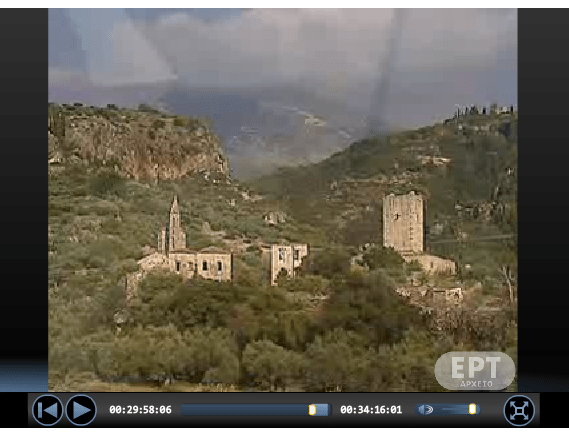
Paddy talks about his home in Kardamyli and the Mani

I doubt this has ever been seen outside of Greece. This video of Paddy is taken from a Greek TV documentary from 1999. We see scenes of Paddy working over his manuscripts, views of the library, dining room and the garden. He talks of his home and the Mani.

I am truly indebted to Nicolas Paissios for sending me this – and there is more to come 🙂


 Click the image to play. Let it run for a while and you will be taken on a journey to Paddy’s house.

Maggie Rainey-Smith’s tribute to Sir Patrick Leigh Fermor and her 2007 meeting

Please read Maggie Rainey-Smith’s tribute and further thoughts on her 2007 visit to Paddy’s house in Kardamyli.

The article includes some lovely new photographs, including pictures with Paddy inside his house

Home truths on abroad – where now for travel writing?

William Dalrymple recalls an encounter with Paddy in the Mani in 2008, discusses the impact of Bruce Chatwin, and asks where next for travel writing.

First published in The Guardian, 19 Sep 2009

William Dalrymple

What is to become of travel writing now that the world is smaller? Who are the successors to Chatwin, Lewis and Thesiger? William Dalrymple names a new generation of stars and sees a sparkling future for the genre – one less to do with posturing and heroic adventures than an intimate knowledge of people and places

Last year, on a visit to the Mani in the Peloponnese, I went to visit the headland where Bruce Chatwin had asked for his ashes to be scattered.

The hillside chapel where Chatwin’s widow, Elizabeth, brought his urn lies in rocky fields near the village of Exchori, high above the bay of Kardamyli. It has a domed, red-tiled roof and round arcaded windows built from stone the colour of haloumi cheese. Inside are faded and flaking Byzantine frescoes of mounted warrior saints, lances held aloft.

The sun was sinking over the Taygetus, and there was a warm smell of wild rosemary and cypress resin in the air. It was, I thought, a perfect place for anyone to rest at the end of their travels.

My companion for the visit was Chatwin’s great friend and sometime mentor, Patrick Leigh Fermor, who was Chatwin’s only real rival as the greatest prose stylist of modern travel writing. Leigh Fermor’s two sublime masterpieces, A Time to Keep Silence and A Time of Gifts, are among the most beautifully written books of travel of any period, and it was really he who created the persona of the bookish wanderer, later adopted by Chatwin: the footloose scholar in the wilds, scrambling through remote mountains, a knapsack full of good books on his shoulder.

Bruce Chatwin, 1940-1989

Inevitably, it was a melancholy visit. Not only were we there to honour the memory of the dead friend who had introduced us, but Leigh Fermor himself was not in great shape. At dinner that night, it was clear that the great writer and war hero, now in his mid-90s, was in very poor health. Over dinner we talked about how travel writing seemed to have faded from view since its great moment of acclaim in the late 1970s and 80s, when both Leigh Fermor and Chatwin had made their names and their reputations. It wasn’t just that publishers were not as receptive as they had once been to the genre, nor that the big bookshops had contracted their literary travel writing sections from prominent shelves at the front to little annexes at the back, usually lost under a great phalanx of Lonely Planet guidebooks. More seriously, and certainly more irreversibly, most of the great travel writers were either dead or dying.

Wilfred Thesiger (1909-2003), who was in many ways the last of the great Victorian explorers, produced no less than four exemplary books in his final decade. More remarkable still, Norman Lewis was heading for his centenary when he published The Happy Ant-Heap in 1998, a characteristically bleak collection of pieces about trips to places so obscure, so uncomfortable and often so horrible, that they would tax anyone, never mind a man in his early 90s who should by rights have been shuffling around in carpet slippers, not planning trips to visit the smoked ancestral corpses of the highlands of Irian Jaya, or the torture chambers of Nicaragua, or any other of the grisly diversions Lewis settles on to bring “some stimulation and variety” to his old age.

One typical adventure of the nonagenarian Lewis took place on a trip to Kos. On reading a story in the local paper about a police investigation into rumours that “women on the small island of Anirini were disposing of unwanted husbands by throwing them down dry wells”, he merrily set off on a boat with three sponge fishermen and a prostitute they had picked up on the Piraeus waterfront (“they spent the crossing sleeping, eating and making love – the last on a strict rota”) in search of this barren island populated by homicidal widows. Before long Lewis, then aged 92, had hopped ashore, rented a room from one of the chief suspects, and was soon cheerfully peering down well-heads in search of rotting cadavers. Continue reading

Patrick Leigh Fermor: The man who walked


Patrick Leigh Fermor was a major in the Paras during the Second World War

This profile by William Dalrymple is perhaps the most well known of all the on-line pieces about Paddy. I have so far been reluctant to add it to the blog, but as my blog is meant to be a ‘one-stop shop’ for all things Leigh Fermor I have decided its time has come.


By William Dalrymple

First published in the Telegraph 06 Sep 2008

At 18 he left home to walk the length of Europe; at 25, as an SOE agent, he kidnapped the German commander of Crete; now at 93, Patrick Leigh Fermor, arguably the greatest living travel writer, is publishing the nearest he may come to an autobiography – and finally learning to type. William Dalrymple meets him at home in Greece

‘You’ve got to bellow a bit,’ Sir Patrick Leigh Fermor said, inclining his face in my direction, and cupping his ear. ‘He’s become an economist? Well, thank God for that. I thought you said he’d become a Communist.’

He took a swig of retsina and returned to his lemon chicken.

‘I’m deaf,’ he continued. ‘That’s the awful truth. That’s why I’m leaning towards you in this rather eerie fashion. I do have a hearing aid, but when I go swimming I always forget about it until I’m two strokes out, and then it starts singing at me. I get out and suck it, and with luck all is well. But both of them have gone now, and that’s one reason why I am off to London next week. Glasses, too. Running out of those very quickly. Occasionally, the one that is lost is found, but their numbers slowly diminish…’

He trailed off. ‘The amount that can go wrong at this age – you’ve no idea. This year I’ve acquired something called tunnel vision. Very odd, and sometimes quite interesting. When I look at someone I can see four eyes, one of them huge and stuck to the side of the mouth. Everyone starts looking a bit like a Picasso painting.’

He paused and considered for a moment, as if confronted by the condition for the first time. ‘And, to be honest, my memory is not in very good shape either. Anything like a date or a proper name just takes wing, and quite often never comes back. Winston Churchill – couldn’t remember his name last week.

‘Even swimming is a bit of a trial now,’ he continued, ‘thanks to this bloody clock thing they’ve put in me – what d’they call it? A pacemaker. It doesn’t mind the swimming. But it doesn’t like the steps on the way down. Terrific nuisance.’

We were sitting eating supper in the moonlight in the arcaded L-shaped cloister that forms the core of Leigh Fermor’s beautiful house in Mani in southern Greece. Since the death of his beloved wife Joan in 2003, Leigh Fermor, known to everyone as Leigh Fermor, has lived here alone in his own Elysium with only an ever-growing clowder of darting, mewing, paw-licking cats for company. He is cooked for and looked after by his housekeeper, Elpida, the daughter of the inn-keeper who was his original landlord when he came to Mani for the first time in 1962.

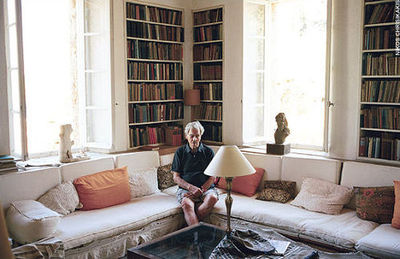
It is the most perfect writer’s house imaginable, designed and partially built by Leigh Fermor himself in an old olive grove overlooking a secluded Mediterranean bay. It is easy to see why, despite growing visibly frailer, he would never want to leave. Buttressed by the old retaining walls of the olive terraces, the whitewashed rooms are cool and airy and lined with books; old copies of the Times Literary Supplement and the New York Review of Books lie scattered around on tables between Attic vases, Indian sculptures and bottles of local ouzo.

A study filled with reference books and old photographs lies across a shady courtyard. There are cicadas grinding in the cypresses, and a wonderful view of the peaks of the Taygetus falling down to the blue waters of the Aegean, which are so clear it is said that in some places you can still see the wrecks of Ottoman galleys lying on the seabed far below.

There is a warm smell of wild rosemary and cypress resin in the air; and from below comes the crash of the sea on the pebbles of the foreshore. Yet there is something unmistakably melancholy in the air: a great traveller even partially immobilised is as sad a sight as an artist with failing vision or a composer grown hard of hearing.

I had driven down from Athens that morning, through slopes of olives charred and blackened by last year’s forest fires. I arrived at Kardamyli late in the evening. Although the area is now almost metropolitan in feel compared to what it was when Leigh Fermor moved here in the 1960s (at that time he had to move the honey-coloured Taygetus stone for his house to its site by mule as there was no road) it still feels wonderfully remote and almost untouched by the modern world.

When Leigh Fermor first arrived in Mani in 1962 he was known principally as a dashing commando. At the age of 25, as a young agent of Special Operations Executive (SOE), he had kidnapped the German commander in Crete, General Kreipe, and returned home to a Distinguished Service Order and movie version of his exploits, Ill Met by Moonlight (1957) with Dirk Bogarde playing him as a handsome black-shirted guerrilla.

It was in this house that Leigh Fermor made the startling transformation – unique in his generation – from war hero to literary genius. To meet, Leigh Fermor may still have the speech patterns and formal manners of a British officer of a previous generation; but on the page he is a soaring prose virtuoso with hardly a single living equal.

It was here in the isolation and beauty of Kardamyli that Leigh Fermor developed his sublime prose style, and here that he wrote most of the books that have made him widely regarded as the world’s greatest travel writer, as well as arguably our finest living prose-poet. While his densely literary and cadent prose style is beyond imitation, his books have become sacred texts for several generations of British writers of non-fiction, including Bruce Chatwin, Colin Thubron, Philip Marsden, Nicholas Crane and Rory Stewart, all of whom have been inspired by the persona he created of the bookish wanderer: the footloose scholar in the wilds, scrambling through remote mountains, a knapsack full of books on his shoulder.

As Anthony Lane put it in the New Yorker, Leigh Fermor ‘was, and remains, an Englishman, with so much living to his credit that the lives conducted by the rest of us seem barely sentient – pinched and paltry things, laughably provincial in their scope… We fret about our kids’ Sats, whereas this man, when he was barely more than a kid himself, walked from Rotterdam to Istanbul. In his sixties he swam the Hellespont, in homage to Lord Byron – his hero, and to some extent his template. In between he has joined a cavalry charge, observed a voodoo ceremony in Haiti, and plunged into a love affair with a princess. He has feasted atop a moonlit tower, with wine and roast lamb hauled up by rope. He has dwelt soundlessly among Trappist monks.’

For myself, it was the reading of his travel books while at Cambridge that inspired me to attempt to follow in his footsteps. With a paperback of Leigh Fermor’s in my backpack, I set off to Jerusalem following the route of the Crusaders during my first summer vacation. Meeting my hero for the first time at Bruce Chatwin’s house, just before the publication of my first book in 1989, was the nearest thing I have had to a formal graduation ceremony as a writer, the moment when you suddenly feel that maybe you really have passed out of your novitiate.

Foremost among Leigh Fermor’s books are his two glorious Greek travelogues, Mani and Roumeli; an exquisite short study of monasticism, A Time to Keep Silence; and most celebrated of all, an account of his journey in the early 1930s, travelling on foot, sleeping in hayricks and castles ‘like a tramp, a pilgrim, or a wandering scholar’, from Holland to Constantinople. On and off for nearly 70 years Fermor has been working on a trilogy about this epic walk. The first volume – and many would say his masterpiece – A Time of Gifts was finally published in 1977. The second, Between the Woods and the Water, followed nine years later. Since then, 22 years have passed with no sign of volume three, the book that should take us to the gates of Byzantium.

Leigh Fermor is now 93 and his fans are getting anxious. But travel writers have longer professional life expectancies than most – Norman Lewis, for example, produced four books between his 88th birthday and his death five years later – so we should not give up hope. Indeed, on a low table when Leigh Fermor showed me into his study, lay an 8in-high pile of manuscript, some of it ring-bound, and some in folders, on which was scribbled in red felt-tip: Vol 3.

In the meantime, Fermor fans have a small savoury to keep them going until the final course is served. This week John Murray is bringing out In Tearing Haste, a volume of letters between Leigh Fermor and the last surviving member of the Mitford sisterhood: Debo Devonshire, his close friend for nearly half a century. The letters are the nearest thing Leigh Fermor may ever get to writing an autobiography, faithfully chronicling his movements since the mid-1950s with the same detailed, painterly, highly written style that he uses in his travelogues.

Though inevitably slighter than his more polished work, the book includes wonderful accounts of some of his most celebrated adventures, such as his disastrous visit to Somerset Maugham at Cap Ferrat. Here he describes the elderly Maugham’s face as ‘so discoloured and green that it looks as though he has been rotting in the Bastille, or chained to a bench of a galley, or inside an iron mask for half a century’.

Having committed the faux-pas of appearing to draw attention to Maugham’s stammer at dinner, Leigh Fermor, who had initially been invited to stay for a week, was approached by his host at the end of the evening who offered him ‘a hand as cold as a toad, with the words “W-w-well I’ll s-s-say g-good-b-b-bye now in c-case I’m not up b-by the t-time y-you l-leave.”?’

It emerged that Leigh Fermor’s proof of the book had yet to reach the Peloponnese, so after supper I produced my own copy. He frowned: there had been a disagreement between the authors and their publisher over the cover produced by the artist John Craxton, who has illustrated all Leigh Fermor’s book since the 1950s, and the book was now covered with something more sketchy, and clearly not at all to Leigh Fermor’s liking. ‘Debo and I complained,’ he said, holding the book almost to the end of his nose and peering disapprovingly at the illustration, ‘but they kept on about business trends or some such jargon. What was it now? Market forces, that’s it. Well I never…’

As he flicked through the proof, I asked if the rumours were true: that after a lifetime of writing in longhand, he was now finally learning to type, the quicker to finish the third volume of his masterpiece.

‘Well, not exactly,’ he replied. ‘At the moment I seem to be collecting typewriters. I’ve got four now. People keep giving me their old ones. But it is true, I am planning to take typing lessons in Evesham this September.’ He paused, before adding, ‘In truth, I am absolutely longing to get down to it, before my sight gets any worse.’
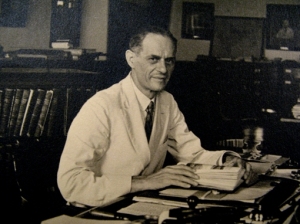
Patrick Leigh Fermor was born in London in 1915 to Sir Lewis Leigh Fermor, the director general of the Geological Survey of India, and the ‘sophisticated and wild’ Eileen Ambler. His mother was a bohemian and highly literate woman, who loved reading to her children and encouraging them to learn poetry by heart. She had been brought up in the wilds of Bihar, as a result of which Leigh Fermor can still sing, It’s a Long Way to Tipperary in Hindi. ‘Although I was brought up in England,’ he remembered, ‘India was a presence in the household, like voices in the next room.’

Almost immediately Leigh Fermor was deserted by his parents. It was the war, and they had to return to India; given the threat of U-boats, it was decided to leave the young Leigh Fermor in England so that someone would survive if the ship were torpedoed. The boy was sent to a farm in Northamptonshire where he was allowed to run free. ‘I think it formed me, you know,’ he said. ‘Made me restless and curious. I was constantly climbing trees and hayricks.’

When his mother and sister returned to collect him three and half years later, he ran away from these ‘beautiful strangers’. In retrospect, Leigh Fermor thinks the experience of ‘those marvellously lawless years unfitted me for the faintest shadow of constraint’, something that marked the rest of his career, especially at school, where he was expelled from a variety of establishments until finding happiness at ‘a co-educational and very advanced school for difficult children’.

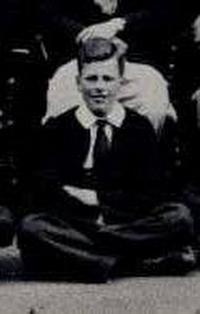
After that school was closed down due to a series of ‘vaguely guessed at improprieties’, Leigh Fermor moved on to the King’s School Canterbury. He liked the fact it was founded during the reign of Justinian ‘when fragments of Thor and Odin had barely stopped smouldering in the Kentish woods’; but his teachers were less sure about their new pupil: ‘He is a dangerous mixture of sophistication and recklessness,’ his housemaster wrote, shortly before expelling him. Unqualified to join Sandhurst, the direction in which his family had been pushing him, he attended crammers in London where he began to write poetry and to read voraciously.
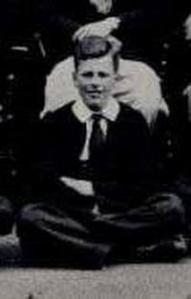
Patrick Leigh Fermor at school, Kings' Canterbury

One of the books he chanced across was The Station, Robert Byron’s newly published book about his travels through the monasteries of Mount Athos. A subsequent meeting with Byron in a ‘blurred and saxophone-haunted nightclub’ made Leigh Fermor, aged 18, ache to follow in the author’s footsteps and visit ‘serpent-haunted dragon-green Byzantium’. He had also read George Orwell’s Down and Out in Paris and London, published in 1933. With nothing to keep him in Britain he set off, having first borrowed a knapsack that had accompanied Byron to Athos, aiming to walk to that living fragment of Byzantium while living as cheaply as Orwell: ‘I loved the idea of roughing it.’

On the wet afternoon of December 9, 1933, the year that Hitler came to power, as ‘a thousand glistening umbrellas were tilted over a thousand bowler hats’, Leigh Fermor left London, boarding a Dutch steamer at Irongate Wharf. His rucksack contained pencils, drawing pads, notebooks, The Oxford Book of English Verse and a volume of Horace. He would not lay eyes on Britain again until January 1937, when he returned ‘for better or for worse, utterly changed by my travels’.

‘I thought I’d keep a diary and turn it into a book, which of course is what I did,’ he said. ‘Except I am still writing that book more than 70 years later.’ It was not just that the journey gave Leigh Fermor the subject for his lifework, it ‘broadened my mind, taught me history, literature and languages. It opened everything up: the world, civilisation and Europe. It also gave me a capacity for solitude and a sense of purpose. It taught me to read and to look at things. It was a great education. I didn’t go to university, I went travelling instead.’

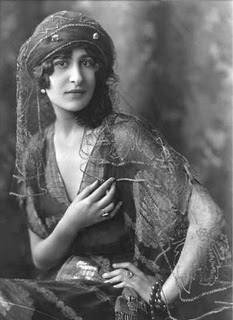
The journey also led him to meeting one of the two great loves of his life, a beautiful Byzantine princess named Balasha Cantacuzene. Leigh Fermor met Balasha in Athens, to which he walked after finally reaching Athos in early 1937. She was 12 years older than him, and had just separated from her husband, a Spanish diplomat. ‘She was 32, and I was 20. We met at just the right time and fell into each other’s arms. It was instant, we clicked immediately. We went off together and lived in a watermill in the Peloponnese for five months. I was writing, she was painting. It was heavenly.’
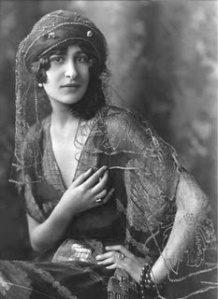
Balasha Cantacuzene

From there the couple moved back to Balasha’s rambling country estate in the dales of Moldavia, where they moved in with Balasha’s sister. Leigh Fermor has written that the two sisters were ‘good, beautiful, courageous, gifted, imaginative, immersed in literature and the arts, kind, funny, unconventional; everybody loved them and so did I.’

For Leigh Fermor, this was one of the happiest periods of his life. For two years he lived there, savouring the last remnants of a world that was just about to disappear: ‘Her family was part of an old-fashioned, French-speaking, Tolstoyan, land-owning world: country-dwelling noblesse of the sort described by Turgenev. They were intensely civilised people. The house was an old manor house, not grand, but delightful and full of pictures and books.

There was a butler who was always a bit tight, and no electricity, so we read with lamps and wicks. I spent the time reading my way through the whole of French literature and playing chess – when I wasn’t making a hash of writing this book.’ He paused, then added, ‘Of course I wanted to marry her, but she said, “Don’t be ridiculous – I’m much older than you.”?’

Both the romance and the world in which it was set were ended for ever by the war. ‘We were aware that war clouds were looming, but didn’t realise how serious it was. We were out on a picnic, some of us on horseback and some in open carriages, when someone shouted across the fields that the Germans had gone into Poland. I made the decision at once: if war had broken out I had to join the Army. I thought it would be over in six months.’

In the event, Leigh Fermor did not lay eyes on Balasha again for a quarter of a century. With the end of the war came the Iron Curtain, and Balasha could no more get out of Romania than Leigh Fermor could get in. When he eventually managed to find a way to get in as a journalist, he found Balasha living in poverty in a Bucharest garret, surviving by teaching English, French and painting. ‘We sat up and scarcely went to bed for 48 hours, laughing the whole time: “Do you remember?” By this time I was with Joan. Balasha took it all in such a philosophical and charming way. She was an extraordinary person.’

It emerged that the Cantacuzenes had been branded ‘elements of putrid background’ and Balasha’s lands had been confiscated soon after the end of the war. She had lost everything. The day Ceausescu’s commissar turned up she and her sister had been given quarter of an hour to pack. The house had subsequently been turned into a lunatic asylum. In Leigh Fermor’s account of the reunion, he wrote how he ‘found them in their attic.

In spite of the interval, the fine looks of my friends, the thoughtful clear glance and the humour were all intact; it was as though we had parted a few months ago, instead of 26 years… [But] early thoughts of leaving Romania lapsed in the end, and they resisted the idea partly from feeling it was too late in the day; secretly, perhaps they also shrank from being a burden to anyone. One by one the same dread illness carried them away.’

The same war that destroyed Leigh Fermor’s great love affair also made his name as a man of action. From Moldavia he returned to Britain and enlisted in the Irish Guards. As a fluent Greek speaker he was soon singled out for intelligence work, and was sent first to Albania and then to Greece as a liaison officer working with the Greek army. After the fall of Greece he found his way to Crete just in time to fight in vain against the Nazi invasion. From there he was evacuated to Alexandria where he set up house with several other young intelligence agents and a refugee Polish countess, Sophie Tarnowska, who moved in with her few possessions: ‘a bathing costume, an evening gown, a uniform and two pet mongooses’.

Before long Leigh Fermor was sent back into Crete to work with the Cretan resistance. He and an odd collection of recently enlisted Greek-speaking classical scholars and archaeologists were parachuted into the occupied island disguised as shepherds and established a troglodyte existence under the stalactites of mountain caves, commanded by a Fellow of All Souls. The port from which Leigh Fermor set off was captured by Rommel’s advancing Afrika Korps the day after he left. ‘It was a low moment in the war: the Germans seemed to be advancing in triumph in all directions.’ It was partly for this reason that Leigh Fermor’s bosses gave permission for his wild scheme to raise morale: kidnapping the German commander of the island.
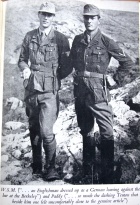
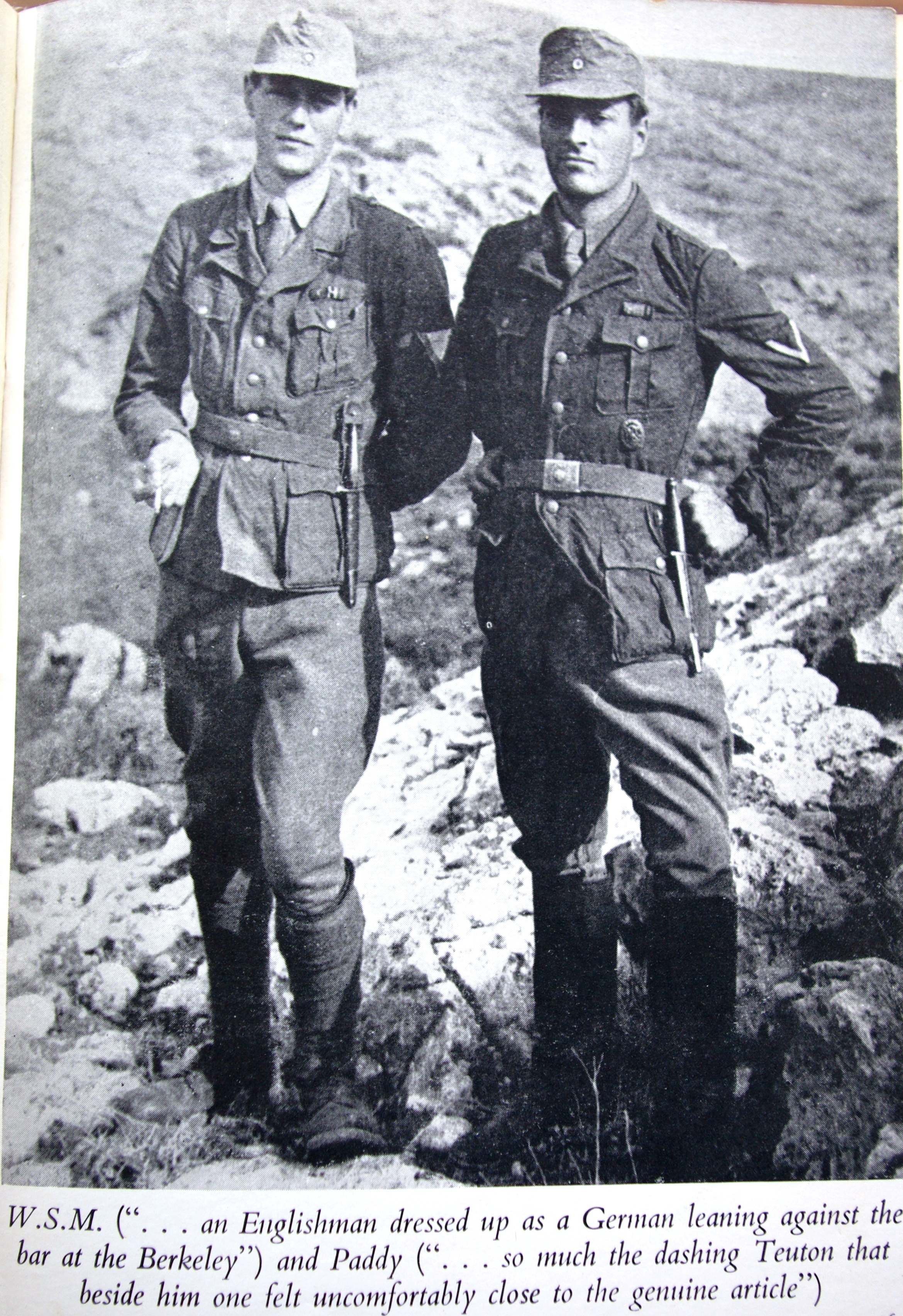
Patrick Leigh Fermor and Moss

Patrick Leigh Fermor and Moss in German Uniform Prior to the Abduction of General Kriepe

In Leigh Fermor’s own account of the abduction of General Kreipe, the climax comes not as the general’s staff car is stopped at night by a British SOE partly dressed in stolen German uniforms, nor as the Cretan partisans help smuggle the general into the highlands and hence to a waiting British submarine; but instead as ‘a brilliant dawn was breaking over the crest of Mount Ida’.

‘We were all three lying smoking in silence, when the general, half to himself, slowly said, “Vides ut alta stet nive candidum Soracte”. It was the opening of one of the few Horace odes I knew by heart. I went on reciting where he had broken off… The general’s blue eyes swivelled away from the mountain top to mine – and when I’d finished, after a long silence, he said: “Ach so, Herr Major!” It was very strange. “Ja, Herr General.” As though for a moment, the war had ceased to exist. We had both drunk at the same fountains long before; and things were different between us for the rest of our time together.’

It is an archetypal Leigh Fermor anecdote: fabulously erudite and romantic, and just a little showy. For his greatest virtues as a writer are also his greatest vices: his incantational love of great waterfalls of words, combined with the wild scholarly enthusiasms of a brilliant autodidact. On the rare occasions he gets it wrong, Leigh Fermor has been responsible for some of the most brightly coloured purple passages in travel literature. But at his best he is sublime, unbeatable.

Back in Egypt, Leigh Fermor met his future wife, and the companion for the second half of his life. Joan Eyres Monsell was then working for the intelligence department as a cipher clerk. ‘She had a house near the Ibn Tulun mosque, and was very go-ahead,’ Leigh Fermor remembers. ‘She was a nurse when the war broke out, and had lived in Spain and Algiers before Cairo. We met at a party and hit it off very quickly.’

When the war was over, Joan and Leigh Fermor remained in Greece, wandering the country and initially finding work in the British Council, whose Athens office was then run by the other great British philhellene of that generation, Sir Steven Runciman. But as ever, Leigh Fermor’s wanderlust soon got the better of him, and before long he had resigned. In 1949 they caught a ship to the Caribbean, a trip that resulted in two books: a travelogue, The Traveller’s Tree, and a fine novel, The Violins of St Jacques. Both were written partially in Trappist monasteries, an experience that Leigh Fermor turned into his third and most tightly written book, A Time to Keep Silence.

It was in the early 1960s that Leigh Fermor married Joan and settled down with her in Kardamyli, to continue his life of writing travel books, interspersed with weekly book reviews for Cyril Connolly’s Sunday Times book pages. It is this more settled phase of life that is so well captured in the new book of letters between Leigh Fermor and Deborah Devonshire. There are lovely descriptions of Leigh Fermor and Joan finding the bay at Kardamyli; the struggles to finish A Time of Gifts; Leigh Fermor’s surprise and pleasure at its rapturous reception; and the slow writing of its sequel.

The final 50 pages of the book have a more melancholy tone, as their friends begin to die, one by one: the English ones often of cancer, the Cretans, more dramatically, falling from precipices, and the like. Finally come the deaths of both Debo’s husband, Andrew, and of Joan Leigh Fermor: ‘The cats miss Joan bitterly,’ Leigh Fermor writes at the end of the book. ‘They are not the only ones… I keep thinking of things I must remember to tell Joan at lunch, knowing they could make her laugh. Letters addressed to her still arrive from distant parts, but even they are dying out now, and increasingly it’s only subscriptions to be renewed.’

Leigh Fermor enjoys a two-hour siesta after lunch – ‘Egyptian PT’ as he calls it. But on my last day in Kardamyli he emerged at 4pm, smiling from ear to ear. ‘Didn’t sleep a wink,’ he said. ‘Got quite carried away reading the book. I was rather dreading it, but was pleasantly surprised.’ He held up the proof approvingly. ‘Some passages are really awfully good.’
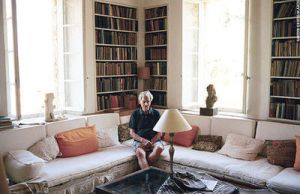
Paddy at home in the Mani

After our lunch we went up the mountain beside the house to see the Byzantine chapel around which the ashes of his friend Bruce Chatwin had been scattered. The chapel was very small – only a little larger than a big garden shed. It had a domed red-tiled roof and round arcaded windows. It lay in the rocky fields near the village of Exchori, high above Kardamyli, and was built from stone the colour of halloumi cheese.

The sun was slowly sinking over the hills at the end of a hot day; from the higher slopes, the tinkle of goat bells cut through the drowsy background whirr of cicadas as shepherd children led their flocks back for the night. It is perfect, beautiful, a peaceful place for anyone to end their days, and as we headed back I asked Leigh Fermor whether he would like to be buried there, too.

‘Oh no,’ he replied instantly. ‘Joan is in Dumbleton. I’d rather like to end up there.’

It’s a characteristic of so many of the greatest English travellers that they come back home in the end. TE Lawrence, for example, finally recognised ‘that I could not sincerely take on the Arab skin’, and the same is true of Leigh Fermor. For all his years in Greece, he remains almost the archetypal Englishman, in its best possible form: ‘My heart is in both,’ he said as we headed downhill. ‘England is not a foreign country to me.’ He paused and looked down over the Aegean, glinting now like broken glass far below us: ‘I do love both countries,’ he said as we headed on home. ‘I really do.’

I knew Patrick Leigh Fermor through his words, and he will know me by mine

I think I am quite privileged to receive so many positive comments about the blog from people I have never met. One thing many agree upon is that Paddy has had a significant impact upon their lives. In some cases reading A Time of Gifts has been life changing, with some literally getting out there on the road and creating their own journey.

One message that really struck a chord was from Thos Henley – after the old abbreviation of Thomas I am told – who was originally from my neck of the woods in Hampshire, England, but who set off on the road two years ago and is now living what I imagine to be a bohemian life somewhere on the left bank of the Seine in Paris. He has even written and recorded some of his own songs, one which includes a reference to Paddy; it is good music and worth listening to. [Edit – I have listened to it a few times now and it really is quite good; have a listen]

Thos’ story is very moving and I asked if he would like to share it with other blog readers. He agreed so over to Thos …

Thos Henley at Paddy's door

“I am a 22 year old musician and a writer from Netley Abbey, Hampshire. Around two years ago I set off the travel France. One of the reasons I did so, was because I had recently discovered Paddy’s work. After this eventful trip all around the country, I settled in Paris, which now acts as my home and I have not been back to England since. In this time I have walked around the largest lakes of Sweden, travelled the expanse of Europe, and released a record in Paris named GOLDEN EUROPE. One of the songs on the record is about my travelling companion on the trip through France. He was my Xan Fielding and in the song I reference Patrick Leigh Fermor. It is called ANOTHER BROTHER and you can find it by clicking here.

Recently, I took a trip with my girlfriend to Greece. We went to Patras and walked to the edge of the Peloponnese. Slowly moving down south we made our way to Kalamata and then Kardamyli. I became good friends with certain locals and on the third day I had a map drawn out for me, with the whereabouts to Paddy’s home.

When I got there, the soles of my shoes had withered away (an overdue happening as I had worn them out for years). I met his house-keeper who spoke a very gentle Greek-English. I was nervous and I could hear Paddy eating his lunch next door and after a few minutes of introducing myself to his assistant I learnt that he was just too old to see anyone. She explained that the emotional toll was too much for the man who had been through it all. Passion carried my persistence but in the end I started to feel like some kind of a stalker and I gave up. Leaving his incredible garden, I heard through an open window, the mumbled low tone of Sir Patrick himself, obviously inquiring about the energetic English boy who had just been at his ocean blue door.

Sitting on the wall that he had made some 20 years or so before my own birth, I began to write him a letter. I explained my story and the fact that in his words I had come to find some sense of freedom in this ever enclosing world in which we all reside. Tears and sweat dripped onto the scribbled words that, no matter how much I tried, would never portray truly what this man meant to me. I wrapped the piece of paper over and around my old Swedish compass. In the letter I had told him I left it for him, as I had no need for it now; it had guided me to his house, where I sat boiling in the Greek sun, and its job, in my eyes, was done.

I swam for hours that day, washing away the heat and the sadness of not meeting ‘my’ Byron. However after reaching my hotel, after the sun had died and the raging fire of the crickets sang in their clicking chorus, I began to see the up side of what I had done. Yes I may not have met the man, but the fact remained that I had been to his home which I wished to visit over my childhood home in England. It was his seas that I wished to swim in over any other ocean in the world and it was his door step where I wrote, what I still hold as the best piece of writing I have done to this day.

This is not an ego talking but personal victory. I can live my life here, in this rainy, grey city of lights, Paris, knowing in myself that Paddy read my words and opened the same compass that I had used for years, its red point quivering on the W. And he would go to sleep that night knowing once more that his life had indeed been the greatest life ever lived and was still just as appreciated as it had always been.

In the end I knew Patrick Leigh Fermor through his words, and he will know me by mine.”

Visit Thos’ MySpace page where there are more photographs, you can find some of his music and videos.

Meeting Patrick Leigh Fermor in the Mani

Recently we have been musing in some posts about following Paddy’s route. For many of his fans this is perhaps a dream, but nevertheless, something many would like to make real. Topping that of course is meeting Paddy himself. In this piece, New Zealand author Maggie Rainey-Smith unexpectedly meets Paddy on a trip to Kardamyli on Greece’s Mani Peninsula, where Paddy has lived since the 1960’s. Some of you may have read it but I think it is such a nice article that it is worth re-visiting.

First published in the New Zealand Herald 15 June 2008

 
The village of Kardamyli is on the west coast of the Mani Peninsula, one of the more traditional and conservative areas of Greece.Recently, I spent two months in Greece chasing the muse, searching for clues, looking for inspiration.

The Mani Peninsula region is famous for the Maniots and their resistance of the Ottoman occupation. It is isolated by the Taygetus mountain range and enclosed by the Aegean and Ionian seas.

The Ottomans failed to infiltrate, but I have to advise that the English have. As I shopped for my Twinings tea and sat outside a cafe in the village of Kardamyli, using the free internet, I lamented the globalisation of this once-remote peninsula.

I wished, for just a moment, that I was back in time when to be a strange woman alone in this small village may have attracted disapproving stares.

In the local bookshop was the very book I’d been looking for: Mani – Travels in the Southern Peloponnese, by Patrick Leigh Fermor. On my terrace overlooking the sea, I opened the book and found myself mesmerised by the most exquisite, evocative travel writing I have ever read. Not only that, I discovered that Fermor is a resident of Kardamyli.

The owner of the bookshop was unimpressed when I asked where Sir Patrick lived, and his lips remained sealed, his expression disapproving. Fermor is almost a saint in Greece.

He was a resistance fighter in Crete during World War II; his exploits were the subject of a film starring Dirk Bogarde (my father was in Crete, but a more modest hero at Maleme, the point where the island was finally lost to the Germans).

At the local cafe, where I made use of the technology, the owner (who looks like a Maniot right out of Fermor’s book, with her blanket of black ringlets and beautiful olive eyes), told me Paddy (as the locals call him) would celebrate his Name Day that very week and that he always opens his home to the locals on that day.

By then, and after one week’s residence, I considered myself a local, and everyone agreed with me.

So with joyous disbelief at my good fortune, on Thursday, November 8, I joined the local villagers at Sir Patrick’s Name Day celebration at his majestic and yet still homely yellow stone house overlooking the Messinian Gulf.

By 10.30am the service in his private chapel was over and we were seated in his lounge – books lining the walls from floor to ceiling: Nancy Mitford, Henry James, James Joyce – eating olives, meatballs, feta and drinking local wine.

On a person’s Name Day you are required to take a gift, and all I had with me was a copy of my first novel About Turns, which I gave to Paddy. He signed my copy of his own book with a personal inscription and a small drawing. We talked about Crete and my dad and his book on the Mani. I gushed, he charmed.

Then the singing began and Paddy was surrounded by adoring local women who toasted him with traditional Name Day songs.

At the end of the singing, Paddy stood and pretended to fire a pistol into the air (an old tradition where real pistols were once used). He is of English and Irish descent. Although his name is Patrick, his Greek Name Day is the day of Michali. Michael is the name he assumed while fighting for the Greek resistance.

With me was an American Orthodox nun who worked in Moscow and a Danish man of the cloth who was studying Byzantine churches. We were Paddy’s “non-local” guests and pinched ourselves to check we weren’t imagining our good fortune.

When it was time to leave, another Michael (Michali), a neighbour of Paddy’s, invited us to his home. We walked through an olive grove up the hill along the coast to another beautiful stone home.

Our new host sold Paddy the land and helped him build his house in 1964. We were feted with fresh coffee and cakes and listened to Michali’s son, who told us that when he decided to leave Kardamyli some years ago to travel, Paddy told him: “You can’t leave.”

And when he returned years later, Paddy told him: “You know we are very fortunate, we live in Kardamyli. We are fortunate – we have the mountains. We are fortunate – we have good food. We are fortunate – we have clean air to breathe. We are fortunate – we have the beautiful sea to swim in.”

“Yes, Paddy, the mountains, the food, the air and the sea,” said the young man, nodding in agreement.

And then Paddy said to him: “And for all these reasons and more, we may just forget to die.”

Sir Patrick Leigh Fermor is 92 years old, he was wearing a double-breasted navy suit when I met him, had a full head of wavy grey-black hair and was still a handsome, charming man with just a slight deafness in one ear.

He spoke with a classical English accent which rather surprised me, considering the years he has spent in Greece.

He is still writing. If you’ve never heard of him, or never read his books, now is the time to start.

By Maggie Rainey-Smith

Writer and WWII hero honoured with Order of the Phoenix

Report of the presentation of the Greek Order of the Phoenix to Paddy

First published Ekathimerini online 3 March 2007

By Helbi

Patrick Leigh Fermor (right) with Colonel Mark Blatherwick, the British defense attache in Athens

The week that passed brought both joy and sorrow to those close to two British heroes who fought for Greece during World War II and whose love for the country never dimmed. The writer Sir Patrick Leigh Fermor, author of famous books such as “Mani” and “Roumeli,” “A Time of Gifts” and “Between Woods and Water,” even settled in Greece, near the Mani village of Kardamyli. This week President Karolos Papoulias bestowed upon him the Order of the Phoenix in the New Year honors for 2007. Ambassador Tassos Kriekoukis, director of protocol for the Foreign Ministry, spoke of “Sir Patrick’s love of writing and traveling but also for Greece, for whose freedom he fought at the side of Greek and British commandos. Who can forget his part in the kidnapping (in wartime Crete) of (German) General Kreipe?” Colonel Mark Blatherwick, the British Defense Attache in Athens, accompanied Sir Patrick Leigh Fermor to the event.

Visit to the veteran of the Peloponnese by Wieland Freund (from Welt Online)

A 2007 interview with Paddy by Welt Online. The Germans have almost the same fascination for Paddy as we do. Afterall his first adventures took place in Germany (A Time of Gifts) and his part in the kidnap of General Kreipe has a particular fascination. 

He also confirms that “Volume Three” is being written – translated by Google – Oh yes, “he says in the rich sunshine,” I will write this book. There is to end on Mount Athos. From there, I have notes for every day. 

So here is the Google translated version. The original in German for the purists and the linguists is the next article below. 

Stop Press! I have had an offer to translate this properly and when I receive it I will replace the trash from Google. In the meantime, my apologies and enjoy trying to make sense of it!

Resistance fighters, hikers, travel writer Patrick Leigh Fermor went to Istanbul as a young man, kidnapped in 1944 in Crete an army general and now lives in Mani. There he kept on the typewriter by Bruce Chatwin. 

Since the sixties, the home of Patrick Leigh Fermor: the Mani peninsula in the Greek Peloponnese. 

That there could be his house did not think you would have to climb into a closet or throw himself into a rabbit hole in order to achieve it – this idea comes with the darkness and returns, turned back into the Enchanted. 

The way to Patrick Leigh Fermor, the Herodotus of the 20th century, leads, it seems, to the edge of the world and then one step beyond. The shimmering leaves of the olive grove, the giant lemon and the red, Greek past of heavy earth might as well be the props of a dream. 

“Paddy” came first in 1952 by Mani 

We keep a vigilant group of cypress trees and follow the overgrown path until a sky-blue gate. Do I need a spell, so it opens and appears Fermor, the travel writer, war hero, the legend? Knocking at least seems too little. 

With 92 years, Patrick Leigh Fermor of immortality as close as it is today even comes close. His way of fame is just off the beaten track to have the world, behind firmly closed doors or in such places as the taciturn Mani. 

Paddy, like not telling the familiar without reverence, came here in 1952 for the first time. How the Spartans and the Byzantines, who fled from Slavs and Turks, and of which he knows everything, he climbed the passes of the up to two and a half meters Taygetos, the Mani, the middle finger of the Peloponnesian hand, centuries made for a natural fortress.

Patrick Leigh Fermor in Berlin

The knocking does not answer 

The back of the slopes wrinkly rich almost to the bay. Bruce Chatwin, who came to Paddy as a “guru to worship” or how to overthrow a king, saw eagles soar over the house of Leigh Fermor. Twenty years later, Paddy Chatwin ashes buried – next to a crumbling Byzantine church not far from here. The Mani is famous for its action songs. 

Southward, on the faded, twinkling towers over the tiny villages, run, it means that a chasm into Hades. Leigh Fermor found it flooded. “Phosphorgefiedert,” he wrote, dip it into the cold depths and swim “through the heart as a huge sapphire. 

We knock in vain to dare us to elaborate the cobbled courtyard and whisper with the housekeeper. It leads us through the garden open arcades, which might as well bend over a cloister. 

Leigh Fermor is tattooed like a sailor 

Leigh Fermor has written so many monasteries in Europe, in towers of “solid ivory, and if anyone here was an escapist, The doors to the rooms, however, the numerous tables, which depends on the sound of glasses and laughter as a smoke curtain, speak a different language. 

Leigh Fermor speaks many. Photographs show it once hung over bursting with charm and zest for life, sometimes almost professorial, and again obviously as a sailor and tattooed. 

We wait under the coffered ceiling of the spacious, wonderfully cluttered living room, from which the English poet John Betjeman once wrote that it was “one of the rooms of the world.” On one wall hang paintings by Nicolas Ghika and John Craxton, leaning on a shelf worn, faded volumes of the great English stylist. On the floor there is a band “Sherlock Holmes”. “Enchanting easy, right?” 

The family left behind her son with strangers 

This could be Merlin: a jumble the gray, wavy hair, sharp features and eons of age in the eyes. Leigh Fermor carries the threadbare sweater a garret of scholars and the trousers of an artist in his studio. 

He is of overwhelming kindness, perfectly shaped “upper class”. In the sunlit bay he called almost everyone who comes to the question, “marvelous”: writers, painters, musicians. “They all knew.” – “I am,” he says mildly, “that old.” 

“For at least one of us children would remain alive, if a submarine sank the ship,” Paddy was in the care of a small family back in England. 

1933 – the first trip to Istanbul 

“I ran,” he says, “shouting and screaming across the yard. I never learned discipline. I was a difficult student. “-” Lazy? “-” Disobedience. “Even a psychiatrist who also treated Virginia Woolf was consulted. Paddy still flew from the school. He had kept up with the daughter of the greengrocer’s hands. 

The autumn of 1933 found him in a room not far from trouble blowing from London’s Shepherd Market, where he should have been cramming so that at least the military school would take him. 

Instead, he took a verse of George Herbert at his word: My way is free, free to the horizon, / Much like the wind. “In December 1933 he embarked for Holland. From there, he wanted to walk into a “green dragon”, Byzantium, which he never called Istanbul. 

On the trip report, the fans are waiting until today 

He is famous for getting lost in the widely spread European history, which he knows like no other. In Mani, one of his best books, the “opposite of a travel guide,” as he says, there is a footnote, the sheer joy of the strangest here, “and there crafty peoples’ lists of Greece: the Melevi Dervishes of” Tower the winds “, the fire dancers from Mavroleki, the hiking quack Eurytaniens. With the gypsies, whom he met in 1934 in the highlands of the Carpathians, said Patrick Leigh Fermor Latin. 

Paddy arrived on New Year’s Day of 1935 in Constantinople, and had better things to do than to write about his trip. He is one of the great English stylists working, slowly, life itself seems always in your way. 

It was not until 1977 “was published, the time of the gifts,” which describes his journey from Hoek van Holland to the middle Danube, nine long years later, “between forests and water”, which leads to the Iron Gate. The third book, the description of the phenomenon must last up to Constantinople, is still expected with such longing that leave a few words from the mouth of Paddy’s heave a sigh British press today. 

Where Chatwin’s old typewriter? 

When Sir Patrick, as he was allowed to call since 2004, was awarded in March in Athens the “Order of the Phoenix,” he told his casual way that he, because his handwriting was always bad, just learn to touch type. 

Oh yes, “he says in the rich sunshine,” I will write this book. There is to end on Mount Athos. From there, I have notes for every day. “We are walking through the garden, the Gulf of Messinia in a dozen colors of light blue. On the burnt grass stretches herself a hangover: “His great-grandmother one day was just there.” 

The studio is housed in an outbuilding. In an iron chest, which bears the inscription of “Traveller’s Club” that tape, books are stacked on the wall a faded French hunting scene. Somewhere there must be also Chatwin old typewriter, a 51er Olivetti. But where? Where? 

Soldier, he was happy because “was always something going on” 

On Mount Athos celebrated his 20th Birthday, then went to Athens, as he later went to Paris and Rome. With a Romanian princess, he lived in an old water mill in the Peloponnese, and followed her to finally Balení, the seat of her family in northern Romania. 

Russia and the horrors of communism were suddenly within reach. “Many of your friends were communists at that time.” – “I did not speak up,” he says. “ “I was so apolitical.” 

In Balení reached him of the war. He, which six years earlier at the Shepherd Market has become clear, “how little I was good for soldiers in peace time,” volunteered. The departure was hasty. “Not even my notebook I took with me. We were so naive. In a few months ago we believed us again. “It took decades. “Were you like a soldier?” – “In a way, yes. “ There was always something going on. ” 

In 1944, he kidnapped a German general 

Books are also in the bathroom and somewhere between them is a plaque commemorating the Battle of Crete. When she was lost, went back Leigh Fermor as major of the Special Operations Executive to Crete. One and a half years he lived disguised as a shepherd in a cave – “wrapped in white cloth from goat and horribly dirty” – and organized the Cretan resistance against the German occupiers. 

The rest is legend, one of the most daring commando raid of the Second World War. One night in April 1944, a large Opel on the road to Knossos, Paddy in a stolen German uniforms on the way. A scuffle and then, at the roadblocks, again and again the cry of “General car. 

For days wandered Leigh Fermor, the people and kidnapped the German General Kreipe through the mountains until they reached the coast, and finally Libya (Egypt). On the difficult journey Kreipe murmurs once verses of Horace. Leigh Fermor is one. „Ach so, Herr Major“,  

About the death, he never speaks 

Paddy has never really written about it. “Ill Met by Moonlight,” the book that tells this story in full, comes from Bill Stanley Moss, his former deputy, and was filmed with Dirk Bogarde as Leigh Fermor. 

When it first appeared in 1950, just came Paddy’s first book, “The Traveller’s Tree,” a description of his travels in the Caribbean out. DThen he was – in the UK, famous in Greece “He embodied an idea of the Renaissance,” writes Cooper, Artemis, “a man of action, which is just as much a scholar.” 

Cooper, the friend and daughter of a friend is writing Paddy’s biography, when he, as he says, “is just gone.” “But now that you mention it: We never really talk about it.” 

The stones for the house came with the donkey 

For lunch there are lemon chicken, tzatziki and Retsina. We sit on chairs Andalusian, a Venetian table at the foot of a guillotined by the passage of time Roman Sibyl. Leigh Fermor has picked up in Rome on the way, he collects nothing. 

He tells the story of Niko Kolokotronis, the Mauerermeister that the contract was to build his house, because six generations were Kolokotronis wall masters, and played all the violin. That was the beginning of the sixties. In the bay there was no electricity, donkeys brought the stones, and Paddy and his wife Joan were living in tents, until the house was finally finished. 

“I scribble in the studio in front of me,” reads a letter from the most beautiful, vibrant with life days in the bay.”Through the window I can see Joan, their army cats invites you to dinner; mass meows to rise, and their tails make waves like the sea.” 

A picture of his wife Joan (cats) in her hand 

Leigh Fermor demands a picture of the mantel, Joan in the forties, which he portrayed with a pencil. “Come on!” She called from a boat, as Paddy, like his hero, Lord Byron swam the Hellespont. “It took three hours.” 

Joan died in June 2003 here.”She was,” he says, his drawing in hand, “in truth much more beautiful. 

Original article here.

Besuch beim Haudegen des Peloponnes Von Wieland Freund (Welt Online)

Widerstandskämpfer, Wanderer, Reiseschriftsteller: Patrick Leigh Fermor ging als junger Mann nach Istanbul, entführte 1944 auf Kreta einen Wehrmachtsgeneral und lebt heute auf Mani. Dort bewahrt er die Schreibmaschine von Bruce Chatwin auf.

Dass es sein Haus gar nicht geben könnte, dass man in einen Schrank steigen oder sich in einen Kaninchenbau stürzen müsste, um es zu erreichen – dieser Gedanke kommt mit der felszerklüfteten Dunkelheit und kehrt tags, ins Verwunschene gewendet, zurück.

Der Weg zu Patrick Leigh Fermor, dem Herodot des 20.Jahrhunderts, führt, scheint’s, an den Rand der Welt und dann noch einen Schritt darüber hinaus. Die flirrenden Blätter des Olivenhains, die riesenhaften Zitronen und die rote, von Vergangenheit schwere griechische Erde könnten ebenso gut die Requisiten eines Traums sein.

“Paddy” kam erstmals 1952 nach Mani
Wir halten auf eine Gruppe wachsamer Zypressen zu und folgen dem zugewachsenen Pfad bis vor eine himmelblaue Pforte. Braucht es einen Zauberspruch, damit sie sich öffnet und Fermor, der Reiseschriftsteller, der Kriegsheld, die Legende erscheint? Klopfen jedenfalls scheint zuwenig.

Mit 92 Jahren ist Patrick Leigh Fermor der Unsterblichkeit so nahe, wie man ihr heute noch nahe kommt. Seine Art Ruhm ist nur abseits des Weltenrummels zu haben, hinter fest verschlossenen Türen oder an so verschwiegenen Orten wie der Mani.

Paddy, wie die Vertrauten nicht ohne Ehrfurcht sagen, kam 1952 zum ersten Mal her. Wie die Spartaner und Byzantiner, die vor Slawen und Osmanen flohen und von denen er alles weiß, erklomm er die Pässe des bis zu zweieinhalbtausend Meter hohen Taygetos, der die Mani, den Mittelfinger der peloponnesischen Hand, Jahrhunderte lang zu einer natürlichen Festung machte.

Read more here!

Joan Leigh Fermor – Obituary from The Independent

Published Tuesday, 10 June 2003

Muse who enlivened a distinguished generation

Like all adorable people Joan Leigh Fermor had something enigmatic about her nature which, together with her wonderful good looks, made her a very seductive presence.

Joan Elizabeth Eyres Monsell, photographer: born London 5 February 1912; married 1939 John Rayner (marriage dissolved 1947), 1968 Patrick Leigh Fermor; died Kardamyli, Greece 4 June 2003.

Like all adorable people Joan Leigh Fermor had something enigmatic about her nature which, together with her wonderful good looks, made her a very seductive presence.

She was also naturally self- effacing. Even in a crowd she maintained a deep and private inner self. In fact I know she regarded every agora with phobia. Paradoxically, she loved good company and long and lasting friendships. It was her elegance, luminous intelligence, curiosity, understanding and unerring high standards that made her such a perfect muse to her lifelong companion and husband Patrick Leigh Fermor, as well as friend and inspiration to a host of distinguished writers, philosophers, painters, sculptors and musicians.

Cyril Connolly described her in a letter to his mother in 1949 as “a person with whom I have everything in common – friends, tastes, intellectual interests – and very beautiful: tall, fair, slanting eyes, yellow skin”. For the future editor of the Times Literary Supplement Alan Pryce-Jones, 17 years earlier, she was

very fair, with huge myopic blue eyes. Her voice had a delicious quaver – no, not quite quaver, an undulation rather in it; her talk was unexpected, funny, clear-minded. She had no time for inessentials; though she was a natural enjoyer, she was also a perfectionist whom [aged 20] experience had already taught to be wary.

When I first met her in 1942 through Peter Watson, owner and founder with Connolly of Horizon magazine, she was living as his neighbour in the only modern block of flats in London, 10 Palace Gate, designed by Welles Coates. She was a dazzling beauty and I, an awkward 20-year-old, was utterly stage-struck when she invited me to dance with her one evening at the very smart Boeuf sur le Toit night-club. The manager tried to remove me as I was wearing sandals, but was promptly reprimanded by Joan.

By wonderful good fortune she was already in Greece when in May 1946 I turned up for the first time in Athens, where she introduced me one evening to Paddy Leigh Fermor, who with his knowledge of the Greek countryside near Athens was instrumental in finding me a place to live and paint on the island of Poros. Joan’s love of Greece and the Greeks started, like mine, from this time.

Athens just after the Second World War was host to a unique group of marvellously talented men and women that included the philhellenes Steven Runciman, Maurice Cardiff, Lady Norton and Osbert Lancaster (whose secretary she had been), the Anglophile Greek painter Nico Ghika, the poet George Seferis and George Katsimbalis, Henry Miller’s colossus of Maroussi.

Anyone who thought foolishly that Joan herself was not really doing anything was as far from the truth as it is possible to get. Her unwavering empathy, generosity, taste and intelligence made her a creative catalyst to all who became her friends. Later on, Constant Lambert, Giacometti, Francis Bacon, Dadie Rylands, Louis MacNeice, Stephen Spender, Balthus, Maurice Bowra and Freddie Ayer, to name only a few, were all devoted admirers.

Joan herself was at that time one of the finest amateur photographers in England. Her photographs were first published, through her friend John Betjeman, in the Architectural Review, and then in Horizon, and are to be found in her husband Paddy’s books about Greece – Mani: travels in the southern Peloponnese (1958) and Roumeli: travels in northern Greece (1966). In 1948 she was employed by Cyril Connolly to be his photographer for a guidebook to south-west France, a book he never wrote, perhaps because, as he recorded in his journal, he “fell very much in love”, distracted by

her dark green cardigan and grey trousers, her camera slung over her shoulder and her golden hair bobbing as she walks, always a little fairer than you think, like the wind in a stubble-field.

During the war she was commissioned to take photographs of buildings vulnerable to bombing. After it a favourite subject was cemeteries – in Paris (Père la Chaise), notably, and Genoa. Somehow I never dared ask her why she gave up photography. It was always foolish to ask Joan a question when one already had a jolly good idea of what the answer might be: probably she did not think she was good enough.

At one time she owned a large convertible Bentley, appropriately nicknamed Moloch. It guzzled petrol as a row of thirsty Lombardy poplars needs water. One summer we set off in it with Paddy to drive to Italy, Joan at the wheel all the way, to meet up with Tom Fisher, Ruth Page, Freddy Ashton and Margot Fonteyn at the Villa Cimbroni in Ravello. We made frequent stops to explore Romanesque churches and eat unforgettable meals in little out-of-the-way restaurants, serving exactly the kind of French cooking admired and written about by Elizabeth David, whom Joan herself so much revered.

Joan and I shared a lifelong affection for cats. Paddy had less admiration and called them “interior desecrators and downholsterers”. Greek cats are good examples of a feline Parkinson’s Law. They prosper. Joan managed to have a large and endearing accumulation of them. One could not call them a collection; they were more like a flock, with Joan their shepherdess, handing out free meals. They repaid her generosity by offering her in winter a duvet of living fur for her bed.

With her beloved brother, Graham Eyres Monsell, she shared an exceptionally good and discerning ear for music. Her collection of eclectic and legendary performances of records was a constant joy for her and all her musical friends. Unfortunately, the vinyl long-playing discs made themselves irresistibly attractive to Greek dust.

She was born Joan Eyres Monsell in 1912, the second of three daughters of Bolton Eyres Monsell, the Conservative MP for South Evesham, later First Lord of the Admiralty and first Viscount Monsell. He had adopted the “Eyres” on his marriage in 1904 to Joan’s mother, Sybil Eyres, heiress to Dumbleton Hall in Worcestershire (subject of two Betjeman poems). Joan went to school at St James’s, Malvern, where in seven years she regretted that she learnt no Latin or Greek; all they taught, she said, was how to curtsy. She was “finished” in Paris and Florence.

When Alan Pryce-Jones fell in love with her in 1932, the First Lord saw him off. “I gather you want to marry my daughter,” he said. “What is your place? And what job have you?” Pryce-Jones had no “place” and no job. “And so, Pryce-Jones, having nothing, without prospects, without a home, you expect to marry my daughter, who has always had the best of everything . . . No, no, Pryce-Jones, come back in a few years when you have something behind you.”

Instead, two months before war broke out in 1939, she married John Rayner, then features editor of the Daily Express, but the marriage did not last, and they divorced in 1947. She served as a nurse, and then worked in the cipher department of embassies overseas, in Spain, then in Algiers and in Cairo, where she moved in the set that included Lawrence Durrell, Robin Fedden and Charles Johnston. It was in Cairo that she met Paddy Leigh Fermor.

She was happiest living with Paddy in what must be the most beautiful house in the Peloponnese, at Kardamyli in the Mani, which she and Paddy built of stone for themselves by the sea on a low promontory between two small bays. “Of course that big room,” John Betjeman wrote to the Leigh Fermors in 1969, “is one of the rooms in the world.”

John Craxton

Joan Leigh Fermor was one of the most remarkable people I have ever met. Apart from beauty and acute intelligence, she had to an unusual degree genuine goodness, both natural and willed, which informed all her actions and relationships. Her great generosity was as natural as discreet, based on her perceptive understanding of those less privileged or lucky than herself.

I first met Joan and Paddy when I married my English husband and settled in London in the early 1960s. Their house in Chelsea was always full of guests, and Joan was the most gracious and informal of hostesses. But unlike some hostesses she did not care whether her guests were successful or not, famous or obscure. I never heard her pronounce a second-hand opinion about a book or a picture. She helped both maternally and with friendship many an impecunious writer and artist whose work she liked, and her sympathy extended to all those to whom life had dealt less favourable cards.

Joan was not religious – just saintly. And although not a believer she was deeply spiritual, to me an example of alma naturalis Christiana. Although she had no children, she had a few daughters and sons – among whom I hoped to be counted – who adored her. She made one feel that, as long as she was there, all was not ill with the world.

Shusha Guppy (whose obituary can be read here)

From The Independent

Joan Leigh Fermor – Obituary from Daily Telegraph

Published: 12:00AM BST 05 Jul 2003

Joan Leigh Fermor, who has died aged 91, created a remarkable house in southern Greece with her husband, the writer Patrick Leigh Fermor, which attracted a host of distinguished figures from the literary and social spheres.

Joan Leigh Fermor was a noted beauty, with a ready gift for company and a sharp intelligence; her friends and admirers included Maurice Bowra, Cyril Connolly, Stephen Spender, Giacometti, Lawrence Durrell, and what sometimes seemed like almost every figure from the literary and scholarly worlds who gathered around the Mediterranean after the Second World War. She was also one of the most distinguished amateur photographers of her generation, and provided the illustrations for several of her husband’s books.

Patrick Leigh Fermor’s Mani (1958), an account of his travels with his wife in the southern Peloponnese, was illustrated with Joan’s photographs; eight years later, the couple produced Roumeli, devoted to the north of the country. In addition, Patrick Leigh Fermor’s Three Letters from the Andes (1991), an account of his mountaineering expedition 20 years earlier, were addressed to his wife. They provided a picture of the gentleman traveller, stoical in the face of all hardships (other than the preparation of a hard-boiled egg at altitude).

Joan Elizabeth Eyres Monsell was born on February 5 1912 at Dumbleton, Gloucestershire. Her father was Bolton Eyres Monsell, the Tory MP for South Worcestershire who went on to become Chief Whip and First Lord of the Admiralty before being created Viscount Monsell in 1935. He had added the name Eyres on his marriage to his wife (Caroline Mary) Sybil, who was lady of the manor and patroness of the living at Dumbleton.

Joan was educated at St James’s, Malvern, and at finishing schools in Paris and Florence. Afterwards she became keen on photography, concentrating – on the advice of her friend John Betjeman – on architectural studies. The first among these were published in Architecture Review; she went on to become a contributor to Horizon.

On the outbreak of war, Joan Monsell became a nurse, and also took photographs of architectural sites which were thought vulnerable to bombing. She then joined the cypher departments of the British embassies in Madrid, Algiers and then Cairo, where she became friendly with Lawrence Durrell, Robin Fedden and Charles Johnston, and where she met Patrick Leigh Fermor. From Cairo, she managed to escape on leave in order to travel in Kurdistan, before moving to Athens, where she became secretary to the cartoonist Osbert Lancaster.

Joan Leigh Fermor was passionately fond of cats, eight of which were settled about her her bed on her last morning. She was also addicted to chess, and kittens were reprimanded only if they had the temerity to muddle the pieces. She was accommodating, too, of her husband’s derring-do – though she watched him swim the Hellespont (at the age of 69) “sitting on her hands so as not to wring them”.

She died on June 4 after a fall in the Mani, where she and her husband had settled nearly half a century before, living in tents while constructing their home. The house, centred on a great room full of books (and often also music), stands on a wild peninsula on the southernmost tip of Greece, looking out on olive groves and cypresses toward the sea, against a backdrop of mountains. There the Leigh Fermors entertained many visitors, plying them with large quantities of wine and the sea-green olive oil from their own trees.

She married, first, in 1939, John Rayner, features editor of the Daily Express; but the match did not survive the war, and was dissolved in 1947. She married Patrick Leigh Fermor in 1968.

Billa Harrod writes: Joan and I met when we were both 18 and remained great friends for more than 70 years. Neither of us was quite the sort of daughter our mothers would have hoped for (luckily they had others). We were very lucky in our backgrounds of big comfortable houses – which we did not always treat as well as we should have, once breaking off an arm of a dignified candelabrum at Dumbleton. (Though when Joan’s father was First Lord of the Admiralty and they lived at Admiralty House in Whitehall, we did appreciate the beautiful fish furniture.)

Joan had more money than most of her friends and was quietly but largely generous when she saw that it would be helpful. She was beautiful and elegant, and also a highbrow, who had the highest standards, and did not suffer fools gladly. Although her actual schooling was rather feeble, she had read a vast amount and had an excellent memory. Music and literature were her real interests, but she was also a superb cook, and taught others to be. The food in her various houses was always delicious.