A 2007 interview with Paddy by Welt Online. The Germans have almost the same fascination for Paddy as we do. Afterall his first adventures took place in Germany (A Time of Gifts) and his part in the kidnap of General Kreipe has a particular fascination.
He also confirms that “Volume Three” is being written – translated by Google – Oh yes, “he says in the rich sunshine,” I will write this book. There is to end on Mount Athos. From there, I have notes for every day.
So here is the Google translated version. The original in German for the purists and the linguists is the next article below.
Stop Press! I have had an offer to translate this properly and when I receive it I will replace the trash from Google. In the meantime, my apologies and enjoy trying to make sense of it!
Resistance fighters, hikers, travel writer Patrick Leigh Fermor went to Istanbul as a young man, kidnapped in 1944 in Crete an army general and now lives in Mani. There he kept on the typewriter by Bruce Chatwin.
Since the sixties, the home of Patrick Leigh Fermor: the Mani peninsula in the Greek Peloponnese.
That there could be his house did not think you would have to climb into a closet or throw himself into a rabbit hole in order to achieve it – this idea comes with the darkness and returns, turned back into the Enchanted.
The way to Patrick Leigh Fermor, the Herodotus of the 20th century, leads, it seems, to the edge of the world and then one step beyond. The shimmering leaves of the olive grove, the giant lemon and the red, Greek past of heavy earth might as well be the props of a dream.
“Paddy” came first in 1952 by Mani
We keep a vigilant group of cypress trees and follow the overgrown path until a sky-blue gate. Do I need a spell, so it opens and appears Fermor, the travel writer, war hero, the legend? Knocking at least seems too little.
With 92 years, Patrick Leigh Fermor of immortality as close as it is today even comes close. His way of fame is just off the beaten track to have the world, behind firmly closed doors or in such places as the taciturn Mani.
Paddy, like not telling the familiar without reverence, came here in 1952 for the first time. How the Spartans and the Byzantines, who fled from Slavs and Turks, and of which he knows everything, he climbed the passes of the up to two and a half meters Taygetos, the Mani, the middle finger of the Peloponnesian hand, centuries made for a natural fortress.
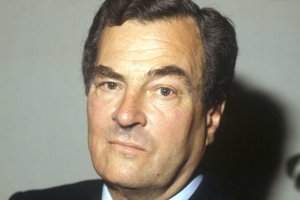
Patrick Leigh Fermor in Berlin
The knocking does not answer
The back of the slopes wrinkly rich almost to the bay. Bruce Chatwin, who came to Paddy as a “guru to worship” or how to overthrow a king, saw eagles soar over the house of Leigh Fermor. Twenty years later, Paddy Chatwin ashes buried – next to a crumbling Byzantine church not far from here. The Mani is famous for its action songs.
Southward, on the faded, twinkling towers over the tiny villages, run, it means that a chasm into Hades. Leigh Fermor found it flooded. “Phosphorgefiedert,” he wrote, dip it into the cold depths and swim “through the heart as a huge sapphire.
We knock in vain to dare us to elaborate the cobbled courtyard and whisper with the housekeeper. It leads us through the garden open arcades, which might as well bend over a cloister.
Leigh Fermor is tattooed like a sailor
Leigh Fermor has written so many monasteries in Europe, in towers of “solid ivory, and if anyone here was an escapist, The doors to the rooms, however, the numerous tables, which depends on the sound of glasses and laughter as a smoke curtain, speak a different language.
Leigh Fermor speaks many. Photographs show it once hung over bursting with charm and zest for life, sometimes almost professorial, and again obviously as a sailor and tattooed.
We wait under the coffered ceiling of the spacious, wonderfully cluttered living room, from which the English poet John Betjeman once wrote that it was “one of the rooms of the world.” On one wall hang paintings by Nicolas Ghika and John Craxton, leaning on a shelf worn, faded volumes of the great English stylist. On the floor there is a band “Sherlock Holmes”. “Enchanting easy, right?”
The family left behind her son with strangers
This could be Merlin: a jumble the gray, wavy hair, sharp features and eons of age in the eyes. Leigh Fermor carries the threadbare sweater a garret of scholars and the trousers of an artist in his studio.
He is of overwhelming kindness, perfectly shaped “upper class”. In the sunlit bay he called almost everyone who comes to the question, “marvelous”: writers, painters, musicians. “They all knew.” – “I am,” he says mildly, “that old.”
“For at least one of us children would remain alive, if a submarine sank the ship,” Paddy was in the care of a small family back in England.
1933 – the first trip to Istanbul
“I ran,” he says, “shouting and screaming across the yard. I never learned discipline. I was a difficult student. “-” Lazy? “-” Disobedience. “Even a psychiatrist who also treated Virginia Woolf was consulted. Paddy still flew from the school. He had kept up with the daughter of the greengrocer’s hands.
The autumn of 1933 found him in a room not far from trouble blowing from London’s Shepherd Market, where he should have been cramming so that at least the military school would take him.
Instead, he took a verse of George Herbert at his word: My way is free, free to the horizon, / Much like the wind. “In December 1933 he embarked for Holland. From there, he wanted to walk into a “green dragon”, Byzantium, which he never called Istanbul.
On the trip report, the fans are waiting until today
He is famous for getting lost in the widely spread European history, which he knows like no other. In Mani, one of his best books, the “opposite of a travel guide,” as he says, there is a footnote, the sheer joy of the strangest here, “and there crafty peoples’ lists of Greece: the Melevi Dervishes of” Tower the winds “, the fire dancers from Mavroleki, the hiking quack Eurytaniens. With the gypsies, whom he met in 1934 in the highlands of the Carpathians, said Patrick Leigh Fermor Latin.
Paddy arrived on New Year’s Day of 1935 in Constantinople, and had better things to do than to write about his trip. He is one of the great English stylists working, slowly, life itself seems always in your way.
It was not until 1977 “was published, the time of the gifts,” which describes his journey from Hoek van Holland to the middle Danube, nine long years later, “between forests and water”, which leads to the Iron Gate. The third book, the description of the phenomenon must last up to Constantinople, is still expected with such longing that leave a few words from the mouth of Paddy’s heave a sigh British press today.
Where Chatwin’s old typewriter?
When Sir Patrick, as he was allowed to call since 2004, was awarded in March in Athens the “Order of the Phoenix,” he told his casual way that he, because his handwriting was always bad, just learn to touch type.
Oh yes, “he says in the rich sunshine,” I will write this book. There is to end on Mount Athos. From there, I have notes for every day. “We are walking through the garden, the Gulf of Messinia in a dozen colors of light blue. On the burnt grass stretches herself a hangover: “His great-grandmother one day was just there.”
The studio is housed in an outbuilding. In an iron chest, which bears the inscription of “Traveller’s Club” that tape, books are stacked on the wall a faded French hunting scene. Somewhere there must be also Chatwin old typewriter, a 51er Olivetti. But where? Where?
Soldier, he was happy because “was always something going on”
On Mount Athos celebrated his 20th Birthday, then went to Athens, as he later went to Paris and Rome. With a Romanian princess, he lived in an old water mill in the Peloponnese, and followed her to finally Balení, the seat of her family in northern Romania.
Russia and the horrors of communism were suddenly within reach. “Many of your friends were communists at that time.” – “I did not speak up,” he says. “ “I was so apolitical.”
In Balení reached him of the war. He, which six years earlier at the Shepherd Market has become clear, “how little I was good for soldiers in peace time,” volunteered. The departure was hasty. “Not even my notebook I took with me. We were so naive. In a few months ago we believed us again. “It took decades. “Were you like a soldier?” – “In a way, yes. “ There was always something going on. ”
In 1944, he kidnapped a German general
Books are also in the bathroom and somewhere between them is a plaque commemorating the Battle of Crete. When she was lost, went back Leigh Fermor as major of the Special Operations Executive to Crete. One and a half years he lived disguised as a shepherd in a cave – “wrapped in white cloth from goat and horribly dirty” – and organized the Cretan resistance against the German occupiers.
The rest is legend, one of the most daring commando raid of the Second World War. One night in April 1944, a large Opel on the road to Knossos, Paddy in a stolen German uniforms on the way. A scuffle and then, at the roadblocks, again and again the cry of “General car.
For days wandered Leigh Fermor, the people and kidnapped the German General Kreipe through the mountains until they reached the coast, and finally Libya (Egypt). On the difficult journey Kreipe murmurs once verses of Horace. Leigh Fermor is one. „Ach so, Herr Major“,
About the death, he never speaks
Paddy has never really written about it. “Ill Met by Moonlight,” the book that tells this story in full, comes from Bill Stanley Moss, his former deputy, and was filmed with Dirk Bogarde as Leigh Fermor.
When it first appeared in 1950, just came Paddy’s first book, “The Traveller’s Tree,” a description of his travels in the Caribbean out. DThen he was – in the UK, famous in Greece “He embodied an idea of the Renaissance,” writes Cooper, Artemis, “a man of action, which is just as much a scholar.”
Cooper, the friend and daughter of a friend is writing Paddy’s biography, when he, as he says, “is just gone.” “But now that you mention it: We never really talk about it.”
The stones for the house came with the donkey
For lunch there are lemon chicken, tzatziki and Retsina. We sit on chairs Andalusian, a Venetian table at the foot of a guillotined by the passage of time Roman Sibyl. Leigh Fermor has picked up in Rome on the way, he collects nothing.
He tells the story of Niko Kolokotronis, the Mauerermeister that the contract was to build his house, because six generations were Kolokotronis wall masters, and played all the violin. That was the beginning of the sixties. In the bay there was no electricity, donkeys brought the stones, and Paddy and his wife Joan were living in tents, until the house was finally finished.
“I scribble in the studio in front of me,” reads a letter from the most beautiful, vibrant with life days in the bay.”Through the window I can see Joan, their army cats invites you to dinner; mass meows to rise, and their tails make waves like the sea.”
A picture of his wife Joan (cats) in her hand
Leigh Fermor demands a picture of the mantel, Joan in the forties, which he portrayed with a pencil. “Come on!” She called from a boat, as Paddy, like his hero, Lord Byron swam the Hellespont. “It took three hours.”
Joan died in June 2003 here.”She was,” he says, his drawing in hand, “in truth much more beautiful.
Original article here.


 Patrick Leigh Fermor