Peace be with you and those you love

This has been another fascinating year in the life of the Paddy Leigh Fermor blog and I have enjoyed every moment. There have been many highlights. Artemis Cooper’s wonderful biography exceeded expectations, and for 2013 we have the news that Vol Three will be published and is to be called the Broken Road.

I think the dominant theme for the first few months of next year will be the house at Kardamyli. There is a groundswell of opinion about doing something to ensure that the fabric of the house is not only maintained, but that real progress can be made towards Paddy’s dream of a writers retreat. The Benaki is facing cutback after cutback. It seems to me that we will all have to help in some way or another.

But that is for another time. Now is the time to reflect on the year that has passed and the year ahead. Also to celebrate, if that is your faith, the birth of Christ. We all love Paddy’s words but I doubt that many would disagree that the introduction to Saint John’s Gospel in the King James Bible is perhaps the most beautiful in the whole of the English language.

Peace be with you and those you love this Christmas time.

In the beginning was the Word, and the Word was with God, and the Word was God.

The same was in the beginning with God.

All things were made by him; and without him was not any thing made that was made.

In him was life; and the life was the light of men.

And the light shineth in darkness; and the darkness comprehended it not.

There was a man sent from God, whose name was John.

The same came for a witness, to bear witness of the Light, that all men through him might believe.

He was not that Light, but was sent to bear witness of that Light.

That was the true Light, which lighteth every man that cometh into the world.

He was in the world, and the world was made by him, and the world knew him not.

He came unto his own, and his own received him not.

But as many as received him, to them gave he power to become the sons of God, even to them that believe on his name:

Which were born, not of blood, nor of the will of the flesh, nor of the will of man, but of God.

And the Word was made flesh, and dwelt among us, (and we beheld his glory, the glory as of the only begotten of the Father,) full of grace and truth.

The First Transylvanian Book Festival: 5th – 9th September 2013

The UNESCO World Heritage fortified church in Viscri

The UNESCO World Heritage fortified church in Viscri

If you enjoy literary festivals, want the opportunity to meet authors like William Blacker, and discover the romanticism and beauty of the Saxon lands of Transylvania whilst discussing the work of Patrick Leigh Fermor, then the place to be in September next year is the very first Transylvanian book festival which will be held during the period 5-9 september 2013.

Planning is well advanced. The event is being arranged by Lucy Abel-Smith who is an expert on Romania and has a house in the area. Her sister-in-law Caroline Knox is  assisting and has run the successful Boswell Literary Festival in Ayrshire for many years.

This will be your chance to join an exciting venture at its very beginning, in what I can assure you is one of the most beautiful places, full of history, romance and mystery right in the heart of Transylvania.

The list of authors who have agreed to speak is growing and includes William Blacker, whose acclaimed Along the Enchanted Way, has seen him hailed as heir to Patrick Leigh Fermor; Jessica Douglas-Home, author of Once Upon Another Time, will talk about the past under Ceausescu and her present work as chair of the Mihai Eminescu Trust, of which the Prince of Wales is Patron. Professor Roy Foster Oxford University and Historian expert on Bram Stoker and his influence on Literature; Michael Jacobs author of Robber of Memories.; and Artemis Cooper have been approached. Other talks will include writers from Romania’s strong literary tradition and will include those from the Romanian, Saxon and Hungarian communities whose work is internationally recognised.

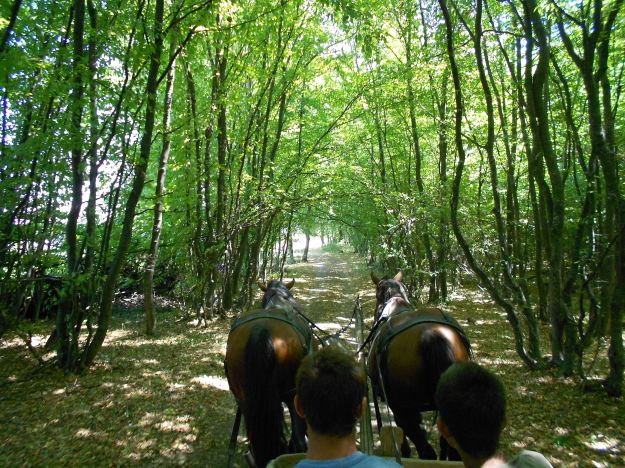
Other talks will focus on the gypsies, the wolves, the wonderful wild flowers, life in the Saxon villages, Count Banffy’s epic ‘They Were Counted’ and inevitably the late Paddy Leigh Fermor. There will be organised walks, the opportunity for horse and cart rides in the beech woods, and the chance to take in some of Transylvania’s wonderful fortified churches

Accommodation will be in three villages in the heart of Saxon Transylvania: Copsa Mare, Richis and Biertan. All have fine churches and picturesque village houses that run as B&Bs. Minibuses will be on hand to transfer guests to picnics, visits and dinners. The costs are currently being finalised. Flights are not included but there are easy connections from Cluj, Turgu-Mures or slightly further afield, Bucharest. There will be a daily rate of entrance fees to the readings and picnics.

Please contact me – tsawford[at]btinternet.com – if you are interested in attending or would like to be on the circulation for more information. The organisers are also looking for sponsors either in cash or kind so please indicate if you or your company can help; all sponsors will be fully acknowledged in the programme and on promotional material, websites and in PR, and given complimentary tickets to events.

DSCN0559

In the forest above Viscri

Book shops vote on alternative Christmas best-sellers

Fed up with Jamie Oliver? Tired of E.L. James? High street book retailers have come up with an alternative list of books that they think will be best-sellers this Christmas. Of course An Adventure must be in your top ten for Christmas presents this year, and judging by various articles the biography is doing very well both in terms sales and recommendations. Here is just one of them by James Hall from the Telegraph.

Around 200 independent bookshop owners voted on the ten books they think will appeal to people looking for something a little different this year.

The list includes titles such as 101 Uses for a Dead Kindle by Adrian Searle and Wenceslas: A Christmas Poem by Carol Ann Duffy, the Poet Laureate.

The number one book is Horologicon: A Day’s Jaunt Through the Lost Words of the English Language by Mark Forsyth. The book examines “extraordinary” words from the English language arranged by the hour of the day.

In second place is Artemis Cooper’s biography of the war hero and travel writer Patrick Leigh Fermor.

Patrick Neale, president of The Booksellers Association, said that the list contains “bizarre”, “obscure” and “undiscovered” titles.

“These out of the ordinary, off-beat titles were nominated during the Association’s annual conference, which brought together around 200 booksellers. These were carefully selected with the imaginative book buyer in mind, who may be looking for something a little different to bestseller books,” said Mr Neale.

The Alternative Top Ten

1. Horologicon by Mark Forsyth

2. Patrick Leigh Fermor by Artemis Cooper

3. The Middle Class ABC by Fi Cotter-Craig and Zebedee Helm

4. Wenceslas by Carol Ann Duffy

5. 101 Uses for a Dead Kindle by Adrian Searle

6. First Class by Chris West

7. On the Map by Simon Garfield

8. Paper: An Elegy by Ian Sansom

9. Fir Tree by Sanna Annukka

10. Bring Me Sunshine by Charlie Connelly

Letting it rip – Patrick Leigh Fermor, Mythmaker

Artemis Cooper reflects on Patrick Leigh Fermor’s flexible approach to historical fact.

By Artemis Cooper

First published in History Today Volume: 62 Issue: 12 2012

Patrick Leigh Fermor could not look at a landscape without wondering who had been there before him and how they had shaped what he saw. This was the springboard for all his travel books. Yet alongside this curiosity about the past ran a more imaginative impulse. Some writers might have tried to curb it, especially when tackling historical passages. Not Paddy, who had great faith in what he called ‘letting it rip,’ which added such zest to his prose. Yet when he came to write about his own history, as an undercover agent in occupied Crete between 1942 and 1945, scruples seemed to stifle even his irrepressible style.

While he cared passionately about getting facts and details right, he rarely set foot in an archive. Most of his ‘mugging up’ came out of encyclopedias, books and conversations. He found the legends surrounding a person or an event every bit as interesting as the truth. Even an old chestnut, like the story of Richard I’s minstrel Blondel singing outside every fortress in the hope of hearing his master’s voice, was worth retelling. ‘[The story] is almost too good to be true’, wrote Paddy in A Time of Gifts (1977), ‘but on the spot, it is impossible to doubt it.’

He pursues the story in a long footnote. Richard was handed over to the Holy Roman Emperor Henry VI by his captor, Leopold of Austria, in 1193. In his place Leopold took a hostage, one Hugh de Morville – possibly the same de Morville who, with three other knights, had murdered Thomas Becket in Canterbury two decades before. ‘Some authorities think the two Morvilles are the same,’ wrote Paddy. ‘I do hope they are right.’

While prepared to concede that they might be wrong, the appearance of a historical figure in an unexpected place produced a charge in Paddy that set his imagination racing. Take the headstone of ‘Ferdinando Palaeologus, descended from ye Imperial lyne of ye last Christian Emperor of Greece’, which Paddy found in a graveyard in Barbados. He traces a direct line from Ferdinando back to the Emperor Constantine, who fell defending the walls of Constantinople in 1453. For the genealogy to hold, all depended on whether or not Constantine’s son Thomas had a son called John. Paddy admits that this figure is ‘shadowy’. Even if he had been told that his thesis was false, as has now been proved, I doubt whether it would have stopped him telling the story.

As well as anecdotal history, he could conjure up a great sweep of time. In A Time of Gifts a character called the Polymath describes the barbarian invasions of the fifth century and the sack of Rome. Paddy did not expect anyone to take it seriously, yet it is still a tour de force which sends the reader skimming over continents, to watch events unfold at exhilarating speed.

Friends urged him to write about his experiences in occupied Crete, especially the abduction of General Kreipe in April-May 1944, one of the most celebrated exploits of the war. He was reluctant because anything by Patrick Leigh Fermor about Crete would be translated and published on the island and, since this was bound to offend or displease someone, he preferred to remain silent. Then, in 1966, he was commissioned to write a 2,000-word article on kidnapping Kreipe, which grew into a typescript of 84,000 words called Abducting a General.  Until then the story had only been told in Ill Met By Moonlight, the 1950 bestseller by William Stanley Moss.

Paddy’s account tells how, still wearing the German uniform in which he kidnapped the general, he enters the village of Aoyeia. As he walked up the main street, doors and windows slammed shut while the men in the café turned their backs on him. The cry went up: ‘Our in-laws are here! The black crows are in the wheat!’ When he approached the priest’s wife she was terrified. ‘It’s me, Pappadia,’ he whispered, ‘It’s me, Mihali!’ (he was always Mihali in Greece). ‘Mihali? I don’t know any Mihali!’ she cried. It took her a moment longer to recognise him, by the gap between his front teeth.

History must be objective, but Paddy found it impossible to be objective about the Cretans. He could never forget how they had guided, fed and protected him during the German occupation, at such risk to themselves. The pages he devotes to their courage and endurance, their love of song and poetry, may make one smile; but we can only respect his devotion to the the people whose hardships he shared and whom he counted among his closest friends.

A Pilgrimage Through Paddy’s London

Rake’s progress: Leigh Fermor set out from his rooms in Shepherd Market for Constantinople in 1933

And we’re off. This is the Patrick Leigh Fermor Tribute Walk, a bit of a Magical Mayfair Mystery Tour or even, as I prefer, a Paddy Pilgrimage: a literary procession in honour of the late warrior-writer through the London he knew during the course of an enviably long and dazzlingly adventurous life.

By Justin Marozzi.

First published in Standpoint Magazine, December 2012.

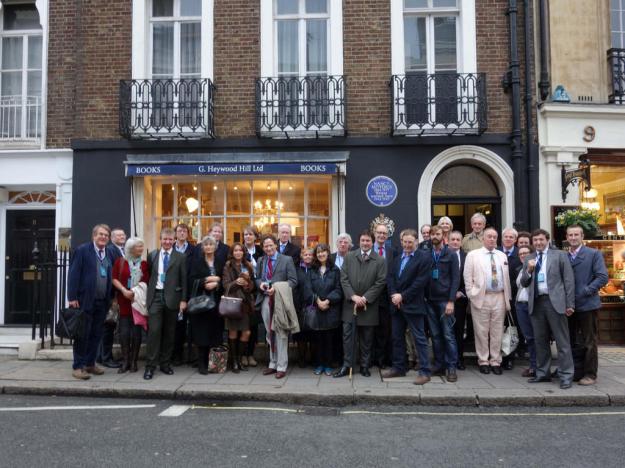
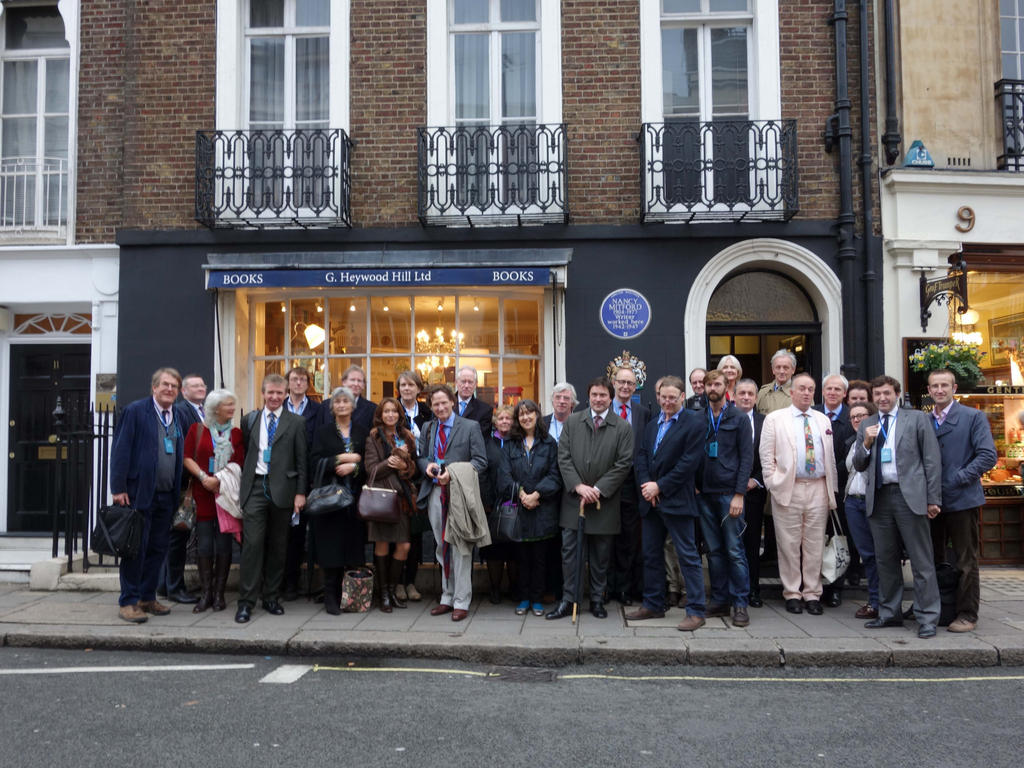
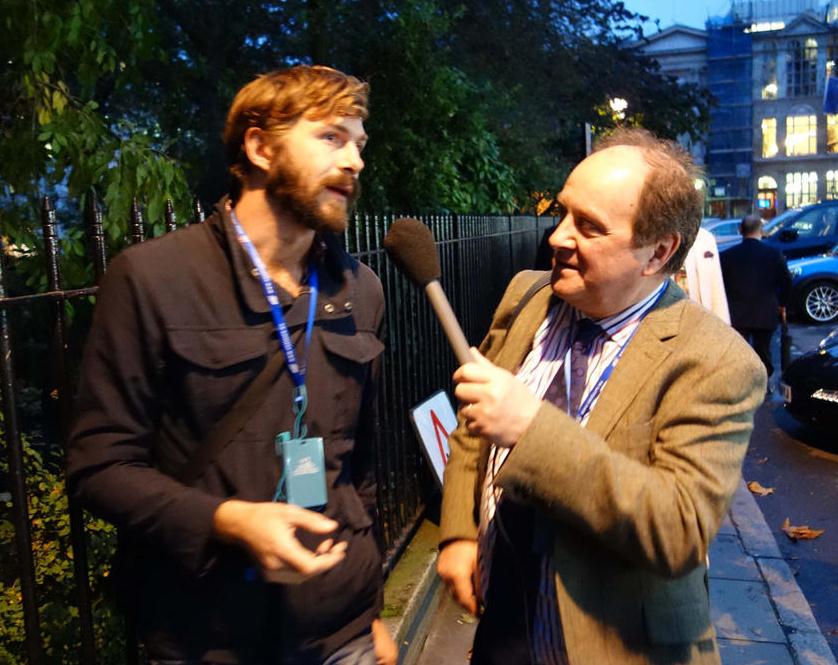
We have gathered at Heywood Hill, the venerable Curzon Street bookshop where Paddy, as he was always known to friends and fans, had an account for decades. The pilgrims are a caravan of travel writers and publishers, friends, acolytes, devotees and disciples, for such is the admiration—shading into unadulterated hero worship in some quarters—for a man considered one of the great prose stylists of the 20th century. Our group includes the travel writers Colin Thubron, Sara Wheeler, Anthony Sattin, Jason Elliot and Robert Macfarlane, the writers and historians Jason Goodwin and Fergus Fleming, publishers Roland Philipps and Barnaby Rogerson (in a tangerine linen suit), Mark Amory of the Spectator, an exuberant throng expertly marshalled by Paddy’s biographer Artemis Cooper.

It is not surprising that a man who wrote like an angel, fought like a knight and had beautiful women swooning at his feet for most of his adult life should attract such a following and such affection. Few men can claim to have walked across a continent, fallen in love with a princess, kidnapped a German general, joined a Greek cavalry charge and written a string of masterpieces.

“Patrick Leigh Fermor, the man, could have sprung from the pages of Cervantes or Homer, and we revere him at Heywood Hill for his courage, style and beautiful manners,” says Nicky Dunne, chairman of the bookshop, who dreamt up this expedition.

Paddy lived above the shop briefly in 1947 with Joan, his future wife. In 1965, horrified to have discovered how Communism had destroyed so many of his friends in the Europe he had walked across in 1933-34—”disaster overtook them all”—he set up an account at Heywood Hill for the great love of his youth, the Byzantine princess and artist Balasha Cantacuzene. “He couldn’t do much but he could make sure that at least she was never without good books,” says Cooper.

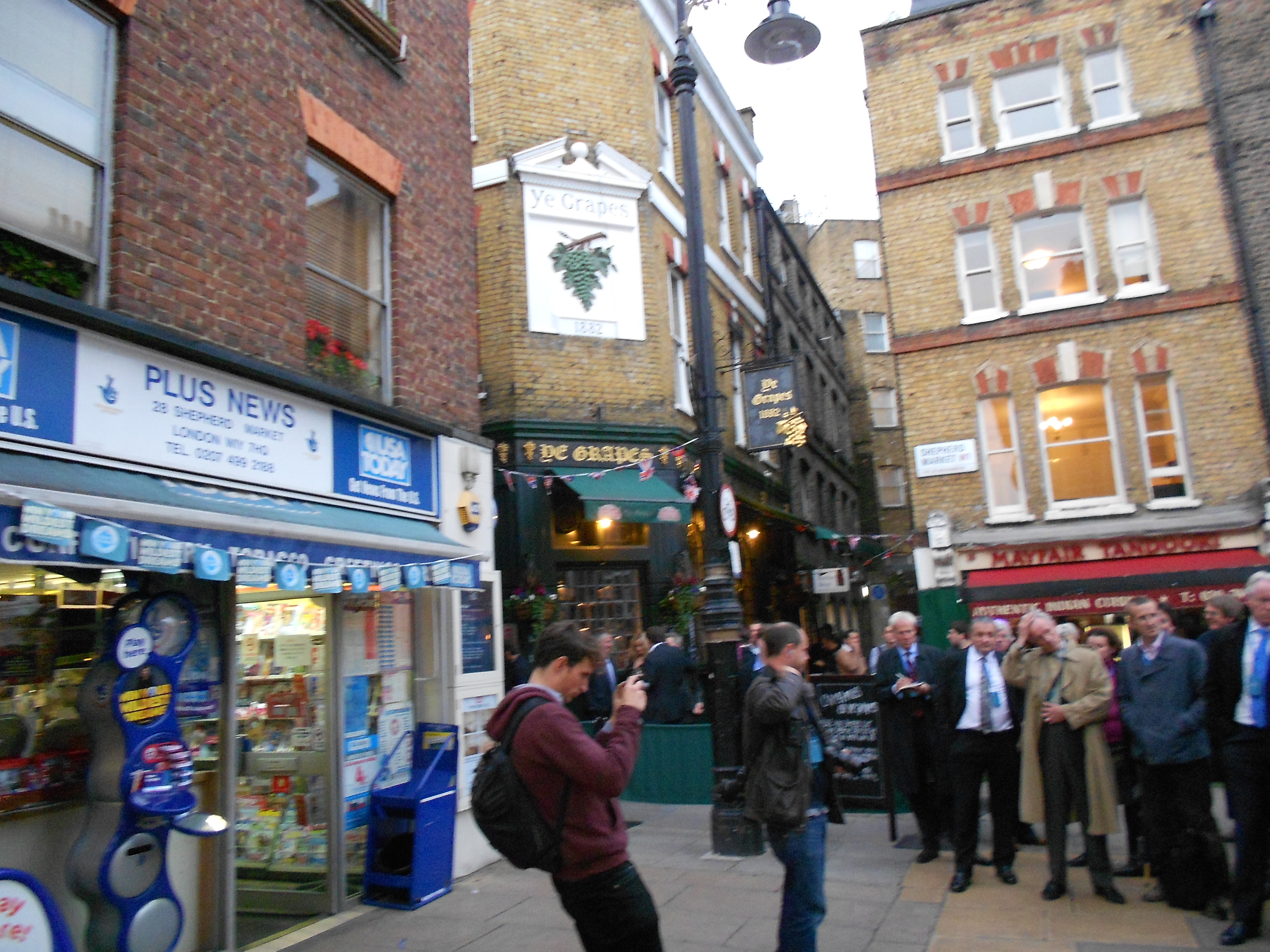
Our unruly, traffic-blocking gaggle spills out onto Curzon Street to the astonishment of passers-by—30 men and women sporting bright blue earpieces is a curious sight—and ducks into Shepherd Market to our next stop, 28 Market Street: four square windows above the “PLUS NEWS” newsagent. Having been kicked out of almost every school he had attended, Paddy washed up here as a restless 18-year-old with literary longings and a diminutive allowance. His long-suffering landlady, assaulted by endless revelry, was Miss Beatrice Stewart, an artist’s model who had sat for Sargent and Augustus John and was later immortalised in bronze as the Angel of Peace in Adrian Jones’s Quadriga of War on the Wellington Arch at Hyde Park Corner. “I can never pass the top of Constitution Hill without thinking of her and gazing up at the winged and wreath-bearing goddess sailing across the sky,” Paddy wrote in a typical flight of fancy.

“This is where the great walk began,” Cooper explains. “He’s lurching between high spirits and utter despair, filled with self-loathing, going to endless parties, ‘drowning hangovers like kittens’. His father wants him to get a job but Paddy thinks a career is life imprisonment. He’s uninstitutionalisable. All he wants to do is write.”

Hightailing it out of this Rake’s Progress, Paddy walked from the Hook of Holland through Nazi Germany to Constantinople. It took him over a year from 1933-34, much of it spent “in a coma of happiness” recounted decades later in the spellbinding prose of A Time of Gifts (1977) and Between the Woods and the Water (1986). Our little saunter is less than a mile in more than an hour. Yet what we may lack in schloss-hopping mileage and accumulated time, we make up for in rowdiness and delight. This could be a lesser-known ecclesiastical ritual of the Eastern Church, the Adoration of the Paddy. And we all know it will end, as it should, with wine.

We head towards Berkeley Square on roads slick with rain. “Paddy was my earliest model of a travel writer: brave, curious, cultivated and a marvellously gifted stylist,” says Thubron, president of the Royal Society of Literature. “It’s strange to be walking commemoratively through a world that’s not usually associated with him—not the Greece or Eastern Europe which all his readers know, but the London—still pouring rain—from which he set out 80 years ago.”

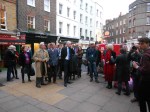
Friends and admirers of Patrick Leigh Fermor outside Heywood Hill, his favourite bookshop, in London’s Shepherd Market

Friends of Patrick Leigh Fermor outside Heywood Hill, his favourite bookshop, in London’s Shepherd Market

Here we are a stone’s throw from The Running Horse pub on Davies Street, from where Paddy briefly and rather successfully sold silk stockings as an impecunious teenager. Invited to share his tips with his fellow salesmen one evening, he popped a stocking onto his hand and described its properties as though it were a condom. He was fired on the spot. “That was the last sales job he ever had,” says Cooper. One night in the summer of 1940, when the London skyline was thick with smoke and flames, Paddy entered Berkeley Square from Piccadilly. “The blaze of an explosion had revealed two sides of that sentimental quadrangle in a disordered wreckage of wood and stone,” he wrote. “Only one thing remained standing. Perched three stories high on a tottering pinnacle of rubble was a white marble privy, glowing shyly in this unaccustomed radiance.”

We beetle along to Lansdowne Row, where Cooper describes a literary catastrophe on neighbouring Stratton Street, once home to the Baroness d’Erlanger, a rich and eccentric artist: “I think she had a bit of a crush on him.” Everyone did. In 1937 or 1938, Paddy left two trunks here full of papers connected with his trans-Europe tramp—every letter, diary and early draft. The Baroness moved home, put Paddy’s trunks into storage at the Harrods Depository, only for Harrods to sell them off years later because Paddy had forgotten to pay the storage charge. He had lost everything. There is a collective writerly wince. “Paddy said the pain used to ache ‘like an old wound in wet weather’, but I think it was the best thing that ever happened to him,” says Cooper. “It sort of set him free, allowing him to remember with advantage.”

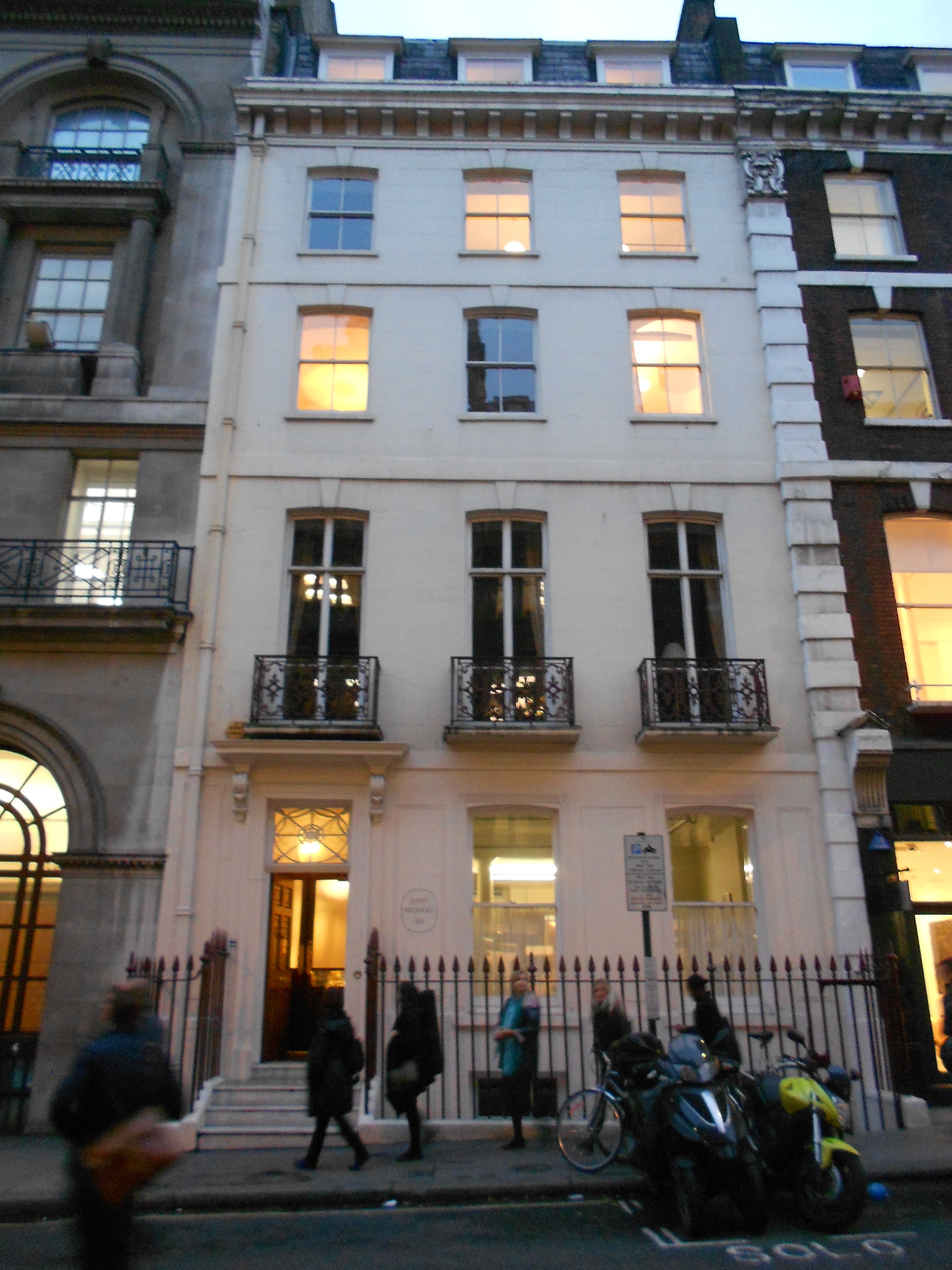
To 50 Albemarle Street, former HQ for John Murray publishers, a powerhouse of British writers from Byron, Darwin and Disraeli to Walter Scott, Conan Doyle and Paddy. “Jock Murray was the best publisher and editor Paddy could have hoped for,” says Cooper. “In the days before agents he was also Paddy’s banker, therapist, PR consultant, book-finder and poste restante.”

Picking up the pace now like horses heading home—drinks at the Travellers Club await—we stride magnificently down Jermyn Street. One imagines Paddy, sartorially something of a peacock, thoroughly at home here.

“Oh God, absolutely!” Cooper says, laughing. “Hats from Lock, shoes from Lobb, Savile Row suits. He loved all these shops. Paddy adored clothes. In all his books the costumes of men and women are described in extraordinary detail. I’ve walked along Jermyn Street with him, striding along with his cane with that lovely flick upwards before putting it down. If you didn’t know, you’d think he’d never left the Home Counties.”

Into the final furlong and past the Cavendish Hotel, an unlovely blend of underground car-park and drive-through fast-food forecourt. “Here he met the tail end of the Bright Young Things, a decade after all those parties that had scandalised society.” Alistair Graham, Jennifer Fry, Eddie Gathorne-Hardy, Mark Ogilvie-Grant . . . and Elizabeth Pelly, to whom Paddy lost his virginity.

“They’re a revelation to him. Godlike and irresistible. Suddenly he feels he’s met kindred spirits.” He didn’t meet Evelyn Waugh at the Cavendish because Waugh was banned. Mrs Rosa Lewis, the owner, did not find her portrayal as Mrs Crump in Vile Bodies amusing. “If I get my ‘ands on that Mr Woo-agh,” she told Paddy, “I’ll cut ‘is winkle orff!”

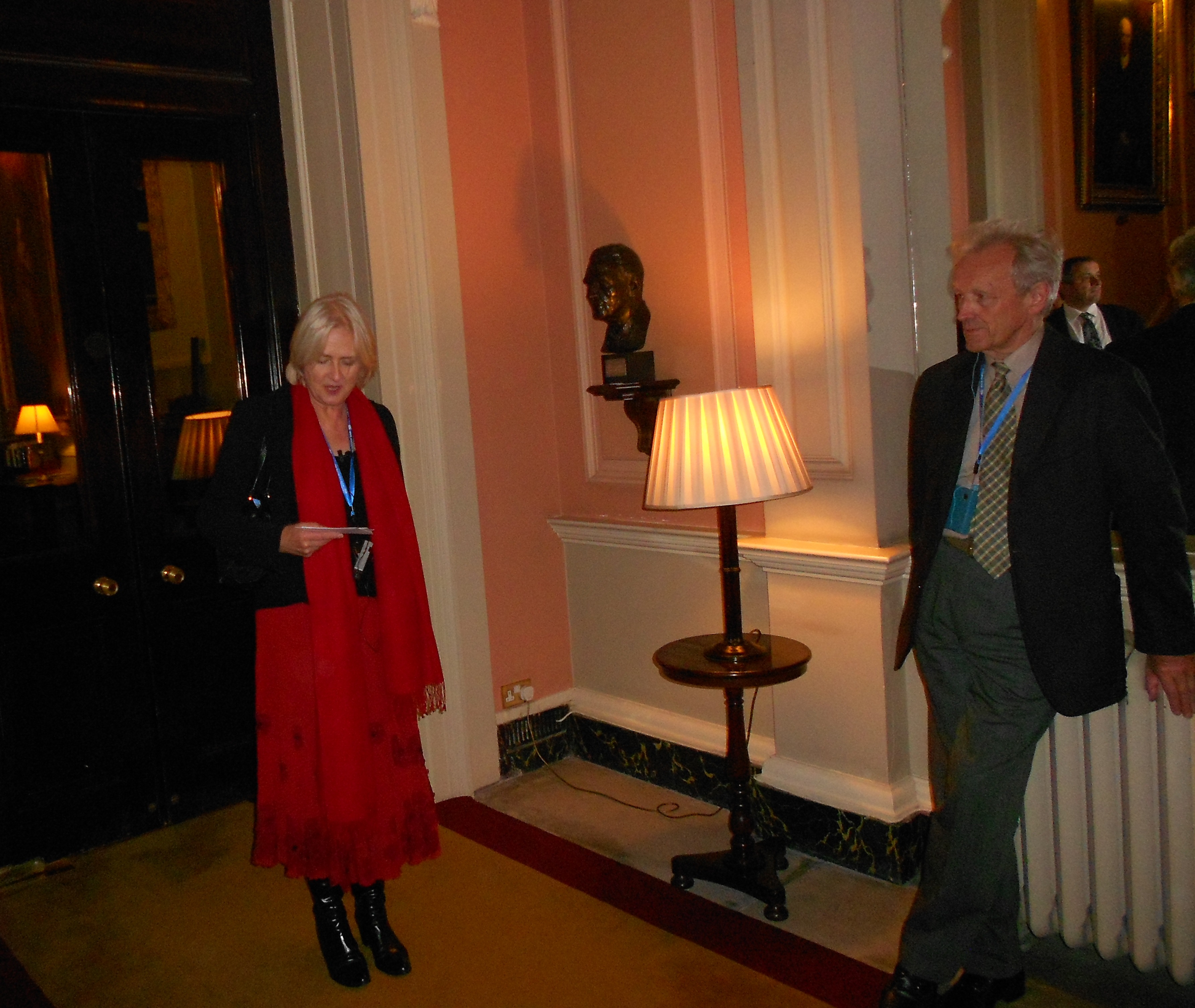
Through St James’s Square and we’re almost trotting into Pall Mall, from where it is a hop, skip and jump up the 11 steps into the Travellers Club, whose bar Paddy did more than most to prop up—together with those of White’s, Pratt’s, the Beefsteak and the Special Forces Club—during 66 years as a member. In 1950, the Club Secretary reported to the House Committee that the nomadically careless Paddy owed “over £100 for storage, if by-law 6 were to be strictly enforced”.

There is an inescapable whiff of glamour and adventure at the launch party. A light sprinkling of aristocracy, a smattering of bohemian scruff, the sparkle of beautiful women, sumptuously suited grandees, suggestions of espionage, the straight-backed swagger of military top brass.

Paddy was a prodigious drinker. He once wrote of retsina: “One of its secrets is drinking it with unstinted abundance. It seems to have an alliance with the air in the promotion of well-being. Many people think that it bestows the gift of bodily health as well; a belief I accept at once without further scrutiny.”

The evening dissolves into high spirits, laughter and torrents of wine. The hommage is complete.

Related articles:

Patrick Leigh Fermor’s ‘magical’ tour

Marathon man – Justin Marozzi interviews Paddy and drinks quite a lot of retsina.

Art of intellect and emotion: A Retrospective of Nikos Hadzikyriakos-Ghikas

Patrick Leigh Fermor by Nikos Ghika

A retrospective first published in Kathimerini 20 December 2006 about Paddy and Joan’s very good friend, the reknowned artist Nikos Ghikas.

By Alexandra Koroxenidis – Kathimerini English Edition

Retrospective exhibition on the work of Nikos Hadzikyriakos-Ghikas shows the unity in his work

If one was to name the one element that pervades the work of the distinguished Greek painter Nikos Hadzikyriakos-Ghikas (1906-1994) throughout its course, it would probably be light. Much has been written about the Cubist-inspired aspect of his work, yet the luminosity and the radiance of Mediterranean light is what will mostly strike the visitor to “Nikos Hadzikyriakos-Ghikas: The Apollonian – The Dionysian,” a large retrospective exhibition of the artist’s work which is curated by his friend art historian Dora Iliopoulou-Rogan and is being held at the Pireos annex of the Benaki Museum on the occasion of the centenary anniversary of the artist’s birth.

For an artist who perhaps more than anything else painted the Greek landscape – its essence and not its surface – this is perhaps to be expected. “Ghikas seeks light and the truth,” Henry Miller – one of the artist’s friends – wrote in his novel “The Colossus of Maroussi.” As an artist of the so-called “Thirties Generation,” Ghikas revealed the essence of “Greekness,” the archetypal notions that were believed to pervade the entire civilization of Greece. Harmony and light were two of them.

Light and its reflection are among the elements that, according to the exhibition’s curator, link the Apollonian and the Dionysiac aspects of the artist’s work, the tectonic, geometric paintings and the more expressionistic, free compositions of labyrinthine, swirling shapes.

“When they say that in my painting I have many different periods, I answer what Ingres said when he was told the same thing. ‘I have sir, many paintbrushes,’” Ghikas once said. Accordingly, instead of examining the work of Ghikas in terms of distinctive stylistic traits which lead from one to the next, Rogan examines the work of Ghikas as an undivided whole, as both Apollonian and Dionysiac, intellectual and emotional at the same time, as equally contained as it is extroverted.

This is a new approach to the work of Ghikas which the exhibition’s curator presents in a voluminous book (of the same title as the exhibition) published by Livanis. A well-designed publication (the book helps counterbalance the effect of a dense yet slightly disorderly exhibition), it is a thorough, fully illustrated book that includes earlier published texts on Ghikas’s work, essays by Kimon Friar, Henry Miller, Christian Zervos and Patrick Leigh Fermor among them. It also unfolds the work of Ghikas across different media: Painting is the focus, yet sculpture, photography and the artist’s work for theater and costume design help show what Rogan has called Huomo universalis, an artist whose work was too broad in scope to fit into a single category and an intellectual – he was also professor of freehand drawing at the National Technical University – who wrote about the art and culture of different civilizations.

Ghikas was as equally deft in line as he was in color. In the exhibition, an entire section presents just a fragment of the hundreds of drawings that Ghikas made. Among them a series of sensual nudes. There are also studies that Ghikas made for set and costume design and drawings that are the artist’s visual memoirs of his travels around the world.

Ghikas was one of the few truly cosmopolitan Greek artists, a man who not only traveled the world but who was part of an international artistic milieu from early on. The only son of Alexandros Hadzikyriakos, an officer in the Greek Royal Navy, he was educated in Paris (this included his final school years) where, at the age of 21, he had his first solo exhibition prefaced by the well-known critic Maurice Raynal. Ghikas’s involvement in the artistic and intellectual elite of Paris in the interwar period (he was friends with Henri Laurens, Fernard Leger, Georges Braque and Henri Matisse and became associated with Le Corbusier, Hans Arp and many others), helped to bring many intellectuals into contact with Greek art and culture. It was largely thanks to Ghikas that the 4th International Congress on Modern Architecture (CIAM IV) was held in Athens instead of Moscow in 1933.

In the mid-1930s Ghikas moved to Greece. Together with Dimitris Pikionis, Socratis Karantinos, Spyros Papaloukas and Stratis Doukas, he published the seminal review “To Trito Mati,” a journal on art and culture that resembled the French “Cahiers d’Art.”

During that period, Ghikas worked intensively in Hydra, the island of his family home (which was later destroyed in a fire), and became inspired by its landscape, light and architecture. In later years, Corfu, where Ghikas and his second wife Barbara Warner had a summer home, also inspired the artist.

None of those landscapes are identifiable. They are semi-abstract renditions that capture a mood and atmosphere, structure and light rather than any realistic description. In many paintings, the Greek landscape is combined with subjects taken from mythology.

Among Ghikas’s broad range of interests, poetry was one of the most pronounced. In the late 1930s, he began the illustration of Nikos Kazantzakis’s “Odyssey.” Twenty years later, in 1958, these illustrations were included in the US edition of “The Odyssey” which was translated by Ghikas’s friend Kimon Friar. Ghikas also illustrated C.P. Cavafy’s poems and Nikos Gatsos’s “Amorgos.”

The work of Ghikas is filled with the tranquility and harmony of the Mediterranean, the resonance of Greek art and history. Ghikas appreciated everything that was Greek but was also deeply curious and sensitive to other, non-Western cultures. He had the open-mindedness of a cosmopolitan, refined man and was one of the few Greek artists to have been recognized internationally.

In 1987, the same year that he was elected honorary member of the Royal Academy of Arts in London, Ghikas donated his work and home on Kriezotou Street in Kolonaki to the Benaki Museum. Held as an expression of appreciation on the part of the Benaki to Ghikas, the retrospective exhibition is also a tribute to one of the most esteemed modern Greek artists.

“Nikos Hadzikyriakos-Ghikas: The Apollonian – The Dionysian,” at the Pireos annex of the Benaki Museum (138 Pireos & Andronikou, 210.345.3111) through January 15.

Nikos Hadzikyriakos-Ghikas Wikipedia page

Patrick Leigh Fermor: An Adventure as BBC Radio 4’s Book of the Week 19-23 November

Don’t forget that you can listen to Artemis Cooper’s biography being read as the BBC Book of the Week on Radio 4 (the world’s greatest radio station) from today.

If you are working or miss an episode you have seven days to catch up via the BBC iPlayer.

Visit the Book of the Week webpage here to find out more.

Jan Morris’ review of An Adventure

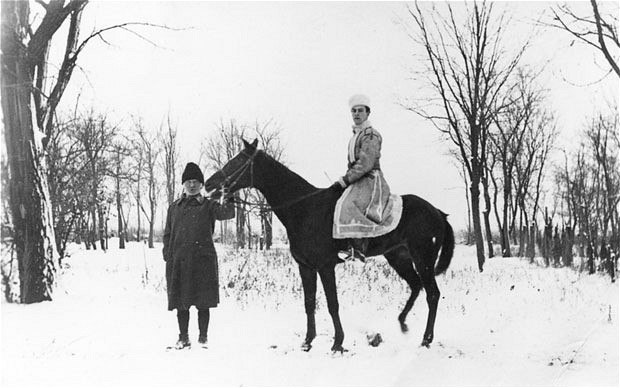
Patrick Leigh Fermor on horseback at Baleni, Moldavia

‘He is justly commemorated in this magnificent biography, and will surely be remembered for ever as one of the best of men.’

By Jan Morris.

First published in the Telegraph, 6 November 2012.

Happy the hero who, after a lifetime of glorious achievement, in death finds a biographer worthy of his memory. Patrick Leigh Fermor, “Paddy” to all his acquaintances and half his readers, died last year to a plethora of obituaries, and his life has been so widely celebrated in print, in film and in legend that the task of writing another 400 pages about him would seem, as he might himself say, Sisyphean. Artemis Cooper, however, rolls the immense boulder with an apparently effortless grace, and makes this marvellous book less a mere life story than an evocation.

The life itself hardly needs retelling. The rapscallion school years, the wonderful adolescent walk across Europe, the derring-do in wartime Crete, when Leigh Fermor was responsible for the kidnapping of a German general, the books that established him as one of the great prose writers of the 20th century, the profound explorations of things Grecian and Byzantine, the illumination of everything by tremendous gifts of scholarship and linguistics – all this is almost too familiar.

But Cooper makes it all seem new. She knew Paddy well herself, she has travelled almost everywhere he travelled, and she has had access to unpublished diaries and innumerable informants. More to my point, she has immersed herself in the minutiae of Leigh Fermor’s character, so that the epic figure of his reputation becomes not clearer, but more convincingly blurred.

In no way does she diminish his renown, but she humanises it. Of course he could sing folk-songs in eight languages, and translate PG Wodehouse into Greek, and swim the Hellespont in his 70th year, and mingle as easily with dukes as with layabouts, and extemporise sonnets, and design his own house, and discuss the most obtuse points of theological dogma or historical theory and write lyrical extravaganzas in a manner that was majestically his own.

Dear God, we knew all that! Did we realise, though, that Paddy smoked at least 50 cigarettes every day for half his life, and for much of it was more or less penniless? Does it surprise us to observe Joan Rayner, later to be his wife, slipping him a few banknotes at the table in case he needs a girl after dinner? We surely would not have expected Somerset Maugham to define him as “a middle-class gigolo for upper-class women”; on the other hand we might be mildly taken aback to learn that in his old age he was simultaneously a member of four London clubs – White’s, Pratt’s, the Beefsteak and the Travellers.

It is no surprise, though, to be told what terrific fun Paddy was. For myself, with a slight distaste for raconteurs and virtuoso conversationalists, I feel I might have been rather overwhelmed by the torrential exuberance of his company, but a vast company of his acquaintances revelled in it, and his friendships were lifelong. Even General Kreipe, the man he kidnapped, was reconciled to him, and a violently vindictive Cretan whose son Paddy had accidentally killed forgave him in the end. Almost at the moment of his own death, Leigh Fermor touchingly wrote in the book he was reading: “Love to all and kindness to all friends, and thank you for a life of great happiness”.

His days were full of astonishments, but I find myself most amazed, as I read this record of his 10 decades, by the truly prodigious energy that pervades its every chapter. His social life, pursued among all classes of society (but mostly, one must concede, among cultivated toffs), was unflagging. His instinct for travel kept him constantly on the move, from boyhood to old age – tirelessly exploring new places and revisiting old haunts, and absolutely never, it seems, either daunted or bored. For years he never learnt to use a typewriter, writing everything in a longhand whose endless crossings-out and juxtapositions were the despair of his publisher, “Jock” Murray: but once he had mastered the machine he could play his prose upon it, so he once reported, in “mad obbligato”.

There seems an element of frenzy to all this. There are few passages of calm in this book, few moments of inner contemplation. As I read about its incessant goings-on I am sometimes haunted by the feeling that they shelter a quieter soul. We hear little about religious convictions in his life, but one of his lesser books concerns three separate sojourns in monasteries, he wrote thoughtfully about his experiences on Mount Athos and he was intensely interested in the varied mysteries of sacred thought. That smashing obbligato passage was played in order to get rid of unwanted visitors; inveterate socialiser that he was, and a cheerful lesser sinner (wine, women and the occasional fib), perhaps just now and then he pined to be alone with one god or another.

He was a good, kind sort of hero anyway, and his life did end on a gentler note, spent largely with his beloved Joan in the house they had built beside the sea in the southern Peloponnese. When she died he divided his time, as was only proper, between Greece and England, and gradually his splendid body failed him. He lost part of his sight, part of his hearing, and in his 96th year he went to his rest beside his wife in Worcestershire.

He is justly commemorated in this magnificent biography, and will surely be remembered for ever as one of the very best of men.

A scanned copy of the review Jan Morris wrote for the Telegraph culture published on 4 November 2012 is below.

Jan Morris review 041112

I felt like staying there for ever

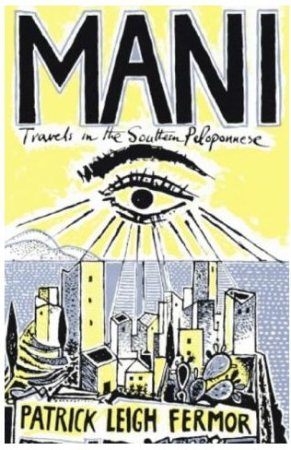
A short extract from Paddy’s masterpiece about Greece, the Mani, and a lost way of life. And of course he did stay.

Beyond the bars of my window the towers descended, their walls blazoned with diagonals of light and shade; and, through a wide gap, castellated villages were poised above the sea on coils of terraces. Through another gap our host’s second daughter, wide-hatted and perched on the back of a wooden sledge and grasping three reins, was sliding round and round a threshing floor behind a horse, a mule and a cow – the first cow I had seen in the Mani – all of them linked in a triple yoke. On a bank above this busy stone disc, the rest of the family were flinging wooden shovelfuls of wheat in the air for the grain to fall on outstretched coloured blankets while the husks drifted away. Others shook large sieves. The sun which climbed behind them outlined this group with a rim of gold and each time a winnower sent up his great fan, for long seconds the floating chaff embowered him in a gold mist.

The sun poured into this stone casket through deep embrasures. Dust gyrated along the shafts of sunlight like plankton under a microscope, and the room was full of the aroma of decay. There was a rusty double-barrelled gun in the corner, a couple of dog-eared Orthodox missals on the shelf, and, pinned to the wall above the table, a faded oleograph of King Constantine and Queen Sophia, with King George and the Queen Mother, Olga Feodorovna, smiling with time-dimmed benevolence through wreaths of laurel. Another picture showed King Constantine’s entry into re-conquered Salonika at the end of the Balkan war. On a poster, Petro Mavromichalis, the ex-war minister, between a pin-up girl cut-out from the cover of Romantzo and a 1926 calendar for the Be Smart Tailors of Madison Avenue, flashed goodwill from his paper monocle. Across this, in a hand unaccustomed to Latin script, Long live Uncle Truman was painstakingly inscribed.

I felt like staying there for ever.

From Mani: Travels in the Southern Peloponnese, by Patrick Leigh Fermor which you can buy here,

Order Paddy’s biography Patrick Leigh Fermor:An Adventure by Artemis Cooper here.

Sunday Times review of Patrick Leigh Fermor: An Adventure

I was sent this review by good friend Chris Hammond.

Click this link to open the pdf.

A man of gifts

A review of Patrick Leigh Fermor: An Adventure by William Dalrymple which is a must read. He knew Paddy and wrote one of the best profiles of Paddy for the Daily Telegraph in 2008 which you can read here.

by William Dalrymple

First published in the Financial Times, 2 November 2012.

Patrick Leigh Fermor, who died last year aged 96, had a facility for bringing together worlds usually considered incompatible. Here was a war hero who was also one of the great English prose stylists; who adored Greece and Britain with equal passion; and who was celebrated for his love of both high and low-living. His masterpiece, A Time of Gifts (1977), an account of the first stage of his 1933-34 walk from the Hook of Holland to Constantinople (“like a tramp, a pilgrim, or a wandering scholar”) has his 18-year-old self moving from doss-houses to Danubian ducal fortresses: “There is much to recommend moving straight from straw to a four-poster,” he writes, “and then back again.”

One of the world’s great walkers, Leigh Fermor was also a writer of great erudition and intelligence, reading widely in at least eight languages. He was gregarious and talkative, loved “saxophone-haunted nightclubs” and, according to Artemis Cooper’s magnificent new biography, was an enthusiastic explorer of Mediterranean brothels. Yet he also appreciated the ascetic and understood “the capacity for solitude and the recollectedness and clarity of spirit that accompany the silent monastic life … [where] the troubled waters of the mind grow still and clear, and much that is hidden away and all that clouds it floats to the surface and can be skimmed away.”

Cooper’s book is the perfect memorial to this remarkable man. She had known him (he was Paddy to his friends) since her childhood and has written a lovingly admiring account of his life which is as full of joie de vivre as its subject. She is not uncritical, and is aware of Leigh Fermor’s frailties: his insensitivities and infidelities. She shows that he was not always the ebullient figure often sighted, glass in hand, at book launches: he frequently suffered from depression and writer’s block. She reminds us that editing a piece of lifeless prose was to him, “deadening, heartbreaking mortician’s work,” like “rougeing and curling a corpse.”

The mythic outlines of Leigh Fermor’s life are well-known. His most famous moment was in April 1944 when, against almost impossible odds, he led the British team that kidnapped the Nazi commander of Crete; but the rest of his life was no less filmic. He went to an experimental school, later closed down, where nude eurhythmics welcomed the rising of the sun. He took part in one of the last cavalry charges on European soil and had a prolonged love affair with a Byzantine princess, the last of the Cantacuzenes. He became the focus of a Cretan blood feud, and attended Molotov cocktail lessons in Palestine and voodoo ceremonies in Haiti. He was beaten up by Irish huntsmen after asking if they buggered their foxes and his car was bombed by communists. Well into his sixties, in homage to Byron, he swam the Hellespont.

He also found the time to pen some of the most beautiful travel books ever written. While his prose – with its “truffled style and dense plumage”, according to Lawrence Durrell, “madly, intoxicatingly overwritten” – is beyond any sane attempt at imitation, his travel books became models for generations of British writers of non-fiction, including Bruce Chatwin, Colin Thubron, Rory Stewart and Robert Macfarlane. All were inspired by the character he created, that of the erudite literary wanderer striding over mountain passes, notebook in hand.

In several places Cooper gently polishes away at the accumulated crust of legend that has begun to cling to Leigh Fermor’s breastplate. She reveals, for example, the moral dilemmas he suffered during his work with the Cretan resistance, when the Nazis wiped out whole villages in response to an ambush.

Cooper also shows that Leigh Fermor didn’t resign from the British Council in Athens after the war as he used to claim: he was sacked by the other great Hellenophile of his generation, Steven Runciman, who didn’t know what to do with Leigh Fermor and wasn’t prepared to pay for him to sit in his office “throwing a party, sitting with his feet on the desk and entertaining a stream of Cretan visitors,” as one colleague recalled. The classicist Maurice Bowra, also in Greece at the time, declared Leigh Fermor, probably correctly, as “unfit for office work.”

Cooper also reveals that, unlike almost all the other British writers of the 1930s, he was actively and successfully heterosexual from the outset. The walk across Europe was accompanied by many a tumble in a village haystack that the author, with his prewar codes of reticence and honour, does not even hint at in his books. He seems to have remained a generous lover until the end. “Most men are just take, take, take,” reported one of his girlfriends, “but with Paddy it’s give, give, give.”

His one drawback in this department seems to have been his tendency to attract pubic lice: “The crabs of the world seem to fly to me,” he writes apologetically to another girlfriend who complained she had found an embarrassing parasite on her eyebrow. “On getting your letter, I made a dash for privacy and thrashed through the undergrowth, but found everything almost eerily calm … The whole thing makes me scratch my head, if I may so put it.”

The last decade has seen the death of the many of our greatest travellers – Wilfred Thesiger, Eric Newby, Norman Lewis – and it is interesting that almost all of them came home in the end. Despite his years in Greece and the Balkans, and for all that he dreaded the damp of England – which he described as “like living in the heart of a lettuce” – Leigh Fermor remained almost absurdly English; to the end, he was completely certain that he wished to be buried in England rather than his adopted home of Greece. His funeral took place at Dumbleton in Worcestershire, where he lies beside his wife, Joan.

For those of us who loved him and his work, and for a whole generation of writers who set off in his footsteps, he was the exemplar, showing how magnificently an English life could still be lived. He remains – pubic lice apart – the model to which we still aspire.

William Dalrymple’s next book, ‘Return of a King: The Battle for Afghanistan’ is published by Bloomsbury in February.

Patrick Leigh Fermor: An Adventure will also be the BBC Radio 4 Book of the Week from 19th November onwards.

You can buy Patrick Leigh Fermor: An Adventure here.

Don’t forget to visit Artemis Cooper’s Facebook page for further information.

Related article:

Patrick Leigh Fermor: The man who walked – the excellent profile of Paddy by William Dalrymple.

Patrick Leigh Fermor: the story was the thing

The Royal Geographical Society was full to overflowing last week to hear Colin Thubron in conversation with Artemis Cooper, the accomplished biographer of Patrick Leigh Fermor. Memory, as we all know, can be an unreliable witness.  As Cooper explained, Paddy, who died at the age of 96 last year, was a story teller: a complex man who struggled with depression, who loved life, who loved people, but who at his heart was intensely private.  It amused me when I first arrived in Greece that everyone we met seemed to have a ‘Paddy’ story: rather like Princess Diana he was one of those charismatic icons that everyone wanted to own: a living legend. It was appropriate that he chose the wild Mani at Kardymili for his home, for it is a land of heroes and myths.

By Lauren O’Hara.

Published in The Cyprus Mail 3 November, 2012

It was brave of Cooper to tackle the question of the elaboration of truth, the ability of PLF like any good raconteur to give edited highlights: to cut and paste to make the tale more engaging: the spirit rather than the letter of historical accuracy.

She took head on too, the reasons for his mixed reception in Crete, the place where he won a DSO for the daring capture of General Kreipe. The place where he was parachuted in by British intelligence to live in the wilds, as a shepherd, to organise the Cretan resistance: the place where he was immortalised on celluloid, forever, by the dashing casting of Dirk Bogarde.

But there was a dark side: the accidental killing by Paddy, mishandling a loaded gun, of his comrade in arms in the Cretan resistance, Yanni Tsangarakis. It resulted in a long blood feud, after the war, leaving Paddy with a death vendetta on his head.  Yanni’s family finally forgave him, but you cannot help but wonder if Paddy ever forgave himself. Cooper also tackled the terrible reprisals that happened as the Germans withdrew from Crete killing many of the men in the villages, and astutely blaming not Paddy but that policy, still used in wars today,  which sees Special Operations’ forces  sabotage and create havoc and then leave. For as we see in the Middle East, Iraq, Afghanistan it is always, however grateful for the intervention, those left behind that count the cost in lives and revenge.

A year ago we were at a party at Paddy’s house to celebrate his life and legacy which left the house as a permanent memorial to the Benaki Foundation: a ‘study centre’ – to be used for writers, scholars and historians. Inevitably, given the limitations of money, for the house comes with no endowment, plans will take time to unfold. Meanwhile, those lucky enough to go will find it full of the spirit of the man: to be loved even more, perhaps, once this biography humanises the hero, for like the Greek gods that squabble and feast in the high mountains behind the house, flawed heroes are far more fun.

Related article:

‘A Tonic and a Treat’ – Patrick Leigh Fermor: A Celebration

Event – Sounds of the Greek World and Beyond: The travel writing of Patrick Leigh Fermor

A commemoration, presented in collaboration with the Society for Modern Greek Studies.

This event will celebrate the travel-writing of Sir Patrick Leigh Fermor (1915-2011), author and Hellenist. After a welcome by Professor Roderick Beaton, Director of the Centre for Hellenic Studies, and an introduction by Professor Tim Youngs, there will be three individual reflections on Patrick Leigh Fermor’s contribution to travel-writing, followed by a panel discussion. Participants include:

  • Professor Tim Youngs, Director: Centre for Travel Writing Studies, Nottingham Trent University; Founding Editor of Studies in Travel Writing
  • Professor David Roessel, Interdisciplinary Centre for Hellenic Studies, The Richard Stockton College of New Jersey; author of In Byron’s Shadow: Modern Greece in the English and American Imagination (Oxford 2003)
  • Sir Michael Llewellyn-Smith, Visiting Professor: King’s College London and former British Ambassador to Greece; author of Athens: A Cultural and Literary History (Oxford 2004)
  • Dr David Wills, Treasurer-elect: Society for Modern Greek Studies; author of The Mirror of Antiquity: 20th Century British Travellers in Greece (Newcastle 2007)
  • Artemis Cooper, author: Patrick Leigh Fermor: An Adventure  (John Murray 2012)

After a vote of thanks by Professor David Holton, Chairman of the Society for Modern Greek Studies, a reception in the Anatomy Museum will follow. By kind permission of the publisher, copies of Artemis Cooper’s new biography of Patrick Leigh Fermor will be available for purchase at the reception.

For further details of the programme, please see the event flyer

The event is open to all and is free. Prior registration is not necessary.

Organisers: John Kittmer & Dr Liana Giannakopoulo.

Location: King’s College London, Anatomy Lecture Theatre, K6.29 King’s Building, King’s College, Strand, WC2R 2LS – map

When: 20/11/2012 (18:30-20:00)

Contact: Queries should be directed to chsevents@kcl.ac.uk


Paddy’s childhood home: The Weedon Bec route near Northampton

The travel writer Patrick Leigh Fermor enjoyed a blissful childhood of ‘barns, ricks and teazles’. His biographer, Artemis Cooper, strolls through the landscape of his adventures.

By Suzi Feay

First published in the Financial Times, 27 October 2012.

“I made the decision very early on that I was not going to walk in Paddy’s footsteps,” says Artemis Cooper, biographer of travel writer, raconteur, war hero and all-round charmer Patrick Leigh Fermor. Just as well, as his youthful exploit of going “on foot to Constantinople”, as detailed in his book A Time of Gifts, is probably his most famous achievement. That’s if you don’t count kidnapping a German general and force-marching him round Mount Ida, Crete, during the second world war, an adventure retold in the movie Ill Met By Moonlight in which PLF was played by Dirk Bogarde. This must be one of the few cases where a film star was eclipsed by his subject. Leigh Fermor continues to enchant from beyond the grave.

Certainly his biographer is smitten. “I’ve known him all my life,” she says of her old family friend, still apt to talk about him in the present tense (he died last year, aged 96). We have met in the Northamptonshire village of Weedon Bec, where Paddy spent his infancy. In her book, Patrick Leigh Fermor: An Adventure, Cooper describes these idyllic years during the first world war, when he lived with “Mummy Martin”, “Daddy Martin” and their children, adored though unrelated. Why he was there is a mystery; he was reunited with his own mother aged four, but was never to feel strongly attached.

By St Peter & St Paul’s Church in Weedon, the main road passes under the Grand Union canal. We climb some steps to the towpath, where a barge puffs out atmospheric smoke. Although this is a lovely spot to begin our walk, there is no mention of the canal in any of his writings about his childhood. Little Paddy-Mike, as he was known, was clearly not allowed to go near it.

We set off, the first of many brightly coloured barges chugging past us, and glimpse a tiny water vole. Cooper tells me about PLF’s legendary vitality. “His energy was amazing. We went to stay with him in Greece and went for a walk. He was in his seventies and we [she and husband Anthony Beevor] were in our thirties and quite fit and it was hard to keep up with him. He was making a point, but still … ”

One thing I gleaned from her book was that Leigh Fermor hated going to sleep. Why was that? “Because it wasn’t living,” Cooper replies. “He felt you had to get the most out of life, every minute of it.” There are amusing tales of a Christmas turkey stuffed with Benzedrine as he whooped it up in wartime Cairo.

At the second bridge over the canal we ascend to the High Street, where the Martins lived at number 42. After some puzzling, we finally discover the house, formerly divided into two tall, thin dwellings. The date “1849” is visible under the porch. Nearby is The Wheatsheaf, behind whose vanished gates Paddy-Mike would play. This would have been a busy little town, but in A Time of Gifts he speaks of a rural childhood of “barns, ricks and teazles, clouded with spinneys and the undulation of ridge and furrow”.

The Grand Union Canal between Dodford and Weedon Bec

We nip into the Heart of England pub opposite, and I ask Cooper what it was like to talk to this legendary conversationalist. “He just made you feel so great,” she beams. “I’d never read Hardy’s The Dynasts. ‘OH, my dear, what a TREAT you have in store, I think I have a copy here, you can take it with you to bed tonight. WHAT, you’ve never read The Bridge-Builders by Kipling? It won’t take a second – I tell you what, after lunch I’m going to have a nap, you can read it then.’ That enthusiasm, never making you feel stupid or under-read. One of his oldest friends said, ‘if only Paddy came in pill form and you could take him whenever you felt depressed.’ That’s how he left you feeling. Even in his nineties.”

We rejoin the canal path as it makes a series of lazy wiggles, talking about Leigh Fermor’s mother (“an awful snob and a name-dropper”) and wife (“If it hadn’t been for Joan, I think he might just have been a charming sponger”). We leave the canal at the next humpbacked bridge and turn west, following a quiet road with a view over tranquil fields. “Now can’t you just imagine the young Paddy, roaming around here playing Robin Hood? Always the romantic.”

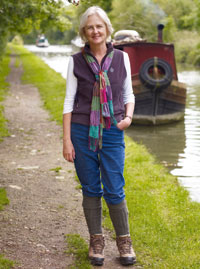
Artemis Cooper togged up!

By the stream running by the path, Cooper takes a photo of a purple flower to identify later. Over the fields lies the village of Dodford, where Leigh Fermor and his mother lived when he was slightly older. At the village green, we turn right past a red telephone box, then left at a set of gates. Cooper has an Edwardian photograph of Vicarage Cottage, his former home, and is eager to find it. Now called Quiet Ways, and somewhat enlarged, it is instantly recognisable; and opposite is the Swan, or “Dirty Duck”, now a private home.

We ascend a footpath and walk through the churchyard of St Mary the Virgin to the A45, which we cross at a place called Four Views. From there, we take a diagonal path across the fields, eventually meeting the Nene Way. A sharp left turn returns us in the direction of Lower Weedon. The soil in the fields is a rich red, the landscape gentle, undramatic, yet quietly beautiful. Our conversation takes a sombre turn as the sky darkens.“The gods gave him great gifts. To be handsome, intelligent, a gifted linguist with a wonderful body … And it doesn’t stop there: to have all that and be charming, a great conversationalist, to be the person everyone loves being with. But with great gifts the gods also make you pay a price. He had periods of depression, and times where he felt that he hadn’t written enough, that he’d wasted his life.”

At Upper Weedon a sharp right turn takes us south, then we turn left on to Farthingstone Road to ascend Weedon Hill, supposedly the site of Boudicca’s last stand. “Well, it’s one of the possible locations. Perhaps the least likely,” Cooper concedes. Leigh Fermor, a magical embroiderer of legend himself, I’m sure would have begged to differ.

More Bondage

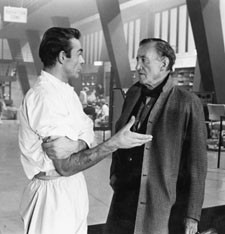
Sean Connery and Ian Fleming

Perhaps unsurprisingly one of the most popular blog posts was something I added a couple of years ago – Paddy’s eye for detail: Ian Fleming, Bondage, James Bond and Pol Roger. With the launch of the new Bond movie plus the popularity of A Fifty Shades of Grey (you should see the search terms that lead people to your favourite blog!) it seems timely to do as I promised, and publish the complete article by Geoffrey Wheatcroft which is about Ian Fleming, a close friend of Paddy and Joan.

by Geoffrey Wheatcroft

First published in the New York Review of Books, 14 August 2008.

Fifty years ago, a fictional spy who had gradually become famous suddenly became notorious. Dr. No was the sixth of the books that had been appearing since 1953 when Ian Fleming, a restless, cynical English newspaperman, published Casino Royale, and with the words “The scent and smoke and sweat of a casino are nauseating at three in the morning,” James Bond first appeared. Fewer than five thousand copies were initially printed, but sales rose with each book, Bond entered the national consciousness, and his adventures began to travel, notably to America. Then in 1958 academic and journalistic critics began to look hard at this phenomenon, and did not like what they saw.

First came Bernard Bergonzi, with “The Case of Mr Fleming.” Apart from finding the sex distasteful—male brutality and female submission, or what Bond himself called “the sweet tang of rape”—he lamented Fleming’s “vulgarity and display” and his love of luxury goods. This was true enough, as anyone knows who has read the books, or who visits the fascinating show about Fleming and Bond at the Imperial War Museum in London on which For Your Eyes Only, Ben Macintyre’s enjoyable new book of the same name, is based. Fleming pioneered brand-name-dropping, and we can see a letter he received from Floris of Jermyn Street, enclosing a bottle of that elegant emporium’s lime essence in return for a puff in Dr. No.

Then the Manchester Guardian (as it still just was) editorially deplored the decline in taste expressed by the “advertising agency world” of the books, which echoed Bergonzi unkindly contrasting Bond with “the perfectly self-assured gentlemanly life” of his obvious predecessors, the Clubland Heroes. That was the title of Richard Usborne’s book, published in the same year as Casino Royale, about the novels of John Buchan, Dornford Yates, and “Sapper,” and those earlier heroes would not, Bergonzi sniffed, have tolerated club servants talking like something out of a New Yorker ad (“If I may suggest, Sir, the Dom Perignon ‘46”). Fleming responded genially to the Guardian with “a squeak from the butterfly before any more big wheels roll down on it,” but he was dismayed by a more ferocious assault, from Paul Johnson in the New Statesman. Under a headline which almost entered the language, “Sex, Snobbery and Sadism,” Johnson denounced Dr. No as “without doubt, the nastiest book I have ever read,” combining schoolboy sex fantasies with suburban “snob-cravings.”

Not that these fusillades did much material damage. Half a dozen more books were to come before Fleming died in 1964, and there was a handy endorsement when John Kennedy revealed his enthusiasm for 007. Author and president met, even discussing harebrained schemes for disposing of Dr. Castro rather than Dr. No (but is it really true that Kennedy and Lee Harvey Oswald were both reading Bond books the night before the assassination in Dallas?). Then Bond went through the financial stratosphere when the film adaptations began in 1962, since when there have been—well, Simon Winder, in The Man Who Saved Britain, his entertainingly idiosyncratic book about Bond and “Bondage,” gives a list before breaking off, “…I’m sorry: I just can’t go on it’s all so terrible. They’re roughly the same, come out at irregular intervals and tend to have the word Die in the title.”

After Fleming’s death came the pastiche novels: Devil May Care by Sebastian Faulks “writing as Ian Fleming” is the twenty-second in a line that began in 1968 with Colonel Sun by Kingsley Amis—and here is a curiosity in itself. Great writers are often parodied by lesser talents, but Fleming must be the only thriller-writer to be mimicked by a Booker Prize winner, and now by another well-known literary novelist. This might have puzzled Fleming, whose ambiguous attitude toward what he shrugged off as his “kiss kiss bang bang” books has already been chronicled in biographies by John Pearson and Andrew Lycett. His life casts only a little light on the real world of espionage, but is more revealing as a rather bleak story of malaise and decline, personal and national.

For all the snobbery of which Fleming was accused, his grandfather Robert Fleming was born in a humble home in Victorian Dundee, started off as a thirteen-year-old clerk for £5 a year, and worked his way up, founding his own bank and accumulating a fortune, a house in Grosvenor Square (where the unlovely American embassy now stands), and an estate in Oxfordshire. His son Valentine became an MP and fathered four sons. The elder two were Peter and Ian, born in May 1908: Faulks’s Devil May Care was launched on the centenary itself, when a blonde in a red jumpsuit whisked the first copies to an awaiting warship (Fleming might have been half amused, while wondering whether his beloved Royal Navy had nothing better to do than host publicity stunts).

In 1917, Valentine was killed on the Western Front. Ian’s life was clouded by that memory, and he was overshadowed by Peter at Eton. Ian didn’t follow his brother to Oxford, being sent instead to Sandhurst military academy. Quite forgetting the wisdom of the Duke of Cambridge (Queen Victoria’s cousin, and commander in chief for most of her reign, visited Sandhurst at a time when there was a high incidence of venereal infection among the officer-cadets, and told them with avuncular sternness, “I understand that some of you young gentlemen have been putting yours where I wouldn’t put my walking stick”), he contracted gonorrhea in one of the first of many escapades, and was removed by his horrified mother.

After flunking out of the army, Fleming flunked out of journalism and stockbroking as well, and was in his thirties when he was rescued by the war. He worked in the Admiralty intelligence department for Rear Admiral John Godfrey, the model for Bond’s boss “M,” became a commander, the rank he gave Bond, and followed from afar the missions of Special Operations Executive in occupied Europe. It’s not hard to see an element of compensation when this desk-bound sailor came to write about derring-do he had never personally experienced. The only time Fleming literally saw action was in August 1942 when he was in a destroyer observing the Dieppe raid. Instigated by the absurd Lord Louis Mountbatten, one of Churchill’s worst appointments, that disastrous enterprise saw one thousand of six thousand men killed in a day for no discernible purpose, a shambles which might have sown the first seeds of doubt in Fleming’s mind about England’s greatness.

After the war he found a comfortable newspaper job, and resumed his liaison with Ann Rothermere, a famous London hostess. Fleming’s one child, Caspar, was born five months after they married in 1952, following her divorce from her second husband. Not that marriage cramped Fleming’s style. Amis thought that Bond was an “amalgam of what many men would like to be,” which may have said more about him than many men. The real-life Fleming showed little of the chivalry toward women with which he occasionally invests his hero. At best he was Philip Larkin’s Englishman, “too selfish, withdrawn/And easily bored to love,” at worst a heartless philanderer; as Rosamond Lehmann (a novelist of a very different kind) astutely put it, “The trouble with Ian is that he gets off with women because he cannot get on with them.”

He got on with Ann on and off, as it were, in a curious relationship. Torture is conspicuous in the books, and an early Dr. No paperback cover (the kind of thing we don’t see much in bookstores now) shows a girl with very little on dangling from manacled wrists while a vast black man stands over her to inflict horrible pain. But then Fleming knew whereof he wrote, warning Ann in one letter to ready herself for more of her own punishment and “be prepared to drink your cocktails standing for a few days.”

Then again, he might have been settling the score. Returning to the small house on the Dover coast he’d been lent by Noël Coward, Fleming heard laughter from the sitting room, which fell silent when he entered, and he realized that Ann and her friends had been guffawing over passages from galleys of Casino Royale. He never cared for Ann’s salon of writers and artists and one can almost see why. One of her friendships at least bequeathed an unforgettable legacy: amid the memorabilia—Ian’s old typewriter, or a cable from Clay Felker asking for a piece on Russian spying for Esquire—a visitor to the show is stopped in his tracks by Lucian Freud’s haunting small portrait of Ann.

And one more of the circle was Cyril Connolly (even if, come to think of it, Ann was exactly the woman he had in mind with his lethal coining “smartistic”). In 1963, Connolly published a parody of Fleming in the London Magazine. “M” has conceived an illicit passion for 007, who is told to get himself done up in drag, go to a nightclub, and entice a kinky visiting KGB general, who turns out to be “M” himself in disguise (“I’m sorry, James,” he says forlornly at the unmasking. “It was the only way I could get you,” at which Bond’s “long rangy body flared out above his black silk panties,” before he cuts his boss short: “I thought fellows like you shot themselves…. Have you got a gun—sir—?”).

This spoof was entitled “Bond Strikes Camp,” and that was the mot juste. There is sometimes a perceptible arch self-consciousness in the original books, but everything since has been one big camp meeting, the movies most obviously, but also the knockoffs. Not surprisingly, Faulks’s Devil May Care is better written than Fleming’s books. If Johnson exaggerated when he said that Fleming had “no literary skill,” so does John Bayley in claiming that “Fleming wrote so well…almost as well as Raymond Chandler.” The quality of writing in popular novels is as varied as in literary fiction, and while Fleming didn’t write as badly as Jeffrey Archer he really didn’t as well as Chandler. His prose style, such as it is, was acquired during his brief sojourn at Reuters: who-what, short sentences, a minimum of adjectives and adverbs, all of which Faulks carefully copies.

While Devil May Care is short on sex and sadism, it does begin with one unfortunate having his tongue torn out; but then Faulks’s own tongue is a little too obviously in his cheek. We get Gorner, an impossibly horrible villain, a brutal enforcer called Chagrin (nice touch), a glamorous heroine with whom James is far too diffident—and a distinctly autumnal flavor. The book is set in 1967, when Fleming not only didn’t write it but could not have written it, and 007, as he admits, is showing his age. Now and again the writing flags. Bond has been in Tehran a few days when he lunches alone on caviar and martinis, before spreading out “some maps he had bought from the hotel shop…. The country was between Turkey to the west and Afghanistan to the east. Its southern frontier was the Persian Gulf, its northern limit the Caspian Sea.” Well, yes.

There are a few other lapses which it would be tedious to list, including a tennis match that is not only implausible in itself but whose scoring goes awry. We all make mistakes, including the originator. After Fleming published On Her Majesty’s Secret Service, that worldly sophisticate was mortified to receive a magisterial rebuke from his friend Patrick Leigh Fermor: Ian surely knew that Pol Roger is the only champagne never sold in half bottles.

2.

When Philip Larkin grumbled once about the “spy rubbish” he resented having to read (along with “science-fiction rubbish, Negro-homosexual rubbish, or dope-taking nervous-breakdown rubbish”),* Fleming must have been what he had in mind, but there is more than one type of espionage novel. The Bond books can be called many things, but not grown-up, whereas a long and distinguished line of adult spy fiction runs from Conrad’s The Secret Agent (published the year before Fleming was born) by way of Somerset Maugham’s Ashenden books to Graham Greene, Eric Ambler, Nigel Dennis, John Le Carré, and Robert Harris, with the Americans Alan Furst and Joseph Kanon latterly carrying on the tradition.

For one thing, real-life espionage is a far grimmer business than 007’s make-believe kissing and banging. W.C. Heinz, who died recently, was one of the great American sportswriters of his age, but he first made his name as a war correspondent, and in particular with one piece from the Battle of the Bulge. Written with a harsh realism that would be unlikely today, “The Morning They Shot the Spies” describes three German soldiers who had been ordered to dress in American uniform and drive a jeep behind Allied lines, where they were soon apprehended and faced the same fate, tethered and blindfolded, as many such. (A sombre footnote in our story belongs to Erskine Childers, author of that still-readable spy yarn The Riddle of the Sands; during the savage Irish Civil War in 1922, years after his book was published, he became, as far as I know, the only thriller-writer to be himself shot by firing squad.)

From 1940, numerous often hopelessly inept agents were parachuted into England where they were caught, and usually executed, although they had a choice. They could accept a patriotic death or, as Tony Soprano would say, they could be flipped. Not a few chose discretion over valor and became double agents, radioing back carefully controlled disinformation (making sure to sound like themselves: Faulks mentions the “fist” or personal quirks by which a particular radio operator’s transmissions could be recognized). By any such standards, the story of one double agent was astounding, not to say utterly improbable, as it is told in Ben Macintyre’s Agent Zigzag and Nicholas Booth’s ZigZag. Both books are well researched and well written; Macintyre’s is masterly.

Born in a Durham mining village in 1914, Eddie Chapman enlisted in the Coldstream Guards, but he soon discovered Soho, girls, and gambling, was discharged for going AWOL, and turned to petty crime, less petty when he graduated to gelignite and safecracking. He also entered the pre-war London equivalent of Damon Runyon’s Broadway, a demimonde of gangsters, journalists, and showbiz: stranger-than-fiction begins when he really did rub shoulders with Noël Coward, Marlene Dietrich, and, in a still more preposterous coincidence, a young man in the film business called Terence Young. Many years later, Young would direct the first Bond movie.

On the lam from a bank robbery in 1939, Chapman took a girl to Jersey, where he was caught and imprisoned, with dramatic consequences when France fell in June 1940, and the Channel Islands were occupied by the Wehrmacht. Highly intelligent, a natural linguist, and thoroughly amoral, Chapman now offered his services to the Germans as a spy. “The life of a secret agent is dangerous enough, but the life of a double agent is infinitely more precarious,” said Sir John Cecil Masterman, Oxford don and intelligence officer; “a single slip can send him crashing to destruction.” Chapman’s iron nerve never slipped. He was inducted into the Abwehr, the intelligence service of the German high command, and in December 1942 (when both books begin with a prologue), carrying a radio, a Colt revolver, and a cyanide pill, he was dropped into a field in Cambridgeshire.

He had long been awaited. The greatest single British contribution to the defeat of the Third Reich, and possibly the greatest British achievement of the past century, is known to us as Bletchley, the unprepossessing country house halfway between Oxford and Cambridge, where an eccentric team of mathematicians, musicians, and classicists broke what the Germans had with good reason believed to be the unbreakable codes of their Enigma machines, and in the process pretty well invented modern computing: the huge creaking and whirring “bombes” of Bletchley, running over endless patterns and permutations, were the forebears of your laptop. Fleming was peripherally concerned with this operation, which is the setting for one of the best recent thrillers, Robert Harris’s Enigma. In its film version a very attentive viewer can catch a fleeting cameo performance as an RAF officer by one of the movie’s backers, Sir Mick Jagger—and we did get some satisfaction from what was done at Bletchley, enjoying the incalculable advantage of reading German radio traffic.

One intercepted Abwehr message said, “Your friend Bobby the Pig grows fatter every day. He is gorging now like a king, roars like a lion and shits like an elephant. Fritz.” The lady cipher clerks were shocked by this vulgarity, but those to whom it was funneled upward added it to their file about the latest agent who would be arriving soon, although this time the information was unneeded. Chapman immediately gave himself up and volunteered to serve his own country, as he had—perhaps and maybe—always intended to do. He was code-named “Agent Zigzag” by one of his handlers (who must have had an unconscious instinct for book titles), and was debriefed at length by such unconventional officers as Tommy “Tar” Robertson, Robin “Tin Eye” Stephens, and the scientist and intrepid dismantler of unexploded bombs, Victor, Lord Rothschild: that scion of the most famous of banking dynasties now listened while Zigzag cheerfully taught him how to rob a bank.

His handlers took to this “most absorbing person,” as one of them called Chapman: “Reckless and impetuous, moody and sentimental, he becomes on acquaintance an extraordinarily likeable character,” and his work of deception soon began. One of his tasks for the Abwehr had been to sabotage an aircraft factory near London, and an explosion was duly faked, with a story planted in the Daily Express for added realism. Still more astonishingly, Zigzag then returned to occupied Europe, where he rejoined the Abwehr in Norway, and became the only British citizen ever awarded the Iron Cross. Eddie’s subsequent reward from his own country after the war was more practical, a character reference describing him as “one of the bravest men who served in the last war,” which regularly kept him out of prison.

What distinguishes the Bond books, apart from the floggings and the Floris, is the simple moral world they inhabit. James, “M,” and Felix Leiter, 007’s likeable Texan buddy, are Good; Drax, Goldfinger, and Rosa Klebb are Bad, with no shades between. When a double agent does appear, she soon gets her comeuppance. By contrast, the adult spy books from Conrad on are set in a misty marshland of compromised loyalty, personal ambiguity, betrayal, and failure. A decade after the arrival of Bond, virile and uncomplicated, The Spy Who Came in from the Cold marked a drastic change of mood with the gray, mousy cuckold George Smiley; if Le Carré had written the Bond books, Leiter would be working for the KGB as well as the CIA.

Which is why, as Tod Hoffman says in The Spy Within, his book about a CIA employee who spied for the Chinese, the spy-hunter does not assume that everyone is a spy, only that anyone might be. People spy from a variety of motives—greed, ideological commitment, or atavistic ties—which raises delicate problems in a country like the United States, with so many hyphenated citizens harboring potential mixed loyalties. Humphrey Bogart’s one truly nasty film is Across the Pacific, made in a hurry just after Pearl Harbor. The villain is a Japanese-American, the “all-American boy,” as he calls himself, who turns out to be spying for the land of his forefathers; the movie could be seen as a justification for the shameful internment of the Nisei by the Roosevelt administration. More recently, Mossad raised more awkward questions when they suborned the American intelligence analyst Jonathan Pollard by appealing to his Jewish loyalty.

When the CIA realized in 1982 that there was a foreign agent working inside American intelligence, they didn’t at first guess that he was one of their own. Larry Wu-Tai Chin had originally been recruited by the US Army during the Korean War as a translator, but then moved to the Foreign Broadcast Information Service run by the CIA. He stayed with the agency for more than thirty years, all the time passing documents to the Chinese. His inducement wasn’t just ties of blood: Chin was paid handsomely enough to spend as he pleased not only on women (he was a “lecherous old scumbag” according to one colleague) and gambling but on real estate in the slums of Baltimore. Not for the first time, the fine minds of an intelligence service quite failed to notice how an employee was living way beyond his salary, and the mystery about the Chin case is not how he was finally rumbled, leading to prison, where he committed suicide in 1986, but how he went undetected for so long.

How much damage he did is hard to assess, but then so is whether most spying does any good. Sir Henry Tizard was president of Magdalen College, Oxford, a scientist as well as a public servant, and a true patriot, who may be said without exaggeration to have helped save his country and civilization: without his work in ensuring that radar was installed around the coastline by 1940, the Battle of Britain might have been lost. Ten years later, at the height of the panic over “atomic spies,” Tizard used to tell colleagues that there were no nuclear secrets. He meant that there was little the Soviets had learned through espionage that could not have been gleaned by less melodramatic means, with competent Russian physicists studying the published American scientific journals.

There might have been an element of donnish exaggeration in that, and obviously signal intelligence of the Bletchley kind is of the highest value in wartime. But a great deal of espionage is solipsistic or circular, shadows chasing shadows, spies spying on spies spying on other spies like the endlessly receding image in facing mirrors. That is something the better spy writers convey, and so intermittently does Fleming. His books also have a political and social content of sorts. While Bond likes to complain about “the cheap self-assertiveness of young labor since the war” and the “buyer’s market of the welfare state,” he is conscious as well of declining British power and prestige, and resents the way that he and his country are patronized by the Americans.

In Devil May Care, Faulks’s Bond voices one or two of his traditional views—the French intelligence services are riddled with Communists—but he also encounters a new complication in the Anglo-American relationship. Gorner is trying to precipitate a nuclear war that will destroy London, and gloats to Bond that “the Americans saved your bacon twice, but your failure to support their crazed adventure in Vietnam has made them angry with you. They will not be so generous on this occasion.”

In the original books Bond recognizes national weakness, or is made to by such foreigners as Tiger Tanaka, head of Japanese intelligence. Bond replies a little morosely that even if the country had been “bled pretty thin by a couple of world wars” and further demoralized by welfare, “we still climb Everest and beat plenty of the world at sports.” Everest had been climbed the day before the Coronation, in the year Bond first appeared, with Sir Winston Churchill back at Downing Street to greet the young queen and inaugurate “a new Elizabethan age.” And yet only three years later, as Tanaka sarcastically observes, the attempt to arrest decline had led to Suez, and “one of the most pitiful bungles in the history of the world.” A bungle and a folly, it would become moreover a byword for late-imperial arrogance, although it might be remembered that Nasser’s initial action had been condemned not only by Sir Anthony Eden’s Tory government but by the Labour opposition and its new leader, Hugh Gaitskell (who was also Ann Fleming’s lover; England can sometimes seem a small country). And most painful of all was the way that Washington pulled the rug from under their supposed British friends.

After the debacle, a chastened and ailing Eden flew to recuperate at Goldeneye, Fleming’s house in Jamaica where the books were written each winter. He soon resigned the premiership, ostensibly because of ill health, although he lived until his eightieth year—a contrast to his Jamaican host. Skeptics have sometimes wondered how Bond managed to shoot straight, play cards and golf so well, or fornicate at all, in view of the superhuman quantities of alcohol he consumed. Fleming indeed drank a bottle of gin a day and smoked several packs, which helped explain why he died at only fifty-six; and the story grew still more melancholy.

Although Ann survived him until her death from cancer in 1981, her heart had already been broken by something worse than Ian’s death, giving the story a bitter conclusion. Their son Caspar was attractive and amusing, as I still remember, but despairing and doomed. He was sacked from Eton (like Bond, although in Caspar’s case because he had a pistol in his room), dropped out of Oxford, and took to drugs (never a good idea for an acute manic-depressive). In 1975, at the age of twenty-three, Ian Fleming’s only child, heir to the Bond millions, ended his life with a deliberate overdose.

* Author’s note:

Larkin’s words may sound more than characteristically dyspeptic, but they were written in a generous and altruistic letter to Charles Monteith of Faber, trying to persuade him, though without success, to take on Barbara Pym and her “ordinary sane novels about ordinary sane people doing ordinary sane things” (August 15, 1965)

Related article:

Paddy’s eye for detail: Ian Fleming, Bondage, James Bond and Pol Roger

Patrick Leigh Fermor: An Adventure shortlisted as Waterstones Book of the Year

Patrick Leigh Fermor: An Adventure by Artemis Cooper

A debut novel translated from French is among the six titles shortlisted for the inaugural Waterstones Book of the Year.

Laurent Binet’s HHhH, published in translation by Harvill Secker, is one of only two novels included on the shortlist, announced today (30th October). Also shortlisted is the Man Booker Prize-winning Bring Up the Bodies by Hilary Mantel (Fourth Estate).

The remaining titles are all non-fiction: Patrick Leigh Fermor: An Adventure by Artemis Cooper (John Murray); The Old Ways: A Journey on Foot by Robert Macfarlane (Hamish Hamilton); On The Map: Why The World Looks The Way It Does by Simon Garfield (Profile Books); and Polpo: A Venetian Cookbook (Of Sorts) by Russell Norman (Bloomsbury Publishing).

The winning title will be promoted in Waterstones stores in the month of December as The Book of the Year, with the chain bookseller’s managing director James Daunt heading up the judging panel to select it.

Binet’s novel tells the story of Operation Anthropoid, the assassination of Nazi leader Reinhard Heydrich in Prague during the Second World War. Its title refers to “Himmlers Hirn heisst Heydrich” (“Himmler’s brain is called Heydrich”), a quip about Heydrich said to have circulated in Nazi Germany. It was awarded the 2010 Prix Goncourt du Premier Roman.

Daunt said: “In an extremely strong year of publishing, we have an exceptional shortlist for our Book of the Year. They have such singular attributes, it will be fascinating to see which emerges the winner.”

The books on the shortlist have not been put forward by publishers. Instead, all Waterstones booksellers were invited to nominate the new book that they thought deserved the Book of the Year title and that they wanted to help more people discover. They were asked to choose a book that stood out in its field, and that would speak to the company’s core customers ­ defined as “those people who love reading and love books.”

The winner will be announced on Thursday 29th November at the Waterstones Christmas Party, which will take place at the bookseller’s King¹s Road shop in Chelsea (London). As well as the support of the entire Waterstones business, the winning author will also receive a case of champagne.

From The Bookseller 30 October 2012

Artemis Cooper to speak at King’s School Canterbury, 14 November

Patrick Leigh Fermor at school, Kings’ Canterbury

Artemis Cooper, the author of Patrick Leigh Fermor: An Adventure, will give a talk on Wednesday 14 November at 7.30 pm in the Clagett Auditorium, Canterbury Cathedral Lodge.

Sir Patrick Leigh Fermor (1915-2011) was one of the King’s School’s most distinguished old boys. He was in The Grange from 1929 to 1931. He went on to be a war hero and is regarded as one of the greatest travel writers.

The biography was published by John Murray on 11 October.

Artemis has already produced Words of Mercury, a selection of Leigh Fermor’s writings, and is now editing what survives of the planned third volume of his autobiographical trilogy, following on from A Time of Gifts and Between the Woods and the Water. It is due to be published in the autumn of 2013 and will be called The Broken Road.

Tickets for the talk cost £5 and are available on-line from The King’s Box Office, or in person from 1 Mint Yard, or on the door. Copies of the book will be available at the talk.

From the King’s School website.

Related articles:

A combination of prefab, garage and potting shed

Some Memories of King’s .. And the final word goes to?

The Observer review of Patrick Leigh Fermor: An Adventure

The Observer review of Patrick Leigh Fermor: An Adventure which concludes that life was one great adventure for Paddy, with the hard part now being to separate the fact from the fiction. It concludes that Fermor emerges as a man determined to live on his own terms, if not his own means!

By Anthony Sattin

First published in The Observer, 21 October 2012.

Traveller and writer Paddy Leigh Fermor is best known for two events. In 1933, at the age of 18, he set off with a little money and a lot of nerve to walk from the Hook of Holland to Constantinople. Eleven years later, with an equal amount of nerve, he led a commando group to occupied Crete to kidnap General Kreipe, the local Nazi commander. From these two events sprang the subjects and passions for his work and his life, the subject of Artemis Cooper’s new biography.

Fermor is a seriously challenging subject for any biographer, perhaps more so for Cooper, who knew him from a very early age. She was contracted to write the book in the 1990s but on the condition it did not appear before his death, perhaps wanting to spare his wife, friends and self the stories of his sexual adventures. Given his wine and cigarette intake, Cooper would have been forgiven for thinking he wouldn’t last as long as he did: he died last year at the age of 96. But not even close acquaintance with her subject and unrestricted access to his archive and friends will have made it any easier to get around the main obstacle: the man himself.

A school and army reject, Fermor was a self-made man in the most literal sense. He started, in the words of his headmaster, as “a dangerous mixture of sophistication and recklessness”. With those and other qualities, he honed his character with the company of extraordinary people and the words of great writers – he had a prodigious memory for prose as well as poetry. However complex his character, it was made more so, from a biographer’s point of view, by the fact that he had already written his own version of some of his life. His books contain some of the finest prose writing of the past century and disprove Wilde’s maxim that “it is better to have a permanent income than to be fascinating”.

Charm, self-taught knowledge and enthusiasm made up for the lack of a university degree or a private income. His teenage walk across Europe and subsequent romantic sojourn in Baleni, Romania, with Princess Balasha Cantacuzene are proof enough of that. But the difficulty of capturing such an unconventional and glamorous life is made harder by the certainty that Fermor was an unreliable narrator.

He was also an infuriatingly slow writer. Driven by a life-long passion for words yet hampered by anxiety about his abilities, Fermor published eight books over 41 years. The Traveller’s Tree describes his postwar journey through the Caribbean; Mani and Roumeli (1958 and 1966) draw on his experiences in Greece, where he would live for much of the latter part of his life. But it is the books that came out of his trans-Europe walk that reveal both the brilliance and the flaws. A Time of Gifts was published in 1977, 44 years after he set out on the journey. Between the Woods and the Water appeared nine years later. Both describe a world of privilege and poverty, communism and the rising tide of Nazism, and end with the unequivocal words, “To be continued”. Yet the third volume hung like an albatross around the author’s neck. As the years passed, Fermor found it impossible to shape the last part of his story in the way he wanted. Yet Cooper refers to one manuscript written in the 1960s, and a diary, and from these the final volume will be fashioned and published next year.

Fermor’s longevity also presents challenges: there is much to record of more than nine decades of travelling, flirting, writing and hard living. Cooper runs through it mostly chronologically, drawing on published work, intimate letters, unpublished notebooks, and letters and interviews with some of the many people who knew and loved him. There are places where she verifies things that might otherwise have seemed a little incredible – some of the hospitality he enjoyed on his Constantinople walk, for instance. There are other places where she shows up inconsistencies. Some were no doubt due to his writing about events from a distant past, but some were deliberate. As Cooper explains it, these came about “partly because he is condensing more than one encounter, and partly out of tact”. He was also quite happy to merge details or elaborate in order to make his story work better. Some might feel cheated by the fabricating of non-fiction but Fermor would insist he always remained true to the spirit of the event.

Fermor emerges as a man determined to live on his own terms, if not his own means, and who mostly – and mostly magnificently – succeeded. Always popping off on a journey when he should have been writing about the last one, always ready to party, he was forever chasing beautiful, fascinating or powerful women, even when with his wife, Joan. She was the great facilitator who funded his passion for travel and writing, as well as women, from her trust fund. Cooper shows that he had often had such a character in his life, starting with his earliest memories, during the first world war, when he was left with a Northamptonshire family, including an older girl he thought was his sister, while his mother and real sister returned to India to be with his father. Fermor remembered spending those first years, “said to be such formative ones, more or less as a small farmer’s child run wild: they have left a memory of complete and unalloyed bliss”. Running wild, as Cooper shows, was one of the things he would do best during the 92 years that followed.

This is not a perfect book. There is too little analysis of man and motives and not enough probing throughout, as though Cooper could still imagine the wild family friend leaning over her shoulder as she wrote. But then Fermor was far from perfect himself. Instead he was funny, learned, sexy, irrepressible, flawed yet much loved, remarkable and, at times, brilliant – not unlike this book. Cooper ends with the words, “it all really happened”, although by then I was in no doubt.

Patrick Leigh Fermor: An Adventure will also be the BBC Radio 4 Book of the Week from 19th November onwards.

You can buy Patrick Leigh Fermor: An Adventure here.

Don’t forget to visit Artemis Cooper’s Facebook page for further information.

‘A Tonic and a Treat’ – Patrick Leigh Fermor: A Celebration

Last Wednesday over seven hundred people packed out the main lecture hall of the Royal Geographic Society to hear Colin Thubron question Artemis Cooper about Paddy’s life in a joint event with the Royal Society of Literature, of which Colin is President. The event, sponsored by Art Tours, was entertaining, if perhaps a little shorter than one would have liked.

By Tom Sawford.

Artemis revealed how difficult it was to get Paddy to talk about his life, his experience and friends until on one visit to Kardamyli after Joan’s death she found every horizontal surface of his study, including the floor, covered with groaning piles of books, magazines, journals and personal correspondence (and I daresay some unpaid bills!). She offered to help him create some order and in doing so she started to ask questions: ‘I didn’t know that you had met so-and-so’ at which point Paddy, always happy to be distracted from his Herculean struggle with Vol Three, would brighten and start to expound on this outing, that visit or other glittering adventure. It was in this way that Artemis was able to make notes and get behind what she describes as the ‘waterfall’ of banter when asked directly to talk about his life.

It appears also that Paddy was perhaps always happy to receive visitors and recount old stories as he suffered both from bouts of personal depression and writer’s block.  Colin Thubron described the time that he and Paddy went for a long swim at Kardamyli and when well away from the house and others he talked to Colin about his struggles with this block, and his inability to understand this and his state of mind. Artemis said that Paddy was not ‘an intellectual’ and did not think too deeply. He was a ‘polymath’, less inclined to ask why, but rather dazzled, entertained, and fascinated by outward appearances and the sheer joy of being.

The other great excuse for not working was his correspondence with the three great correspondents of his life: Debo Devonshire, Annie Fleming and Diana Cooper. They were an ‘entertainment’ which Paddy approached with great enthusiasm and which ‘took up a lot of his time’ enabling him to divert his energies from his other writing.

We were also given a glimpse of The Broken Road (Vol Three) which is being edited jointly by Artemis and Colin. As the biography tells us it will be based almost entirely on the work that Paddy wrote in the early sixties for a US magazine ‘A Youthful Journey’ which was meant to be no more than 5,000 words. Once Paddy had reached the Romanian-Bulgarian border in this retelling he was suddenly gripped by a passion to write down this story in great detail, the result being over 50,000 words about the leg from Romania to Istanbul, although Colin said that the account does not include his time in the City.

Colin told us that this is difficult work, and they are being most careful not to add their own words. There is much work to be done but as I was told last week by Roland Phillips from John Murray, the publication date remains September 2013, not far short of the 70th anniversary of the start of Paddy’s youthful journey.

During the question and answer session a variety of subjects were raised from the condition of the house at Kardamylli – things are moving forward – to whether or not the Horace ode recitation actually did happen – yes it did but it may not have been on Mount Ida.

When it came to the last question a rather large man, wrapped in colourful braces stood up and shouted out that this was not a question but a statement, a Traveller’s Tribute. I think I could hear the whole audience groan quietly in apprehension, but all turned out well. Holding up a copy of the biography he boomed ‘This book is nothing short of a tonic and a treat! It kept me sane today during a long and boring train journey from Scotland!!’ Cue laughter and applause.

The event was sponsored by Art Tours who are arranging a tour of Patrick Leigh Fermor’s Mani in the spring of 2013. Places are limited and already about half are taken so if you wish to go on this tour, which will include Artemis Cooper as a guide and key speaker, please make contact with Edward Gates at Art Tours as quickly as you can edward[at]arttoursltd.com

In addition Art Tours have 15 signed copies of the biography Patrick Leigh Fermor: An Adventure to give away in a competition. To have a chance of winning, please send your Name, Postal Address, email address, and telephone number to Edward. Winners will be contacted in early November.

If you would like to know more about the Mani tour please download this pdf or contact Edward Gates at Art Tours Ltd on +44 (0)207 449 9707 or by email edward[at]arttoursltd.com


A quinquereme among abbeys

‘This year marks the millennium of St Coloman’s martyrdom in 1012 and his feast day of October 13th, Kolomani, will be marked with celebrations in Melk’. Above, the abbey at Melk, Wachau Valley, Austria. Photograph: Elfi Kluck/Getty Images

Irish saints and the Abbey of Melk. Surely there is a link to Paddy? Of course he visited here in 1934 and wrote about it at length in A Time of Gifts pp 154-158.

By Alexander O’Hara.

First published in The Irish Times, October 9 2012

The Abbey of Melk sits like a benevolent sleeping giant above the little town of Melk and the Danube. To the east lies the Wachau, one of the most magnificent stretches of river scenery in Europe, and the eastern foothills of the Alps, to the west, Mauthausen and Bavaria.

This Baroque pile, a Benedictine monastery since 1089, is one of the most recognisable attractions in Austria. The Anglo-Irish writer Patrick Leigh Fermor, who died last year, memorably described it as a “quinquereme among abbeys” in his 1977 classic A Time of Gifts, a wistful memoir of his travels by foot through Central Europe on the eve of Hitler’s rise to power in 1933 when he was 18. He captures the awe of approaching Melk in the snow and seeing the Abbey rise up on its limestone bluff above the Danube valley. Most of the tourists who now visit the Abbey church (which, with all the gold, has been memorably likened to being inside a giant rapper’s mouth by AA Gill) – probably take little notice of a side altar and Baroque tomb to the left of the high altar. This is the tomb of St Coloman, an Irish martyr and the first patron saint of Austria. This year marks the millennium of his martyrdom in 1012 and his feast day of October 13th, Kolomani, will be marked with special celebrations in Melk.

How did an Irish man come to be patron saint of Austria? The story begins in the autumn of 1012 when an Irish pilgrim named Colmán (Coloman is the Germanised version of the name) was on his way to Jerusalem following the old Roman road along the Danube towards Vienna. He was on the overland pilgrimage route, an ancient path that followed the course of the Danube valley through Hungary. This had been reopened following the conversion to Christianity of King Stephen of Hungary in 997 and the destruction of the Holy Sepulchre by Caliph Al-Hakim in 1009 had provoked an upsurge in pilgrimage to the Holy Land. Coloman only made it as far as Stockerau, a town 30km to the north west of Vienna. He had unwittingly entered a war zone in what was a borderland known as the Bavarian Eastern March, a strategic frontier wedged between the Magyars or Hungarians to the east and the Moravians to the north. The Babenberg margraves, the rulers of the March, were in the process of extending their control and territory in this colonial land.

Stockerau stood on the borders of the March and was subject to frequent raiding. The locals were in no mood to welcome exotic strangers, and garbed as a pilgrim and speaking Gaelic, Coloman clearly stood out. According to a near-contemporary account, the locals suspected him of being an enemy spy and summarily lynched him from a tree (on dying for the cúpla focal see Frank McNally, An Irishman’s Diary, March 16th, 2012).

The exact circumstances of Coloman’s murder will never be known, but following his death, miracles began to take place – the dead man’s hair and nails continued to grow, the dead tree on which he was hanged began to bloom, and people were healed who came in contact with his body. News of these miracles came to the attention of Margrave Henry I at Melk. One of the powerful Babenberg dynasty who were to rule Austria from 976 to 1246, Henry recognised the power of this new saint and sent his soldiers and clerics to take the body from Stockerau to his residence at Melk which later became the famous monastery we know today.

The Austrian Babenbergs traced their descent to the Franconian Babenbergs whose fortress at Bamberg in Germany gave the dynasty its name. The patron saint of Franconia was (and still is) St Kilian, another Irish man who was martyred in 689, and whose relics lie in the cathedral of Würzburg. It is noteworthy that both Henry I’s father and brother were both buried in the same cathedral where Kilian’s relics were kept. By promoting the new Irish martyr Coloman as a dynastic and regional patron for the region that would become known as Austria, Henry may have hoped to shape a spiritual landscape for this new land that drew on common cultural traditions of Bavaria and Franconia where there was a strong tradition of veneration to Irish missionary and martyr saints such as St Kilian.

The new cult of St Coloman became a vehicle for the Babenberg margraves, which they were keen to latch on to from the beginning in order to cement their new power base in the Eastern March and to bring cohesion to this frontier region. In time, Coloman came to be venerated as the patron saint of the historical core of Austria, Österreich ob und unter der Enns, from 1244 until 1663. Today Coloman is the patron saint for convicts who are hanged, passengers, and livestock as well as being one of the many ironies of history. As an eminent Austrian historian remarked, “It might seem particularly ironic today that the first Patron of Austria had fallen victim to Austrian xenophobia; something which nobody could have foreseen”.

Coloman’s feast day this Saturday (13 October) will be celebrated in Melk, the millennium anniversary of the death of the unfortunate Irish pilgrim who became Austria’s first patron saint.

Visit Saint Coloman’s Wikipedia page.

Nomad who lived in caves and palaces

The review you have all been waiting for from the Daily Mail.

By Philip Marsden

First published in The Daily Mail, 15 October 2012.

Patrick Leigh Fermor was, to his many fans, a child of the gods. He was good-looking, charming and adventurous, his conversation a stream of brilliant references, jokes and anecdotes. He could recite poetry and sing songs in more than half a dozen languages. ‘Wouldn’t it be lovely,’ suggested one of his circle, ‘if Paddy came in pill-form so you could take one whenever you felt depressed.’

He was also a war hero. He spent a good deal of time behind German lines in Crete, and was awarded the DSO for capturing the island’s commander General Kreipe.

For rest and recreation he would slip across the sea to Cairo where he was at the centre of a group of fearless officers who lived and partied at a villa on the Nile. The baths were filled with alcohol and, for Christmas 1942, they served turkey stuffed with Benzedrine.

Yet in terms of his legacy, Leigh Fermor’s high jinks are far outweighed by his meticulously crafted writing. He produced prose of such lyrical power that almost single-handedly he freed travel writing from its backwater and pushed it into the literary mainstream.

Nowhere did his life and his writing combine to greater effect than in his masterpiece A Time Of Gifts. The book tells the story, the  first part at least, of his year-long, pre-war hike from the Hook of Holland to Constantinople. He was 18. At one moment he might be sleeping in a cave in the Carpathians, at the next in a schloss or palace.

He makes friends wherever he goes. He has a number of dream-like affairs until he meets a Romanian woman, Balasha, with whom, until the war five years later, he lives and travels – alternately in Greece and on  her family estate in the forests  of Moldova. Life for Leigh Fermor continued in much the same way after the war. But now the Soviet shadow lay across much of the old Europe he knew.

The more poignant moments of Artemis Cooper’s captivating biography come from the intertwined story of Balasha. ‘They do not want us, our education and culture any more,’ she wrote to him in 1946. Years later, Leigh Fermor slipped into Ceausescu’s Romania to find her living in an attic.

For two days they laughed and reminisced, but loss and hardship had aged her. He left undetected, and set up a postal account for  her in a London bookshop.

For most of the Fifties, Leigh Fermor was on the move – flitting between Paris and Devon, monasteries in Normandy, a  half-ruined palace near Rome  and his beloved Greece.

He wrote and read and fell in and out of love. But increasingly he found himself returning to a photographer he had first met in Cairo, Joan Rayner.

It was a strange and open relationship. They finally married in 1968, and built the house in Greece where they lived for the rest of their lives.

It is not easy writing a biography of someone who has poured so much of his own life into his books, but Artemis Cooper has done a brilliant job.

The story rips along, as Leigh Fermor’s life did, with friends and lovers, books and journeys and parties, all milling and jostling around him in a noisy and joyous throng.

And in the quieter moments we are left with something far more enduring: a man for whom the world was endlessly fascinating, and who found that he could recreate for his readers with carefully crafted words the same wonder that it gave him.

Patrick Leigh Fermor: An Adventure will also be the BBC Radio 4 Book of the Week from 19th November onwards.

You can buy Patrick Leigh Fermor: An Adventure here.

Don’t forget to visit Artemis Cooper’s Facebook page for further information.

The Scotsman review: Patrick Leigh Fermor: An Adventure by Artemis Cooper

Patrick Leigh Fermor led one of the most enviable of 20th-century lives. The usual difficulty confronting the biographer of another writer – that the subject did little but sit at a desk and write – does not apply here.

By Roger Hutchinson

First published in The Scotsman 20 October 2012

Once he knuckled down to it, Leigh Fermor loved playing around with words. He was one of our greatest stylists and he was devoted to producing unimprovable books. But writing did not come easily to him, at least partly because it was something of a distraction from the main event, which was living an unimprovable life.

The difficulty in this case is rather how to tell the story of an inimicable writer whose own published work, from the travelogues to the letters, was itself autobiographical, without producing an inferior cover version. Patrick Leigh Fermor has a legion of devoted fans who can recite the story of his wartime abduction of General Heinrich Kreipe, for instance, by rote – and often do. In describing Leigh Fermor’s life, Artemis Cooper had often to revisit a told tale while correcting detail, expounding and inserting context. It was not an easy commission, and she has delivered it brilliantly. Cooper’s biography of Patrick Leigh Fermor is subtitled “An Adventure”. That is how we will remember him, as one of the post-imperial explorers; as a man who refused to accept that there were no undiscovered cultural territories left, even within the crowded borders of Europe.

To summarise his adult life: as a restless 18-year-old in 1933, Paddy Leigh Fermor crossed the Channel and then walked from the Hook of Holland to Constantinople, as this most philhellene of modern philhellenes would always call Istanbul.

During the Second World War he joined the Special Operations Executive, who parachuted him into German-occupied Crete. There he liaised comfortably with Cretan partisans and bandits to pull off one of the war’s greatest coups de théâtre: the abduction and safe delivery to Allied captivity of a German commander, General Heinrich Kreipe.

After the war he travelled widely but was always drawn back to Greece. He built a house on the Mani peninsula – which had been, significantly, the only part of Magna Graecia to resist Ottoman colonisation since the fall of Constantinople in 1453. Before his death last year at the age of 96, he wrote some of the most acclaimed travel books of the 20th century.

Two of those books, A Time of Gifts and Between the Woods and the Water told of the first two-thirds of his walk through pre-war Europe. Artemis Cooper is surely right to lay great significance on that particular adventure. Wherever else he went – Leigh Fermor’s first book, The Traveller’s Tree, was about the Caribbean, and he later published three long letters from the Andes – Europe retained his fascination and Greece, the wellspring of Europe, remained his muse.

Walking from Holland to Turkey gave the young Leigh Fermor a pedestrian’s-eye view of an interconnected continent. He saw how customs and dialects changed gradually, mile after mile, from one valley to the next. He used his facility with languages to tease out links between apparently independent cultures. In Cooper’s words, he acquired a “three-dimensional panorama of Europe … both in memory and imagination”.

That panorama, that cultural and historical landscape, was Leigh Fermor’s uncharted territory. His walking companions in the hills of northern Greece would dread the sight of a lonely shepherd, for Paddy would invariably stop and interrogate the man for half-an-hour while his friends kicked their heels and looked nervously at the sinking sun. But Leigh Fermor was not passing the time of day. He was exploring.

Since their deaths, inventions, embellishments and fantasies in the travelogues of Bruce Chatwin and Ryszard Kapusciski have become the subject of critical examination. If any modern travel writer’s experiences seem to skirt the borders of mythology, they would be those of Patrick Leigh Fermor. But Artemis Cooper acquits him of making up anything substantial. He did not in fact ride across the whole of the Great Hungarian Plain. He walked most of it. But “I decided to put myself on horseback for a bit. I thought the reader might be getting bored of me just plodding along … you won’t tell anyone, will you?”

Different characters were sometimes conflated into one person for literary convenience. “Paddy was making a novel of his life,” writes Cooper. That may be so. His working title for the transcontinental epic was Parallax, which suggests a degree of displacement from reality. But if so, it was a novel based firmly on non-fiction. Cooper is nonetheless right to query the spirit if not the detail of what has become, for male readers at least, one of the most memorable incidents in Paddy’s travels.

He was swimming naked in a central European river with a young aristocrat when – according to Leigh Fermor – two young peasant girls teased them from the bank. A chase ensued, which resulted in an orgy in a hayrick. All very Cider With Rosie, but Cooper wonders “were Rumanian peasant girls really so spontaneous and easy-going?” It appears that female migrant harvest workers of the time were “expected to oblige young gentlemen of the estate”. A carefree romp in the hay in the years before Europe burned may actually have been the cynical exercise of droit de seigneur.

If so, it was one of the last occasions that Patrick Leigh Fermor resorted to demanding sex. Peregrine Worsthorne tells of how, as a young man in post-war London, he occasionally found his chatting up of a pretty debutante abruptly curtailed by the arrival in their company of a dashing, handsome war hero, newly arrived from Jamaica or Rhodes and with the tan to prove it. Exit debutante, on Leigh Fermor’s arm.

His partnership with and then marriage to Joan Raynor was an open relationship, at least on Leigh Fermor’s side. More than that: Raynor’s inheritance subsidised his peripatetic life at least until the enormous success of A Time of Gifts in the late 1970s, which in turn created a new market for his previous volumes about Greece, Mani and Roumeli.

Like most enviable lives, it was far from blameless. Wounded women were littered in his wake. Some British visitors to Athens were less than impressed by this Englishman who posed as “more Greek than the Greeks”.

Some Greeks shared their disdain. Revisionist historians criticised his role in wartime Crete, and warned their fellow Hellenes that for all his fluency and charm, Leigh Fermor was no latterday Byron. His unoccupied car was blown up outside his Mani house, probably by members of the Greek Communist Party which he had vocally opposed. The accidental fatal shooting of a partisan in Crete led to a long blood feud which made it difficult for Leigh Fermor to re-enter the island until the 1970s, and possibly explains why he chose to settle in the Peloponnese rather than among the hills and harbours of his dreams.

His own books have already eclipsed those incidents, not only among readers of English but also in Greece, where in 2007 the government of his adopted land made him a Commander of the Order of the Phoenix for services to literature.

Travel writers such as Jan 
Morris have described Leigh Fermor as the master of their trade and its greatest exponent in the 20th century.

When A Time of Gifts was published in 1977, Frederick Raphael wrote: “One feels he could not cross Oxford Street in less than two volumes; but then what volumes they would be!”

They are not for everyone. Leigh Fermor wrote that written English is a language whose Latinates need pegging down with simple Anglo-Saxonisms, and some feel that he personally could have made more and better use of the mallet. His exuberance is either captivating or florid. It is certainly unique among English prose styles.

Artemis Cooper says that “Paddy had found a way of writing that could deploy a lifetime’s reading and experience, while never losing sight of his ebullient, well-meaning and occasionally clumsy 18-year-old self … this was a wonderful way of disarming his readers, who would then be willing to follow him into the wildest fantasies and digressions”.

Those fantasies and digressions took decades to express. A Time of Gifts had arguably been 40 years in the making when it was published in 1977. Its sequel, Between the Woods and the Water, did not appear until 1986.

The third and final volume has been awaited ever since. Following Leigh Fermor’s death, a foot-high manuscript was apparently found on his desk. It will be published next year.

In the meantime, Artemis Cooper offers us an abridged version of his last leg through Romania and Bulgaria to European Turkey. He stayed a while in Constantinople, we learn, before taking a boat via Salonika to Mount Athos early in 1935.

Greece was his true destination. Constantinople – Istanbul – was by 1935 no more than the cracked shell of Byzantium. From then on his pulse was with the Hellenes. In them he found the root of the European mystery.

From their midst he set out to solve it. It was a quixotic, endless quest. Artemis Cooper’s fine biography gives colour and substance to the adventure, and a delicate, sympathetic portrait of the man who made it his life.

Patrick Leigh Fermor: An Adventure will also be the BBC Radio 4 Book of the Week from 19th November onwards.

You can buy Patrick Leigh Fermor: An Adventure here.

Don’t forget to visit Artemis Cooper’s Facebook page for further information.

More pictures from the launch of Patrick Leigh Fermor: An Adventure

Some further pictures from the launch of the biography last week in Paddy’s old Club, The Travellers, in Pall Mall.

Read Patrick Leigh Fermor’s ‘magical’ tour here and listen to the Radio 4 Today programme recording.


Patrick Leigh Fermor: An Adventure will also be the BBC Radio 4 Book of the Week from 19th November onwards.

You can buy Patrick Leigh Fermor: An Adventure here.

Don’t forget to visit Artemis Cooper’s Facebook page for further information.

My hero: Patrick Leigh Fermor

Patrick Leigh Fermor: his books had a devoted following. Photograph by Joan Leigh Fermor

Patrick Leigh Fermor once seriously annoyed Richard Burton at a London dinner table with Elizabeth Taylor. Burton was in the mood for quoting Shakespeare but the second he stopped, Paddy would cap the quote and go on for several more lines. Finally Burton kicked back his chair and said “Elizabeth, we’re leaving!” Their distraught host accompanied his star guests to the door, urging them not to mind Paddy, who was, after all, a war hero. “F*** war heroes!” roared Burton.

by Artemis Cooper

First published in The Guardian, 20 October 2012

Yet at a time when men were defined by their war, Paddy’s DSO shone with a dazzling lustre. In the spring of 1944, he led the Anglo-Cretan team that captured the German general Heinrich Kreipe and whisked him away from occupied Crete under the very noses of the enemy. There was no doubting his courage. One of the young men who had served with him recalled: “While everybody in our company pretended to be a palikari [a brave warrior], you radiated a genuine fearlessness.” He also possessed a heroic determination. The Kreipe operation nearly ended in disaster, and it succeeded because Paddy refused to acknowledge that possibility. In Budapest decades later he went looking for a sick friend, and spent two days trailing through every nursing home and clinic in the city till he found him. He wrote with painful slowness, going over every sentence again and again, often discouraged to the point of despair – yet he never gave up.

But what of the famous third volume of his trilogy, that he never finished? Did he give up on that? Not really, but in his 90s he must have known that he no longer had the energy to construct the flights of imagination and memory that had earned A Time of Gifts and Between the Woods and the Water such a devoted following. But he never admitted, to himself or anyone else, that it would never be published. If anyone asked he would reply, “I’m plugging away” – and he was.

Patrick Leigh Fermor: An Adventure will also be the BBC Radio 4 Book of the Week from 19th November onwards.

You can buy Patrick Leigh Fermor: An Adventure here.

Don’t forget to visit Artemis Cooper’s Facebook page for further information.

Travelling man – biography of a charmer

SIR PATRICK LEIGH FERMOR, who died last year at the age of 96, was known to everyone as Paddy, “a friendly, cheerful name with a spring in its step”, writes his biographer, Artemis Cooper. Leigh Fermor lived to the full a charmed life packed with incident and adventure, despite its unpropitious beginnings. His parents returned to India shortly after his birth and only when his mother reappeared four years later did he discover that he had been living, very happily, in someone else’s family. His parents were ill-suited and soon parted. Leigh Fermor was never close to his father, an austere, distinguished civil servant, and he found his mother’s tendency to veer between possessive love and complete neglect destabilising. “A dangerous mixture of sophistication and recklessness”, he was repeatedly expelled from school.

First published in The Economist, 20 October 2012.

Aged 18, precocious and disillusioned, he set out to walk from Hook of Holland to Constantinople. He explored eastern Europe, fell in love with a Romanian princess and lived with her in a Balkan idyll until the outbreak of war. Back in England he was commissioned in the intelligence corps and sent to the Middle East. After escaping from a defeated Greece he returned to Crete to help organise the resistance and made his name with the capture and evacuation to Egypt of a German general. Thereafter he was widely regarded in Greece as a hero second only to Lord Byron. The affection was mutual and 20 years later he built and settled in a house in the south of the Peloponnese. After the war Leigh Fermor continued to travel widely and he used his facility with languages, scholarship and extraordinary memory to good effect as an author. Easily distracted and notoriously slow to complete a piece of writing, he published fewer than a dozen works. But his two books on Greece and, most especially, “A Time of Gifts”, the first of two volumes recounting the story of his pre-war walk across Europe, established him as an acclaimed and bestselling travel writer.

Leigh Fermor was a man of legendary charm with a great gift for friendship. As a young man, footloose with rucksack and notebook, he was readily welcomed into houses humble and palatial. In his company people felt livelier and more entertaining. A friend wished that he could come in pill-form to be taken whenever one felt depressed. He was amusing and amused, quick to burst into song, ever the last to leave a party. Energetic, attractive and susceptible, he regularly fell in love but was devoted to his wife, Joan Eyres Monsell. Despite smoking 80 to 100 cigarettes a day and drinking prodigious amounts of alcohol, he remained remarkably fit. At the age of 69 he emulated Byron and swam the Hellespont in Turkey.

It is not easy to convey the flavour of a man whose fame to a large extent rests on his ebullient personality and conversation but Ms Cooper succeeds admirably in this readable and entertaining book. Nor is she shy of admitting his shortcomings and his bouts of depression when he would retreat to a Trappist monastery in France.

Leigh Fermor was not to everyone’s taste. Some found him insufferably bumptious; his enthusiasm and noise could be “wearing”. Essentially, though, he was well loved, a man of action and a self-taught intellectual, who brightened the lives of his many friends and readers.

Patrick Leigh Fermor: An Adventure will also be the BBC Radio 4 Book of the Week from 19th November onwards.

You can buy Patrick Leigh Fermor: An Adventure here.

Don’t forget to visit Artemis Cooper’s Facebook page for further information.

Patrick Leigh Fermor’s ‘magical’ tour

Friends of Patrick Leigh Fermor outside Heywood Hill, his favourite bookshop, in London’s Shepherd Market

To celebrate the publication of Artemis Cooper’s biography of travel writer Patrick Leigh Fermor, Today presenter James Naughtie joined a party led by Artemis Cooper to walk past some of Patrick Leigh Fermor’s London haunts. As you may see from the photograph, the participants included Colin Thubron, Cherie Lunghi, Justin Marozzi, Robert Macfarlane, and Gabriella Bullock who is “Billy” Moss’ daughter.

Starting at Paddy’s favourite bookshop (and temporary post-war residence) Heywood Hill, we first braved the traffic in Curzon Street to cross into Shepherd Market where curious drinkers at The Grapes watched as we gazed in awe at 28 Shepherd Market, the place from where Paddy set out on his walk on 8 December 1933. It may have been bombed in the war as the building is a replacement with the enticing Plus News newsagent on the ground floor.

We weaved our way in the dusk to Berkeley Square which Paddy passed through one night during the blitz and later noted ‘only one thing remained standing, three storeys high, stood a white marble privvy’. The journey to Stratton Street was quick and this is where Paddy left two trunks containing most of his documents from the walk which were eventually deposited by the keeper into Harrod’s Depository; Paddy could not pay the large accumulated storage fee and when he did return the trunks and their contents had been sold and dispersed. Artemis observed that perhaps it was a good thing as he had to rely upon his mind and was perhaps ‘set free’.

50 Albemarle Street, the entrance to publisher John Murray

Our touristic snake trailed into Albemarle Street and we passed John Murray’s at number 50, crossed Piccadilly to the entrance of The Ritz where Paddy often stayed, but once had great difficulty entering when in training at the Guards’ Depot as he was dressed in the uniform of a private soldier, the Ritz being for officers only.

Paddy went to riotous and notorious parties at The Cavendish hotel in Duke Street, St James’ with many of the “bright young things” which did not include Evelyn Waugh as he had offended the owner, Mrs Lewis who said of him ‘When I see that Mr Waugh I’m going to cut his winkle orf’. Mrs Lewis indulged Paddy and others of somewhat straightened means and let them build up virtually unlimited credit. She knew that they would be unable to pay, but it was small beer to some of her more wealthy clients who did not check their bills too closely and ended up paying for Paddy’s extravagancies.

Throughout the walk we were accompanied by James Naughtie from Radio 4’s Today programme. He recorded the package below and left early as you would expect from someone who has to get up at about 3.30 am when presenting the programme. Naughtie grabbed some time with Nick Hunt who walked Paddy’s route from Hook of Holland to Constantinople just this year. He promised to make Nick a star. Let’s hope so.

Nick Hunt being interviewed by James Naughtie

This tour through Paddy’s Mayfair was a pre-cursor to the official launch of Patrick Leigh Fermor: An Adventure at Paddy’s old club, The Travellers. Artemis got a very well deserved round of applause for the biography, and she spent most of the evening busy signing books; dozens must have been sold. Ian Hislop made a sartorially unkempt appearance near the end (how did he get in without a tie?), and I think I saw Bank of England Governor, Sir Mervyn King pop in and do his bit for the consumer economy.

Artemis and Colin Thubron in the lobby of the Travellers Club with bust of Paddy


Patrick Leigh Fermor: An Adventure will also be the BBC Radio 4 Book of the Week from 19th November onwards.

You can buy Patrick Leigh Fermor: An Adventure here.

Don’t forget to visit Artemis Cooper’s Facebook page for further information.

In Paddy’s footsteps around Mayfair – BBC Radio 4 Today Programme now!

Yesterday evening a small group of some of Britain’s best travel writers, the odd actor and even your blog editor were invited by Heywood Hill bookshop to an evening tour of Paddy’s Mayfair led by Artemis Cooper as tour guide in chief. This event was a pre-cursor to the official launch of Patrick Leigh Fermor: An Adventure at Paddy’s old club, The Travellers.

James Naughtie from Radio 4’s Today programme was there to record a package for this morning ‘s programme which will be broadcast in the next hour (probably before 8.30 am). It will probably include an interview with Nick Hunt who is making good progress with his book.

Love letters to foreign lands – from The Spectator

One thing is certain. In the coming days I may bore you with reviews of Patrick Leigh Fermor: An Adventure, but this is one that merits reading as it is more thoughtful. Just wait for the Daily Mail review which I will offer in our mission of complete on-line coverage!

By Philip Mansel

First published in The Spectator, 13 October 2012.

Xenophilia is as English as Stilton. Despite a reputation for insularity, no other nation has produced so many writers who have  immersed themselves in other countries. From Borrow to Lawrence, Byron to Auden, the list is impressive. In one of the wonderful letters quoted in this perceptive, haunting and highly readable biography, Patrick Leigh Fermor called living in England ‘like living in the heart of a lettuce. I pine for hot stones and thorns and olive trees and prickly pears.’ In the opinion of his biographer Artemis Cooper he had an ‘entirely European sensibility’. In the house he built in the mountains of Mani in the Peloponnese, between olive groves and the sea, however, he sometimes missed London.

This is a book about the use and operation of charm, written, as Victorians might have said, by One Who Knew Him Well. Artemis Cooper defines his charm as a combination of ‘happiness, excitement, youth, good looks, eagerness to please and an open heart’. She might have added skill with languages and a driving literary and historical curiosity, not always apparent in the works of Norman Douglas, the Italophile travel writer to whom he was sometimes compared. At least ‘eight languages existed in his head in a state of perpetual acrobatics’. His high spirits — he once described himself as being ‘in a coma of happiness’ — and kind-heartedness helped him to understand other countries — to get under their skin — at least as well as more cynical writers.

A casual remark — ‘castles were seldom out of sight’ — expresses one effect of his charm. After 1934, aristocratic acquaintances entertained and housed him as he walked or rode along the Danube, across the Hungarian plain and into the mountains of Transylvania, on the travels described in A Time of Gifts and Between the Woods and the Water. Wherever he went, arms opened, barriers fell. He ended up in the embrace of Balasha Cantacuzene, descendant of a princely dynasty, living in a manor house in Moldavia. He left in September 1939 to join the British army.

He had chosen well. Diaries, papers and letters recording his journey, lost by Harrods Depository, in his words ‘ached liked an old wound in wet weather’. Throughout the horrors of war and communism, however, Balasha Cantacuzene guarded a  ‘green diary’ which Paddy had left behind in 1939. She returned it at their last meeting in 1965. It was invaluable for writing Between the Woods and the Water.

‘Useless as a regular officer, but will serve the army well in other ways,’ a perceptive commanding officer wrote of Paddy in 1940. Among other feats, our hero delivered, for interrogation in Cairo, a German general whom he had captured in Crete. After 1944 he lived, mainly between Athens and London, in an Anglo-Greek world as distinctive as the Anglo-Florentine world of the 19th and 20th centuries. He particularly enjoyed the ‘louche and delinquent’ dockside tavernas of the Asia Minor refugees in Piraeus.

One of his girlfriends called him ‘the most English person I have ever met’. Perhaps because of his security about his identity, he could step out of his English skin. In the 1950s he supported Greece over ‘the Cyprus question’. In contrast, his fellow Anglo-Greek Lawrence Durrell, who  called him ‘the most enchanting maniac I’ve ever met’, was compared to a Gauleiter by the poet George Seferis for working for Britain in Cyprus.

The books started to appear: Mani (1958) and Roumeli (1966), which includes an enquiry into the clash between the ‘Hellenic’ and the ‘Romaic’ aspects of Greece, between private ambition and wider aspiration, which would interest European bankers today. But it was A Time of Gifts (1977), about his walk across Europe, that made him famous. He was admired in the countries about which he wrote, as well as his own. Not for him the horrors of academic publication, where ‘a few experts stand to attention and salute in half a dozen periodicals; an art historian presents arms here and there. And the rest is silence.’

This is not just the life of a charmer. It is also a book about the process of writing. Cooper, whose admiration does not blunt her critical sense, shows how Paddy blurred the frontiers between truth and fiction. Imagination often replaced memory. In parts of some books he was ‘making a novel of his life’.

His style — described by Cooper as ‘sumptuous, precise and acute’ — was all the more enjoyable for its contrast with the bare prose of postwar Britain. Farewells were ‘shattering deracinations’. In Germany there was ‘hardly an interprandial moment’. The account of Germans eating and drinking in the Munich Hofbrauhaus is a tour de force, over several pages:

Their voices, only partly gagged by the cheekfuls of good things they were grinding down, grew louder, while their unmodulated laughter jarred the air in frequent claps. Pumpernickel and aniseed rolls and pretzels bridged all the slack moments, but supplies always came through before a true lull threatened.

Inevitably there were snipers on the sidelines. Dismissing him from the British Institute of Athens, Steven Runciman complained of ‘Paddy’s little irregularities’: too many parties, too few repaid loans. ‘A middle-class gigolo for upper-class women’,  was the verdict of Somerset Maugham.

Indeed this biography could also be a handbook on how to live with a writer. Joan Eyres Monsell, whom Leigh Fermor married, took and labelled photographs as a visual reference for his books. She read them once a year, and was generous with her money. As she put down a handful of notes when leaving a restaurant, the immortal words — ‘here you are, that should be enough if you want to find a girl’ — were overheard by a friend.

Paddy’s only novel, The Violins of Saint Jacques (1953), is one of his finest works. Brilliantly plotted and playfully written (tree roots are ‘like dancing partners in a waltzing forest’), at a faster pace than later books, it is a portrait of a vanished French colony, Saint Jacques des Alises, ‘the glory of the Antilles’, in 1900. It is also a novel of aristocratic decline, which anticipates aspects of  Sybille Bedford’s A Legacy and Lampedusa’s The Leopard. It describes  the impact on a private love affair  — between a Count’s daughter Josephine de Serindan and the governor’s son Marcel Sciocca — of the political feud between French royalists and the Third Republic. It culminates in one of the most dramatic ball scenes in an English novel, which ends in an eruption: ‘It looked as if the volcano was conspiring with the Count to add lustre to his rout.’ In the end, with ‘a deafening clap of thunder as if the world had been blown in two’, the volcano destroys the island. All that remains is the sound of violins, heard every carnival from beneath the waves.

All Leigh Fermor’s books are love letters to foreign lands — Caribbean islands, France, Austria, Hungary or Greece. The loss of his projected books on Crete and Romania is, for admirers, a tragedy. Hopefully it will soon be mitigated by the publication of more letters, his portraits of friends, and his 1963 account of ‘A Youthful Journey’ from Orsova to the Black Sea.

Patrick Leigh Fermor: An Adventure will also be the BBC Radio 4 Book of the Week from 19th November onwards.

You can buy Patrick Leigh Fermor: An Adventure here.

Don’t forget to visit Artemis Cooper’s Facebook page for further information.

Independent review of Patrick Leigh Fermor: An Adventure, By Artemis Cooper

I have disliked the cult of Paddy Leigh Fermor ever since reading Between the Woods and the Water, the first book of his pressed into my hands. It had won all sorts of travel awards, but seemed to chronicle a life of effortless ease moving from one country-house party to another, fuelled by intricate aristocratic connections and coloured by a frankly unbelievable glow of back-lit romance – like being trapped in a grown-up version of The Sound of Music.

By Barnaby Rogerson

First published in The Independent, 13 October 2012.

I began to question the 50 years of unstinted hero-worship accorded him by my elders and betters, alongside his irritating lack of regard for either Turks or Islam, as well as the breathless accounts of two generations of British travel-writers who have sought to measure their shadow against that of Paddy’s over a glass of ouzo on the terrace of his house overlooking the Aegean.

But, fortunately, I find myself to be totally in the wrong. Artemis Cooper’s funny, wise, learned but totally candid biography reveals Leigh Fermor (1915-2011) to be an adventurer through and through. The artifice of effortless gentility is blown away and Paddy is revealed as a much more interesting character, a fascinatingly self-made and self-educated man. He is also placed in the pantheon of literary liggers, a consummate lifelong freeloader, a prince among sponge-artists, which he paid for with his unique energy, talent and enthusiasm for song, dance, talk, memorised verse, drink and other men’s wives.

Freya Stark, describing her first meeting, left an impression of him “looking in this wine-dark sea so like a Hellenistic sea-god of a rather low period, and I do like him. He is the genuine buccaneer.” Steven Runciman complained how in his office in Athens “all the girls were love with him… and how he used to borrow money from them”. Somerset Maugham, with his customary acerbic malevolence, labelled him a “middle-class gigolo for upper-class women”. That can be balanced (not exactly contradicted) by the fond memories of an old lover: “Most men are just take, take, take – but with Paddy it’s give, give, give.”

So the first third of the biography is bowled along by an inner tension, for the reader cannot but suspect that the sexy young man who occupies the centre of the stage isn’t about to be exposed and fall very heavily from grace. Paddy consorted with the very grandest British families, at their country homes and in London, but yet had no money, no work, no home, no prospects and not much of an education, having been expelled from a number of prep schools and his second-rate public school.

Even his double-barrelled name is revealed to be a fake, one of the many deluded affectations thought up by his snobbish mother: the daughter of a prosperous Irish quarryman, unsuitably married to a brilliant scholarship boy from south London. Cooper gives us a grounding to Paddy’s adventurous life by providing occasional glimpses of the parallel middle-class story of his elder sister, Venetia.

The making of Paddy was a decision, one hungover morning, in 1933, to hang up his borrowed tail-coat and abandon the Bright Young Things, buy some army surplus clothing, catch a ferry to the Hook of Holland and start walking to Constantinople. He took just three books, a German dictionary, the Oxford Book of English Verse and a present from his mother, a copy of Horace inscribed “leave they home, O youth and seek out alien shores”.

She had lived this advice, abandoning him as a baby for four years to return to her geologist husband in India. But frustrated by her marriage and gifted with restless misdirected energies, she would return and teach Paddy to perform, while coping with her mood swings, before packing him off to an unsuitable prep school at a tender age.

Paddy loved life on the road, and all his life was genuinely fascinated by history, literature and architecture. He also had an extraordinary ear for languages, and lived with an intensity that attracted everyone he met, be it bargees giving him a lift after getting spectacularly drunk at a bar or Bohemian landlords astonished at the interest and encyclopaedic but disordered knowledge of this handsome tramp. The final making of him as a man was the love of Princess Balasha, who having been abandoned by her own husband, took Paddy off to live with her in a manor house in Moldavia.

His years in Romania with Balisha were his university, but more vivid. For here history smelled of blood, and pride in ancient chapels and mythology came alive in the spirit-possessed dances of the peasants.

Paddy only came back home in order to fight for Britain when war had been declared. Despite his ambition to serve in the Irish Guards, he was rightly judged “quite useless as a regimental officer but in other capacities will serve the army well”. Those capacities, most especially as an SOE liaison officer with the Cretan resistance, have deservedly become legendary. Paddy’s charm, his infectious delight in company, his ear for language, his physical strength and bravery, were matched by something much, much rarer in war: an innate sense of empathy, humanity and compassion.

The final touch to his birth as a writer was the unconditional love and financial support of the photographer Joan Rayner. She could cope with his fits of depression, his absences, his habitual philandering and was his travelling companion, editor and occasional restrainer. She was the enabling hero of the second half of Paddy’s life, who shared his love of Greece and the open road, and provided the supporting mother and father that Paddy had so completely lacked as a child.

Paddy for his part would try to give back to the world all the many gifts he had received as a man: his books on Greece, first and foremost, but also by entertaining a stream of visitors, holidaying friends, translating for Cretan colleagues, denouncing British policy over Cyprus, writing reviews and forewords, and encouraging young writers. As Dilys Powell wrote, “a wandering scholar but with a difference; unlike the celebrated travellers of the past, he has become part of the country he describes”. And since my reading of Cooper’s page-turning biography, he has acquired yet another fan.

Patrick Leigh Fermor: An Adventure will also be the BBC Radio 4 Book of the Week from 19th November onwards.

You can buy Patrick Leigh Fermor: An Adventure here.

Don’t forget to visit Artemis Cooper’s Facebook page for further information.

‘Biography is dirty work; someone has to do it’

Mariella Frostrup

Listen to Paddy’s biographer Artemis Cooper on the BBC Radio 4 programme Open Book discussing the art and challenges of writing a biography, and of course the writing of Patrick Leigh Fermor: An Adventure.

A very interesting conversation between Artemis, presenter Mariella Frostrup, and the prolific biographer Hunter Davis. Their discussion starts at 11 min 30 seconds after the first package with Michael Chabron.

Listen online here

Download the MP3 by clicking here.

If you have difficulties go to the Open Book download page and look for the October 14 2012 episode.