Category Archives: Uncategorized

Lawrence Durrell and Patrick Leigh Fermor

I have been trawling again for PLF linkages and found this on James O’Fee’s blog on Impala Publications. O’Fee makes many references to Paddy and his blog section is worth a trawl. I like the last quote in particular.

In Bitter Lemons, the writer Lawrence Durrell describes a visit from Patrick Leigh Fermor –

“In that warm light the faces of my friends lived and glowed….Freya Stark…Sir Harry Luke…Patrick Leigh Fermor and the Corn Godess, who always arrive when I am on an island, unannounced and whose luggage has always been left at the airport (‘But we’ve brought the wine-the most important thing’).” [pp102-3]

“Last night the sound of the front door closing upon breathless chuckles and secretive ranting, then the voice of Patrick Leigh Fermor: ‘Any old clothes?’ in Greek. Appeared with his arm round the shoulders of Michaelis who had shown him the way up the rocky path in darkness. ‘Joan is winded, holed below the Plimsoll line. I’ve left her resting half way up. Send out a seneschal with a taper, or a sedan if you have one.’ It is as joyous a reunion as ever we had on Rhodes.

“After a splendid dinner by the fire he starts singing, songs of Crete, Athens, Macedonia. When I go out to refill the ouzo bottle at the little tavern across the way I find the street completely filled with people listening in utter silence and darkness. Everyone seems struck dumb. ‘What is it?’ I say, catching sight of Frangos. ‘Never have I heard of Englishmen singing Greek songs like this!’ Their reverent amazement is touching; it is as if they want to embrace Paddy wherever he goes.” (pp 104-5)

Related website:

James O’Fee blog at Impala Publications

Remembering John Craxton

An event in memory of the late English artist was held last week at the British Embassy in Athens, and Paddy was there.

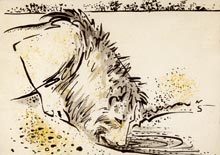
The early works of John Craxton evoked an ‘arcadian’ feel but later became more schematic. Cubism and other 20th-century movements had an influence on his work.

First published in Ekathimerini online on 21 April 2010

By A Koroxenidis

When the late English painter John Craxton (1922-2009) first visited Greece in the mid-1940s he discovered what he called “human identities,” a world that suited him and was to soon become his home.

In the 60s Craxton settled in Hania, Crete, in a house facing the old harbor. He led a simple bohemian life, appreciated the local lifestyle and explored the country’s cultural history, especially the Byzantine churches on the island. For many years, he also served as as Britain’s consular correspondent in Hania.

John Craxton

His friends and the people close to him, who gathered last week at the British Embassy in an event dedicated to Craxton’s memory, remember him as a talented artist, an intellectual, a generous, straightforward and well-mannered person who had humor, sophistication and an optimist view of life. A learned artist, Craxton was part of an intellectual international milieu.

Following an opening by British Ambassador to Athens Dr David Landsman, novelist and playwright Paris Takopoulos, who met Craxton in London in the late 1940s, referred to the artist’s knowledge of Greek modern culture and also spoke of the great value that Craxton placed on friendship. He also noted that Craxton was an excellent critic of art.

John Craxton work from Greece

Maria Vassilaki, associate professor of Byzantine art at the University of Thessaly, was another longtime friend of Craxton. [Maria was co-curtaor of the Byzantium 330-1453 Exhibition – see myByzantine blog]

Vassilaki spoke of his [Craxton’s] deep knowlege of Byzantine art and of their long conversations on Byzantine art and culture, on which they had planned to publish a book. Craxton had abandoned the idea but Vassilaki has edited the book and plans to publish it with Crete University Press.

Journalist (formerly at Kathimerini) and writer Maria Karavia mused upon her memories of Craxton and his friendship with the painter Nikos Hadjikyriakos-Ghikas, with whom he stayed whenever he visited Athens. Her warm memories include Craxton’s tender and colorful use of the Greek language.

The British author Sir Patrick “Paddy” Leigh Fermor was also among the speakers. Craxton and Leigh Fermor had worked together on a number of projects, with the former illustrating the covers of many of the latter’s books.

Born to musician parents, Craxton was raised in an artistic and intellectual family. He studied art in Paris and, as a young artist, produced paintings of an “arcadian” feel. His first visits to Greece inspired him in the designs for a 1951 production of the ballet “Daphnis et Chloe” by the Royal Ballet.

A major retrospective on his work was held at the Whitechapel Art Gallery in 1967. In 1993, Craxton was elected Royal Academician by the Royal Academy of Arts, London.

Welcome to the Patrick Leigh Fermor blog

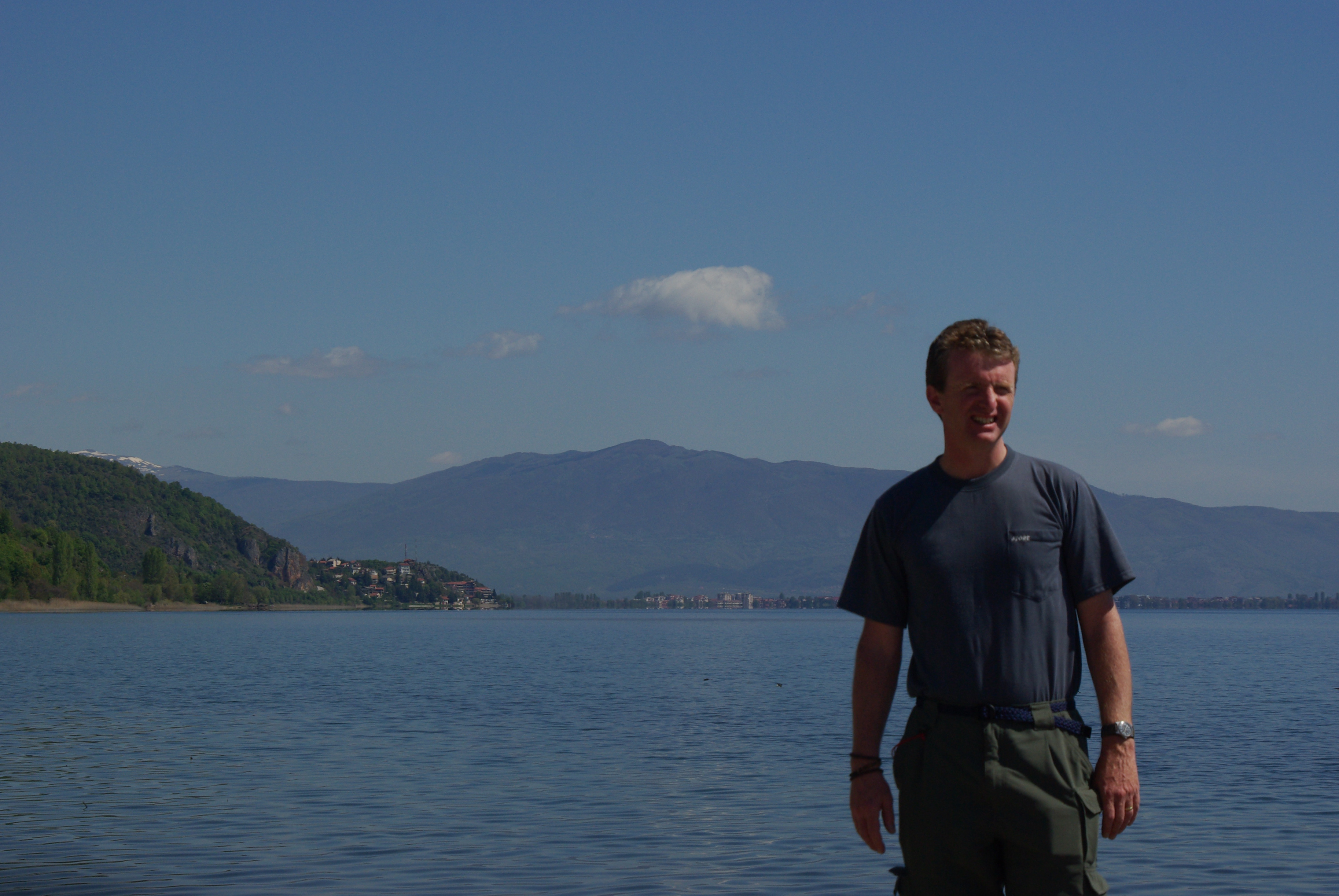
Tom at Lake Ohrid on the Via Egnatia, 2009

My name is Tom Sawford and I live in Winchester, Hampshire, England.

I first became aware of Paddy quite late in life; I guess he is an acquired taste. Maybe you need to have some awareness of the broad range of subject matter that he can, often without warning, cover in his books. Perhaps it is only after formal education, reading widely, developing a broad appreciation for history, and just plain living that you have the ability to grasp some of what he is getting at. A strongly developed vocabulary is also a boon; or at least a dictionary and of course now with access to Google it is possible to quickly research some of the more obscure topics that Paddy assumes mere mortals will be aware of. I remember the first time I read A Time of Gifts and being amused that Paddy clearly expected his readers to have at least a schoolboy/girl grasp of Latin as phrases pour out with no explanation or translation.

But surely that is the attraction of his work. It aims for the highest pinnacles of linguistic and intellectual endeavour and if you like what you read it drags you along with it, drinking from the cup of knowledge that Paddy offers.

He is of course so much more than a writer. It has been said that he is the ‘greatest English travel writer’. I don’t agree with that. I believe he travels to write, having so much more to say than to merely discuss the merits of one hotel over another or the quality of food in Greek fishing  villages. In my view he was the “Greatest Living Englishman”. Not that we don’t have other great Englishman (but perhaps less than we once had), but more than that he is that unique person who personifies what was once the mark of an Englishman; educated; heroic, handsome, generous; and modest (to a degree).

Sir Patrick Michael Leigh Fermor DSO OBE lived a full life, and had experiences that few others will likely ever have again. He had lived a pretty full life before the second world war, even living with a Romanian princess who was older than he, and during that conflict he applied his skills to fighting behind German lines, and was unique in achieving the capture, with “Billy” Moss, of the German Garrison Commander of Crete, Major General Kriepe. After the war he travelled, wrote, married, developed long-lasting friendships, and built a house in Greece. My epithet stands because few can match what he has done and also the manner in which he did it.

The purpose of this blog is to bring the life and work of Paddy, and his many colleagues, to the attention of a wider audience, and to create an archive of on-line material. He, and they, deserve to be recognised and remembered in a world that has changed much during their lives, but would be the poorer without them.

If you would like to help with the blog, make a contribution or anything else, please contact me tsawford[at]btinternet.com.

Tom Sawford

April 2010

This Patrick Leigh Fermor blog

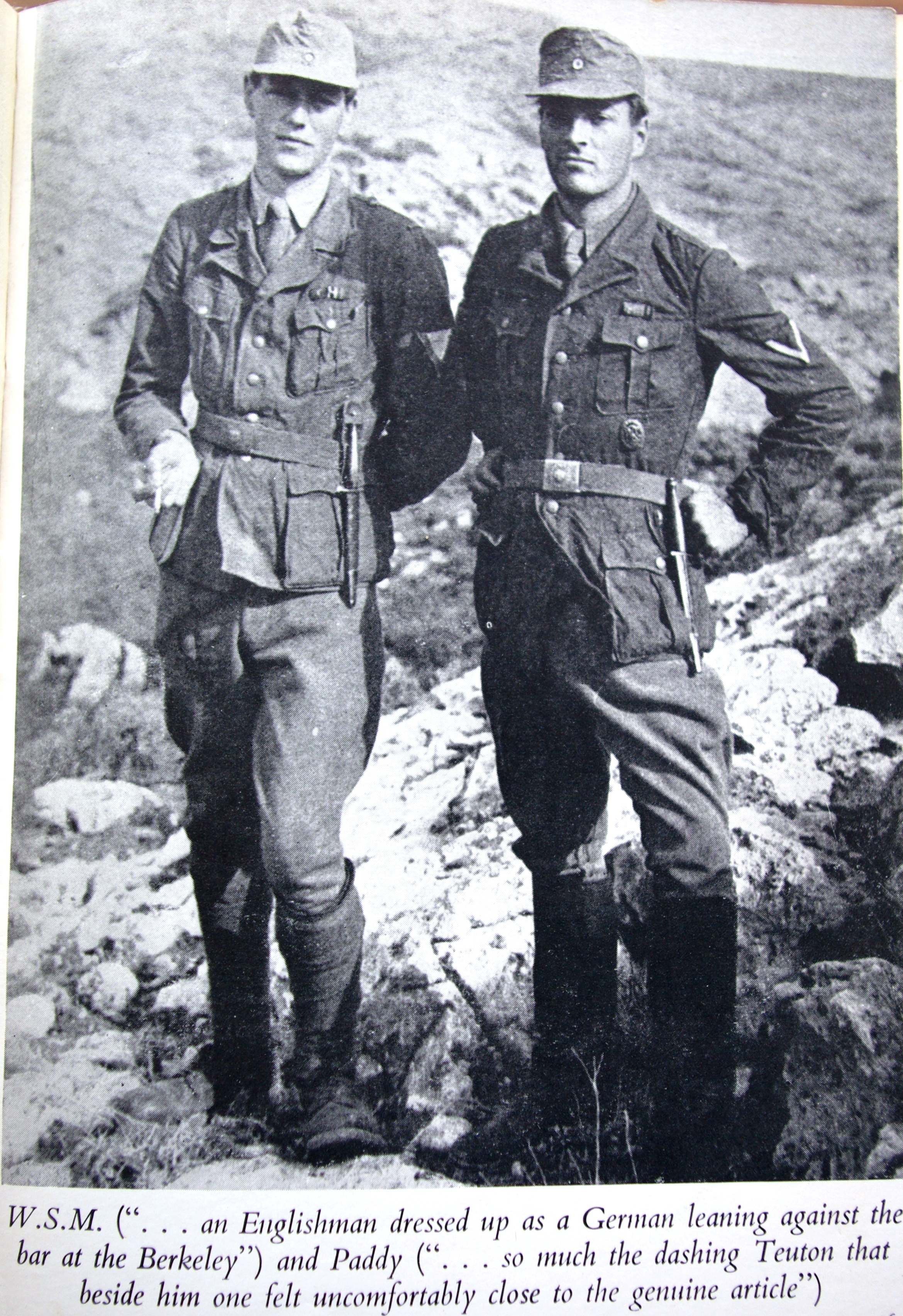
Patrick Leigh Fermor and Moss

W Stanley Moss and Patrick Leigh Fermor in German Uniform Prior to the Abduction of General Kriepe

The blog is live but only in a test phase at the moment. I will be adding a little more content before I am satisfied but the idea is to post interesting pieces about Paddy, his life, times, travels, war, friends etc.

As far as possible I also want to gather together what material I can such as photographs etc.

Once we are going I would welcome as many comments as possible!