Category Archives: Paddy in the News

Paddy’s eye for detail: Ian Fleming, Bondage, James Bond and Pol Roger

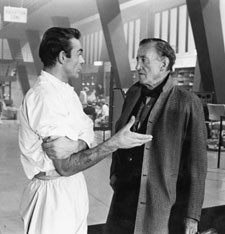
Sean Connery and Ian Fleming

As background to the Imperial War Museum’s 2008-09 exhibition For Your Eyes Only: Ian Fleming and James BondThe New York Review of Books  featured a discussion of the merits of Ian Flemings’s work by Geoffrey Wheatcroft. Entitled ‘Bondage’ it is a wide-ranging review, and for shock factor it intially does tend to focus on Fleming’s penchant for what Wheatcroft calls ‘schoolboy sexual fantasies’. One critic found Fleming’s ‘sex distasteful—male brutality and female submission, or what Bond himself called “the sweet tang of rape”—he lamented Fleming’s “vulgarity and display” and his love of luxury goods.’

Well, that all makes for good reading but two things caught my eye. First of all there is some mild criticism for the overrated Sebastian Faulks and his 2008 attempt at writing a Bond story Devil May Care; more on Mr Faulks at a later date. Not only do I not particularly rate his writing (and I doubt he cares) but he is also a critic of Paddy’s.

The second was a letter that Paddy wrote to Ian Fleming picking him up on a point about Pol Roger champagne. Fleming was probably the first proponent of what would now be called ‘brand placement‘. As anyone who has read a Bond book or seen a film cannot fail to have missed, Bond does not get by with ‘Tesco Value’ when he can obtain a top brand alternative, presumably on Her Majesty’s expenses.

Paddy and Joan were friends of the Flemings, but, along with Debo Devonshire, were particularly close to Anne Fleming, and supported her through the difficult times following Ian’s death and his failure to get his estate in order. Read In Tearing Haste for more on this.

The particular part of the NYRB article that caught my attention is below, and shows Paddy’s excellent eye for detail, which we see constantly in his own work:

“While Devil May Care is short on sex and sadism, it does begin with one unfortunate having his tongue torn out; but then Faulks’s own tongue is a little too obviously in his cheek. We get Gorner, an impossibly horrible villain, a brutal enforcer called Chagrin (nice touch), a glamorous heroine with whom James is far too diffident—and a distinctly autumnal flavour. The book is set in 1967, when Fleming not only didn’t write it but could not have written it, and 007, as he admits, is showing his age. Now and again the writing flags. Bond has been in Tehran a few days when he lunches alone on caviar and martinis, before spreading out “some maps he had bought from the hotel shop…. The country was between Turkey to the west and Afghanistan to the east. Its southern frontier was the Persian Gulf, its northern limit the Caspian Sea.” Well, yes.

There are a few other lapses which it would be tedious to list, including a tennis match that is not only implausible in itself but whose scoring goes awry. We all make mistakes, including the originator. After Fleming published On Her Majesty’s Secret Service, that worldly sophisticate was mortified to receive a magisterial rebuke from his friend Patrick Leigh Fermor: Ian surely knew that Pol Roger is the only champagne never sold in half bottles.”

You can read the full article from the NYRB here. I will publish it at some later date for the archive.

Meeting Patrick Leigh Fermor in the Mani

Recently we have been musing in some posts about following Paddy’s route. For many of his fans this is perhaps a dream, but nevertheless, something many would like to make real. Topping that of course is meeting Paddy himself. In this piece, New Zealand author Maggie Rainey-Smith unexpectedly meets Paddy on a trip to Kardamyli on Greece’s Mani Peninsula, where Paddy has lived since the 1960’s. Some of you may have read it but I think it is such a nice article that it is worth re-visiting.

First published in the New Zealand Herald 15 June 2008

 
The village of Kardamyli is on the west coast of the Mani Peninsula, one of the more traditional and conservative areas of Greece.Recently, I spent two months in Greece chasing the muse, searching for clues, looking for inspiration.

The Mani Peninsula region is famous for the Maniots and their resistance of the Ottoman occupation. It is isolated by the Taygetus mountain range and enclosed by the Aegean and Ionian seas.

The Ottomans failed to infiltrate, but I have to advise that the English have. As I shopped for my Twinings tea and sat outside a cafe in the village of Kardamyli, using the free internet, I lamented the globalisation of this once-remote peninsula.

I wished, for just a moment, that I was back in time when to be a strange woman alone in this small village may have attracted disapproving stares.

In the local bookshop was the very book I’d been looking for: Mani – Travels in the Southern Peloponnese, by Patrick Leigh Fermor. On my terrace overlooking the sea, I opened the book and found myself mesmerised by the most exquisite, evocative travel writing I have ever read. Not only that, I discovered that Fermor is a resident of Kardamyli.

The owner of the bookshop was unimpressed when I asked where Sir Patrick lived, and his lips remained sealed, his expression disapproving. Fermor is almost a saint in Greece.

He was a resistance fighter in Crete during World War II; his exploits were the subject of a film starring Dirk Bogarde (my father was in Crete, but a more modest hero at Maleme, the point where the island was finally lost to the Germans).

At the local cafe, where I made use of the technology, the owner (who looks like a Maniot right out of Fermor’s book, with her blanket of black ringlets and beautiful olive eyes), told me Paddy (as the locals call him) would celebrate his Name Day that very week and that he always opens his home to the locals on that day.

By then, and after one week’s residence, I considered myself a local, and everyone agreed with me.

So with joyous disbelief at my good fortune, on Thursday, November 8, I joined the local villagers at Sir Patrick’s Name Day celebration at his majestic and yet still homely yellow stone house overlooking the Messinian Gulf.

By 10.30am the service in his private chapel was over and we were seated in his lounge – books lining the walls from floor to ceiling: Nancy Mitford, Henry James, James Joyce – eating olives, meatballs, feta and drinking local wine.

On a person’s Name Day you are required to take a gift, and all I had with me was a copy of my first novel About Turns, which I gave to Paddy. He signed my copy of his own book with a personal inscription and a small drawing. We talked about Crete and my dad and his book on the Mani. I gushed, he charmed.

Then the singing began and Paddy was surrounded by adoring local women who toasted him with traditional Name Day songs.

At the end of the singing, Paddy stood and pretended to fire a pistol into the air (an old tradition where real pistols were once used). He is of English and Irish descent. Although his name is Patrick, his Greek Name Day is the day of Michali. Michael is the name he assumed while fighting for the Greek resistance.

With me was an American Orthodox nun who worked in Moscow and a Danish man of the cloth who was studying Byzantine churches. We were Paddy’s “non-local” guests and pinched ourselves to check we weren’t imagining our good fortune.

When it was time to leave, another Michael (Michali), a neighbour of Paddy’s, invited us to his home. We walked through an olive grove up the hill along the coast to another beautiful stone home.

Our new host sold Paddy the land and helped him build his house in 1964. We were feted with fresh coffee and cakes and listened to Michali’s son, who told us that when he decided to leave Kardamyli some years ago to travel, Paddy told him: “You can’t leave.”

And when he returned years later, Paddy told him: “You know we are very fortunate, we live in Kardamyli. We are fortunate – we have the mountains. We are fortunate – we have good food. We are fortunate – we have clean air to breathe. We are fortunate – we have the beautiful sea to swim in.”

“Yes, Paddy, the mountains, the food, the air and the sea,” said the young man, nodding in agreement.

And then Paddy said to him: “And for all these reasons and more, we may just forget to die.”

Sir Patrick Leigh Fermor is 92 years old, he was wearing a double-breasted navy suit when I met him, had a full head of wavy grey-black hair and was still a handsome, charming man with just a slight deafness in one ear.

He spoke with a classical English accent which rather surprised me, considering the years he has spent in Greece.

He is still writing. If you’ve never heard of him, or never read his books, now is the time to start.

By Maggie Rainey-Smith

Reluctant hero finally accepts his knighthood

I have edited this slightly to remove non-Paddy related stuff. something to add to the archive.

By Nigel Reynolds

First Published in the Telegraph : 12:01AM GMT 31 Dec 2003

Patrick Leigh Fermor, the veteran travel writer, philhellene, scholar and soldier, has finally accepted a knighthood, saying that it would have been “rude” to turn the honour down for a second time.

Leigh Fermor, 88, who lives in Greece where he is treated as a national hero, refused a knighthood in 1991.

 He said at his home in the Peloponnese last night: “I turned it down then because I didn’t think that I deserved it.

“I’d written a few books, that’s all.”

He was among a list of 300 prominent figures from the arts and entertainment world to have declined honours since the Second World War which was disclosed in a leaked Cabinet Office document shortly before Christmas.

The author, hailed by many critics as Britain’s best travel writer, receives his honour for services to literature and to British-Greek relations in the diplomatic and overseas list.

The Cabinet Office refused to discuss his change of heart…

… Leigh Fermor, whose wife, Joan, a photographer, died in the summer aged 91, first sprang to fame working for the SOE organising guerrilla operations in wartime Crete.

In a celebrated episode, for which he was awarded the DSO, he and a friend, disguised as German soldiers, kidnapped Gen Kreipe, the island’s garrison commander. For three weeks they evaded German search parties and Kreipe was eventually taken off Crete by motorboat.

The exploit was turned into the film Ill Met By Moonlight in 1956, with Dirk Bogarde cast as Leigh Fermor.

Until the war, Leigh Fermor had been rootless. After school, at the age of 18 he spent a year walking from Holland to Istanbul and then he roamed the Balkans.

After the war, he built himself a house and settled in the Peloponnese living off his writing, principally about his travels and Greek culture, history and folklore. His best-known books are The Mani, written in 1958, and Roumeli (1966).

A Long Walk Starts (and Ends) With a Step

I was just taking another look at Matt Gross’ Frugal Travel section of the New York Times and discovered that after writing the piece I published on 13 June he left the NYT. I wonder if he was so inspired by Paddy’s travels that he decided to take off and cover the whole route? Perhaps not. Here is his signing off piece from his NYT Blog.

By MATT GROSS

This weekend’s Travel section cover story — “Frugal Europe, On Foot” — is my last as the paper’s Frugal Traveler columnist. After four years of roaming the world on a budget, from Alabama and Albania to Uruguay and Urumqi, I’m taking a rest, and handing over the illustrious mantle to a new shoestringer, who’ll appear in this space next month.

But for my final feature, I wanted an adventure that would challenge me — physically, psychologically, culturally, linguistically, technologically, logistically and, of course, financially. Maybe a sailing adventure? Done that. A lengthy train journey? Done. A trek into the mountains? Done — on foot and on horseback. I’ve gone round the world, across America and grandly circled Europe, so what was left to be done?

The answer came in the form of Patrick Leigh Fermor, the 95-year-old war hero who’s known as Britain’s greatest living travel writer. His books “A Time of Gifts” and “Between the Woods and the Water” chronicle his nearly penniless journey, in 1933 and 1934, from Rotterdam to Istanbul — on foot. And when I looked at the route he took through the remains of the Austro-Hungarian Empire, I realized I had an adventure in the making: a two-week walking tour that would take me from Vienna through Slovakia to Budapest.

Throughout 180 miles, I dealt with three official languages (German, Slovak, Hungarian) and some unofficial ones (Italian, English, French, Hebrew). I used maps both paper and electronic. I took inspiration from literature: not just Mr. Leigh Fermor’s books but also “The Unnamed,” by Joshua Ferris, “The Road,” by Cormac McCarthy, “The Places in Between,” by Rory Stewart, and “The Long Walk,” by Stephen King (writing as Richard Bachman). I found great bars and restaurants via Twitter and Foursquare — and through common, random luck. I walked till my ankles screamed, and sang to myself during long hours alone.

And when I met new people — as I did just about everywhere — I was amazed, again and again, at their spontaneous generosity, their willingness to feed, shelter and befriend a mysterious stranger attempting to do what few sane travelers would even contemplate.

In other words, I don’t expect you, my readers, to follow precisely in my blistered footsteps, but I hope this story — and all the Frugal Traveler articles I’ve written — will inspire you to set off on your own crazy adventures, confident in the knowledge that no matter how little money you have, the world will, if you embrace it fully, take very good care of you indeed.

Are you inspired? I know I am. It would be a nice idea if perhaps next year we could get a bunch of people together and walk some of the route. On the other hand perhaps it is best to do as Paddy did and make a solo attempt. If anyone has ideas on this get in touch with me tsawford[at]btinternet.com or post a comment below.

Related article:

Walking Paddy’s Route in Mitelleuropa: Frugal Europe, on Foot

Hay Q and A: Who are the three greatest living writers?

Well done William!

The Hay Q&A

We asked some of the leading authors at this year’s Guardian Hay festival a series of questions. Here are their answers

Q4: Who are the three greatest living writers?

William Dalrymple: “Among novelists, Cormac McCarthy; among travel writers, Patrick Leigh Fermor; among short story writers, Jhumpa Lahiri.”

From the Guardian.

Walking Paddy’s Route in Mitelleuropa: Frugal Europe, on Foot

It’s time to be honest now: who amongst the regular readers of this blog, or even those that stumble across us because they have read ‘A Time of Gifts’ or ‘Between the Woods and the Water’, has not thought about following Paddy’s 1930’s route? For myself it is a definite goal. It is an ambition; probably a passion. I had come across the following article but have been inspired to re-produce it by Blog reader Matt who says he first got into Paddy’s work when stationed in Baghdad:

Tom, The New York Times travel writer, Matt Gross, just did an article on PLF. He walked the Vienna to Budapest stretch recently … I first read PLF while stationed in Baghdad four years ago and revisit him often. Living in Heidelberg, I’ve been able to visit some of the places he mentioned specifically and have recommended A Time For Gifts to many of my fellow Americans living here or travelling to Europe. As I’m in the process of moving back to the States, it will be a few years before I’m able to pick up the thread of his travels. I’m not sure if you’re in contact with PLF, but pass him the respects of this Yankee officer. Matt

Frugal Europe, on Foot

First published in the New York Times,  May 23, 2010

The article is written by New York Times’ Frugal Traveler columnist Matt Gross who attempted to follow in the footsteps of Patrick Leigh Fermor. Like all good stories it begins ….

ONCE upon a time, a young man went for a walk. It was December 1933, and an 18-year-old Englishman named Patrick Leigh Fermor put on a pair of hobnail boots and a secondhand greatcoat, gathered up his rucksack and left London on a ship bound for Rotterdam, where he planned to travel 1,400 miles to Istanbul [Ed: Constantinople!] — on foot. He had virtually no money; at best, he’d arrive in, say, Munich to find his mother had sent him £5. But what he did have was an outgoing nature, a sense of adventure, an affinity for languages and a broad network of friends of friends.

 “If I lived on bread and cheese and apples,” he later wrote, “jogging along on fifty pounds a year like Lord Durham with a few noughts knocked off, there would even be some cash left over for papers and pencils and an occasional mug of beer. A new life! Freedom! Something to write about!”

 Something to write about indeed! The books he produced from the yearlong journey — “A Time of Gifts” and “Between the Woods and the Water” — are gorgeously rendered classics that have led many to call Mr. Leigh Fermor, now 95, Britain’s greatest living travel writer. But to my mind, he’s always had another title: the original Frugal Traveler — the embodiment of that idea that, though a wanderer may be penniless, he doesn’t have to suffer.

 And Mr. Leigh Fermor never suffered, thanks to the miracle of human generosity. Peasants gave him baskets of eggs and swigs of raspberry schnapps. Small-town mayors found him beds. The lingering nobility of Europe put him up in their castles, invited him to balls and lent him their horses. When Mr. Leigh Fermor did sleep rough — in hayricks and barns or on the banks of his beloved Danube — he did it by choice, not because (or not merely because) poverty required it. He knew, even at 18, that the world is an experience to be savored in all its multifarious incarnations.
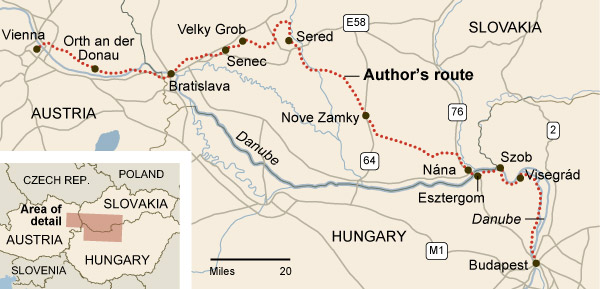
Matt Gross' route

Could a young person (is 35 still young?) with strong legs and little money find the same spirit of hospitality that Mr. Leigh Fermor encountered some 76 years ago? At the end of March, I set out to find the answer. With only two weeks free, my plan was to walk from Vienna to Budapest, a 180-mile route that would connect the old poles of the Austro-Hungarian Empire and track Mr. Leigh Fermor’s trail as closely as possible, taking me along the Danube to Bratislava, the Slovakian capital, and across the plains of Slovakia south to Hungary — through three countries whose languages, cultures and histories could not be more different, or more intertwined.

It was tempting, the day I arrived in Vienna, to just walk east from the airport, but I couldn’t completely skip the Austrian capital, where Mr. Leigh Fermor had spent three weeks among the “crooked lanes” and “facades of broken pediment and tiered shutter.” And so I followed his lead, going into the imperial crypt, where the grandest members of the Hapsburg family lay entombed in elaborate sarcophagi, and into the museums, although I shied away from the most famous in favor of oddities like the International Esperanto Museum. And I luxuriated in storied places like Cafe Alt Wien and Cafe Bendl.

But after two nights in Vienna, I was restless. So I crossed the Danube, put on my 45-pound pack and took off down the Donauradweg, a well-kept biking trail that runs from the river’s source to its mouth at the Black Sea. To my right, the Danube, more green than blue, sparkled in the cool sunlight, and I encountered fishermen tending their rods, elderly sunbathers, nordic hikers poling along and cyclists speeding in both directions.

This first day, I figured, I’d take it easy and do only 15 miles. Ideally, I’d need to hit 18 miles a day — about six hours of walking — to reach my goal. It seemed reasonable, especially with the terrain so uniformly flat. The path, sometimes dirt, sometimes paved, would often stretch so far and straight that I couldn’t imagine I’d ever reach the end, and then I’d finally hit a slight turn and face the same thing: an art-school lesson in perspective, complete with the first low foothills of the Carpathians at the vanishing point — and a scampering rabbit to remind me this was no still life.

Even with such straightforward terrain, there were snags. An attempted shortcut through a fuel depot left me with minor scratches and an extra three miles. But such mistakes have a way of turning out for the best. Had I stayed on the trail, I would have never crossed paths, two hours later, at the edge of Donau-Auen National Park, with Jean-Marc and Marie, newlywed French cyclists who stopped to say hello when they saw a lone hiker in the middle of nowhere. They were taking an extended honeymoon: a two-year bicycle journey from their home in Paris — to Japan!

“Do you know where you’re staying tonight?” I asked. They didn’t. I told them to meet me at Orth an der Donau, a small Austrian town a couple of miles farther down the Danube, where I had arranged for a place to stay via CouchSurfing.org. Maybe, I said, my host could find them somewhere to pitch their tent.

THE host, Roland Hauser, whom we met in front of Orth’s impressive castle, did better than that. He invited them home to his dreamland of soft beds and hot showers. Roland, 26, had traveled from California to Southeast Asia to New Zealand, and his German-accented English was peppered with words like “sí” and “bueno.” That evening, we cooked spaghetti Bolognese, nibbled Südtirolean ham and drank big bottles of beer. I went to sleep marveling at our extraordinary, Fermorian luck.

In the morning, after coffee, I threw out my underwear. This was a strategy to lighten my load — bring old undies and get rid of them day by day. Frankly, I should have done that with everything, as the pack was needlessly heavy. Along with two weeks’ worth of shirts, I had an ultralight down jacket, a waterproof shell and rain pants. A tent and sleeping bag. One pair of jeans and lightweight canvas shoes to change into at day’s end; nothing worse than walking 20 miles and spending the evening in the same clothes. And I packed Mr. Leigh Fermor’s books and Claudio Magris’s “Danube,” which I never had time to read. And my computer and camera gear — work necessities, alas.

When I set off, I was wearing my typical walking outfit: khaki pants by a company in Portland, Ore., called Nau; waterproof running sneakers by Lafuma; good socks (as important as good shoes); and a long-sleeved cotton shirt.

The walk began well. My feet were tender, but the flatness of the Marchfelddamm, a high berm that doubled as biking path and flood deterrent, ensured that I wasn’t struggling. This was the heart of the Donau-Auen National Park: forests of thin trees broken by occasional streams flowing to the Danube. At first, I appreciated the play of light on the water and between the trunks, but hour after plodding hour of unchanging scenery soon became mind-numbing, and I simply marched, putting one foot in front of the other and watching for kilometer markers. It would be 13 miles before I could stop for lunch, and another 10 before I reached my day’s goal: Bratislava.

But there’s a funny thing about long walks. With patience, all those steps add up, and by 2 p.m., I’d crossed a bridge over the Danube and settled into a cafe in the stately town of Hainburg, where an open-faced baguette pizza and glass of beer gave me the courage to face the miles ahead. And soon I found myself trudging along the shoulder of the small highway with cars flying past — and missing the monotonous near-silence of the forest.

Not far off, I could see Bratislava’s hilltop castle — in Mr. Leigh Fermor’s era, a burned-out wreck worked by prostitutes but in the 1950s rebuilt as a stately white-and-red palace — and it teased me with its apparent nearness. Still, I had far to go, past a derelict border post, and through three miles of snaking bike paths, before I crossed the Danube again and was in the heart of Bratislava’s old town, all cobblestones and tile roofs and sidewalk cafes.

After checking into the Hotel Kyjev — a 1970s tower turned budget boutique — I checked myself out: I wasn’t sore, out of breath or even tired. I did have blisters on my feet, but they were easily treated: puncture, drain, clean, bandage. My ankles, however, were terribly swollen, the peroneal tendons in particular, a result (I think) of how my body mechanics had altered with the weight on my back. I popped some ibuprofren, took a shower, then hobbled outside for dinner.

It was the Friday during Passover, and like any wandering Jew, I wanted a Sabbath meal. And thanks to Chabad, the Hasidic Jewish outreach organization, I got one, at the home of the transplanted American rabbi Baruch Myers. He was only too willing to share his food (cucumber salad, gefilte fish), his friendship and his family, including a battalion of adorable children who cheerily walked me through the Passover story.

It wasn’t just this heartfelt welcome that got to me; it was the very existence of a Jewish community in Bratislava. Back in his day, Mr. Leigh Fermor wrote, the Jews “were numerous enough to give a pronounced character to the town.” No longer. The Holocaust had reduced the Jewish population to, in Rabbi Myers’s estimate, 1,000 people. There was a synagogue, a few kosher restaurants, a Jewish museum and even a pension, but few visitors today would see in Bratislava a Jewish-inflected city.

On Saturday, partly inspired by the rabbi and partly because of my feet, I rested and contemplated the future. I had walked 40 miles so far, and if my ankles were any indication, there was no way I’d make the remaining 140. Unless … If I took a train a short way — say, 15 miles northeast — I could certainly walk another 10 miles. I’d be breaking my rules, but those rules were arbitrary. Continue reading

World War II Veterans event British Embassy Athens

An account from the British Embassy Athens website telling of a Greek and British veterans gathering held on 9 March 2009. Of course Paddy was there!

A unique gathering of almost 30 WWII Veterans under the Ambassador’s Residence roof

It was a unique and rare occasion to witness the gathering of almost 30 WWII Veterans under one roof. The British Ambassador, Dr David Landsman, and the British Defence Attaché hosted the gathering at the British Ambassador’s Residence on Monday 9th March. Addressing this “distinguished and unique group of people,” Ambassador, Dr David Landsman said, “We are living in a better world, thanks to the sacrifices you made.”

Opening the event, the Defence Attaché welcomed the Veterans and conducted a brief presentation on the current status of the British Armed Forces. Highlighting the importance of formally recognizing the Armed Forces and our Veterans, he explained that the British Government has now nominated 27th June as a national day of celebration.

Amidst the array of celebrities in the room, a selection took the time to say a few words on behalf of their fellow veterans. Amongst them, Jason Mavrikis MBE, Sir Patrick (Paddy) Leigh Fermor DSO OBE, Themis Marinos (S.O.E.), Air Marshal Constantinos Hatzilakos (RAFA Hellenic Pilots), Lt General Korkas (Sacred Squadron), Captain Rigas Rigopoulos (Levante Flotila)

Zeus Xenios award

First publisjhed in Kathimerini 31 May 2003

FOO YUN CHEE

Greece yesterday paid tribute to 10 individuals, Greeks and foreigners, who, through their works, have helped increase awareness of the country, its culture and peculiarities. The 10 individuals, including writers, a violinist, a director, an entertainer, a composer, a stage designer and a singer follow a path first laid out by the ancient poet Homer, Ioannis Patellis, head of the Greek National Tourism Organization (GNTO) said.

“Homer was the first to advertise the attractions of our country to the outside world,” he said. Contemporary figures such as composers Mikis Theodorakis and Manos Hadjidakis, author Nikos Kazantzakis, opera singers Maria Callas and Agnes Baltsa and the legendary Melina Mercouri, through their achievements, have further continued the tradition of promoting Greece, he said.

Patellis said the success of these well-known personalities in their respective fields had been invaluable in promoting Greece as a tourist destination. The 10 individuals singled out this year have played an equally effective role in raising Greece’s profile abroad, he said. Starting this year, the GNTO intends to honor such individuals with a distinction aptly named Zeus Xenios (god of hospitality). The first Zeus Xenios awards were yesterday bestowed upon French-born Greek TV presenter Nikos Aliagas, Briton Patrick Leigh Fermor (who joined Greeks in fighting the German occupation during World War II and stayed on), Russian doctor of literature and translator of Greek poetry Mikhail Gasparov, Greek violin prodigy Leonidas Kavakos, Greek music composer Periklis Koukos, Greek singer Vicky Leandros, film director John Madden, Greek artist Mina Papatheodorou-Valyraki, Greek stage designer Nikos Petropoulos and Hollywood director-cum-actress Nia Vardalos.

Publication of Mani from Kathimerini

Selection: Michalis Katsigeras

First published in Kathimerini October 17, 1958

PATRICK LEIGH FERMOR: The latest book by the distinguished British writer and philhellene Patrick Leigh Fermor, titled “Mani,” is to be released in London on December 1. The book describes the region of Mani, its history and customs with the sympathy and wit that generally characterizes all his writing on Greek issues. Leigh Fermor came to Greece for the first time 1935. He has none of the reserve that is usually a characteristic of the British people [Ed –  Huh!!!] and fell in love with Greece at first sight. He learned to speak Greek very quickly and the next year, in 1936, translated Rodokanakis’s “Odysseus” into English. In the years before the war, he travelled a great deal. During the German occupation of Greece, he was sent to Crete where he played a leading role in the abduction of the German General Kreipe. He now lives in Crete, among his Cretan friends.[Ed – not quite true – Paddy was nomadic at this time eventually settling near Kardamyli in the mani] (Ed. Note: “Mani” was translated into Greek by Tzannis Tzannetakis in 1973 when he was in internal exile during the military dictatorship.) POPE PIUS XII: Vatican City – Vatican City’s radio station issued an official announcement today that Pope Pius XII has passed away. His death came at about 3.50 a.m. local time. Italian President Giovanni Gronchi and Prime Minister Amintore Fanfani ordered a period of national mourning.

A chronicler of a bygone age a rememberer of things past

An interesting background piece from Kathimerini which mentioned that Vol 3 was due in 2007! This is the first time I have come across a possible publication date. Obviously missed now, and who knows if that is due to editorial problems, being incomplete or perhaps this too will be delayed like his biography until after his death?

Patrick Leigh Fermor keeps alive in shimmering prose the spirit of the Greece he reveres

by Willard Manus, a freelance journalist who lives in the US and spends time in Greece

First published in Kathimerini 20 July 2006.

Reading Patrick Leigh Fermor today is both an exhilarating and depressing experience. Exhilarating because of the depth and brilliance of his prose, depressing because the Greece he portrays so memorably has been hammered to dust by the march of time.

Fermor, who was knighted in 2003, is best known in Greece and in his native Britain, where he was born 92 years ago. «The Traveller’s Tree,» published in 1950, dealt with the journey he made around the Caribbean islands in 1947-48. It won the Heinemann Foundation Prize for Literature, and established him as a writer of note.

His next two books were «A Time to Keep Silence» (1952), which described his stay in various European monasteries, and «The Violins of Saint-Jacque» (1956), a novel. A decade later, he published two books on Greece, «Mani: Travels in the Southern Peloponnese» and «Roumeli: Travels in Northern Greece,» which quickly earned him a reputation as the pre-eminent non-native writer on 20th century Greece.

Fermor’s attachment to Greece goes deep. His first experience of the country dated back to 1933, when, as a rebellious and untamed 19-year-old, he dropped out of Sandhurst and set out on a walking tour of Europe whose eventual destination was Constantinople. Envisioning himself as «a medieval pilgrim, an affable tramp with a knapsack and hobnailed boots,» he embarked, in midwinter, on a journey that eventually spanned three years and took him through the Netherlands, Germany, Austria, Hungary, Romania and, eventually, Greece.

Remarkably, Fermor did not write about his picaresque adventures in pre-war Europe until many years later. «So when ‘A Time of Gifts’ appeared in 1977 and ‘Beneath the Winds and the Water’ in 1986, the life of the mid-30s that he described had been utterly destroyed,» his biographer Artemis Cooper has noted, «and much of the land he had walked over was in the grip of communism for years. Yet his memory recreated this world with an astonishing freshness and immediacy, and recaptured the young man he was then: full of curiosity, optimism and joy in the vibrant diversity of the world.»

The concluding volume of Fermor’s trilogy is scheduled for publication (by John Murray Ltd) in early 2007. Continue reading

Paddy writes to The Times about EOKA and the Cyprus situation in 1956

First published in Kathimerini April 10, 1956

Selection: Michalis Katsigeras

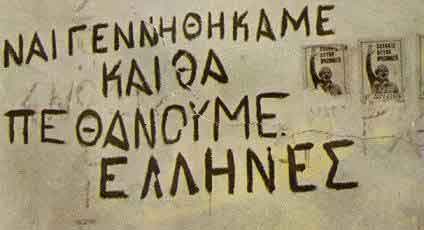
EOKA Slogans (Yes we were born and we will die as Greeks)

EOKA: London, 9 – The National Organization of Cypriot Fighters (EOKA) appears to have transferred its activities from the sunlit shores of the Mediterranean to the foggy banks of the Thames, where it is fast developing into a nightmare. London’s evening papers carried large headlines today revealing EOKA’s terrible plans, to which the British authorities do not appear to be indifferent. The Turkish Embassy has been put under heavy guard. Sources at Scotland Yard have so far maintained a silence regarding the reports of EOKA’s plans, which they appear to be in ignorance of. PATRICK LEIGH FERMOR: A letter from the famous British Philhellene and author, Patrick Leigh Fermor, was published in this week’s Sunday Times. Fermor said that the idea of uniting Cyprus with Greece was contemporaneous with the foreign occupation of the island, but that the issue had received more widespread attention ever since Archbishop Sofronios’s reference to it during his speech to mark the occasion of Britain’s acquisition of the island from the Turkish Sultan in 1878.

Profile of Patrick Leigh Fermor by Max Hastings

A personal view by Max Hastings who thinks that Paddy’s best book is Mani.

First published in the Daily Telegraph 12:01AM GMT 04 Jan 2004

Not long after the Second World War, an English couple chanced upon a remote taverna in the mountains of Greece. As they ate their simple lunch the proprietor, perceiving their nationality, remarked: “We had another English couple here once, before the war. They stayed for weeks. They were so beautiful and so in love. And every night they dressed for dinner!”

It was this last foible that had plainly captivated him, and indeed conjured for his listeners an enchanting vision of young lovers in “the full soup and fish”, as P G Wodehouse would have said, in this lonely Greek inn. All became clear when the innkeeper added: “His name was Lefemor.”

This was, of course, the inimitable Paddy (he has never been known as anything else), though the innkeeper was wrong about the nationality of his other guest – she was in truth a Romanian princess, Balasha Cantacuzene, with whom he enjoyed a romantic idyll through the last few years before the war.

Legend has it that “Lefemor’s” distraught family ordered him home, finally cabling the fare when he pleaded poverty to explain his inability to return. He merely used the money to protract the affair.

Like many stories told both by and about Sir Patrick Leigh Fermor – as he became this week at the age of 88 – this one may be a trifle fanciful, owing as much to soaring imagination as to historical fact. No matter. It is the sort of story about Paddy which ought to be true.

He richly deserves his honour not only for what he has written – some of the finest travel books of all time – but for what he has been. In prose, as I heard one of his oldest friends put it recently, “he possesses an extraordinary gift for expressing beauty in words”.

He has fulfilled the dream of so many upper-class Englishmen of his generation, to live, love, play the hero, sage and wit with a lightness of touch which, translated into the milieu of the kitchen, would produce a souffle of genius.

He was the son of Sir Lewis Leigh Fermor, a geologist who travelled widely and made his reputation in India. “His tall, straight figure might often be seen dancing in Calcutta,” the DNB observes playfully. Paddy’s somewhat erratic schooling terminated at King’s Canterbury, from which he was sacked for some misdemeanour – “holding hands with the greengrocer’s daughter” is his own version, which will serve as well as any other.

Rejecting parental plans for Sandhurst and the Army, in December 1933 at the age of 18 he set out instead to walk to Constantinople, with very little money but some rather grand letters of introduction. The consequence was that for the next 18 months, he was wafted from schloss to schloss across old Europe, plunging his insatiable social, cultural, intellectual and linguistic curiosity into a river of happy encounters.

These he has described in the two volumes, A Time of Gifts (1977) and Between the Woods and the Water (1986). A third instalment of the journey has been long in preparation, but it is unlikely that anyone except his publisher expects it to get finished.

He has always been a slow writer, each of the eight books in his modest output requiring long and painful labour. His dilatoriness has been reinforced, perhaps, by indifference to money. Though he has never had any, somehow God or friends have eagerly provided. He has practised a superior brand of Micawberism, founded upon the belief that something or somebody would turn up, which in his case it always has.

When war came in 1939 he left Baleni, the wonderful Romanian mansion where he had been living with his princess, to join the Irish Guards. Instead, however, he was commissioned into the Intelligence Corps as a Greek speaker. He spent the winter of 1940 as a liaison officer with the Greek Army.

Affectionately sceptical friends say that Paddy’s linguistic fluency is a trifle exaggerated. Sixty years ago an Englishman who heard him gassing away nineteen to the dozen said to a neighbouring Greek woman: “Is he as fluent as he sounds?” She replied: “No. He is simply making a wonderful noise.” This is a little unjust, and of course he has indeed become a master of the Greek language after living in the Peloponnese for so long. He possesses a gift for communicating with his fellow man of any nationality, class or condition, without need for anything as vulgar as a phrasebook. Continue reading

Writer and WWII hero honoured with Order of the Phoenix

Report of the presentation of the Greek Order of the Phoenix to Paddy

First published Ekathimerini online 3 March 2007

By Helbi

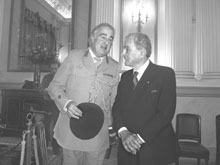
Patrick Leigh Fermor (right) with Colonel Mark Blatherwick, the British defense attache in Athens

The week that passed brought both joy and sorrow to those close to two British heroes who fought for Greece during World War II and whose love for the country never dimmed. The writer Sir Patrick Leigh Fermor, author of famous books such as “Mani” and “Roumeli,” “A Time of Gifts” and “Between Woods and Water,” even settled in Greece, near the Mani village of Kardamyli. This week President Karolos Papoulias bestowed upon him the Order of the Phoenix in the New Year honors for 2007. Ambassador Tassos Kriekoukis, director of protocol for the Foreign Ministry, spoke of “Sir Patrick’s love of writing and traveling but also for Greece, for whose freedom he fought at the side of Greek and British commandos. Who can forget his part in the kidnapping (in wartime Crete) of (German) General Kreipe?” Colonel Mark Blatherwick, the British Defense Attache in Athens, accompanied Sir Patrick Leigh Fermor to the event.