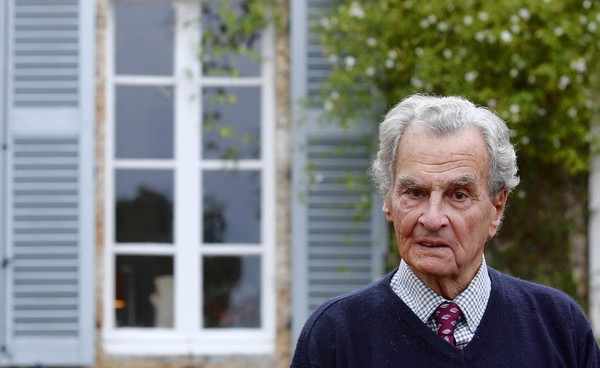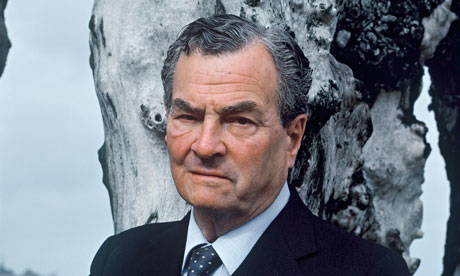
Category Archives: Paddy’s Death

Sir Patrick “Paddy” Michael Leigh Fermor, DSO, OBE: 11 February 1915 – 10 June 2011

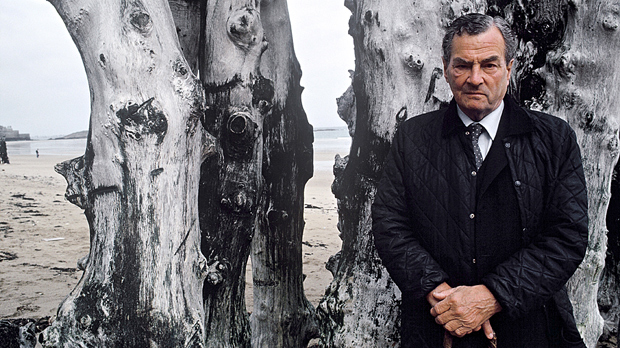
'A dangerous mixture of sophistication and recklessness': Patrick Leigh Fermor in Saint Malo, France, in 1992 Photograph: Ulf Andersen/Getty Images

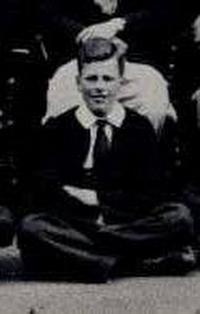
Patrick Leigh Fermor at school, Kings' Canterbury

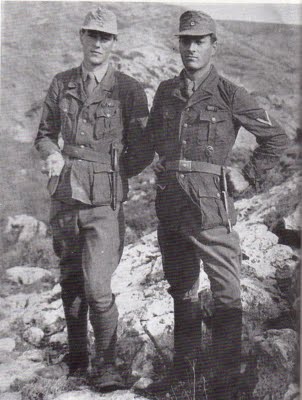
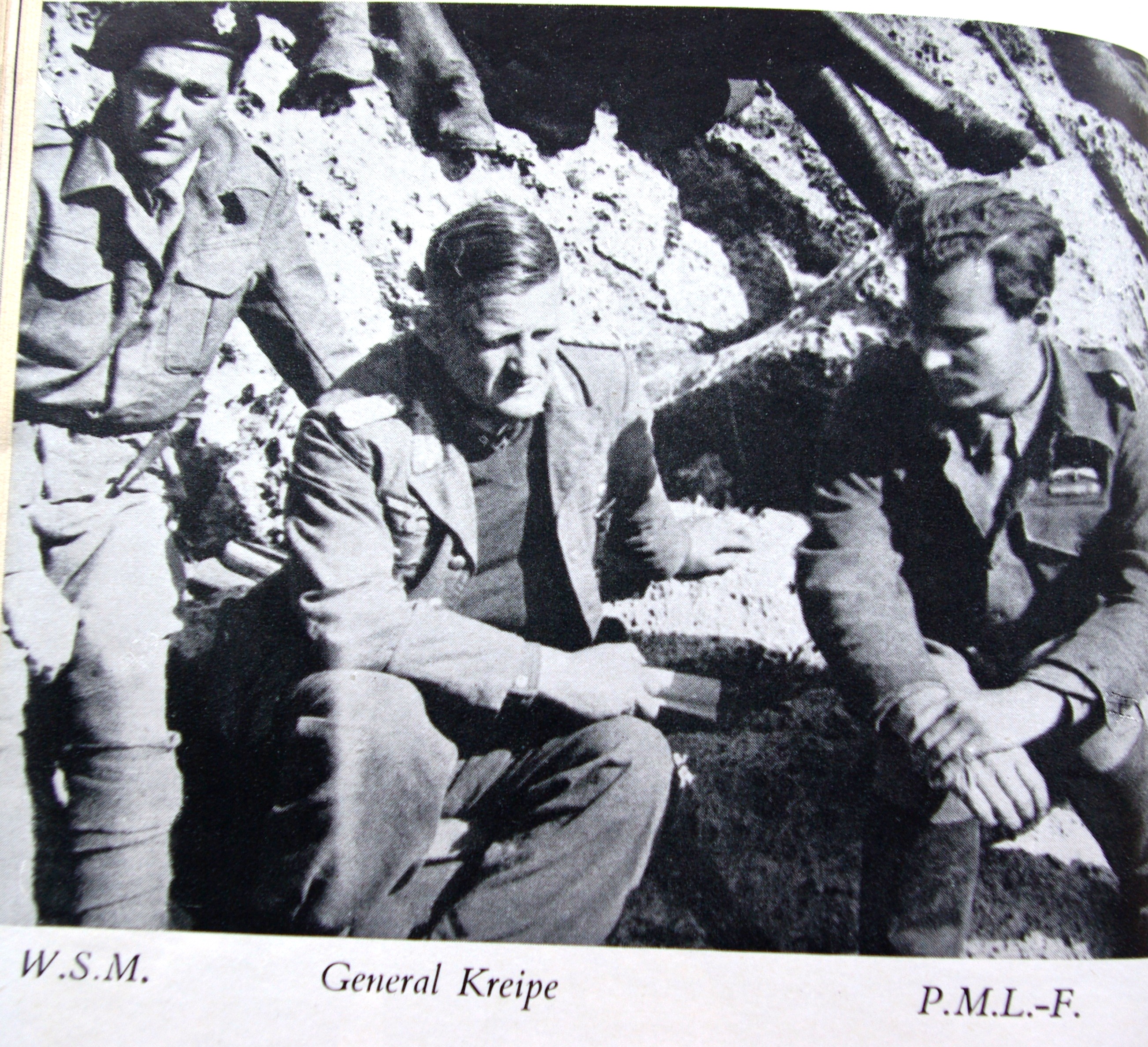
Billy Moss and Paddy Leigh Fermor, Crete 1944

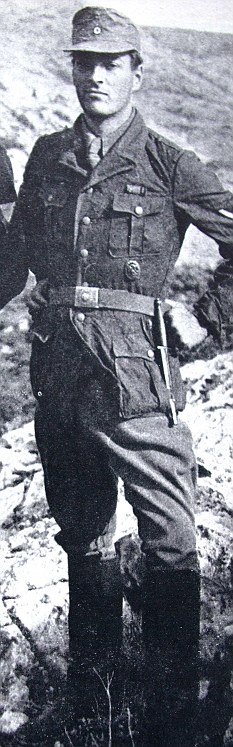
Paddy in uniform

Paddy in Ithaca in 1946 photographed by Joan

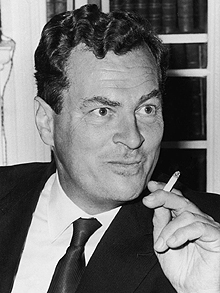
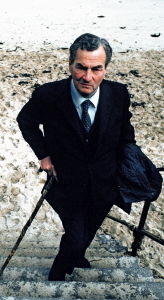
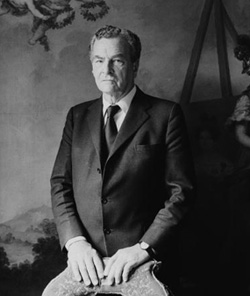
Paddy in 1966

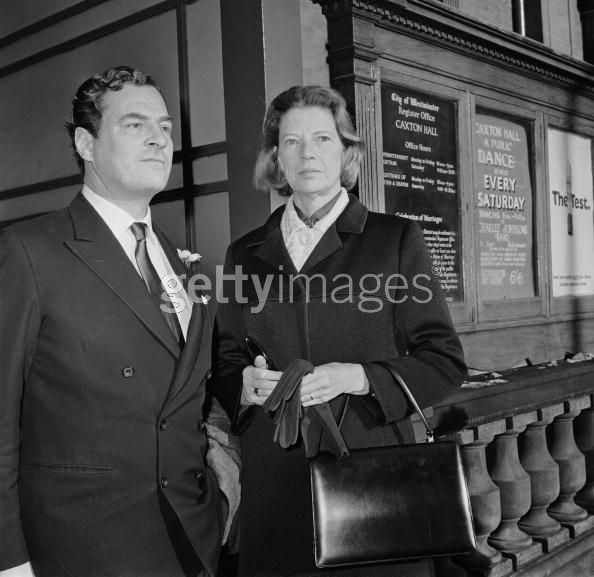
Patrick Leigh Fermor with Joan Rayner after their wedding 17th January 1968. (Photo by Evening Standard/Hulton Archive/Getty Images)

Leigh Fermor will be remembered as someone who lived and talked as well as he wrote

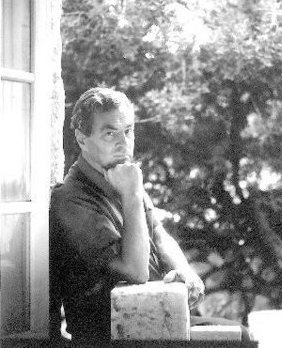
At home in The Mani

Paddy on his 94th birthday (February 11, 2009)

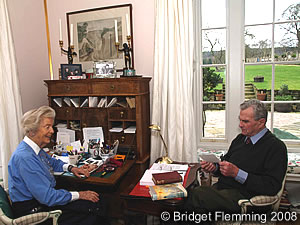
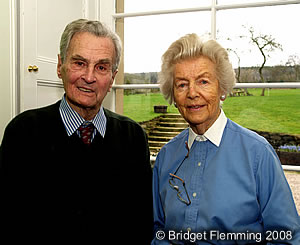
Debo and Paddy 2008

Paddy and Debo 2008

We may just forget to die

This post is from Diana Gilliland Wright’s lovely blog entitled “Surprised by Time” which she describes as ‘Outtakes from my work as a historian of the 15th-century intersection of the Byzantines, the Venetians, and the Ottomans.’
I found Paddy through my interest in those very same subjects so it is no surprise that Diana has  corresponded with Paddy … and almost met him …
In 1987, I wrote to Patrick Leigh Fermor asking if I might visit him in Kardamyli, and said I was researching the Villehardouins and their castles.  He replied (that is the return address on his envelope):
Dear Mrs. Hanson,
     Thank you for your letter and the kind and v. encouraging. words.
     I’m going slightly off my rocker about impending calls this summer, and don’t see how I’m going to do any work, so don’t, please, be too upset if it’s no go then: but no harm in trying (0172-73225) when you are in the area.
     I look forward to the Villehardouin book as I know too little about them.  Please forgive tearing haste — Just back from England, where my wife had a hip operation — and best of luck.
                                                                        Yours sincerely
                                                                        Patrick Leigh Fermor

'Please forgive tearing haste ....'

I was in turmoil.  What do you say after you say I am so glad to meet you?     Why would he want to spend any time with me? At Kardamyli I took a room, looked at the “castle,” spent a couple of hours sitting on the rocky beach by his house, obsessing all the while. In the evening I drank too much ouzo and decided I would not be the visitor from Porlock.  In the morning when I paid my bill, I asked the landlady if she knew him.  Of course, she said, he walks by here every day.  I gave her a note and a gift of books I had brought for him and went away sorrowful.  I did not realize for twenty years that the woman with her was Joan, his wife.  I have twice more been invited to visit in the area, and promised introductions, but both times it seemed I would be taking something that was not mine.

The obituaries, and the dozens of articles over the past several years, have filled much space with his walk from London to Constantinople, and his kidnapping of the German general.  Essentially, everything he did was larger than anyone else’s life.  But there is an unmentioned aspect of PLF that moves me deeply.  In A Time of Gifts, he wrote of an extended stay in the Abbey of St. Wandrille de Fontanelle in the 1950s.  Reviewers of the book have assumed that he was there to write a book, and he did considerable work on one.

Few have noticed a the scattered phrases that put this time in deeper perspective: “I managed, with considerable trepidation, to explain my proposal” (16); “depression and unspeakable loneliness” (19); “having finished a flask of Calvados . . . I sat at my desk in a condition of overwhelming gloom and accidie” (22); ” I slept badly and fell asleep during the day, felt restless alone in my cell and depressed by the lack of alcohol, the disappearance of which had caused a sudden halt in the customary monsoon” (28).

Fragments, but I see the Abbey as his shelter while he stopped what must have been years of heavy drinking.  One has only to read Antony Beevor’s Crete: The Battle and the Resistance and notice how frequently PLF is cited and how rarely written about, to understand that the kidnapped general was a distraction from a war in which he saw and participated in the unspeakable.  He needed to drink.
Two anecdotes reflect my emotional response to him.  The first is from a Greek tavern owner in the town where PLF and his Romanian princess stayed before the war: “They were,” he said, “so beautiful.  And they dressed for dinner.”
The second is from a New Zealand writer:
Paddy told him: “You know we are very fortunate, we live in Kardamyli. We are fortunate – we have the mountains. We are fortunate – we have good food. We are fortunate – we have clean air to breathe. We are fortunate – we have the beautiful sea to swim in.”
          “Yes, Paddy, the mountains, the food, the air and the sea,” said the young man, nodding in agreement.
          And then Paddy said to him: “And for all these reasons and more, we may just forget to die.”

Diana Gilliland Wright

http://surprisedbytime.blogspot.com
http://nauplion.net
nauplion@gmail.com

The announcement of Paddy’s death in The Telegraph


From The Australian: Travel writing titan Patrick Leigh Fermor strode happily with all walks of life

First published in The Australian, 15 June 2011.

OBITUARY: Patrick Leigh Fermor. Author. Born India, February 11, 1915. Died Worcestershire, England, June 10, aged 96.

AN author whose books were deeply rooted in the experience of a remarkable life, Patrick Leigh Fermor was an erudite man whose learning stemmed more from his travels, the people he met and the languages he acquired than from study. The Balkans, and especially Greece and its culture present and past, were the subject of some of his finest books.

He had spent much of World War II in Greece and then Crete, where he organised resistance activity, and distinguished himself by capturing a German general. This exploit was the subject of the 1952 book Ill Met by Moonlight by W. Stanley Moss, which became a film of the same title in 1956, starring Dirk Bogarde as Leigh Fermor and Marius Goring as his German captive.

Patrick Michael Leigh Fermor was born in 1915 in India. After three years at King’s School, Canterbury, where his nonconformist spirit precluded academic distinction, he went to an army crammer in anticipation of a military career.

The curtailment of his formal education was compensated by his intellectual curiosity and by the civilising influence of his mother, who introduced him to the pleasures of art and literature. His gifts did not necessarily fit him for regimental duties or reconcile him to the restrictions of peacetime soldiering. His inclinations were rather those of an 18th-century patrician eager to scan the broader horizons offered by the grand tour. And so, shortly before his 19th birthday instead of joining the army, he sailed to Rotterdam and set out on foot for Constantinople.

That solitary trek across Europe in the mid-1930s developed his linguistic talent – already fluent in French and German, he added Bulgarian, Greek and Romanian to his languages – and also his ability to hit it off with people of various nationalities and walks of life.

Sojourns in palaces and castles would alternate with bivouacs in barns and doss-houses. These adventures and his school career were entertainingly described in two volumes of autobiography, A Time of Gifts (1977) and Between the Woods and the Water (1986).

He returned to Greece immediately after reaching his goal in Turkey. The dignity and gaiety of the shepherds, peasants and fishermen among whom he lived inspired a lifelong contempt for materialistic values as well as a suspicion of the benefits of economic progress. A lack of creature comforts appealed to a latent element of austerity in his nature.

At the outbreak of war he hastened back to England and enlisted. He served as a liaison officer to the Greek forces in Albania and took part in the battles of Greece and Crete.

After the fall of Crete he returned there, one of a handful of English officers, to organise the resistance movement. He endeared himself to the islanders, who saw in him a reflection of their own leventeia (an amalgam of high spirits, humour, quick wits and zest for life).

His flair for guerilla warfare was accompanied by an unsuspected gift for administration, which he exploited with outstanding success in the ambush, capture and evacuation to Egypt of General Kreipe, the German commander.

A bout of rheumatic fever laid him low for several months. No sooner had he recovered than he volunteered for a third mission to Crete before being posted home to take command of an Allied airborne reconnaissance group which, but for the German surrender, would have parachuted into Oflag IV at Colditz to defend the fort and arm the prisoners against the threat of deportation east.

After demobilisation he joined the British Council and was sent as deputy director to the British Institute in Athens. This was an opportunity to broaden his understanding of Greece. As a travelling lecturer, he visited most of the mainland and the Aegean archipelago, studying folklore and customs, assimilating regional dialects, and immersing himself in village life. He had no vocation for teaching, however, and after a year he resigned his position to start writing.

Oddly, his first book was not on a Greek theme. A journey to the Caribbean, sponsored by John Murray, resulted in the publication in 1950 of The Traveller’s Tree. Much of the book was written in the Benedictine abbey of St Wandrille in Normandy, to which he retired for weeks at a time.

These retreats led over the next few years to further investigations into the monkish life. These, notably at the abbey of Solemnes and the Cistercian monastery of La Grande Trappe, with a visit to the rock monasteries of Cappadocia, furnished material for A Time to Keep Silence, published in 1953.

In a succession of temporary havens and during journeys to France, Italy and further visits to Greece, Leigh Fermor completed a translation from the French of Colette’s Chance Acquaintance (1952) and he wrote a novel, The Violins of Saint-Jacques (1953).

His first volume on Greece, Mani (1958), was based on his more recent journey but enhanced by distillations from the experience he had acquired during more than two decades, raising it above the level of mere travel writing. The acclaim he won was repeated eight years later on the publication of its companion volume, Roumeli (1966).

By this time he had settled in Greece, and in 1968 he married Joan Eyres-Monsell, who had accompanied him on his travels ever since the end of the war. They designed the lovely house on a cliff-edge in the southern Peloponnese.

Further publications included Three Letters from the Andes (1991) the collection Words of Mercury (2004) and, in 2008, In Tearing Haste, an entertaining selection of his 50-year correspondence with the Duchess of Devonshire. He was knighted in 2004 and the Greek government made him a Commander of the Order of the Phoenix in February 2007.

Each of his books reveals stylistic virtuosity and imaginativeness. Another striking feature is his polymathy, the ease with which he disserts on a wide range of subjects, to name but a few beginning with the same letter, heraldry, hagiology, Hellenism, headgear (Byzantine) and history (church).

Those who knew Leigh Fermor will not easily forget his laughter, his singing and his infectious enthusiasm. In his company a bus ride became an odyssey; on his lips a mundane event was transformed into a saga.

He was blessed with arete, that Greek quality liable to half-translation as virtue, goodness or valour. His appetite for life was prodigious, and he appreciated the joys of the flesh as well as those of the mind and the spirit.

The pleasure he derived from his youthful foot-slogging was repeated in his late middle age, when he joined expeditions to the Andes and the Himalayas led by his friend Robin Fedden. In his 70th year he swam the Hellespont. He continued to live in Greece until the day before his death.

His wife died in 2003. There were no children.

Christopher Hitchens pays tribute to Patrick Leigh Fermor: The Last of the Scholar Warriors


Sir Patrick Michael Leigh Fermor,by Steve Pyke (1991)

Farewell to Patrick Leigh Fermor and his extraordinary generation.

By Christopher Hitchens

First published in Slate on Monday, June 13, 2011

The death of Sir Patrick Leigh Fermor at the age of 96, commemorated in many obituaries as the end of a celebrated travel writer, in fact brings down the final curtain on an extraordinary group of British irregular warriors whose contribution to the defeat of Hitler, significant in military terms, still managed to recall an age when nobility and even chivalry were a part of warfare. All these men were “travel writers” in their way, in that they were explorers, archaeologists, amateur linguists, anthropologists, and just plain adventurers. Men, as Saki put it so well in The Unbearable Bassington, “who wolves have sniffed at.” But they put their amateur skills to work after the near-collapse of Britain’s conventional forces in 1940 had left most of the European mainland under Nazi control, and after Winston Churchill had sent out a call to “set Europe ablaze” by means of guerrilla warfare.

Suddenly it was found that there were many bright and brave young men, not very well suited to the officers’ mess, who nevertheless had military skills and who had, moreover, back-country knowledge of many tough neighborhoods in the Balkans, the Mediterranean, and the Middle East.

Leigh Fermor had lived in Greece before the war, had taken a part in the revolution of 1935, and had seen the German invasion sweep all before it. He spoke the language and loved the culture and could be fairly inconspicuously infiltrated onto the island of Crete. In 1944, with the help of some British special forces and a team of Cretan partisans, he managed to kidnap the commander of the German occupation, Gen. Heinrich Kreipe, and carry him over a long stretch of arduous terrain before loading him into a fast motorboat that sped him to Egypt and British captivity. The humiliation of the German authorities could not have been more complete. Perhaps resenting this, Gen. Kreipe was at first obnoxious and self-pitying, until the moment came when he was being taken over the crest of Mount Ida and a “brilliant dawn” suddenly broke. According to Leigh Fermor’s memoirs:

“We were all three lying smoking in silence, when the general, half to himself, slowly said: Vides et ulta stet nive candidum Soracte. [“See how Mount Soracte stands out white with deep snow.”] It was the opening of one of the few Horace odes I knew by heart. I went on reciting where he had broken off. … The general’s blue eyes swiveled away from the mountain top to mine and when I’d finished, after a long silence, he said: “Ach so, Herr Major!” It was very strange. “Ja, Herr General.” As though for a moment the war had ceased to exist. We had both drunk at the same fountains long before, and things were different between us for the rest of our time together.”

Have no fear, this did not result in some sickly reconciliation. Several of Kreipe’s colleagues were executed at the end of the war for the atrocious reprisals they took against Cretan civilians. One of Leigh Fermor’s colleagues, another distinguished classicist named Montague Woodhouse, once told me that Greek villagers urged him to strike the hardest possible blows against the Nazis, so as to make the inevitable reprisals worthwhile. He lived up to this by demolishing the Gorgopotamos viaduct in 1942,* wrecking Nazi communications. But the brutality of the combat doesn’t negate that moment of civilized gallantry at Mount Ida, where the idea of culture over barbarism also scored a brief triumph. (Woodhouse went on to become a Conservative politician and active Cold Warrior, but while fighting Hitler he was quite happy to work with Communist and nationalist fighters, and he wrote in his memoirs that “the only bearable war is a war of national liberation.”)

What a cast of literally classic characters this league of gentleman comprised. Bernard Knox went with poet John Cornford to fight for the Spanish Republic, was later parachuted into France and Italy to arrange the covert demolition and sabotage of Vichy and Mussolini, and, after the war, set up the Center for Hellenic Studies at Harvard.* Nicholas Hammond, who had walked rifle in hand over the mountains of Epirus and Macedonia, later suggested from his study of the terrain that those seeking the burial treasure of Philip of Macedon might consider digging at Vergina. (He was right.) Some of the brotherhood was very much to the left: Basil Davidson helped organize Tito’s red partisans in Bosnia, and after the war he went to work with the African rebels who fought against fascist Portugal’s dirty empire. Frank Thompson, brother of the British Marxist historian Edward Thompson, was liaison officer to the resistance in Bulgaria before being betrayed and executed. Others were more ambivalent: Sir Fitzroy Maclean was a Tory aristocrat but helped persuade Churchill that Tito’s forces in Yugoslavia were harder fighters than the monarchists when it came to killing Nazis. On the more traditional side of British derring-do, Billy McLean and Julian Amery emerged from the guerrilla resistance in Albania with a lively hatred of Communism and later took part in several quixotic attempts to “roll back” the Iron Curtain. Col. David Smiley saw irregular action in almost every theater, and in the 1960s and 1970s he organized the almost unique defeat of a Communist insurgency in Oman.

Now the bugle has sounded for the last and perhaps the most Byronic of this astonishing generation. When I met him some years ago, Leigh Fermor (a slight and elegant figure who didn’t look as if he could squash a roach; he was perfectly played by Dirk Bogarde in Ill Met by Moonlight, the movie of the Kreipe operation) was still able to drink anybody senseless, still capable of hiking the wildest parts of Greece, and still producing the most limpidly written accounts of his solitary, scholarly expeditions. (He had also just finished, for a bet, translating P.G. Wodehouse’s story The Great Sermon Handicap into classical Greek.) That other great classicist and rebel soldier T.E. Lawrence, pressed into the service of an imperial war, betrayed the Arabs he had been helping and ended his life as a twisted and cynical recluse. In the middle of a war that was total, Patrick Leigh Fermor fought a clean fight and kept faith with those whose cause he had adopted. To his last breath, he remained curious and open-minded to an almost innocent degree and was a conveyor of optimism and humor to his younger admirers. For as long as he is read and remembered, the ideal of the hero will be a real one.

Christopher Hitchens’ Kindle Single, The Enemy, on the demise of Osama Bin Laden, has just been published.

Greek blog: People & Ideas

Sir Patrick Michael Leigh Fermor,by Steve Pyke (1991)

An article in Greek about Paddy. It mentions this blog, myself and Thos Henley.

Μου αρέσουν πολύ τα βιβλία του Patrick Leigh Fermor «Μάνη» και «Ρούμελη» καθώς και ένα άλλο με τίτλο “Words of Mercury” με αποσπάσματα από τα διάφορα ταξιδιωτικά του, τις απίστευτες περιπέτειές του και με δοκίμια που αποδεικνύουν το θαυμαστό εύρος των γνώσεών του. Επειδή λοιπόν μου αρέσει τόσο το γράψιμο του PLF -ενός ανθρώπου που έχει περάσει μεγάλο μέρος της ζωής του στην Ελλάδα- χάρηκα που ανακάλυψα στο διαδίκτυο ένα ολόκληρο σάϊτ αφιερωμένο σ’εκείνον και σκέφτηκα να αναδημοσιεύσω εδώ κάτι από αυτό το σάϊτ.

Εδώ ο δημιουργός του σάϊτ, εξηγεί γιατί θεωρεί τον PLF τον πιο σημαντικό ζώντα Άγγλο:

Access the complete article here.

Paddy’s radio obituary this Friday 23 June on BBC Radio 4’s Last Word programme

Following my contacts with the BBC (!!) I have found out that the Radio 4 obituary programme, Last Word, will be running a lengthy feature on Paddy this Friday.

You can obviously listen on the radio, via some TV services, and on the internet. The programme should also be available to listen to afterwards via BBC iPlayer. Visit the Last Word website for more details.

Complain about the BBC reporting of the death of Patrick Leigh Fermor

Following my article moaning about the paucity of BBC reporting around Paddy’s death, I have sent in a comment to the Feedback programme which holds BBC executives to account.

If enough of us raise the issue, I am sure that something will be done. At the very least we may get some weak explanation.

I encourage you to follow me and send an email to feedback@bbc.co.uk with your complaint. Don’t forget to add your name; town; and telephone number. They like to have that so they can get back to you if required.

The text of my email is below:

The writer, soldier, war hero and polymath, Paddy Leigh Fermor died on 10th June. I run a blog devoted to his life and work and was contacted by two news outlets by 1.00 pm.  The first report on the BBC was on the 6.00 pm news. I neither heard nor saw any more on the BBC until the website produced an obituary which included errors. The Broadcasting House programme on 12 Jun ran an excellent personal tribute by Colin Thubron.

 That seems to have been it for the BBC. Paddy represents one of the last of the WW2 generation; and a particularly distinguished one. His wartime service was uniquely famous for his role in capturing the German commander of Crete. He is acknowledged by many as Britain’s greatest travel writer yet we had few reports, no repeat showing of Traveller’s Century, in fact nothing to mark the passing of this great man.

 This has caused a lot of anguish and I would like the BBC to explain why they could not have done better when minor actresses receive more reporting, and also what the BBC intend to do to rectify this situation. Perhaps Paddy was seen as too much a figure of the establishment due to his friendships and he ran afoul of some left-wing inspired editorial policy, but if so it shows that the BBC team did not understand the man at all. 

Related article:

The pitiful BBC reporting of Paddy’s death: they let Paddy down for a second time 

Join dozens of others and leave your tribute on the Your Paddy Thoughts page

We already have some wonderful tributes and direct memories of Paddy. Please add your own thoughts, or your story about meeting him. Perhaps you even have some memory of someone in your family who came across Paddy sometime in his long life.

Visit the Paddy Thoughts page to leave a comment. Let’s all hear your thoughts and tributes to Paddy.

He brought so much joy into our lives and the lives of others, let’s say what we think!

Your Paddy Thoughts

Your Paddy Thoughts - click the image

A personal tribute by Jan Morris: A war hero and a travel writer of grace, Paddy was the ideal English scholar

Patrick Leigh Fermor, who has died aged 96, was one of ‘God’s intimate loners’. Quirkily bold and full of fun, he reflected the easygoing confidence of the best of Englishness. The doyenne of travel writing assesses his unique genius.

by Jan Morris.

First published in The Guardian, 12 June 2011.

Envy, they say, is the writer’s fault, but no writer of my acquaintance resented the pre-eminence of Patrick Leigh Fermor, the supreme English travel writer, who died on Friday after 96 years of a gloriously enviable life. He stood alone.

One must not gush, but like Venice, Château d’Yquem or a Rolls-Royce of the 1930s, he really was beyond competition; and since so far as I know everybody liked him, everyone enjoyed his mastery.

Few of us want to be called travel writers nowadays, the genre having been cheapened and weakened in these times of universal travel and almost universal literary ambition, but Leigh Fermor made of the genre a lovely instrument of grace, humour and reflection. He was, in my view, perhaps the last of a line that began with Alexander Kinglake and Eothen in the 1840s and depended for its style upon the easygoing confidence of the best of Englishness, in the best days of England. Nobody could be less racist, insular or pompous: but then the best of England never was.

For in many ways Paddy Leigh Fermor really was the ideal Englishman – good-looking in a gentle sort of way, strong but not beefy, full of fun, poetical and scholarly, metaphysically inclined, with a wife, a house, a cat and a calling, all of which he loved. Besides, he was a war hero.

In an aesthetic sense he was lucky to live when he did, because it enabled him to fight a fine war in a just cause. He was no Rupert Brooke or Wilfred Owen, because to fulfil the heroic image completely he ought to have died in battle, preferably at Gallipoli, but nevertheless he was a hero in a particularly English (as against British) kind – an individualist hero, quirkily bold, adventuring on his own or with friends and enjoying himself.

In war as in peace, he was one of a kind. He went to no university, but he was one of God’s own autodidacts, with a prodigious gift for languages and a fascination with the most intricate, subtle and sometimes obstruse constructions of historical learning. Partly because he chose to live for much of his life in the southern Peloponnese, he was especially good at relating modern to ancient worlds, so that travelling with him, if only on the page, was like simultaneously travelling through several ages.

Nothing illustrates his life better than the story of his most famous book, an uncompleted trilogy about his adolescent pedestrian journey across Europe, from Hook of Holland to Constantinople, just before the second world war. There is nothing ordinary about this work. In it a solitary young man, scarcely out of school, pits himself in a literary sense against the astonishingly varied social and political circumstances of 1930s Europe. He earns his living by his wits, by his outgoing personality, by his willingness to have a go at anything, and by drawing pictures of people, and he makes friends with Europeans of every class and kind, from the wildest of aristocrats to the grizzliest of peasants – treating them all, as Kipling would have liked, just the same. The journey lasted several months. The trilogy took a lifetime to write. Leigh Fermor was 19 when he started his walk, but did not put pen to paper (A Time of Gifts, 1977) until he was in his sixties. The second volume (Between the Woods and the Water) appeared 10 years later, while the third volume has never been published, and perhaps remains unfinished – eagerly expected for 30 years already, and now presumably awaiting its dramatic posthumous revelation.

Nothing could be more Leigh Fermorian! Part of the original manuscript was lost and Leigh Fermor had to rewrite it long after the event, which perhaps gives the work an extra element of the imagination. He was hardly more than a boy when he started thinking about it, a nonagenarian when he last laid down his pen, and in between he had not only fought his war and become famous, but had produced several other books of travel, memoir and fiction.

But just as, so it seems to me, the central character of the narrative remains essentially unaltered, certainly unabashed, from start to quasi-finish of his odyssey, so the character of Leigh Fermor himself remained instantly familiar, in frail old age as in irrepressible youth.

He was a true travel writer. Most of his books were based upon movement and actual journeys remained the basis of his studies of place. Unlike most of his successors and disciples, he was not world-ranging. He wrote little about Africa or India or China, let alone Australasia or the United States. Europe, and especially Grecian and Byzantine Europe, was essentially his stomping-ground and the classic travel works of his maturity were about two regions of Greece, Mani and Roumeli.

The first of his published books, Travellers’ Tree (1950), was indeed a journey through the Caribbean Islands, and won him immediate recognition, but for me its best moment occurs when Leigh Fermor, wandering around the parish churches of Barbados, comes across the graveyard inscription: Here lyeth ye body of Ferdinando Palaeologus, descended from ye Imperial lyne of ye last Christian Emperor of Greece. Died 3 Oct 1679. Forty years after the book’s publication I wrote to reassure Paddy that the inscription was still in good order. “How very nice to know,” he replied, “that you and our old pal Palaeologus are prospering!”

He wrote that message on a picture postcard of Kardamyli, where he and his wife were living in the adorable house above the sea that they had themselves designed, and he wrote it in a form that had become by then a sort of Leigh Fermor trademark. The text was written within a loosely scrawled cloud, and around the cloud, meticulously disposed, were 10 or 12 birds, seabirds I suppose, which gave the ensemble a delightful sense of liberty. Leigh Fermor was an able artist, as those clients of Mitteleuropa had discovered, and he used this agreeable device to make the mere signing of a book, or the dashing off of a picture postcard, a small ceremony of goodwill.

I know little about Leigh Fermor’s religious convictions, although he did frequently retreat into monasteries, and once wrote a book (A Time to Keep Silence, 1957) about his experiences. He ended the writing of it at the top-storey window of a Benedictine priory in Hampshire and said of the blessing he found there that it brought “a message of tranquillity to quieten the mind and compose the spirit”. He was certainly a man of profound contemplative habit, a kind man, and in the course of my own long if sporadic correspondence with him I was chiefly impressed by his generous association with nature – the world, so to speak, seen from that top-storey window.

Here, he once writes, “a big blackbird has settled on my window sill. Can’t move!” Here he is sorry to report that Tiny Tim the cat is “in a better world, mousing above the clouds”. And time again Paddy reports that from the table where he writes under his pergola he can see the dolphins of the Mediterranean delightfully swimming up the bay.

A complex soul, then, but with a stillness at the heart of him. The obituarists, I do not doubt, will make much of his wartime guerrilla exploits – above all his part in the kidnapping of the German general Heinrich Kreipe in Crete in 1944, and his whisking away to captivity in Egypt. It was certainly a wonderfully dashing adventure, bravado at its most filmic, and it certainly illustrated one part of Leigh Fermor’s multi-faceted character.

For me the most telling part of the oft-told tale, though, is an episode when he overhears the captive general, waiting in the dawn to be shipped away from the island, murmuring some lines from Horace which Paddy himself had long before translated from the Latin. He recognised them at once, and responded in kind, with five more stanzas. As he remembered half a century later, “the general’s blue eyes had swivelled way from the mountaintop to mine – and when I had finished, after a long silence, he said ‘Ach so, Herr Major!'”

It was very strange, the young major thought, “as though for a moment the war had ceased to exist”. But I think of that moment as the silent stillness at the heart of his own often tumultuous and complex mind. Beloved as he was, rich in friendships, celebrated, successful, happy, convivial, nevertheless he struck me always as one of God’s intimate loners.

One must not gush, one must not gush, but I am proud to have known him, and happy in my sadness to be writing about him now.

LIFE AND TIMES

■ Sir Patrick Leigh Fermor, born in London in 1915, was the architect of one of the most daring feats of the second world war, the kidnapping of the commander of the German garrison on Crete in April 1944 while working for British special operations on Crete.

Dressed as a German police corporal, he and a fellow British soldier ambushed and took control of a car containing General Heinrich Kreipe, the island’s commander, and bluffed their way through 22 checkpoints.

After three weeks avoiding German searches, Kreipe was taken off the island by boat. The daring escapade was later turned into a film, Ill Met by Moonlight, in which Leigh Fermor was played by Dirk Bogarde.

■ He wrote some of the finest pieces of travel writing and has been described as a “cross between Indiana Jones, James Bond and Graham Greene”. His most celebrated book, A Time of Gifts (1977), told of a year-long walk from Rotterdam to Istanbul in 1934, when he was 18.

■ He married Joan Elizabeth Rayner, daughter of the first Viscount Monsell, in 1968. She died in June 2003 aged 91. There were no children.

Washington Post obituary: Patrick Leigh Fermor, British adventurer, writer and war hero

By Matt Schudel

First Published in The Washington Post, Sunday, June 12 2011

Long before Patrick Leigh Fermor died June 10 at age 96, his extraordinary achievements as a writer, adventurer and war hero had entered into legend. At 18, he set out across Europe on foot, reciting poetry along the way, sleeping in a barn one night, in a castle the next.

He rode into battle on horseback in a Greek cavalry charge in the 1930s. He went into disguise as a shepherd on the island of Crete and, in one of the most daring escapades of World War II, pulled off the kidnapping of a German general. In a subsequent movie about it, he was portrayed by Dirk Bogarde.

Mr. Leigh Fermor was a constant traveler who wrote books about monks in France, islands in the Caribbean and the people of Greece. Finally, more than four decades after his solitary transcontinental trek as a teenager, he wrote two books, “A Time of Gifts” and “Between the Woods and the Water,” which have become classics of modern travel literature.

His books, composed in a striking, original prose style, led British author Jan Morris to pronounce Mr. Leigh Fermor “beyond cavil the greatest of living travel writers.”

Although he lived in Greece for many years, Mr. Leigh Fermor died at his home in the English county of Worcestershire. The cause of death was not disclosed.

Until the end, he remained the classic British writer-adventurer, a blend of casual diffidence, cool confidence and infinite charm. Historian and journalist Max Hastings called Mr. Leigh Fermor “perhaps the most brilliant conversationalist of his time.”

Mr. Leigh Fermor’s formal education ended when he was expelled from a British boarding school for boys, ostensibly for sneaking away to see girls.

“He is a dangerous mixture of sophistication and recklessness,” a housemaster wrote in an official report, “which makes one anxious about his influence on other boys.” Continue reading

Obituaries from Germany, Greece, Italy and Spain

A selection of obituaries about Paddy from Europe. He was well known and respected all over Europe.

Welt Online

Greek Reporter

Il Giornale

ΣΚΑΪ.gr

enet.gr

EL PAÍS

ABC Periódico  

Hechos de Hoy … unfortunately they use a photo of Bruce Chatwin!

MeLoLeggo.it

Leer y Viajar

Serving is honour enough

From Matthew Bell’s Diary.

First published in the Independent on Sunday, 12 June 2011.

Patrick Leigh Fermor, author of two of the most poetic travel books ever written, chose to die at home in Worcestershire on Friday, after seeing the world. He was, according to his biographer Artemis Cooper, desperate to come home one last time to see his friends. Since the death of his wife in 2003, Sir Patrick had been living in Kardamyli, his house in the Mani, southern Greece. I can reveal that fans will be able to visit the house, as he has left it to the Benaki Museum in Greece. His death at the age of 96 cast a shadow over the 25th wedding celebrations of Cooper to her husband, the historian Antony Beevor, who held a party in London on Wednesday. Other friends of the writer included Debo, Duchess of Devonshire, whose book of correspondence with Paddy, In Tearing Haste, was a hit in 2008. The good news is that Paddy had nearly finished editing the third and last volume of his travelogue, which follows the wonderful A Time of Gifts and Between the Woods and the Water. This will cover the year 1935, in which he walked from the Iron Gates, on the Danube, through Bulgaria, Romania and Greece to Constantinople. The pressure is now on for Cooper to finish her biography too. “I have written too many words,” she tells me, “though some parts aren’t written at all.”

The pitiful BBC reporting of Paddy’s death: they let Paddy down for a second time

Time for a moan, and a big moan at that. I write without any objectivity, and with the clear unreconstructed bias of a fan. The BBC let Paddy and Billy Moss down in 1944 when they captured Kreipe; the BBC did not send out the agreed message about having already taken the General off the island thus intensifying the search. In my view the reporting of his death is another let down for Paddy.

I listened to as much news as I could on Friday, and I only recall hearing one mention on the BBC Radio Four news programmes: Adam Porter’s account 25 minutes into the Six O’clock news. Not even a mention on the flagship daily arts programme, Front Row, and as far as I could tell nothing on the television news either.

Even the short obituary on the BBC news website contains a glaring error saying that Paddy lived his last years in Crete; no, it was in the Mani near Kardamyli!! Sloppy journalism and showing a distinct disdain for the man. (edit: I see they have now changed this to ‘Greece’ – well that hits the spot!)

Colin Thubon gave an excellent tribute on the Broadcasting House programme this morning, Sunday 12 June.

The death of Paddy at the age of 96 years is clearly distressing to his family, friends, and even those of us who are quite simply admirers. However, it is much more than this; it is an event of national and international significance.

We have lost a great man, one of the last of a breed of British men who gave their all to secure victory against Fascism, and then went on to live even more remarkable lives afterwards. Paddy’s achievements were unique and worth celebrating in themselves. However, as one of the last of a kind the case for a full and proper tribute is even more compelling.

I only hope that at this very moment BBC editorial staff are working on a proper programme to commemorate his life, and that even at this late hour the BBC may rescue itself from the condemnation it appears to want to bring upon itself.

Tom Sawford

Thos Henley’s personal tribute to Paddy

Thos Henley at Paddy's door

Thos Henley is a young musician and cites Paddy as one of his major influences and inspirations. He has already written two articles for the Blog and felt moved to provide his own tribute to Paddy …..

“A splendid afternoon to set out”, these were the first words that I read of Sir Patrick Leigh Fermor, the first of his beautifully constructed sentences that I whispered out loud to myself in a miasma of wanderlust; the first words of A Time of Gifts.

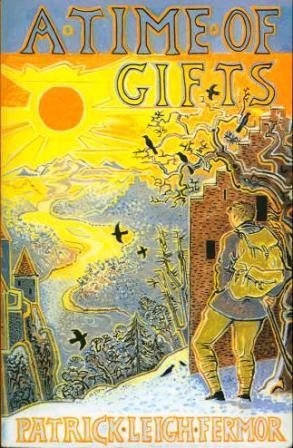
It is hard to sum up in words what this book and this man mean to me. Paddy has become somewhat of a deity for me and my travels in the last few years. I remember there was a time when I toyed and teased with the idea of walking to Italy and I knew at the back of my skull, deep in my conscious that this lust for walking was substantial, but at that time I had no real reason to do so. Paddy was my reason. I discovered A Time of Gifts in an old dusty maze of a bookshop in England’s old capital, in Winchester and was first stopped in my tracks by the wonderfully sharp, romantic imagery of John Craxton’s front cover. But this was nothing compared to the prose, memories, history and romance that inhabited its fading pages.

The storks that flow through his European rambles flick and swoop through the milestones of his adventures and I think I will always have a memory, a sight of those migrating long necked birds as they followed him through cold Holland, into shape-shifting Germany as he turned nineteen, and onto Stuttgart where he imitated the constructed Mr Brown, and from there; a drunken night in Prague, a lonely night in Hungary and onto Greece, love, war, heroism, Cairo, love again, legacy and literature. I wake every day in envy of this life of his and wonder how I (in my infinite competitive nature that inhabits all wistful youth) could ever match, or come close to this man. But with this jealousy, has revolved structure and reason. With the words of A Time of Gifts, or Between The Woods and The Water, Or Travellers Tree, A Time to Keep Silence, and the crackling, volcanic prose of his short, sharp masterpiece; The Violins of Saint Jacques, I have faith in this ever deteriorating, modern, seemingly unromantic world that we live in.

I visited Paddy’s house last year, on a personal crusade. It was my Hellespont, though the journey was less rough. He was too tired and old then to see me and I completely understood his situation. As I sat outside his house and wrote down a scribbled confession of my devotion for his personage, and wrapped the letter around my old Swedish compass, I could hear his deep dark voice, speaking Greek, still with his old fashioned, distinguished English accent, and that was enough for me. I will always remember that moment, when I was yards away from greatness and blessed enough to hear its tone.

I am (as I type this tribute) recording my first proper album entitled “In Hearing Taste” which features a song of the same title. This is my song to Paddy and I hope in some way it will live on along his words, his life and his memory, as an accolade and a tribute to what he stood, and stands for.

I could go on and on about what this man has meant to me and how he inspires me. In September of this year I aim to move to a small Greek island where 600 old Greek ladies live a simple, hermit like life. Greece has become a refuge for me. A place where legends lived and where relaxation and creativity swim side by side in caves and in cool, turquoise shores. Byron lived, rode and died in Messolonghi, Cohen found the guitar in Hydra, Durrell fell in love with Cyprus and Rhodes and of course Leigh Fermor built his house in the Mani. These are my influences, my heroes, the men to whom I escape to when a mobile phone rings, or when the buzz of electricity takes over silence, and thus I will join them in the Hellenic dream.

And so now, as Paddy has had to leave us, is our time to keep silence. Indeed we have a well stacked, inherited future in front of us, for he has left us with his legacy, his talent, his wit and his gift. Now is the time to open that gift, and indulge ourselves in his heroism and his beauty; he is our icon. Now is the time of gifts and I must say, it is a splendid afternoon to set out on this adventure that he has rolled out in front of us.

Thomas James Henley

Paris, June 2011

Related articles:

I knew Patrick Leigh Fermor through his words, and he will know me by mine

Lawrence Durrell and Patrick Leigh Fermor by Thos Henley

A Tribute to Paddy on BBC Radio 4’s Broadcasting House by Colin Thubron

by Colin Thubron,

You can listen on BBC iPlayer (if it works in your country) here … The tribute starts at around the 33 minute mark.

There are just seven days to listen to this so assume you have until midnight Saturday 18 June.

Washington Post: Writer-adventurer Patrick Leigh Fermor dies at 96

First published in The Washington Post 10 June 2011

By Matt Schudel

Patrick Leigh Fermor, who may have been the greatest travel writer of the 20th century, has died at the age of 96. He was one of those intrepid British adventurers of a bygone age who could recite the odes of Horace from memory, sleep in a barn one night and dance with royalty the next.

When he was 18, Mr. Leigh Fermor walked across Europe, and when I say that, I mean exactly that: He walked on his own two feet from England to Turkey. He chronicled this remarkable journey in a book written many years later, “A Time of Gifts.”

During World War II, Mr. Leigh Fermor was part of the British special operations forces and managed to kidnap the German general who was in charge of the occupied island of Crete. Mr. Leigh Fermor conversed with Greek shepherds, using the ancient Greek he had learned in school. He lived with a Romanian princess at her estate in Moldavia. He wrote many books, all with a brilliantly original prose, and was by any standards a remarkable man. The full obituary will follow.

The Channel 4 News report of Paddy’s death

Click the picture to play

Daily Mail obituary: Max Hastings pays tribute to one of Britain’s last war heroes

The Lionheart who stole a Nazi – and the heart of every woman: Max Hastings pays tribute to one of Britain’s last war heroes.

By Max Hastings

First published in the Daily Mail, 11 June 2011.

Paddy disguised as a German NCO during World War II, when he and fellow Special Operations soldiers carried out the daring kidnapping of General Heinrich Kreipe

One of the last authentic heroes of World War II is gone. Sir Patrick Leigh Fermor, a legend to his generation, died early yesterday in Worcestershire at the age of 96.

Paddy’, as he was universally known and beloved, spent two years as a British agent of the Special Operations Executive (SOE) in Crete. His most celebrated exploit, in April 1944, was to kidnap the commander of the German 22nd Division, General Heinrich Kreipe, a  story romantically portrayed in the 1957 movie Ill Met By Moonlight, with Paddy played  by Dirk Bogarde.

The SOE team and their Cretan guerrilla companions marched the general, evading furious German pursuit, to a beach from which the Royal Navy spirited them to Egypt.

Paddy received a richly-deserved DSO, but the Cretan experience was only one chapter in a lifetime devoted to the pursuit of adventure, learning and romance.

After the war, a succession of wonderful books about far-flung places made him the most famous travel writer of his generation.

Awesomely good-looking as a young man, he spoke half-a-dozen languages fluently and had a smattering of several more. His wit, zest for life and joy in companionship won him a legion of friends, some very grand — his comic correspondence with Debo, Duchess of Devonshire was published as a book last year — and others entirely humble.

He was loved for what he was as much as for what he did, though heaven knows, what he did was remarkable enough.

Paddy was born in 1915, the son of a distinguished geologist who spent most of his life in India, leaving his son to his own devices in England for much of his childhood. An unsuccessful schoolboy, he was eventually expelled from the King’s School, Canterbury, allegedly after being caught holding hands with a greengrocer’s daughter.

At the age of 18, in December 1933, he set out on a remarkable quest, to walk across Europe from the Hook of Holland to Constantinople, carrying only a few clothes and the Oxford Book Of English Verse in his rucksack.

He slept often in barns and shepherds’ huts, but a few letters of introduction to German noblemen enabled him to start dossing down in mansions and castles. Successive hosts ‘passed me on to others like a parcel’, as he put it to me many years later.

Those were golden days, when the European aristocracy had plentiful money and leisure. They were captivated by his boundless curiosity about their countries, languages and people.

In training: Paddy was part of the secret Special Operation Executive, who conducted behind enemy lines operations during the War

He reached Constantinople at last on New Year’s Day 1935, then plunged into adventures in Greece, some of them as a spectator of a minor civil war. He told some of the story of his great journey in two books published 40 years later, A Time Of Gifts and Between The Woods And The Water, which became instant classics.

In Athens, he met a Romanian princess named Balasha Cantacuzene. They fell in love and spent the next two years together.

W  hen the war came, he joined the Irish Guards. His command of languages caused him to be sent first to serve as a liaison officer in the doomed 1941 Greek campaign, then transferred to SOE, with which he spent the rest of the conflict.

Paddy brought the spirit of Lord Byron, British hero of the 19th century struggle for Greek independence, to the war in Crete. He loved the Cretans, revelled in the romance of life in their mountains, often disguised in their traditional dress.

 ‘He was a born warrior,’ said his friend, the writer Lord Kinross.

‘He was lionised by all the hostesses in Cairo between missions. He had the Irish charm, that giving, generous spirit and gift of the gab — and, of course, he was incredibly handsome.’

Paddy told me, with the happy mischief in his eyes: ‘The Cretans were the finest natural guerrilla fighters in the world. They were always so keen on kidnapping girls that the idea of kidnapping a German general struck them as tremendous fun.’

A model gentleman: Sir Patrick was a man who was a joy to every company he met and devoted himself to the fun and fascination of exotic people and places

Captain Billy Moss, who afterwards wrote a best-selling account of the episode, was Paddy’s companion in the venture. The two British officers disguised themselves as German NCOs — which required Paddy regretfully to shave off his moustache. On the night of April 26, 1944, they flagged down the general’s car in darkness as he drove to his residence at the Villa Ariadne south of Heraklion.

‘Ist dies das General’s wagen?’ demanded Paddy. ‘Ja, ja,’ said a voice from inside.

Moss quickly coshed the driver and took the steering wheel. Paddy put on the general’s hat and clambered into the front of the big Opel, while three guerrillas sat on the semi-conscious old general in the back.

During the hours that followed, they drove unchecked past 22 German control posts and the centre of Heraklion. Only when safely in open country did they abandon the car and start walking.

Three weeks later, after an epic march across the mountains and many hair’s-breadth escapes, they found themselves safely aboard a British warship, bound for Alexandria, and their kidnapped German general was handed over for interrogation.

Paddy succumbed to rheumatic fever, but this did not prevent him from returning to Crete by parachute for a further mission, followed by more adventures at the end of the war in North-West Europe.

His love affair with Greece persisted. In the 1950s, he wrote two fine travel books about the country, Mani and Roumeli, and built a heavenly house at Karadamyli on the coast of the Peloponnese with his wife, the photographer Joan Eyres-Monsell, where they lived for most of the year thereafter for the rest of their lives. He became the Greeks’ favourite Englishman, an honorary citizen of Heraklion.

The writer Lawrence Durrell memorably described how Paddy once visited his villa in Cyprus: ‘After a splendid dinner by the fire he starts singing — songs of Crete, Athens, Macedonia. When I go out to refill the ouzo bottle, I find the street completely filled with people listening in utter silence and darkness. Everyone seems struck dumb.

Anecdote: Writer Lawrence Durrell described the time Paddy visited his villa in Cyprus and left locals dumbstruck with his Greek songsAnecdote: Writer Lawrence Durrell described the time Paddy visited his villa in Cyprus and left locals dumbstruck with his Greek songs

‘One said: “Never have I heard of Englishmen singing Greek songs like this!” It is as if they want to embrace Paddy wherever he goes.’

I first met Paddy as a very young man, when I listened enthralled to him holding forth to a dinner party with quotations from Horace, snatches of Romanian, Bulgarian and Greek, both ancient and modern. I read avidly his travel books, and later reckoned it a privilege to get to know him a little.

He remained until his death a model of the 1940s British gentleman abroad: impeccably dressed, effortlessly courteous and literate, tirelessly funny.

He was one of those men who brought joy to every company he joined in war and peace. He was completely unpolitical, and though indifferent to money was lucky enough to live among the rich with no need to care about tomorrow. He devoted himself to the fun and fascination of exotic people and places, and wrote like an angel.

In 1991 he became one of the few men ever to refuse a knighthood, though he belatedly accepted one in 2004: more than a hero of the war, he was a British hero for our times.

Related article:

Obituary from The Independent by Paddy Leigh Fermor’s biographer Artemis Cooper

Leigh Fermor will be remembered as someone who lived and talked as well as he wrote

Sir Patrick Leigh Fermor: Soldier, scholar and celebrated travel writer hailed as the best of his time.

By Artemis Cooper

First published in The Independent Saturday, 11 June 2011.

In Greece just after the Second World War, Patrick Leigh Fermor was on a lecture tour for the British Council.

The lecture was supposed to be on British culture, but he had been persuaded to talk about his wartime exploits on Crete. Leigh Fermor took sips from a large glass as he spoke and when it was nearly finished, he topped it up from a carafe of water. The liquid turned instantly cloudy: he had added water to a nearly empty tumbler of neat ouzo.

A roar of appreciation went up from the audience at this impromptu display of leventeia. A quality prized in Greece, leventeia indicates high spirits, humour, quickness of mind and action, charm, generosity, the love of living dangerously and a readiness for anything. Sir Patrick Michael Leigh Fermor had leventeia in spades.

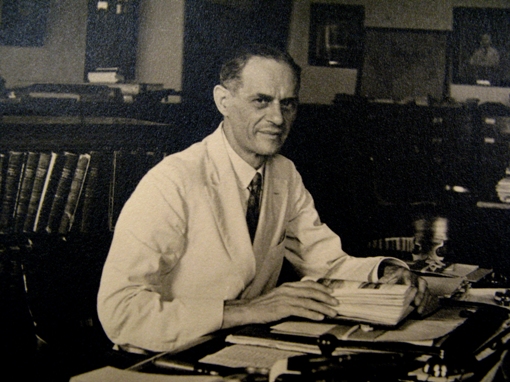
Sir Lewis Leigh Fermor

He was born in 1915, the second child and only son of Lewis Leigh Fermor and his wife, Aileen Taaffe Ambler. The family were based in Calcutta, where Lewis Fermor worked for the Geological Survey of India. Aileen went to England for the birth, but did not dare bring Leigh Fermor back to India as the First World War intensified. She entrusted her baby to the Martins, a couple she scarcely knew in the village of Road Weedon, Northamptonshire, and for the next four years “Paddy-Mike” was adored, indulged and allowed to run wild. When his mother and sister Vanessa came back to collect him in 1919, it was the end of an infant idyll that had, he admitted, “unfitted me for the faintest shadow of constraint.”

Leigh Fermor saw little of his father but was devoted to his flamboyant mother, who wrote plays, played the piano and loved reading aloud. He learnt to read late but devoured the works of Sir Walter Scott before he was 10, awaking an addiction for history, heraldry and adventure. Yet he was not a success academically, perpetually in trouble, and expelled from almost every school he attended.

The King’s School, Canterbury, might have been the exception, but he was often in trouble, and the final straw came when he was caught holding hands with the greengrocer’s daughter. His last report complained that he was a “dangerous mixture of sophistication and recklessness”, and a bad influence on the other boys.

His parents felt a career in the army was the only hope, but he gravitated to Bohemian London and a raffish group who introduced him to nightclubs, strong drink and modern poetry, and encouraged his ambition to be a writer – but he had nothing to write about. He was drifting in a fog of disappointment when the solution came: he would embark on a walk across Europe from the Hook of Holland to Constantinople.

He was 18 when he set off in 1932. With an allowance of £5 a month he slept in hostels, sheep-folds, monasteries, barns, people’s sofas, and for a few luxurious months in castles and country houses in Hungary and Transylvania. He reached Constantinople on New Year’s Day, 1935. He spent his 20th birthday on Mount Athos, and a month later took part in a Greek royalist cavalry charge against Venizelist rebels across the River Struma on a borrowed horse. He then made his way to Athens, where he met Princess Balasha Cantacuzène.

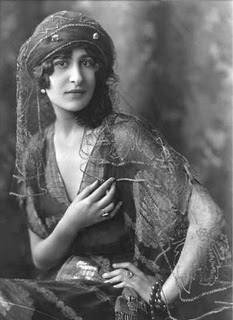
Balasha Cantacuzene

A Romanian painter with dark, exotic looks, Balasha was eight years older and recently divorced. That summer they lived in a watermill opposite the island of Poros, and in autumn they retreated to Balasha’s family home in Romania. Baleni, in the Cantacuzene estates in Moldavia, was his refuge for three years. Here he made the first attempt to write up his notes from his trans-European journey. He did not like the results, but he did earn money by translating Constantine Rodocanachis’s Ulysse fils d’Ulysse which as Forever Ulysses became a bestseller in America. When war was declared, Leigh Fermor decided to go home. “The farewells next day,” he wrote, “were like marching orders out of paradise.”

He had hoped to join the Irish Guards, but took the commission offered by the Intelligence Corps which gave him the opportunity to return to Greece. As a British Liaison Officer he followed the Greek army’s early successes against the Italians on the Albanian border in late 1940. When the Germans invaded the following April, the British and Greek forces retreated southwards. Leigh Fermor escaped by caique to Crete, where he took part in the battle in May 1941 against German paratroopers; when the battle was lost he was evacuated to Egypt. He was sent back to occupied Crete in June 1942, as one of a handful of SOE officers who were helping the Cretan Resistance.

After the Italian surrender in August 1943 he was contacted by the Italian general Angelo Carta. Rather than co-operate with the Germans, Carta wanted to leave Crete. Leigh Fermor saw him safely to Egypt – a mission which sparked the idea of kidnapping a German general. Promoted to major, he returned from Cairo to Crete in February 1944. With his second-in-command, Capt William Stanley Moss, and a hand-picked team of resistance fighters, the ambush took place on 26 April, when General Heinrich Kreipe, commander of the Sebastopol Division, was pulled out of his car on his way to his villa.

Moss, Kreipe and Paddy

The hardest part was not so much the capture but the getaway. The wireless broke down, German troops flooded the south coast, from where they had planned to rendezvous with a Royal Navy launch, and the General hurt his shoulder in a fall. The party spent two weeks in caves and sheepfolds in the White Mountains, making their way over the snowy ridges of Mount Ida to a more secluded evacuation point. German patrols kept up the pressure, and leaflets were dropped warning that anyone who gave aid and succour to the kidnappers could expect the most severe punishment. No one gave them away.

The success of the operation and the discomfiture of the occupiers gave the Cretans a tremendous boost: as one of them put it, “the horn-wearers won’t dare look us in the eye!” William Stanley Moss’s diary was made into a book, Ill Met by Moonlight (and later a film with Dirk Bogarde.) Leigh Fermor was awarded the DSO and remains a hero on Crete. But he never published an account of his own experiences on the island.

After the war, he became assistant director of the British Institute in Athens. A colleague recalled the songs and laughter emerging from his office, which was a magnet for Cretans looking for a job. His boss sent him on a lecture tour to get him out of the way, which proved a success and took him all round Greece. This was the first of many journeys taken with Joan Rayner, a tall, blonde intellectual he had first met in Cairo. Daughter of the first Viscount Monsell, who had been First Lord of the Admiralty in the 1930s, she was widely travelled and a talented photographer.

In October 1949, the couple set off for the French Antilles. Leigh Fermor had been commissioned to write captions for a book of photographs by his friend A Costa, but this developed into his first full-length book, The Traveller’s Tree (1950). The reviews were generous in their praise and he was earmarked as a writer to watch.

He was now free to concentrate on Greece. Over the next few years he and Joan travelled all over the mainland and the archipelago, by boat and bus and mule and on foot, exploring a country that was still remote outside the main towns and where customs and traditions were observed as they had been for centuries.

Spells of travel would be broken by long stints of writing, translation and journalism. In 1953 came two small books. A series of articles on monasteries, written for the Cornhill Magazine, were collected in A Time to Keep Silence, while his only novel, The Violins of Saint Jacques, grew out of a chapter he was supposed to have written for a book called Memorable Balls. He translated the wartime memoirs of his friend George Psychoundakis, which appeared in 1955 as The Cretan Runner, and wrote for The Spectator and The Sunday Times.

Beyond an insatiable thirst for travel, wine and books, Leigh Fermor and Joan lived a frugal life. She had a small private income, and by living abroad for most of the year they avoided tax. Friends helped by lending houses where he could write; among the most important was a house in Normandy owned by Amy Smart, the Egyptian wife of the diplomat Sir Walter Smart, and that of the painter Nico Ghika on the island of Hydra. When they were in England, Joan would retire to her family home at Dumbleton in Worcestershire while Leigh Fermor headed for the bright lights.

His friends scooped him up into a round of celebrations and reunions and house parties, where Leigh Fermor revelled in company. Among them were brothers-in-arms like Xan Fielding and George Jellicoe, celebrated hostesses such as Annie Fleming, Deborah Devonshire and Diana Cooper, and writers and poets such as John Betjeman, Robin Fedden, Philip Toynbee, and later, Bruce Chatwin.

Writing, on the other hand, was hard and solitary. Though many of his set-piece descriptions were written at a gallop and barely changed, other passages involved months of work. He was acutely attuned to internal rhythms; the alteration of one word would set up a ripple effect demanding whole chapters to be rewritten. His friend and publisher, Jock Murray, was often in despair as every set of proofs came back covered in crossings-out and addenda.

It was not until 1958 that Murray published Mani, Leigh Fermor’s first book on Greece. It shows the southern Peloponnese as it was before tourism – a land of rocks and dazzling light, blood feuds and deep superstition, where people still told tales of their struggles against the Turks and pirates. Its companion volume, Roumeli covers his travels from Macedonia to the Gulf of Corinth.

Leigh Fermor and Joan were keen to settle in Greece, and they were always on the look-out for the perfect patch of land. They found it in 1963, in the Mani, a little promontory near the village of Kardamyli, south of Kalamata. Surrounded by olive groves, it looked out to sea and had its own rocky beach. With the help of a local stonemason, Leigh Fermor and Joan set about building the house. The result was the perfect monastery-built-for-two, at the heart of which was a library described by John Betjeman as “one of the rooms of the world”.

A Time of Gifts, 1977

Leigh Fermor at last had a permanent home, all his books in one place and uninterrupted solitude. His next subject was the one he had waited half a lifetime to write – the story of his great walk to Constantinople. “Shanks’s Europe”, as he called it, was worth the wait. A Time of Gifts appeared in 1977, and Between the Woods and the Water, the second volume in a proposed trilogy, in 1986. Together they present a snapshot of old Europe just before the joint cataclysms of war and Communism swept them away for ever. Every paragraph reflects the loss of a way of life still linked to its soil and its history, while celebrating the joy and enthusiasm of a young man discovering the riches of a continent. The reviews hailed him as the best travel writer of his time – and reader reviews on Amazon show him being rediscovered.

Unfortunately, the clamour for him to finish the last volume ushered in an ice age of writer’s block. In 1988 and 1990 he revisited his old haunts in Bulgaria and Romania, hoping to kick-start the creative process. Shocked by the all-obliterating change, he found his own memories fading. In an effort to get him over it Jock Murray commissioned another book about a journey to Peru, which appeared as Three Letters from the Andes (1991). He wrote articles, introductions, obituaries, reviews, and even translated a story by PG Wodehouse into Greek – but the pen-paralysis persisted. The two people he most relied on for moral support died: Murray in 1993, and his wife Joan 10 years later. Leigh Fermor was knighted on his 90th birthday, but his eyesight was beginning to deteriorate. He carried on writing in longhand for as long as he could, but the final volume of his trilogy remains unfinished.

He will be remembered by his friends as someone who lived and talked as well as he wrote, whose leventeia was irrepressible, his conversation unforgettable. He could launch into a monologue that turned into a one-man show, a verbal rollercoaster that ranged from the Pyrenees to the Carpathians or chased mythical beasts through primeval forests, tribal customs, Guatemalan bus tickets, German heraldry and Napoleonic uniforms – leaving the company breathless with laughter and exhilaration.

British soldier and travel writer Patrick Leigh Fermor with Joan Rayner after their wedding at Caxton Hall, Westminster, London, 17th January 1968. (Photo by Evening Standard/Hulton Archive/Getty Images)

Patrick Michael Leigh Fermor, writer and soldier: born London 11 February 1915; OBE (military) 1943; DSO 1944; Kt 2004; married 1968 Hon Joan Eyres-Monsell (died 2003); died 10 June 2011.

LA Times: Sir Patrick Michael Leigh Fermor dies at 96; erudite British travel writer

British travel writer Sir Patrick Leigh Fermor spent most of his time in southern Greece, near the town of Kardamyli. He returned to Britain the day before he died, according to his publisher. (Thanassis Stavrakis / Associated Press)

As a young man he walked from Holland to Constantinople, providing fodder for two of his acclaimed books. As an army major during WWII, he led a team that captured a German general in Nazi-occupied Crete.

First published in the Los Angeles Times, 11 June 2011

British travel writer Sir Patrick Michael Leigh Fermor, who tramped across Europe in his teens and captured a German general in Nazi-occupied Crete during World War II, died in Britain on Friday. He was 96.

Leigh Fermor had arrived in Britain on Thursday, a day before his death, said his publishing house, John Murray. The author lived most of the year in Greece, near the southern village of Kardamyli.

Leigh Fermor combined a love of adventure with the erudition of an older age and an eclectic inquisitiveness. His elegant prose, with baroque digressions into the arcana of history and folklore, furnished more than half a dozen books and earned a host of literary awards.

At 18, after a disastrous career at a succession of schools, he decided to walk from Holland to Constantinople, now Istanbul.

It was 1933, the year Adolf Hitler came to power.

As a British army major 11 years later, Leigh Fermor headed a team of British special operations officers and Greek resistance fighters that captured the German military commander of Crete, Gen. Karl Kreipe. Eluding a furious manhunt, the small band spirited the disgruntled Kreipe over the island’s snow-topped mountains to a southern cove, from which he was shipped to Egypt.

The action, for which Leigh Fermor was awarded the Distinguished Service Order, reportedly prompted the infamous Nazi order to execute captured Allied commandos. With a price on his head, he returned to Crete to coordinate covert operations.

The escapade was recorded by Leigh Fermor’s fellow officer William Stanley Moss in his book “Ill Met by Moonlight,” later turned into a film starring Dirk Bogarde.

Leigh Fermor was born Feb. 11, 1915, of English and Irish descent. His father was the India-based geologist Sir Lewis Leigh Fermor.

The author’s two-year rambles through the twilight of old Europe — equipped with the Oxford Book of English Verse, a volume of Horace and an old army greatcoat — provided the material for “A Time of Gifts” (1977) and, nine years later, “Between the Woods and the Water.”

Leigh Fermor won the Heinemann Foundation Prize in 1950 with his first book, “The Traveler’s Tree,” about the West Indies. Later came “A Time to Keep Silence” and the Greek travel books “Mani” and “Roumeli.”

His writings are studded with gems of obscure knowledge, a fine sense of place and character, and surreal anecdotes. In Missolonghi, Greece, he tracked down a pair of slippers that had belonged to Lord Byron. He rode with a Greek cavalry unit during a rebellion in the 1930s before peeling off to visit a camp of Sarakatsan nomads. He swam the Hellespont, capped Latin verses unexpectedly quoted by his captive general and had an affair with a Romanian princess.

His books inspired generations of travel writers. As author Michael Joseph Gross noted in a 2007 Times article, “When they grow up, travel writers want to be Fermor the way foreign correspondents want to be Ryszard Kapuscinski.”

Leigh Fermor also matched the ideal of a certain model of Englishman: a charming, polyglot scholar — albeit self-taught — and gentleman who had a good war, consorted with aristocracy and lived in foreign parts, worshipped by the locals.

He was knighted in 2004 — accepting an honor he had declined in 1991.

His wife, Joan Leigh Fermor, died in 2003. The couple had no children.

Join many others and post your tributes to Patrick Leigh Fermor on the blog

Don’t forget to visit the Paddy Thoughts page to leave a comment. Let’s all hear your thoughts and tributes to Paddy.

He brought so much joy into our lives and the lives of others, let’s say what we think!

Your Paddy Thoughts

Your Paddy Thoughts - click the image

New York Times: Patrick Leigh Fermor, Travel Writer, Dies at 96

Thanassis Stavrakis/Associated Press: Patrick Leigh Fermor in Greece in 2001. He had worked undercover there for the British military during World War II.

Patrick Leigh Fermor, the British writer whose erudite, high-spirited accounts of his adventures in prewar Europe, southern Greece and the Caribbean are widely regarded as classics of travel literature, died on Friday at his home in Worcestershire, England. He was 96.

by Richard B Woodward

First published in The New York Times, 11 June 2011

Patrick Leigh Fermor in Greece in 2001. He had worked undercover there for the British military during World War II.

Roland Philipps, Mr. Leigh Fermor’s editor at John Murray Publishers in Britain, confirmed his death.

Mr. Leigh Fermor was regarded by many as the finest travel writer alive on the strength of two autobiographical volumes, “A Time of Gifts” (1977) and “Between the Woods and the Water” (1986), which both recalled his walk across Europe in the 1930s, begun when he was a teenager and lasting more than three years.

Reviewing “Between the Woods and the Water” for The New York Times, John Gross wrote that it was not primarily for the “information it contains that his book deserves to be read (though he packs in a great deal), but for its sumptuous coloring, the acuteness of his responses, the loving precision with which he conjures up people and places.”

Once described by the BBC as “a cross between Indiana Jones, James Bond and Graham Greene,” Mr. Leigh Fermor was as renowned for his feats of derring-do as for his opulent prose.

After joining the Irish Guards during World War II, he was judged to be promising officer material for the Special Operations Executive, the unit created by Winston Churchill to wage war by unconventional means. Mr. Leigh Fermor’s superiors deemed his fluency in modern Greek useful in leading resistance to German occupation in the Aegean.

For 18 months he lived disguised as a shepherd in Crete, emerging from the mountains with a team that in 1944 kidnapped Gen. Heinrich Kreipe, the island’s German commander. The operation provoked brutal reprisals toward the local population. It earned Mr. Leigh Fermor the Distinguished Service Order and later became the basis for the 1957 English film “Ill Met by Moonlight,” directed by Michael Powell and starring Dirk Bogarde.

By the time the film was released, Mr. Leigh Fermor had received a measure of attention for his writing. He toured the Caribbean with two friends after the war and in 1950 published “The Traveller’s Tree,” a collection of island-hopping tales. They first revealed the qualities readers would learn to expect from his books: sly humor, curiosity, wide-ranging social connections and sympathies, familiarity with arcane history and a dashing literary style steeped in the ancient writing of Greece and Rome.

“The afternoon was baking and shadowless, and the town seemed only with an effort to remain upright among its thoroughfares of dust,” he wrote of a trip to Guadeloupe. “It was as empty as a sarcophagus.”

The Caribbean was the setting for his only novel, “The Violins of Saint-Jacques,” published in 1953 and turned into an opera in 1966 by the Australian composer Malcolm Williamson. Mr. Leigh Fermor also published in 1953 “A Time to Keep Silence,” a short, reverent study of the monastic life resulting from his stays in a pair of French abbeys and a tour of the rock-carved monasteries in Cappadocia, Turkey.

The warmth of Greece drew him back in the 1950s. He bought a home in Mani, in the southern Peloponnese. He and his wife, the former Joan Eyres Monsell, a photographer, divided their time between Greece and Britain. They married in 1968 after many years of companionship. She died in 2003.

The couple’s tables, in Mani and in Worcestershire, were reputed to be among the liveliest in Europe. Guests, both celebrities and local people, came to dine with them. The journalist and historian Max Hastings called Mr. Leigh Fermor “perhaps the most brilliant conversationalist of his time, wearing his literacy light as wings, brimming over with laughter.”

Mr. Leigh Fermor’s books about life in Greece — “Mani,” in 1958, and “Roumeli,” in 1966 — confirmed him as the armchair traveler’s ideal. (For his decades of writing about Greece, the government in 2007 awarded him its highest honor, the Commander of the Phoenix.)

But it was his earliest wanderings in Europe, undertaken when he was scarcely 18 and reconstructed for publication in adulthood, that earned him international acclaim.

He set off across the English Channel in December 1933 with little more in his backpack than clothes, a copy of Horace’s “Odes,” an automatic pistol and some letters of introduction. His journey did not end until January 1937, when he reached Constantinople (now Istanbul.)

On foot and on horseback, by train and automobile, Mr. Leigh Fermor found hospitality among people alien to most English speakers of the time: Orthodox Jewish woodcutters in Transylvania, Hungarian Gypsies, White Russian exiles, German barons, French-speaking monks in Austria, and Romanian shepherds along the Danube.

At one point he strayed by mistake into a Munich beer hall crowded with Nazis.

“The vaults of the great chamber faded into infinity through blue strata of smoke,” he wrote. “Hobnails grated, mugs clashed and the combined smell of beer and bodies and old clothes and farmyards sprang at the newcomer. I squeezed in at a table of peasants, and was soon lifting one of those masskrugs to my lips. It was heavier than a brace of iron dumbbells, but the blond beer inside was cool and marvelous, a brooding, cylindrical liter of Teutonic myth.”

Patrick Michael Leigh Fermor was born in London on Feb. 11, 1915. His father, Sir Lewis Leigh Fermor, was a geologist in India who became the first president of the Indian National Science Academy. His mother, the former Eileen Ambler, joined her husband on the subcontinent shortly after Patrick’s birth, leaving the boy in the care of a farmer’s family in Northamptonshire. (Reunited in adolescence with his mother and older sister, he continued to regard them as “beautiful strangers.”)

Mr. Leigh Fermor grew up willfully independent, unable to adapt for long to any school’s regimen. His headmaster at King’s School, Canterbury, where he was expelled, reportedly for holding hands with the local greengrocer’s daughter, wrote him up as “a dangerous mix of sophistication and recklessness which makes one anxious about his influence on other boys.”

After he accepted a knighthood in 2004, an honor he had turned down in 1991, he was known as Sir Patrick. But to his many friends he was Paddy, a man who maintained a zest for life, even into his 90s. “If you think you can match him ouzo for ouzo, on a back street in downtown Athens, you’d better think again,” Anthony Lane wrote in an admiring profile in The New Yorker in 2006.

Mr. Leigh Fermor continued working well into his last years, leaving no immediate survivors; he and his wife had no children.

A planned third book about his youthful travels never appeared, but his biographer Artemis Cooper told the British newspaper The Guardian that Mr. Leigh Fermor had completed a draft, and that it would be published.

Asked to confirm the impending publication, Mr. Philipps responded by e-mail, “I am afraid I cannot confirm this, except to say I very hope it is the case.”

In his eagerness to complete his last book, Mr. Leigh Fermor also accomplished something he had long put off: he taught himself to type.

Travel writing great Patrick Leigh Fermor dies aged 96

Patrick Leigh Fermor in 2008. Photograph: Eamonnb McCabe

Friends and colleagues pay tribute to author revered for his account of walking across Europe

By Richard Lea

First published in the Guardian 10 June 2011

The writer Patrick Leigh Fermor, who walked his way into the eternal affection of restless souls with his account of a journey across Europe on foot, has died aged 96.

His editor at John Murray, Roland Phillips, said he was immensely sad that “such a great writer – a figure who was a hero to me long before I ever met him – has died” and hailed him as “the greatest travel writer of the 20th century”.

Leigh Fermor began his travels in December 1933, putting a school career he recalled as full of “discipline problems … like fighting, climbing out at night, losing my books” behind him with the idea of a “change of scenery”. Taking only a sleeping bag, the Oxford Book of English Verse and a volume of Horace, he walked up the Rhine and down the Danube, sleeping in barns and shepherd huts along the way, finally arriving at Constantinople in 1935.

With the second world war approaching he enlisted in the Irish Guards, and was awarded the DSO for his heroism as a member of the Special Operations Executive in German-occupied Crete. He met his wife, Joan, in 1946, living with her in cheap hotels and in friends’ houses during the 1950s while working as a journalist and writer.

An account of a journey to the West Indies, The Traveller’s Tree, was published in 1950 and found fame in Ian Fleming’s Live and Let Die, where James Bond is told it contains all he needs to know about the islands. Other journeys followed, including a slim volume recounting time spent in French monasteries, A Time to Keep Silence, published in 1957, and he moved to Greece in 1968. But it was the publication in 1977 of the first volume of his European odyssey, A Time of Gifts, which sealed his fame.

According to his biographer Artemis Cooper, the story of Leigh Fermor’s first expedition contains “very little analysis, it’s purely the beauty and the romance”.

“They’re very much books about memory,” she said. “They’re written by a man of 50, looking back at a boy of 18, evoking the joy of travelling while young – that amazing, honeyed time.” Although he had a visceral dislike of nazism, she continued, he wasn’t interested in the political turmoil sweeping through Europe in the 1930s. “He’s looking beyond reality to an idealised version of Europe without frontiers, seen through the eyes of painters such as Vermeer, Breughel and Altdorfer.”

“He is very much sui generis, standing apart from much modern travel writing, which is very gritty, very hard, very unromantic,” she said.

A second volume followed, Between the Woods and the Water, in 1986, leaving the author at the Iron Gate which marks the border between the Kingdom of Yugoslavia and Romania.

According to Phillips, Leigh Fermor was a “passionate rewriter”. “The story goes that he took several years to return the proofs of Between the Woods and the Water to John Murray,” he said, “and that they returned with every word rewritten in his scrawl.”

Readers are still awaiting the promised third leg of Leigh Fermor’s trip, despite the author’s repeated promises to “pull my socks up and get on with it” and his 2007 declaration that he was learning to type so that he could complete it more quickly.

Cooper, who visited him at his Greek home earlier this year, said that the writer had been working on corrections to a finished text. “A early draft of the third volume has existed for some time, and will be published in due course,” she said.

Paddy’s death: As reported by Associated Press

British writer Sir Patrick Leigh Fermor dies at 96

By NICHOLAS PAPHITIS, Associated Press

ATHENS, Greece (AP) — British travel writer Sir Patrick Michael Leigh Fermor, who tramped across Europe in his teens and captured a German general in Nazi-occupied Crete during World War II, died in Britain on Friday. He was 96.

Leigh Fermor died in Britain where he had arrived on Thursday, a day before his death, his publisher, John Murray, said.

Leigh Fermor’s war exploits and books about Greek travel made him highly popular in Greece, where he lived most of the year in a house he had designed in the 1960s near the southern village of Kardamyli.

A Greek Culture Ministry statement described him as “perhaps the greatest contemporary travel writer, (who) loved Greece as his second country.” It also called him one of Greece’s most significant cultural ambassadors in the world.

Known as “Paddy” to friends, admirers and name-droppers alike, Leigh Fermor combined a love of adventure with the erudition of an older age — and the eclectic inquisitiveness that spawned his mini glossary of beggar slang from remote Greek villages.

His elegant prose, with baroque digressions into the arcana of history and folklore, furnished more than half a dozen books and earned a bag of literary awards.

At the age of 18, after a disastrous career at a succession of schools — excluding a progressive establishment that promoted naked country dancing in a barn — Leigh Fermor decided to walk from Holland to Constantinople, modern Istanbul.

It was 1933, the year Adolf Hitler came to power.

As a British army major 11 years later, Leigh Fermor headed a team of British special operations officers and Greek resistance fighters that captured the German military commander of Crete, Gen. Karl Kreipe. Eluding a furious manhunt, the small band spirited the disgruntled Kreipe over the island’s snow-topped mountains to a southern cove, from which he was shipped to Alexandria.

The action, for which Leigh Fermor won the Distinguished Service Order, reportedly prompted the infamous Nazi order to execute captured allied commandos. With a price on his head, he returned to Crete to coordinate covert operations.

The escapade was recorded by Leigh Fermor’s fellow officer William Stanley Moss in his book “Ill Met by Moonlight,” later turned into a film starring Dirk Bogarde. The protagonists were reunited for a Greek TV show in 1972, where Kreipe said he bore his abductors no ill-will “otherwise I would not have come here.”

Leigh Fermor was born in 1915, of English and Irish descent. His father was the India-based geologist Sir Lewis Leigh Fermor, who, in his son’s words, “discovered an Indian mineral which was named after him and a worm with eight hairs on its back; and — brittle trove! — a formation of snowflake.”

As a schoolboy, the author did not prosper, and told how he was finally kicked out for holding hands with a green grocer’s daughter of “sonnet-begetting beauty.”

His two-year perambulations through the twilight of old Europe — equipped with the Oxford Book of English Verse, a volume of Horace and an old army greatcoat — provided the material for “A Time of Gifts” (1977), and, nine years later, “Between the Woods and the Water.” The final part of the planned trilogy never materialized, despite the author’s reported acquisition, at the dawn of the 21st century, of his first typewriter.

Leigh Fermor won the Heinemann Foundation Prize in 1950 with his first book, “The Traveler’s Tree,” about the West Indies. Later came “Mani,” and “Roumeli,” with photographs by his wife, Joan, both about Greece — where he lived for more than half a century in a house above the sea near Kardamyli.

His writings are studded with gems of obscure knowledge, a fine sense of place and character, and surreal anecdotes. In Missolonghi, he tracked down a pair of slippers that had belonged to Lord Byron. He rode with a Greek cavalry unit during a rebellion in the 1930s before peeling off to visit a camp of Sarakatsan nomads. He swam the Hellespont, capped Latin verses unexpectedly quoted by his captive general, and had an affair with a Romanian princess.

He abhorred the blare of radios in the Greek countryside (“these rabid wirelesses should be hunted out and muzzled, or shot down like mad dogs”) and disliked the early Frankish castles “that encircle the Grecian mountaintops like so many crowns of thorns.”

His books inspired generations of travel writers, including his friend Bruce Chatwin, whose ashes were buried by a Byzantine chapel on a mountainside near Kardamyli. Leigh Fermor also matched the ideal of a certain model of Englishman: a charming, polyglot scholar — albeit self-taught — and gentleman who had a good war, consorted with the aristocracy and lived in foreign parts, worshipped by the locals. For years, fans descended on Kardamyli hoping to catch a glimpse of the writer or his stone-built home, while a blog devoted to Patrick Leigh Fermor acclaims him as the Greatest Living Englishman.

He was knighted in 2004 — accepting the honor he had declined in 1991. In 2007, Greece awarded him the Order of the Phoenix.

A funeral is expected to be held next week in Dumbleton village, near Cheltenham in England, where he had a house and where his late wife, Joan, is buried.

Travel writer Patrick Leigh Fermor dies

A news article from Channel Four news which has quite a few quotes from Artemis Cooper. It appears that they may have spoken to her today.

Click the image to read.

BBC Obituary: Sir Patrick Leigh Fermor

Billy Moss and Paddy Leigh Fermor

Sir Patrick Leigh Fermor, who has died aged 96, was both a man of action and an intellectual.

From the BBC news website.

His exploits during WWII, when he led a group of British officers and Greek guerrillas which captured the German military commander of Crete, has become the stuff of legend.

After the war, through a series of colourful yet scholarly books, including A Time of Gifts and Mani: Travels in the Southern Peloponnese, he re-invented himself as perhaps the finest travel writer of his generation.

Patrick Michael Leigh Fermor – known in early life as Michael and later to his many friends as Paddy – was born in London on 11 February 1915.

His father, Sir Lewis Leigh Fermor, was a distinguished geologist and Fellow of The Royal Society who spent much of his career in India.

With his parents often abroad, Leigh Fermor enjoyed a carefree childhood, often with foster-parents on a farm in Northamptonshire.

European odyssey

After a brief, unhappy, sojourn “among the snake-belts and the bat-oil of a horrible preparatory school”, he progressed to King’s School, Canterbury, where one house-master dubbed him “a dangerous mixture of sophistication and recklessness”.

“Sacked”, as he put it, from King’s following a teenage dalliance with the daughter of a town greengrocer, he read voraciously – Latin, Greek, Shakespeare, history – for the Sandhurst Military Academy entrance examination.

But deciding that the life of a peacetime soldier was not for him, Leigh Fermor determined, aged just 17, to walk across Europe from the Hook of Holland to Constantinople (now Istanbul).

So, on 8 December 1933, a month after Adolf Hitler came to power in Germany, he set off from London with just a small rucksack containing a few clothes, the Oxford Book of English Verse and a volume of Horace’s odes for company.

On just a pound a week he was to cross the continent, tramp-like, wandering through town, village and city, across mountains and beside rivers, sleeping in doss-houses and castles and, above all, writing.

This journey, which he chronicled much later in life in A Time of Gifts (1977) and Between the Woods & the Water (1986), brought him face-to-face with the last blossoming of a now vanished Europe.

It was a world of gypsies, isolated farming communities whose ways had changed little since the Thirty Years’ War, faded Austro-Hungarian aristocracy and Mitteleuropean Jewish communities now lost to World War Two, the Holocaust, and the Cold War.

Wartime intelligence officer

Erudition shone from every page, whether describing duelling in Heidelberg where “those dashing scars were school ties that could never be taken off” or the Carpathian mountains, with its “fiendish monocled horsemen, queens in lonely towers, toppling ranges, deep forests, plains full of half-wild horses… mad noblemen and rioting jacqueries”.

After reaching Constantinople he travelled extensively in the Greek archipelago, celebrating his 21st birthday in a Russian monastery on Mount Athos and witnessing a civil war before returning to Britain.

At the outbreak of World War Two Patrick Leigh Fermor – the scion of an Anglo-Irish family – enlisted in the Irish Guards.

With his intimate knowledge of south-eastern Europe and first-class linguistic skills, he soon found himself serving as the Intelligence Corps’ liaison officer to Greek Headquarters in Albania.

After fighting against the German forces then sweeping through Greece and the Balkans, he was posted to occupied Crete in 1942. There, for two-and-a-half years, he organised resistance to the 22,000 German troops occupying the island.

Disguised as a shepherd, he directed an operation to capture the island’s military commander, Major General Karl Kreipe.

After snatching the general and hijacking his staff car, Leigh Fermor and his British and Cretan comrades drove through the capital city, Heraklion, successfully negotiating 14 checkpoints on route.

As Major Leigh Fermor and his colleague, Major Stanley ‘Billy’ Moss, were dressed as German corporals, capture would have meant certain death. After three weeks hiding in the hills, they finally accompanied their precious cargo by boat to Cairo.

Rich prose style

This daring escapade, for which he was awarded the Distinguished Service Order, was immortalised by Moss in his 1950 book Ill Met By Moonlight. Dirk Bogarde played Leigh Fermor in the successful big screen adaptation.

After the war Leigh Fermor worked briefly as deputy director of the British Institute in Athens before resuming his travels.

His first book, The Traveller’s Tree (1950), is an account of journeying in the Caribbean, the “ultimate purpose” of which, as set out in the book’s preface, was “to retransmit to the reader whatever interest and enjoyment we encountered. In a word, to give pleasure”.

This he did, through vivid descriptions of the languorous beauty of island life, the linguistic Tower of Babel bequeathed by colonialism and the continuing legacy of the slave trade. Architecture, history, culture, all were essential themes to Leigh Fermor, as central to his first work as to his last.

In 1953 he published a novel, The Violins of St Jacques. A fantasy set in the decadent world of early 20th Century Martinique, the book’s florid and luxurious romanticism proved a radical departure for its author.

But it was Greece, both ancient and modern, to which Leigh Fermor often looked for inspiration. Works like Mani (1958) and Roumeli (1966) explored the complex and colourful sweep of Hellenistic culture.

Together with the account of his transeuropean walk, they represent a formidable body of work.

Though he latterly lived in Crete, rarely visiting his homeland, Patrick Leigh Fermor was an archetypal Englishman.

The recipient of many awards and prizes – including a knighthood, the freedom of four Greek cities and as a Chevalier of France’s Order of Arts and Letters – he was praised throughout the world as a thrilling writer, a real-life hero and a genteel observer of the human condition.

The Guardian: Sir Patrick Leigh Fermor obituary

'A dangerous mixture of sophistication and recklessness': Patrick Leigh Fermor in Saint Malo, France, in 1992 Photograph: Ulf Andersen/Getty Images

Highly regarded travel writer and heroic wartime SOE officer

By James Campbell

First published in The Guardian 10 June 2011

Patrick Leigh Fermor, who has died aged 96, was an intrepid traveller, a heroic soldier and a writer with a unique prose style. His books, most of which were autobiographical, made surprisingly scant mention of his military exploits, drawing instead on remarkable geographical and scholarly explorations. To Paddy, as he was universally known, an acre of land in almost any corner of Europe was fertile ground for the study of language, history, song, dress, heraldry, military custom – anything to stimulate his momentous urge to speculate and extrapolate. If there is ever room for a patron saint of autodidacts, it has to be Paddy Leigh Fermor.

Rather than go to university in 1933, at the age of “18 and three-quarters”, he set out in December that year to walk from the Hook of Holland to what he insisted on calling Constantinople, or even Byzantium [Istanbul]. There was no hurry, he wrote 65 years later in an article for the London Magazine. His journey took him “south-east through the snow into Germany, then up the Rhine and eastwards down the Danube … in Hungary I borrowed a horse, then plunged into Transylvania; from Romania, on into Bulgaria”. At New Year, 1935, he crossed the Turkish border at Adrianople and reached his destination.

The European trek was undertaken with a book in mind – he was inspired by George Orwell’s Down and Out in Paris and London – but 40 years would pass before Paddy published the first volume of his projected trilogy on the adventure. Asked why it took so long, he shot back: “Laziness and timidity.” A Time of Gifts (1977) is not only a great travel book (a term he disliked), but one of the wonders of modern literature.

Five years after his journey ended, he was serving with the Irish Guards during the second world war. He joined the Special Operations Executive in 1941, helping to co-ordinate the resistance in German-occupied Crete, and commanding, as he put it, “some minor guerrilla operations”. The most audacious was the ambush and kidnap of the man overseeing the Nazi occupation of the island, General Heinrich Kreipe, who was spirited off to Alexandria.

Paddy’s adventures began practically at the moment he was born. His father, Sir Lewis Leigh Fermor, was the director of the Geological Survey of India. After giving birth to her son in London, his mother, Eileen (nee Ambler), a hopeful but unsuccessful playwright, took Paddy’s elder sister and returned to the east. The newborn was left behind, “so that one of us might survive if the ship were sunk by a submarine”. He was raised in Northamptonshire by a family called Martin and, as he told me when I interviewed him in 2005, “spent a very happy first few years of my life as a wild-natured boy. I wasn’t ever told not to do anything.” The experience left him unsuited to “the faintest shadow of constraint”. As for his parents, “I didn’t meet either of them until I was four years old”. Lewis and Eileen later separated, and Paddy then lived with his mother in London, near Regent’s Park.

With pride, he would tell how he went to a school “for rather naughty children”, and was expelled from two others, including the King’s school, Canterbury, where he had formed an illicit liaison with the local greengrocer’s daughter, eight years older than him, in whom perhaps he glimpsed a loving mother. His housemaster described him as “a dangerous mixture of sophistication and recklessness”, which was perceptive.

Among the books he packed for his European journey in 1933 was a volume of Horace. To pass the time while marching, he recited aloud “a great deal of Shakespeare, several Marlowe speeches, most of Keats’s Odes” as well as “the usual pieces of Tennyson, Browning and Coleridge”. This would be related with charming if showy modesty.

The immense repertoire had a frivolous side. Throughout his adult life, Paddy was a great performer of party turns: songs in Cretan dialect; The Walrus and the Carpenter recited backwards; Falling in Love Again sung in the same direction – but in German. When I was at his house in the Peloponnese, in Greece, he restricted himself, after a lunch that lasted several hours, to It’s a Long Way to Tipperary in Hindustani.

A Time of Gifts is written with a youthful eagerness, with intricately detailed descriptions of sights passed along the way, conversations, drinks imbibed, the cadence of birdsong. Yet it is almost entirely a work of mature recollection. The figure setting out for the Netherlands after a final celebration with friends – “a thousand glistening umbrellas were tilted over a thousand bowler hats in Piccadilly; the Jermyn Street shops, distorted by streaming water, had become a submarine arcade” – is a lad of 18, with all the appropriate responses, but his sensibility is in the control of a writer several decades older. While making a BBC television programme about Paddy’s journey in 2008, the explorer and film-maker Benedict Allen was able to authenticate many of the elaborate and seemingly fanciful descriptions in the book.

Back in Athens, after the main journey to Istanbul was completed, Paddy met the first great love of his life, Balasha Cantacuzene, a Romanian princess 12 years his senior, with whom he lived on the family’s “Tolstoyan” estate in Moldavia until the outbreak of the war. A quarter of a century later, he returned to Romania and found the princess living in a Bucharest garret, disgraced by the government, but with charm and humour intact.

In the 1950s, he lived the life of a nomad. His letters to the Duchess of Devonshire (their correspondence was published as In Tearing Haste in 2008) carry addresses in Italy, France, Cameroon, as well as various corners of England and his beloved Greece. He had a lifelong attraction to the aristocracy, and it sometimes seems as if every excursion involved a castle or a palace somewhere, and every other acquaintance had a title, but his charm and popularity resided in the fact that he was just as content dancing with Greek peasants and sleeping under stars.

Elaboration was Paddy’s forte. His manuscripts were like some literary version of snakes and ladders, with the revisions themselves undergoing repeated rewriting. A friend told me that even quotations from other authors were subject to revision. The second volume, Between the Woods and the Water, appeared in 1986, taking the traveller up to Orsova on the Danube south of the Carpathians. The final chapter closes with the hopeful words, “To Be Concluded”. All through his 80s and 90s, well-meaning friends and fans alike asked about the progress of volume three, and Paddy, hiding his irritation, would say that he was “going to pull my socks up and get on with it”. A visitor to his Greek home in 2008 saw an eight-inch-high pile of manuscript. When and if it does appear, this will be a series some eight decades in the making.

Paddy was never to match the productivity he achieved during the 50s. His first book was The Traveller’s Tree (1950), based on a voyage in the Caribbean in the company of Joan Eyres-Monsell, daughter of the First Lord of the Admiralty, whom he had met at the end of the war. Paddy and Joan became lifelong companions (they married in 1968). She had “more money than most of her friends”, an old school chum wrote at Joan’s death in 2003, aged 91. They settled in Greece in 1964 (three year before the colonels’ junta), while keeping a house near Evesham, in Worcestershire.

After The Traveller’s Tree came his only novel, The Violins of Saint-Jacques (1953), also with a Caribbean setting (it was made into an opera by Malcolm Williamson). Lodging at a Benedictine monastery in Normandy in the mid-50s in order to concentrate on the first of his two books about Greece, he ended up writing about the monastery instead. A Time to Keep Silence (1957) is the least elaborate and most accessible of his books. It included photographs by Joan, as did Mani (1958), a compendious account of the southernmost region of the Peloponnese. Its northern Greek twin, Roumeli, appeared in 1966. Other notable projects included translations from the French of Paul Morand and co-writing the screenplay for John Huston’s film The Roots of Heaven (1958).

He took no part in the making of the film with which most people associate him. Ill Met by Moonlight (1957) is Michael Powell and Emeric Pressburger’s rather feeble version of the kidnap of General Kreipe. Dirk Bogarde played Paddy, who disliked the film. “It was all so much more interesting than they made it seem,” he told me.

The kidnap took place in April 1944. With permission from the Special Operations Executive (SOE) in Cairo, Paddy and his team of British commandos and Cretan guerrillas stopped Kreipe’s car as made its way to HQ in Heraklion. With the general pressed down on the vehicle’s floor, Paddy donned his uniform and set off towards a prearranged hiding-place with the captive on board. The German chauffeur had been carried off and killed by the Cretans, much to the displeasure of Paddy, who had wanted to keep the operation bloodless in order to reduce the chance of reprisals.

Before reaching safety, they had to pass through several roadblocks and were saved only by Paddy’s command of German. The strange company – Paddy, the general and W Stanley Moss (author of the book Ill Met by Moonlight) slept in caves for a month until it was safe to have Kreipe removed to Egypt. Passing the time one day, Kreipe began to recite some lines from Horace’s ode Ad Thalictrum. The Latin syllables caught his captor’s ear. “As luck would have it, it was one of those I knew by heart.” After the general had run out of steam, Paddy carried on through the remaining 40 lines to the end. “We got on rather better after that.” In 1972, an almost equally unlikely event occurred, when the pair were reunited on a Greek version of This Is Your Life.

Until his death, Paddy was pursued by the rumour that his “jape” (as the historian MRD Foot called it) had brought terrible vengeance on the local population. In a Guardian obituary in 2006 of George Psychoundakis, a shepherd and a “runner” in the resistance, it was stated that villages had been burned in reprisal for the Kreipe kidnapping. This was denied and later corrected by the newspaper. In his book Crete: The Battle and the Resistance (1991), Antony Beevor went to some lengths to establish with the help of German documentation that no direct reprisals took place. Certainly, the Cretans were grateful to Paddy and the odd bunch of English classicists and scholars – some of them posted to Crete on account of having studied ancient Greek at school – who were among his colleagues. In 1947, he was made an honorary citizen of Heraklion. In the mid-50s, he translated Psychoundakis’s close-up version of the occupation, The Cretan Runner (1998), and was later responsible for having the shepherd’s vernacular rendering of the Odyssey published in Athens.

In 1964, the Leigh Fermors focused their energy on building a house on a peninsula about a mile outside the village of Kardamyli. A local mason, Nikos Kolokotronis, provided the expertise. “Settled in tents, we read Vitruvius and Palladio,” Paddy wrote. “Learned all we could from old Mani buildings, and planned the house.” Limestone was quarried from the foothills of the Taygetos mountains, which rear up behind the building as the Gulf of Messenia opens before it. Other materials, such as a seven-foot marble lintel, came from Tripoli and beyond.

He was justly proud of the garden (designed by Joan), the sundial table and the fabulous azure prospect below. There was nothing fussy about it. Paddy referred to his chair-scratching cats as “interior desecrators and natural downholsterers”, and enjoyed the day when “a white goat entered from the terrace, followed by six more in single file”. They inspected the living room, then left again “without the goats or the house seeming in any way out of countenance”.

It was from the same terrace that I first entered the living room, the only guest, apart from the goats, ever to have done so, according to Paddy. Staying in a pension in Kardamyli, I had loftily turned down the offer of a lift to our lunch appointment, and set out to walk with rudimentary directions. I was soon lost, scrambling down olive terraces, smearing and tearing my carefully pressed trousers. Worse, I was late. Eventually, I came to the sea and after climbing over rocks as large as a garden shed, arrived at a set of zigzag steps leading up the cliff face. I traipsed across the terrace and entered by the French windows, to find Paddy seated on a divan reading the Times Literary Supplement. He complimented me on my sense of direction, and said urgently: “We must have a drink straight away!” Paddy was a two gin-and-tonics before lunch man. He was, in fact, a promoter of the life-enhancing qualities of alcohol, and even of the “not always harmful” effects of a hangover.

In 1943, he was appointed OBE (military), and a year later received the Distinguished Service Order. His books won many awards, including the Duff Cooper memorial prize (for Mani) and the WH Smith award (A Time of Gifts). He was knighted in 2004.

Peter Levi writes: When Patrick Leigh Fermor announced his intention to walk to Constantinople through Bulgaria, he was warned by an old British sergeant with local experience that if he went that way, he would start out with a bum like silk and end up with one like an army boot. This view turned out to be mistaken, but among many other adventures, he played bicycle polo in Hungary, fell passionately in love with a princess in Romania, and took part in the last Greek cavalry charge, in a civil war he never quite understood.

He was exactly the right age to be a war hero, and in his two years with the Cretan resistance made a number of lifelong friends, blood-brothers and brothers by baptism. At one point General [later Field Marshal] Bernard Montgomery ordered him to depart at once and come on leave to Cairo, but received a telegram saying he had misunderstood, and that Major Leigh Fermor was enjoying himself enormously and did not want any leave. “What I liked about Paddy,” one of his Cretan blood-brothers said to me, “was he was such a good man, so morally good. He could throw his pistol 40 feet in the air like this, and catch it again by the handle.”

He was not meant for the boring side of military life. When he did get to Cairo. he learned the SOE song, to the tune of a popular song of the time. “We’re a poor lot of mugs/ Who were trained to be things,/ And now we’re at the mercy of the Greeks and the Jugs,/ Nobody’s using us now.” His Cairo parties were also memorable. It was the Indian summer of whatever Cairo had once been, and there was one party where he counted nine crowned heads among the guests. His way into this happy life was by volunteering for the Irish Guards, being put into the intelligence corps, and working as a liaison officer with the Greeks.

His way out was equally a matter of luck. After some time in airborne reconnaissance over Germany in 1945, he was made vice-director of the British Institute in Athens by Lieutenant General Ronald Scobie, who wanted courses in Greek culture and archaeology organised for his soldiers, who had nothing to do. One of his first recruits to the small corps of lecturers was the author and translator Philip Sherrard. They were both at the beginning of a long love affair with their subject.

Paddy came home to be demobbed, and lived for a time in the couriers’ rooms high up in the Ritz hotel that cost half a guinea a night. He arrived there with Xan Fielding, his comrade in arms, who had a barrel of Cretan wine on one shoulder, and with Joan.

He was so honestly high-spririted and friendly that many who were prepared to reject him fell at once under his charm. He was still as wild as he would have been at 16. He was the sort of man who would take you to White’s for dinner because you were handy, without telling you he was a new member, and proceed to sing the menu in Italian.

The house where he and Joan lived in Greece was as essential an expression of his creative power as Pope’s Twickenham or Horace Walpole’s Strawberry Hill. Its remarkable tranquillity and beauty were qualities seldom encountered. His writing house in the garden had a magnificent stove-like fireplace, an imitation from a prewar Bulgarian house, and the saloon or great room of their house had a huge window of Turkish inspiration. It was a feat that he stayed on intimately good terms with the Greeks for so many years. The only problem was about water rights: he supplied mountain water free, which was at once used as a basis for a new settlement with all the horrors of development to follow. When he cut off the supply there were growls, but peace soon returned.

He was a member of the Academy of Athens, and got a gold medal from the city authorities. His London life was dashing. Dressed for a night on the town in what he called his James Bond greatcoat, a present from Ian Fleming, he was a fine sight.

Among his casual attainments, he climbed a peak in the Andes with the mountaineer Robin Fedden and the Duke of Devonshire (who beat the others to the top), and he swam the Hellespont, where he encountered a Russian submarine. In the 1980s he underwent treatment for cancer, which proved successful. Yet his life was distinctly bookish and scholarly: he was a discoverer of obscure and new writers, he translated poetry, and was at some deep level essentially a poet.

• Patrick Michael Leigh Fermor, soldier, traveller and writer, born 11 February 1915; died 10 June 2011

• Peter Levi died in 2000

Telegraph obituary: Sir Patrick Leigh Fermor

Paddy in 1966

Sir Patrick Leigh Fermor, who died today aged 96, was one of the few genuine Renaissance figures produced by Britain in the 20th century, a man both of action and learning, a modern Philip Sidney or Lord Byron.

First published in The Telegraph 10 June 2011

Leigh Fermor was the architect of one of the most daring feats of the Second World War, the kidnapping of the commander of the German garrison on Crete, and also the author of some of the finest works in the canon of English travel writing.

His most celebrated book told the story of his year-long walk across Europe from Rotterdam to Istanbul in 1934, when he was 18 and the Continent was on the verge of cataclysmic change. His account of his adventures was projected as a trilogy, of which only the first two parts have so far been published, A Time of Gifts in 1977 and Between the Woods and the Water nine years later.

The journey was a cultural awakening for Leigh Fermor that bred in him a love of language and of remote places and set the pattern for his future life. The exuberant personality revealed in his writing won him many admirers, who also revelled in the remarkable range of his learning and the irresistible flow of his descriptive prose, rivalled for luxuriousness only by that of one of his principal influences, Norman Douglas.

Others were not so taken with his tales, suspecting him at best of a faulty memory and at worst of private myth-making, and dismissing his parade of arcane erudition as more intellectual snobbery than dilettante scholarship. Yet such criticism misread the essential modesty of the man, insisted too narrowly on accuracy in a genre founded by storytelling, and failed to realise that Leigh Fermor was above all a comic writer. It was for comic, often self-mocking, effect that he loosed his great streams of words, their tumbling onrush of sound designed to intoxicate and above all to entertain.

Leigh Fermor began his journey in December 1933, carrying a rucksack that had accompanied the travel writer Robert Byron – 10 years his senior and a lifelong literary influence – to Mount Athos for the trip written up as The Station (1931). His course took him across Hitler’s Germany to Transylvania, then through the Balkans to what he insisted on calling Constantinople.

Though he at first kept to his aim of travelling “like a tramp or pilgrim”, sleeping in police cells and beer halls, by the time he reached Central Europe his charm led to his being passed from schloss to schloss by a network of margraves and voivodes. The architecture, ritual and genealogy of each halt were later recalled with a loving eye.

Critics legitimately doubted how such details could be remembered more than half a century later (especially since Leigh Fermor had lost some of the diaries he kept, although he often gave proof of having an exceptionally retentive memory). Yet the accuracy or otherwise of particular incidents was beside the point. Leigh Fermor’s achievement was, like Proust, to have rendered the past visible, and to have preserved a civilisation which had since been swept away like leaves in a storm. The books are also a brilliantly sustained evocation in youthful exhilaration and joy, and perhaps the nearest equivalent in English to Alain-Fournier’s masterpiece of nostalgia, Le Grand Meaulnes.

Leigh Fermor completed his journey on New Year’s Day 1935, albeit by train rather than on foot, having been compelled to travel thus across the militarised zone that then constituted the Turkish frontier. He next visited the country with which he would become most associated, Greece, spending his 20th birthday at St Panteleimon, the Russian monastery on Mount Athos. Later he attached himself to some friends fighting on the royalist side of the Venizelist revolution and took part in a cavalry charge with drawn sabres at Orliako bridge, in Macedonia.

Following a spell in Athens, he then moved to Romania to live with his first love, the painter Balasha Cantacuzene, at her country house in Moldavia. There he passed most of the three years before the Second World War, funded in part by the proceeds of his translation from the Greek in 1938 of CP Rodocanachi’s novel Forever Ulysses, which became a book club selection in America and of which he took a share of the royalties. Having not attended university, Leigh Fermor, who from youth had been an avid reader, used this blissful time to immerse himself in the literature of half a dozen cultures, including French, German and Romanian.

On the outbreak of war Leigh Fermor first joined the Irish Guards but was then transferred to the Intelligence Corps due to his knowledge of the Balkans. He was initially attached as a liaison officer to the Greek forces fighting the Italians in Albania, then – having survived the fall of Crete in 1941 – was sent back to the island by SOE to command extremely hazardous guerrilla operations against the occupying Nazis.

For a year and a half Leigh Fermor, disguised as a Cretan shepherd (albeit one with a taste for waistcoats embroidered with black arabesques and scarlet silk linings) endured a perilous existence, living in freezing mountain caves while harassing German troops. Other dangers were less foreseeable. While checking his rifle Leigh Fermor accidentally shot a trusted guide who subsequently died of the wound.

His occasional bouts of leave were spent in Cairo, at Tara, the rowdy household presided over by a Polish countess, Sophie Tarnowska. It was on a steamy bathroom window in the house that Leigh Fermor and another of Tara’s residents, Bill Stanley Moss, conceived a remarkable operation that they subsequently executed with great dash on Crete in April 1944.

Dressed as German police corporals, the pair stopped the car belonging to General Karl Kreipe, the island’s commander, while he was returning one evening to his villa near Knossos. The chauffeur disposed of, Leigh Fermor donned the general’s hat and, with Moss driving the car, they bluffed their way through the centre of Heraklion and a further 22 checkpoints. Kreipe, meanwhile, was hidden under the back seat and sat on by three hefty andartes, or Cretan partisans.

For three weeks the group evaded German search parties, finally marching the general over the top of Mount Ida, the mythical birthplace of Zeus. It was here occurred one of the most celebrated incidents in the Leigh Fermor legend.

Gazing up at the snowy peak, Kreipe recited the first line of Horace’s ode Ad Thaliarchum – “Vides ut alta stet nive candidum Soracte” (See how Soracte stands white with snow on high). Leigh Fermor immediately continued the poem to its end. The two men realised that they had “drunk at the same fountains” before the war, as Leigh Fermor put it, and things between them were very different from then on.

Kreipe was eventually taken off Crete by motorboat to Cairo. The exploit was later filmed (in the Alps) as Ill Met by Moonlight (1956), with Dirk Bogarde implausibly cast as Leigh Fermor, who was awarded the DSO for his part in the mission. Such was his standing thereafter on Crete that in local tellings of the deed Kreipe was heard to mutter while being abducted “I am starting to wonder who is occupying this island – us or the British.”

Patrick Michael Leigh Fermor was born in London on February 11 1915. He was of Anglo-Irish stock and the son of Sir Lewis Leigh Fermor, director of the Geological Survey of India and a naturalist after whom the mineral fermorite was named. He also discovered a worm with eight hairs on its back and a particular formation of snowflake.

Soon after Paddy’s birth, his mother and sister braved German submarines to sail to India to rejoin Sir Lewis, but for fear of the entire family being lost the infant Paddy was left in the care of a farmer and spent the first four years of life roaming across the fields of Northamptonshire. Among his earliest memories was of attending a Peace Day bonfire in 1919 at which one of the village boys was killed after swallowing a firework he had been clutching in his teeth.

These undisciplined formative years confirmed in him a natural unruliness that was still less likely to be curbed once his parents divorced. His mother, a glamorous red-headed playwright, set up home in Primrose Hill, and persuaded a neighbour, Arthur Rackham, to decorate Paddy’s room with drawings of hobgoblins.

His formal education was thereafter sporadic. A spell at a progressive school where staff and pupils alike dispensed with clothing was remedied by a private tutor who imbued him with a love of poetry and history. He was then sent to The King’s School, Canterbury, from which he was expelled (after several mischievous incidents) when caught holding hands with a greengrocer’s daughter.

It was decided that he should be sent to Sandhurst, but while up in London studying for the necessary exams he drifted into the fringes of the bohemian set (making friends with, among others, Nancy Mitford and Sacheverell Sitwell) and lodging in Shepherd’s Market, Piccadilly, with Beatrice Stewart, once the model for the figure of Peace in the quadriga atop Constitution Arch at Hyde Park Corner. In her rooms Leigh Fermor began (unsuccessfully) to write verse and then, in the winter of 1933, to plan his walk across Europe.

After the war, which ended while he was preparing for a potentially suicidal mission to penetrate Colditz, Leigh Fermor first worked for the British Institute in Athens. There he renewed his acquaintance with Seven Runciman and Osbert Lancaster as well as with Greek writers such as George Seferis. Then in the late 1940s he was commissioned to write the text to a book of photographs of the Caribbean.

It was this trip that gave direction to his later career. From the captions he wrote for the pictures sprang two of his first three books, The Traveller’s Tree (1950) and The Violins of Saint Jacques, his only novel (later turned into an opera), based on an incident in which a ball on Martinique was abruptly ended by the eruption of a volcano. These two titles were separated by a short meditation on monasticism, A Time to Keep Silence (1953).

But after this flurry of activity, the rest of his slender literary output appeared at intervals of a decade or more. He was not wholly idle in the meantime, writing the script for one of John Huston’s lesser films, The Roots of Heaven, and occasional journalism (some of it collected in the anthology of his work Words of Mercury that was published in 2003), but in general he much preferred research to the business of writing, and re-writing; it could take him half a dozen drafts before he would be satisfied with a sentence.

Then there were friends to entertain, among them Cyril Connolly, the present Duke of Devonshire and Bruce Chatwin, who chose to be buried near Leigh Fermor’s home in Greece. This was a house at Kardamyli, deep in the Peloponnese and overlooking the sea, which he and his wife designed themselves. Leigh Fermor liked to bathe, and at the age of 70 swam the four miles across the Hellespont.

Greece was the inspiration for his two other important books, Mani (1958) and Roumeli (1966), distillations respectively of the history, legends, blood feuds and folk culture of the far south and north of a love and understanding of his adopted homeland.

Into his mid-eighties, Leigh Fermor retained the handsome looks (somewhat reminiscent of Jack Hawkins) of a man 20 years younger, and remained amused, energetic and excellent company. His mild manner concealed a sharper mind, and broader tastes, than might have been expected. High on his left shoulder there rode a large tattoo of a full-breasted, two-tailed Greek mermaid.

Patrick Leigh Fermor was awarded a military OBE in 1943 and was appointed a Companion of Literature in 1991. He received a knighthood in the New Year’s Honours List, 2004.

He married, in 1968, Joan Rayner (née Eyres-Monsell), daughter of the 1st Viscount Monsell and Paddy’s boon companion in all he did for more than 50 years. She died in 2003. There were no children.

Paddy died in England

I have heard via a source that Paddy died last night in Evesham, Worcestershire. Another source informed me that fairly recently he had become gravely ill and had asked to be brought back to England so that he might die here. He was evacuated to England on 9 June.

We can only presume that Paddy wanted to be near to Joan and their English home in the village of Dumbleton, Gloucestershire. Joan is buried in the churchyard of St Peter’s church in the village.