
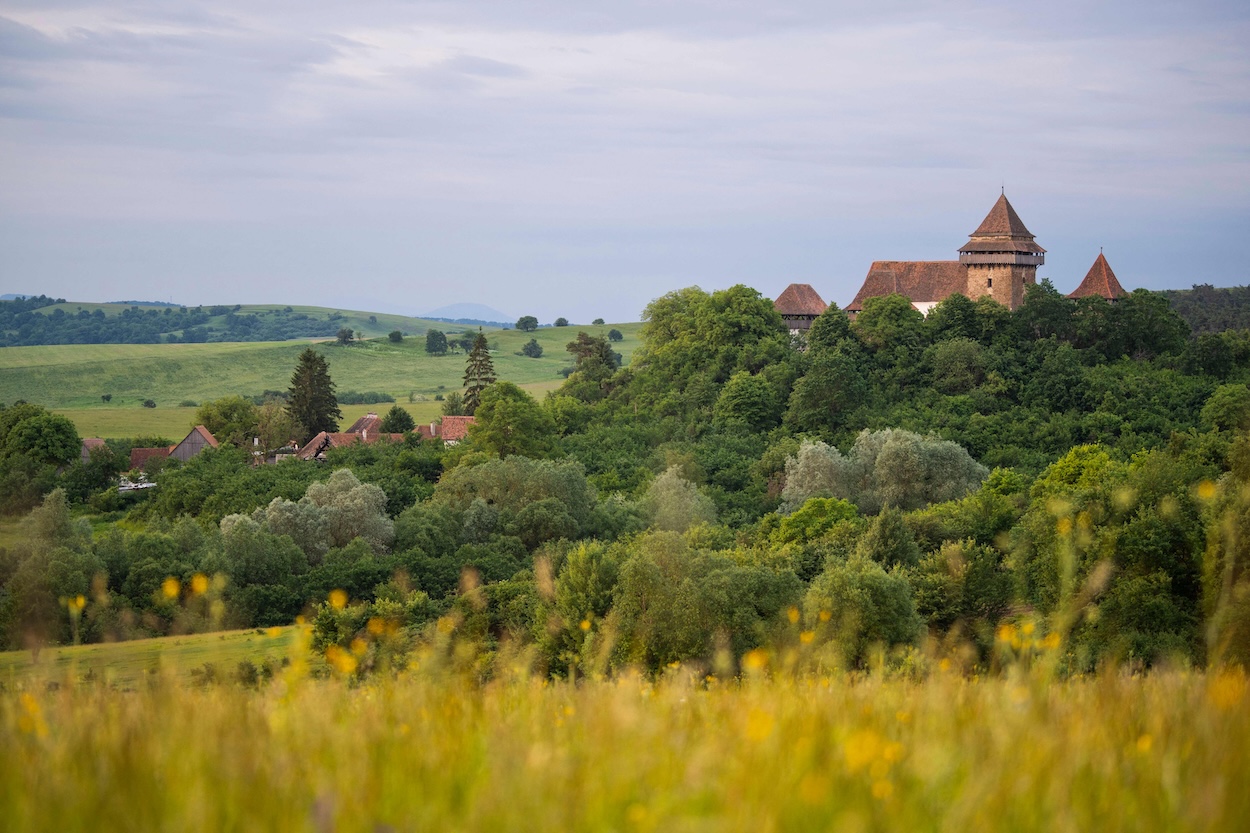
The fortified church in Viscri, near the King’s estate (Getty)
We hit downtown Zalánpatak at rush hour, and it was gridlocked. True, you get used to livestock on Romanian roads; the 30-minute gravel zig-zag from the nearest main road had brought us up against stray dogs, horses and carts and free-range pigs. A shepherd huddled near the roadside in a sheepskin poncho – crook in one hand, iPhone in the other. But it’s when you’re sitting immobile on a village street with a herd of cows pushing past on either side – when you feel the vehicle rock as bovine flank thwacks against the car door – that you start to grasp why King Charles III might have a bit of a soft spot for the place.
By Richard Bratby
First Published in The Spectator
You start to grasp why King Charles III might have a bit of a soft spot for the place
I mean, it’d take a very determined paparazzo to make it this far, and they’d still have to contend with the language. Charles’s love for this Hungarian-speaking region of Transylvania is no great secret. ‘Fang Club: Inside the dusty Dracula village where King Charles has been secretly holidaying for 25 years’ blurted the Sun – the tone of surprise (like the reference to Dracula) seems obligatory. But if you’re a Briton visiting Romania – and particularly if, like me, you’re the kind who longs to vanish inside the books of Miklos Banffy or Patrick Leigh-Fermor – you soon discover that His Majesty is one step ahead of you.
His portrait hangs in a restaurant in Sighisoara. ‘Is he on your banknotes yet?’ asks an Uber driver in Bucharest. In 2022 we’d stayed, unwittingly, at another of HM’s Romanian pads, a guest house in the nearby village of Miclosoara, and had been regaled with under-the-counter palinka and tales of the latest royal visit. ‘Where you’re sitting, I roasted a Mangalica hog for him last May,’ said the young man who runs the place on behalf of Count Kálnoky, who manages the King’s Transylvanian properties. ‘Do you think he’ll be able to come again now he is King?’ he asked, anxiously.
By all accounts, the answer has been yes, but the King’s retreat at Zalánpatak (population: 110) is open to paying guests regardless, at least when he’s not in residence. Once you’ve juddered along that gravel road, crawled past the straggle of pastel-coloured cottages and waited for the cows to go home, it’s the last homestead on your left: a big wooden gate with an iron bell-pull. The road continues over the hills and the booking email from the Count’s agent urges you not to drive it ‘even if Google Maps says so’, a warning that anyone familiar with Romanian country roads will take very seriously indeed.
Within the gate there’s an orchard and a cluster of wooden-framed cottages. There are no signs, no reception desk: just a blue-washed farmhouse with a stone fireplace and the Prince of Wales’s feathers painted on the gable. The King’s cottage is at the top of a grassy courtyard but our room was further down the hill, described, slightly disarmingly, as the ‘serf’s house’. Oh well, we’re both journos. We’ve been called worse. The door-frames had been padded with leather, 19th-century Transylvanian farmhands, presumably, being quite a bit shorter than your typical 21st-century monarch.
Still, what joy after a long journey (and there’s no quick route to Zalánpatak) to find an electric kettle, tea cups and real British tea-bags. None of those yellow Lipton abominations for HM; he knows how to make his subjects feel at home. Guests dine together (boar goulash and plum brandy). One, an American lady who’d stumbled across the place on a hotel booking website, was astonished by how basic it all was. Unfamiliar with the habits of the British aristocracy (or the traditions of Gordonstoun), she’d expected that a royal residence must, by its nature, be palatial.
But woodsmoke and palinka take the edge off most things, and the Count’s people can organise all sorts of rural activities – mostly involving horses, though they do have a hot tub (ask in advance: it’s wood-fired and takes a while to warm up). As with any homestay, there’s a fascination in nosing about and trying to piece together the owner’s private tastes and foibles. That watercolour… it isn’t one of his, is it? Did HM choose the board games in the living room? (Articulate looked quite well-used). A big, well-worn armchair faces a dormer window with a view over the valley. It seemed presumptuous to sit in it, and apparently only one person ever has. The King likes to read there.
And then… well, that’s it, really. The isolation is the whole point. There’s no television and only patchy internet. The trade-off is silence; real silence, of the kind almost unobtainable in the UK, with not a single motor vehicle audible and only the jangle of cowbells to break the quiet. For an urbanite – even one with an impossibly romantic view of old Europe – it was slightly disconcerting. Late at night, the cottage door rattled in the breeze. Transylvanians don’t buy the fictionalised, Bram Stoker version of their home that obsesses English-speaking visitors, though that hadn’t prevented them from nailing a crucifix just above the bed.
Wolves, though? And bears? We’re in the foothills of the Carpathians; the place is teeming with predators. We’d seen two bears on the drive over – each the size of a St Bernard, and staring at the passing cars with the assurance that comes from being Europe’s top carnivore. Locals were taking selfies with the smaller bear, which seemed ill-advised. But in the midnight stillness at Zalánpatak I did start to wonder just how solid the wooden doors really were. Could we be certain that there wasn’t any honey in the room? What if the bears simply wanted a decent cup of builders’ tea?
Best not to overthink it. The locals have lived with the local fauna for centuries and that palinka braces a fellow marvellously. But in a spot like this, a little enchantment goes a very long way. You can understand why a man who has spent his whole life in the public gaze would want to drink deeply from that slow, healing silence. We, on the other hand, had options that aren’t open to a monarch. Craving urban civilisation, we headed for the Ramada in Sibiu: cafés to try, bookshops and galleries to browse and at the end of each day, crisp sheets, satellite TV and sterile, faceless, blissful anonymity. That’s a luxury that our King – God bless him – can never enjoy.
 Patrick Leigh Fermor