
Tag Archives: Slightly Foxed

Studying to be quiet

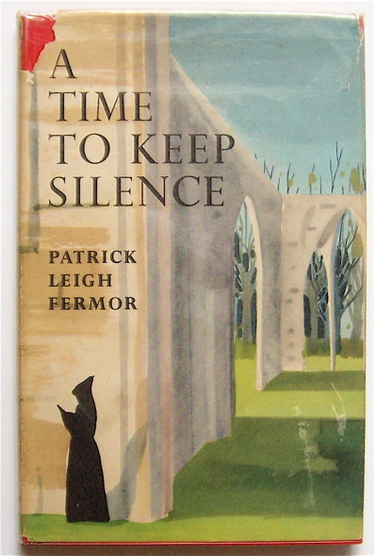
The lovely people at Slightly Foxed sent me this article which is usually behind their paywall suggesting that I might publish it so that you can all enjoy it. In their most recent issue of the quarterly magazine, they featured an article by Guy Stagg on Patrick Leigh Fermor’s A Time to Keep Silence.

If you have not already heard of Slightly Foxed, they are an independent literary magazine (now celebrating their twentieth year!) with a wide range of contributors who write personal and lively book recommendations. They also publish a collectable series of pocket-sized reprints of memoirs and biographies, a series of wonderful children’s classics, and produce a highly acclaimed literary podcast, hosted by Rosie Goldsmith which we have featured on the blog before. The first was an interview with Dashing for the Post editor Adam Sisman, and in the second, Artemis Cooper, Paddy’s biographer, and Nick Hunt, author of Walking the Woods and the Water, joined the Slightly Foxed team to explore the life and literary work of Patrick Leigh Fermor.

By Guy Stagg

First published in Foxed Quarterly

Midway through my twenties, I spent the best part of a year walking across Europe. Often I passed the night with monks, nuns or religious communities, arriving on their doorstep to ask for shelter. I was always grateful for the kindness they showed me, and curious about the quiet dedication of their lives, withdrawing from the world to devote themselves to prayer.

Patrick Leigh Fermor’s famous account of his walk across Europe had inspired my trip, but on returning home I began to read a less well-known book of his, A Time to Keep Silence (1957). It’s a slim volume, less than a hundred pages long and comprising three essays that started life as letters to his partner, Joan Rayner. The letters describe a series of monasteries he visited in the decade after the war: the first a retreat at St Wandrille de Fontanelle, a Benedictine abbey in Normandy; the second moving from the Abbey of Solesmes – another Benedictine foundation – to La Grande Trappe, the mother-house of the Trappist order; and the third featuring the abandoned monasteries of Cappadocia, in Turkey, once occupied by the region’s Greek Orthodox monks.

Leigh Fermor was no believer. He went to the first of these monasteries seeking a quiet place to work, away from the temptations of Paris. In fact, he was a little embarrassed by his lack of faith and relieved that nobody ever questioned his reasons for coming.

However, he was profoundly affected by the monasteries he visited and made several more retreats over the course of his life. That mixture of admiration and bewilderment is what gives these essays their particular charm and interest.

It has to be admitted that his first impressions were less than positive. Soon after arriving at St Wandrille, ‘It began to rain over the woods outside, and a mood of depression and of unspeakable loneliness suddenly felled me like a hammer-stroke.’ Then came lassitude:

‘I had a sensation of the temperature of life falling to zero, the blood running every second thinner and slower as if the heart might in the end imperceptibly stop beating.’ Next came exhaustion: ‘After initial spells of insomnia, nightmare and falling asleep by day, I found that my capacity for sleep was becoming more and more remarkable: till the hours I spent in or on my bed vastly outnumbered the hours I spent awake; and my sleep was so profound that I might have been under the influence of some hypnotic drug.’

When at last he emerges from this cataleptic state, he experiences ‘nineteen hours a day of absolute and god-like freedom’.

This sequence will be familiar to anyone who has stayed for more than a few days in a monastery, and now, in an age of mobile phones, the effect is even more pronounced: a retreat often serves as a digital detox. To begin with, the lack of distraction causes boredom, despondency and fatigue, but then the visitor gets used to an enforced disconnection and finds an abundant sense of calm.

Though Leigh Fermor adjusts to the monastic timetable, he’s still struck by the strangeness of the place. After all, in a religious community most of the motives and ambitions we take for granted in society are either suspended or inverted.

Only by living for a while in a monastery can one quite grasp its staggering difference from the ordinary life that we lead. The two ways of life do not share a single attribute; and the thoughts, ambitions, sounds, light, time and mood that surround the inhabitants of a cloister are not only unlike anything to which one is accustomed, but in some curious way, seem its exact reverse.

When he travels to La Grande Trappe, that strangeness only intensifies. He describes how the Trappists spend their lives in silence, praying in church seven hours a day and labouring in the fields the rest of the time, with no opportunity for relaxation or study. In his own freezing cell, a sheet of paper pinned to the wall lists three columns of priestly attributes. One column ends with the words: Plus on est mort, plus on a la vie. Another concludes: Le prêtre est un homme crucifié.

However, Leigh Fermor is still able to imagine his way into this dismal calling. As he explains, while Benedictines spend their days in prayer to make up for those who cannot pray, providing a kind of spiritual windfall, the Trappists take this one step further, performing vicarious penance to lessen the whole world’s burden of sin. And the result of all this mortification is not sadness but a surprising serenity:

‘the lightness, the spiritual buoyancy, the experience of liberty regained by the shedding of all earthly possessions and vanities and ambitions’.

By the end of his stay, the Trappist calling remains a mystery but no longer seems a madness. Leigh Fermor is conscious of the romantic expectations he brings with him on retreat, and of how the nineteenth-century restoration of monastic life encouraged this romance. So he’s amused by the ‘baronial chimneypieces and heavy Norse vaults’ in the refectory at Solesmes, and the rumour that the refectory of a German-speaking Trappist abbey contains a painted skeleton holding a scythe, with the motto ‘Tonight perhaps?’ inscribed on the wall above. At the same time, he’s sensitive to the beauty of monastic architecture and the ancient routines taking place among the cloisters.

That beauty seeps into his prose. Critics of Leigh Fermor argue that his style is too Baroque, too indulgent, but here his language has been tempered by the austerity of his surroundings. As a result, the
occasional lyricism is much more enjoyable:

As it declined, the sun beat the grey Norman stone into thin edifices of gold; and, when dusk had swallowed them up, the buildings of the monastery were pierced by many gleaming windows – oblong and classical, Norman and rounded, or high tangles of Gothic tracery – as the Abbey prepared itself for the night.

By contrast, when he visits the rock monasteries of Cappadocia, that lyricism becomes elegiac. Little is known about the inhabitants of these foundations – when the churches and cells were built, who lived in them and why they were abandoned – but the sparseness of their settlements provides a corrective to the medieval fantasia he encountered in Western monasticism.

Remote and unstirring and unproblematical as they may appear, these outlandish places are far closer to the primitive beginnings of monasticism than the dim northern silence and the claustral penumbra which the thought of monasteries most readily conjures up. The scenery of early Christendom lay all around us.

Leigh Fermor led a fascinating life, but his books often read as if he’s trying to dazzle: all those erudite references, all those elaborate metaphors, the endless parade of aristocratic friends. In A Time to Keep Silence, he has absorbed something from monastic humility, desiring less to impress the reader than to understand the subject. As a result, it’s the book of his I most like to reread, returning to the stillness he found in these sacred places, and the ‘message of tranquillity to quieten the mind and compose the spirit’.

In the months after the pandemic, I visited Solesmes myself and found the plain church, the romantic refectory and the glorious Gregorian chant exactly as Leigh Fermor described them. Of course, that’s the point of monastic life: to be a still point in a turning world.

During the author’s stay the community numbered over a hundred members, but now that number has dwindled to forty. In the decade or so after the war, monastic life enjoyed a brief boom in popularity, with numerous former servicemen taking their vows. Several of the monks Leigh Fermor met during his stay had followed this trajectory – one English Trappist had been shot down in his bomber and had spent time in a German prisoner-of-war camp – but the 1960s brought an end to the trend. Instead, spiritual seekers turned to Eastern and New Age traditions, or else the growing number of counter-cultural communities.

In a coda to these essays, Leigh Fermor laments the British monasteries lost during the Reformation, but he also celebrates the newfoundations established in the nineteenth and twentieth centuries to revive the monastic tradition in Britain. Most of those foundations remain intact but, as with La Trappe and Solesmes, their communities are ageing and their numbers shrinking. Of course, this simply reflects the wider state of Christianity in Western Europe, but it means that Leigh Fermor’s hopeful tone about the future of monasticism looks misplaced. Whereas suppression was once the main risk to religious life, nowadays apathy is a much greater threat. What’s more, the sacrifices of the monastic calling seem even harder to understand in an age bent on personal freedom and self-fulfilment.

These deep and delicate essays teach us to appreciate how much we have lost.

GUY STAGG is currently writing a book about the role of retreat in the lives of
various philosophers, writers and artists.

Patrick Leigh Fermor: An Adventure – Slightly Foxed Podcast

Slightly Foxed produce the most beautiful books, and run a quarterly podcast which we have featured before. This one features Artemis Cooper and Nick Hunt discussing all things Paddy. Something to listen to in bed on a Sunday morning perhaps.

You can listen to the podcast on the Slightly Foxed site here or below.

Artemis Cooper, Paddy’s biographer, and Nick Hunt, author of Walking the Woods and the Water, join the Slightly Foxed team to explore the life and literary work of Patrick Leigh Fermor.

Equipped with a gift for languages, a love of Byron and a rucksack full of notebooks, in December 1933 Paddy set off on foot to follow the course of the Rhine and the Danube, walking hundreds of miles. Years later he recorded much of the journey in A Time of Gifts and Between the Woods and the Water. In these books Baroque architecture and noble bloodlines abound, but adventure is at the heart of his writing. There was to have been a third volume, but for years Paddy struggled with it. Only after his death were Artemis and Colin Thubron able to see The Broken Road into print.

The trilogy inspired Nick Hunt to follow in Paddy’s footsteps. What were country lanes are now highways, and many names have changed, but Nick found places that Paddy had visited, with their echoes of times past.

Following discussions of a love affair with a Romanian princess, Paddy’s role in the Cretan resistance in the Second World War and Caribbean volcanoes in The Violins of Saint-Jacques, we turn our focus to his books on the Greek regions of Roumeli and the Mani, and the beautiful house that Paddy and his wife Joan built in the latter, Kardamyli. And via our reading recommendations we travel from Calcutta to Kabul In a Land Far from Home, to William Trevor’s Ireland and to Cal Flynn’s Islands of Abandonment.

Slightly Foxed Podcast – Dashing for the Post editor Adam Sisman

Adam Sisman

I do look forward to the emails I receive from Slightly Foxed, the specialist London-based publisher of fine reproduction books. They are always upbeat and inclusive. Their publications are varied but always popular. I have started to collect some of their children’s books for my grandchildren!

Earlier in 2019 they started a podcast which I highlighted back in June. Episode 6 includes an interview with Adam Sisman, who edited Dashing for the Post: Selected Letters of Patrick Leigh Fermor (2016) and More Dashing: Further Letters of Patrick Leigh Fermor (2018). Unfortunately the interview is not about his Paddy work, but I thought that you might like to hear Adam speak!

Listen to the podcast here.

Leave thy home, O youth, and seek out alien shores . . . Robert Macfarlane reads Petronius

One of the first things Patrick Leigh Fermor is given in A Time of Gifts is a book: the first volume of the Loeb edition of Horace. His mother (‘she was an enormous reader’) bought it for him as a farewell present, and on its flyleaf she wrote the prose translation of an exquisite short poem by Petronius, which could hardly have been more appropriate as a valediction to her son, or indeed to anyone setting out on a voyage into adulthood:

Leave thy home, O youth, and seek out alien shores . . . Yield not to misfortune: the far-off Danube shall know thee, the cold North-wind and the untroubled kingdom of Canopus and the men who gaze on the new birth of Phoebus or upon his setting

The journey of A Time of Gifts is set going by the gift of a book—and it is a book that has in turn set going many journeys. The edition of A Time of Gifts that Don gave me that day in Cambridge had as its cover a beautiful painting by John Craxton, commissioned specially for the book, and clearly alluding to Petronius’s poem. It shows a young man standing on snowy high ground, puttees on his ankles and a walking stick in his right hand, looking eastwards to where the sun is rising orange over icy mountains, from which runs a mighty river. Black crows fly stark against white trees: there is a sense of huge possibility to the day ahead and to the land beyond.

Extract from The Gifts of Reading , Robert Macfarlane. First published in Slightly Foxed Quarterly. Continue reading

A Great Adventure

‘When I first read A Time of Gifts I felt it in my feet. It spoke to my soles. It rang with what in German is called Sehnsucht: a yearning or wistful longing for the unknown and the mysterious. It made me want to stand up and march out – to walk into an adventure.’ Robert Macfarlane

Andrew Merrills finds himself betwixt the woods and the water in this charming piece from Slightly Foxed Issue 38.

by Andrew Merrils

Few people living at the time would have regarded the early Thirties as a golden age, nor has posterity been kind to the period that W. H. Auden described as ‘a low, dishonest decade’. In 1933, the Japanese invaded Manchuria, Hitler became Chancellor of the Reich, and the first stirrings of the Spanish Civil War were felt in Catalonia. While hindsight bathes 1914 in the gentle summer glow of a prelapsarian world, the early Thirties seem autumnal and telescope all too easily into the bitter winter that was to follow. But for one man at least, the cold months of 1933–4 provided a still moment in time, which he would remember with fondness for the rest of his life.

In late December 1933, Patrick Leigh Fermor set out on foot for Constantinople (as he anachronistically termed it). Recently expelled from school for the unpardonable crime of holding hands with a local girl, and insufficiently inspired by the prospect of Sandhurst and a career of peacetime soldiering, the 19-year-old decided to head east on foot. His backpack was evidently stuffed to the brim, with a greatcoat, jerseys, shirts (including white linen ones for dressy occasions), puttees, nailed boots, a selection of stationery, a copy of The Oxford Book of English Verse and the first volume of the Loeb Horace. The clothing was soon lost but was replaced as he headed east by many generous donations from hosts and chance acquaintances. The literary ture was a more permanent part of his baggage; though he lost his Oxford volume, this was complemented by a vast corpus of writing in English, French and Latin that he had committed to memory. A little over a year later, the young traveller arrived at the Golden Horn.

Writing the account of the journey would take much longer. The first of three projected volumes, A Time of Gifts, was published in 1977, when the author was 62; the second, Between the Woods and the Water, which traces the journey from the Hungarian frontier (where the first leaves off) to the Iron Gates in Romania, came in 1982. The third book remained unfinished at the time of the author’s death in 2011.

Between the long adventure itself and its eventual publication, Patrick Leigh Fermor had led an improbably rich and full life. He was famous for his wartime heroism in occupied Crete, where he lived as a shepherd among the resistance fighters in the mountains and masterminded the daring abduction of the German garrison commander. These actions were commemorated in the memoir Ill Met by Moonlight by his colleague Sandy [sic] Moss, and his own role was played by Dirk Bogarde in the 1957 Powell and Pressburger film of the same title. In the decades that followed, Leigh Fermor produced some of the finest travel writing in English. His published books included a seminal study of the Caribbean in The Traveller’s Tree, a reflection on the monastic life in A Time to Keep Silence, and two remarkable books on Greece, Mani and Roumeli.

Much has been written about him since his death, and each of his books has its own admirers. But for those new to his writing, there is no better place to start than with A Time of Gifts and Between the Woods and the Water, as an introduction both to the young man on the brink of a great adventure, and the mature writer at the height of his powers. While both shine through in these two books, it is the former who strikes the reader most forcibly. Almost immediately, we are confronted with the extraordinary personality of the young man who wanders across their pages, and it is easy to imagine how this spirit must have charmed and delighted those with whom he came into contact.

His was a well-populated road, from the two German girls in Stuttgart who swept the young ‘Mr Brown’ into an exhilarating tumble of drinking, singing and Christmas parties, to the lugubrious Frisian in Vienna who shared his poverty and some ingenious schemes for generating money before disappearing into the murky world of saccharine-smuggling on the Middle Danube. And these are some of his less remarkable social successes. By the time he reached Mitteleuropa proper, Leigh Fermor had become the darling of the fading imperial aristocracy. We read of raucous games of bicycle polo on the lawns of castles, of horses borrowed for a few days’ ride across the Great Hungarian Plain, and a seemingly endless succession of benevolent Anglophiles who welcomed the dusty young traveller with food, alcohol and the free run of their libraries.

Even if we sometimes feel a tinge of envy at the ease with which the young Patrick drifted into this travellers’ inheritance, it is hard to begrudge him it: the same easy charms that won over the inhabitants of central Europe in the 1930s can still delight a reader eighty years later.

Leigh Fermor has always been loved for the richness of his prose, and both books do full justice to the deep romantic undercurrents of the rivers along which he was travelling. Yet even in his most purple passages, he has a peculiarly literary sensitivity; he writes, not as a traveller in uncharted lands, but as one who is acutely aware of the many writers who have come before him. Nor is this simply the prerogative of the adult writer, usurping the fresh observations of youth with his own literary stylizations. The wide-eyed observer at centre stage also views the world through the lens of his reading. Take this account of Wachau in A Time of Gifts:

Melk was the threshold of this unspeakably beautiful valley. As we have seen by now, castles beyond counting had been looming along the river. They were perched on dizzier spurs here, more dramatic in decay and more mysteriously cobwebbed with fable. The towered headlands dropped sheer, the liquid arcs flowed round them in semicircles. From ruins further from the shore the land sloped more gently, and vineyards and orchards descended in layers to the tree-reflecting banks. The river streamed past wooded islands and when I gazed either way, the seeming water-staircase climbed into the distance. Its associations with the Niebelungenlied are close, but later mythology haunts it. If any landscape is the meeting place of chivalrous romance and fairy tales, it is this. The stream winds into distances where Camelot or Avalon might lie, the woods suggest mythical fauna, the songs of Minnesingers and the sound of horns just out of earshot.

If anyone was attuned to the mythic properties of Old Europe it was the knight errant of 1934. Leigh Fermor gazed at the unfolding landscape with a romantic longing inflamed by a short life stuffed with literature and history. When he passed through the Low Countries, he looked through Bruegel’s eyes; his view of Vienna was a palimpsest of Ottoman armies and Habsburg emperors, against which the complex realities of the mid-1930s were not always visible to him. And when not prompted into reverie by the landscapes around him, he turned inward to the rich body of literature that he had committed to memory. The list of these works is among the most famous passages of Leigh Fermor’s writing. I won’t cite it in full here, since it runs to several pages, but it includes (among many other things) Shakespeare, Spenser, Keats, ‘an abundance of A. E. Housman’, the Sitwells, Norman Douglas and Evelyn Waugh, ‘large quantities of Villon’, and a respectable body of Virgil, Horace, Catullus and Lucan.If a love of literature brightened the colours of Leigh Fermor’s world, it also created a deeper yearning, and this is perhaps his most appealing trait, at least to me. Time and again, he writes of the fervour with which he engaged in spirited conversation with his learned hosts or plunged himself into their well-furnished libraries. Here, he gulped great draughts of European history, poring over details of Germanic folklore or piecing together the complex literary heritage of the world through which he was passing, and which was soon to be lost forever. In recounting these moments, his prose reaches its sublime best, as when he talks about the libraries of Prague:

Where, in this half-recollected maze, do the reviving memories of the libraries belong? To the Old University, perhaps, one of the most ancient and famous in Europe, founded by the great King Charles IV in 1384. I’m not sure. But I drive wedge-shaped salients into oblivion nevertheless and follow them through the recoiling mists with enfilading perspectives of books until bay after bay coheres. Each of them is tiered with burnished leather bindings and gold and scarlet gleam on the spines of hazel and chestnut and pale vellum. Globes space out the chessboard floors. There are glass-topped homes for incunables. Triangular lecterns display graduals and antiphonals and Books of Hours and coloured scenes encrust the capitals on the buckled parchment; block-notes and lozenges climb and fall on four-letter Georgian staves where Carolingian uncials and blackletter spell out the responses. The concerted spin of a score of barley-sugar pillars uphold elliptic galleries where brass combines with polished oak, and obelisks and pineapples alternate on the balustrades.

The conceit which underscores this passage – the image of memory as a library – is a key theme throughout both books. Not only does this recall the prodigious literary memory of the young man, it also reminds us of the act of memory that went into the composition of the books themselves. While A Time of Gifts and Between the Woods and the Water do an exquisite job in representing the world through the eyes of a 19-year-old, the reader never forgets the mature writer who acts as mediator and amanuensis. For the successful travel writer, war hero and beloved raconteur who wrote these books, these are stories of a half-remembered youth as well as a half-forgotten Europe.‘For now the time of gifts is gone’ runs the line from Louis MacNeice that provides Leigh Fermor’s first title, and it is this faint melancholy which makes both books so powerful. These are the memories of a lifetime, and in writing them down, in revisiting the notebooks and the maps that had lain untouched for years, the writer creates them anew. Nowhere is this more apparent than in the conclusion to the most intimate episode of the sequence. For a giddy chapter, the traveller had careered around Transylvania in a car with his close friend István, and with Angéla, something of a kindred spirit. The reader is caught up in the breathless pleasure of the episode, which climaxes in a manic motor chase with a west-bound train, but which deflates as the companions consider their parting:

The reader may think that I am lingering too long over these pages. I think so too, and I know why: when we reached our destination in an hour or two, we would have come full cycle. It wasn’t only an architectural world, but the whole sequence of these enchanted Transylvanian months that would come to a stop. I was about to turn south, away from all my friends, and the dactylic ring of Magyar would die away. Then there was István; I would miss him bitterly; and the loss of Angéla – who is little more than a darting luminous phantom in these pages – would be a break I could hardly bear to think of; and I can’t help putting off the moment for a paragraph or two.

Everyone has their favourite sections of these extraordinary books, whether they are drinking songs in snow-bound Germany, the majestic descriptions of pre-war Vienna, or the madcap charabanc rides through Transylvania. Mine comes at the beginning of the narrative. The account of the Groote Kirk in Rotterdam isn’t as succulent as some of the richer morsels later on – the young traveller had only just entered the continent, and both he and his older self were keen to get on. But it captures the themes of the book perfectly:

Filled with dim early morning light, the concavity of grey masonry and whitewash joined in pointed arches high overhead and the floor diminished along the nave in a chessboard of black and white flagstones. So compellingly did the vision tally with a score of half-forgotten Dutch pictures that my mind’s eye instantaneously furnished the void with those seventeenth century groups which should have been sitting or strolling there: burghers with pointed corn-coloured beards – and impious spaniels that refused to stay outside – conferring gravely with their wives and children, still as chessmen, in black broadcloth and identical honeycomb ruffs under the tremendous hatchmented pillars. Except for this church, the beautiful city was to be bombed to fragments a few years later. I would have lingered, had I known.

‘I would have lingered, had I known’: these are books for readers, for poets and for travellers. But most of all, they’re books for lingerers.

Adventures for Harriet – A literary hike along Paddy’s route in memory of Harriet Clarke

As those who correspond with me know, I can be very slow to follow-up on the messages and suggestions that so many of you send me, but on the whole I do tend to catch-up eventually. Jennie Harrison Bunning, who is in charge of Marketing and Publicity at the always brilliant Slightly Foxed – a quarterly magazine for book-lovers who don’t feel entirely at home in the here-today-and-gone-tomorrow world of overnight publishing sensations and over-hyped new books – got in touch just one month ago to tell me about a great cause that they are supporting, and as it is Paddy (and Nick Hunt) related, I’m happy to bring it to your attention, and to ask for your support.

Jennie wrote:

Dear Tom

Congratulations on your very good website pertaining to all things PLF! It’s a brilliant tribute, and filled with really useful and interesting content.

I’m writing to let you know about an upcoming Paddy-related adventure that I hope you’ll find of interest. On 1 May 2017 Katy Macmillan-Scott is embarking on a 600-mile journey by foot across Europe, in memory of her best friend Harriet Clarke and to raise awareness for Never Too Young, Bowel Cancer UK’s campaign for the under 50s. Her route will follow the first leg of Paddy’s 1933 journey, from the Hook of Holland to Budapest.

We all very much enjoyed Nick Hunt’s book about his experience of walking in Paddy’s footsteps and I believe Katy has been in touch with Nick who’s been encouraging. It’s the same trip but will perhaps be rather different through the eyes of a ‘lady adventurer’, as such! You can find out more about her walk here: https://www.adventuresforharriet.co.uk/

At Slightly Foxed we’re going to be supporting Katy by donating proceeds from book sales, and by sharing news of her journey through our news and social media channels. She’s an incredibly inspiring young woman and has already almost doubled her fund-raising goal of £1000, which is brilliant.

Just to give you a quick overview of what we’re doing.

· We’re donating 10% of the sale price of all books listed on our online shop here: https://foxedquarterly.com/products/adventures-for-harriet-a-literary-hike-from-rotterdam-to-istanbul/

· On Friday 24 March we ran this full-length article on A Time of Gifts in our newsletter to subscribers

· While Katy is away (1 – 20 May) we’re going to be sharing a daily extract from A Time of Gifts and other books, interspersed with Katy’s diary entries, original archive images and photos from her trip, on our blog and through social media channels.

· We’ll be using the tag #adventuresforharriet and #literaryadventure (among others) and will start to post fairly regularly from now on. Our Instagram and Twitter handles are @FoxedQuarterly and we’re on Facebook here: https://www.facebook.com/FoxedQuarterly/

Would there be an opportunity in an upcoming newsletter for you to share news of Katy’s adventure with your subscribers? And might you be able to share news in any other way, or temporarily encourage sales of the books though our channels to raise more money? We’d be happy to supply Andrew Merrills’s article for you to use.

It would be wonderful if we could coordinate efforts to help raise awareness of Katy’s walk, and bring a new generation of readers to the great PLF at the same time.

I hope to hear from you soon.

With all good wishes

Jennie

Clearly the issue of cancer is one that offers a challenge to us all, but the fact that Harriet could die from bowel cancer at the very young age of just 32 is a great tragedy. Read more on Katy’s website or donate directly via her Just Giving site here. I hope to keep you updated over the coming weeks.