Category Archives: Paddy’s Friends

One Man’s Great Game: Lieutenant Colonel “Billy” McLean

When you get involved with the life and times of Patrick Leigh Fermor, you find all sorts of possible avenues to explore. One group I am trying to bring together on the blog are the occupants of Tara in Cairo during the war. Given my interest in the Balkans, Albania in particular, I followed the route of “Billy” McLean and the British Military Missions to Yugoslavia and Albania which were manned by SOE men. Billy was an occupant of Tara and Xan Fielding wrote his biography. Of course Paddy was there as well.

In the course of my investigations I have read, in the last few weeks, the book Eastern Approaches by Fitzroy MacLean who as a very young Brigadier was personally chosen by Churchill to lead the mission to Tito’s partisans, and Billy McLean’s biography – One Man in His Time. Both books are interesting and I will review them if I have time. I have to say I was a little disappointed in Xan’s writing style, but it is workmanlike and is probably an accurate portrayal.

Billy McLean’s life is absolutely fascinating. He was a real adventurer and never stopped his adventures or travel until he died in 1986. I have dug out his obituary from the Daily Telegraph Second Book of Obituaries – Heroes and Adventurers, and as I did before with Xan Fielding’s obit, I have retyped it word for word as I cannot find an online version.

Go on, explore your own Paddy related avenue, and maybe write to me and we can publish for others to hear about!

First published in the Daily Telegraph, 20 November 1986.

Lieutenant Colonel “Billy” McLean, who has died aged 67, spent 40 years playing his own version of the Great Game. Like some latter-day knight errant, he travelled tirelessly in the Muslim world, working always against the encroaching influence of the Soviet Union, while at the same time seeking adventure among tribal peoples.

McLean’s unusual life often had elements of intrigue that no one else could unravel. “What is Billy really up to?” was a question that would be asked at the bar of White’s Club as he set off on another trip to Jordan or Iran, Morocco or the Yemen.

In McLean’s character there were shades of Buchan and Lawrence and Thesiger. All seemed to coalesce in the Yemen, where from five years, from 1962, McLean helped the royalists under Iman al-Badr to resist President Nassar’s attempts to take over the country. He made numerous reconnaissances in the Yemen desert and many arduous journeys, by camel and on foot, to the royalist forces in their remote mountain strongholds.

It was entirely due to McLean that Britain never followed America in recognising Nassar’s, and the Soviet Union’s, puppet republican government in the Yemen; and it was he who persuaded the Saudis to increase their aid to the Iman’s forces. Thanks also to McLean, the royalists received Western mercenary support and arms from the RAF. Largely as a result of McLean’s efforts, North Yemen did not become one of Nassar’s fiefdoms and did not join its neighbour South Yemen (Aden) in the Communist camp.

Neil Loudon Desmond McLean was born on November 28 1918, a direct descendent of “Gillean of the Battle-Axe”, known in Argyll in the 13th century.

After Eton and Sandhurst (where he rode several winners in point-to-points), McLean was commissioned into the Royal Scots Greys and sent to Palestine [prior to the war] in 1939.

At the end of the following year he went to occupied Abyssinia [Ed: Ethiopia] where he proved himself an outstanding guerrilla leader, as part of Orde Wingate’s Gideon Force. He led a force of Eritrean and Abyssinian irregulars – known as “McLean’s Foot” – against the Italians near Gondar.

His burgeoning career as an irregular soldier continued in Special Operations Executive; in 1943 he led a five man military mission to Albania, to co-ordinate resistance to the Axis powers. Peter Kemp (qv) described his first meeting with McLean when he parachuted into Albania to join the mission: “Approaching up the hill with long, easy strides came a tall figure in jodhpurs and a wide crimson cummerbund, a young man with long fair hair brushed back from a broad forehead and wearing a major’s crown on the shoulder straps of his open-necked army shirt.”

With one break, McLean remained in Albania until the German retreat from that country and inspired those under him with his military skill and courage. He was promoted to lieutenant-colonel at the age of 24.

His contacts with the Albanian communist leader Enver Hoxha turned sour when the left-wing elements of SOE favoured the partisans at the expense of the Zogist faction led by Abas Kupi, which McLean supported against charges of collaboration with the Germans.

In 1945 he volunteered for SOE duties in the Far East, where he became military adviser in Kashgar, Chinese Turkistan. Here he learnt the ways of the Turkis, Uzbeks, Kazaks, Tajiks and Tartars, who were under threat of domination by the Soviet Union, and travelled extensively in Asia. McLean’s fascination and sympathy with Muslim minorities and tribal peoples would continue for the rest of his life. He devoted much of his time to the cause of the Pathans and the Kurds, as well as the royalist Yemenis.

After the war he sought election to Parliament, twice unsuccessfully for the Preston South constituency, in 1950 and 1951. He became Conservative MP for Inverness in 1954, and held the seat until the 1964 general election.

As a Highlander himself, McLean was able to identify with the Celtic character of his constituents. But they could not be expected to appreciate the reasons for his long absences on the Middle East.

While he was an MP, and afterwards, McLean was, as described by a colleague, “a sort of unpaid under-secretary for the Foreign Office”. His political contacts in the Muslim world were probably unique among Westerners, in particular his relationship with King Saud during the Yemen war and his personal friendship with King Hussein over many years. In the mid-1960’s he was involved in an unsuccessful attempt to “spring” a revolutionary leader from jail in Algeria [Ed: using a yacht and accompanied by King Leka of the Albanians who fancied coming along for the ride. The attempt was foiled by the CIA who wanted the ‘kudos’ of freeing the man, which they did some months later].

McLean was always passionate in defence of British interests, as he saw them, which did not always accord with the Government’s view. In his later years, still pursuing those interests he visited Somalia, Iran, Western Sahara, the Pakistan-Afghanistan border, China, Israel, Turkey and Jordan.

In 1979 Harold Macmillan wrote to McLean: “You are one of those people whose services to our dear country are known only to a few.”

By his many friends and admirers he will be remembered as possibly the last of the paladins. While his role may not always have been appreciated in Britain, his independence and total integrity were recognised n all the countries where his influence was felt.

Alongside his flair for guerrilla fighting, he had a passion for secret enterprises, deep-laid schemes, and political complexities. He combined acute political understanding with military gifts ideally suited to irregular warfare.

His comrade-in-arms in Albania and the Yemen, David Smiley, has written of McLean: “His charming character seemed languid and nonchalant to the point of idleness, but underneath this façade he was unusually brave, physically tough and extremely intelligent, with a quick, active and unconventional mind.”

His wisdom, sense of humour, human curiosity and kindness endeared him to a wide circle of contemporary friends and younger people, who saw his values as ones they could respect without sentimentality or danger of being considered old-fashioned. He revelled in argument and banter, and was always interested in the opinions of the younger generation.

McLean was both a keen shot and underwater fisherman: one of his great pleasures was to spear moray eels off the coast of Majorca. He was very partial to Middle Eastern and Chinese cooking.

He married, in 1949, Daska Kennedy (neé Ivanovic), who supported, sustained and understood him during his unconventional life.
Related article:

Xan Fielding Obituary

The obituary of Daphne Fielding from The Independent

Paddy was very close to Daphne Fielding. She was the wife of the man who must be considered his best friend (read In Tearing Haste and you will have few doubts).

First published in The Independent 17 December 1997.

Daphne Winifred Louise Vivian, writer: born 11 July 1904; married 1926 Viscount Weymouth (succeeded 1946 as sixth Marquess of Bath, died 1992; two sons, and two sons and one daughter deceased; marriage dissolved 1953), 1953 Xan Fielding (died 1991; marriage dissolved 1978); died 5 December 1997.

Daphne Fielding was a society author in the decades between 1950 and 1980. Having been a part of the world of Bright Young Things in the 1920s, she was well known in society as the Marchioness of Bath, and following her marriage to Xan Fielding she produced a stream of books of easy charm which achieved great popularity. Good-looking when young, in later life she was a tall, handsome figure, and could have been mistaken for a distinguished actress.

Daphne was the daughter of the fourth Lord Vivian and his wife, Barbara, a former Gaiety Girl, who was to marry three further times. The family was eccentric; many years later, her brother the fifth Lord Vivian (who died in 1991), variously a farm labourer in Canada, a publicity manager in San Francisco and a partner of the impresario C.B. Cochran, had the misfortune to be shot in the stomach in 1954 by his mistress Mavis Wheeler, the former wife of Sir Mortimer Wheeler, the archaeologist, a drama which occupied the headlines for many days.

Daphne emerged from a childhood which was a mixture of hilarity and insecurity, later described with relish in her memoirs, Mercury Presides (though Evelyn Waugh declared these as “marred by discretion and good taste”). She passed through Queen’s College in London, and St James’s, Malvern, and gravitated, through her friends the Lygon sisters, to the stimulating world of Oxford in the 1920s, and to that set dominated by Harold Acton, Evelyn Waugh and Brian Howard. The friends she made then were friends for life, a group that gave each other unswerving loyalty despite infidelities and political differences, everlastingly self-protecting; and a group through which she met Viscount Weymouth, heir to the Marquess of Bath.

There was parental opposition to their union, Henry Weymouth’s father declaring that he needed “a steady wife” and finding that Daphne did not fit this category. Weighing in, her father announced that he thought Weymouth an unsuitable husband. They were married in secret at St Paul’s, Knightsbridge, in 1926, and then again considerably more publicly at St Martin-in-the Fields in 1927, the bride dressed by Norman Hartnell. (When eventually they were divorced, there was a prolonged court case before three judges to dissolve that earlier marriage, and regularise the unusual situation.)

Old Lord Bath in 1928 handed the running of the Wiltshire family seat, Longleat, to his son (not without certain misgivings about his capacity for work) and he and Daphne threw themselves wholeheartedly into the management of the estate. They employed Russell Page to redo the gardens and were involved in extensive forestry work. To supplement her income, Daphne wrote articles for newspapers and magazines, which brought her under the protective care of Lord Beaverbrook.

They had four sons and a daughter. The eldest boy died in 1930, just before his first birthday, and the youngest, Lord Valentine Thynne, died after hanging himself in 1979. Her daughter Caroline predeceased her, and she is survived by two sons, the present Marquess and his brother, Lord Christopher, who are on notoriously bad terms. (There was a rumour that at Lord Christopher’s wedding to Antonia Palmer in 1968 the cake was laced with LSD. The Queen was a guest.)

Henry Weymouth spent much of the Second World War as a prisoner of the Germans, which did not help the marriage. In 1946 he succeeded his father as Marquess of Bath. Forced by crippling death duties he opened Longleat to the public in 1949, with an entrance fee of half a crown a head. By 1953 he had added a tearoom and tennis court, laid out a putting green, and floated pedalos for hire on the lake. But the marriage was over and the Baths were divorced in May 1953.

Daphne wrote the first guidebook to Longleat, a lively history of the Thynne family from 1566 to 1949, which she researched and wrote in three weeks. This she followed with Before the Sunset Fades (1953), a slim 30- page book about life above and below stairs at Long- leat, decorated, appropriately, by her old friend and Wiltshire neighbour Cecil Beaton.

In 1953 she married the war hero and travel writer Xan Fielding, a man 14 years her junior, a happy marriage which lasted until 1978. During these years they lived variously in Cornwall, Morocco, Portugal and Uzes, where they settled for some years, surrounded by a variety of pets and visited by their many friends.

While married to Fielding, she wrote her books Mercury Presides (1954) and its sequel, The Nearest Way Home (1970), and a novel, The Adonis Garden (1961), of which Evelyn Waugh wrote that she had “squandered six books in one”, adding, “You have used almost everything that has happened in the last twelve years.”

The Duchess of Jermyn Street, a life of Rosa Lewis of the Cavendish Hotel subsequently serialised on television, was to have been written with the help of George Kinnaird (a writer who also used to help Baroness de Stoekl with her books), but he gave up while going through a divorce. It was published in 1964 and Evelyn Waugh described it as “jolly good but I think full of inaccuracies”.

She wrote a joint life of Lady Cunard and her daughter Nancy, Emerald and Nancy (1968), which her friend Dirk Bogarde judged “light on the intellect”, fearing that Fielding had whitewashed these two monsters on the grounds that “she couldn’t be beastly to chums”; and a portrait of Iris Tree, The Rainbow Picnic (1974).

Raleigh Trevelyan, of Hamish Hamilton, then commissioned her to write a life of Gladys Deacon, the 93-year-old Duchess of Marlborough, whom he had come across while researching his book about the Whitakers of Sicily, Princes Under the Volcano (1972). This was not her usual milieu, since the duchess belonged to the belle epoque and intellectual world of Paris of a generation older than Daphne Fielding. Nevertheless she was able to tap her wide circle of loyal friends for anecdotes. To her surprise a man wrongly described as “a young intellectual” proved to have embarked on the same research. However, her friends closed ranks around her, and a word from Lady Diana Cooper to her biographer, Philip Ziegler, caused him to drop the rival’s incipient Collins contract like a hot potato.

I know this, for I was that rival. Both books were in due course published, hers under the title The Face on the Sphinx (1978). But the story had a happy ending, for those same friends helped me with my life of Cecil Beaton, and Diana Cooper, in her more usual role as peacemaker, effected a successful rapprochement between us. I enjoyed a number of meetings with Daphne in New York in 1981, during which she chatted amicably about our experiences and regaled me with Cecil Beaton stories. I always remember her line about Patrick Leigh Fermor: “Do you know Paddy? He’s such a good friend. He should be turned into pills so that you can take him when you feel low.”

Her friend Robert Heber-Percy averred that Daphne Fielding was a better conversationalist and letter-writer than author of books.

In 1978 Xan Fielding left Daphne for a lady described by her friends as “an older woman”. Bereft but brave, she was lucky to meet once more an old Oxford friend, Ben Kittridge, an American millionaire, with whom she went to live in Arizona until his death in 1981. Thereafter she returned to England and settled in the Old Laundry in the shadow of Badminton, where for two years the fox-hunting 10th Duke of Beaufort (“Master”) lived on, and where, until her death from cancer in 1995, her daughter Caroline lived as the next Duchess of Beaufort.

Daphne Fielding’s last years were spent there. At the famous Horse Trials she could be seen driving about in a tiny self- propelled vehicle and every Sunday she lunched with her son-in-law, where she was a by no means unnoticed figure at the table.

The 11th Duke of Devonshire – The Times obituary

Another obituary of Paddy´s friend. Note links to The Times may not work soon as it goes paid for within weeks.

First published in The Times May 4, 2004

Although descended from a line of dukes reaching back to the end of the 17th century, the 11th Duke of Devonshire did not expect to succeed to the title. Indeed, when he was 18, his father, the 10th Duke, took him to one side and told him that he would have to make his own way in the world. Chatsworth and the other great family houses, pictures and glorious gardens would all go to his elder brother, his father explained. This was the only way that the family’s valuable heritage could be preserved and passed down to future generations.

But things did not work out that way. The 10th Duke’s elder son, the Marquess of Hartington – who married Kathleen (“Kick”) Kennedy, sister of President Kennedy – was killed in action in the last months of the Second World War. His younger brother, Andrew, thus became Marquess of Hartington and heir to the vast ducal estates at the age of 24.

At the age of 21 he had married Deborah (“Debo”) Mitford, the sixth of the 2nd Lord Redesdale’s daughters. She was to prove a remarkable chatelaine, restoring the main family seat, Chatsworth, to the grandeur of 50 years earlier, when it was known as “the Palace on the Peak”. More than that, her salesmanship and the style of her refurbishment made Chatsworth a house that people from all over Britain and the world wanted to see (for decades it has notched up 300,000 paying visitors a year).

This was not something that anyone could have envisaged on their wedding day in 1941, least of all the young couple themselves. A few days beforehand the bride had written to her sister, Diana, then in Holloway prison (she was married to the leader of the British Union of Fascists, Sir Oswald Mosley), saying how sorry she was that they could not be together for her marriage and adding that she and her husband expected to be “very poor”.

But by 1950, at the age of 30, the Marquess of Hartington had become the 11th Duke. His father had died suddenly at the age of 55. The 10th Duke’s great interest had always been in country pursuits. One of these was cutting up fallen trees with a saw for the family fires. It was while doing this at Compton Place, his seaside house in Eastbourne, that he suffered a coronary thrombosis and died.

The 10th Duke was under the impression that he had, in 1946, divested himself of personal ownership of his estates, greatly lessening death duties, which were then the highest the country had ever known. Unfortunately, the arrangements did not pass muster with the Inland Revenue, and the arguments over the Devonshire inheritance went on for 17 years.

In the end, the bulk of the inheritance was saved, but formidable bills had to be met. Hardwick Hall, part castle and part Tudor fort in Derbyshire, with its High Great Chamber – which Sacheverell Sitwell called “the most beautiful room, not in England alone, but in the whole of Europe” – had to be sold to help meet the debts. The family had been living there until the 1950s. Old Masters and rare Italian drawings were also dispatched to the salerooms. Indeed, over the past 20 years alone, paintings from the Devonshire estate have realised more than £26 million, with books raising a further £600,000.

In 1952, two years after succeeding to the title, the Duke bought a pretty, small, terraced house in Mayfair. It was there he brought up his three children. The seller was Anthony Eden (later the Earl of Avon), who had moved to the Foreign Secretary’s official residence in Carlton Gardens.

It was 1959 before Chatsworth was in a condition for the family to move in. By then it was owned by a trust, of which the Duke was just one trustee, and he had leased a suite of rooms for his family. Most of the 175 rooms today bear the constant burden of the visitors who keep the place going. The family rooms are big and spacious, with glorious views and handsome pictures. In the private dining room are portraits of Mary Queen of Scots, Charles I and Henry VIII. But the Duke kept on the terraced house in Mayfair as a London bolt hole.

It is on the inherited landed estates that the commercial action has taken place. Shoots and well-known stretches of river are let. Two hotels have been developed: the fairytale castellated Lismore Castle in Ireland, pitched high above the River Blackwater and once the home of Sir Walter Raleigh, is in constant demand for renting by wealthy Americans.

In the 1980s the Duke came to an agreement with the Inland Revenue, allowing more public access to his estates in the Yorkshire Dales in response to a cut in death duties. This was made possible by a Land Act passed by the Labour Government in 1975. Neither side has disclosed the saving in death duties but it is believed to amount to some millions of pounds.

In the 1990s the Duke decided that if he could get planning permission on the Chatsworth estate for some open-cast coal mining, it would benefit financially for some years to come. Local traditional miners, who had lost their jobs when the mines were closed, were furious. Anne Scargill, married to the Yorkshire miners’ leader, led protesting miners’ wives to Chatsworth, loudspeakers blazing, in opposition to the whole idea. It was a cold day and the Duke met them carrying a large silver tureen of hot consommé laced with sherry. Afterwards, he said that he found Mrs Scargill “absolutely charming”, and added that if he was in her position he, too, would protest. Mrs Scargill’s verdict was: “Such a gent, we couldn’t get cross with him.” She added: “He was dead straight with us too, he said he wanted the open mining because he needed the money.”

He was a tall, slim, fit man and noticeable wherever he went. He wore suits of the finest lightweight worsted, always well brushed and pressed. And there was something else that made him recognisable: as a young man he took to wearing pale lemon socks, and it became a lifetime habit. He made no secret of the fact that he liked clothes and when he went on his summer holidays to Eastbourne he used to wear a boater. He had the youthful figure to carry it off.

Andrew Robert Buxton Cavendish was the younger son of the 10th Duke, who had held junior post in the Colonial and Commonwealth Offices, and his wife, Lady Alice-Mary Cecil (known as “Moucher”) a woman of note in her own right. She was the first Chancellor of the University of Exeter and in Coronation year, and for 16 years subsequently, she was the most senior of the Queen’s ladies-in-waiting, as Mistress of the Robes. Her brother was the 5th Marquis of Salisbury (known as “Bobbity”), who resigned with Eden in 1938, going on to be Leader of the House of Lords and an influential presence in the Tory Party at least until his rash second resignation in 1957.

The Duchess made the bigger impact of the two on their second son. From her he derived his interest in politics and current affairs, a love of books, gardening and much else. She also encouraged him to speak out and question things. Harold Macmillan, who married her husband’s sister, Lady Dorothy Cavendish, had written about how hard the Duchess found it when she moved from the Salisbury seat at Hatfield to Chatsworth: “The Cavendishes went in for long silences which she found trying; the Cecils talked all the time about everything under the sun and had animated and furiously contested verbal contests.”

Andrew Cecil went to Eton and Trinity College, Cambridge, but at the age of 20 he was in the Coldstream Guards and training for the Second World War. In 1944 he led his company to capture a hill during the Italian campaign and held onto it with dwindling supplies and under fire from three sides until relieved. For this he was awarded the Military Cross.

In 1945 and in 1950 he contested Chesterfield unsuccessfully for the Tories in two hard-fought general election campaigns. During one his car was overturned: the Cavendishes had not yet become the popular figures they are today. Harold Macmillan made his wife’s nephew Under-Secretary of State for Commonwealth Relations in 1960, and in 1962 promoted him to be Minister of State. (The Prime Minister would murmur as he made his evening tour of the Smoking Room: “You know, Andrew is awfully good with natives.”) Inevitably the cry of nepotism was raised – never more effectively than in a political pamphlet prepared by the Daily Mirror, which listed all the relatives, whether through blood or marriage, to whom Macmillan had given jobs in his Government. At the time such criticism seemed to be water off a duck’s back so far as the Duke was concerned. But more than 30 years later, in 1996, the Duke criticised the ministerial appointments made by Macmillan as “nepotism of an unacceptable kind in the 20th century”. But by then he had left the Tories, having tired of Margaret Thatcher’s dictatorial tendencies, and become an early member of the Social Democratic Party (actually entertaining Roy Jenkins during one SDP annual conference held in Derbyshire). He never enrolled as a Liberal Democrat, and on his rare visits to the House of Lords sat on the cross benches.

He was a man of many interests, the principal one, perhaps, being books. Requests to his bookseller, Heywood Hill in Curzon Street (which he owned) would frequently come on Monday mornings in the wake of his weekend house guests, one of whom had probably aroused his interest in some subject. Biographies of British prime ministers and American presidents could always be counted upon to appeal. Even so his tastes were catholic. One morning he called up and said: “I want to start a shelf of really good, interesting rogues.” He had been a customer at Heywood Hill since the end of the war, during which it was run for a while by Nancy Mitford, his sister-in-law. He was a little irritated in 1971 when the shop was sold without his being warned beforehand. No one, however, realised that he wanted it. But, in 1991, when it came up for sale again, he promptly bought it, also founding in 1995 the Heywood Hill literary prize of £10,000. This is awarded annually for style, wit and elegance, and is open to publishers, writers, collectors, reviewers and even cartoonists. For years he was a pillar of support to the London Library. When the library raised more than £3 million for its work in 1991, the Duke had helped in various ways, not least lending a room in Pratt’s Club in St James’s where he was proprietor, for use during the appeal. The library made him a vice-president in 1993.

Few other things gave the Duke greater pleasure than the successes of Derby County or Chesterfield in the League or the FA Cup. Their colours were sported and banners unfurled at Chatsworth and over the years there were parties and celebrations. “It is no pose,” he insisted. “When Derby or Chesterfield do well people go around with a spring to their step – I do myself.”

Racing was a challenge that fascinated him, though running horses was never as great a preoccupation for the Cavendishes as it was with the Derbys or the Roseberys. But the Duke won top races, and with horses for which he had not paid a vast sum of money. His best horse was the chestnut mare Park Top, the winner of the King George VI and Queen Elizabeth Stakes and the Coronation Cup in 1969. His only book was written about her. It was Park Top’s failure in the Prix de l’Arc de Triomphe which resulted in the Duke’s good manners snapping. On form, the mare was expected to win, but she failed and the French crowd booed. This annoyed the Duke as she was clearly off-form and he gave them the V-sign, saying afterwards: “The crowd were so unfair to the horse and I did what I saw Harvey Smith do to the establishment at Hickstead.”

Tennis was another interest and well into middle age the Duke had a coach come regularly to give him a game at Chatsworth. He was president of the ruling body, the Lawn Tennis Association, for six years and had been a vice-president of the All England Club at Wimbledon since 1965.

In 1991 the Duke and Duchess celebrated the 50th anniversary of their wedding in an imaginative and original way. It was a great success. They invited all the couples in Derbyshire who had married in 1941 to come to Chatsworth for a full afternoon tea, with bands playing. Some 3,700 people sat down to tea, which was provided by eight field kitchens. Traffic jams were predicted but were minimal as marshals patrolled the approach roads with two-way radios and coloured flags.

In a speech the Duke said that he and his wife had been very lucky in life and they were very happy to share their good fortune with the people of Derbyshire. His speech was cut short by the Duchess, saying in an audible aside: “Come on dear – you are sounding like President Ronald Reagan.”

The Duke served as trustee of the National Gallery, 1960-86; he was Mayor of Buxton, 1952-54; and a member of the Horserace Totalisator Board, 1977-86. He was appointed one of the 24 Knights of the Garter in 1996. Every head of his family from the 1st Duke in 1698 had held this honour before him.


The 11th Duke of Devonshire, KG, MC, was born on January 2, 1920. He died on May 3, 2004, aged 84.

Chatsworth Celebrates the Many Lives of Deborah Devonshire

As you will know by now Deborah Devonshire (one of the famous Mitford sisters), the Dowager Duchess of Devonshire is one of Paddy’s closest friends. Their communication by letters over more than half a century forms the basis for the collection of letters edited by Charlotte Mosley – ‘In Tearing Haste’ – of which I have written before. The seat of the Dukes of Devonshire is Chatsworth in Derbyshire and this year Chatsworth will be staging a special exhibition to celebrates Debo’s 90th birthday. I thought it worth posting details for those who may be interested. For more information please  read the press release below or visit www.chatsworth.org .

In an epic year, Chatsworth is staging a special exhibition throughout 2010 in honour of the 90th birthday of Deborah Devonshire (on March 31), now Dowager Duchess of Devonshire and the last surviving of the famous Mitford sisters.

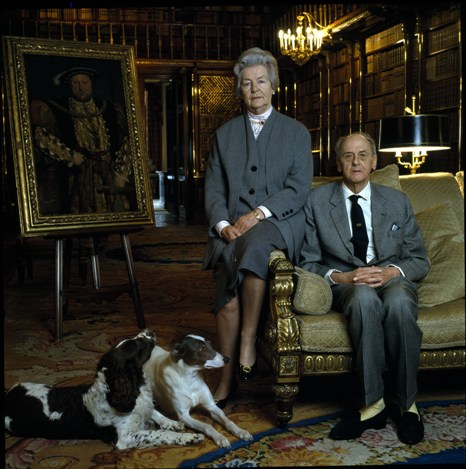
Andrew and Deborah Devonshire

 Feb 18, 2010 – Sister, mother, wife, Duchess, writer and celebrated national treasure.  Over the years Deborah Devonshire’s path has taken her in many directions creating a life story which is nothing short of fascinating. In an epic year, Chatsworth is staging a special exhibition throughout 2010 in honour of the 90th birthday of Deborah (on March 31), now Dowager Duchess of Devonshire and the last surviving of the famous Mitford sisters, marking the nine eventful decades of her life, illustrating her many interests and achievements.  

Memories of the Dowager’s Mitford ancestry, and her famous siblings, will be evoked with many unique items never seen by visitors before, including numerous letters, plates from the much loved Berlin dinner service sold by her father and purchased by her husband, the Cavendish/Devonshire family tree and the beautiful Renoir painting left to Chatsworth by her sister Pamela.

Visitors will experience a rare insight into the remarkable life of Deborah, illustrated with mementos and keepsakes personally chosen by her Grace including early diaries, the Dowager’s childhood ice skates (skating was an early passion), her nature notebook and a copy of her wedding invitation.  Deborah’s passion for all things outdoors quickly becomes clear.  A keen supporter and participant in all country pursuits, the exhibition will include the Duchess’s gun and game books.  Two of her beautiful handmade walking sticks are also featured, and her love of poultry reflected in a wooden chicken sculpture and her rosettes and prizes for eggs.

Deborah comments: “Putting this exhibition together has meant thinking back over the nine decades of my life so far, and trying to gather together mementos and photographs that will interest visitors to Chatsworth this year. I hope people will enjoy the wide range of things on view, from Paris dresses and works of art I love, to family photographs and a telephone from the gift shop at Graceland. I have been lucky enough to know many fascinating people and be involved in local and national organisations and good causes, and the displays will reflect these.”

In the 1950s, the Dowager had the huge task of restoring Chatsworth after the depressing war years (it had been leased to a girls school), and making it fit for the growing number of visitors, and as a family home. The wallpaper patterns that she used then will be shown alongside the books she wrote later in life, celebrating Chatsworth’s house, collections, garden, food and landscape. Her growing family is represented by glamorous private images of her and her young children by Norman Parkinson.

As Duchess, she was involved in many significant public and state events, and chose to take on many public responsibilities, charitable concerns and interests. The robes she wore to the Queen’s coronation in 1953, at which her son, the present Duke, was page to his grandmother Mary, widow of the 10th Duke, will be on display, alongside presentation objects from public engagements over the last 60 years.

Having known many famous artists and writers, there will be displays of early work by Lucian Freud, sculpted heads of some of the Dowager’s more illustrious artistic friends, by Angela Conner, and the special edition of one of his books given to her by Evelyn Waugh, with blank pages to avoid the bother of actually having to read it.

Deborah continues: “I have known Lucian Freud for well over fifty years, and he remains a great friend and a fascinating person. Being painted by him, when I was in my thirties, was a slow process, as he is not a lightning artist, but I think the result is full of insight – I certainly get more like the picture the older I become.”

Her tastes and style are represented by a number of exquisite couture gowns and other clothes and hats; favourite works of art by Atkinson Grimshaw, Tchelitchev, Jo Self, Epstein, Frink and others; a selection of the jewelled insect brooches she was given by her husband over many decades; and mementos of her hero Elvis Presley, including the Elvis telephone, and a section of fence from Graceland.

After 54 years in charge of Chatsworth [and its estate], Bolton Abbey and Lismore Castle in partnership with her husband, the late Duke, the Dowager’s retirement has not been quiet. Memorabilia relating to her latest books, and forthcoming memoirs, will be on display, together with new photographs taken for the exhibition, including a special image of the Dowager with her seventeen great grandchildren.

Chatsworth re-opens on March 14 and the exhibition runs until 31 October 2010. Entrance is free with house admission. For more information please visit http://www.chatsworth.org

The Duke of Devonshire’s obituary from The Independent

Andrew Cavendish was the 11th Duke of Devonshire, Debo’s beloved husband and a close friend of Paddy for over half a century. Paddy and Andrew shared many long walks and expeditions together some of which are detailed in the book of letters ‘In Tearing Haste’ whilst the most comprehensive account of one of their shared journeys is ‘Three Letters from the Andes’ published in 1991 during which Paddy described his own responsibilities as ‘looking after the primus stove’. 

First published in The Independent Thursday, 6 May 2004 

 Rescuer of Chatsworth and reviver of the family tradition of patronage 

“I am a very rich duke, a most agreeable thing to be, even in these days,” said the hero in Nancy Mitford’s 1945 novel The Pursuit of Love. Her brother-in-law Andrew Cavendish, when he succeeded five years later as 11th Duke of Devonshire, had every reason to disagree. 

Andrew Robert Buxton Cavendish, landowner: born London 2 January 1920; MC 1944; styled 1944-50 Marquess of Hartington, succeeded 1950 as 11th Duke of Devonshire; Mayor of Buxton 1952-54; President, Royal Hospital and Home (formerly Royal Hospital and Home for Incurables), Putney 1954-91; President, Building Societies Association 1954-61; President, Lawn Tennis Association 1955-61; Chairman, Grand Council, British Empire Cancer Campaign 1956-81; Parliamentary Under-Secretary of State for Commonwealth Relations 1960-62; Minister of State, Commonwealth Relations Office 1962-64, and for Colonial Affairs 1963-64; PC 1964; Chancellor, Manchester University 1965-86; Steward, Jockey Club 1966-69; President, National Association for Deaf Children 1978-95; Chairman, Thoroughbred Breeders’ Association 1978-81; President, RNIB 1979-85; Patron in Chief, Polite Society 1991-2004; Vice-President, London Library 1993-2004; KG 1996; married 1941 The Hon Deborah Freeman-Mitford (one son, two daughters, and two sons and one daughter deceased); died Chatsworth, Derbyshire 3 May 2004.  

Born a second son on the second day of 1920, he grew up with no expectation of becoming a duke. His father’s premature death in 1950 left him with huge death duties to pay, and the extra liability of palatial Chatsworth, at a time when smaller houses were going down like ninepins. How he overcame all these difficulties, making Chatsworth habitable and a source of widespread enjoyment, discovering in the process new ways of helping all manner of people and institutions, as well as reviving the family tradition of enlightened patronage, is one of the success stories of our time. 

The Cavendish family roots were in Suffolk, but “Bess of Hardwick”, founder of the dynasty, was born in Derbyshire, in 1518. Successive marriages, the second to Sir William Cavendish, enabled her to expand her property. Quarrels with her fourth husband, the Earl of Shrewsbury, led her to leave the house she had built at Chatsworth, and build another, even larger, at Hardwick itself. Her sons built on this foundation, the second becoming father of the first Duke of Newcastle, the first buying back Chatsworth and created Earl of Devonshire in 1618 (the title came not from any territorial connection, but because it had just become vacant by the death without issue of the previous holder). 

They were royalists in the Civil War, when the family wealth was diminished – save in the library, watched over by Thomas Hobbes, the philosopher. The fourth Earl, of imperious disposition, fell out with the Stuarts and retreated to Chatsworth, which he rebuilt and enlarged. He supported William III, who elevated him to be the first Duke of Devonshire. His son, Steward of the Household to Queen Anne and later to George I, was the first great virtuoso of the family, and built up the collection of old master drawings at Chatsworth. He was the first, too, to succeed on the Turf, buying Flying Childers, “the fleetest horse that ever ran at Newmarket”. 

The second Duke’s son and grandson were both Lord-Lieutenants of Ireland, and between them remodelled the grounds at Chatsworth, the fourth Duke commissioning James Paine to build the new stables. By his marriage to the only daughter of the great Earl of Burlington, architect and connoisseur, more came to Chatsworth, from the Boyle Irish estates to the drawings of Inigo Jones. His son, husband of the famous Georgiana Spencer, was himself a notable figure. Their only son, the sixth Duke, the greatest collector of all, made Chatsworth what it is today. 

“He appears to be disposed to spend a great deal of money,” said the family auditor to his father. “So much the better,” was the memorable reply. “He will have a great deal of money to spend.” He did, enlarging and beautifying Chatsworth with the help of Jeffry Wyatville and Joseph Paxton. He bought wonderful books, marble and antiquities, including a fifth-century bronze head of Apollo, commissioned sculpture from Canova, and for him Paxton built the splendid conservatory at Chatsworth, forerunner of the Crystal Palace. 

But he remained the “Bachelor Duke”: dying childless in 1858, he was succeeded by a cousin who had fortunately inherited much himself, including the wealth and books of the scientist Henry Cavendish and the Compton family estates on the South Coast. He himself invested in industry, built up Eastbourne and gave Cambridge the Cavendish Laboratory. His son reverted to politics (he was the only person to refuse the premiership three times) and horse-racing. The ninth Duke became Governor-General of Canada during the First World War, when Chatsworth was inevitably neglected. All the plants in Paxton’s conservatory died and it had to be pulled down, but gradually life returned to normal. 

So Lord Andrew Cavendish grew up between the wars, when the hereditary peerage had not become a political plaything and leisure was a way of life, not a profession. Devonshire House in London had gone, pulled down to make way for a motor showroom, and so had Chiswick House (now in the care of English Heritage), but the family still owned four other great houses besides Chatsworth and Hardwick. The footmen still wore full livery (lemon coat, dark blue breeches and white stocking) if there were more than six to dinner. 

It was 1938 when his grandfather died, aged 69. Andrew’s father was Under-Secretary of State for Dominion Affairs and abroad, and Andrew was about to leave Eton for Trinity College, Cambridge. He had taken neither very seriously. His father worried about this, as about his occasional flutters on and off the Turf. But an old friend said to him, “Surely you wouldn’t like your son to get good reports?”, and Newmarket turned youthful diversion into an abiding passion. Neither overcame an earlier, deeper and even more long-lasting love of books and reading. A year later his elder brother William, now Marquess of Hartington, came of age, with a series of parties – the last at Chatsworth in August 1939. Then came the war and goodbye to all that. 

Both brothers went into the Coldstream Guards, to be “sorted out” like many others by drill, boots and sergeant-majors. Caterham was varied by escape to London, where Andrew would take Deborah Mitford, the youngest of the six daughters of Lord Redesdale, out to dinner; in April 1941 they married. Then came posting abroad, via North Africa to Italy, where he first saw action; unable to sleep the night before, he read Nigel Balchin’s The Small Back Room, just out, from cover to cover. In the fierce fighting north of Rome in July 1944, he was awarded the MC. His company captured a hill south of Strada, and held it despite being cut off on all sides. The citation records his “endless cheerfulness, energy and disregard of danger”; he himself said, “I got it for being cheerful”, a characteristic self-depreciation. 

That same spring his elder brother married Kathleen Kennedy, sister of the future President of the United States; only four months later he was killed in action in France. This was a crushing blow, still remembered with pain almost 60 years later. Used, by gentle warning from his father, to accept the minor, less demanding role of a younger son, he now found himself pitchforked into new responsibility. When he left the Army, he dutifully stood in the Conservative interest for the neighbouring seat of Chesterfield in 1945 and again in 1950. 

Adjusting to post-war austerity and high taxation was another problem. His father, well advised like his forebears by Currey & Co, made over the estate, the gift dependent on his living for five years. In November 1950, 14 weeks short of this term, he died, aged only 55. 

His estate was then valued at £5.9m, and at the current rate of 80 per cent death duties came out at £4.72m. It was clear that huge economies would have to be made; the question was how to make them without diminishing the sources of revenue needed to maintain what was left. The 11th Duke and his Duchess counted their assets: they were both 30, young, energetic and, untrammelled by conventions now out of date, were prepared to do something different. Time was on their side, and Chatsworth, hitherto more a place just to visit, proved to be the key to the future. Continue reading

But he went for a Burton instead …

I am still thoroughly enjoying ‘In Tearing Haste’ which is my ‘train’ book, read as I travel up and down to London. I am nearing the end but want to share some of my favourite bits. Here are a couple of impromptu PLF rhymes that he passed on to Debo in a letter dated 12 August 1958.

In early August 1958 Paddy and Joan, with Alan the Spy (is this Alan Pryce-Jones who had once been engaged to Joan?), and Roxanne Sedgewick climbed Mount Olympus in Greece. The climb was tough and Joan said that she was to be buried there if she fell down a crevasse. She did not want to be lugged down and placed on a train back to Athens. Paddy wrote her an epitaph:

Bury me here on Olympus
In the home of the lonely wall-creeper
But don’t take me back to Athens, please,
Stretched out on a second class sleeper …

Later that week upon their return the group grew to include Coote Lygon (Lady Dorothy (Coote) Lygon 1912-2001) who was in the WAAF during the war. As she smoked a cigar she told a story using all the regular RAF slang which inspired Paddy to write this:

‘What’s happened to Winko?’ asked Groupie.
The Mess Corporal wagged his old head:
‘He said that he’d fancy a Bass, sir,
But he went for a Burton instead …’

Ind Coope Burton Ale

The obituary of George Psychoundakis aka The Cretan Runner

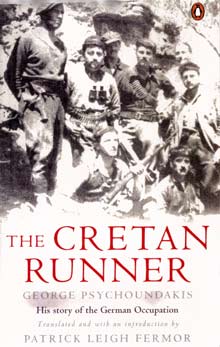
The Cretan Runner

The obituary that follows is of George Psychoundakis, who as a young man was a runner for the resistance in Crete during the German occupation in World War II. First of all he ran for local partisans groups or andartes, but from about 1941 he did most of his work with the Special Operations Executive.  At the end of the war George was mistakenly taken for a deserter and locked up. He spent around 16 months in gaol and whilst there he wrote his wartime memoires. Somehow Paddy became aware of his incarceration and had George released. He then helped George by translating his memoires into English and sorting out a publisher. The book has been translated into many languages and is called The Cretan Runner. This obituary includes a section written by Paddy at the end.

First published: 12:10AM GMT 18 Feb 2006 in the Telegraph

George Psychoundakis, who died at Canea, Crete, on January 29 aged 85, was best known for his extraordinary account of clandestine life in the Resistance after the German occupation of his island in 1941; the book was translated into English by Patrick (now Sir Patrick) Leigh Fermor, and enjoyed success in Britain as The Cretan Runner.

George Psychoundakis was born on November 3 1920 at the village of Asi Gonia, perched high in a mountain pass in central Crete. He was the eldest of four children, born to a family whose only possessions were a single-room house and a few sheep and goats.

Education at the village school was basic; but unlike most of his fellows George learnt to write as well as read, and gleaned what learning he could from books lent by the schoolteacher and the village priest.

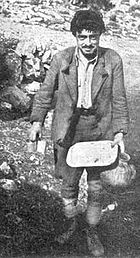
George Psychoundakis during the Resistance

When the German invasion of Crete began, he was 21, a light, wiry, elfin figure who could move among the mountains with speed and agility. While the Germans imposed their rule with the utmost brutality, Psychoundakis was among the many who guided straggling Allied soldiers over the mountains to the south coast, from where they could be evacuated.

As the Resistance grew more organised, Psychoundakis became a runner, carrying messages, wireless sets, batteries and weapons between villages and secret wireless stations, always on foot, always in danger, often exhausted and hungry, over some of the most precipitous terrain in Europe.

It was gruelling work, but in an interview many years later Psychoundakis made light of the hundreds of miles he covered at a run: “I felt as if I were flying, so light and easy – just like drinking a cup of coffee.”

Patrick Leigh Fermor, one of a handful of SOE officers whose job it was to co-ordinate the Cretan resistance, first met Psychoundakis at the end of July 1942 in a rocky hide-out above the village of Vaphé.

The messages Psychoundakis was carrying were twisted into tiny billets and hidden away in his clothes: “They were produced,” wrote Leigh Fermor, “with a comic kind of conjuror’s flourish, after grotesquely furtive glances over the shoulder and fingers laid on lips in a caricature of clandestine security precautions that made us all laugh.” His clothes were in rags, one of his patched boots was held together with a length of wire – but his humour and cheerfulness were infectious.

Humour and danger went hand in hand. Psychoundakis told how a couple of German soldiers decided to help him with an overladen donkey, which was carrying a heavy wireless set under bags of wheat. The Germans beat the poor creature so hard that Psychoundakis was afraid they would knock off the saddle-bags – but mercifully their attention was drawn to some village girls, and the soldiers started flirting with them instead.

He also describes British officers with wry amusement – one had “pyjamas, a washbasin, and a thousand and two mysterious objects. He wore a row of medals on his breast, and had a rucksack full of geological books which he studied all day long.”

At the same time, the harshness of everyday life was everpresent. Near starvation at one point with another SOE officer, Jack Smith-Hughes, Psychoundakis described how they picked broken snail shells off blades of grass and ate them, pretending that each was more delicious than the last.

A bed of springy branches in a dry cave was a luxury: George spent many a night freezing on a rain-soaked mountainside, listening out for German search-parties, knowing what they would do if he were caught. Tales of torture, burning villages and summary executions were all too familiar. On the one occasion he visited England, in 1955, Psychoundakis was awarded the King’s Medal for Courage in the Cause of Freedom. Continue reading