Category Archives: Profiles of Paddy

The troubled waters of the mind grow still and clear

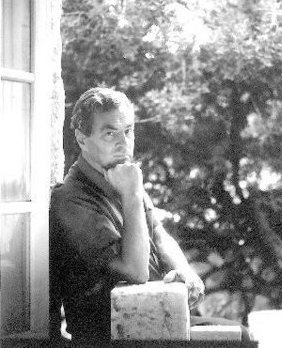
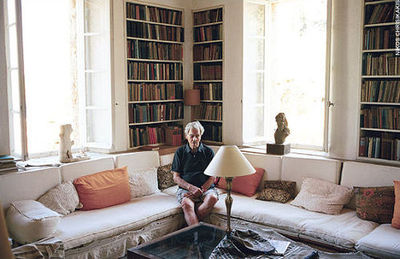
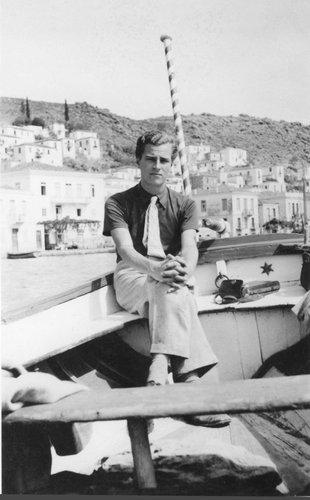
Paddy in Greece photographed by Joan

Don’t you feel like me that with the passing of Paddy as one of the last of his generation we have clearly entered a new age dominated by uncertainty; a lack of confidence in the values we once held as unquestionably true? These beliefs that bound us (in the West?) together for the latter part of the twentieth century are now unravelling at an ever-increasing pace. As we enter the End Game of the economic crisis, and as the decade of The Forever War rumbles on like the noise of a busy road in the middle distance – there only when we take the trouble to notice – we suffer a dearth of leadership and heroes of substance. Paddy and those of his generation had no such crisis of confidence; they served without question. They sacrificed themselves for the things they believed in, and they provided the leadership, entrepreneurship, creativity, and wisdom that helped rebuild Europe after almost half a century of ethnic and social strife, and destructive war. Maybe they also share some blame for the way things turned out, but who will step up now?

In this considered profile, which prompted my rambling reflection, Paddy’s good friend Colin Thubron assesses his contribution, not as a warrior, but as a writer, and I think for the first time, reveals the torment of Paddy’s troubling writer’s block towards the end of his life.

by Colin Thubron

First published in the New York Review of Books, Volume 58, Number 14

When Patrick Leigh Fermor died in June at the age of ninety-six, it seemed as if an era had come to an end. He was the last of a generation of warrior–travel writers that included the Arabian explorer Wilfred Thesiger, the controversial mystic Laurens van der Post, and the indefatigable Norman Lewis of Naples ‘44. Among these, Leigh Fermor shines with the élan and the effortlessly cultured glow of an apparent golden age. A war hero of polymathic exuberance, brilliant linguistic skills, and an elephantine memory, he was sometimes fancifully compared to Lord Byron or Sir Philip Sydney.

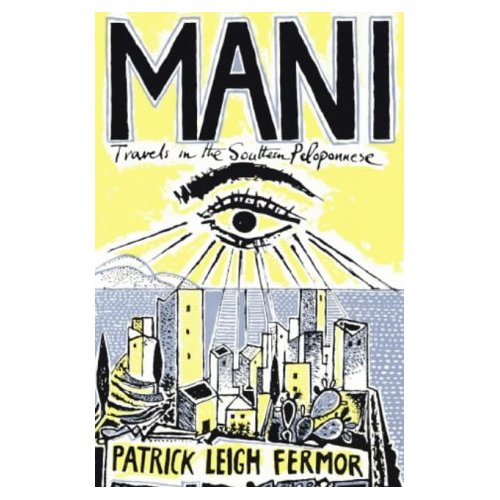
Two pairs of books came to exemplify his achievement. The first pair—Mani (1958) and Roumeli (1966)—celebrated the Greece that held his abiding fascination and where he lived for forty-five years on a once-wild promontory in the Peloponnese. In Mani, especially, he described this backwater region as a world whose way of life had survived in a fierce and enchanted time warp.

The land he depicted is barely recognizable now—tourism, he observed, destroys the object it loves—but it was less the Greece of classical antiquity that beguiled him than the spirit and folk culture of the hinterland: the earthy, demotic Romiosyne that he once contrasted with the Hellenic ideal in a playful balance sheet of the country’s character.

In these, and in later books, the style was the man: robustly imaginative, cultivated without pedantry, unstoppably digressive, forgivably swanky, and filled with infectious learning. The impression—overflowing into elaborate footnotes and flights of learned fantasy—is one of omnivorous delight in the quirks and byways of history, art, language, genealogy, myth, song, superstition, costume, heraldry, and everything else that struck his fancy.

His literary models were Norman Douglas and Robert Byron, but his writing was more vivid than the one, more kindly than the other. Despite the richness of his prose (occasionally slipping into purple) he forged an illusion of intimacy with his readers, as if they were sharing his mind in the moment of writing. But in fact his manuscripts were worked, reworked, and reworked again with such painstaking perfectionism that his publisher (the benign Jock Murray) often had to reset his galley proofs wholesale. The apparently natural flow of words was in reality a densely worked choreography, which came at cost.

Fifteen years ago, swimming in the Ionian Sea beneath his home, where nobody could overhear us, Paddy (as friends and fans called him) suddenly confessed to me the writer’s block that would plague the rest of his life. The expectations of a now-avid public, and his own obsessive perfectionism, were taking their toll, and he could not overleap this cruel impediment.

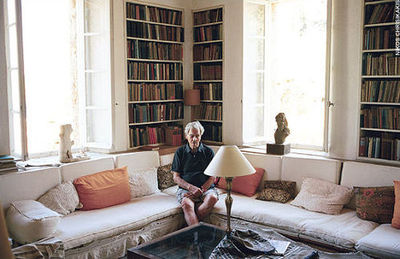
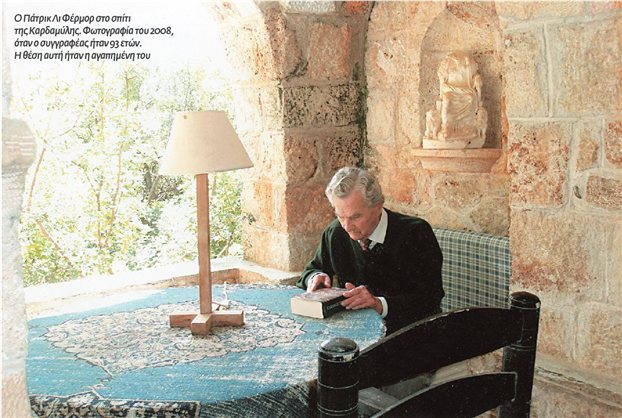
I remember him strong into old age. He swam every morning, with a sturdy breaststroke far out to sea, the tattoo of a twin-tailed mermaid glistening on his shoulder. He still kept up a striding march in the Taygetus foothills, where he and his wife Joan had designed their own house above the ocean. It was a place of “mad splendor,” he wrote. Its sitting-room library—bookshelves banked nine feet high—opened onto a vista of cypresses and the Messenian Gulf, and was flagged with the greenish stone of Mount Pelion. In the afternoon Paddy would disappear into his study to confront—or escape—the demons of his failed writing, and would emerge to the liberation of ouzo or whiskey, generally to report some arcane piece of research—that the Huns wore stitched field-mouse skins, perhaps—or to share a passage of Ovid. We dined in the monastic half-cloister he had built beside his home, and once we visited the tiny, red-tiled Byzantine chapel where—five years before—he had buried the ashes of Bruce Chatwin.

The conflict between a natural gregariousness and the solitude of writing never quite resolved for him. In a short, intriguing study named A Time to Keep Silence (1953) he recorded his sojourn in three great French monasteries. He described this retreat not as a religious exercise, but as a need for a haven for writing, and the nature of its cleansing—”the troubled waters of the mind grow still and clear”—remains suspended like a question mark in the oeuvre of a man to whom self-revelation seemed indulgence.

The second pair of books, which established Paddy’s primacy among travel writers, must be among the most extraordinary ever written. In 1933, as a youth of eighteen, he left England for a journey that would take a year and a half. As “a thousand glistening umbrellas were tilted over a thousand bowler hats in Piccadilly,” he set out to walk to Constantinople (as he nostalgically called Istanbul). Walking stick in hand, a copy of Horace’s Odes in his rucksack, he pursued a meandering course up the Rhine and down the Danube, across the Great Hungarian Plain, into Romania and through the Balkans to Turkey.

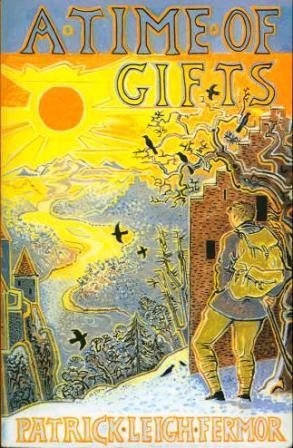
It was almost forty-five years before he published the first part of this journey, and another nine years before the second. A Time of Gifts (1977) and Between the Woods and the Water (1986) represent prodigious feats of memory. They record the rite of passage of a precocious, exuberant young man as he encounters the peoples and languages of a Middle Europe now littered with obsolete names: Bohemia, Transylvania, Wallachia. His story must have become the dream journey of every enterprising and footloose adolescent.

Inevitably the accuracy of Paddy’s memory was questioned, and he was frank about occasional imaginative license and conflation. (His first diary was stolen in Munich, a solitary last one recovered years later in Romania.) Certainly his recall was extraordinary. I remember the first time we met (by chance), when he quoted verbatim from my first book passages that I had myself forgotten. A year before his death we chanted verses from the Rubáiyát of Omar Khayyám together in an antiphonal competition (which he won).

His urge to describe his epic journey more than forty years after its end was a deeply natural one. He was revisiting his youthful persona with the judgment and knowledge of maturity; yet in a sense he had remained unchanged. Despite his sophisticated learning, he retained an almost boyish innocence, as if the troubles of the modern age had bypassed him. In the Peloponnese, where he settled to live in the 1960s, he had remained in thrall to a more ancient, rooted culture than that of the urban West.

The final volume of his proposed trilogy—carrying its author through the Balkans and down the Black Sea coast to Turkey—became his tormenting and elusive project for the next quarter- century, and was never completed. Some near-finished version, however, survives him, and will eventually be published.

With his youthful trek done, Leigh Fermor’s career took off into near fable. Caught up in Greek unrest, he joined in a triumphal royalist cavalry charge against wilting Venizelist rebels. In Athens he fell in love with the artist Princess Balasha Cantacuzene, twelve years older than him, and lived with her in Moldavia for over two years, before World War II recalled him to London.

As a fluent Greek speaker he was recruited by the Intelligence Corps, and sent as a liaison officer with the Greek army first to Albania and finally to Crete, where he survived the brutal German invasion. For almost two years, while an officer in the Special Operations Executive, he lived disguised as a shepherd in the Cretan mountains, organizing the gathering of intelligence.

Then, in 1944, occurred the exploit that—more than any other—was to burnish him into legend. He and his fellow SOE officer Stanley Moss dreamed up a scheme of harebrained bravado. Dressed in stolen German uniforms, with a party of Cretan guerrillas, they ambushed the car of General Heinrich Kreipe, the German commander of occupied Crete, kidnapped him, and concealed him under the back seat. Moss took the wheel, Paddy donned the general’s cap, and together they drove through twenty-two checkpoints to emerge on the far side of Herakleion and march Kreipe for three weeks over the mountains, to be picked up by motor launch and taken to Egypt.

It was during this hazardous Cretan march, as the dawn broke over Mount Ida, mythical birthplace of Zeus, that the abducted general began to murmur a verse of Horace: Vides ut alta stet nive candidum/Soracte….1 It was an ode that Paddy knew by heart, and he completed the six stanzas to their end. “The general’s blue eyes had swivelled away from the mountain-top to mine,” Paddy later wrote,

—and when I’d finished, after a long silence, he said: “Ach so, Herr Major!” It was very strange. As though, for a long moment, the war had ceased to exist. We had both drunk at the same fountains long before; and things were different between us for the rest of our time together.

This precocious kidnapping was later reimagined in a lackluster movie named Ill Met by Moonlight (1957) with Dirk Bogarde playing Paddy. But there were other exploits too. Paddy had already engineered the defection of the Italian General Angelico Carta from Crete; and he was due to undertake a near-suicidal mission to Colditz when the war ended.

His upbeat account of these events was tempered by regret. He had planned that the abduction of Kreipe be bloodless, but his accompanying Cretan partisans slit the chauffeur’s throat, and rumors of grim German reprisals for the abduction have never quite died down. Above all, Paddy’s accidental shooting of one of his fellow guerrillas may have stained his memory of the whole period.

On June 16 Leigh Fermor was buried back in the English countryside, attended by an Intelligence Corps guard of honor, to lie beside his wife Joan, his dear comrade since 1946. This was, in a sense, fitting. For in certain ways he was exemplary of a wartime Englishness now almost gone, whose more dashing qualities merged seamlessly into the hardy stylishness of Greek leventéa.

To those who knew him, his books are hauntingly redolent of his sensibility. His conversation was irrepressibly warm and inventive far into old age, moving from arcane anecdotes to fanciful wordplay or bursting into polyglot song (sometimes singing the lyrics backward). His friends ranged from Deborah, Duchess of Devonshire—last of the six legendary Mitford sisters (his correspondence with her was published in 20082)—to early acquaintance with a raffish interwar bohemia and his own great predecessor, the travel writer and aesthete Robert Byron, whose borrowed rucksack he bore across Central Europe as a youth.

Almost the last time I met Paddy, he had returned home after an operation for suspected cancer, and I feared he would be depleted, his old zest gone. He was growing deaf, and he suffered from tunnel vision (which he called Simplonitis). For a while, sitting over lunch, he seemed subdued. Then something struck him. He perked up, and said: “You know, there is an apple lying on a table in the hall. It’s been there all weekend. Wouldn’t it be marvelous if it cocked a snook at Newton, and simply took off into the air!”

This was typical of his boyish resilience. In the field of travel he evoked both the youthful wanderer who discovers another world and the avid scholar who melds with it. His prose was too rich and elaborate to be a safe influence on others (although a few have tried); but he brought to the genre not only the distinction of his densely brilliant books, but his innate dignity, ebullient mind, and capacious heart.

  1. 1″See Mount Soracte white with snow….”
  2. 2The correspondence, In Tearing Haste , edited by Charlotte Mosley, was published in the US by New York Review Books (2010), which has also republished the other books by Patrick Leigh Fermor mentioned in this article, as well as The Traveller’s Tree .
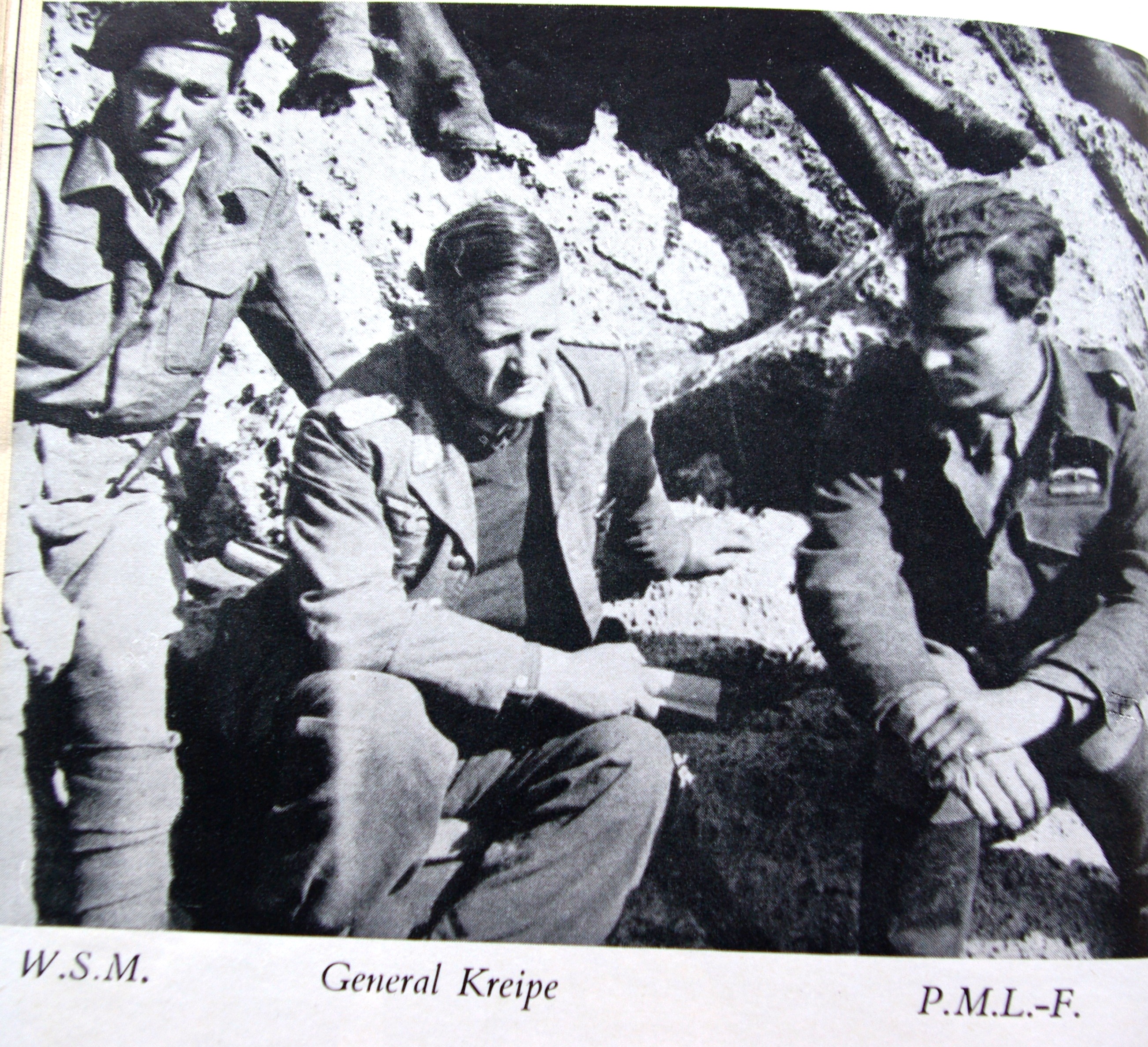
Fermor the Magnificent

Moss, Kreipe and Paddy

By Jeremy Bernstein

First published in the Los Angeles Times. January 18, 1998

Here is the scene: The time is late April of 1944. The place is near the summit of Mt. Ida, the highest mountain on Crete. There is still snow. Gathered are five Cretans, fully mustached and heavily armed. Three other men wear German uniforms. This is deceptive: Two of them are British officers (commandos). The third, however, is something else. If you are very familiar with German military uniforms, you will see from pictures of the group that he is a general. In these photographs he is not looking at the camera. He does not smile. It is little wonder. His name is Karl Kreipe. He was, until he was kidnapped two days before, the commanding general of the German occupation forces on Crete. He was due to be promoted to lieutenant general yesterday. German patrols are looking for him.

As dawn breaks over Mt. Ida, he murmurs to himself:

Vides ut alta stet nive candidum Soracte
(“Do you not see how Soracte is shining”)….

Then, surprisingly, one of the British officers continues,

nec jam sustineant onus
Silvae laborantes, geluque
Flumina constiterint acuto

(“beneath a heavy covering of snow, and how
The laboring trees can no longer hold up their burden,
And how the rivers are frozen by the sharp cold?”).

(Translation of the Latin was provided by Professor W.C. Dowling of Rutgers University.)

The officer continues through the next five stanzas to the end of Horace’s Soracte ode. Many years later, he wrote, “The general’s blue eyes had swiveled away from the mountaintop to my own — and when I’d finished, after a long silence, he said: ‘Ach so, Herr Major!’ It was very strange as though, for a long moment, the war had ceased to exist. We had both drunk from the same fountains long before, and things were different between us for the rest of our time together.”

Readers of this anecdote may divide into two groups: both, in my view, equally fortunate. A few of you will recognize this scene as one of the mosaic tiles out of which Patrick Leigh Fermor’s (the British major was he) magnificent travel book “A Time of Gifts” was composed. (Readers intrigued by this passing anecdote who want to know more about what was one of the most daring exploits of World War II will enjoy reading “Ill Met by Moonlight” by W. Stanley Moss — he was the other British officer — George G. Harrap & Co.: London, 1950, as well as “Crete: The Battle and the Resistance” by Antony Beevor, Penguin Books: New York, 1991. Both books have photographs.) You are fortunate readers because you have discovered this marvelous author. But those of you who have not discovered him are also fortunate: When you do, you will have in front of you hours of enormous pleasure and satisfaction. I should confess that, until a few years ago, I had never heard of Fermor either. But in the fall of 1993, I went on a bicycle trip around Crete. Looking for something to read, I found “A Time of Gifts” in a local bookstore. I glanced through the first few pages and decided there and then that I would try to read everything the man ever wrote.

While all of Fermor’s books (there are not that many, only half a dozen or so by my count) are autobiographical, he has never written an autobiography. Nor, as far as I can determine, has anyone written his biography. The best one can do is to snatch fragments from his own books and from books written by people who came across him in passing. Constructing a person’s life this way, especially the life of a man like Fermor, is like trying to cross a rapidly flowing stream by hopping from rock to rock. There are lacunae for which I simply cannot account. What, for example, was he doing living in a vast Romanian country house near the Russian border for about two years just before the war? And later, how did he come to spend an almost equal amount of time in the Caribbean: an experience that resulted in the first of his travel books, “The Traveller’s Tree”? Moreover, why was that book actually written in two monasteries in France where Fermor was a resident visitor? This experience resulted in a gem of a short book, “A Time to Keep Silence,” which, he informs us, began as letters written from the monasteries to the woman who was to become his wife. We are told nothing more about her, not even her name. Why, I don’t know. But here, at least, are a few of the steppingstones in his life.

Fermor, whom friends apparently call “Paddy,” was born on Feb. 11, 1915, in London. As he wrote in an introductory letter to Xan Fielding (one of his fellow clandestine officers on Crete who was responsible for the west of the island, while Fermor was responsible for the east) in “A Time of Gifts”: “In the second year of World War I, soon after I was born, my mother and sister sailed away to India (where my father was a servant of the Indian Government) he directed the Geological Survey of India, and I was left behind so that one of us might survive if the ship were sunk by a submarine.” Fermor was deposited with a country family which “left a memory of complete and unalloyed bliss.” But, he continued, “when my mother and sister got back at last, I rushed several fields away and fought off their advances in gruff Northhamptonshire tones; and they understood they had a small savage on their hands, and not a friendly one.” Taken in hand, he was sent to a series of schools, all of which “ended in uniform catastrophe.” He explained: “Harmless in appearance, more presentable by now and of refreshingly unconstricted address, I would earn excellent opinions at first. But as soon as early influences began to tell, these short-lived virtues must have seemed a cruel Fauntleroy veneer, cynically assumed to mask the Charles Addams fiend that lurked beneath: It coloured with an even darker tinct the sum of misdeeds which soon began heaping up. When I catch a glimpse of similar children today, I am transfixed with fellow-feelings, and with dread.”

By this time, his mother and father had separated, and in locus parentis he was sent to two psychiatrists, one of whom he later found out had treated Virginia Woolf. This was followed by a stay at a cramming institution where he prepared himself for the examination to get into a public school, in this case, King’s School, Canterbury. His tenure at King’s School was abruptly terminated when he was discovered holding hands with the daughter of a local green grocer ” in the back-shop on upturned apple baskets.” He notes that his house master’s penultimate report remarked that he had made “some attempts at improvement but more to avoid detection. He is a dangerous mixture of sophistication and recklessness which makes one anxious about his influence on other boys.”

While this is not necessarily an ideal recommendation for getting into a university, it does nicely for the army, Fermor’s next goal. Somehow he managed to winkle a decent letter to Sandhurst, the British West Point. The only obstacle was obtaining what was known as the school certificate (which I suppose was something like a GED), a high school degree for people who did not actually finish high school. To this end, he was sent at the age of 17 to London to live and work with a tutor. All went well, and he managed to pass the London certificate. But then the scheme came unglued. He lost interest in the army. He began to write poetry and to hang out with a Bohemian group of “Bright Young People” of whom he was the youngest. Then at 18, he had a perfectly lunar idea. He would walk (walk!) from Holland to Istanbul. As he wrote to Fielding: “I would travel on foot, sleep in hayricks in the summer, shelter in barns when it was raining or snowing and only consort with peasants and tramps. If I lived on bread and cheese and apples, jogging along on fifty pounds a year supplied by his father and supplemented by a £15 loan from the father of a school friend … there would even be some cash left over for paper and pencils and an occasional mug of beer. A new life! Freedom! Something to write about!” Something to write about, indeed — except that it would happen 40 years later! The first volume of the triptych describing this incredible 18-month journey, “A Time of Gifts,” appeared in 1977; the second, “Between the Woods and the Water” in 1986; we still await the third.

What makes a great writer? I find this as difficult to characterize as trying to characterize what makes a woman beautiful. In both cases, it is something we feel in our guts. One thing, it seems to me, that great writers have in common is an obsessive love of language: words, words, words. In Fermor’s case, it was a love for all languages. When he left England in 1933 for his walk, Fermor had, it appears, schoolboy French and some Latin and classical Greek. By the time he enlisted in the Irish guards in 1939, the Latin had turned into Romanian and the classical Greek into modern Greek of sufficient fluency so that he could pass for a Cretan shepherd during the three years that he was in the resistance. In addition, he had acquired enough German so that after Gen. Kreipe was abducted, he could pass for a German soldier when they drove the general’s car, with him in it, past the sentries who were guarding the complex in which he lived.

But that is not all. Everywhere he went he absorbed languages. Here is a passage from “Between the Woods and the Water,” in which Fermor has come upon a strange enclave of Orthodox Jewish woodcutters high in the Carpathian Mountains in Transylvania. He was as taken in by them as he was taken in by nearly everyone he encountered. They were curious about him and he about them, although they were initially wary of such an odd visitor. Then, he wrote, “everything took a different turn when scripture cropped up. The book in front of the Rabbi was the Torah, or part of it, printed in dense Hebrew black-letter that was irresistible to someone with a passion for alphabets; especially these particular letters, with their aura of magic. Laboriously I could phonetically decipher the sounds of some of the simpler words, without a glimmer of their meanings, of course, and this sign of interest gave pleasure. I showed them some of the words I had copied down in Bratislava Fermor kept diaries and this one miraculously reappeared after the war, sent by the people with whom he had left it on the continent from shops and Jewish newspapers in cafes, and the meanings, which I had forgotten, made them laugh; those biblical symbols recommended a stall for repairing umbrellas, or ‘Daniel Kisch, Koscher Wuerst und Salami.’ How did the Song of Miriam sound in the original and the Song of Deborah; David’s lament for Absolom; and the rose of Sharon and the lily of the valley? The moment it became clear, through my clumsy translations into German, which passage I was trying to convey, the Rabbi at once began to recite, often accompanied by his sons. Our eyes were alight; it was like a marvelous game. Next came the rivers of Babylon, and the harps hanging on willows: This they uttered in unfaltering unison, and when they came to ‘If I forget thee, O Jerusalem,’ the moment was extremely solemn. In the back of my diary are a few lines in Hebrew, utterly indecipherable to me; and underneath them are the phonetic sounds I took down from his recitation of them.”

And Fermor continues: “By this time the otherworldly Rabbi and his sons and I were excited. Enthusiasm ran high. These passages, so famous in England, were doubly charged with meaning for them, and their emotion was infectious. They seemed astonished — touched too — that their tribal poetry enjoyed such glory and affection in the outside world; utterly cut off, I think they had no inkling of this. A feeling of great warmth and delight had sprung up and the Rabbi kept polishing his glasses, not for use, but out of enjoyment and nervous energy, and his brother surveyed us with benevolent amusement. It got dark while we sat at the table, and when he took off the glass chimney to light the paraffin lamp, three pairs of spectacles flashed. If it had been Friday night, the Rabbi said, they would have asked me to light it; he explained about the shabbas goy. This was the Sabbath-gentile whom well-off Jews — ‘not like us’ — employed in their houses to light fires and lamps and tie and untie knots or perform the many tasks the Law forbids on the Seventh Day. I said I was sorry it was only Thursday (the Sabbath begins at sunset on Friday) as I could have made myself useful for a change. We said good night with laughter.” Considering the kind of world war he would fight (after his tour of duty in Crete, Fermor joined an airborne reconnaissance force that considered rescuing prisoners from a concentration camp just before the war ended), he knew, as well as anybody, what the fate of these woodcutters must have been. Part of the beauty of his writing is that here, and elsewhere, he allows us to fill in this blank for ourselves. We read these books knowing, as he does, that the world he is describing no longer exists. There is no need for him to tell us.

As Fermor wrote in his letter to Fielding, his original intention had been to walk across Europe, sleeping in hayricks and barns. It didn’t quite work out that way: He often slept in castles and mansions and, sometimes, instead of walking, he rode horses and fast motor cars or sailed on barges. It is clear that he was, and is, a man of extraordinary charm. A photograph of him taken in 1943 in Crete would pass for the photograph of a film star. His army contemporaries describe him as being Byronic. I am not sure what that means, except that at one point he seems to have swum the Hellespont. On his walk he made friends with nearly everyone he met. Some were Central European nobility with wonderful castles and libraries that he haunted. There were Gypsies and shepherds. There was a family of Czech acrobats he encountered in Vienna when he was trying to supplement his pound-a-week allowance with sketches in pencil. He couldn’t sell them a sketch, but they ended up giving him an autographed picture of themselves, which he kept as a remembrance. All of this is described in a language that is so rich and precise that, after reading a few pages, one shakes one’s head in wonder. (Reading Nabokov has the same effect on me.) If you are a writer, you either want to rush to your laptop or jump out of a window.

After his sojourns in the Caribbean and France, Fermor chose Greece as his permanent home. He lives, it says on the jackets of his books, in a house he designed and built himself. He has written two wonderful books about Greece, “Mani” and “Roumeli.” He ends “Roumeli” with a prose poem based on Greek place names. Here is a small part of it:

Chalcis is the flurry of the tide, Naxos the boxwood click of a rosary muffled by a nun’s skirt; Ossa is a giant’s tread, Pelion the beat of centaurs’ hoofs through glades of chestnut, Tempe a susurrus of plane trees, and Rhodes a flutter of moths.

Santorini zigzags to the sky at dawn like a lark singing but dies at sunset with the Dies Irae. Komotini is a muezzin’s call, Patmos the faraway trumpets of the Apocalypse.

The Dodacenese is a sea-song by twelve sponge-fishers, Antikythera a mermaid forsaken; Skopelos, a lobster’s and Poros, a mock-turtle’s song, Aegina a tambourine.

The Sporades are the sea’s whispers through olive trees.

And Patrick Leigh Fermor is a treasure and delight.

Πάτρικ Λι Φέρμορ:«Πατρίδα είναι εκεί που έχει κανείς τα βιβλία του»

Paddy contemplating a fine read

It roughly translates as “Patrick Leigh Fermor – Homeland is where one’s books are” and it is about “Unknown details of life, action and work of British writer of travel literature, as recounted specific ‘Tribune’ reporter Joy Kiosse”. You can enjoy in the Greek or if appalling at it like me use Google Translate. It is quite a good article. I like the first paragraph ….

In mythology, heroes were not immortal, and some are in today’s life. The memory but Patrick Leigh Fermor, Paddy’s, like shouting his friends, the Sun-Michael for Mani and the Cretans, will remain immortal. Written with a broad humanitarian education, self-taught, untamed, hero, kind and generous friend peculiar humor, fearless and bold, persistent traveler with an insatiable thirst to discover the world, polyglot and general man with deep knowledge of the classics and history, the Fermor took all these elements to the end of his life.

by Joy Kiosse

First published in Tovima on 2 July 2011.

Από την Πέμπτη 16 Ιουνίου ο σερ Πάτρικ Λι Φέρμοραναπαύεται στο μικρό κοιμητήριο που βρίσκεται στον περίβολο του ναού του Αγίου Πέτρου στο Ντάμπλτον της Αγγλίας, δίπλα στο μνήμα της συζύγου του Τζόαν. Είναι μια ήσυχη πράσινη πλαγιά περιτριγυρισμένη από ψηλά δέντρα.

Στη μυθολογία οι ήρωες δεν ήταν αθάνατοι- και κάπως είναι και στη σημερινή ζωή. Η μνήμη όμως του Πάτρικ Λι Φέρμορ, του Πάντι, όπως τον φώναζαν οι φίλοι του, του κυρ-Μιχάλη για τους Μανιάτες και τους Κρητικούς, θα μείνει αθάνατη. Συγγραφέας με πλατιά ανθρωπιστική μόρφωση, αυτοδίδακτος, ατίθασος, ήρωας, καλός και γενναιόδωρος φίλος με ιδιότυπο χιούμορ, άφοβος και παράτολμος, επίμονος ταξιδιώτης με ακόρεστη δίψα για να γνωρίσει τον κόσμο, πολύγλωσσος και γενικότερα άνθρωπος με βαθιά γνώση των κλασικών και της Ιστορίας, ο Φέρμορ κράτησε όλα αυτά τα στοιχεία ως το τέλος της ζωής του.

Ακόμη, είχε το χάρισμα να σαγηνεύει τους συνομιλητές του και ήταν εξαιρετικά αγαπητός σε όλες τις παρέες. Την τελευταία ημέρα του στην Καρδαμύλη, το μεσημέρι στο τραπέζι απήγγειλε με τη βραχνή πια φωνή του ένα μεγάλο ποίημα του Γουίτιερ. Ναι, είχε μνήμη! Οχι όμως μηχανική. Ακούγοντάς τον να απαγγέλλει και ταυτόχρονα να υποδύεται τον ήρωα του ποιήματος είχες τη βεβαιότητα ότι γνώριζε σε βάθος το νόημα κάθε στίχου, κάθε φράσης, κάθε λέξης.

Στο νοσοκομείο της Αθήνας την πρώτη φορά βαφτιστήρια και φίλοι από την Κρήτη και τη Μάνη βρέθηκαν δίπλα του, λες και είχαν ειδοποιηθεί με σήματα μορς. Ανάμεσά τους υπήρχε μια αυθόρμητη σχέση αγάπης και σεβασμού- όπως και εκείνος αγάπησε και σεβάστηκε την Ελλάδα. Ναι, το σπάνιο στοιχείο αυτής της σχέσης του με την Ελλάδα ήταν ο σεβασμός που έδειξε στον τόπο.

Μετά την πρώτη επέμβαση επέστρεψε στην Καρδαμύλη, ελπίζοντας ότι είχε ξεπεράσει για κάμποσο καιρό το πρόβλημα της υγείας του και ότι θα πρόφταινε να τελειώσει το βιβλίο του. Τρεις εβδομάδες αργότερα, την ημέρα που ο δήμαρχος της Καρδαμύλης θα του έδινε το χρυσό κλειδί της πόλης, χρειάστηκε να επιστρέψει εσπευσμένα στο νοσοκομείο. Και ύστερα από μια δεύτερη επέμβαση πήρε την απόφαση να γυρίσει στην Αγγλία, γνωρίζοντας πως δεν θα επέστρεφε ποτέ πια. Το ταξίδι είχε τελειώσει.

Ο Πάντι τιμήθηκε στη ζωή του όσο λίγοι συγγραφείς ή ακόμη και ήρωες. Την πρώτη φορά που θέλησαν να του απονείμουν τον τίτλο του ιππότη (ΟΒΕ), αρνήθηκε, λέγοντας ότι δεν τον άξιζε. Τελικά έγινε σερ το 2004, «κα θώς δεν θα ήταν… ευγενικό να αρνηθεί δεύτερη φορά». Πάντως ποτέ δεν ακούστηκε κάποιος να τον αποκαλεί «σερ». Ολοι τον φώναζαν Πάντι και στην Καρδαμύλη και στην Κρήτη «κυρ Μιχάλη»- ήταν το ψευδώνυμό του στα βουνά της Κρήτης και το δεύτερο χριστιανικό του όνομα, που κανείς δεν το ήξερε, παρ΄ όλα αυτά όμως οι Ελληνες το γιόρταζαν.

Διακρίσεις, διπλώματα- όσα δεν πήρε στα μαθητικά του χρόνια-, ασημένιες πλακέτες και πάλι διακρίσεις υπάρχουν στη Μάνη, περισσότερο ως έργα τέχνης, καδράκια σπαρμένα στα διάφορα δωμάτια. «Κυρ Μιχάλη, πρέπει να πιείτε αυτό το φάρμακο», «Κυρ Μιχάλη,έξω περιμένει ο τάδε, να έρθει;», «Κυρ Μιχάλη,ήρθε η βαφτιστικιά σου η Αγγλία»… Και ο κυρ Μιχάλης έγνεφε καταφατικά.

Του άρεσε να έχει κόσμο όταν δεν ήταν σκυμμένος στα χαρτιά του. Κατά βάθος του άρεσε και το «κυρ-Μιχάλης», καθώς στο πίσω μέρος του μυαλού του υπήρχαν πάντα η Κρήτη και οι συναγωνιστές του. Βαριά άρρωστος στο νοσοκομείο, τις νύχτες έβλεπε πως ήταν στη σπηλιά στα Ανώγεια και έτρεχε στο μπαλκόνι να το σκάσει, και άλλοτε πως τον κυνηγούσαν και έτρεχε για να μην τον πιάσουν.

Υπό τους ήχους μιας γκάιντας

Εκείνη την Πέμπτη ο καιρός ήταν χαρούμενος στη μικρή πολίχνη του Ντάμπλτον. Ο ήλιος μπαινόβγαινε στα σύννεφα πάνω από την εκκλησία όπου συγκεντρώθηκαν φίλοι και συγγενείς και παλιοί συμπολεμιστές του. Οταν έφθασε η σορός σκεπασμένη με τη βρετανική σημαία, ο ιερέας βρισκόταν στην άκρη του φράχτη περιμένοντας να δώσει την τελευταία ευχή. Μετά προχώρησαν μαζί στην εκκλησία, όπου στην πόρτα περίμεναν να αποδώσουν τιμές βετεράνοι της Ιρλανδικής Φρουράς. Μέσα στον ναό η τελετή ήταν σύντομη, χωρίς λόγους.

Η σοπράνο Σάρα Γκάμπριελ τραγούδησε ασυνόδευτη ένα απόσπασμα από τον «Ντον Τζιοβάνι» του Μότσαρτ, το εκκλησίασμα έψαλε δύο ύμνους, διαβάστηκαν δύο σύντομα αποσπάσματα από την «Κήπο του Κύρου» του σερ Τόμας Μπράουν και από το «Απόκρυφο Βιβλίο» του Πρωτευαγγελιστή, και το εκκλησίασμα ακολούθησε τη σορό στον περίβολο της εκκλησίας υπό τους ήχους μιας γκάιντας. Κοντά στο μνήμα ένας μουσικός της Ιρλανδικής Φρουράς σάλπισε το σιωπητήριο. Αυτό ήταν. Η σημαία διπλώθηκε, η σορός κατέβηκε, ενώ την έραιναν ροδοπέταλα και μια χούφτα χώμα που ήρθε από την Ελλάδα. Μετά σιωπή.

Δίπλα στο μαξιλαράκι με τα παράσημα- ανάμεσά τους ξεχωρίζει ο ελληνικός Φοίνικας- βρίσκονταν τα στεφάνια. Εκείνο από την Ελληνική Πρεσβεία στο Λονδίνο (άλλωστε ο πρέσβης κ. Α. Σάντης παρέστη στην κηδεία), ένα δάφνινο από το Μουσείο Μπενάκη με την ευχή «στο καλό Πάντι», ένα από τον αρχηγό του Γενικού Επιτελείου Στρατού της Ελλάδος, ένα από τους Βυρωνιστές, άλλα από την οικογένεια του συναγωνιστή και φίλου του λόρδου Τζέλικο, από την Αδελφότητα των Ελλήνων Βετεράνων, από το Βritish Council της Αθήνας, από βαφτισιμιές… και πολλά μικρά μπουκέτα αγριολούλουδα από φίλους.

Καρδαμύλη, «το σπίτι του»

Τους τελευταίους μήνες της ζωής του ο Πάτρικ Λι Φέρμορ τούς πέρασε στην Καρδαμύλη της Μάνης. Εκεί ήταν «το σπίτι του». Οταν τον ρωτούσαν οι δημοσιογράφοι ποια από τις δύο χώρες θεωρούσε πατρίδα του, ποιο από τα δύο σπίτια ένιωθε περισσότερο δικό του, εκείνο της Αγγλίας με τον παλιό μύλο, το ρυάκι και τα πανύψηλα δένδρα ή το άλλο, της Μάνης, «Πατρίδα είναι εκεί που έχει κανείς τα βιβλία του» απαντούσε. Και η αλήθεια είναι ότι τα βιβλία του Ντάμπλτον δεν μπορούν να συγκριθούν με τις βιβλιοθήκες της Καρδαμύλης. Εφέτος, στις αρχές του χρόνου, ο Πάτρικ Λι Φέρμορ επέστρεψε στην Καρδαμύλη, όπου προσπάθησε απελπισμένα να τελειώσει τον τρίτο τόμο της τριλογίας του. Πρόκειται για το τελευταίο μέρος του οδοιπορικού ενός 18άρη που ξεκίνησε από την Ολλανδία για να διασχίσει με τα πόδια όλη την Ευρώπη, ως την Κωνσταντινούπολη. Οι πρώτοι δύο τόμοι που εκδόθηκαν με τις αναμνήσεις αυτής της περιπέτειας, «Α time of Gifts» (1977) και «From the Woods to the Water» (1986) – έχουν μεταφραστεί στα ελληνικά-, γνώρισαν μεγάλη επιτυχία.

Σε αυτό το ταξίδι ο Φέρμορ μόλις που πρόλαβε να γνωρίσει έναν κόσμο ο οποίος, με τον Β΄ Παγκόσμιο Πόλεμο, θα χανόταν για πάντα. Ενα συστατικό γράμμα σε κάποιον ευγενή στη Γερμανία άνοιξε τη μία μετά την άλλη τις πόρτες των αρχοντικών και των κάστρων της Μεσευρώπης με τις πολύτιμες συλλογές έργων τέχνης και τις παλιές βιβλιοθήκες. Λίγα χρόνια αργότερα, μετά τον Πόλεμο, τίποτε από αυτά δεν υπήρχε. Ολα είχαν χαθεί, μαζί και ο τρόπος ζωής των φεουδαρχών αρχόντων και του αγροτικού πληθυσμού. Οι βομβαρδισμοί και το σοβιετικό καθεστώς έσβησαν έναν ολόκληρο κόσμο από τον χάρτη της Οικουμένης.

Οι Βρετανοί είχαν από καιρό ανακηρύξει τον Πάτρικ Λι Φέρμορ τον μεγαλύτερο ταξιδιωτικό συγγραφέα τους- ίσως τον κορυφαίο σε ολόκληρο τον κόσμο. Ο Φέρμορ δεν ήταν όμως μόνο ένας εξαιρετικός ταξιδιωτικός συγγραφέας. Οι περιγραφές του δεν περιορίζονταν στη διαδρομή. Τον ενδιέφερε η φύση, αλλά και ο άνθρωπος, οι ιστορίες που έλεγαν οι πέτρες και τα κτίσματα. Τον σαγήνευαν οι μικρές αφηγήσεις που άκουγε στα καφενεία. Τον βοηθούσαν να καταλάβει τους ανθρώπους και να κατανοήσει ό,τι κράτησαν από τον πολιτισμό τους. Σε αυτό τον βοήθησε πολύ και η ευκολία του στην εκμάθηση ξένων γλωσσών. Ακόμη και πρόσφατα διόρθωνε εκφράσεις και λέξεις συνομιλητών του στα ρουμανικά. Και εκείνοι δεν πίστευαν στα αφτιά τους…

ΓΙΑΤΙ ΔΕΝ ΕΠΕΣΤΡΕΨΕ ΣΤΗΝ ΚΡΗΤΗ – Η ΑΠΟΚΑΛΥΠΤΙΚΗ ΒΙΟΓΡΑΦΙΑ

Ο Πάτρικ Λι Φέρμορ καταγόταν από προνομιούχο οικογένεια.Ο πατέρας του,ο σερ Λούις,ήταν διευθυντής του Γεωλογικού Ινστιτούτου στην Ινδία,με αποτέλεσμα αυτός και η γυναίκα του να κρατηθούν για ένα πολύ μεγάλο διάστημα μακριά από τον γιο τους.Παιδάκι τον εμπιστεύθηκαν σε μια αγροτική οικογένεια και μεγάλωσε ελεύθερος στη φύση.Σε αυτή την ελευθερία οφείλεται ίσως ο ατίθασος χαρακτήρας του,αλλά και μια περίεργη,αυστηρή πειθαρχία,προσαρμοσμένη όμως στους δικούς του όρους.

Οταν,μετά τον Α΄ Παγκόσμιο Πόλεμο, μαζεύτηκε η οικογένεια,στο σπίτι γινόταν πολλή κουβέντα για πουλιά,για λουλούδια και για τόπους μακρινούς.Η μητέρα του,θέλοντας να του ανοίξει τους ορίζοντες- αφού το ένα μετά το άλλο τα σχολεία τον έδιωχναν-,του διάβαζε ποίηση και κλασικούς.Η οικογένεια τον προόριζε για στρατιωτικό.Γι΄ αυτό και εκείνος αποφάσισε να φύγει για την Ευρώπη.Χωρίς χρήματα,χωρίς χρονικούς περιορισμούς,σχεδόν χωρίς πρόγραμμα.Στο σακίδιό του είχε την κλασική ανθολογία ποίησης των εκδόσεων Οξφόρδης,τις Ωδές του Οράτιου,ίσως και κάποιο έργο του Σαίξπηρ.

Για να κρατά συντροφιά στον εαυτό του, όσο περπατούσε απήγγελε ποίηση,με αποτέλεσμα να τη μάθει απέξω,ενώ επαναλάμβανε όσα πρόφταινε να αρπάξει από τη γλώσσα κάθε τόπου από τον οποίο περνούσε.Κοιμόταν σε καπηλειά και αχυρώνες με την ίδια άνεση που έμενε σε πύργους και άκουγε τις ιστορίες των ανθρώπων που συναντούσε αναζητώντας τις ρίζες και τους μύθους των τόπων τους.Για να κερδίζει κάποια χρήματα έκανε ό,τι δουλειά έβρισκε- ενώ σχεδίαζε και προσωπογραφίες.Κάποια στιγμή έφθασε στον προορισμό: την Πρωτοχρονιά του 1935 τη γιόρτασε στην Κωνσταντινούπολη.Αλλά κάπου κατά τη διάρκεια του ταξιδιού οι σημειώσεις είχαν χαθεί.

Εφυγε από την Κωνσταντινούπολη με ένα ακόμη συστατικό γράμμα στην τσέπη.Αυτή τη φορά ήταν από τον έλληνα πρόξενο προς τον Πέτρο Σταθάτο στο Μόδι της Μακεδονίας.Υστερα από έναν σταθμό στο Αγιον Ορος,προχώρησε στο Μόδι.Η ατμόσφαιρα ενός ελληνικού σπιτιού και η αρχοντιά του οικοδεσπότη τού άνοιξαν τις πόρτες της Ελλάδας.Με ένα άλογο τριγύρισε στη Μακεδονία.Πλησίασε τους Σαρακατσάνους- για τους οποίους και έγραψε-,ώσπου κατέληξε στη Θεσσαλονίκη,όπου βρέθηκε στη μέση μιας σύρραξης ανάμεσα σε βασιλικούς και βενιζελικούς.Καθώς οι Σταθάτοι ήταν βασιλικοί και το άλογο ήταν δικό τους,προσχώρησε- πού αλλού;- στο στρατόπεδο των βασιλικών.Πάντως ο Φέρμορ δεν ήταν πολιτικοποιημένος.Αλλά ακόμη και αν ήταν,το έκρυβε τόσο καλά,ώστε κανείς δεν μπορούσε να τον τοποθετήσει σε «στρατόπεδο».

Το περιστατικό που τον σημάδεψε

Για τη ζωή και τις περιπέτειές του έχουν γραφτεί πολλά και έχουν ειπωθεί περισσότερα.Για την ιστορία της Κρήτης ο ίδιος έχει μιλήσει πολύ λίγο,ενώ δεν έχει γράψει τίποτε.Επρεπε να βρίσκεται παρέα με πάρα πολύ στενούς φίλους και να έχουν πιει πολύ κρασί για να πιάσει τη διήγηση.Και πάλι όμως,έκανε την ιστορία του ελαφριά,σχεδόν διασκεδαστική και εξωπραγματική.

Υπάρχει ένα τραγικό περιστατικό σε αυτή την ιστορία,που χάραξε τη ζωή του Φέρμορ και για το οποίο ο ίδιος δεν μίλησε ποτέ,ενώ ούτε ο υπαρχηγός του,στρατηγός Στάνλεϊ Μός,το αναφέρει στο βιβλίο του «Ιll met by moonlight» («Κακό συναπάντημα στο φεγγρόφωτο»),που είναι αφιερωμένο στην απαγωγή του στρατηγού Κράιπε.Το έψαξε η βιογράφος του Αρτεμις Κούπερ στα αρχεία του υπουργείου Πολέμου.

Στη Μάνη ο Φέρμορ διάβαζε και ξαναδιάβαζε το χοντρό ντοσιέ με τα χειρόγραφα και τις δακτυλογραφημένες σελίδες που ήταν γεμάτα διορθώσεις με τα τρεμουλιαστά και όπως πάντα δυσανάγνωστα γράμματά του.Ο τόμος είχε σχεδόν τελειώσει.Ηθελε ίσως κάποιο «χτένισμα» και υπολογιζόταν να κυκλοφορήσει πριν από τα Χριστούγεννα του 2011. Την επιμέλεια είχε η Αρτεμις Κούπερ,η οποία είχε επιμεληθεί και την έκδοση του «Words of mercury» το 2003.

Οι Βρετανοί έχουν από καιρό ανακηρύξει τον Πάτρικ Λι Φέρμορ τον μεγαλύτερο ταξιδιωτικό συγγραφέα τους- ίσως τον κορυφαίο στον κόσμο.Ο Φέρμορ δεν ήταν όμως μόνο ένας εξαιρετικός ταξιδιωτικός συγγραφέας.Οι περιγραφές του δεν περιορίζονταν στη διαδρομή.Τον ενδιέφερε η φύση,αλλά και ο άνθρωπος,οι ιστορίες που έλεγαν οι πέτρες και τα κτίσματα.Τον σαγήνευαν οι μικρές αφηγήσεις που άκουγε στα καφενεία.Τον βοηθούσαν να καταλάβει τους ανθρώπους και να κατανοήσει ό,τι κράτησαν από τον πολιτισμό τους.Σε αυτό τον βοήθησε πολύ και η ευκολία του στην εκμάθηση ξένων γλωσσών.Ακόμη και πρόσφατα διόρθωνε εκφράσεις και λέξεις συνομιλητών του στα ρουμανικά.Και εκείνοι δεν πίστευαν στα αφτιά τους…

Patrick Leigh Fermor remembered by Colin Thubron

When I was asked to select a passage from his work that encapsulated the spirit of Paddy Leigh Fermor, who died last Friday, a crowd of images leapt to mind, from his encounter with the grotesque burghers of Munich in A Time of Gifts to the eerie vespers of A Time to Keep Silence, to the gongs of Byzantium and the gambolling of dolphins in Mani.

By Colin Thubron

First published in The Spectator, 18 June 2011

Almost any page of his work glitters with the ebullience and precision of his style, and its almost choreographic way with sentences. And his writing was the ideal instrument for his omnivorous love of things: his encyclopaedic delight in history, genealogy, heraldry, costume, the quirks and byways of folklore and language.

This was a man who seemed to embody panache. From boyhood he was a renegade. The housemaster at his public school, from which he was predictably sacked, called him ‘a dangerous mixture of sophistication and recklessness’. In his youth he walked across Europe in the first year of Hitler’s coming to power, and during the war lived for over two years in the Cretan mountains disguised as a shepherd before famously abducting the German military commander of Crete. Later, during the Greek civil war he joined a royalist cavalry charge, and at the age of 70, in emulation of Lord Byron, he swam the Hellespont — with his wife in a boat behind him — sitting on her hands (he wrote) in order not to wring them.

I believe he was erudite rather than intellectual — he embraced and celebrated experience more than he analysed it, and his descriptions even of obscure history and customs were lit up by a playful vitality. He wrote, of course, at a time when the world seemed less accessible than now and when to plunge into the Taygetus mountains of the southern Peloponnese, for instance, was a more remote experience than an Andean trek today. In this he seems the product of an earlier age, as he does in his wide learning, his immersion in his chosen subject, and his eschewing of the psychological.

Always there was this zestful inventiveness and cultivated pleasure in fantasy — not whimsical fantasy, but rather the product of a full-blooded imagination. Almost the last time I saw him, he had returned from hospital after an operation for suspected cancer. I was worried that I’d find him depleted and his old flare gone. At first he was indeed a little subdued, eating lunch. Then suddenly he perked up and said: ‘You know, there is an apple lying on a table in the hall. It’s been there all weekend… Wouldn’t it be marvellous if it cocked a snook at Newton, and simply took off into the air!’

Then I knew he was himself again.

He had few disciples. It was hard to emulate such writing, and rather dangerous. He was a master of that rich and sculptured style: but I think nobody else was. What he gave to travel writing was less a specific following than his unique personal stature: as near as we are likely to come to a Renaissance man. He bestowed on the genre his innate dignity, his literary brilliance, his polymathic mind, and his generous heart.

A Prince of the Road by Colin Thubron

This is a major essay about Paddy by his good friend Colin Thubron. Perhaps worth printing and reading at your leisure.

Use the Print Friendly facility. Print Friendly and PDF

by Colin Thubron

First published in the New York Review of Books, January 17 2008.

To suggest that Patrick Leigh Fermor is the greatest travel writer alive is to omit a great deal. In Britain and Greece he is a near legend, celebrated not only for his books but for his wartime exploits as a guerrilla leader in occupied Crete, where his abduction of a German general has passed into folklore. He is, perhaps, the last of a breed of writer-travelers whose reputation has an aura of genuine action and courage.

The qualities suited to the travel writer’s trade have always been contradictory. The mental (and physical) robustness necessary for ambitious travel often excludes the sensitivity to record it, and vice versa. So there are travelers who write, and writers who travel—and they rarely converge in the same person.

In Leigh Fermor, they do. The richness of his prose, his polymathic exuberance, and his cultural allusiveness render him less immediately accessible than some of his contemporaries, such as Peter Fleming or Norman Lewis. But his six travel books—one for each decade of his adult life—have secured him a readership drawn to a voice that is omnivorous in its tastes and curiosity, learned without condescension, cultivated but never effete, curiously innocent, occasionally swanky, infectiously joyous. If he is less known in the United States than he is in Britain, it is because Leigh Fermor is deeply European.

His reputation rests, above all, on two pairs of books—about his youthful walk across pre-war Europe, published in 1977 and 1986—and about Greece, published in 1958 and 1966. But then there is A Time to Keep Silence. In the oeuvre of a traveler whose books are full of worldly curiosity, this short reflection on the monastic life sits like a troubled question mark. First published in Britain in 1953, it now appears in the US for the first time. In less than a hundred pages it records the author’s stay in the ancient French monasteries of St. Wandrille, Solesmes, and La Grande Trappe, with a brief excursion to the deserted Byzantine chapels of Cappadocian Turkey.

Yet there are readers for whom A Time to Keep Silence is Leigh Fermor’s finest—if most uncharacteristically elusive—book. In her introduction, the religious historian (and ex-nun) Karen Armstrong writes:

The monks’ monotonous way of life has been deliberately designed to protect them from the distractions of, and the lust for, novelty: they do the same things day after day; they dress alike and shun individuality and personal style. They keep almost perpetual silence….

Nothing could be more antipathetic to everything that Leigh Fermor’s books project and embrace. His persona as a writer brims with “individuality and personal style.” So, of course, does his prose. He is famously gregarious, and a dazzling raconteur. For a traveler so tough, his books are rich in pleasures: in leisure, in wine, in company. History and landscape bring a visceral exhilaration.

In 1952, aged thirty-seven, Leigh Fermor arrived at the Benedictine abbey of St. Wandrille de Fontenelle, near Rouen, in quest not of religious retreat but of somewhere cheap and quiet in which to write his first book, on the Caribbean. The regimen of the monastery—the bloodless gloom of Vespers, the sepulchral mealtime recitations while the monks ate in silence—filled him at first with revulsion:

As I sat at Vespers watching them, now cowled, now uncovered, according to the progress of the liturgy, they appeared preternaturally pale, some of them nearly green. The bone-structure of their faces lay nearly always close beneath the surface. But, though a deep hollow often accentuated the shadow under the cheekbone, their faces were virtually without a wrinkle, and it was this creaseless haggardness that made their faces so distinct from any others. How different, I thought, from the fierce, whiskered, brigand-faces of the Greek monks of Athos or the Meteora, whose eyes smoulder and flash and twinkle under brows that are always tied up in knots of rage or laughter or concentration or suddenly relaxed into bland, Olympian benevolence.

There is no doubt about where Leigh Fermor’s sympathies lay. As for writing, he retired to his cell on the first day in the quiet, and picked up his pen:

But an hour passed, and nothing happened. It began to rain over the woods outside, and a mood of depression and of unspeakable loneliness suddenly felled me like a hammer-stroke.

For three or four days, little changed. He was prey to insomnia and a flat depression. Then he started to sleep. He slept until a few meals and church services a day were his only lucid moments. Then the pattern changed again. His lassitude dwindled away and was succeeded by a “limpid freshness.” He now slept only five hours in twenty-four. It was as if a profound tiredness, rooted in the outside world with its demands on nervous libido and instant response, had overswept him, then receded in this quietude to release a flood of unimpeded energy. “Even the major causes of guilt and anxiety had slid away.”

From the monastery’s library—a magnificent repository of the sacred and secular—he was able to borrow even those heretical books placed on the index or locked in the depository (named the Enfer) as destructive of monastic calm. And as he grew to know them, the monks became, to his charitable and indulgent mind, almost uniformly attractive.

Moving on, he was delayed only two weeks by the abbey of Solesmes, guardian of early Church music, before he reached the great Cistercian monastery of La Grande Trappe in southern Normandy. Among this grimly disciplined and silent order, the cycle that Leigh Fermor had experienced in St. Wandrille—the same tension between tenderness and revulsion—repeated itself more gently. Here the Benedictine dedication to the efficacy of prayer was reinforced by a notion of ferocious penance:

A Trappist monk rises at one or two in the morning according to the season. Seven hours of his day are spent in church, singing the offices, kneeling or standing in silent meditation, often in the dark…. There are no cells. All, from the Abbot downwards, sleep in cubicles in a dormitory on palliasses of straw stretched out on bare planks. Heating does not exist…. A special deaf and dumb language for cases of necessity has been evolved and codified, and the entire lifetime of a lay-brother, who does not participate in the singing of the offices, may pass without the uttering of a word beyond the confessional or his spiritual consultations with the Abbot. A monk on the point of death is removed from his infirmary bed and laid across a bed of straw which is scattered over a cross of ashes. There, after the last ghostly comforts in the presence of the assembled monks, he expires. His body is exposed for a while in the church. No coffin is used at his burial; his face is covered by his hood, and he is lowered into his grave with his habit folded about him.

A Time to Keep Silence evolved, sometimes word for word, from the letters written to Leigh Fermor’s future wife from these brief sojourns in monastic cells. They are touched by the unease of the doubter or atheist (he is never specific) who has intruded into the midst of pious conviction, and by his subsequent gratitude for the monks’ discretion which allowed him to escape any awkward challenge.

But for all the revolution in his feelings—and his brief excursions into the nature of prayer or temptation—it is less the inner journey than Leigh Fermor’s descriptions of monastic life that linger in the memory. He is a master of externals. The somber glamour of ritual and the drama of architecture rise naturally to his pen. In Roumeli, his book on northern Greece, he celebrates the pinnacle monasteries of Meteora with a gusto more immediate to him than the arcane inner lives of the sober monks of Normandy. His brief chapter on the rock chapels of Cappadocia, with which A Time to Keep Silence ends, relaxes into descriptive ease as it portrays a hermit city redolent of the dawn of monastic Christendom, whose human inhabitants have long gone.

Leigh Fermor’s sumptuous and sometimes complicated style has won him many admirers, barely one successful imitator, and a handful of disgruntled critics. When he writes that the quietude of St. Wandrille and his limited contact with the monks “compelled me again and again to seek my parallels in painting,” it sounds less like a limitation than a joyful release. The memory of Old Masters is never far away. In the muted light by which they worship, the monks evoke the canvases of Zurbarán and El Greco. The towering pinnacles of Solesmes remind him of the Rhenish castles of Gustave Doré and Victor Hugo. The wintry landscapes around La Trappe blend with those of Breughel and Bosch.

Sound itself turns visual. Leigh Fermor, in an act of nostalgic remembrance, conjures the ruined English abbeys lifting up their broken arches and emptied rose-windows “as though some tremendous Gregorian chant had been interrupted hundreds of years ago to hang there petrified at its climax ever since”; and the complex chanting of the conventual High Mass elicits an image of the Gregorian notation—with its comet tails and arabesques—printed in the monks’ missals.

These stylistic flourishes would be woeful in lesser hands. But with Leigh Fermor they rarely fail. His early models include Alexander William Kinglake and Norman Douglas, but most potent perhaps was the influence of his precocious near-contemporary, Robert Byron, who died at sea in 1941, and who in The Road to Oxiana, an account of travel in Persia and Afghanistan, interleaved humorous vignettes with some of the most precise and beautiful architectural descriptions in the language. Continue reading

The Times Literary Supplement: Patrick Leigh Fermor

First published in The Times Literary Supplement, 6 July 2011

There was a time in the early 1950s when, upon arrival in the TLS office of a book about cannibalism or Voodoo, the editor would drop it in an envelope and say, “This is one for Paddy”. Patrick Leigh Fermor, who died last month at the age of ninety-six, is now best known for his connection to Greece and his youthful trek across Central Europe in the direction of Constantinople (as he insisted on calling it). But in his first book, The Traveller’s Tree, an account of a journey by schooner through the Caribbean islands published in 1950, he was in pursuit of “the whole phenomenon of Afro-American religion”. Before long, the TLS was commissioning the former mountain guerrilla fighter and Intelligence Corps Liaison Officer to write on related matters. He could open a review of a book on Haiti in 1953 by telling readers that “The bibliography of Voodoo – or Voudoun, as some purists insist, with little basis, on spelling it – mounts impressively”. A discussion of cannibalism in the correspondence columns of the TLS was just the sort of thing to elicit a contribution from Fermor: “Apropos of the recent letters about the ethical and culinary aspects of cannibalism, may I quote from a book I wrote years ago . . .”.

There followed a list of the gustatory advantages of various folk, according to the palates of the Caribs who “invaded the Caribbean chain, eating all the male Arawaks they could lay hands on and marrying their widows”. The book he wished to quote from was, of course, The Traveller’s Tree (it was by now 1980), which included this pre-Columbian version of a restaurant review:

“French people were considered delicious, and by far the best of the Europeans, and next came the English. The Dutch were dull and rather tasteless, while the Spanish were so stringy and full of gristle as to be practically uneatable.”

In later years, Paddy – as he was known to friend, reader and stranger alike – wrote for this paper on various topics, including Crete, scene of his wartime adventure. In the common run of Grub Street, there are many people one could call on to evaluate an anthology of nonsense – but Poiémate me Zographies se Mikra Paidia, which Paddy reviewed in 1977, was nonsense in modern Greek. In December 1979, he contributed a clamorous, ringing poem on the subject of Christmas:

What franker frankincense, frankly, can rank
in scents with fawn-born dawning
Weak we in Christmas week, lifetime a shriek-
ing streak – lend length and strengthen!
Poultice the harm away, charm the short
solstice day! Send strength and lengthen!

Among other curiosities we found on rooting through the archive was this plea from May 1968: “Patrick Leigh Fermor, author, traveller: biographical information, letters, personal reminiscences for biography”. The requester was J. Marder, writing from Athens. What became of it, and him? An authorized biography by Artemis Cooper is expected to appear at the end of next year.

We have received this “personal reminiscence” from a correspondent:

“In 2005, I was commissioned by a newspaper to write a profile of Patrick Leigh Fermor. A preliminary meeting took place at the West London home of Magouche Fielding, widow of Xan, PLF’s comrade-in-arms, but my editor insisted that no piece about Fermor could appear without a first-hand account of the house which he designed and helped build in the mid-1960s in Mani, at the southernmost tip of the Peloponnese. So it was that, after an overnight stay in Athens and a five-hour drive to the village of Kardamyli, I rang Paddy from a seaside pension.

“‘Good Lord. You’re here already!’ he exclaimed, though all proper warning had been issued. ‘Look here. Come to supper straight away. It’ll be a rotten supper. But come to supper straight away.’ Desiring nothing more than an ouzo followed by a soft pillow, I had the presence of mind to resist. Paddy was understanding. ‘Look here. Come to lunch tomorrow. It’ll be a much better lunch.’ Suppers and lunches, it transpired, were prepared by different maids.

“At about one the following day I set off for the two-kilometre walk from Kardamyli, with directions from a villager. ‘As the road bends to the left, you take the footpath to the right. Go through the olive grove, and arrive at Mr Fermor’s door.’ What could be simpler? There was indeed a bend in the road and a footpath to the right. But there was also another, closer to the bend, up ahead. Then another. After involuntary exploration of hitherto uncharted olive groves and what seemed a sizeable stretch of the Mediterranean coast, I squelched into Paddy’s house from the shore, to find him seated on the sofa reading the TLS. ‘Good Lord. I think you’re the only creature, apart from a goat, who has come in that way. We must have a drink straight away.’ The last was among his favourite phrases.

“Lunch lasted some six hours. (Lemon chicken, with litres of retsina or red Lamia.) Songs in various languages were sung, including a rendering of ‘It’s a Long Way to Tipperary’ in Hindustani. Lost lines of poems were sought. An anecdote about my lately deceased father and his claim to have seen salmon leaping in a narrow Perthshire stream, confirmed only after his death, threw Paddy into a search for the perfect epithet: ‘The corroborating salmon. The justifying salmon. The proving salmon’. Well into the evening, I prepared to leave. ‘Look here. Come to lunch on Sunday’ (this was Friday). I said I would on be on my way back to Athens. He was startled. ‘Good Lord. You’re leaving already? Then come to supper tomorrow.’ I did so, after an all-day hike in the Tagetos mountains which rear up behind the house that Paddy built, as the Gulf of Messenia opens before it. This time, I arrived punctually, to be admitted by the allegedly rotten cook (in fact supper tasted very good). She directed me to Paddy’s study in a separate building in the garden. I knocked before entering, to find him at his desk, alone in Mani on a late March evening, dressed in Jermyn Street shirt, pullover and grey flannels, reading a Loeb Horace. Towers of manuscripts could not obscure him. Among them, perhaps, was a draft of the third and concluding part of his epic walk from the Hook of Holland to Constantinople – the first, though not the last, heroic adventure of Patrick Leigh Fermor.”

Honoring Patrick Leigh Fermor: Review Essay

This is quite an excellent essay that focuses on Paddy’s writing more than many other profiles.

Paddy in 1966

by Willard Manus

Reading Patrick Leigh Fermor today is both an exhilarating and depressing experience, exhilarating because of the depth and brilliance of his prose, depressing because the Greece he portrays so memorably has been hammered to dust by the march of time. Fermor, who was knighted in 2003, is best known in Greece and in his native Britain, where he was born nine decades ago to Sir Lewis Leigh Fermor, director of the Geological Society in India, and Eileen Ambler, who was partly raised there. His first book, The Traveller’s Tree, published in 1950, dealt with the journey he made through the Caribbean islands in 1947-48. The book won the Heinemann Foundation Prize for Literature, and established him as a writer of note.

His next two books, 1952’s A Time to Keep Silence, which described his stay in various European monasteries (where he discovered in himself “a capacity for solitude”), and 1956’s The Violins of Saint-Jacque, a novel, are interesting but minor works. His literary and political importance is linked to the two books on Greece he published a decade later—Mani: Travels in the Southern Peloponnese and Roumeli: Travels in Northern Greece. Established his reputation as the pre-eminent non-native writer on 20th century Greece.

Fermor’s first experience of the country dated back to 1933, when as a rebellious and untamed 19-year-old, he dropped out of Sandhurst and set out on a walking tour of Europe with Constantinople as his ultimate destination was Constantinople. Envisioning himself as “a medieval pilgrim, an affable tramp with a knapsack and hobnailed boots,” he embarked, in mid-winter, on a journey that eventually spanned three years and took him through the Netherlands, Germany, Austria, Hungary, Rumania and, eventually, Greece. 2

Remarkably, Fermor did not write about his picaresque adventures in pre-war Europe until many years later. “So when A Time of Gifts appeared in 1977 and Beneath the Winds and the Water in 1986, the life of the mid-thirties that he described had been utterly destroyed,” his biographer Artemis Cooper has noted, “and much of the land he had walked over was in the grip of communism for years. Yet his memory recreated this world with an astonishing freshness and immediacy, and recaptured the young man he was then: full of curiosity, optimism and joy in the vibrant diversity of the world.”  The concluding volume of Fermor’s trilogy is scheduled for publication (by John Murray Ltd.) in early 2007.

Fermor made it to Constantinople on New Year’s Day, 1935, and then crossed south into Greece. He spent time in a monastery on Mt. Athos, got caught up later in a Royalist vs. Republican battle in Macedonia, arriving finally in Athens, where he met the great love of his life, the Romanian Balasha Cantacuzene. They went to Poros and lived together in an old water mill, where he wrote and she painted. When the money ran out they retreated to her decaying family home in Baldeni, Moldavia.

Fermor described the house in an essay published in Words of Mercury, “Most of a large estate had been lopped away in the agrarian reform. There was little cash about, people were paid in kind by a sort of sharing system, so, in a way, were the owners; and, on the spot, there was enough to go around. Elderly pensioners hovered in the middle distance and an ancient staff would come into being at moments of need. . . .

“There was one crone there who knew how to cast spells and break them by incantations; another, by magic, could deliver whole villages from rats. After sheep-shearing, a claca, fifty girls and crones, bristling with distaffs would gather in a barn to spin; hilarious days with a lot of food, drink, singing and story-telling.

“Snow reached the windowsills and lasted till spring. There were cloudy rides under a sky full of rooks; otherwise, it was an indoors life of painting, writing, reading, talk and lamp-lit evenings with Mallarme, Apollinaire, Proust and Gide handy; there was Les Enfants Terribles and Le Grand Meaulnes and L’ Aiglon read aloud; all these were early debarbarizing steps in beguiling and unknown territory.”

Fermor was not quite the barbarian he fancied himself. Despite having rejected higher education, he was already something of a polymath, an autodidact. Not only was he conversant in five European languages (only Hungarian stumped him), he was knowledgeable about art, history, architecture, geography, sociology, religion, fashion, etymology, cartography, heraldry and many other subjects, all of which he had absorbed through voracious reading.

The importance of books in his life was discussed in a piece he wrote for The Pleasure of Reading (ed. Antonia Fraser, Bloomsbury, 1992). “When the miracle of literacy happened at last, it turned an unlettered brute into a book-ridden lunatic,” he confessed. “Till it was light enough to read, furious dawn-watches ushered in days flat on hearth-rugs or grass, in ricks or up trees, which ended in stifling torch lit hours under bedclothes.”‘

Among his favorite writers were Dickens, Thackeray (Vanity Fair, anyway), the Sitwells, Norman Douglas, Aldous Huxley and Evelyn Waugh, not to speak of Kipling and Houseman; Baudelaire and Ronsard in French; Horace and Virgil in Latin; Holderlin, Rilke and Stefan George in German.

“The young learn as quick as mynahs, at an age, luckily, when everything sticks,” he continued. What also stuck were “reams of Shakespeare, border ballads, passages of Donne, Raleigh, Wyatt and Marvel . . . two Latin hymns, remnants of spasmodic religious mania . . swatches from Homer, two or three epitaphs of Simonides, and two four-line moon-poems of Sappho.”

Fermor’s list also includes “the eleventh edition of the Encyclopedia Britannica … a battery of atlases, concordances, dictionaries, Loeb classics, Pleiades editions, Oxford companions, Cambridge histories, anthologies and books on birds, beasts, plants and stars.”

When Britain declared war in 1939, Fermor immediately went home to join up, leaving Balasha behind in Romania. He first enlisted in the Irish Guards, but because of his fluent command of Greek he was commissioned into the Intelligence Corps, serving at first as liaison officer to the Greek army fighting the Italians inAlbania. After Greece fell, Fermor was sent to Crete where he took part in the battle against the German airborne invasion. He remained on the island after the German triumph; disguised now as a Cretan shepherd, with a big handlebar moustache and a dagger in his belt, the tall, slim, Fermor cut a swashbuckling figure as he roamed the mountains to help organize the resistance movement.

It was there, in Crete’s high, wild country, that he recalled in Words of Mercury that…

“devotion to the Greek mountains and their population took root. . . . We lived in goat-folds and abandoned conical cheese-makers’ huts and above all, in the myriad caverns that mercilessly riddle the island’s stiff spine. Some were too shallow to keep out the snow, others could house a Cyclops and all his flocks. Here, at ibex- and eagle-height, we settled with our small retinues. Enemy searches kept us on the move and it was in a hundred of these eyries that we got to know an older Crete and an older Greece than anyone dreams of in the plains. Under the dripping stalactites we sprawled and sat cross-legged, our eyes red with smoke, on the branches that padded the cave’s floor and spooned our suppers out of a communal tin plate: beans, lentils, cooked snails and herbs, accompanied by that twice-baked herdsman’s bread that must be soaked in water or goat’s milk before it is eaten. Toasting goat’s cheese sizzled on the points of long daggers and oil dewed our whiskers. These sessions were often cheered by flasks of raki, occasionally distilled from mulberries, sent by the guardian village below. On lucky nights, calabashes of powerful amber-colored wine loosened all our tongues. Over the shoulders of each figure was a bristly white cloak stiff as bark, with the sleeves hanging loose like penguins’ wings; the hoods raised against the wind gave the bearded and mustachioed faces a look of Cistercians turned bandit. Someone would be smashing shells with his pistol-butt and offering peeled walnuts in a horny palm; another sliced tobacco on the stock of a rifle; for hours we forgot the war with talk and singing and stories; laughter echoed along the minotaurish warrens.”

In 1944 Fermor took part in a bold and perilous mission that later became the subject of a best-selling book, Ill Met by Moonlight by W. Stanley Moss, a fellow intelligence officer. 5 The British plan was to kidnap the German army’s chief of staff, General Muller, who had become notorious and hated for his brutal treatment of both Cretan partisans and civilians. When Muller was called away, the new target was his replacement: General Heinrich Kreipe, a professional soldier arriving straight from service on the Russian front.

Fermor and his team, which included Moss, Sandy Rendel (former political correspondent for the Sunday Times), the Cretan partisan Niki Akoumianakis and a dozen other andartes, had to radically alter their original plan. Fermor and Moss agreed to disguise themselves as German military policemen. That meant Fermor had to part with his Cretan moustache Without it, he looked so much the stiff-necked Teuton that Moss kidded him about being on the wrong side. They decided to promote themselves to corporal’s rank and decorate themselves with a few (stolen) ribbons.

Taking up positions outside the isolated Villa Ariadne—the headquarters for the German army had been built above Heraklion before the war by the archaeologist Sir Arthur Evans—Fermor and Moss flagged the general’s car down at 9.30 pm.

“Is dies das general’s wagon?” he asked.

“Ja, ja,” came the muffled answer from inside.

With that assurance, key members of the band attacked from all sides, tearing at the doors of the car. The beam of a flashlight showed the startled face of the general and the chauffeur reaching for his automatic. There was the thud of a bludgeon; the chauffeur keeled over and was dragged out of sight.

The general, who offered no resistance, was brought to Anogia, the largest village on Crete, located on the northern slopes of Mt. Ida. “Famous for its independent spirit, its idiosyncrasy of dress and accent, it had always been a great hideout of ours,” said Fermor in an account written in 1969  for the Imperial War Museum.

Fermor related that a note had been left in the general’s car stating that he was safe and “would be treated with the respect due to his rank,” and that the kidnap had been carried out by British officers and Greek nationals serving as soldiers in the forces of His Hellenic Majesty. “The point  was to give the Germans no excuse for carnage and reprisals in the Knossos area.”

The next day, however, a single-winged Feiseler-Storck reconnaissance plane circled above Anovia and dropped a steady snowfall of leaflets. “To all Cretans,” the message read, “last night the German General Kreipe was abducted by bandits. He is being concealed in the Cretan mountains and his whereabouts cannot be unknown to the inhabitants. If the General isn’t returned within three days, all rebel villages in the Heraklion district will be razed to the ground and the severest reprisals exacted on the civilian population.”

The general was not, of course, returned to the Germans; he was smuggled off the island and delivered by submarine to British army headquarters in Egypt, and the Germans exacted their promised revenge. Fermor deals with this in circumspect fashion in his official report, asserting that “most untrue to form, there had been little violence, few arrests, no shooting on the part of the Germans.”

Fermor’s statement is disputed by Dr. Michael E. Paradise, a Midwest-based Greek-American whose father and two brothers were members of the British intelligence group on Crete. Though in his teens, Michael himself was often used as a courier. “Attacking in the darkness of one night,” he wrote in the April 10, 1997 edition of The Greek American (a now-defunct, New York-based newspaper), “the Germans proceeded to destroy several villages with the utmost brutality and ferocity. I was witness of the destruction of one of the villages, Ano Meros, on Mt. Kendros in Amari.”

The kidnapping of Gen. Kreipe, Paradise asserted, “contributed to the unnecessary death of hundreds of men, who were hunted down like wild animals in the streets of their villages, then, while some were injured and still alive, they were burnt in the houses of the villages, and buried in them when the dynamiting of the houses followed.”

Most Cretans, though, have not held a grudge against Fermor and his gung-ho confederates. As one veteran Cretan commando said at the time of Kreipe’s abduction, “So they’ll burn down all the houses one day. And what then? My house was burnt down four times by the Turks. Let the Germans burn it down for a fifth time! And they killed scores of my family, scores of them, my child, yet here I am! We’re at war and war has all of these things. You can’t make a wedding feast without meat.”

After the war—and his brief Caribbean sojourn—Fermor realized that his love of Greece had tied himself forever to the country’s fortunes. He lived for a time on Evia, then Ithaca and Hydra (in the house of the painter, Niko Ghika). Soon after he began his travels in the far corners of the Greek mainland which led to the publication of his two masterpieces, Mani and Rozemeli. Accompanied by the photographer (and his wife-to-be) Joan Rayner (daughter of the Conservative politician and First Lord of the Admiralty in Ramsay MacDonald’s coalition government, Belton Eyres Monsell), whom he had met in wartime Cairo, Fermor set off with this goal in mind: “To situate and describe present-day Greece of the mountains and islands in relationship to their habitat and history.”

Mani is the southernmost part of Greece, an isolated, mountainous and forbidding peninsula known for its stark, sun-blistered landscape and warlike, feuding inhabitants. Despite having been warned not to attempt to penetrate into The Deep Mani— “the Maniatis are dangerous”—”they are Jews”—”they fear and hate foreigners”—”they live on salted starfish”—Fermor and Rayner defiantly set out on foot and mule, bus and caique, in search of an authentic Greek world.

What they found and reported on was a revelation to one and all. The Mani was a strange, combative place, to be sure—most people lived in pyrgi, stone towers that were more fortress than domicile—but it was fantastical at the same time, rich in history and bravery (no part of Greece played a more conspicuous and valuable part in the War of Independence). With its code of honor and hospitality, its love of freedom, the Mani was also pulsing with life, colorful in speech, custom, ritual and superstition.

The book that came out of this expedition into the heart and soul of the Mani became an instant classic. Fermor’s prose and Rayner’s photographs (sadly dropped from subsequent editions) won plaudits from critics and readers alike. The British artist (and longtime Greek resident) Polly Hope has said, “Mani was one of the books that brought me to Greece. When my husband and I first read it we knew instantly that this was the world we wanted to go to. It told of magic and fury and history and people and landscape. Completely breathtaking. We read it and reread it and read it again until our heads were full of towers and feuds, cucumbers like slices of ancient pillars, and ouzo. Donkeys and heat. And the dark sea that because of the extraordinary Greek light stands up vertically as far as the horizon. We had to go. And immediately. “We did, and remained, though not in Mani. Still all these years later it is the book that tells about Greece as it is. It is still right and as clear and informative as that first reading. Although tourism has spread its ugly veil over most of Greece the people are still there, the feuds and cucumbers, the vertical sea and broiling sun.”

Similar praise was bestowed on Roumeli when it was published eight years later. Fermor and Rayner’s portrait of the northeast corner of Greece, including Messolonghi, where Lord Byron (one of Fermor’s heroes) fought and died for Greece, is as vivid and compelling as anything in Mani. Whether writing about the sarakatsans, the nomadic shepherds—”self-appointed Ishmaels”—who inhabited the mountaintops, speaking in a  secret tongue; or the origins of the local Karayiozi puppet shows; or the Meteora monasteries; or the “stone-age banquet” (celebrating an arranged marriage) to which they were invited, Fermor’s prose shines and shimmers like beaten gold.

Historian John J. Norwich believes that Fermor “writes English as well as anyone alive.” 7 He also praised ‘the preternatural copiousness” of Fermor’s two books. Jan Morris seconded the statement, adding that Fermor was “beyond cavil, the greatest living travel writer.” In November, 2004 the British Guild of Travel Writers concurred, bestowing on Fermor its Lifetime Achievement Award.

Fermor won another important prize in 2004: the second Gennadius Trustees’ Award for his support of things Greek. At the ceremony in Athens,  the previous recipient of the award, writer/translator Edmund Keeley, said, “I look upon Mr. Fermor as one of my first mentors, a man of letters who taught me, perhaps more than any other Philhellene, the best way to write about the second country we have both come to love and to  celebrate in our work.”

After lauding Fermor for his “imaginative projection of Greece,” Keeley offered a specific example of the kind of “special insight” that Fermor  brings to his writing about Greece. “A scene in his superb book on the Mani . . . not only captures the essence of Greek hedonism . . . but  demonstrates his easy and subtle understanding of the Greek sensibility.”

The scene took place in “the glaring white town” of Kalamata where the Feast of St. John the Baptist was being celebrated. Fermor, his wife Joan, and their friend the writer Xan Fielding sat down to eat their dinner set out at the water’s edge on flagstones “that flung back the heat like a casserole with the lid off.”

Suddenly they decided to pick up their iron table, neatly laid out, and set it down a few yards out to sea, followed by their three chairs, then by the three of them sitting down with the cool water up to their waists. Quite sensible, the only slightly odd thing about this was that all three were fully dressed. Yet the really significant moment, the epiphany, came when the waiter arrived on the quay, gazed in surprise at the space they’d left empty on the burning flagstones, and then (quoting Fermor) “observing us with a quickly masked flicker of pleasure,” stepped without further hesitation into the sea and “advanced with a butler’s gravity” to put down their meal before them, three broiled fish, “piping hot, and with their golden brown scales sparkling.”

As Keeley pointed out, “It is Fermor’s seeing both that flicker of pleasure and the quick masking of it that says so much, more even than his report that others on the quay sent their seaborne fellow diners can after measuring can of retsina, and a dozen boats gathered around to help them consume the complimentary wine, and a mandolin arrived . . . to accompany rebetika songs in praise of the liberated life. Only those who have often taken apart and savored a broiled tsipoura or fangri . fresh from the sea and amply bathed in an olive-oil-and-lemon sauce would recognize why no representative Greek citizen given to pleasure would think of disturbing, except in a celebratory way, any table holding such a succulent, earthy gift from the Gods. And only a writer with Fermor’s precise vision and brilliant skill in expression would choose to show our hedonistic waiter appropriately masking his pleasure and assuming the gravity of a butler as he entered the sea on his mission to deliver the gods’ gift.”

It is, alas, harder and harder to find such raffish scenes in 21stcentury, tourist-choked, EU-regimented Greece. Even Fermor, in a recent essay, had to admit that much of what he first encountered and experienced in Greece has disappeared. “Progress has altered the face and character of the country,” he commented. And as for tourism, “it destroys the object of its love.” 10

That said, Fermor still continues to write about Greece. In his 90s, living alone in the pyrgos he built in the Outer Mani—Joan died in 2000, of injuries suffered in a fall—he toils away on the final book of his Hook of Holland to Constantinople trilogy, the one that deals with his first years in Greece, working from notebooks, maps and memory. In a way Fermor is a chronicler of a bygone age, a rememberer of things past. The Greece he reveres may have died, but he battles with the last strength in him to keep its spirit alive.

Notes

1. ‘Only two of Fermor’s books are in print in the United States: A Time of Gifts and Between the Woods and the Water. They are New York Review of Books Classics. In the UK, most of Fermor’s books are published in hardbound and paperback by John Murray Ltd., but Penguin has published a few of his titles as paper reprints. The following are his major publications. Mani: Travels in the Southern Peloponnese. Photos by Joan Eyres (London: Murray, 1958); Translation of George Pyschounadkis, The Cretan Runner: His story of the Germany Occupation. (London: J. Murray, 1978, c1955); Roumeli: Travels in Northern Greece (London & NY; Penguin, 1983, c1966); Introduction to Kostas Chatzepateras, Greece 1940-41 Eyewinessed (Anixi Attikis {Greece}: Efstathiadis Group, 1995); Text with Stephen Spender of Ghika: Paintings, Drawings, Sculpture (London: Lund Humpries, 1964); A Time of Gifts; On Foot to Constantinople, from the Hook of Holland to the Middle Danube (NY: New York Review of BooKs, 2005).

2. Quotations is from a review from “Scholar in the Woods,” a review by James Campbell in The Guardian, April 8, 2005.

3. ‘James Campbell, Words of Mercury.

4. A11 quotes regarding Fermor’s reading tastes are taken from his essay in
the anthology The Pleasures of Reading edited by Antonia Fraser, Bloomsbury,
1992.

5. ‘The details of the kidnapping are taken from Ill Met by Moonlight (London:
Harrap, 1950). In the movie of the same name released in 1958, Fermor is
played by Dirk Bogarde.

6. Letter to the author sent in 2004.

7. Copy written for the dusk jacket of the paperback edition of Between the Woods and the Water.

8. Ibid.

9. This and subsequent Keeley citations are from a 2004 letter to the author. Date?

10. See Fermor’s essay in A Time of Gifts.

Constantinople on foot, Antibes in a Jaguar – interview with Patrick Leigh Fermor

Nearly twenty years ago I interviewed Patrick Leigh Fermor when he was awarded a small but lustrous French literary prize by the town of Antibes in the south of France. He died today at the age of ninety-six and this account is reprinted here in tribute. To paraphrase Scott Fitzgerald, our count of enchanting witnesses has diminished by one.

By Julian Evans

First published in The Guardian, October 1992. Republished on Julian Evan’s website 10 June 2011.

The first time I rode in a Jaguar was as the guest of a Bordeaux wine merchant who had invited me to lunch at one of the family châteaux (his sister’s, I think). His idea of le chic britannique was to drive with one hand on the wheel and his foot on the floor, down roads lined with broom that swept the flanks of the dusty, hurtling car.

The second time was a few weeks ago, in Antibes. I had an exhibition to go to, followed by lunch and later an award ceremony and dinner for a literary prize.

I had dawdled in my hotel room, wondering how to get to the exhibition. Eventually I decided to order a taxi and took the lift down to the hotel reception. On the apron outside, the sun bouncing off the glossy declivity of its bonnet, a Jaguar was waiting.

The French possess a unique ability to appropriate elements of other nations’ identity and recreate them as their own. Their skyscrapers, their tweed caps and their seasides once belonged somewhere else, and now they’re completely French. In Britain the rakish Jaguar XJ6 is a serious (which means class-conscious) reward of mercantile or political labour. Owning a Jaguar is something a company director rises to. In France a Jaguar is ultimately a toy; a plaything, no stranger to amusement. One begins to suspect the French of a certain income of giving each other Jaguars for Christmas. I say this because, in my experience, there are conventions to the awarding of literary prizes and the provision of chauffeur-driven Jaguars for visiting journalists is not one of them.

The Prix Jacques Audiberti de la Ville d’Antibes, worth 50,000 francs to the laureate, was set up four years ago to honour a writer with a special interest in the Mediterranean. In four years, it has twice been awarded to a British writer, the first time to Lawrence Durrell, and this year to Patrick Leigh Fermor. (The other two laureates, Jacques Lacarrière and Jacqueline de Romilly, have been French.)

Audiberti was a playwright and poet. He was born into the artistic community of Antibes, a cosmopolitan list which, apart from Picasso and Graham Greene, includes Guy de Maupassant, Jules Verne, Scott Fitzgerald, Nicolas de Staël and Nikos Kazantzakis. Audiberti is one of that long roll of second-division writers whom the French enjoy and do not forget. They stay in print, and have streets – and prizes – named after them.

The willingness of this small seaside town to honour foreign writers is one of its obscurer virtues. From the perspective of a country that pays only lip service to literary internationalism (the Booker’s Commonwealth entry requirements are, after all, based on an imperial notion of extended British citizenship), it is interesting.

As Michel Déon, the president of the jury – an Academician and a hugely successful novelist in France and continental Europe – said to me at the award ceremony that evening: ‘I lived in Southend before the war. I remember it as a beautiful place of villas and tennis courts. I think I am the only person to have written a novel set in Southend. But I think I will wait a very long time if I wait for an invitation to go back.’

Antibes is a rich, old town, top-heavy with money and reserve. The villas on the Cap, lived in all year round, are bounded by high white walls inset with electrically operated gates. Behind the walls, massed pines lead down discreetly lit drives to houses and cupolas of shiny stucco: Belgravia-on-Sea. Antibes is a place where, if you step off the tourist rack, you feel you are likely to be asked your business. This is generally a less difficult question to answer if you are in the back of a Jaguar.

The association of literature with the very rich makes it suspect for some, but the town has little to gain from literary huckstering. It has the Musée Picasso in the Château Grimaldi; more wealthy tourists than it can carelessly accommodate; more than enough literary associations. (Graham Greene made it his home for twenty-five years before his death in 1991.) The Jacques Audiberti prize gives the impression of being itself a serious plaything for the town: a chance for it to indulge in some culturally-minded Mediterranean generosity.

Such questions of wealth and vanity would not occur to Patrick Leigh Fermor. He has spent almost sixty years adventuring outside England. For the last twenty-seven years he has lived on the edge of the Taygetus mountains in the Peloponnese in a house he built with his wife, Joan.

He describes this retreat with a flash of pleasure. ‘No social duties, no cocktail parties, no visiting!’ He says it as if reading from an embossed plate outside his front door.

He regards his success in France, where two of his books, A Time of Gifts and Between the Woods and the Water, have recently been translated for the first time, as an incredible stroke of fortune. A linguist, scholar and soldier, he was stationed with resistance forces in Crete for two years in World War Two because he had learnt ‘obsolete Greek’ at school; he organised and carried out the kidnap of the German commander on the island, General Kreipe (who thus became the only German general to reach Cairo).

Fifty years later, he has not lost the diffident speech habits of the officer class. ‘Total delight,’ he says, raising his eyebrows high. ‘Frightfully pleased and honoured. A miracle, really….’

In fact the lightness Leigh Fermor conveys in person predates the war: it goes back to the fag end – the closing bars – of the Jazz Age, when he lived in bohemian circumstances in Mayfair’s Shepherd Market. It is also misleading as a clue to his books. His chronicles of a young man trudging across Europe to Constantinople are a lengthy essay in cheerfulness. Their greatest charm is that he mines every scene for positive impressions, even a Bierkeller in Cologne packed with Brownshirts or a Bratislavan brothel.

There is also an unstudied erudition to his writing. In the case of the brothel, he can name four authors – Lucian, Juvenal, Petronius and Villon – that it conjures up. He has a fascination for language, for its passage through history and dialect; he is able to winkle out in his later book of wanderings in northern Greece the seesaw of fortune that has the Greeks proud to call themselves ‘Romios’ at one era, then turns it into a term of abuse in the next, post-Byzantium. Few writers have explained, as he does in Roumeli: Travels in Northern Greece, a love for a country more eloquently than this:

‘I had begun to grasp, in the past few weeks, one of the great and uncovenanted delights of Greece; a pre-coming-of-age present in my case: a direct and immediate link, friendly and equal on either side, between human beings, something which melts barriers of hierarchy and background and money and, except for a few tribal and historic feuds, politics and nationality as well. It is not a thing which functions in the teeth of convention, but in almost prelapsarian unawareness of its existence. Self-consciousness, awe and condescension (and their baleful remedy of forced egalitarianism), and the feudal hangover and the post-Fall-of-the-Bastille flicker – all the gloomy factors which limit the range of life and deoxygenize the air of Western Europe, are absent. Existence, these glances say, is a torment, an enemy, an adventure and a joke which we are in league to undergo, outwit, exploit and enjoy on equal terms as accomplices, fellow-hedonists and fellow-victims. A stranger begins to realize that the armour which has been irking him and the arsenal he has been lugging about for half a lifetime are no longer needed. Miraculous lightness takes their place.’

Leigh Fermor was born in the second year of the Great War. He roamed free on a Northamptonshire farm for four years as a foster-child, and when his mother and sister came to fetch him they got a small savage back.

He was tamed by degrees, but the lawless years stamped him. Schools couldn’t hold him; a psychiatrist recommended a very advanced school for difficult children near Bury St Edmunds, an exotic paradise where children and staff performed nature-worshipping eurhythmics naked together in a barn. Later he ran away from prep school, and he was sacked from the King’s School in Canterbury after being discovered, at the end of a chain of reckless behaviour, making love to a shopgirl on some upturned apple-baskets.

His gallant and long-suffering mother made attempts to settle him, but her greatest gift was the imagination to see that he had to be allowed freedom. His first wanderings across Europe would nowadays be a stunt for a professional travel writer. Leigh Fermor walked because he was poor, he was young, and he wanted to go as slowly as he could. His rule was that he would only accept lifts in bad weather. He met Robert Byron in a nightclub: ‘dragon-green Byzantium loomed serpent-haunted and gong-tormented’. He set out on 9th December 1933 and did not come back to England until 1937.

Books came later. An illuminating story connects the delay to his close and lifelong attachment to women. (In print these adventures are delicately recounted. A sentence from a description of an affair with a married Hungarian girl in a red skirt sums them up – ‘All had marvellously changed of a sudden… during the next two nights and days, all unentwined moments seemed a waste.’)

This story comes up in a roundabout way when I ask him if Greece is the place where he has been most happy. He begins to talk about Moldavia. When the walk came to an end, he became friends with a family who had a rambling country house there: he stayed for two years.

‘I was very attached to one member of the household, a girl, and we were having an idyllic time, picnics and riding, watching the reaping and all the hayricks being made. We rode all over northern Moldavia and Bessarabia. Suddenly war broke out, and I had no prescient feeling that the war was going to last as long or tear everything up by the roots, so I left a lot of things there, including my great fat battered green diary which had all my travels in.

‘When the Communists took over, the family were given a quarter of an hour to pack and only allowed to take one suitcase each, and this great friend of mine who I adored, saw my diary lying on top of a bookcase. It caught her eye and she chucked it into the bag she took off with her to the Carpathian foothills, where they were forced to settle. I was blacklisted and couldn’t get back to see her for twelve years. Eventually I smuggled myself in, and I arrived at her house and there it was on the table: the diary that all these books are based on. It was a miraculous recovery.’

Leigh Fermor’s miraculous Europe has vanished. The castles he was invited to have been turned into lunatic asylums; the hillocks of Moldavia have been bulldozed; the amiable nineteen-year-old freak that everyone took under their wing has been succeeded by whole populations. But there is a thoroughness – an almost architectural thoroughness – to his re-creation of the journey. The books are a restoration project. Of the final volume, he is ‘making very heavy weather. I go back to a country and follow the route very roughly to see if I am going to drop any terrific bricks – “I sat dreamily in the marketplace and gazed up at the weathercock on the cathedral”, that sort of thing, so I go back to see if the weathercock is visible from there or not. And recently I went back to Bulgaria, and it put me off my stroke frightfully. They were cheerful people, marvellous singers, and now it is entirely soulless, organised in a Marxist sort of way, and with it the death of all joy and pleasure, and’ – he pauses to stare hard into the pre-Marxist past – ‘that upset me terribly.’

His excursion into civilisation this time around might have been expected to put him off his stroke. But he very nearly bounces as he says: ‘Terrific fun.’ Antibes, unlike Bulgaria, is more or less as it was, in the glamour of the Fitzgerald years.

Several events are laid on. There is, in fact, a celebration of British writing. It is Graham Greene’s birthday, and an exhibition of his life is opened on the second floor of the Musée Picasso. The town wanted to name a square in Greene’s honour, but his estate said that things were not done like that in England. (It is difficult not to cavil at British stiffness: our ambassador has twice been invited and has not replied.) The secretary of the prize, Pierre Joannon, throws a lunch at his villa, on a terrace the size of a tennis court, overlooking the Golfe-Juan. Greene’s partner Yvonne Cloetta is there, looking elegant and frail, and so is Vivienne, Paddy Campbell’s widow. ‘If he were still alive,’ she says sweetly, ‘he would kill Peter Mayle.’ I spend some time talking to an American postgraduate with cornflower-blue eyes – she has been awarded the other prize of the day, which provides a grant to a student of Lawrence Durrell’s work – then I mention to M. Joannon that I would love a swim in his pool. He returns with an armful of swimming costumes.

At night the Jaguars ferry the guests down a succession of pine-masked drives, first for the prizegiving, to a villa whose lighted veranda and enormous garden recall Jay Gatsby’s East Egg mansion, and then to dinner at a ‘large, proud, rose-coloured hotel’: the Hôtel du Cap Eden Roc which was the model for Gausse’s Hôtel des Étrangers, the place of Dick and Nicole Diver’s first appearance in Tender Is the Night.

Towards the end of dinner, Leigh Fermor stands to tell the mayor of Antibes in his diffident way what a wonderful gift he has of doing it all so lightly. One of the last and unlikeliest of the Bright Young Things is at home here, despite the social duties, while I retain a brief contrasting memory of the self-conscious beauty contests that are literary prizes in Britain. On the way back to our hotel I am consoled by another Fitzgeraldian moment, as the Jaguar is overfull and I find an American academic with cornflower-blue eyes sitting on my lap in the front seat.

You need to watch the French sometimes. They have a habit of equating writing with glamour that in recent years has led to endless novels with architect heroes and slight storylines in oriental settings. On this occasion, they succeeded in making a robust occidentalist – a virtuoso of the unfinished journey and rescuer of a disappeared past – one of their own. He joins the Jaguar.

So No More He’ll Go A-Roving

Patrick Leigh Fermor was a maker of paradisiacal sentences that leave the reader hungry for life.

Toward the end of his life, the great writer, war hero and traveler Sir Patrick Leigh Fermor, who died on June 10 at age 96, grew deaf and suffered from poor eyesight, sometimes wearing a rakish eye patch to correct his vision. But when I saw him last September he was still volubly alert, his memory undimmed as he retold stories of World War II. His hair was thick, hardly grayed, and his hands resting on the tablecloth resembled knots of wood. We were seated outside for lunch beneath the Byzantine-styled arches of his villa in southern Greece. Ilex trees cast shadows on the stone walls, and waves washed the rocky beach nearby.

It was good to be back.

by David Mason

First published in The Wall Street Journal, 18 June 2011.

Thirty years ago, my first wife and I had lived in a tiny stone hut next door to this magnificent house on a bay called Kalamitsi, land once considered sacred to the Nereids, sea nymphs of Greek myth. A young would-be writer, I was given the great gift of friendship by Paddy and his wife, Joan. They meant as much to me as models of gracious living as anyone I have ever known. Joan (tall, angular, quiet, unfailingly wise) died in 2003, and Paddy soldiered on in her absence, buoyed by friends and his own unkillable enthusiasm for life.

In September, Paddy talked of the British retreat from northern Greece nearly 70 years earlier, how he and several companions in a Special Operations Executive unit found themselves making a mad dash south with a suitcase of money meant to shore up the Greek war effort. They bought a fishing boat, but it was shot out from under them by dive-bombing Stukas, “sending the suitcase and all that money straight to Davy Jones”—and several British commandos, Paddy among them, into the Aegean to swim for their lives. Following more trials, they made it to Crete in time for another battle and another retreat.

Paddy would return in 1942 to the island by parachute to live in the caves and mountains among shepherds and guerrilla fighters. He is best known for having kidnapped the German commander of the Cretan occupation in 1944—a story often related with romantic dash and brio and even made into a movie. Dirk Bogarde portrayed Paddy onscreen in “Ill Met by Moonlight” (1957). Yet Paddy himself avoided starring roles. The movie was based on a fellow officer’s book on the raid, and Paddy preferred translating a Greek account by George Psychoundakis, “The Cretan Runner” (1955), to writing his own.

Never inclined to introspection, Paddy was endlessly curious about the world, and that curiosity distinguished his life and writing from our confessional age. He insisted that the reference library be near the dining-room table for consultation during mealtime arguments. Once, as he recounted in his lecture, “The Aftermath of Travel,” he started researching “the distribution of crocodiles on the Upper Volta River, where I had never been or ever wanted to go. I took down the right volume of the Encyclopedia, but must have opened it at the wrong page, for three weeks later I had read the complete works of Voltaire, but I still knew nothing about the distribution of those crocodiles.”

What made Paddy famous as a writer—or as famous as a writer’s writer can be—was his narrative of walking from Holland to Constantinople in the early 1930s. The writing was spurred by the unexpected recovery of diaries that he had assumed were lost forever, and what resulted was a pair of masterpieces, “A Time of Gifts” (1977) and “Between the Woods and the Water” (1986). A third volume completing the journey is still awaited. The glacial pace of Paddy’s writing frustrated many readers, but his weaving and unweaving of sentences resulted in some of the richest English prose we have. Here he is in Vienna with a young Frisian Islander who learned his English from reading Shakespeare:

Our way back took us along the Graben and the Kärntnerstrasse. About lamplighting time, I had noticed a small, drifting population of decorative girls who shot unmistakable glances of invitation at passersby. Konrad shook his head. “You must beware, dear young,” he said in a solemn voice. “These are wenches and they are always seeking only pelf. They are wanton, and it is their wont.”

The particular exuberance of his prose came from endless revision, where he added layer upon layer of detail as his mind leapt nimbly across cultures and centuries. He wrote to me in 1985 about the second volume: “I have just put the mss on the Oitylo-Athens bus where it is to be met by the typist, who will get to work on it at once: now for pruning, revision, scissors and paste, the moment I get it back.” His manuscripts were fringed with emendations, often covered with fanciful scrawls and illustrations.

I have a copy of one of them, “Notes on the Hellespont,” sent to me after he had celebrated his 70th birthday by swimming that legendary strait. The typescript is covered not only with marginal arrows and alterations but also with seagulls, clouds and waves drawn with his fountain pen. “I was swimming sidestroke, and began to notice a strange fluctuating and hissing noise under my submerged left ear; it was very eerie, like an echo in a vast dark room below, and I thought it must have been the grinding of pebbles and silt at the bottom of the sea.” Continue reading

Patrick Leigh Fermor: A Personal Memoir

One of the downsides of getting older – I am now 62 – is that one’s friends die. Friday, it was the turn of Patrick Leigh Fermor, aged ninety-six, and I am having trouble accepting that he is gone.

By Paul A. Rahe

First published in Ricochet on 12 June 2011.

I first met Paddy in the summer of 1983. I was working then – oddly enough, as I am working right now – on a book on classical Sparta, and I had a grant and a hunch. The Spartan way of life was based on something like slave labor. The Spartans ruled the southernmost two-fifths of the Peloponnesus and drew their livelihood from farms worked by their helots (the word in Greek means captives), who reportedly outnumbered them seven-to-one. In their realm, there were and are two river valleys – one in Laconia and the other in Messenia – divided by a mountain range named Taygetus, and there was and is mountainous terrain elsewhere in Messenia. I had read extensively about the history of slavery, and I was persuaded that there must have been gangs of runaway helots in the hills of Messenia, as there later were in early modern Jamaica and in other locales where servile labor was the norm and there was wilderness nearby. I knew that the Greek resistance during the Second World War had operated in the mountainous country of northern Greece, but I knew little about their operations in the Peloponnesus. A fellow ancient historian who had lived in Greece for some years and had tried to make it as a novelist said to me, when he heard of my hunch, “You ought to talk to Paddy Leigh Fermor. He lives down there, and he fought with the resistance on Crete. He lives in Kardamyle. You should look him up.”

And that is precisely what I did. With the grant I had been given, I bought a plane ticket, and I spent some weeks in the company of a former student who hailed from Thessalonica, exploring the Peloponnesus – by boat, in a rental car, and on foot. Kardamyle was in the Mani – the southernmost prong of the Taygetus range, and it was one of the towns that Agamemnon had offered Achilles in an attempt to get him to take the girl back. When we got there, however, Paddy was away. So I mailed him a brief note and moved on. When we returned, I telephoned him – and he immediately invited the two of us to lunch.

Leyla, who had long been their cook, produced a sumptuous feast. We ate, and we drank, and then we drank some more – and the next thing we knew it was 5 p.m. Paddy and Joan, fearful that we were too intoxicated to successfully traverse the half-mile on foot back to Kardamyle, offered us beds. It was one of the most delightful afternoons that I have ever spent. The historian and journalist Max Hasting has observed that Paddy was “perhaps the most brilliant conversationalist of his time.” Never have I encountered anyone as entertaining.

Paddy was – there is no other word for it – a hero. He lived the strenuous life. There was in him an exuberance that could not be contained. Christopher Marlowe, who was of a similar temperament, managed to make it through the King’s School in Canterbury, but Paddy did not. There was some hanky-panky with the daughter of a greengrocer, but that cannot have been the whole story. “He is a dangerous mixture of sophistication and recklessness,” his housemaster wrote in an official report, “which makes one anxious about his influence on other boys.” I would have been anxious myself.

Not long thereafter, with the support of his mother, who mailed him a fiver from time to time, Paddy set out in December, 1933 by ship for the Hook of Holland – and walked from there to Constantinople and on to Mount Athos and its monasteries. It took him more a year, and you can read about his adventures in two of the books that he later published – A Time of Gifts (1978) and Between the Woods and the Water (1986) – which together constitute what the Germans call a Bildungsroman. In those volumes, you will encounter a world of peasants and aristocrats, of socialists and fascists that no longer exists.

Balasha Cantacuzene

On that journey, Paddy met an older woman. He was nineteen. She was married and thirty-one. You can find a description of the beginning their affair in the second of the two volumes mentioned above. Her name was Bălaşa Cantacuzino, and she was a Romanian princess descended from the Byzantine royal house. When his trip was over, they settled down together, oscillating between Athens and at her country house in Moldavia. Then came the Second World War, and he volunteered for the British army. The two would not meet again until after the fall of Nicolae Ceaușescu in 1989.

During the war, Paddy fought in Albania, Greece, and on Crete. After being evacuated to Cairo, he joined the Special Operations Executive and spent much of the remainder of the war running guerrilla operations in the mountains of Crete. He left the island in May, 1944 under truly exceptional circumstances. On 26 April 1944, on a bet made with friends back in Cairo, Paddy, W. Stanley Moss, and a group of Cretan shepherds kidnapped General Karl Heinrich Georg Ferdinand Kreipe, the German commander on the island.

The two Englishmen dressed up as German police corporals and stopped Kreipe’s car as he was making his way back one evening to his villa near Knossos. Having eliminated the chauffeur, Paddy put on the general’s hat, and Billy Moss drove the car. Kreipe was hidden beneath the back seat – on which three hefty Cretan andartes sat. They then bluffed their way through Heraklion and an addition twenty-two checkpoints before ditching the car and hiking into the mountains – where, for three weeks, they evaded German search parties before being picked up by a British motor launch on the south coast.

At one point, as they neared the top of Mount Ida at the break of dawn, Kreipe quoted the first line of Horace’s ode Ad Thaliarchum – “Vides ut alta stet nive candidum Soracte” (See how Soracte stands white with snow on high), and Paddy finished the poem to its end. “At least,” the general remarked, “I am in the hands of gentlemen.” In the days that followed, before they were evacuated to Cairo, the two discussed Greek tragedy and Latin poetry. In 1972, they would meet again in Athens to tape a television show. Afterwards, Paddy once told me, they went out to dinner and sang old German drinking songs. Well before that time, however, Billy Moss had published a book on the incident entitled Ill Met by Moonlight, and Michael Powell had made a movie with the same name in which Dirke Bogarde was cast as Paddy.

Before the war, Paddy had begun his literary career with a translation of of CP Rodocanachi’s novel Forever Ulysses (1938). Afterwards, he began to write books of his own. The first of these was a travel book, focused on the West Indies and entitled The Traveller’s Tree (1950). It won the Heinemann Foundation Prize for Literature. Soon thereafter he published a novel set in Martinique entitled The Violins of Saint-Jacques (1953), which was turned into an opera by Malcolm Williamson; a meditation on monasticism entitled A Time to Keep Silence (1957); and two travel books focused on two of the wilder regions of Greece: Mani (1958) and Roumeli (1966). That all of these remain in print is no surprise. Five years ago, Paddy was described to me by an Oxford don as the greatest living master of English prose.

In 1984, I was offered by the Institute of Current World Affairs a fellowship two years in length, which would take me to Greece, Turkey, and Cyprus, and I jumped at the chance to situate myself in Istanbul (where I lived in the neighborhood in which Claire Berlinski now resides) and to explore the landscape and experience the seasons in the world within which the ancient Greeks had made their home. I spent most of my time in Turkey, exploring its nooks and crannies and writing long newsletters about contemporary affairs. From time to time, however, I hopped a plane to Greece, interviewed various figures in Athens, and partied with some journalists I knew (Robert Kaplan was based in Athens in those days).

On those occasions, I always took a bus to Kardamyle and spent a few days with Paddy and Joan. Their house, which Paddy had designed himself, was built out of stone and situated on a bluff overlooking the sea. We rose when we chose, ate breakfast separately, and Paddy put pen to paper while Joan saw to the management of the establishment – and I read a novel, a travel book, or something pertinent to the composition of my first book Republics Ancient and Modern (which Paddy would later review for the Christmas books section of The Spectator).

After lunch, where we drank a considerable amount of wine, we would nap. Then, we would go back to work, and, at about 5 p.m., Paddy and I would head off for an extended walk in the mountains. He was about seventy at the time, but he was astonishingly vigorous. Every day he would go for a long swim, disappearing into the drink and reappearing a half hour later. On his seventieth birthday, he swam the Hellespont – something that very few men half that age could manage. (I know. I watched from a motor launch once while a thirty-something friend gave it a try).

Before dinner, there were drinks. “C’est le moment,” Paddy would say, quoting Victor Hugo, “quand les lions vont boire.” Dinner itself was a feast, and it often ended with the singing of songs. Paddy taught me The Foggy, Foggy Dew, and I taught him They Call the Wind Maria. After a week or so, I would take the bus back to Athens and head on to Greek Cyprus or back to Istanbul. On one such occasion, I carried to the British embassy the manuscript of Between the Woods and the Water. From there, I gather, it was sent on by diplomatic pouch to Paddy’s publisher in London. He had served his country well, and his compatriots took good care of him. He was offered a knighthood in 1991 and finally accepted one in 2004.

In the 1990s, when I came to Greece in the summer, I would fly in to the Athens international airport, and then I would generally take a bus across to the domestic airport, go up to the counter, look over the available flights, and book a ticket for an island that I had never visited. Then, after a week or so on, say, Paros, I would go down to the harbor and catch whatever boat there happened to be – for Lemnos or Andros or some other unfamiliar spot. Eventually, after having spent three or four weeks exploring, I would return to Athens and go down to the Mani to see Paddy and Joan. The routine in Kardamyle was the same – except that, towards the end of the millennium, Paddy was less able to hike in the mountains.

After I got married, there was less traveling. In 2003, however, I did manage to see Paddy in England at their country house in Gloucestershire (Joan was the daughter of a Viscount). Ours was a subdued lunch. Joan had died at the age of ninety-one in Kardamyle hardly more than a week before. I last saw him in Kardamyle in March, 2006. I had spent Michaelmas and Hilary Terms as a Visiting Fellow at All Souls College, Oxford, and I was about to take up a similar fellowship at the American Academy in Berlin. There were, however, two weeks in which we had no place to call our own. So my wife, our daughters, and I flew to Greece, rented a car, and, after a brief visit to Athens, headed to Delphi and on from there to the Peloponnesus – where we stopped at Olympia, the Apollo Temple at Vassae, Mycenae, and other sights. I tried to call Paddy, but the Greeks had added a digit to the old number, and I could not figure it out. So we drove to Kardamyle and then out to his house on the outskirts of town, and I rang the bell.

Paddy at home

And there he was – older, quite a bit slower in his gait, but very much himself. “Paul Rahe,” he said. “I don’t believe my eyes. Come in, my dear boy.” And when I mentioned my family, his response was immediate: “Bring them in. You can all stay here.” And so we did. That night we took him to dinner at the restaurant in town that Leyla now runs, and we sat up late talking and drinking. His eyesight was not good. He had glaucoma and in the candlelight at one point was not sure that we were still there. He had had a heart attack and had a pacemaker. He could hardly walk up the drive to the highway. But there was still a twinkle in his eye, and he was as alive as ever.

He was also writing, and in his nineties, after decades of resistance, he had actually learned how to type (no one could read his handwriting). A Time of Gifts and Between the Woods and the Water were intended to be the first two parts of a trilogy. With the third part, he had had a terrible time. After 1989, he had returned to Roumania and Bulgaria to retrace his steps, and it was not as he remembered it. When I visited in the 1990s, I would ask about the third volume, and Joan would pull me aside and tell me not to mention it. “He is having trouble with it. He is very frustrated. That trip back to review his path robbed him of the confidence he had in his memory,” she once said.

When I saw Paddy in 2006, however, he was halfway done with the manuscript, and he was going over it to look for things that could be cut. I gather that somewhere in the house at Kardamyle there is a manuscript and that on the cover it reads “Volume Three.” I wonder what he called it. That last night just over five years ago, he, my wife, and I tried to come up with a title, and we could not think of anything satisfactory.

If and when the third volume of his trilogy does come out, I will buy a copy. Reading it will, I am confident, bring back the man. His other books do. I doubt, however, whether I will ever meet the like again – and that I very much regret. Perhaps the biography that Artemis Cooper is writing will relieve my gloom.

Christopher Hitchens pays tribute to Patrick Leigh Fermor: The Last of the Scholar Warriors


Sir Patrick Michael Leigh Fermor,by Steve Pyke (1991)

Farewell to Patrick Leigh Fermor and his extraordinary generation.

By Christopher Hitchens

First published in Slate on Monday, June 13, 2011

The death of Sir Patrick Leigh Fermor at the age of 96, commemorated in many obituaries as the end of a celebrated travel writer, in fact brings down the final curtain on an extraordinary group of British irregular warriors whose contribution to the defeat of Hitler, significant in military terms, still managed to recall an age when nobility and even chivalry were a part of warfare. All these men were “travel writers” in their way, in that they were explorers, archaeologists, amateur linguists, anthropologists, and just plain adventurers. Men, as Saki put it so well in The Unbearable Bassington, “who wolves have sniffed at.” But they put their amateur skills to work after the near-collapse of Britain’s conventional forces in 1940 had left most of the European mainland under Nazi control, and after Winston Churchill had sent out a call to “set Europe ablaze” by means of guerrilla warfare.

Suddenly it was found that there were many bright and brave young men, not very well suited to the officers’ mess, who nevertheless had military skills and who had, moreover, back-country knowledge of many tough neighborhoods in the Balkans, the Mediterranean, and the Middle East.

Leigh Fermor had lived in Greece before the war, had taken a part in the revolution of 1935, and had seen the German invasion sweep all before it. He spoke the language and loved the culture and could be fairly inconspicuously infiltrated onto the island of Crete. In 1944, with the help of some British special forces and a team of Cretan partisans, he managed to kidnap the commander of the German occupation, Gen. Heinrich Kreipe, and carry him over a long stretch of arduous terrain before loading him into a fast motorboat that sped him to Egypt and British captivity. The humiliation of the German authorities could not have been more complete. Perhaps resenting this, Gen. Kreipe was at first obnoxious and self-pitying, until the moment came when he was being taken over the crest of Mount Ida and a “brilliant dawn” suddenly broke. According to Leigh Fermor’s memoirs:

“We were all three lying smoking in silence, when the general, half to himself, slowly said: Vides et ulta stet nive candidum Soracte. [“See how Mount Soracte stands out white with deep snow.”] It was the opening of one of the few Horace odes I knew by heart. I went on reciting where he had broken off. … The general’s blue eyes swiveled away from the mountain top to mine and when I’d finished, after a long silence, he said: “Ach so, Herr Major!” It was very strange. “Ja, Herr General.” As though for a moment the war had ceased to exist. We had both drunk at the same fountains long before, and things were different between us for the rest of our time together.”

Have no fear, this did not result in some sickly reconciliation. Several of Kreipe’s colleagues were executed at the end of the war for the atrocious reprisals they took against Cretan civilians. One of Leigh Fermor’s colleagues, another distinguished classicist named Montague Woodhouse, once told me that Greek villagers urged him to strike the hardest possible blows against the Nazis, so as to make the inevitable reprisals worthwhile. He lived up to this by demolishing the Gorgopotamos viaduct in 1942,* wrecking Nazi communications. But the brutality of the combat doesn’t negate that moment of civilized gallantry at Mount Ida, where the idea of culture over barbarism also scored a brief triumph. (Woodhouse went on to become a Conservative politician and active Cold Warrior, but while fighting Hitler he was quite happy to work with Communist and nationalist fighters, and he wrote in his memoirs that “the only bearable war is a war of national liberation.”)

What a cast of literally classic characters this league of gentleman comprised. Bernard Knox went with poet John Cornford to fight for the Spanish Republic, was later parachuted into France and Italy to arrange the covert demolition and sabotage of Vichy and Mussolini, and, after the war, set up the Center for Hellenic Studies at Harvard.* Nicholas Hammond, who had walked rifle in hand over the mountains of Epirus and Macedonia, later suggested from his study of the terrain that those seeking the burial treasure of Philip of Macedon might consider digging at Vergina. (He was right.) Some of the brotherhood was very much to the left: Basil Davidson helped organize Tito’s red partisans in Bosnia, and after the war he went to work with the African rebels who fought against fascist Portugal’s dirty empire. Frank Thompson, brother of the British Marxist historian Edward Thompson, was liaison officer to the resistance in Bulgaria before being betrayed and executed. Others were more ambivalent: Sir Fitzroy Maclean was a Tory aristocrat but helped persuade Churchill that Tito’s forces in Yugoslavia were harder fighters than the monarchists when it came to killing Nazis. On the more traditional side of British derring-do, Billy McLean and Julian Amery emerged from the guerrilla resistance in Albania with a lively hatred of Communism and later took part in several quixotic attempts to “roll back” the Iron Curtain. Col. David Smiley saw irregular action in almost every theater, and in the 1960s and 1970s he organized the almost unique defeat of a Communist insurgency in Oman.

Now the bugle has sounded for the last and perhaps the most Byronic of this astonishing generation. When I met him some years ago, Leigh Fermor (a slight and elegant figure who didn’t look as if he could squash a roach; he was perfectly played by Dirk Bogarde in Ill Met by Moonlight, the movie of the Kreipe operation) was still able to drink anybody senseless, still capable of hiking the wildest parts of Greece, and still producing the most limpidly written accounts of his solitary, scholarly expeditions. (He had also just finished, for a bet, translating P.G. Wodehouse’s story The Great Sermon Handicap into classical Greek.) That other great classicist and rebel soldier T.E. Lawrence, pressed into the service of an imperial war, betrayed the Arabs he had been helping and ended his life as a twisted and cynical recluse. In the middle of a war that was total, Patrick Leigh Fermor fought a clean fight and kept faith with those whose cause he had adopted. To his last breath, he remained curious and open-minded to an almost innocent degree and was a conveyor of optimism and humor to his younger admirers. For as long as he is read and remembered, the ideal of the hero will be a real one.

Christopher Hitchens’ Kindle Single, The Enemy, on the demise of Osama Bin Laden, has just been published.

A personal tribute by Jan Morris: A war hero and a travel writer of grace, Paddy was the ideal English scholar

Patrick Leigh Fermor, who has died aged 96, was one of ‘God’s intimate loners’. Quirkily bold and full of fun, he reflected the easygoing confidence of the best of Englishness. The doyenne of travel writing assesses his unique genius.

by Jan Morris.

First published in The Guardian, 12 June 2011.

Envy, they say, is the writer’s fault, but no writer of my acquaintance resented the pre-eminence of Patrick Leigh Fermor, the supreme English travel writer, who died on Friday after 96 years of a gloriously enviable life. He stood alone.

One must not gush, but like Venice, Château d’Yquem or a Rolls-Royce of the 1930s, he really was beyond competition; and since so far as I know everybody liked him, everyone enjoyed his mastery.

Few of us want to be called travel writers nowadays, the genre having been cheapened and weakened in these times of universal travel and almost universal literary ambition, but Leigh Fermor made of the genre a lovely instrument of grace, humour and reflection. He was, in my view, perhaps the last of a line that began with Alexander Kinglake and Eothen in the 1840s and depended for its style upon the easygoing confidence of the best of Englishness, in the best days of England. Nobody could be less racist, insular or pompous: but then the best of England never was.

For in many ways Paddy Leigh Fermor really was the ideal Englishman – good-looking in a gentle sort of way, strong but not beefy, full of fun, poetical and scholarly, metaphysically inclined, with a wife, a house, a cat and a calling, all of which he loved. Besides, he was a war hero.

In an aesthetic sense he was lucky to live when he did, because it enabled him to fight a fine war in a just cause. He was no Rupert Brooke or Wilfred Owen, because to fulfil the heroic image completely he ought to have died in battle, preferably at Gallipoli, but nevertheless he was a hero in a particularly English (as against British) kind – an individualist hero, quirkily bold, adventuring on his own or with friends and enjoying himself.

In war as in peace, he was one of a kind. He went to no university, but he was one of God’s own autodidacts, with a prodigious gift for languages and a fascination with the most intricate, subtle and sometimes obstruse constructions of historical learning. Partly because he chose to live for much of his life in the southern Peloponnese, he was especially good at relating modern to ancient worlds, so that travelling with him, if only on the page, was like simultaneously travelling through several ages.

Nothing illustrates his life better than the story of his most famous book, an uncompleted trilogy about his adolescent pedestrian journey across Europe, from Hook of Holland to Constantinople, just before the second world war. There is nothing ordinary about this work. In it a solitary young man, scarcely out of school, pits himself in a literary sense against the astonishingly varied social and political circumstances of 1930s Europe. He earns his living by his wits, by his outgoing personality, by his willingness to have a go at anything, and by drawing pictures of people, and he makes friends with Europeans of every class and kind, from the wildest of aristocrats to the grizzliest of peasants – treating them all, as Kipling would have liked, just the same. The journey lasted several months. The trilogy took a lifetime to write. Leigh Fermor was 19 when he started his walk, but did not put pen to paper (A Time of Gifts, 1977) until he was in his sixties. The second volume (Between the Woods and the Water) appeared 10 years later, while the third volume has never been published, and perhaps remains unfinished – eagerly expected for 30 years already, and now presumably awaiting its dramatic posthumous revelation.

Nothing could be more Leigh Fermorian! Part of the original manuscript was lost and Leigh Fermor had to rewrite it long after the event, which perhaps gives the work an extra element of the imagination. He was hardly more than a boy when he started thinking about it, a nonagenarian when he last laid down his pen, and in between he had not only fought his war and become famous, but had produced several other books of travel, memoir and fiction.

But just as, so it seems to me, the central character of the narrative remains essentially unaltered, certainly unabashed, from start to quasi-finish of his odyssey, so the character of Leigh Fermor himself remained instantly familiar, in frail old age as in irrepressible youth.

He was a true travel writer. Most of his books were based upon movement and actual journeys remained the basis of his studies of place. Unlike most of his successors and disciples, he was not world-ranging. He wrote little about Africa or India or China, let alone Australasia or the United States. Europe, and especially Grecian and Byzantine Europe, was essentially his stomping-ground and the classic travel works of his maturity were about two regions of Greece, Mani and Roumeli.

The first of his published books, Travellers’ Tree (1950), was indeed a journey through the Caribbean Islands, and won him immediate recognition, but for me its best moment occurs when Leigh Fermor, wandering around the parish churches of Barbados, comes across the graveyard inscription: Here lyeth ye body of Ferdinando Palaeologus, descended from ye Imperial lyne of ye last Christian Emperor of Greece. Died 3 Oct 1679. Forty years after the book’s publication I wrote to reassure Paddy that the inscription was still in good order. “How very nice to know,” he replied, “that you and our old pal Palaeologus are prospering!”

He wrote that message on a picture postcard of Kardamyli, where he and his wife were living in the adorable house above the sea that they had themselves designed, and he wrote it in a form that had become by then a sort of Leigh Fermor trademark. The text was written within a loosely scrawled cloud, and around the cloud, meticulously disposed, were 10 or 12 birds, seabirds I suppose, which gave the ensemble a delightful sense of liberty. Leigh Fermor was an able artist, as those clients of Mitteleuropa had discovered, and he used this agreeable device to make the mere signing of a book, or the dashing off of a picture postcard, a small ceremony of goodwill.

I know little about Leigh Fermor’s religious convictions, although he did frequently retreat into monasteries, and once wrote a book (A Time to Keep Silence, 1957) about his experiences. He ended the writing of it at the top-storey window of a Benedictine priory in Hampshire and said of the blessing he found there that it brought “a message of tranquillity to quieten the mind and compose the spirit”. He was certainly a man of profound contemplative habit, a kind man, and in the course of my own long if sporadic correspondence with him I was chiefly impressed by his generous association with nature – the world, so to speak, seen from that top-storey window.

Here, he once writes, “a big blackbird has settled on my window sill. Can’t move!” Here he is sorry to report that Tiny Tim the cat is “in a better world, mousing above the clouds”. And time again Paddy reports that from the table where he writes under his pergola he can see the dolphins of the Mediterranean delightfully swimming up the bay.

A complex soul, then, but with a stillness at the heart of him. The obituarists, I do not doubt, will make much of his wartime guerrilla exploits – above all his part in the kidnapping of the German general Heinrich Kreipe in Crete in 1944, and his whisking away to captivity in Egypt. It was certainly a wonderfully dashing adventure, bravado at its most filmic, and it certainly illustrated one part of Leigh Fermor’s multi-faceted character.

For me the most telling part of the oft-told tale, though, is an episode when he overhears the captive general, waiting in the dawn to be shipped away from the island, murmuring some lines from Horace which Paddy himself had long before translated from the Latin. He recognised them at once, and responded in kind, with five more stanzas. As he remembered half a century later, “the general’s blue eyes had swivelled way from the mountaintop to mine – and when I had finished, after a long silence, he said ‘Ach so, Herr Major!'”

It was very strange, the young major thought, “as though for a moment the war had ceased to exist”. But I think of that moment as the silent stillness at the heart of his own often tumultuous and complex mind. Beloved as he was, rich in friendships, celebrated, successful, happy, convivial, nevertheless he struck me always as one of God’s intimate loners.

One must not gush, one must not gush, but I am proud to have known him, and happy in my sadness to be writing about him now.

LIFE AND TIMES

■ Sir Patrick Leigh Fermor, born in London in 1915, was the architect of one of the most daring feats of the second world war, the kidnapping of the commander of the German garrison on Crete in April 1944 while working for British special operations on Crete.

Dressed as a German police corporal, he and a fellow British soldier ambushed and took control of a car containing General Heinrich Kreipe, the island’s commander, and bluffed their way through 22 checkpoints.

After three weeks avoiding German searches, Kreipe was taken off the island by boat. The daring escapade was later turned into a film, Ill Met by Moonlight, in which Leigh Fermor was played by Dirk Bogarde.

■ He wrote some of the finest pieces of travel writing and has been described as a “cross between Indiana Jones, James Bond and Graham Greene”. His most celebrated book, A Time of Gifts (1977), told of a year-long walk from Rotterdam to Istanbul in 1934, when he was 18.

■ He married Joan Elizabeth Rayner, daughter of the first Viscount Monsell, in 1968. She died in June 2003 aged 91. There were no children.

Anthony Lane’s New Yorker article on Fermor is now free to view

Anthony Lane's New Yorker article, May 2006

In trying to make this blog a focal point for all information related to Paddy I have had some problems accessing all on-line material. The one I most sought is the acclaimed May 22, 2006 profile by Anthony Lane which was published in the New Yorker.

This has sat behind their subscriber firewall, tempting us with one-off subscriptions. Now it appears that (possibly marking Paddy’s death?) this is no longer the case. You can now visit their archive, read the article in full on-line, print it or possibly even download it.

There are many profiles of Paddy. This is probably one of the longest and best, and includes interview material with him that many will have not seen before.

Take a trip to the New Yorker website and have a read.

Editor’s Note:  the pdf download appears to be no longer available – click on the article to magnify to read and then drag your cursor to move around the page.

Tales of a literary traveller: Sir Patrick Leigh Fermor

I have been amiss and I should have published this earlier. I was contacted by John Stathatos who is a Greek photographer and knows Paddy. He emailed me back in January which was during my ‘down time’ on the blog.
Dear Tom,
While chasing up references to Costa, I discovered that the Robin Hanbury-Tenison piece on your site (“The Friendly Isles: in the Footsteps of Patrick Leigh Fermor“) is actually based on an earlier and more wide-ranging article entitled “Tales of a Literary Traveller”, first published in the Geographical magazine in 2004. You can find the earlier one here: Why this should be available on a site called CBS MoneyWatch is entirely beyond me, but that’s the Internet for you…
All the best,
John

Tales of a literary traveller: Sir Patrick Leigh Fermor DSO, OBE is widely considered to be our greatest living travel writer, and was knighted earlier this year for, as he put it, just writing a few books. Robin Hanbury-Tenison, who has known ‘Paddy’ for 50 years, explains why the great man’s writing is as powerful and important today as it has ever been

First published in the Geographical August 2004

by  Robin Hanbury-Tenison

Robin Hanbury-Tenison

Patrick Leigh Fermor is a unique mixture of hero, historian, traveller and writer: the last and the greatest of a generation whose like we won’t see again. Bringing the landscape alive as no other writer can, he uses his profound and eclectic understanding of cultures and peoples, their origins and current place in the world, to paint vivid pictures–nobody has illuminated the geography of Europe better through literature. Everything is grist to his mill; nothing is ever banal. He expects much of his readers and we’re kept on our toes, constantly reaching for the dictionary or Brewer’s. In return for these achievements, he was finally knighted this year at the age of 88. He had modestly refused this honour previously on the grounds that all he had done was “write a few books”.

I first met Paddy (as he has always been known) in Athens in 1954 when I was a callow 18-year-old travelling through Greece. I remember sitting at a cafe in Metaxas Square while waves of witty erudition washed back and forth between him and my older travelling companion, and being humbled into awed silence. Paddy has always appeared larger than life, both in his personality and in his relatively rare and carefully honed writing. We corresponded from time to time over the years and eventually met again when he and his wife Joan had my wife and me to lunch at their house in Greece, where we were made to feel instantly at home.

Since Joan’s death, Paddy has spent more time in England, which gives us all more opportunity to see him. In May this year, a dinner was held for him by the Travellers Club, at which he was presented with a specially commissioned map of the route that he followed through Europe during the early 1930s and that he later wrote about so vividly. He spoke at the dinner and, now 89, held us all spellbound with some classic tales. One of the club waitresses was from Sofia and, to her delight and the amazement of all around, he launched into apparently fluent Bulgarian as she served him.

The bare details of his life, too, delight and amaze. The son of Sir Lewis Leigh Ferrnor, the director of the Geological Survey of India, Paddy was sacked at 17 from King’s School, Canterbury (for the terrible crime of “holding hands with the greengrocer’s daughter”), and spent the next 18 months walking to Constantinople, a journey that he wrote about with apparent total recall some 40 years later in A Time of Gifts, the first volume of a trilogy. It was followed by Between the Woods and the Water. We still await the final volume.

In the Second World War, Paddy served with the Special Operations Executive–the precursor of the SAS–and, because he spoke Greek, was parachuted into Crete behind enemy lines to help organise resistance against the Germans. In April 1944, having already spent more than a year living there, he pulled off one of the most dramatic exploits of the war.

Dressed as Feldpolizei corporals, Paddy and Captain Billy Moss–who subsequently wrote the book on which the film Ill Met by Moonlight was based–stopped the car in which General Heinrich Kreipe, the recently arrived commander of the German occupation forces, was being driven by his chauffeur. The driver was removed and handed over to members of the Cretan Resistance, while Paddy put on the general’s hat and proceeded to drive on through 22 control posts. The car was then abandoned, and the two soldiers marched their prisoner through that night and the next day to a cave high in the mountains.

In order to avoid reprisals against the Cretans, leaflets were to be dropped all over Crete, containing a message that the BBC also broadcast: that the general was safe, and would be treated with the respect due his rank; that the operation had been carried out by British officers; and that they were all on their way to Cairo by submarine. Two days later, they woke among some rocks near the summit of Mount Ida, just as dawn was breaking. Half to himself, General Kreipe recited in Latin the opening line of a Horace ode. As Paddy subsequently described in his report to the Imperial War Museum: “He was in luck. It is the opening line of one of the few odes of Horace I know by heart–Ad Thaliarchum, I.ix” and he went on to recite the remaining five stanzas. “The general’s blue eyes swivelled away from the mountain-top to mine–and when I’d finished, after a long silence, he said: ‘Ach so, Herr Major!’ It was very strange. ‘Ja, Herr General.’ As though, for a long moment, the war had ceased to exist. We had both drunk at the same fountains long before; and things were different between us for the rest of our time together.”

After the war, Paddy spent six months travelling through the Caribbean with Joan Eyres-Monsell–the woman who, 20 years later, was to become his wife–and Costa, the great Greek photographer. The result was his first book, The Traveller’s Tree, which brought the Caribbean to the notice of post-war Britain. Back then, the many islands they visited were thoroughly run down. The great buildings–of church, state and planters’ wealth–were mostly ruined and rotten. In the depressed economic climate immediately following the war, the future looked bleak; indeed, ‘King Sugar’ was about to die, this time as a victim of sugar beet and the macropolitics being played out between the USA and Europe.

Yet Paddy still managed to reveal the archipelago’s romance and magic, and The Traveller’s Tree was hailed as a masterpiece and won the Heinemann Prize. Paddy’s portrayal of the islands could be said to have jump-started the tourism industry upon which the Caribbean has since largely depended.

It was the Caribbean, too, that provided the backdrop to Paddy’s only novel, The Violins of Saint-Jacques, which brings alive the glamour and the passions of the planters in their heyday. This tale of a rich island being destroyed by a volcanic eruption in the middle of a splendid planters’ ball is based on the true story of the annihilation in 1902 of St-Pierre, the old capital of Martinique. There, 26,000 people died instantly in the New World’s Pompeii. The sole survivor was the town drunk, who was incarcerated in a cell below ground. He spent the rest of his life as an exhibit in Barnum and Bailey’s Circus.

Paddy eventually returned to Greece, where, during the 1960s, he built a wonderful house above a private cove near the fishing village of Kardamili in the southern Peloponnese. There, in a large room that John Betjeman, an early visitor, called “one of the rooms in the world”, he and Joan entertained a string of artists and writers with copious quantities of retsina, and Paddy wrote.

His greatest book, Mani, was about a journey through that little-known and, at the time, archaic region; the book has been in print ever since. Paddy travelled simply, staying with fishermen and farmers, which enabled him to capture the essence of the region, as this extract reveals:

Beyond the bars of my window the towers descended, their walls blazoned with diagonals of light and shade; and, through a wide gap, castellated villages were poised above the sea on coils of terraces. Through another gap our host’s second daughter, wide hatted and perched on the back of a wooden sledge and grasping three reins, was sliding round a threshing floor behind a horse, a mule and a cow–the first cow I had seen in the Mani–all of them linked in a triple yoke. On a bank above this busy stone disc, the rest of the family were flinging wooden shovelfuls of wheat in the air for the grain to fall on outstretched coloured blankets while the husks drifted away. Others shook large sieves. The sun which climbed behind them outlined this group with a rim of gold and each time a winnower sent up his great fan, for long seconds the floating chaff embowered him in a golden mist.

Almost every page has its own literary tour de force, often with intimidating displays of learning and research mixed with fantasy, imagination and acute descriptions of the scene itself. In his next book, Roumeli, about the minority communities of northern Greece, Paddy becomes fascinated by the last true nomads of the region, the Sarakatsans. His description of their wanderings is, for me, the best sort of literary geography lesson, and has even more geopolitical relevance now than when he wrote it:

The sudden cage of frontiers which sprang up after the Balkan Wars failed to confine them and they fanned out in autumn all over southern Albania and across the lower marches of Serbia as far as Montenegro and Herzogovina and Bosnia and into Bulgaria to the foothills of the Great Balkan. Those who thought of the Rhodope mountains as their home–the very ones, indeed, in the highlands that loom above the Thracian plains–were particularly bold in the extent of their winter wanderings. Not only did they strike northwards, like those I saw by the Black Sea, but, before the Hebrus river became an inviolable barrier, their caravans reached Constantinople and up went their wigwams under the walls of Theodosius. Others settled along the shores of the Sea of Marmara and spread over the rich green hills of the Dardanelles. Many crossed the Hellespont to pitch camp on the plain of Troy. Bold nomads would continue to the meadows of Bythinia and winter among the poplar trees or push on into Cappadocia and scatter their flocks across the volcanic wildernesses round the rock monasteries of Urgub. The boldest even reached Iconium, the home of Jellalludin and the metropolis of the whirling dervishes. They never looked on these enormous journeys as expatriation: until the deracination of the 1920s, much of Asia Minor was part of the Greek world; and even beyond its confines there were ancient Greek colonies.

Those attempting today to sort out the chaos in what was, for a while, southern Yugoslavia could learn a lot from reading Paddy’s books.

One of the main criticisms of Paddy’s writing is that there simply isn’t enough of it. But very few 20th-century writers, with perhaps the exception of Graham Greene, have managed to be prolific while maintaining consistent quality of this kind. The relatively small number of books (much boosted by the release of the paperback of Words of Mercury this mouth) is the work, to quote Anthony Sattin in the Sunday Times, of “one of the greatest travel writers of all time”, a heartfelt wanderer truly involved in mankind.

New editions of both Mani and Roumeli will be published by John Murray near the end of this year. A Time of Gifts and Between the Woods and the Water were reissued by John Murray in March. Words of Mercury is out now in paperback.

Early inspiration: Following Paddy around the Caribbean

Though Patrick Leigh Fermor’s most famous works recount his European travels, it was the Caribbean that inspired his first book. Fifty years later, Robin Hanbury-Tenison and his wife retraced Paddy’s steps:

We hired horses and rode, as Paddy did, between tall forest giants, listening to the jungle buzz and background twitterings. Suddenly, a beautiful, melodious note rang out. This was followed after o moment by three more notes of startling clarity and sweetness and the theme, a bit like the opening bars of Beethoven’s Fifth, was repeated every few minutes. It was a rufous-throated solitaire, which Leigh Fermor describes as making “a noise so melancholy that it seemed the perfect emanation of these sad and beautiful forests. It haunts the high woods of Dominica and nowhere else in the world.”

How does everything about a place change in 50 years, and yet the place itself remain the same? It is because of that unique mixture of cultures that is the Caribbean–and no-one has captured and evoked the extraordinary differences between the islands better than Paddy did in The Traveller’s Tree. Ash says: “Each island is a distinct and idiosyncratic entity, a civilisation, or the reverse, fortuitous in its origins and empirical in its development. “And then again, quoting an old Jamaican: “We’re always going somewhere. But we never get there.”

Patrick Leigh Fermor, however, not only travelled but also arrived. And those of us who read his dispatches home–those calm, intelligent tales of lives lived elsewhere–are in his debt.

Scholar in the wilds – a profile of Patrick Leigh Fermor

A comprehensive profile of Patrick Leigh Fermor.

By James Campbell. First published in The Guardian 9 April 2005

As a teenager, Patrick Leigh Fermor walked through Europe to Turkey, sleeping in hayricks and castles. Forty years later he wrote two pioneering books about it; a third is still in progress. He lived in Romania, met his wife in Egypt, and was decorated for his wartime exploits in Crete. Now 90, he continues to work in the house he built in Greece in the 1960s.

“So here’s the traveller,” a Hungarian hostess greets the teenage Patrick Leigh Fermor as he trudges towards her Danubian country house. The year is 1934 and Leigh Fermor is four months into his walk from the Hook of Holland to Constantinople, undertaken to shake off what he refers to, 70 years on, as “my rather rackety past”. The journey is captured, with erudition and fond detail, in A Time of Gifts (1977) and Between the Woods and the Water (1986). They are unique in several respects, not least that they were written more than 40 years after the events described. Leigh Fermor derived the former title from a couplet by Louis MacNeice, “For now the time of gifts is gone – / O boys that grow, O snows that melt”, which encapsulates the double vision involved in evoking one’s own adolescence from a distance. A concluding volume, which will take the boy to his destination, has long been promised.

Leigh Fermor is not a “travel writer” – like others, he disavows the term – but there is no denying he is a traveller. After Constantinople (as he still insists on calling it, though the name was changed to Istanbul in 1930), he moved to Romania, where he stayed for two years, barely conscious of the inklings of war from beyond the Carpathian mountains. In the 1950s, he explored the then-intractable southern finger of the Peloponnese known as Mani, where he lives, followed by a similar journey in the north of Greece, making his reports, in characteristically exuberant style, in the books Mani (1958) and Roumeli (1966). His stays in French monasteries, where he achieved “a state of peace that is unthought of in the ordinary world”, are recorded in an exquisite book of fewer than 100 pages, A Time to Keep Silence (1957).

Mani: Travels in the Southern Peloponnese

Mani: Travels in the Southern Peloponnese

He is also a scholar, with a facility for languages so prodigious that he would amuse himself on his footslog by singing German songs backwards and, when those ran out, reciting parts of Keats the same way: “Yawa! Yawa! rof I lliw ylf ot eeht”, etc. “It can be quite effective,” he says. After a lunch of lemon chicken at home in Mani, accompanied by an endlessly replenished carafe of retsina, he entertains his guest with a rendering of “It’s a Long Way to Tipperary” in Hindustani.

In addition, Leigh Fermor is recognisably that figure many writers of the past century have yearned to be, the man of action. When the inklings could no longer be ignored in 1939, he abandoned his Romanian idyll and enlisted in the Irish Guards. A major in Special Operations Executive during the second world war, he was awarded the DSO for heroic actions on German-occupied Crete. Few writers are entitled to include in their Who’s Who entry: “Commanded some minor guerrilla operations.” His publisher, John Murray, whose father, the late “Jock” Murray, edited most of Leigh Fermor’s books, describes him as “almost a Byronic figure. If you met him on a train, before long he would be reciting The Odyssey , or singing Cretan songs. He loves talking, and people are always absorbed by him.”

Known as Paddy to the acquainted and unacquainted alike, Leigh Fermor has turned 90. He is still sturdy, with an all-round handsome appearance. Here is a man who at 69 swam the Hellespont (or Dardanelles), two kilometres wide at its narrowest, in emulation of Byron and Leander, who swam it nightly for the love of Hero. Leigh Fermor swam it under the concerned watch of his wife Joan, who followed in a small boat, and averted her eyes as he narrowly missed being sunk by a liner. An innocent sweetness hovers about his face, which finds a focus in his eyes as he makes a joke or stumbles on a happy recollection. There is a dash of the old soldier, clubbable and courteous, in his approach, his speech punctuated by “Look here …” and “I say …”, and not much of the “rather rackety” figure he claims to have been before he cured his ills by walking. When, relatively late in life, he became a mentor to Bruce Chatwin, the younger writer adopted Leigh Fermor’s motto, solvitur ambulando – it is solved by walking.

Paddy at home in the Mani

After more than six decades in the country, Leigh Fermor is inextricably tied to Greece. His command of the language extends to several regional dialects. He is an honorary citizen of the Cretan capital Heraklion, and of the village of Kardamili in Mani, and is a proud godfather to children in both places. In the mid-1960s, as if to lay the foundation for a committed life, he built a house that reflects the various aspects of his personality. Perched on a peninsula jutting into the Gulf of Messenia, it overlooks a small uninhabited island, behind which the sun sets nightly. He has described how he and Joan camped in tents nearby as the works progressed, studying Vitruvius and Palladio, but admits that the design was largely the result of improvisation. Ceilings, cornices and fireplaces allude to Levantine and Macedonian architecture. Hard by the commodious living room, an L-shaped arcade, which might have been built centuries ago, provides a link to the other rooms and gives on to an olive grove below. Out of nowhere, cats materialise on chairs and divans, prompting Leigh Fermor to remark on “interior desecrators and natural downholsterers”. The great limestone blocks of the main structure were hewn out of the Taygetus mountains, visible in the background, as the sea is present in the foreground. A weathered zigzag stone staircase leads down to a horseshoe bay. “There was no road here at all when we came. The stone had to be brought up by mule. We got most of the tiles from another part of the Peloponnese, after an earthquake. They were happy to be rid of them – couldn’t understand why we wanted this old stuff. They wanted everything new.” The master mason behind the house was a local craftsman, Niku Kolokatrones, whom Leigh Fermor met by accident while out walking. “I spotted his bag of carpenter’s tools and told him I was looking for somebody to help me build a house. He said, ‘Why not take me? I can do everything.’ And he was absolutely right.”

It was finally fit for habitation in 1968, and the couple “lived very happily here for 30 years”. Joan Leigh Fermor, daughter of the Conservative politician and First Lord of the Admiralty in Ramsay MacDonald’s coalition government, Bolton Eyres Monsell, died in 2003 at 91, after a fall. The couple met in wartime Cairo. She took the photographs for several of his books, including the first, The Traveller’s Tree (1950), an account of a journey through the West Indies, and for Mani and Roumeli – although these pictures have sadly been omitted from later editions.

He was born in London in 1915, to Sir Lewis Leigh Fermor, who became director-general of the Geological Survey in India, and Eileen Ambler, who was partly raised there. His childhood relationship with his parents was “rather strange, because I didn’t really know either of them until I was about three-and-a-half. My mother returned to India after I was born, leaving me with a family in Northamptonshire. I spent a very happy first three years of my life there as a wild-natured boy. I wasn’t ever told not to do anything.” When his mother returned, at the end of the first world war, “my whole background changed. We went to live in London. And she was rather unhappy, because I didn’t really know much about her, or my father or my sister, who had been born four years earlier. They hadn’t seen me since I was a few months old.” He claims he was “more or less tamed after that”, though he has written that his lawless infancy “unfitted me for the faintest shadow of constraint”.

Patrick Leigh Fermor at school, Kings Canterbury

His mother “adored anything to do with the stage” and wrote plays that were never produced. She made friends with Arthur Rackham, who painted a picture inside the front door of their house in Primrose Hill Studios “of Peter Pan in Kensington Gardens, being blown along in a nest with a ragged shirt for a sail”. He wonders if it’s still there. When the time came to think about school, the “wild boy” re-emerged, and he was beaten from one educational establishment to another. “I didn’t mind the beatings, because there was a bravado about that kind of thing.” At one stage, he was sent to a school in Suffolk for disturbed children – or, as he puts it, “where rather naughty children went” – and later to King’s School, Canterbury, the oldest public school in England, where the unruly old boys included Christopher Marlowe. “It was all rather marvellous,” says Leigh Fermor, who casts a rosy light on almost all experience, “but my discipline problems cropped up again. Things like fighting, climbing out at night, losing my books.” Among his contemporaries at King’s was Alan Watts, who later wrote popular books on Zen Buddhism and became a hippie guru. In his autobiography, Watts recalled Paddy “constantly being flogged for his pranks and exploits – in other words, for having a creative imagination”. Watts confirms the familiar tale that Paddy was expelled “for the peccadillo of taking a walk with the daughter of the local greengrocer”. Leigh Fermor recalls: “She was about eight years older than me – totally innocent, but it was a useful pretext for the sack. I think it was very kindly meant. Far better to get the sack for something slightly romantic than for just being a total nuisance.”

Believing that the best place for a nuisance was the army, his parents tried to direct him towards Sandhurst, but his academic failures put paid to that too. The military historian Antony Beevor, who was an officer cadet at Sandhurst, and has known Leigh Fermor for many years, believes he would not have prospered. “I think he may have had a romantic idea of what army life was like, but he would have found the peacetime garrison incredibly stultifying. Army life in the 1930s was very staid. Paddy was too much of a free spirit.”

It was then that Leigh Fermor came up with a scheme “to change scenery”. Envisaging himself as “a medieval pilgrim, an affable tramp with a knapsack and hobnailed boots”, he decided to walk across Europe to Turkey. “It was a new life. Freedom. Something to write about.” To make it even more improbable, he set out in December when, as he states in the opening paragraph of A Time of Gifts, “a thousand glistening umbrellas were tilted over a thousand bowler hats in Piccadilly; the Jermyn Street shops, distorted by stream ing water, had become a submarine arcade.” When his ship docked in Rotterdam, “snow covered everything”. He dossed down wherever he landed, on one occasion outside a pigsty to the sound of “sleepy grunts prompted by dreams, perhaps, or indigestion”.

In addition to his sleeping bag, Leigh Fermor packed the Oxford Book of English Verse and a volume of Horace. An allowance of £4 a month was to be collected along the way. “My general course was up the Rhine and down the Danube. Then to Swabia, and then into Bavaria.” At the time, he had published a few poems (“dreadful stuff”), but was inspired to switch to travel writing by Robert Byron, whose book about a journey to Mount Athos in north-eastern Greece, The Station , had recently been published. “I was keeping copious notes, songs, sketches and so on, but in Munich a disaster happened. I stayed at a Jugendherberge and my rucksack was pinched, with all my notes and drawings.” And then comes the Paddy stroke: “In a way it was rather a blessing, because my rucksack was far too heavy. It had far too many things.” His sleeping bag was lost too -“good riddance, really” – and his money and passport. “The British Consul gave me a fiver – said pay me back some time.”

Leigh Fermor has pursued his literary career haphazardly. His Caribbean book was originally meant to be a series of captions for photographs. Then came his only novel, The Violins of Saint-Jacques (1953), followed by A Time to Keep Silence and Mani , all written in the mid-50s, after which he restricted himself to one public outing per decade. However, the 40-year interlude between the events of his European journey and the writing of the books enhances their appeal. At times, the hero of A Time of Gifts seems like a boy faced with a tapestry on which the entire history and culture of Europe is portrayed, unpicking it thread by thread. Byzantine plainsong; Yiddish syntax; the whereabouts of the coast of Bohemia (it existed, for 13 years); the finer nuances of regional architecture – “the wild scholarly enthusiasms of a brilliant autodidact”, as the writer William Dalrymple says. Theories are worked out, set down and often jettisoned, before another day’s walking begins. No one modulates as energetically from speculations on the origin of Greek place names to the “not always harmful effects of hangovers” as Leigh Fermor does. “If they fall short of the double vision which turns Salisbury Cathedral into Cologne,” he writes of his sore heads, “they invest the scenery with a lustre which is unknown to total abstainers.” When it came to writing about the journey, Leigh Fermor claims that “losing the notebook didn’t really seem to matter. I’d got all the places I’d been to noted down in another little notebook. Early impressions and all that sort of thing would only have been a hindrance.” It is impossible to say where imagination gets the upper hand over memory, and aficionados are adamant it does not matter.

Dalrymple, who as a student set out to follow the route of the First Crusade in emulation of Leigh Fermor, says: “I can’t think of any younger writers who have tried to write like Paddy, who have succeeded in the attempt. Not that I haven’t tried. When I set out on my first long journey in the summer vacation I had just read A Time of Gifts and I tried to write my logbook in faux-Paddy style. The result was disastrous. Just last summer I visited Mani and reread his wonderful book, and found myself again trying to write like him. I should have learned my lesson by now.” Dalrymple feels that the strongest influence of Leigh Fermor on the younger generation of travel writers “has been the persona he creates of the bookish wanderer: the footloose scholar in the wilds, scrambling through the mountains, a knapsack full of good books on his shoulder. You see this filtering through in the writing of Chatwin and Philip Marsden, among others.”

According to Jeremy Lewis, author of a biography of Cyril Connolly, with whom Joan was friendly, “Occasionally, one comes across some unromantic soul who objects to Leigh Fermor on the prosaic ground that he couldn’t possibly remember in such persuasive detail the events of 60 years ago.” Lewis suspects that “quite a lot of it is made up. He’s a tremendous yarn-spinner, and he has that slight chip on the shoulder of someone who hasn’t been to university. Sometimes one gets the feeling that he’s desperate to show he’s not an intellectual hick. He’s quite similar to Chatwin in that way. With Chatwin I find it irritating, but not with Leigh Fermor.” Lewis adds, “There is also a strong boy-scout element about him, which annoys some people, singing round the campfire and so on. I doubt if there was ever anything very rackety about Paddy.”

Balasha Cantacuzene

He has been asked many times why the composition of the books was delayed for so long, and has finessed the reply to his characteristic self-effacement: “Laziness and timidity.” He had a shot at writing during his sojourn in Romania in the late 1930s, “but I thought it was no good, so I shoved it aside. And I was right, actually, because when I tried it much later it all began to flow.” His companion in Romania, the first love of his life, was a young painter, Balasha Cantacuzene, whose family was part of an “old-fashioned, French-speaking, Tolstoyan, land-owning world. They were intensely civilised people. I spent the time reading a tremendous amount … when I wasn’t making a hash of writing. I felt rather different at the end of it all, from the kind of person I’d been before.”

After the communist takeover at the end of the war, the Ceausescu government branded the Cantacuzenes “elements of putrid background” and forced them to leave their property. Leigh Fermor made it his mission to rescue them from their new dismal circumstances, eventually succeeding in slipping into the country on a motorcycle and contacting Balasha and her sister. They met for only 48 hours. “We dared risk no more, and during that time I was unable to leave the tiny flat where they were then living, for fear of being seen.” He found that their early thoughts of leaving Romania had lapsed, “partly from feeling it was too late in the day; also, they said that Romania, after all, was where they belonged”.

His war service was spent mainly on Crete. After the British retreat from the island in May 1941, Leigh Fermor was among a small number of officers who remained, helping to organise resistance to the occupation, “living up in the mountains, dressed as a shepherd, with my wireless and so on”. In the spring of 1944, after an onslaught on villages “with fire and sword” by German troops in reprisal for the rash actions of some Cretan guerrillas, Leigh Fermor conceived a plan to kidnap the general responsible for the carnage, and to spirit him off to Cairo. The idea was to make a “symbolic gesture, involving no bloodshed, not even a plane sabotaged or a petrol dump blown up; something which would hit the enemy hard”. Together with a select band of associates, British and Cretan, he succeeded – except that the officer they were after, General Müller, had already left Crete, and they found themselves taking charge of his replacement, a milder figure by all accounts, General Kreipe. After three weeks of trekking through the mountains, they managed to get the captive on board a vessel bound for Egypt.

The events were drawn into a book, Ill Met by Moonlight (1950), by Leigh Fermor’s comrade in the operation, W Stanley Moss, and an inferior film in 1957, with Dirk Bogarde playing Paddy. He is polite about the actor, whom he met, but it is clear that Bogarde’s performance as Major Fermor failed to impress. “I didn’t go to the opening, or anything like that. It was all so much more interesting than they made it seem.” The military historian MRD Foot has referred to the Cretan escapade as “a tremendous jape”, which in Leigh Fermor’s opinion puts it in a “rather frivolous perspective”. Beevor, whose book The Battle for Crete (1991), pays handsome tribute to Leigh Fermor’s actions, feels the description of the kidnapping as a “jape” is unjust. “What was very clever about the Kreipe operation was that it was planned meticulously to give the Cretans a tremendous boost to morale. They needed to do something that would damage the Germans, but was not going to provoke civilian casualties. They were absolutely scrupulous about this.” Certain accounts of the exploit have suggested that it resulted in reprisals against the local pop ulation, but, says Beevor, “they are completely wrong. I’ve been through all the relevant documentation, and there is nothing to suggest that the kidnapping of General Kreipe provoked direct reaction from the Germans. It wasn’t just a jape. When I was researching my book, a member of the Cretan resistance told me, ‘The whole island felt two inches taller’.”

Captor and captive, stuck together in freezing caves (the general had to sleep between Leigh Fermor and Moss, all sharing a single blanket), found a common bond in the Odes of Horace. In a report written at the request of the Imperial War Museum in 1969, published in Artemis Cooper’s anthology of Leigh Fermor’s writings, Words of Mercury (2003), he described what happened: “We were all three lying smoking in silence, when the general, half to himself, slowly said: ‘Vides ut alta stet nive candidum / Soracte …’ [You see how Soracte stands gleaming white with deep snow]. I was in luck. It is the opening line of one of the few Odes of Horace I know by heart. I went on reciting where he had broken off: ‘… Nec iam sustineant onus …’ and so on, through the remaining five stanzas to the end.”

Moss, Kreipe and Paddy

The heroics in eastern Crete had a surprise sequel, which throws into relief the absurdity of war. Some 30 years later, Leigh Fermor was asked to take part in a Greek television programme based on This Is Your Life , in which the subject was to be General Kreipe. “I felt quite certain when I heard about it that it was not on the level, and so I found out General Kreipe’s number and got on the telephone to him. I said, ‘It’s Major Fermor’. He said, ‘Ach, Major Fermor, how are you? It seems we are going to meet again soon.’ I said, ‘So you are coming?’ He said, ‘Yes, of course I’m coming. Tell me, what’s the weather like? Shall I bring a pullover?’ And you know, it was the most terrific success. They were all there.” The exception was Moss, who died in 1965; and it is probably safe to discount the Cretan guerrillas who carried off the general’s chauffeur and slit his throat, much to Leigh Fermor’s displeasure.

He writes in a small studio apart from the main house. Dictionaries, volumes of Proust, books of verse in various languages and back issues of the TLS occupy every surface. Asked if he has a title in mind for the promised last volume of his European trilogy, he looks suddenly pained and answers no. He describes himself as “a very slow writer”. His pages are laboriously revised and readers who revel in his florescent style may be surprised to learn that the finished sentences are pared down from something the author considers “too exaggerated and flowery and overwritten”. Murray says: “It’s rather like a musician: each time he changes a word, he has to go back and change all the other words round about it so that the harmony is right.” Murray recalls “seven versions of A Time of Gifts being submitted to my father. And each one would be written-over, with bubbles containing extra bits. The early manuscripts are like works of art themselves.”

As he is writing, Leigh Fermor thinks of one or two friends “that it might amuse. How would they respond? Where would they sneer?” He refers to his old notebooks for things like dates and place names, but relies on memory for a clearer vision of the walking boy and the snows. “I’ve written quite a large amount. For some reason, I got a sort of scunner against it several years ago. I thought it wasn’t any good. I always think that. But now I think I was wrong. I’m going to pull my socks up and get on with it.”

Patrick Leigh Fermor

Born: February 11, 1915, London.

Education: 1929-33 King’s School, Canterbury.

Married: 1968 Joan Eyres Monsell.

Employment: 1945-46 deputy director British Institute, Athens.

Books: 1950 The Traveller’s Tree; ’53 The Violins of Saint-Jacques; ’57 A Time To Keep Silence; ’58 Mani; ’66 Roumeli; ’77 A Time of Gifts; ’86 Between the Woods and the Water; ’91 Three Letters from the Andes; 2003 Words of Mercury.

Some awards: 1944 DS0; ’47 honorary citizen of Heraklion, Crete; ’58 Duff Cooper Memorial Prize; ’78 WH Smith Award; ’86 Thomas Cook Travel Book Award; ’91 Companion of Literature; 2004 Knighthood.

Profile of Patrick Leigh Fermor by Max Hastings

A personal view by Max Hastings who thinks that Paddy’s best book is Mani.

First published in the Daily Telegraph 12:01AM GMT 04 Jan 2004

Not long after the Second World War, an English couple chanced upon a remote taverna in the mountains of Greece. As they ate their simple lunch the proprietor, perceiving their nationality, remarked: “We had another English couple here once, before the war. They stayed for weeks. They were so beautiful and so in love. And every night they dressed for dinner!”

It was this last foible that had plainly captivated him, and indeed conjured for his listeners an enchanting vision of young lovers in “the full soup and fish”, as P G Wodehouse would have said, in this lonely Greek inn. All became clear when the innkeeper added: “His name was Lefemor.”

This was, of course, the inimitable Paddy (he has never been known as anything else), though the innkeeper was wrong about the nationality of his other guest – she was in truth a Romanian princess, Balasha Cantacuzene, with whom he enjoyed a romantic idyll through the last few years before the war.

Legend has it that “Lefemor’s” distraught family ordered him home, finally cabling the fare when he pleaded poverty to explain his inability to return. He merely used the money to protract the affair.

Like many stories told both by and about Sir Patrick Leigh Fermor – as he became this week at the age of 88 – this one may be a trifle fanciful, owing as much to soaring imagination as to historical fact. No matter. It is the sort of story about Paddy which ought to be true.

He richly deserves his honour not only for what he has written – some of the finest travel books of all time – but for what he has been. In prose, as I heard one of his oldest friends put it recently, “he possesses an extraordinary gift for expressing beauty in words”.

He has fulfilled the dream of so many upper-class Englishmen of his generation, to live, love, play the hero, sage and wit with a lightness of touch which, translated into the milieu of the kitchen, would produce a souffle of genius.

He was the son of Sir Lewis Leigh Fermor, a geologist who travelled widely and made his reputation in India. “His tall, straight figure might often be seen dancing in Calcutta,” the DNB observes playfully. Paddy’s somewhat erratic schooling terminated at King’s Canterbury, from which he was sacked for some misdemeanour – “holding hands with the greengrocer’s daughter” is his own version, which will serve as well as any other.

Rejecting parental plans for Sandhurst and the Army, in December 1933 at the age of 18 he set out instead to walk to Constantinople, with very little money but some rather grand letters of introduction. The consequence was that for the next 18 months, he was wafted from schloss to schloss across old Europe, plunging his insatiable social, cultural, intellectual and linguistic curiosity into a river of happy encounters.

These he has described in the two volumes, A Time of Gifts (1977) and Between the Woods and the Water (1986). A third instalment of the journey has been long in preparation, but it is unlikely that anyone except his publisher expects it to get finished.

He has always been a slow writer, each of the eight books in his modest output requiring long and painful labour. His dilatoriness has been reinforced, perhaps, by indifference to money. Though he has never had any, somehow God or friends have eagerly provided. He has practised a superior brand of Micawberism, founded upon the belief that something or somebody would turn up, which in his case it always has.

When war came in 1939 he left Baleni, the wonderful Romanian mansion where he had been living with his princess, to join the Irish Guards. Instead, however, he was commissioned into the Intelligence Corps as a Greek speaker. He spent the winter of 1940 as a liaison officer with the Greek Army.

Affectionately sceptical friends say that Paddy’s linguistic fluency is a trifle exaggerated. Sixty years ago an Englishman who heard him gassing away nineteen to the dozen said to a neighbouring Greek woman: “Is he as fluent as he sounds?” She replied: “No. He is simply making a wonderful noise.” This is a little unjust, and of course he has indeed become a master of the Greek language after living in the Peloponnese for so long. He possesses a gift for communicating with his fellow man of any nationality, class or condition, without need for anything as vulgar as a phrasebook. Continue reading