Category Archives: An Adventure: Paddy’s Biography by Artemis Cooper

Patrick Leigh Fermor: An Adventure shortlisted as Waterstones Book of the Year

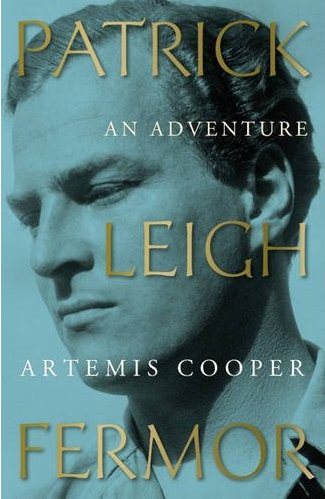
Patrick Leigh Fermor: An Adventure by Artemis Cooper

A debut novel translated from French is among the six titles shortlisted for the inaugural Waterstones Book of the Year.

Laurent Binet’s HHhH, published in translation by Harvill Secker, is one of only two novels included on the shortlist, announced today (30th October). Also shortlisted is the Man Booker Prize-winning Bring Up the Bodies by Hilary Mantel (Fourth Estate).

The remaining titles are all non-fiction: Patrick Leigh Fermor: An Adventure by Artemis Cooper (John Murray); The Old Ways: A Journey on Foot by Robert Macfarlane (Hamish Hamilton); On The Map: Why The World Looks The Way It Does by Simon Garfield (Profile Books); and Polpo: A Venetian Cookbook (Of Sorts) by Russell Norman (Bloomsbury Publishing).

The winning title will be promoted in Waterstones stores in the month of December as The Book of the Year, with the chain bookseller’s managing director James Daunt heading up the judging panel to select it.

Binet’s novel tells the story of Operation Anthropoid, the assassination of Nazi leader Reinhard Heydrich in Prague during the Second World War. Its title refers to “Himmlers Hirn heisst Heydrich” (“Himmler’s brain is called Heydrich”), a quip about Heydrich said to have circulated in Nazi Germany. It was awarded the 2010 Prix Goncourt du Premier Roman.

Daunt said: “In an extremely strong year of publishing, we have an exceptional shortlist for our Book of the Year. They have such singular attributes, it will be fascinating to see which emerges the winner.”

The books on the shortlist have not been put forward by publishers. Instead, all Waterstones booksellers were invited to nominate the new book that they thought deserved the Book of the Year title and that they wanted to help more people discover. They were asked to choose a book that stood out in its field, and that would speak to the company’s core customers ­ defined as “those people who love reading and love books.”

The winner will be announced on Thursday 29th November at the Waterstones Christmas Party, which will take place at the bookseller’s King¹s Road shop in Chelsea (London). As well as the support of the entire Waterstones business, the winning author will also receive a case of champagne.

From The Bookseller 30 October 2012

Artemis Cooper to speak at King’s School Canterbury, 14 November

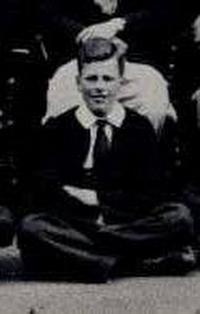
Patrick Leigh Fermor at school, Kings’ Canterbury

Artemis Cooper, the author of Patrick Leigh Fermor: An Adventure, will give a talk on Wednesday 14 November at 7.30 pm in the Clagett Auditorium, Canterbury Cathedral Lodge.

Sir Patrick Leigh Fermor (1915-2011) was one of the King’s School’s most distinguished old boys. He was in The Grange from 1929 to 1931. He went on to be a war hero and is regarded as one of the greatest travel writers.

The biography was published by John Murray on 11 October.

Artemis has already produced Words of Mercury, a selection of Leigh Fermor’s writings, and is now editing what survives of the planned third volume of his autobiographical trilogy, following on from A Time of Gifts and Between the Woods and the Water. It is due to be published in the autumn of 2013 and will be called The Broken Road.

Tickets for the talk cost £5 and are available on-line from The King’s Box Office, or in person from 1 Mint Yard, or on the door. Copies of the book will be available at the talk.

From the King’s School website.

Related articles:

A combination of prefab, garage and potting shed

Some Memories of King’s .. And the final word goes to?

The Observer review of Patrick Leigh Fermor: An Adventure

The Observer review of Patrick Leigh Fermor: An Adventure which concludes that life was one great adventure for Paddy, with the hard part now being to separate the fact from the fiction. It concludes that Fermor emerges as a man determined to live on his own terms, if not his own means!

By Anthony Sattin

First published in The Observer, 21 October 2012.

Traveller and writer Paddy Leigh Fermor is best known for two events. In 1933, at the age of 18, he set off with a little money and a lot of nerve to walk from the Hook of Holland to Constantinople. Eleven years later, with an equal amount of nerve, he led a commando group to occupied Crete to kidnap General Kreipe, the local Nazi commander. From these two events sprang the subjects and passions for his work and his life, the subject of Artemis Cooper’s new biography.

Fermor is a seriously challenging subject for any biographer, perhaps more so for Cooper, who knew him from a very early age. She was contracted to write the book in the 1990s but on the condition it did not appear before his death, perhaps wanting to spare his wife, friends and self the stories of his sexual adventures. Given his wine and cigarette intake, Cooper would have been forgiven for thinking he wouldn’t last as long as he did: he died last year at the age of 96. But not even close acquaintance with her subject and unrestricted access to his archive and friends will have made it any easier to get around the main obstacle: the man himself.

A school and army reject, Fermor was a self-made man in the most literal sense. He started, in the words of his headmaster, as “a dangerous mixture of sophistication and recklessness”. With those and other qualities, he honed his character with the company of extraordinary people and the words of great writers – he had a prodigious memory for prose as well as poetry. However complex his character, it was made more so, from a biographer’s point of view, by the fact that he had already written his own version of some of his life. His books contain some of the finest prose writing of the past century and disprove Wilde’s maxim that “it is better to have a permanent income than to be fascinating”.

Charm, self-taught knowledge and enthusiasm made up for the lack of a university degree or a private income. His teenage walk across Europe and subsequent romantic sojourn in Baleni, Romania, with Princess Balasha Cantacuzene are proof enough of that. But the difficulty of capturing such an unconventional and glamorous life is made harder by the certainty that Fermor was an unreliable narrator.

He was also an infuriatingly slow writer. Driven by a life-long passion for words yet hampered by anxiety about his abilities, Fermor published eight books over 41 years. The Traveller’s Tree describes his postwar journey through the Caribbean; Mani and Roumeli (1958 and 1966) draw on his experiences in Greece, where he would live for much of the latter part of his life. But it is the books that came out of his trans-Europe walk that reveal both the brilliance and the flaws. A Time of Gifts was published in 1977, 44 years after he set out on the journey. Between the Woods and the Water appeared nine years later. Both describe a world of privilege and poverty, communism and the rising tide of Nazism, and end with the unequivocal words, “To be continued”. Yet the third volume hung like an albatross around the author’s neck. As the years passed, Fermor found it impossible to shape the last part of his story in the way he wanted. Yet Cooper refers to one manuscript written in the 1960s, and a diary, and from these the final volume will be fashioned and published next year.

Fermor’s longevity also presents challenges: there is much to record of more than nine decades of travelling, flirting, writing and hard living. Cooper runs through it mostly chronologically, drawing on published work, intimate letters, unpublished notebooks, and letters and interviews with some of the many people who knew and loved him. There are places where she verifies things that might otherwise have seemed a little incredible – some of the hospitality he enjoyed on his Constantinople walk, for instance. There are other places where she shows up inconsistencies. Some were no doubt due to his writing about events from a distant past, but some were deliberate. As Cooper explains it, these came about “partly because he is condensing more than one encounter, and partly out of tact”. He was also quite happy to merge details or elaborate in order to make his story work better. Some might feel cheated by the fabricating of non-fiction but Fermor would insist he always remained true to the spirit of the event.

Fermor emerges as a man determined to live on his own terms, if not his own means, and who mostly – and mostly magnificently – succeeded. Always popping off on a journey when he should have been writing about the last one, always ready to party, he was forever chasing beautiful, fascinating or powerful women, even when with his wife, Joan. She was the great facilitator who funded his passion for travel and writing, as well as women, from her trust fund. Cooper shows that he had often had such a character in his life, starting with his earliest memories, during the first world war, when he was left with a Northamptonshire family, including an older girl he thought was his sister, while his mother and real sister returned to India to be with his father. Fermor remembered spending those first years, “said to be such formative ones, more or less as a small farmer’s child run wild: they have left a memory of complete and unalloyed bliss”. Running wild, as Cooper shows, was one of the things he would do best during the 92 years that followed.

This is not a perfect book. There is too little analysis of man and motives and not enough probing throughout, as though Cooper could still imagine the wild family friend leaning over her shoulder as she wrote. But then Fermor was far from perfect himself. Instead he was funny, learned, sexy, irrepressible, flawed yet much loved, remarkable and, at times, brilliant – not unlike this book. Cooper ends with the words, “it all really happened”, although by then I was in no doubt.

Patrick Leigh Fermor: An Adventure will also be the BBC Radio 4 Book of the Week from 19th November onwards.

You can buy Patrick Leigh Fermor: An Adventure here.

Don’t forget to visit Artemis Cooper’s Facebook page for further information.

‘A Tonic and a Treat’ – Patrick Leigh Fermor: A Celebration

Last Wednesday over seven hundred people packed out the main lecture hall of the Royal Geographic Society to hear Colin Thubron question Artemis Cooper about Paddy’s life in a joint event with the Royal Society of Literature, of which Colin is President. The event, sponsored by Art Tours, was entertaining, if perhaps a little shorter than one would have liked.

By Tom Sawford.

Artemis revealed how difficult it was to get Paddy to talk about his life, his experience and friends until on one visit to Kardamyli after Joan’s death she found every horizontal surface of his study, including the floor, covered with groaning piles of books, magazines, journals and personal correspondence (and I daresay some unpaid bills!). She offered to help him create some order and in doing so she started to ask questions: ‘I didn’t know that you had met so-and-so’ at which point Paddy, always happy to be distracted from his Herculean struggle with Vol Three, would brighten and start to expound on this outing, that visit or other glittering adventure. It was in this way that Artemis was able to make notes and get behind what she describes as the ‘waterfall’ of banter when asked directly to talk about his life.

It appears also that Paddy was perhaps always happy to receive visitors and recount old stories as he suffered both from bouts of personal depression and writer’s block.  Colin Thubron described the time that he and Paddy went for a long swim at Kardamyli and when well away from the house and others he talked to Colin about his struggles with this block, and his inability to understand this and his state of mind. Artemis said that Paddy was not ‘an intellectual’ and did not think too deeply. He was a ‘polymath’, less inclined to ask why, but rather dazzled, entertained, and fascinated by outward appearances and the sheer joy of being.

The other great excuse for not working was his correspondence with the three great correspondents of his life: Debo Devonshire, Annie Fleming and Diana Cooper. They were an ‘entertainment’ which Paddy approached with great enthusiasm and which ‘took up a lot of his time’ enabling him to divert his energies from his other writing.

We were also given a glimpse of The Broken Road (Vol Three) which is being edited jointly by Artemis and Colin. As the biography tells us it will be based almost entirely on the work that Paddy wrote in the early sixties for a US magazine ‘A Youthful Journey’ which was meant to be no more than 5,000 words. Once Paddy had reached the Romanian-Bulgarian border in this retelling he was suddenly gripped by a passion to write down this story in great detail, the result being over 50,000 words about the leg from Romania to Istanbul, although Colin said that the account does not include his time in the City.

Colin told us that this is difficult work, and they are being most careful not to add their own words. There is much work to be done but as I was told last week by Roland Phillips from John Murray, the publication date remains September 2013, not far short of the 70th anniversary of the start of Paddy’s youthful journey.

During the question and answer session a variety of subjects were raised from the condition of the house at Kardamylli – things are moving forward – to whether or not the Horace ode recitation actually did happen – yes it did but it may not have been on Mount Ida.

When it came to the last question a rather large man, wrapped in colourful braces stood up and shouted out that this was not a question but a statement, a Traveller’s Tribute. I think I could hear the whole audience groan quietly in apprehension, but all turned out well. Holding up a copy of the biography he boomed ‘This book is nothing short of a tonic and a treat! It kept me sane today during a long and boring train journey from Scotland!!’ Cue laughter and applause.

The event was sponsored by Art Tours who are arranging a tour of Patrick Leigh Fermor’s Mani in the spring of 2013. Places are limited and already about half are taken so if you wish to go on this tour, which will include Artemis Cooper as a guide and key speaker, please make contact with Edward Gates at Art Tours as quickly as you can edward[at]arttoursltd.com

In addition Art Tours have 15 signed copies of the biography Patrick Leigh Fermor: An Adventure to give away in a competition. To have a chance of winning, please send your Name, Postal Address, email address, and telephone number to Edward. Winners will be contacted in early November.

If you would like to know more about the Mani tour please download this pdf or contact Edward Gates at Art Tours Ltd on +44 (0)207 449 9707 or by email edward[at]arttoursltd.com


Nomad who lived in caves and palaces

The review you have all been waiting for from the Daily Mail.

By Philip Marsden

First published in The Daily Mail, 15 October 2012.

Patrick Leigh Fermor was, to his many fans, a child of the gods. He was good-looking, charming and adventurous, his conversation a stream of brilliant references, jokes and anecdotes. He could recite poetry and sing songs in more than half a dozen languages. ‘Wouldn’t it be lovely,’ suggested one of his circle, ‘if Paddy came in pill-form so you could take one whenever you felt depressed.’

He was also a war hero. He spent a good deal of time behind German lines in Crete, and was awarded the DSO for capturing the island’s commander General Kreipe.

For rest and recreation he would slip across the sea to Cairo where he was at the centre of a group of fearless officers who lived and partied at a villa on the Nile. The baths were filled with alcohol and, for Christmas 1942, they served turkey stuffed with Benzedrine.

Yet in terms of his legacy, Leigh Fermor’s high jinks are far outweighed by his meticulously crafted writing. He produced prose of such lyrical power that almost single-handedly he freed travel writing from its backwater and pushed it into the literary mainstream.

Nowhere did his life and his writing combine to greater effect than in his masterpiece A Time Of Gifts. The book tells the story, the  first part at least, of his year-long, pre-war hike from the Hook of Holland to Constantinople. He was 18. At one moment he might be sleeping in a cave in the Carpathians, at the next in a schloss or palace.

He makes friends wherever he goes. He has a number of dream-like affairs until he meets a Romanian woman, Balasha, with whom, until the war five years later, he lives and travels – alternately in Greece and on  her family estate in the forests  of Moldova. Life for Leigh Fermor continued in much the same way after the war. But now the Soviet shadow lay across much of the old Europe he knew.

The more poignant moments of Artemis Cooper’s captivating biography come from the intertwined story of Balasha. ‘They do not want us, our education and culture any more,’ she wrote to him in 1946. Years later, Leigh Fermor slipped into Ceausescu’s Romania to find her living in an attic.

For two days they laughed and reminisced, but loss and hardship had aged her. He left undetected, and set up a postal account for  her in a London bookshop.

For most of the Fifties, Leigh Fermor was on the move – flitting between Paris and Devon, monasteries in Normandy, a  half-ruined palace near Rome  and his beloved Greece.

He wrote and read and fell in and out of love. But increasingly he found himself returning to a photographer he had first met in Cairo, Joan Rayner.

It was a strange and open relationship. They finally married in 1968, and built the house in Greece where they lived for the rest of their lives.

It is not easy writing a biography of someone who has poured so much of his own life into his books, but Artemis Cooper has done a brilliant job.

The story rips along, as Leigh Fermor’s life did, with friends and lovers, books and journeys and parties, all milling and jostling around him in a noisy and joyous throng.

And in the quieter moments we are left with something far more enduring: a man for whom the world was endlessly fascinating, and who found that he could recreate for his readers with carefully crafted words the same wonder that it gave him.

Patrick Leigh Fermor: An Adventure will also be the BBC Radio 4 Book of the Week from 19th November onwards.

You can buy Patrick Leigh Fermor: An Adventure here.

Don’t forget to visit Artemis Cooper’s Facebook page for further information.

The Scotsman review: Patrick Leigh Fermor: An Adventure by Artemis Cooper

Patrick Leigh Fermor led one of the most enviable of 20th-century lives. The usual difficulty confronting the biographer of another writer – that the subject did little but sit at a desk and write – does not apply here.

By Roger Hutchinson

First published in The Scotsman 20 October 2012

Once he knuckled down to it, Leigh Fermor loved playing around with words. He was one of our greatest stylists and he was devoted to producing unimprovable books. But writing did not come easily to him, at least partly because it was something of a distraction from the main event, which was living an unimprovable life.

The difficulty in this case is rather how to tell the story of an inimicable writer whose own published work, from the travelogues to the letters, was itself autobiographical, without producing an inferior cover version. Patrick Leigh Fermor has a legion of devoted fans who can recite the story of his wartime abduction of General Heinrich Kreipe, for instance, by rote – and often do. In describing Leigh Fermor’s life, Artemis Cooper had often to revisit a told tale while correcting detail, expounding and inserting context. It was not an easy commission, and she has delivered it brilliantly. Cooper’s biography of Patrick Leigh Fermor is subtitled “An Adventure”. That is how we will remember him, as one of the post-imperial explorers; as a man who refused to accept that there were no undiscovered cultural territories left, even within the crowded borders of Europe.

To summarise his adult life: as a restless 18-year-old in 1933, Paddy Leigh Fermor crossed the Channel and then walked from the Hook of Holland to Constantinople, as this most philhellene of modern philhellenes would always call Istanbul.

During the Second World War he joined the Special Operations Executive, who parachuted him into German-occupied Crete. There he liaised comfortably with Cretan partisans and bandits to pull off one of the war’s greatest coups de théâtre: the abduction and safe delivery to Allied captivity of a German commander, General Heinrich Kreipe.

After the war he travelled widely but was always drawn back to Greece. He built a house on the Mani peninsula – which had been, significantly, the only part of Magna Graecia to resist Ottoman colonisation since the fall of Constantinople in 1453. Before his death last year at the age of 96, he wrote some of the most acclaimed travel books of the 20th century.

Two of those books, A Time of Gifts and Between the Woods and the Water told of the first two-thirds of his walk through pre-war Europe. Artemis Cooper is surely right to lay great significance on that particular adventure. Wherever else he went – Leigh Fermor’s first book, The Traveller’s Tree, was about the Caribbean, and he later published three long letters from the Andes – Europe retained his fascination and Greece, the wellspring of Europe, remained his muse.

Walking from Holland to Turkey gave the young Leigh Fermor a pedestrian’s-eye view of an interconnected continent. He saw how customs and dialects changed gradually, mile after mile, from one valley to the next. He used his facility with languages to tease out links between apparently independent cultures. In Cooper’s words, he acquired a “three-dimensional panorama of Europe … both in memory and imagination”.

That panorama, that cultural and historical landscape, was Leigh Fermor’s uncharted territory. His walking companions in the hills of northern Greece would dread the sight of a lonely shepherd, for Paddy would invariably stop and interrogate the man for half-an-hour while his friends kicked their heels and looked nervously at the sinking sun. But Leigh Fermor was not passing the time of day. He was exploring.

Since their deaths, inventions, embellishments and fantasies in the travelogues of Bruce Chatwin and Ryszard Kapusciski have become the subject of critical examination. If any modern travel writer’s experiences seem to skirt the borders of mythology, they would be those of Patrick Leigh Fermor. But Artemis Cooper acquits him of making up anything substantial. He did not in fact ride across the whole of the Great Hungarian Plain. He walked most of it. But “I decided to put myself on horseback for a bit. I thought the reader might be getting bored of me just plodding along … you won’t tell anyone, will you?”

Different characters were sometimes conflated into one person for literary convenience. “Paddy was making a novel of his life,” writes Cooper. That may be so. His working title for the transcontinental epic was Parallax, which suggests a degree of displacement from reality. But if so, it was a novel based firmly on non-fiction. Cooper is nonetheless right to query the spirit if not the detail of what has become, for male readers at least, one of the most memorable incidents in Paddy’s travels.

He was swimming naked in a central European river with a young aristocrat when – according to Leigh Fermor – two young peasant girls teased them from the bank. A chase ensued, which resulted in an orgy in a hayrick. All very Cider With Rosie, but Cooper wonders “were Rumanian peasant girls really so spontaneous and easy-going?” It appears that female migrant harvest workers of the time were “expected to oblige young gentlemen of the estate”. A carefree romp in the hay in the years before Europe burned may actually have been the cynical exercise of droit de seigneur.

If so, it was one of the last occasions that Patrick Leigh Fermor resorted to demanding sex. Peregrine Worsthorne tells of how, as a young man in post-war London, he occasionally found his chatting up of a pretty debutante abruptly curtailed by the arrival in their company of a dashing, handsome war hero, newly arrived from Jamaica or Rhodes and with the tan to prove it. Exit debutante, on Leigh Fermor’s arm.

His partnership with and then marriage to Joan Raynor was an open relationship, at least on Leigh Fermor’s side. More than that: Raynor’s inheritance subsidised his peripatetic life at least until the enormous success of A Time of Gifts in the late 1970s, which in turn created a new market for his previous volumes about Greece, Mani and Roumeli.

Like most enviable lives, it was far from blameless. Wounded women were littered in his wake. Some British visitors to Athens were less than impressed by this Englishman who posed as “more Greek than the Greeks”.

Some Greeks shared their disdain. Revisionist historians criticised his role in wartime Crete, and warned their fellow Hellenes that for all his fluency and charm, Leigh Fermor was no latterday Byron. His unoccupied car was blown up outside his Mani house, probably by members of the Greek Communist Party which he had vocally opposed. The accidental fatal shooting of a partisan in Crete led to a long blood feud which made it difficult for Leigh Fermor to re-enter the island until the 1970s, and possibly explains why he chose to settle in the Peloponnese rather than among the hills and harbours of his dreams.

His own books have already eclipsed those incidents, not only among readers of English but also in Greece, where in 2007 the government of his adopted land made him a Commander of the Order of the Phoenix for services to literature.

Travel writers such as Jan 
Morris have described Leigh Fermor as the master of their trade and its greatest exponent in the 20th century.

When A Time of Gifts was published in 1977, Frederick Raphael wrote: “One feels he could not cross Oxford Street in less than two volumes; but then what volumes they would be!”

They are not for everyone. Leigh Fermor wrote that written English is a language whose Latinates need pegging down with simple Anglo-Saxonisms, and some feel that he personally could have made more and better use of the mallet. His exuberance is either captivating or florid. It is certainly unique among English prose styles.

Artemis Cooper says that “Paddy had found a way of writing that could deploy a lifetime’s reading and experience, while never losing sight of his ebullient, well-meaning and occasionally clumsy 18-year-old self … this was a wonderful way of disarming his readers, who would then be willing to follow him into the wildest fantasies and digressions”.

Those fantasies and digressions took decades to express. A Time of Gifts had arguably been 40 years in the making when it was published in 1977. Its sequel, Between the Woods and the Water, did not appear until 1986.

The third and final volume has been awaited ever since. Following Leigh Fermor’s death, a foot-high manuscript was apparently found on his desk. It will be published next year.

In the meantime, Artemis Cooper offers us an abridged version of his last leg through Romania and Bulgaria to European Turkey. He stayed a while in Constantinople, we learn, before taking a boat via Salonika to Mount Athos early in 1935.

Greece was his true destination. Constantinople – Istanbul – was by 1935 no more than the cracked shell of Byzantium. From then on his pulse was with the Hellenes. In them he found the root of the European mystery.

From their midst he set out to solve it. It was a quixotic, endless quest. Artemis Cooper’s fine biography gives colour and substance to the adventure, and a delicate, sympathetic portrait of the man who made it his life.

Patrick Leigh Fermor: An Adventure will also be the BBC Radio 4 Book of the Week from 19th November onwards.

You can buy Patrick Leigh Fermor: An Adventure here.

Don’t forget to visit Artemis Cooper’s Facebook page for further information.

More pictures from the launch of Patrick Leigh Fermor: An Adventure

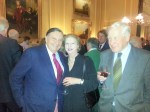
Some further pictures from the launch of the biography last week in Paddy’s old Club, The Travellers, in Pall Mall.

Read Patrick Leigh Fermor’s ‘magical’ tour here and listen to the Radio 4 Today programme recording.


Patrick Leigh Fermor: An Adventure will also be the BBC Radio 4 Book of the Week from 19th November onwards.

You can buy Patrick Leigh Fermor: An Adventure here.

Don’t forget to visit Artemis Cooper’s Facebook page for further information.

My hero: Patrick Leigh Fermor

Patrick Leigh Fermor: his books had a devoted following. Photograph by Joan Leigh Fermor

Patrick Leigh Fermor once seriously annoyed Richard Burton at a London dinner table with Elizabeth Taylor. Burton was in the mood for quoting Shakespeare but the second he stopped, Paddy would cap the quote and go on for several more lines. Finally Burton kicked back his chair and said “Elizabeth, we’re leaving!” Their distraught host accompanied his star guests to the door, urging them not to mind Paddy, who was, after all, a war hero. “F*** war heroes!” roared Burton.

by Artemis Cooper

First published in The Guardian, 20 October 2012

Yet at a time when men were defined by their war, Paddy’s DSO shone with a dazzling lustre. In the spring of 1944, he led the Anglo-Cretan team that captured the German general Heinrich Kreipe and whisked him away from occupied Crete under the very noses of the enemy. There was no doubting his courage. One of the young men who had served with him recalled: “While everybody in our company pretended to be a palikari [a brave warrior], you radiated a genuine fearlessness.” He also possessed a heroic determination. The Kreipe operation nearly ended in disaster, and it succeeded because Paddy refused to acknowledge that possibility. In Budapest decades later he went looking for a sick friend, and spent two days trailing through every nursing home and clinic in the city till he found him. He wrote with painful slowness, going over every sentence again and again, often discouraged to the point of despair – yet he never gave up.

But what of the famous third volume of his trilogy, that he never finished? Did he give up on that? Not really, but in his 90s he must have known that he no longer had the energy to construct the flights of imagination and memory that had earned A Time of Gifts and Between the Woods and the Water such a devoted following. But he never admitted, to himself or anyone else, that it would never be published. If anyone asked he would reply, “I’m plugging away” – and he was.

Patrick Leigh Fermor: An Adventure will also be the BBC Radio 4 Book of the Week from 19th November onwards.

You can buy Patrick Leigh Fermor: An Adventure here.

Don’t forget to visit Artemis Cooper’s Facebook page for further information.

Travelling man – biography of a charmer

SIR PATRICK LEIGH FERMOR, who died last year at the age of 96, was known to everyone as Paddy, “a friendly, cheerful name with a spring in its step”, writes his biographer, Artemis Cooper. Leigh Fermor lived to the full a charmed life packed with incident and adventure, despite its unpropitious beginnings. His parents returned to India shortly after his birth and only when his mother reappeared four years later did he discover that he had been living, very happily, in someone else’s family. His parents were ill-suited and soon parted. Leigh Fermor was never close to his father, an austere, distinguished civil servant, and he found his mother’s tendency to veer between possessive love and complete neglect destabilising. “A dangerous mixture of sophistication and recklessness”, he was repeatedly expelled from school.

First published in The Economist, 20 October 2012.

Aged 18, precocious and disillusioned, he set out to walk from Hook of Holland to Constantinople. He explored eastern Europe, fell in love with a Romanian princess and lived with her in a Balkan idyll until the outbreak of war. Back in England he was commissioned in the intelligence corps and sent to the Middle East. After escaping from a defeated Greece he returned to Crete to help organise the resistance and made his name with the capture and evacuation to Egypt of a German general. Thereafter he was widely regarded in Greece as a hero second only to Lord Byron. The affection was mutual and 20 years later he built and settled in a house in the south of the Peloponnese. After the war Leigh Fermor continued to travel widely and he used his facility with languages, scholarship and extraordinary memory to good effect as an author. Easily distracted and notoriously slow to complete a piece of writing, he published fewer than a dozen works. But his two books on Greece and, most especially, “A Time of Gifts”, the first of two volumes recounting the story of his pre-war walk across Europe, established him as an acclaimed and bestselling travel writer.

Leigh Fermor was a man of legendary charm with a great gift for friendship. As a young man, footloose with rucksack and notebook, he was readily welcomed into houses humble and palatial. In his company people felt livelier and more entertaining. A friend wished that he could come in pill-form to be taken whenever one felt depressed. He was amusing and amused, quick to burst into song, ever the last to leave a party. Energetic, attractive and susceptible, he regularly fell in love but was devoted to his wife, Joan Eyres Monsell. Despite smoking 80 to 100 cigarettes a day and drinking prodigious amounts of alcohol, he remained remarkably fit. At the age of 69 he emulated Byron and swam the Hellespont in Turkey.

It is not easy to convey the flavour of a man whose fame to a large extent rests on his ebullient personality and conversation but Ms Cooper succeeds admirably in this readable and entertaining book. Nor is she shy of admitting his shortcomings and his bouts of depression when he would retreat to a Trappist monastery in France.

Leigh Fermor was not to everyone’s taste. Some found him insufferably bumptious; his enthusiasm and noise could be “wearing”. Essentially, though, he was well loved, a man of action and a self-taught intellectual, who brightened the lives of his many friends and readers.

Patrick Leigh Fermor: An Adventure will also be the BBC Radio 4 Book of the Week from 19th November onwards.

You can buy Patrick Leigh Fermor: An Adventure here.

Don’t forget to visit Artemis Cooper’s Facebook page for further information.

Patrick Leigh Fermor’s ‘magical’ tour

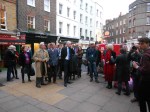
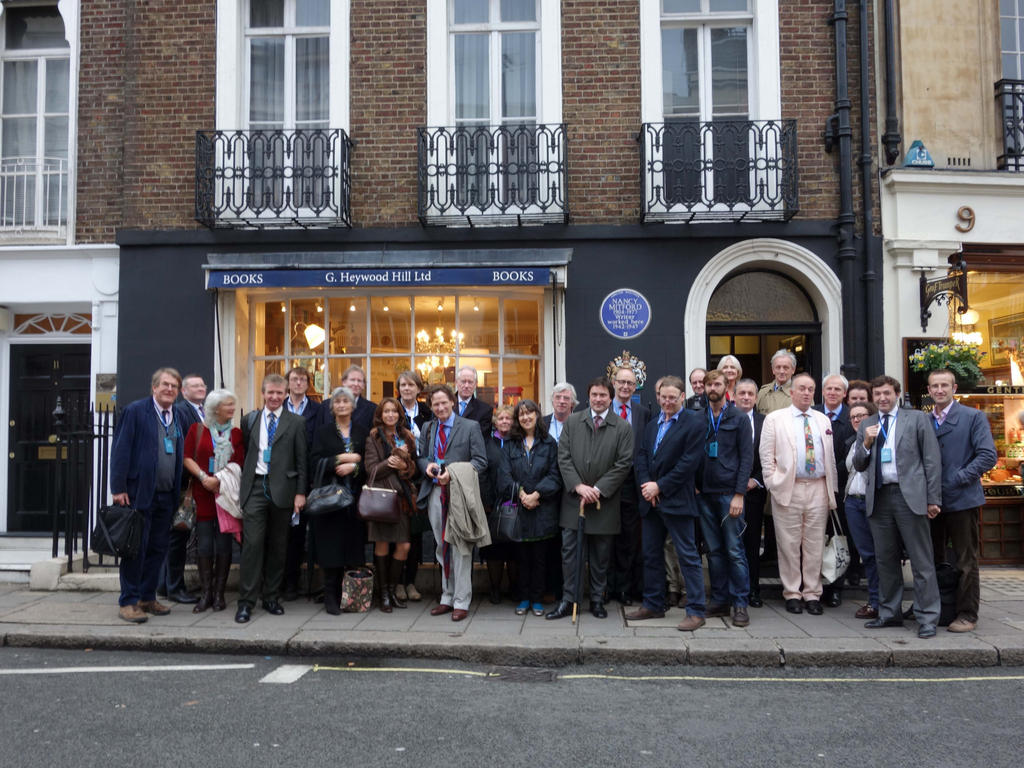
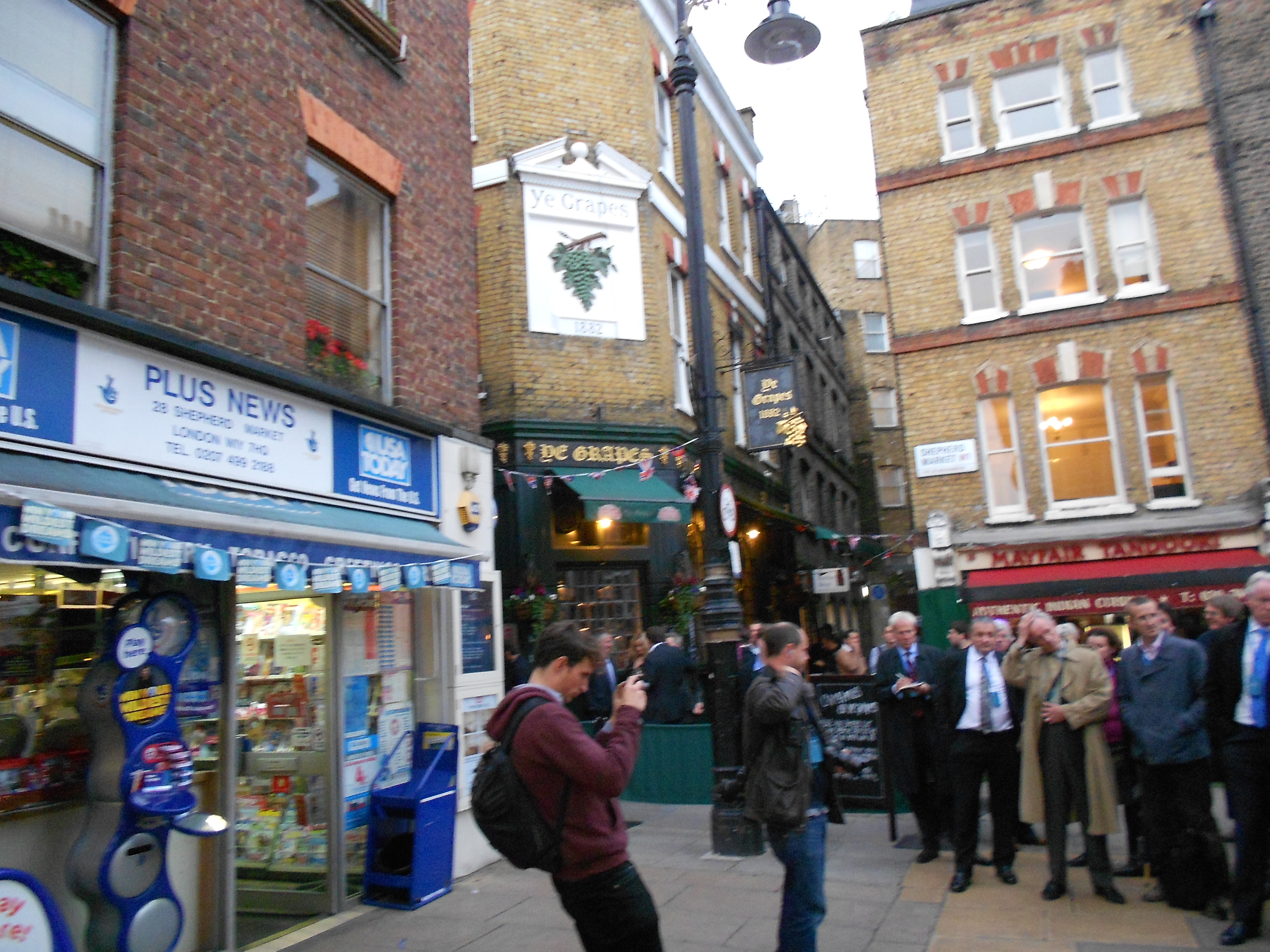
Friends of Patrick Leigh Fermor outside Heywood Hill, his favourite bookshop, in London’s Shepherd Market

To celebrate the publication of Artemis Cooper’s biography of travel writer Patrick Leigh Fermor, Today presenter James Naughtie joined a party led by Artemis Cooper to walk past some of Patrick Leigh Fermor’s London haunts. As you may see from the photograph, the participants included Colin Thubron, Cherie Lunghi, Justin Marozzi, Robert Macfarlane, and Gabriella Bullock who is “Billy” Moss’ daughter.

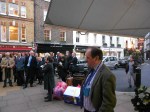
Starting at Paddy’s favourite bookshop (and temporary post-war residence) Heywood Hill, we first braved the traffic in Curzon Street to cross into Shepherd Market where curious drinkers at The Grapes watched as we gazed in awe at 28 Shepherd Market, the place from where Paddy set out on his walk on 8 December 1933. It may have been bombed in the war as the building is a replacement with the enticing Plus News newsagent on the ground floor.

We weaved our way in the dusk to Berkeley Square which Paddy passed through one night during the blitz and later noted ‘only one thing remained standing, three storeys high, stood a white marble privvy’. The journey to Stratton Street was quick and this is where Paddy left two trunks containing most of his documents from the walk which were eventually deposited by the keeper into Harrod’s Depository; Paddy could not pay the large accumulated storage fee and when he did return the trunks and their contents had been sold and dispersed. Artemis observed that perhaps it was a good thing as he had to rely upon his mind and was perhaps ‘set free’.

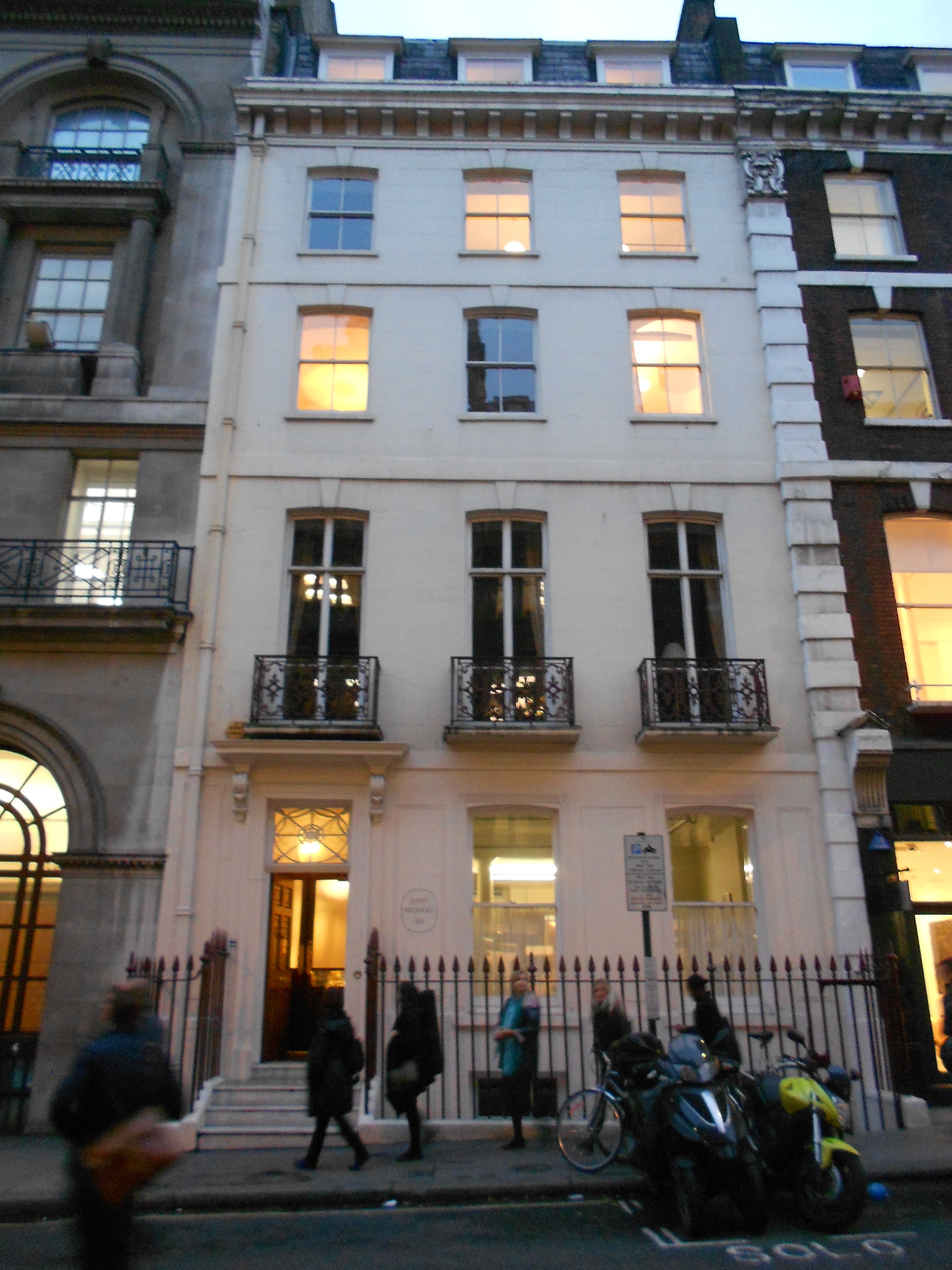
50 Albemarle Street, the entrance to publisher John Murray

Our touristic snake trailed into Albemarle Street and we passed John Murray’s at number 50, crossed Piccadilly to the entrance of The Ritz where Paddy often stayed, but once had great difficulty entering when in training at the Guards’ Depot as he was dressed in the uniform of a private soldier, the Ritz being for officers only.

Paddy went to riotous and notorious parties at The Cavendish hotel in Duke Street, St James’ with many of the “bright young things” which did not include Evelyn Waugh as he had offended the owner, Mrs Lewis who said of him ‘When I see that Mr Waugh I’m going to cut his winkle orf’. Mrs Lewis indulged Paddy and others of somewhat straightened means and let them build up virtually unlimited credit. She knew that they would be unable to pay, but it was small beer to some of her more wealthy clients who did not check their bills too closely and ended up paying for Paddy’s extravagancies.

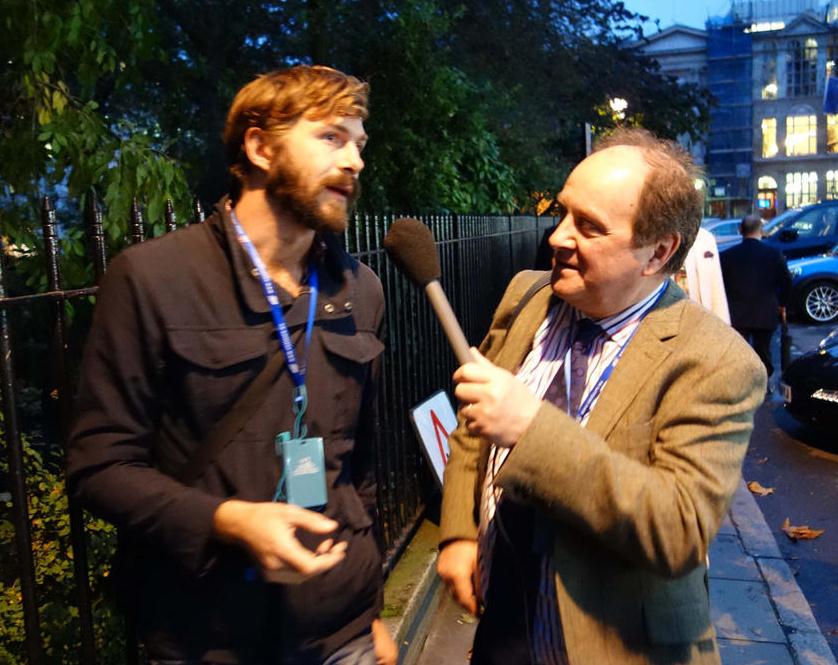
Throughout the walk we were accompanied by James Naughtie from Radio 4’s Today programme. He recorded the package below and left early as you would expect from someone who has to get up at about 3.30 am when presenting the programme. Naughtie grabbed some time with Nick Hunt who walked Paddy’s route from Hook of Holland to Constantinople just this year. He promised to make Nick a star. Let’s hope so.

Nick Hunt being interviewed by James Naughtie

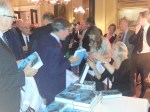
This tour through Paddy’s Mayfair was a pre-cursor to the official launch of Patrick Leigh Fermor: An Adventure at Paddy’s old club, The Travellers. Artemis got a very well deserved round of applause for the biography, and she spent most of the evening busy signing books; dozens must have been sold. Ian Hislop made a sartorially unkempt appearance near the end (how did he get in without a tie?), and I think I saw Bank of England Governor, Sir Mervyn King pop in and do his bit for the consumer economy.

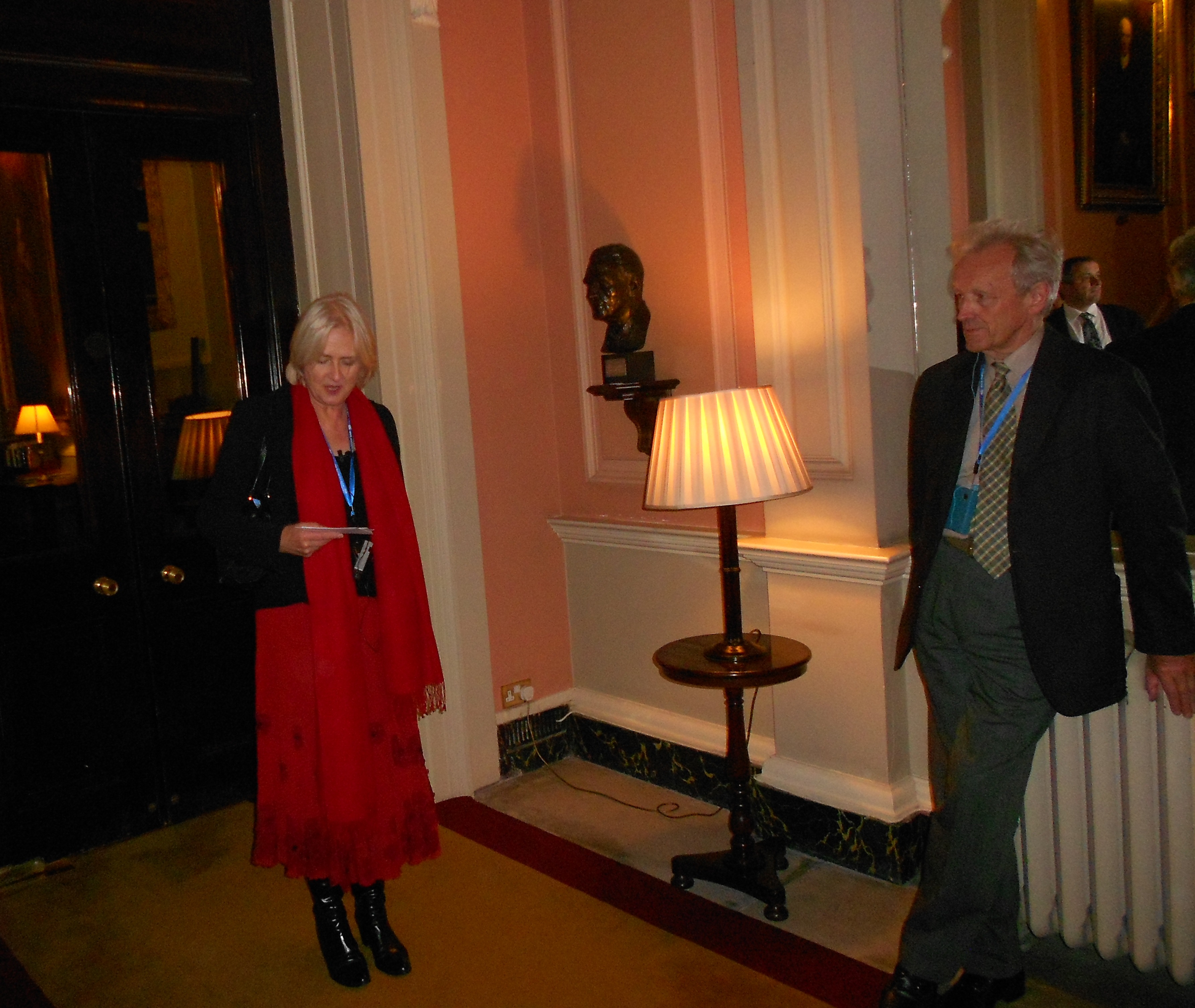
Artemis and Colin Thubron in the lobby of the Travellers Club with bust of Paddy


Patrick Leigh Fermor: An Adventure will also be the BBC Radio 4 Book of the Week from 19th November onwards.

You can buy Patrick Leigh Fermor: An Adventure here.

Don’t forget to visit Artemis Cooper’s Facebook page for further information.

In Paddy’s footsteps around Mayfair – BBC Radio 4 Today Programme now!

Yesterday evening a small group of some of Britain’s best travel writers, the odd actor and even your blog editor were invited by Heywood Hill bookshop to an evening tour of Paddy’s Mayfair led by Artemis Cooper as tour guide in chief. This event was a pre-cursor to the official launch of Patrick Leigh Fermor: An Adventure at Paddy’s old club, The Travellers.

James Naughtie from Radio 4’s Today programme was there to record a package for this morning ‘s programme which will be broadcast in the next hour (probably before 8.30 am). It will probably include an interview with Nick Hunt who is making good progress with his book.

Love letters to foreign lands – from The Spectator

One thing is certain. In the coming days I may bore you with reviews of Patrick Leigh Fermor: An Adventure, but this is one that merits reading as it is more thoughtful. Just wait for the Daily Mail review which I will offer in our mission of complete on-line coverage!

By Philip Mansel

First published in The Spectator, 13 October 2012.

Xenophilia is as English as Stilton. Despite a reputation for insularity, no other nation has produced so many writers who have  immersed themselves in other countries. From Borrow to Lawrence, Byron to Auden, the list is impressive. In one of the wonderful letters quoted in this perceptive, haunting and highly readable biography, Patrick Leigh Fermor called living in England ‘like living in the heart of a lettuce. I pine for hot stones and thorns and olive trees and prickly pears.’ In the opinion of his biographer Artemis Cooper he had an ‘entirely European sensibility’. In the house he built in the mountains of Mani in the Peloponnese, between olive groves and the sea, however, he sometimes missed London.

This is a book about the use and operation of charm, written, as Victorians might have said, by One Who Knew Him Well. Artemis Cooper defines his charm as a combination of ‘happiness, excitement, youth, good looks, eagerness to please and an open heart’. She might have added skill with languages and a driving literary and historical curiosity, not always apparent in the works of Norman Douglas, the Italophile travel writer to whom he was sometimes compared. At least ‘eight languages existed in his head in a state of perpetual acrobatics’. His high spirits — he once described himself as being ‘in a coma of happiness’ — and kind-heartedness helped him to understand other countries — to get under their skin — at least as well as more cynical writers.

A casual remark — ‘castles were seldom out of sight’ — expresses one effect of his charm. After 1934, aristocratic acquaintances entertained and housed him as he walked or rode along the Danube, across the Hungarian plain and into the mountains of Transylvania, on the travels described in A Time of Gifts and Between the Woods and the Water. Wherever he went, arms opened, barriers fell. He ended up in the embrace of Balasha Cantacuzene, descendant of a princely dynasty, living in a manor house in Moldavia. He left in September 1939 to join the British army.

He had chosen well. Diaries, papers and letters recording his journey, lost by Harrods Depository, in his words ‘ached liked an old wound in wet weather’. Throughout the horrors of war and communism, however, Balasha Cantacuzene guarded a  ‘green diary’ which Paddy had left behind in 1939. She returned it at their last meeting in 1965. It was invaluable for writing Between the Woods and the Water.

‘Useless as a regular officer, but will serve the army well in other ways,’ a perceptive commanding officer wrote of Paddy in 1940. Among other feats, our hero delivered, for interrogation in Cairo, a German general whom he had captured in Crete. After 1944 he lived, mainly between Athens and London, in an Anglo-Greek world as distinctive as the Anglo-Florentine world of the 19th and 20th centuries. He particularly enjoyed the ‘louche and delinquent’ dockside tavernas of the Asia Minor refugees in Piraeus.

One of his girlfriends called him ‘the most English person I have ever met’. Perhaps because of his security about his identity, he could step out of his English skin. In the 1950s he supported Greece over ‘the Cyprus question’. In contrast, his fellow Anglo-Greek Lawrence Durrell, who  called him ‘the most enchanting maniac I’ve ever met’, was compared to a Gauleiter by the poet George Seferis for working for Britain in Cyprus.

The books started to appear: Mani (1958) and Roumeli (1966), which includes an enquiry into the clash between the ‘Hellenic’ and the ‘Romaic’ aspects of Greece, between private ambition and wider aspiration, which would interest European bankers today. But it was A Time of Gifts (1977), about his walk across Europe, that made him famous. He was admired in the countries about which he wrote, as well as his own. Not for him the horrors of academic publication, where ‘a few experts stand to attention and salute in half a dozen periodicals; an art historian presents arms here and there. And the rest is silence.’

This is not just the life of a charmer. It is also a book about the process of writing. Cooper, whose admiration does not blunt her critical sense, shows how Paddy blurred the frontiers between truth and fiction. Imagination often replaced memory. In parts of some books he was ‘making a novel of his life’.

His style — described by Cooper as ‘sumptuous, precise and acute’ — was all the more enjoyable for its contrast with the bare prose of postwar Britain. Farewells were ‘shattering deracinations’. In Germany there was ‘hardly an interprandial moment’. The account of Germans eating and drinking in the Munich Hofbrauhaus is a tour de force, over several pages:

Their voices, only partly gagged by the cheekfuls of good things they were grinding down, grew louder, while their unmodulated laughter jarred the air in frequent claps. Pumpernickel and aniseed rolls and pretzels bridged all the slack moments, but supplies always came through before a true lull threatened.

Inevitably there were snipers on the sidelines. Dismissing him from the British Institute of Athens, Steven Runciman complained of ‘Paddy’s little irregularities’: too many parties, too few repaid loans. ‘A middle-class gigolo for upper-class women’,  was the verdict of Somerset Maugham.

Indeed this biography could also be a handbook on how to live with a writer. Joan Eyres Monsell, whom Leigh Fermor married, took and labelled photographs as a visual reference for his books. She read them once a year, and was generous with her money. As she put down a handful of notes when leaving a restaurant, the immortal words — ‘here you are, that should be enough if you want to find a girl’ — were overheard by a friend.

Paddy’s only novel, The Violins of Saint Jacques (1953), is one of his finest works. Brilliantly plotted and playfully written (tree roots are ‘like dancing partners in a waltzing forest’), at a faster pace than later books, it is a portrait of a vanished French colony, Saint Jacques des Alises, ‘the glory of the Antilles’, in 1900. It is also a novel of aristocratic decline, which anticipates aspects of  Sybille Bedford’s A Legacy and Lampedusa’s The Leopard. It describes  the impact on a private love affair  — between a Count’s daughter Josephine de Serindan and the governor’s son Marcel Sciocca — of the political feud between French royalists and the Third Republic. It culminates in one of the most dramatic ball scenes in an English novel, which ends in an eruption: ‘It looked as if the volcano was conspiring with the Count to add lustre to his rout.’ In the end, with ‘a deafening clap of thunder as if the world had been blown in two’, the volcano destroys the island. All that remains is the sound of violins, heard every carnival from beneath the waves.

All Leigh Fermor’s books are love letters to foreign lands — Caribbean islands, France, Austria, Hungary or Greece. The loss of his projected books on Crete and Romania is, for admirers, a tragedy. Hopefully it will soon be mitigated by the publication of more letters, his portraits of friends, and his 1963 account of ‘A Youthful Journey’ from Orsova to the Black Sea.

Patrick Leigh Fermor: An Adventure will also be the BBC Radio 4 Book of the Week from 19th November onwards.

You can buy Patrick Leigh Fermor: An Adventure here.

Don’t forget to visit Artemis Cooper’s Facebook page for further information.

Independent review of Patrick Leigh Fermor: An Adventure, By Artemis Cooper

I have disliked the cult of Paddy Leigh Fermor ever since reading Between the Woods and the Water, the first book of his pressed into my hands. It had won all sorts of travel awards, but seemed to chronicle a life of effortless ease moving from one country-house party to another, fuelled by intricate aristocratic connections and coloured by a frankly unbelievable glow of back-lit romance – like being trapped in a grown-up version of The Sound of Music.

By Barnaby Rogerson

First published in The Independent, 13 October 2012.

I began to question the 50 years of unstinted hero-worship accorded him by my elders and betters, alongside his irritating lack of regard for either Turks or Islam, as well as the breathless accounts of two generations of British travel-writers who have sought to measure their shadow against that of Paddy’s over a glass of ouzo on the terrace of his house overlooking the Aegean.

But, fortunately, I find myself to be totally in the wrong. Artemis Cooper’s funny, wise, learned but totally candid biography reveals Leigh Fermor (1915-2011) to be an adventurer through and through. The artifice of effortless gentility is blown away and Paddy is revealed as a much more interesting character, a fascinatingly self-made and self-educated man. He is also placed in the pantheon of literary liggers, a consummate lifelong freeloader, a prince among sponge-artists, which he paid for with his unique energy, talent and enthusiasm for song, dance, talk, memorised verse, drink and other men’s wives.

Freya Stark, describing her first meeting, left an impression of him “looking in this wine-dark sea so like a Hellenistic sea-god of a rather low period, and I do like him. He is the genuine buccaneer.” Steven Runciman complained how in his office in Athens “all the girls were love with him… and how he used to borrow money from them”. Somerset Maugham, with his customary acerbic malevolence, labelled him a “middle-class gigolo for upper-class women”. That can be balanced (not exactly contradicted) by the fond memories of an old lover: “Most men are just take, take, take – but with Paddy it’s give, give, give.”

So the first third of the biography is bowled along by an inner tension, for the reader cannot but suspect that the sexy young man who occupies the centre of the stage isn’t about to be exposed and fall very heavily from grace. Paddy consorted with the very grandest British families, at their country homes and in London, but yet had no money, no work, no home, no prospects and not much of an education, having been expelled from a number of prep schools and his second-rate public school.

Even his double-barrelled name is revealed to be a fake, one of the many deluded affectations thought up by his snobbish mother: the daughter of a prosperous Irish quarryman, unsuitably married to a brilliant scholarship boy from south London. Cooper gives us a grounding to Paddy’s adventurous life by providing occasional glimpses of the parallel middle-class story of his elder sister, Venetia.

The making of Paddy was a decision, one hungover morning, in 1933, to hang up his borrowed tail-coat and abandon the Bright Young Things, buy some army surplus clothing, catch a ferry to the Hook of Holland and start walking to Constantinople. He took just three books, a German dictionary, the Oxford Book of English Verse and a present from his mother, a copy of Horace inscribed “leave they home, O youth and seek out alien shores”.

She had lived this advice, abandoning him as a baby for four years to return to her geologist husband in India. But frustrated by her marriage and gifted with restless misdirected energies, she would return and teach Paddy to perform, while coping with her mood swings, before packing him off to an unsuitable prep school at a tender age.

Paddy loved life on the road, and all his life was genuinely fascinated by history, literature and architecture. He also had an extraordinary ear for languages, and lived with an intensity that attracted everyone he met, be it bargees giving him a lift after getting spectacularly drunk at a bar or Bohemian landlords astonished at the interest and encyclopaedic but disordered knowledge of this handsome tramp. The final making of him as a man was the love of Princess Balasha, who having been abandoned by her own husband, took Paddy off to live with her in a manor house in Moldavia.

His years in Romania with Balisha were his university, but more vivid. For here history smelled of blood, and pride in ancient chapels and mythology came alive in the spirit-possessed dances of the peasants.

Paddy only came back home in order to fight for Britain when war had been declared. Despite his ambition to serve in the Irish Guards, he was rightly judged “quite useless as a regimental officer but in other capacities will serve the army well”. Those capacities, most especially as an SOE liaison officer with the Cretan resistance, have deservedly become legendary. Paddy’s charm, his infectious delight in company, his ear for language, his physical strength and bravery, were matched by something much, much rarer in war: an innate sense of empathy, humanity and compassion.

The final touch to his birth as a writer was the unconditional love and financial support of the photographer Joan Rayner. She could cope with his fits of depression, his absences, his habitual philandering and was his travelling companion, editor and occasional restrainer. She was the enabling hero of the second half of Paddy’s life, who shared his love of Greece and the open road, and provided the supporting mother and father that Paddy had so completely lacked as a child.

Paddy for his part would try to give back to the world all the many gifts he had received as a man: his books on Greece, first and foremost, but also by entertaining a stream of visitors, holidaying friends, translating for Cretan colleagues, denouncing British policy over Cyprus, writing reviews and forewords, and encouraging young writers. As Dilys Powell wrote, “a wandering scholar but with a difference; unlike the celebrated travellers of the past, he has become part of the country he describes”. And since my reading of Cooper’s page-turning biography, he has acquired yet another fan.

Patrick Leigh Fermor: An Adventure will also be the BBC Radio 4 Book of the Week from 19th November onwards.

You can buy Patrick Leigh Fermor: An Adventure here.

Don’t forget to visit Artemis Cooper’s Facebook page for further information.

‘Biography is dirty work; someone has to do it’

Mariella Frostrup

Listen to Paddy’s biographer Artemis Cooper on the BBC Radio 4 programme Open Book discussing the art and challenges of writing a biography, and of course the writing of Patrick Leigh Fermor: An Adventure.

A very interesting conversation between Artemis, presenter Mariella Frostrup, and the prolific biographer Hunter Davis. Their discussion starts at 11 min 30 seconds after the first package with Michael Chabron.

Listen online here

Download the MP3 by clicking here.

If you have difficulties go to the Open Book download page and look for the October 14 2012 episode.

The ultimate pilgrimage to Paddy’s house in the Mani?

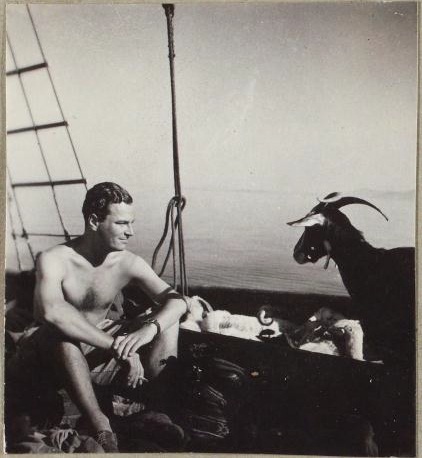
Paddy with Goat! Photo by Joan Leigh Fermor, from the Trustees of the National Library of Scotland

If you wanted to make a trip to see Paddy’s house at Kardamyli and to visit the wider Mani this may be the one for you. In the company of Paddy’s biographer, Artemis Cooper, this six-day tour will take in Mistra, Monemvasia, and Paddy’s house in Kardamyli, as well as other sites in the Mani.

This tour has been arranged by Art Tours (sponsors of the Royal Geographic Society event about Paddy 24 Oct) and is designed to celebrate Paddy’s life, whilst exploring the dazzling, rocky region he loved best in Greece, and where he and Joan lived for over forty years.

It is a celebration of his life and travels and is planned to run from 7-12 May 2013. Artemis will bring a unique insight into Paddy’s life and personality, and to cover the wider history of the region she will be joined by art historian James McDonaugh.

If you would like to know more please download this pdf or contact Edward Gates at Art Tours Ltd on +44 (0)207 449 9707 or by email edward[at]arttoursltd.com

Guardian review of Patrick Leigh Fermor: An Adventure

Perhaps the most remarkable thing about Patrick Leigh Fermor’s legendary life is that it lasted as long as it did. He died in 2011 at the age of 96, having survived enough assaults on his existence to make Rasputin seem like a quitter. He was car-bombed by communists in Greece, knifed in Bulgaria, and pursued by thousands of Wehrmacht troops across Crete after kidnapping the commander of German forces on the island. Malaria, cancer and traffic accidents failed to claim him.

By Robert Macfarlane

The Guardian, Friday 12 October 2012.

He was the target of a long-standing Cretan blood vendetta, which did not deter him from returning to the island, though assassins waited with rifles and binoculars outside the villages he visited. He was beaten into a bloody mess by a gang of pink-coated Irish huntsmen after he asked if they buggered their foxes. He smoked 80 cigarettes a day for 30 years, and often set his bed-clothes ablaze after falling asleep with a lit fag in hand. He drank epically, and would “drown hangovers like kittens” in breakfast pints of beer and vodka. As a young SOE agent in Cairo in 1943, the centrepiece of his Christmas lunch was a turkey stuffed with Benzedrine pills; at the age of 69 he swam the Hellespont – and was nearly swept away by the current.

Yes, Leigh Fermor was an insurer’s nightmare, an actuary’s case-study, and his longevity was preposterous. He might best be imagined as a mixture of Peter Pan, Forrest Gump, James Bond and Thomas Browne. He was elegant as a cat, darkly handsome, unboreable, curious, fearless, fortunate, blessed with a near-eidetic memory, and surely one of the great English prose stylists of his generation.

In 1933, aged 18, he set off to walk from the Hook of Holland to Constantinople, passing through a Europe on the brink of calamity. Decades later, he published two books recounting his wander through that enshadowed land, A Time of Gifts (1977) and Between the Woods and the Water (1985). Both were instant classics, celebrated for their evocation of a since-shattered world, and for the tendrils and curlicues of their language. In between that walk and those books, Paddy (as he was mostly known) was the lover of a Romanian princess, took part in a royalist cavalry charge in Greece, parachuted into occupied Crete to co-ordinate the resistance, spent months in silent retreat in monasteries, became the most famous English Hellenophile since Byron, was played by Dirk Bogarde in a Powell and Pressburger film, and transformed travel writing.

He lived an inspirationally heterodox life that combined adventure and reflection in unique measure. His story has hitherto been known only in parts, and mostly through the refractive prism of his own tellings. At last his biography has been detailed in full, in Artemis Cooper’s tender and excellent book. Reading it is an odd experience: there is the melancholy of having one’s hero humanised, joined with renewed astonishment at the miracle he made of himself. Continue reading

You can still win some wonderful prizes in Heywood Hill’s Paddy competition

As many will know, Paddy set off on his European odyssey from Shepherd Market in Mayfair. His biographer, Artemis Cooper, has discovered that Paddy and Joan lived above Heywood Hill’s bookshop in Shepherd Market after the war. He kept an account there for Balasha Cantacuzene, the Romanian princess and great love of his youth, so that she could buy books whenever she wanted. He remained a lifelong customer of Heywood Hill.

This wonderful bookshop which I visited last week is offering you all the chance to win some amazing prizes in a draw to celebrate the publication on 11 October of Artemis Cooper’s biography of Patrick Leigh Fermor: An Adventure. If you order a copy through them you will be automatically entered to win:

1st Prize

Signed First Edition of A Time of Gifts by Patrick Leigh Fermor
Original John Craxton lithograph from A Poet’s Eye 1944
Watercolour of a View From The Library at Kardamyli by Isobel Brigham
Magnum of Laurent-Perrier Brut NV
£100 Heywood Hill voucher

You may well have already ordered a copy of the book at Amazon or some such place, but you know that you will need a second copy to give as a present to Aunty Mable, so why not order a further copy from Heywood Hill and have a chance of winning?

The first edition is worth in the region of £500 alone and was donated by John Murray, let alone a original Craxton!

The Heywood Hill Prize Draw closes on the evening of 29 November when the winner will be drawn from a hat by Artemis Cooper.

To order your copy and to enter The Heywood Hill Prize Draw 2012, contact them at:

10 Curzon Street, London W1J 5HH
+44 20 7629 0647

PLF@heywoodhill.com

More details available on the Heywood Hill website.

http://static.heywoodhill.com/prize_draw_2012.htm

A man so charming he won over his hostage

Charles Moore reviews ‘Patrick Leigh Fermor: an Adventure’ by Artemis Cooper (John Murray) 

By Charles Moore

First published in the Daily Telegraph 08 October 2012.

The single most famous story about Patrick Leigh Fermor is his kidnap of the German General Kreipe in occupied Crete in 1944. The fugitive party of two British officers and three Cretans spent an uncomfortable night on the slopes of Mount Ida. As the dawn broke, and lit the mountain, Leigh Fermor heard the General muttering the first line of Horace’s Ode to Thaliarchus: “See, Soracte’s mighty peak stands deep in virgin snow.” Leigh Fermor recognised the Latin, and quoted the rest of the poem. As he later put it, “…for a long moment, the war had ceased to exist. We had both drunk at the same fountains long before; and things were different between us for the rest of our time together.”

This moment of ancient, shared civilisation overcoming a terrible present is a great theme. It is the subject, for example, of Jean Renoir’s film La Grande Illusion, in which a French and a German officer on opposite sides in the First World War feel that they share what really matters.

Leigh Fermor’s long life (he died last year aged 96) was full of dash, variety and colour. He wrote beautifully, and entranced beautiful women. He was physically brave, and travelled widely, intrepidly and observantly. He was, in a self-taught way, learned, and a superb linguist. He could sing, dance, compose impromptu poetry and make everyone laugh. He and his wife Joan built a house in Greece of such character and interest that John Betjeman called it “a book in itself”. He was a war hero and, like Byron, a model for many aspiring writers greedy to combine art and life, rather than choosing between one and the other. I knew Paddy a bit myself, and I have never met a man with more charm, by which I mean the ability to create in his interlocutor the feeling of pleasure and possibility. But was it all a grande illusion, a wonderful holiday from reality?

Artemis Cooper was a family friend of Leigh Fermor, and loved him dearly. This excellent, well-sourced book is sympathetic to him. But she is aware of how he could be painted differently, and states the case. Was he, for example, a show-off and a sponger (he was chronically short of money and depended heavily on Joan’s private income)? Was he, as Somerset Maugham put it, “a middle-class gigolo for upper-class women”? Was he, both in life and art, a sort of Peter Pan, shying away from anything grown-up (such as fatherhood), always looking for a Wendy so that he could go on having smiling, heartless fun? He was once asked to contribute to a book about great parties in history with the astonishing title of Memorable Balls: does the phrase fit the life of Patrick Leigh Fermor?

There are certainly moments when it feels like it. The information that Joan used to give him cash so that he could visit prostitutes is one. So – though there is artistic reason for it – is his tendency to present the product of his imagination as fact. Some even argue that the famous kidnap was a piece of useless swagger – what Kreipe called a “hussar-stunt” – which ensured that the Cretans, in reprisal, were treated even more bestially by the Germans.

One cannot ignore these criticisms, and Leigh Fermor felt them himself. Like many delightful, gregarious companions, he doubted whether he deserved to be loved. But, in Artemis Cooper’s convincing reading, he wins in the end.

First, he wins as a friend. He was always grateful to people who helped him (not a well-known characteristic of most writers). He thanked them beautifully, and he did what he could to help them in return. He was famously hospitable, and his life was cluttered by efforts to advance the careers of others, particularly impecunious Greeks. As an editor, I quite often asked Paddy to write things. Most commissions would be refused or – he was famous for this – arrive incredibly late, but whenever I asked him to contribute a memoir of a friend who had just died, he did it with great speed and generosity.

Second, he wins as a writer. Not everyone likes what Lawrence Durrell called (in praise) his “truffled style”, but, unlike so much “fine writing”, it is saved by its energy and wit, its close attention to detail, and its astonishing virtuosity.

I think the friendships and the art went together. Leigh Fermor was profoundly sensitive to human character, particularly in its oddities. His interest in peasants, or monks, or petty gentry, cut off from industrialisation, his fascination with their traditions and customs, their languages and dialects (the more obscure the better) was a human interest, not an academic one. He loved them, and he wanted to rescue and decorate their story.

His most famous books, A Time of Gifts and Between the Woods and the Water, describe his journey on foot, which began in 1933, from the Hook of Holland to Constantinople. They capture, with painterly vividness, what he saw and whom he met. And because those scenes and people were almost obliterated by the Second World War and then by communism, by writing about them afterwards, he gave them the eternal status of literature rather than mere memoir.

In the early Seventies, Greek television did a sort of This is Your Life, in which Leigh Fermor was reunited with his Cretan companions and with General Kreipe himself. How had Paddy treated him, journalists asked the general. “Ritterlich. Wie ein Ritter,” Kreipe replied – “Chivalrously. Like a knight.” Possibly such virtues are dead, but if so, we are the poorer. In life and in literature, Patrick Leigh Fermor proved that chivalry was not all illusion.

Related article:

Patrick Leigh Fermor … This is Your (Ill Met by Moonlight) Greek Life

On the trail of Patrick Leigh Fermor in Greece

This is a little bit toe-curling but as I always say we place all things Paddy related here …  for the record!

Ahead of a new Patrick Leigh Fermor biography, Kevin Rushby visits the Mani peninsula, home of the great man and unsung resting place of another British travel writing giant, Bruce Chatwin.

By Kevin Rushby

First published in the Guardian 28 September 2012.

Kardamyli, on Greece’s Mani peninsula, was home to Sir Patrick Leigh Fermor.

Old Mr Fotis turned my question over in his mind while sipping his morning coffee. Below the veranda some youths had been playing noisily on the harbour wall, but now they all dived into the turquoise sea and set off on the long swim to the rocky island in the bay. It had a fragment of crenellated wall on top of it, the ruins of a Venetian fortress. Fotis watched them go, half-smiling.

“We do seem to attract a lot of writers,” said the old man eventually. “But that’s a name I don’t remember.”

“Bruce Chatwin, Baroose Chit-win, Chaatwing.” I tried a few variations but none struck a chord. “His ashes are scattered somewhere in the hills.”

“No, I never heard of him.”

“What about Sir Patrick Leigh Fermor? You must know about him.”

I’d first heard of Kardamyli because of Leigh Fermor, who had made the place his home. I’d always hoped we might meet, but then the grand old man of British travel writing had died in June 2011 (leaving the literary world praying that he had finished the final volume of his Time of Gifts trilogy). I’d come to the Mani on a sort of literary homage, hoping to find a little of the magic that had attracted first Leigh Fermor and later Chatwin.

The old man shook his head. “No, I don’t think so. There was a writer called Robert. Now he was famous – cured himself of cancer by walking around Crete. [Former South Africa cricketer Bob Crisp wrote of his walk around Crete in the 1970s.] He was very famous.”

This felt all wrong. Was I in the right place? How annoying that the locals should raise this unknown above the two giants of travel literature.

Fotis leaned back and shouted in Greek to his wife in the kitchen. She came through, cloth in hand. “Robert Crisp,” she said, smiling. “What a wonderful man! So handsome! I remember him sitting up at Dioskouri’s taverna drinking and talking with Paddy. They were always laughing.”

My ears pricked up. Fotis’s face underwent a transformation. “Ah Paddy! That is him – your English writer. Of course, Paddy – or Michali we called him. Yes, Paddy was here for years and years. When I was young we used to say he was a British spy and had a tunnel going out to sea where submarines would come.”

It didn’t surprise me. Leigh Fermor had been, by all accounts, extremely old school, endlessly curious and an accomplished linguist – all well-known attributes of British spies. He produced a clutch of good books and two classics of the genre, A Time of Gifts and Between the Woods and the Water, detailing his journey as an 18-year-old on foot to Constantinople.

“Did you see a lot of him?” I asked.

Fotis shrugged. “Sometimes. He liked to walk a lot. Now Robert Crisp – I used to see him. What a character!”

“Is Paddy’s house still empty?” I persisted. “I heard it was now a museum.”

Fotis shook his head. “No, no. He left it to the Benaki Museum in Athens (benaki.gr) and they’re supposed to turn it into a writers’ centre. My guess is nothing will happen for a while.”

I could hardly complain about Greek tardiness: Leigh Fermor himself had taken 78 years over his trilogy, and even then no one seemed very sure if he had completed the task. There was, I decided, only one way to get close to the spirit of these colossi of travel-writing: to walk.

“Which paths did Paddy like best?”

Fotis fetched a map and gave me directions. It was already hot when I left him on his veranda. I could see the youths lazing on the harbour wall again, tired by their long swim. Was this really the time of year for walking?

I headed through the ruined village, as instructed, and found a narrow steep path rising up the hillside. Before too long I came across the stone tomb that locals say is the grave of Castor and Pollux, heavenly twins and brothers to Helen of Troy. Kardamyli is mentioned in Homer’s Iliad as one of the seven towns that Agamemnon gave to Achilles.

Sweat was pouring off me now, but I kept going. Scents of thyme and sage rose from the undergrowth. Fotis had said there were lots of snakes up here, but I didn’t see any. The views of the bay below, however, were becoming more and more magnificent.

The Mani is the middle finger of the three-pronged southern Peloponnese, a 40-mile long skeletal digit that was almost inaccessible, except by sea, until recently. When Leigh Fermor first came here in 1951, it was by a marathon mountain hike across the Taygetus range, whose slopes seem always to be either burned dry by summer sun, or weighted with winter snow.

Tower in the Taygetus mountains. Photograph: Kevin Rushby

The people here were different. For a start they had turned vengeance into a lifelong passion, building war towers to threaten their neighbours and generally making life on a stony mountain even grimmer than it needed to be and clinging to weird atavistic beliefs. No wonder that in the 1950s most of the younger people abandoned it for places not as badly infested with saltwater ghouls and blood-sucking phantoms – Melbourne and Tottenham were particularly popular.

Fotis himself had been one of them, settling in Australia for many years before coming home and opening a hotel. Nowadays some parts of the Mani are thick with holiday homes and development, but Kardamyli remains delightfully quiet and understated, the sort of Greek village where old widows in black sit out every morning watching the world go by.

Having reached a good height on the mountain I started to follow the contours, dipping in and out of the shade of walnut trees and cypress, drinking clear cold water from a spring. Further on I came to the village of Proastio, where Fotis had told me there was a church for every family, the ancestors having been sailors, and very superstitious. At the gorgeous little basilica of Agios Nikolaos in the main street I got the priest to come and unlock the door, revealing a gallery of perfect 17th-century Byzantine murals.

Byzantine murals in Proastio church. Photograph: Kevin Rushby

I tried the name Chatwin on him, and wondered how to mime death, cremation and scattering of ashes. But the Orthodox Church does not approve of cremation and his face told me I would not get far.

Returning to Kardamyli by a steep cobbled donkey trail, a kalderimi, I passed Fotis’s veranda once again.

“Who was that writer?” he called. “My wife thinks she knows.”

Anna came out. “Paddy himself scattered the ashes of a writer friend of his, up in Exochori.”

That was where I had just been walking, only higher. Next morning I started much earlier and with a water bottle. Fotis was already up and about when I passed his house.

“Exochori is my home village,” he said. “But what you see now is just old people up there. The old Maniati culture is gone. We used to grow silkworms and our mothers made all our underclothes from it. Can you believe it? We were peasants in the most remote part of Europe, but we wore silk.”

He tried to give me directions to the church, but it got so confusing that I just pretended to understand and resolved to ask along the way. As it happened, this was a useless strategy since the few old people I bumped into spoke no English, and my phrasebook was inexplicably silent on the important line, “Where are scattered the remains of the travel writer?”

In the end I came across a small white-washed shrine with a view of the sea. There was just room to enter, and inside a votive candle burned on a tray with some fresh flowers. A white dog appeared. I elected to call it the Chatwin Church. After a few minutes of contemplation I set off again, southwards past one of the war towers, a gorgeous forest monastery and finally the unspoilt hamlet of Castania, where the taverna owner marched me into the kitchen, pointed out the various dishes and then served a vast quantity of delicious food with a jug of rough wine. It took several strong coffees to get me moving again for the long tramp home.

Back in Kardamyli late that afternoon, Fotis was keen to hear of my walk, but he scoffed at my description of the Chatwin Church. “No, no! That is not it. Come on – I’ll take you there.”

“I’m a bit tired.”

“Good God, we’re not walking! In my car.”

Soon we were on a longer, twisting route. Fotis pointed out landmarks and patches of land that his family owned. I asked about his ancestors.

“The Mani was always where people came to hide,” he said. “Our family are said to have arrived when Byzantium fell to the Ottomans in 1453.”

“They came from Constantinople?”

He nodded. “Our family tradition is that we were clowns for the Byzantine emperor.” He smiled. “But I’ve no idea if that is true.”

He slowed the car down. “Look. This is where you turn off the main road, between the school and the cemetery.”

We pulled up in the shade of two pine trees then set off walking. We picked our way through some old stone houses, their walls overgrown with vines, their shutters closed.

“Holiday homes now,” said Fotis. “Exochori people working in Athens.”

Sunset above Kardamyli. Photograph: Kevin Rushby

Then we were on a grassy rill of land and I could see the church, a tiny Byzantine basilica, its rough stone walls and ancient pantiles crusted with lichens. Laid out before it was a wonderful tranquil panorama of the sea, its surface smooth as a sheet of silk. It was obvious why a traveller would want to come to rest here, overlooking the sea Homer’s heroes had sailed.

I stood there for a long time. Fotis was searching for the key to the church, normally left in a crack or niche, but there was no sign of it and we gave up. Back in the car, I asked Fotis to point out the house of Paddy Leigh Fermor and glimpsed a low pantiled roof almost submerged in trees on a crag next to the sea.

“Is there no way to see it?”

He shrugged. “It’s all shut up.”

“Is there a beach?”

“Yes – a tiny one.”

I memorised the spot. When Leigh Fermor came to the Mani he did some impressive wild swimming. To honour his adventurous spirit I felt I should swim around to his house and take a look. So next morning, before the heat of day, I entered the sea by the harbour and swam south down the rocky coast hunting for that tiny beach. I swam for what seemed a long time and had given up and turned back when I saw it: a little shingly beach with a single-storey house above. I swam closer until I could stand in the water.

It was a lovely place: deep verandas and stone walls under a pantile roof. Mosaics of pebbles had been made on a flight of steps. I called out but got no answer. The house was shuttered and quiet as though still in mourning. I waded up the beach and sat at the foot of the pebble path. I could see a colonnade with rooms off it, then a larger living room.

I thought of the years that Leigh Fermor had spent here: by all accounts he was a great host and storyteller. When I’d asked one old lady in the village if she had read any of his books, she’d laughed, “Why would any of us read his books? He told us all the stories himself!”

The last story had been that third volume of his epic walk across Europe, but he had never finished it, perhaps never would have. And now a great peace had descended on the place, a peace I didn’t want to disturb. I walked back down to the water and swam out into the bay. Without thinking, I found myself heading for the island of Meropi, the one that those youths had swum to. I would explore the ruins of that Venetian castle.

Order Paddy’s biographyPatrick Leigh Fermor:An Adventure by Artemis Cooper here.

Related article:

Chatwin and Paddy: In the Footsteps of Bruce Chatwin

Patrick Leigh Fermor: extract from the new biography

Patrick Leigh Fermor with Billy Moss in Crete, April 1944, wearing German uniforms Photo: Estate of William Stanley Moss, by permission

The Telegraph ran an extract from the biography over the weekend. It was the Kreipe kidnap again!

In an extract from her life of the travel writer and war hero Patrick Leigh Fermor, Artemis Cooper chronicles a daring kidnap in wartime Crete.

First published in the Daily Telegraph 29 September 2102.

After months of training in clandestine warfare in Palestine, Paddy Leigh Fermor joined the handful of SOE officers in occupied Crete who were working with the Cretan resistance in June 1942. His big chance came in the autumn of the following year when he formulated a plan to kidnap a German general: not just any general but the hated Gen Friedrich-Wilhelm Müller, responsible for the butchery of the Viannos villages in September 1943. Supposing Müller were kidnapped and whisked off the island? At a time when Greece was beginning to feel like a backwater as the war pushed up through Italy, an operation of this kind would generate a lot of noise and publicity: it would make the Germans look remarkably foolish, and give a terrific boost to Cretan morale.

Despite questions being asked about the mission because of the risks it posed to Cretan lives, the plan went ahead on January 6 1944. A car came to pick up Paddy and his number two, Billy Moss, a young Coldstreamer who had had a spell guarding Rudolf Hess, in the early hours of the morning, and drove them to Heliopolis where they met the rest of the party.

They flew to an airstrip east of Benghazi, where they spent two miserable weeks in sodden tents waiting for the weather to clear. Since it refused to oblige, they were flown to Bari, hoping for better flying conditions there. On February 4 they took off from Brindisi for Crete, aiming for the Omalo plateau, a tiny, shallow bowl in the jagged, snow-covered peaks in the mountains south of Neapolis. For the pilot, the zone was so restricted that the team could not be dropped in a “stick” formation – he would have to circle and come in again four times, dropping each man off individually.

Snow and loose cloud swirled around the open bomb-bay, and far below they could see the dropping zone marked by three pinpricks of light formed by three signal fires. Paddy was the first to jump. Welcoming Cretan hands hauled him to his feet, and then all eyes turned again to the snow-streaked sky. Paddy gave the all-clear with a torch to signal his safe arrival, but the clouds were thickening and the pilot could no longer see the signal fires: he was forced to turn back.

The bad weather continued. Paddy spent the next seven weeks in a cave with Sandy Rendel, the SOE officer in charge of the Lasithi area. But in late March came news that threw the whole mission into question. The intended victim, Gen Müller, had been posted to Chania as commander of Fortress Crete. SOE Cairo was informed, but decided to go ahead with the operation anyway. After all, the aim was to boost Cretan morale and damage German confidence; from this standpoint, one general was as good as another. Continue reading

A celebration of Patrick Leigh Fermor by Colin Thubron and Artemis Cooper

There are many events planned to celebrate the publication of Patrick Leigh Fermor: An Adventure by Artemis Cooper, but perhaps the one I am most looking forward to is this one held on 24 October 2012.

Artemis Cooper talks to Colin Thubron about their mutual friend at the Royal Geographic Society. This is a joint event with the Royal Society of Literature. There are membership discounts and RLS members should book through the Royal Society of Literature at http://www.rslit.org

Booking details for the Royal Geographic Society can be found here.

The event is sponsored by Art Tours Ltd who specialise in bespoke cultural travel for private clients. They also organise trips for museum patron groups, academic bodies and specialist clubs and societies. Art Tours’ aim is to bring painting, sculpture and architecture to life, using experts of the highest quality, while ensuring that their clients experience seamless luxury travel. The focus is on visits to private collections and behind the scenes access to public museums and historic sites. Visit the Art Tours website here http://www.arttoursltd.com/

Don’t forget you can purchase your copy of Patrick Leigh Fermor: An Adventure by Artemis Cooper here.

Related article:

Media coverage and updated events for Patrick Leigh Fermor: An Adventure by Artemis Cooper

Everyone fell in love with Paddy Leigh Fermor


Attracted to the man: ‘It wasn’t a sex thing,’ says the biographer Artemis Cooper, ‘Patrick Leigh Fermor was so curious, kind and funny’ Photo: Martin Pope

Like all those who met Patrick Leigh Fermor, his biographer Artemis Cooper found the travel writer and war hero utterly beguiling.

By Allison Pearson

First published in the Daily Telegraph 28 Sep 2012

It’s not usual to fall in love with an 83-year-old man when you are 37, but then Patrick Leigh Fermor was not your usual 83-year-old. It was 1998, and I had been sent to interview Leigh Fermor, the legendary travel writer and war hero. He was returning to Crete, where he had helped the resistance. Not much caring for either travel writing or wars, I was bemused by the assignment. I pictured myself having to look after some dear old boy and trying to get a few dusty stories out of him. Little did I know.

Two days later, I had drunk more in 48 hours than in the previous 20 years, and I think I spent large chunks of our delightful if inconclusive interview asleep in a bar under the Leigh Fermor jacket. I then found myself stumbling up a Cretan hillside with the “dear old boy” ahead, leaping from rock to rock, all the while telling me stories about Greek mythology, Dylan Thomas and Lady Diana Cooper. Did I know her? No. “Absolutely charming. And look at this flower over here, there’s this fascinating thing about its name. Have you ever been to Constantinople?” No, I… “You must be terribly hungry.” Yes, I… “Well, in the war we used to eat grass and snails, and the astonishing thing is…”

Occasionally, my handsome guide would break into song or poetry. By the time we reached a village, and tucked into a meal of melting lamb straight from a spit, I was exhausted but besotted. There was no prospect of getting that evasive, erudite faun to answer my questions, but I didn’t care. I have rarely felt happier. I had been Paddied.

“In Paddy’s company everyone felt livelier, funnier and more entertaining, and the gift never deserted him,” writes Artemis Cooper in her splendid new biography, Patrick Leigh Fermor: An Adventure. The book is a primer for those poor souls yet to encounter his work and a valuable, decoding manual for the multitude who believe that Leigh Fermor’s trilogy about his youthful walk from the Hook of Holland to Istanbul – A Time of Gifts, Between the Woods and the Water and the long-awaited third volume, The Broken Road (to be published next year) – marks one of the high points of 20th-century English prose.

Artemis Cooper laughs when I tell her my Paddy-crush story (he was always Paddy, never Patrick). Cooper was 17 when she developed a crush on him herself (he was a friend of her father, John Julius Norwich). Paddy was in his fifties. “I thought he was amazing. He had what the Greeks call leventeia – the jokes, the physical courage, the sheer joy of life. What he did to you, he could do that to anyone, both men and women,” she says. “It wasn’t a sex thing. It was the fact he was so curious about everyone, so kind and funny. And devastatingly attractive.”

If it were possible to be libidinous towards the whole world, then Paddy Leigh Fermor was. It wasn’t just a sex thing – though there were lovers aplenty, as Cooper was unsurprised to discover during her research. It was also a lust for experience that began when he was boarded as a baby with a Northamptonshire farmer’s family (his parents were in India). For four years, little Paddy ran wild in the fields, a state of “complete and unalloyed bliss” that ended when his mother (“a beautiful stranger”) returned to England and he was sent to a series of schools, from which he was soon expelled.

Cooper believes that Paddy spent the rest of his life pursuing the freedom and joy of his infancy. Her first chapter is called Neverland, and there was a touch of Peter Pan about her subject. Paddy and his wife, the photographer Joan Rayner, never had children. Cooper points out that Joan, like several women he was drawn to, was older, “a Wendy figure” who organised – and subsidised – his life so the boy wonder could go on flying. The most shocking story in the book comes when Joan, after dinner in Cyprus one night, hands Paddy some cash saying, “Here you are, that should be enough if you want to find a girl.” But more of that later.

I am talking to Artemis Cooper, who is married to the historian Antony Beevor, at the kitchen table of their house in Fulham. Looking much younger than her 59 years, Cooper is a descendant of the famous beauty and Leigh Fermor friend, Diana Cooper. She has her granny’s bluebell eyes as well as a dreamy look that belies a biographer’s forensic intelligence. Was it daunting, trying to tell the life story of a man who had told that story so brilliantly himself?

“It was sooo daunting,” she sighs. “Paddy had this enormous reserve, which he covered with a torrent of dazzling talk. And you think, ‘How am I going to get the other side of the waterfall, into the cave behind?’ ”

Cooper enjoyed many face-to-face interviews with him before his death, at the age of 96, in June last year. But such meetings could be infuriatingly unproductive. Leigh Fermor came from a generation that viewed talking about oneself with the deepest suspicion. Paddy never dwindled into anecdotage – he was still lapping up fresh stories in his eighties – but Cooper says he was happiest refining formal set-pieces rather than delving into more personal stuff. “There are certain things he loves talking about,” she smiles, “like that story about kidnapping the German general on Crete, but then I ask about his feelings and he completely clams up.”

She still speaks of Paddy in the present tense, and I understand why. It’s hard to accept all that springer-spaniel energy and the fabulous library of a mind are gone, and not writing at home in Kardamyli, the house that the Leigh Fermors built in Greece after decades of nomadic travels.

The incredible Paddy story about kidnapping a German general has the unlikely virtue of being true (see the Telegraph’s Review section tomorrow). It was immortalised in the film Ill Met By Moonlight. Paddy was played by Dirk Bogarde, though, for my drachma, the original was even more dashing, looking like Errol Flynn – who was, Cooper’s biography reveals, an old mucker of Paddy’s. Of course he was. Who wasn’t?

It was another heroic tale – swimming the Hellespont, love affair with a princess – to add to the Paddy mythology. Readers of A Time of Gifts have often wondered how the author, who was in his sixties when he sat down to write it, could possibly remember in such detail a journey he had made when he was barely 18. Artemis nods: “I said to Paddy, ‘Look, there seems to be this discrepancy here between two versions of how you got across the great Hungarian plain. In one version, you’re riding and in the other there’s no horse at all.’” She says Paddy admitted to “having smudged the facts a little. I did ride a fair amount, so I decided to put myself on horseback for a bit. I felt the reader might be getting bored of me just plodding along. You won’t let on, will you?”

She rolls her eyes. “Oh, no, I won’t LET ON. I’m only your biographer, for heavens sake!”

In the book, Cooper charitably calls this “just one instance of the interplay of Paddy’s memory and his imagination”, although playing fast and loose with the facts would be another interpretation. No matter. A Time of Gifts becomes more, not less, of a tale as you start to wonder how tall it is.

Knowing Paddy as a friend was sometimes a constraint on her probing. “I didn’t want to upset him. He would never talk about the women in his life.” Eventually, she deduced that whenever he said of a woman, “we were terrific pals”, he had been to bed with her.

The book reveals love affairs with Ricki Huston (ex-wife of John, the director) and Lyndall Passerini Hopkinson (daughter of Antonia White). “They aren’t necessarily the most interesting of his love affairs, there were loads of others; they just happened to be the two I had letters for on both sides.” She smiles. “Considering Paddy’s success with the ladies, it’s amazing that no children came out of the woodwork!”

Indeed, the Leigh Fermors had an open relationship. Joan announced she wasn’t going to have sex with Paddy any more but “she didn’t expect him to remain celibate”. That was many years into their loving relationship, but still a fair while before they actually married in 1968.

Cooper worries about what Paddy would have thought of the book. “I think he’d be horrified by certain bits. Horrified that I’ve broken faith with him and divulged secrets.”

I don’t agree. In the final weeks of his life, Artemis Cooper read A Time of Gifts to Paddy. The body may have been failing, but that great writing brain was still refining, still asking for a “but” to be changed to a “yet”. When he died, she raced to his side. “I had half an hour with him before the undertaker arrived. I found a copy of A Time of Gifts and I put it in his hands.” She is crying now. We are both crying.

On the front of Patrick Leigh Fermor: An Adventure is the photograph of the most glorious, sensitive, scholarly and dashing man it’s possible to imagine. Sometimes you can judge a book by its cover.

‘Patrick Leigh Fermor: An Adventure’ by Artemis Cooper is available to purchase here.

Related article:

Media coverage and updated events for Patrick Leigh Fermor: An Adventure by Artemis Cooper

Media coverage and updated events for Patrick Leigh Fermor: An Adventure by Artemis Cooper

Patrick Leigh Fermor: An Adventure b yArtemis Cooper

For those who want to catch an early glimpse of Paddy’s biography you will need to get down to the newsagent or on-line this weekend as the carnival is beginning.

Publicity kicks off this week. There will be an interview with Artemis in the Daily Telegraph tomorrow 28 September, and an extract in the Daily Telegraph Weekend section on Saturday 29 September. On the same day there will be a PLF feature in the Guardian travel pages (will that actually be a LPF feature?), with heaps more to come including a big Financial Times Magazine feature, Guardian Review feature, BBC Radio 4 Open Book interview, and a full programme of events between now and December, which you can download here. This is updated but you will need to check all details. I cannot be held responsible for errors or omissions.

Best of all Patrick Leigh Fermor: An Adventure will also be the BBC Radio 4 Book of the Week from 19th November onwards.

You can buy the book here.

Don’t forget to visit Artemis Cooper’s Facebook page for further information.

Patrick Leigh Fermor: An Adventure – Talks and presentations by Artemis Cooper

We are now only about six weeks away from the publication on 11 October of An Adventure, the biography of Patrick Leigh Fermor by his friend and literary executor, Artemis Cooper. Personally I am very excited and there are a number of events planned which will build up to the day and beyond.

Artemis will be speaking at a range of locations and signing her book. Entry to many of the events is by ticket, but some offer a refund of the ticket price off a purchase of the hardback book.

See the attached pdf for details which I will update as further information becomes available. This includes links to websites. I cannot be held responsible for errors or omissions.

An Adventure – talks by Artemis Cooper v3

Also you can visit Artemis’ new Facebook page here.

To pre-order or purchase your copy of An Adventure click here.

An opportunity to win some wonderful prizes in Heywood Hill’s Paddy competition

As many will know, Paddy set off on his European odyssey from Shepherd Market. His biographer Artemis Cooper has discovered that Paddy lived above Heywood Hill immediately after the war. He kept an account there for Balasha Cantacuzene, the Romanian princess and great love of his youth, so that she could buy books whenever she wanted. He remained a lifelong customer of Heywood Hill.

To celebrate the publication in October the biography of Patrick Leigh Fermor : An Adventure, Heywood Hill are running a Prize draw. If you order a copy through them you will be automatically entered to win:

1st Prize
Signed First Edition of A Time of Gifts by Patrick Leigh Fermor
Original John Craxton lithograph from A Poet’s Eye 1944
Watercolour of a View From The Library at Kardamyli by Isobel Brigham
Magnum of Laurent-Perrier Brut NV
£100 Heywood Hill voucher

To order your copy and to enter The Heywood Hill Prize Draw 2012, contact them at:

10 Curzon Street, London W1J 5HH
+44 20 7629 0647

PLF@heywoodhill.com

More details available on their website.

Worldwide availability of An Adventure by Artemis Cooper

A short update to follow-up the question asked by many of you unlucky enough not to be resident in this wet and sceptered isle; will An Adventure be published elsewhere other than in the UK in October?

The answer is yes, and certainly for the following countries. I am informed that it will appear in bookshops in Canada, Germany, France, Greece, New Zealand (especially for you Maggie), and of course Australia. In the US it will be published by the New York Review of Books.

One would imagine that copies may only be available in English at this stage. I will keep you all updated.

To pre-order or purchase your copy of An Adventure click here.

Artemis Cooper “Patrick Leigh Fermor in Greece.” – webcast online

Artemis Cooper

On May 24 2012, Artemis Cooper spoke at the Gennadius Library, Athens, on the subject of “Patrick Leigh Fermor in Greece.” Her lively and inspiring lecture stirred the interest of the audience that filled Cotsen Hall. She traced his life, experiences, and legacy in Greece from his early travels to the end of his life, on 10 June 2011. She talked about the things that drew Patrick Leigh Fermor to Greece in the first place; his ‘participation’ in the Venizelist rebellion of 1935; his early travels in Thrace and Macedonia, and first encounters with the Sarakatsani; his experiences in the war on the Albanian front and Crete, as well as the post-war explorations of Greece that produced Mani and Roumeli. She also touched on the Cyprus years; his friendship with George Seferis, George Katsimbalis, and Nicos Hadjikyriacos Ghika; how he and his wife came to settle in Kardamyli, and built their house with the architect Nicos Hadjimichalis; how the Greek translation of Mani was undertaken by Tzannis Tzannetakis, while he was in exile in Kythera under the Junta of the Colonels. Finally, she reflected on his position in the village of Kardamyli and how he is seen in Greece today.

Artemis Cooper studied English Literature at Oxford, and worked in Egypt and New Mexico before beginning her career as a writer. Her previous books include Cairo in the War: 1939-1945; Watching in the Dark, A Child’s Fight for Life; and Writing at the Kitchen Table, The Authorized biography of Elizabeth David. She has also edited two volumes of letters, and co-authored Paris After the Liberation: 1945-1949 with her husband, the historian Antony Beevor. Her biography of Patrick Leigh Fermor is based on unrestricted access to his private papers, and interviews with him in England and Greece over several years.

To watch the video visit the Gennadius Library website.

An Adventure – Artemis Cooper’s biography of Patrick Leigh Fermor now available for pre-order

The biography of Patrick Leigh Fermor, entitled “An Adventure” by Artemis Cooper and published by John Murray is now available for pre-order at Amazon. It should be available on 11 October 2o12.

I respect the comments of those who recently said that I should not link to Amazon for a range of reasons and not just because of the potential impact to independent booksellers. I could link to other places but how does one choose? Also Amazon is very convenient for some people.

If you are a bookseller and wish to promote your site/shop I would be very happy if you added a comment here. Readers could then make a choice about order location.

‘Europe is already falling apart’

Antony Beevor

‘I feel uneasy at the way historians are consulted as if history is going to repeat itself. It never does,’ says Antony Beevor Photo: ANDREW CROWLEY

‘Antony Beevor, chronicler of European history, has chilling warnings about the current rise in militant nationalism.’

by Elizabeth Grice

First published in The Telegraph, 28 May 2012.

Clearly the conversation that Elizabeth Grice had with Antony Beevor was a little more complelling than the article she has written, but in the context of his relationship with Paddy (and of course Artemis Cooper), and the state of Europe which, has at its epicentre Paddy’s beloved Greece, I thought I would share this with you.

Antony Beevor, chronicler of European history, has chilling warnings about the current rise in militant nationalism.

Nothing I’ve heard from politicians or economists on the world crisis has shivered my spine like an hour spent with the gentle‑mannered historian Antony Beevor, whose mighty new book on the Second World War is making him the pundit of the moment. He does not mean to be alarmist, and that is why the soft warnings in his sunlit garden are chilling.

Of course the rise of the Right in Europe is not the same as the rise of the Right in the Thirties, he soothes. But isn’t it terrifying the way the Greeks are portraying the Germans as Nazis in their popular press, with Angela Merkel in Nazi uniform? There are “far too many jibes” about a Fourth Reich. The weedlike eruption of extremist parties makes him “uneasy” – and if Beevor is uneasy, it probably means the rest of us should be scared witless.

“The great European dream was to diminish militant nationalism,” he says. “We would all be happy Europeans together. But we are going to see the old monster of militant nationalism being awoken when people realise how little control their politicians have. We are already seeing political disintegration in Europe.”

It’s fascinating the way serious historians are being treated as quasi-prophets for the economically bewildered. Tomorrow, Beevor is due to lecture to the Ministry of Foreign Affairs in the Hague on the Second World War and the current euro crisis and he says he is having to change his script daily “as more and more terrifying news comes in”.

“I feel slightly uneasy at the way historians are consulted as if history is going to repeat itself,” he says. “It never does. It is misleading and dangerous to make sweeping parallels with the Second World War. Politicians like Blair and Bush liked to sound Churchillian or Rooseveltian at times of crisis, but the comparisons of Saddam Hussein to Hitler were preposterous. Eden compared Nasser to Hitler and that led us into the Suez disaster.

“It is this compulsion to look backwards at a time of crisis because one’s got no idea of what lies ahead. There is a notion of security that somehow it must resemble the past. It’s never going to. Just because we muddled through in the past doesn’t mean we can automatically muddle through in the future.”

The only similarity between now and the late Thirties, he says unconsolingly, is that the public have not been told the truth about how desperate the situation is because no politician, then or now, dares to spell it out. “One must remember that Churchill was derided and scorned when he warned of the dangers of German rearmament. He could only come to power once war had started. That, I think, is rather alarming.”

Everything is rather alarming seen through the Beevor long lens. There is even drama in his person. He has a lot of silvery hair and leaping black eyebrows. Though his speech is a torrent of pure Queen’s English fluency, in occasional silences he picks at his fingers. Perhaps he is suppressing anxiety.

If so, it can’t be on account of his sales figures. The military historian – of whom it is always joyfully recorded that at Winchester he failed history and English A-level – has sold more than five million books. His most acclaimed, Stalingrad, won the Samuel Johnson prize for non-fiction, the Wolfson history prize and the Hawthornden prize, all in one week in 1999. With the money, he bought a house in Kent that friends like to nickname Schloss Stalingrad or Dunstalingrad. Here, in a pastoral retreat surrounded by sheep and alpacas, he and his wife, Artemis Cooper, do most of their writing. Her biography of Patrick Leigh Fermor comes out in the autumn.

After his non-compliance in formal education, Beevor joined the Army in 1965 and served with the 11th Hussars. On a posting to Wales, he was so bored that he began a semi-autobiographical novel that made him rethink his motives for being a soldier. They were all wrong: he realised he had a big chip on his shoulder about proving himself physically, a legacy of having been bullied as a child. From the age of four to seven he had walked with an armpit crutch, with one leg strapped up behind his back, because of a degenerative disease of the hip.

John Keegan, whose ground-breaking book Face of Battle revolutionised the chronicling of war, had taught him military history at Sandhurst. Once Beevor got into his considerable stride as a writer (he is from a long line of female authors), he found Keegan’s way of looking at history from the bottom up rather than the top down fitted with his own ideas of conveying the fear, chaos and horror of war from a soldier’s perspective. A soldier himself, he already understood the psychology of war.

“I’m not saying every military historian should have been a former soldier – that was the problem in the past – but some military experience is useful, if only to understand that armies are emotional organisations, not the cold mechanical institutions so often portrayed.”

Beevor’s skill is in making big historical events resonate with people through the detail of human experience gleaned from letters, interview transcripts and diaries. “I am not someone who believes I am going to find a historical scoop,” he says. “What I find satisfying is lots of good low-grade material [in Stalingrad’s cellars, lice are seen leaving the dead body of a German to take up residence in one that was still warm], which helps to build the mosaic through detail. I just love the days when you come out of the archives with half a dozen excellent descriptions or poignant accounts of personal experiences.”

Interest in the Second World War was flat when Beevor started his four-year project on Stalingrad. The book was expected to sell 6,000 copies, but flew off the shelves. Berlin: the Downfall 1945, six years later, was another triumph. The resurgence of interest in history was a phenomenon he could never have predicted. “People’s interest in the past had changed. My timing was lucky. Timing is a big percentage in life, in love or anything else.”

Beevor claims there is nothing he likes better than to start a book with an idea and then to realise he was completely wrong. He has no time for historians who are simply out to prove a thesis. Much historical fiction makes him grind his teeth, especially where words and thoughts are put into the minds of real historical characters, as in the Booker prize-winning Wolf Hall by Hilary Mantel. “We are part of an age where there is virtually no distinction between fact and fiction. The failure to distinguish between historical truth and the imagination of the novelist is a danger area. I am not attacking the quality of Mantel’s fiction but I would have preferred it if she had not called the character Thomas Cromwell. My wife does not agree with me. She thinks I am being far too pedantic.”

He was dragged by his daughter, Nella, 22, to see the film of Dan Brown’s novel The Da Vinci Code (“an absolute load of tripe”) on the basis that it was so bad he might find it amusing. On leaving, Beevor heard a man say to his girlfriend: “That really makes you think.”

“So depressing,” he slumps. “I didn’t know whether to laugh or cry. It is frankly grotesque that nearly 50 per cent of the population was persuaded that Mary Magdalene had a child by Jesus and the bloodline continued.” As for Tom Cruise in the 2008 film Valkyrie: “Most people seeing it would have thought it was an accurate account of the July bomb plot, when it was absolute rubbish. Sorry, but the interests of the entertainment industry and the interests of history are fundamentally incompatible.”

He admits to panic that he would drown in the sea of material for his latest book, The Second World War. Copying across information from the archives into skeleton chapters, he would find that he had 110 pages of notes for a single chapter. And yet there is one more massive Beevor analysis of the conflict still to come – about the Battle of the Bulge in the winter of 1944 – before he starts an epic life of Napoleon, followed perhaps by a novel set in 1917‑45. He is 65, and at his present rate of production, that will take him well into his seventies. “I can’t envisage stopping writing,” he says. “My dear father-in-law, John Julius Norwich, is still writing at 82. My God, it really keeps the marbles jangling.”

Antony Beevor’s ‘The Second World War’ is available to order from Telegraph Books for £20 plus £1.25 p&p. Call 0844 871 1515 or visit books.telegraph.co.uk. He will be at the Telegraph Hay Festival at 7pm on June 9; http://www.hayfestival.com

An Adventure

Artemis Cooper

Word has reached me that the biography of Paddy by Artemis Cooper is now completed and is going through the final editorial stages. The much anticipated book will be published by John Murray and is likely to hit the bookshops in October.

Artemis is Paddy’s literary executor and a good friend. Her father, the historian John Julius Norwich being a friend of Paddy’s for many years. She has had exclusive access to Paddy’s archive and will be able to fill in many of the gaps in his life story, including more details about the last stage of his 1934 journey through Bulgaria, Romania, and Thrace to Constantinople. We are all hopeful that her next project will be the completion of ‘Volume Three’, the book that Paddy was unable to complete despite attempts over many years.

I hope to bring you more news about the biography, which will be called ‘An Adventure’, in the coming months.

To pre-order or purchase your copy click here.