

The ruined Maniot tower village of Vathia, Deep Mani, September 2021. Copyright Tom Sawford 2021
A new genetic study has revealed that the people of Deep Mani, who inhabit one of the remotest regions of mainland Greece, represent one of the most genetically distinctive populations in Europe, shaped by more than a millennium of isolation. The findings, published today in Communications Biology, reveal that many lineages can be traced back to the Bronze Age, Iron Age, and Roman period of Greece.
In the rugged, scarcely accessible reaches of the Mani Peninsula in southern Greece, a compelling genetic narrative has come to light, illuminating a population that has remained remarkably isolated for over a millennium. New research published on February 4, 2026, in Communications Biology uncovers the extraordinary genetic distinctiveness of the Deep Maniot Greeks, whose ancestry appears as an unbroken thread weaving back through Bronze Age, Iron Age, and Roman periods of Greek history. Situated at Europe’s southeastern fringe, these people embody a living genetic repository—a veritable time capsule that predates the sweeping demographic changes experienced by surrounding Balkan populations throughout late antiquity and the early Middle Ages.
The Mani Peninsula’s stark landscape—characterized by precipitous mountains, jagged coastlines, and iconic stone tower houses—has long inspired explorers and historians, from Jules Verne to Sir Patrick Leigh Fermor. Yet beneath this evocative scenery now lies a trove of untapped genetic information that reveals the Deep Maniots as a genetic “island” distinct from the broader mosaic of mainland Greek populations. Unlike their neighbors, who bear genetic imprints of medieval migratory waves such as the Slavic expansions, Deep Maniots show minimal admixture from these later populations, suggesting a unique and sustained isolation shaped by geography and social customs.
This groundbreaking study is the product of an international collaboration among institutions including the University of Oxford, Tel Aviv University, the National and Kapodistrian University of Athens, the Areopolis Health Centre, the European University Cyprus, and FamilyTreeDNA. Together, these researchers undertook a high-resolution genetic analysis focusing on the paternal Y-chromosome and maternal mitochondrial DNA. Their findings reveal a population primarily descended from local Greek-speaking communities extant before the Medieval era, preserving genetic continuity that challenges previous assumptions about population upheavals around the Mediterranean basin.
Specifically, paternal haplogroups traced back to epochs spanning the Bronze Age, Iron Age, and Roman era intricately map onto the distribution of Deep Mani’s remarkably distinctive megalithic residential and religious architecture. These correspondences suggest that the present-day inhabitants are direct descendants of the builders of these ancient stone structures, implying a genetic and cultural lineage sustained over at least 1,400 years. The study thus offers a rare biological validation to archaeological hypotheses concerning the longevity of population continuity despite external pressures and regional destabilization.
Genealogical analyses further highlight a striking pattern of male lineage dominance, with over half of present-day Deep Maniot men tracing their ancestry to a single male progenitor from circa the 7th century CE. This bottleneck, likely linked to plagues, warfare, or sociopolitical turmoil of the period, underscores the demographic fragility and resilience of the community through this tumultuous epoch. Intriguingly, maternal lineages tell a more diverse story, indicating sporadic yet meaningful exchanges with populations across the Eastern Mediterranean, the Caucasus, Western Europe, and North Africa. This matrilineal diversity aligns with social customs of patrilocality and patriarchy, whereby male lines remained deeply rooted locally, while some women integrated from outside groups—revealing a complex interplay of genetics and social structure.
The research team employed a suite of sophisticated molecular dating methodologies, enabling them to accurately establish the origins of founding clans within Deep Mani, with foundational lineages emerging in the 14th and 15th centuries. This temporal framework bridges historical and oral accounts of Deep Maniot genealogies, many of which have long been orally transmitted but lacked corroboration through empirical data. The genetic verification of these ancestral narratives enriches our understanding of family ties that have historically underpinned the community’s social cohesion, forged through centuries in a harsh, isolated environment.
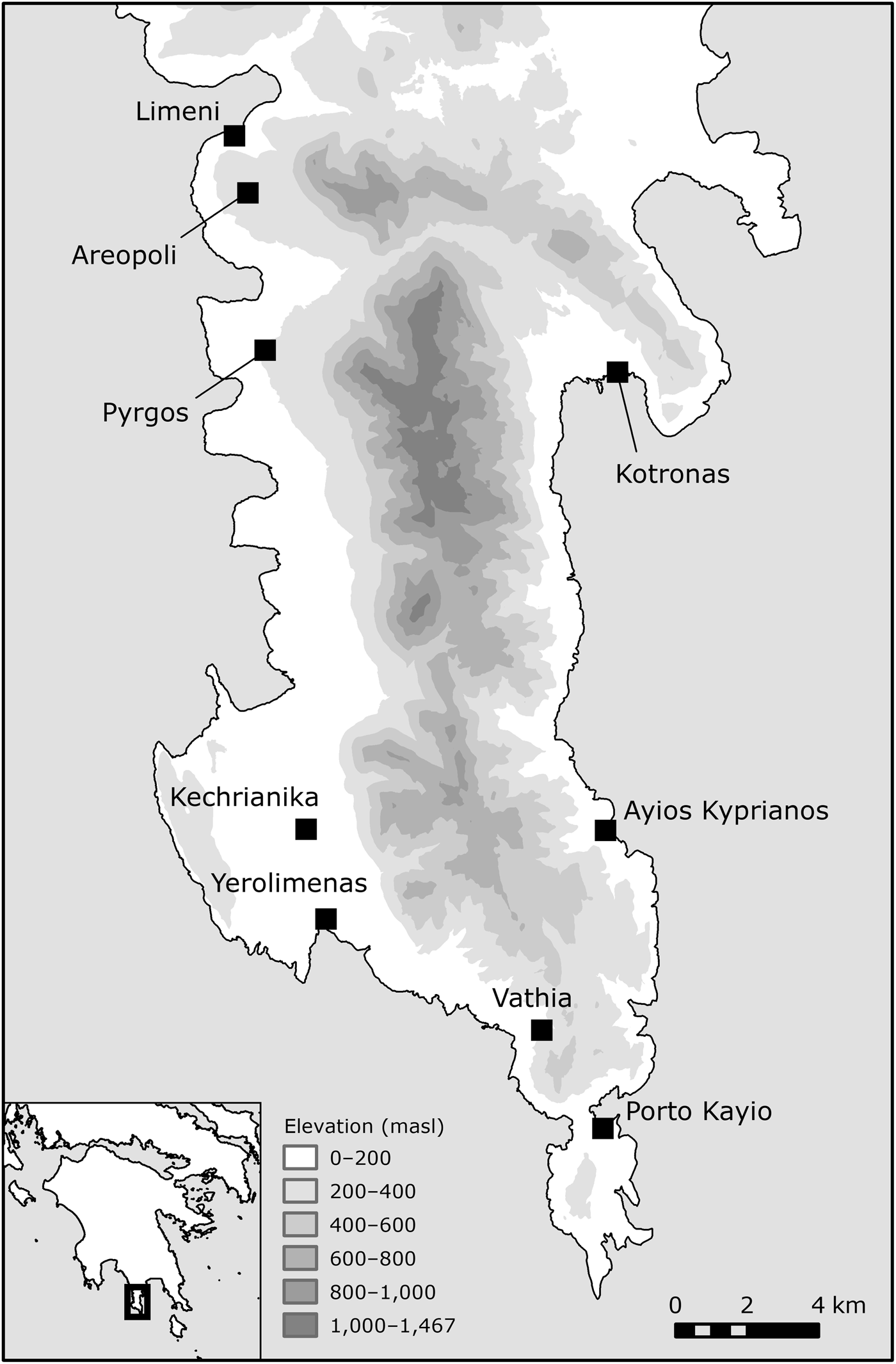
Major waypoints that the Leigh Fermors visited during their trip through the Deep Mani.
This meticulous gene-cultural investigation was facilitated by profound collaboration with the Maniot community, especially the involvement of Dr. Anargyros Mariolis, Director of the Areopolis Health Centre, whose enduring relationships with local residents ensured a representative and ethically conducted sampling across clans and villages. This engagement model underscored the mutual benefits of indigenous participation in scientific inquiry, guaranteeing that findings resonate with the lived histories and identities of the Deep Maniots themselves.
Of considerable historical interest, early Byzantine accounts, such as those of Emperor Constantine VII Porphyrogenitus in the tenth century, referenced the archaic lineage of the Deep Maniots. Porphyrogenitus noted their distinctiveness from Slavic settlers and remarked on the persistence of pagan worship into the ninth century, despite the wider Christianization of the empire. The new genetic insights provide a substantive biological dimension to such testimonies, reinforcing the view of Mani as a culturally and demographically exceptional enclave within the Greek world.
Beyond historical and anthropological implications, the researchers propose that further genomic investigations may unlock valuable clinical and public health insights applicable directly to the Deep Maniot population. Understanding the population’s unique genetic architecture could pave the way for precision medicine initiatives tailored to its specific demographic and genetic context, exemplifying how fundamental research translates into tangible benefits for studied communities.
This landmark work not only enriches our knowledge of Balkan population history but also exemplifies how integrated genetic, archaeological, and historical research can unravel complex legacies persisted across millennia. The Deep Maniots emerge from this study as a genetic reservoir preserving pre-Medieval southern Greek heritage with remarkable fidelity, their DNA narrating a profound story of resilience, isolation, and continuity in an ever-changing world.
As Dr. Leonidas-Romanos Davranoglou, the project’s lead author, reflects, “Our study highlights how geographic isolation and social organization can sustain ancient genetic landscapes in pockets where broader historical upheavals catalyze profound demographic transformations elsewhere.” This research invites a reevaluation of the presupposed homogeneity of Mediterranean populations and opens avenues for future work probing the intersections of genetics, history, and culture in other similarly isolated communities.
In sum, the Deep Maniot Greeks stand as a living archive, their genes chronicling epochs of human experience from antiquity to the present. This research illuminates not only an era of Greek history often veiled in ambiguity but also the enduring human story of identity, survival, and connection to place, resonating far beyond the cliffs and towers of the Mani Peninsula.
The full study ‘Uniparental analysis of Deep Maniot Greeks reveals genetic continuity from the pre-Medieval era’ has been published in Communications Biology.
See also: Mapping the Leigh Fermors’ Journey Through the Deep Mani in 1951
 Patrick Leigh Fermor
very interesting, as we found the Mani fascinating when we travelled there many years ago. It would be interesting to see if the mitochondrial DNA of the women in Olymbos, on the north of Karpathos should a similar pattern: a matrilineal society, isolated, speaking a Doric form of Greek.
Absolutely deserved, but I do not believe PLF was ever knighted.
JM Jon Morgan BA(Hons) MSc. CMS. Dip. EMG dadmjsdm@aol.com 07907 209 416
>
Paddy was eventually knighted in 2004. You are perhaps thinking about 1991 when he turned it down?
Fascinating, thank you. Another Spring on the horizon, another pledge to self to explore the Mani finally.