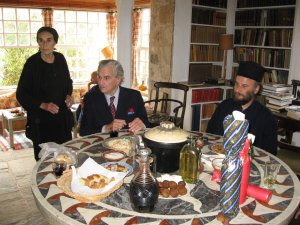
Click the picture to play


Click the picture to play
The Lionheart who stole a Nazi – and the heart of every woman: Max Hastings pays tribute to one of Britain’s last war heroes.
By Max Hastings
First published in the Daily Mail, 11 June 2011.
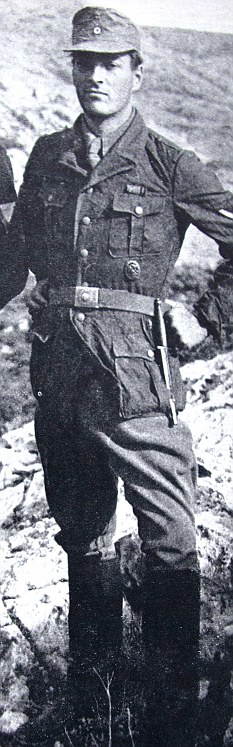
Paddy disguised as a German NCO during World War II, when he and fellow Special Operations soldiers carried out the daring kidnapping of General Heinrich Kreipe
One of the last authentic heroes of World War II is gone. Sir Patrick Leigh Fermor, a legend to his generation, died early yesterday in Worcestershire at the age of 96.
Paddy’, as he was universally known and beloved, spent two years as a British agent of the Special Operations Executive (SOE) in Crete. His most celebrated exploit, in April 1944, was to kidnap the commander of the German 22nd Division, General Heinrich Kreipe, a story romantically portrayed in the 1957 movie Ill Met By Moonlight, with Paddy played by Dirk Bogarde.
The SOE team and their Cretan guerrilla companions marched the general, evading furious German pursuit, to a beach from which the Royal Navy spirited them to Egypt.
Paddy received a richly-deserved DSO, but the Cretan experience was only one chapter in a lifetime devoted to the pursuit of adventure, learning and romance.
After the war, a succession of wonderful books about far-flung places made him the most famous travel writer of his generation.
Awesomely good-looking as a young man, he spoke half-a-dozen languages fluently and had a smattering of several more. His wit, zest for life and joy in companionship won him a legion of friends, some very grand — his comic correspondence with Debo, Duchess of Devonshire was published as a book last year — and others entirely humble.
He was loved for what he was as much as for what he did, though heaven knows, what he did was remarkable enough.
Paddy was born in 1915, the son of a distinguished geologist who spent most of his life in India, leaving his son to his own devices in England for much of his childhood. An unsuccessful schoolboy, he was eventually expelled from the King’s School, Canterbury, allegedly after being caught holding hands with a greengrocer’s daughter.
At the age of 18, in December 1933, he set out on a remarkable quest, to walk across Europe from the Hook of Holland to Constantinople, carrying only a few clothes and the Oxford Book Of English Verse in his rucksack.
Those were golden days, when the European aristocracy had plentiful money and leisure. They were captivated by his boundless curiosity about their countries, languages and people.
In training: Paddy was part of the secret Special Operation Executive, who conducted behind enemy lines operations during the War
He reached Constantinople at last on New Year’s Day 1935, then plunged into adventures in Greece, some of them as a spectator of a minor civil war. He told some of the story of his great journey in two books published 40 years later, A Time Of Gifts and Between The Woods And The Water, which became instant classics.
In Athens, he met a Romanian princess named Balasha Cantacuzene. They fell in love and spent the next two years together.
W hen the war came, he joined the Irish Guards. His command of languages caused him to be sent first to serve as a liaison officer in the doomed 1941 Greek campaign, then transferred to SOE, with which he spent the rest of the conflict.
Paddy brought the spirit of Lord Byron, British hero of the 19th century struggle for Greek independence, to the war in Crete. He loved the Cretans, revelled in the romance of life in their mountains, often disguised in their traditional dress.
‘He was lionised by all the hostesses in Cairo between missions. He had the Irish charm, that giving, generous spirit and gift of the gab — and, of course, he was incredibly handsome.’
Paddy told me, with the happy mischief in his eyes: ‘The Cretans were the finest natural guerrilla fighters in the world. They were always so keen on kidnapping girls that the idea of kidnapping a German general struck them as tremendous fun.’
A model gentleman: Sir Patrick was a man who was a joy to every company he met and devoted himself to the fun and fascination of exotic people and places
Captain Billy Moss, who afterwards wrote a best-selling account of the episode, was Paddy’s companion in the venture. The two British officers disguised themselves as German NCOs — which required Paddy regretfully to shave off his moustache. On the night of April 26, 1944, they flagged down the general’s car in darkness as he drove to his residence at the Villa Ariadne south of Heraklion.
‘Ist dies das General’s wagen?’ demanded Paddy. ‘Ja, ja,’ said a voice from inside.
Moss quickly coshed the driver and took the steering wheel. Paddy put on the general’s hat and clambered into the front of the big Opel, while three guerrillas sat on the semi-conscious old general in the back.
During the hours that followed, they drove unchecked past 22 German control posts and the centre of Heraklion. Only when safely in open country did they abandon the car and start walking.
Three weeks later, after an epic march across the mountains and many hair’s-breadth escapes, they found themselves safely aboard a British warship, bound for Alexandria, and their kidnapped German general was handed over for interrogation.
Paddy succumbed to rheumatic fever, but this did not prevent him from returning to Crete by parachute for a further mission, followed by more adventures at the end of the war in North-West Europe.
His love affair with Greece persisted. In the 1950s, he wrote two fine travel books about the country, Mani and Roumeli, and built a heavenly house at Karadamyli on the coast of the Peloponnese with his wife, the photographer Joan Eyres-Monsell, where they lived for most of the year thereafter for the rest of their lives. He became the Greeks’ favourite Englishman, an honorary citizen of Heraklion.
The writer Lawrence Durrell memorably described how Paddy once visited his villa in Cyprus: ‘After a splendid dinner by the fire he starts singing — songs of Crete, Athens, Macedonia. When I go out to refill the ouzo bottle, I find the street completely filled with people listening in utter silence and darkness. Everyone seems struck dumb.
 Anecdote: Writer Lawrence Durrell described the time Paddy visited his villa in Cyprus and left locals dumbstruck with his Greek songs
‘One said: “Never have I heard of Englishmen singing Greek songs like this!” It is as if they want to embrace Paddy wherever he goes.’
I first met Paddy as a very young man, when I listened enthralled to him holding forth to a dinner party with quotations from Horace, snatches of Romanian, Bulgarian and Greek, both ancient and modern. I read avidly his travel books, and later reckoned it a privilege to get to know him a little.
He remained until his death a model of the 1940s British gentleman abroad: impeccably dressed, effortlessly courteous and literate, tirelessly funny.
He was one of those men who brought joy to every company he joined in war and peace. He was completely unpolitical, and though indifferent to money was lucky enough to live among the rich with no need to care about tomorrow. He devoted himself to the fun and fascination of exotic people and places, and wrote like an angel.
In 1991 he became one of the few men ever to refuse a knighthood, though he belatedly accepted one in 2004: more than a hero of the war, he was a British hero for our times.
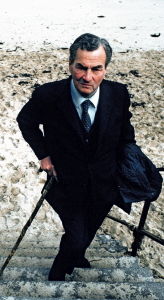
Leigh Fermor will be remembered as someone who lived and talked as well as he wrote
Sir Patrick Leigh Fermor: Soldier, scholar and celebrated travel writer hailed as the best of his time.
By Artemis Cooper
First published in The Independent Saturday, 11 June 2011.
In Greece just after the Second World War, Patrick Leigh Fermor was on a lecture tour for the British Council.
The lecture was supposed to be on British culture, but he had been persuaded to talk about his wartime exploits on Crete. Leigh Fermor took sips from a large glass as he spoke and when it was nearly finished, he topped it up from a carafe of water. The liquid turned instantly cloudy: he had added water to a nearly empty tumbler of neat ouzo.
A roar of appreciation went up from the audience at this impromptu display of leventeia. A quality prized in Greece, leventeia indicates high spirits, humour, quickness of mind and action, charm, generosity, the love of living dangerously and a readiness for anything. Sir Patrick Michael Leigh Fermor had leventeia in spades.
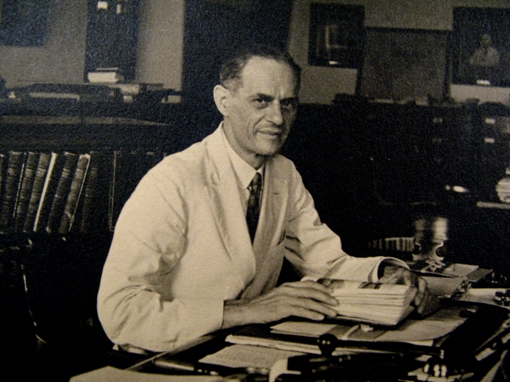
Sir Lewis Leigh Fermor
He was born in 1915, the second child and only son of Lewis Leigh Fermor and his wife, Aileen Taaffe Ambler. The family were based in Calcutta, where Lewis Fermor worked for the Geological Survey of India. Aileen went to England for the birth, but did not dare bring Leigh Fermor back to India as the First World War intensified. She entrusted her baby to the Martins, a couple she scarcely knew in the village of Road Weedon, Northamptonshire, and for the next four years “Paddy-Mike” was adored, indulged and allowed to run wild. When his mother and sister Vanessa came back to collect him in 1919, it was the end of an infant idyll that had, he admitted, “unfitted me for the faintest shadow of constraint.”
Leigh Fermor saw little of his father but was devoted to his flamboyant mother, who wrote plays, played the piano and loved reading aloud. He learnt to read late but devoured the works of Sir Walter Scott before he was 10, awaking an addiction for history, heraldry and adventure. Yet he was not a success academically, perpetually in trouble, and expelled from almost every school he attended.
The King’s School, Canterbury, might have been the exception, but he was often in trouble, and the final straw came when he was caught holding hands with the greengrocer’s daughter. His last report complained that he was a “dangerous mixture of sophistication and recklessness”, and a bad influence on the other boys.
His parents felt a career in the army was the only hope, but he gravitated to Bohemian London and a raffish group who introduced him to nightclubs, strong drink and modern poetry, and encouraged his ambition to be a writer – but he had nothing to write about. He was drifting in a fog of disappointment when the solution came: he would embark on a walk across Europe from the Hook of Holland to Constantinople.
He was 18 when he set off in 1932. With an allowance of £5 a month he slept in hostels, sheep-folds, monasteries, barns, people’s sofas, and for a few luxurious months in castles and country houses in Hungary and Transylvania. He reached Constantinople on New Year’s Day, 1935. He spent his 20th birthday on Mount Athos, and a month later took part in a Greek royalist cavalry charge against Venizelist rebels across the River Struma on a borrowed horse. He then made his way to Athens, where he met Princess Balasha Cantacuzène.
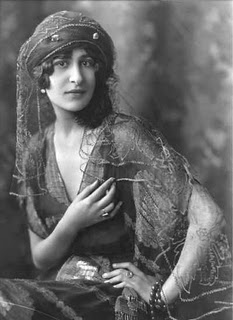
Balasha Cantacuzene
A Romanian painter with dark, exotic looks, Balasha was eight years older and recently divorced. That summer they lived in a watermill opposite the island of Poros, and in autumn they retreated to Balasha’s family home in Romania. Baleni, in the Cantacuzene estates in Moldavia, was his refuge for three years. Here he made the first attempt to write up his notes from his trans-European journey. He did not like the results, but he did earn money by translating Constantine Rodocanachis’s Ulysse fils d’Ulysse which as Forever Ulysses became a bestseller in America. When war was declared, Leigh Fermor decided to go home. “The farewells next day,” he wrote, “were like marching orders out of paradise.”
He had hoped to join the Irish Guards, but took the commission offered by the Intelligence Corps which gave him the opportunity to return to Greece. As a British Liaison Officer he followed the Greek army’s early successes against the Italians on the Albanian border in late 1940. When the Germans invaded the following April, the British and Greek forces retreated southwards. Leigh Fermor escaped by caique to Crete, where he took part in the battle in May 1941 against German paratroopers; when the battle was lost he was evacuated to Egypt. He was sent back to occupied Crete in June 1942, as one of a handful of SOE officers who were helping the Cretan Resistance.
After the Italian surrender in August 1943 he was contacted by the Italian general Angelo Carta. Rather than co-operate with the Germans, Carta wanted to leave Crete. Leigh Fermor saw him safely to Egypt – a mission which sparked the idea of kidnapping a German general. Promoted to major, he returned from Cairo to Crete in February 1944. With his second-in-command, Capt William Stanley Moss, and a hand-picked team of resistance fighters, the ambush took place on 26 April, when General Heinrich Kreipe, commander of the Sebastopol Division, was pulled out of his car on his way to his villa.
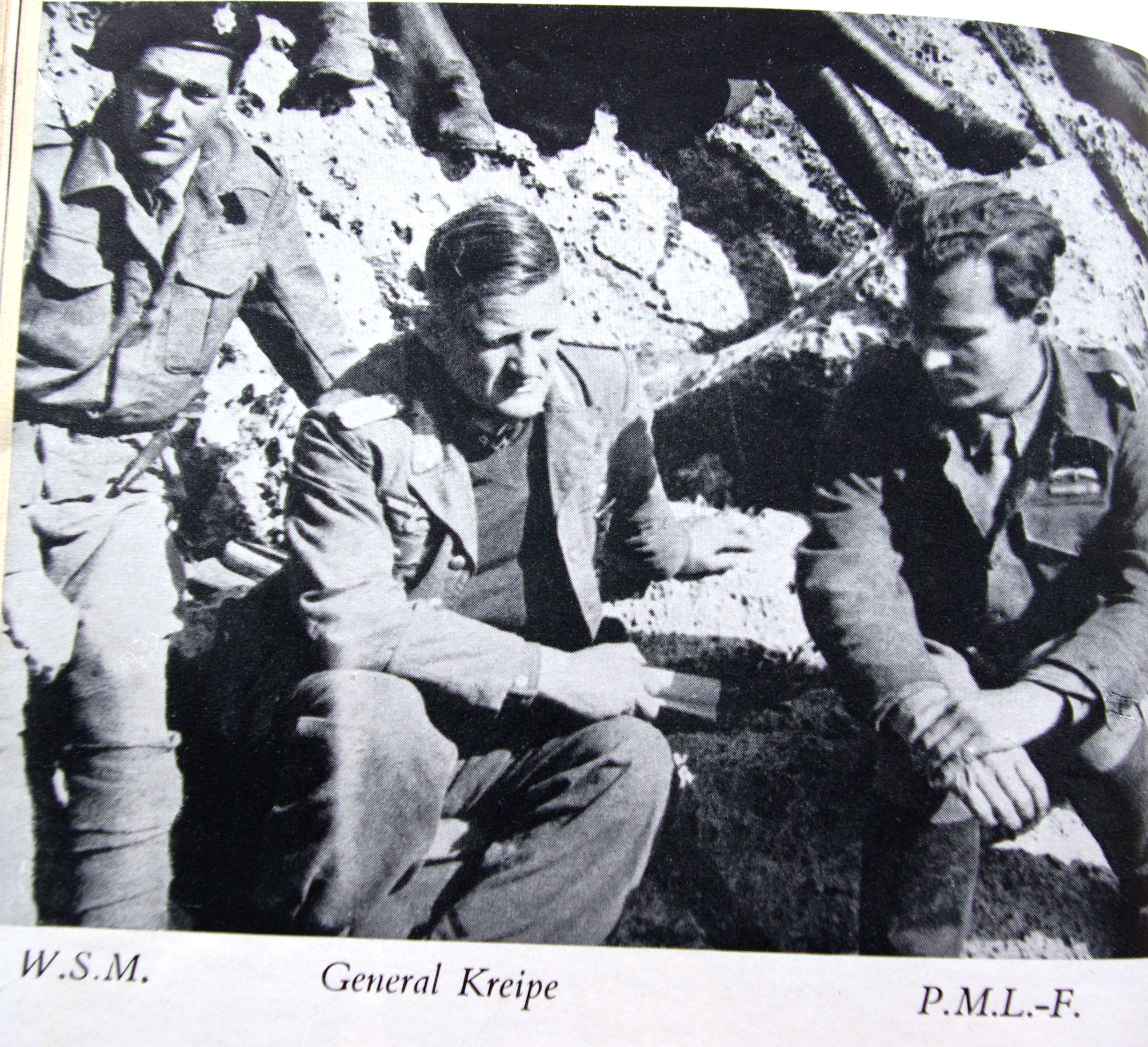
Moss, Kreipe and Paddy
The hardest part was not so much the capture but the getaway. The wireless broke down, German troops flooded the south coast, from where they had planned to rendezvous with a Royal Navy launch, and the General hurt his shoulder in a fall. The party spent two weeks in caves and sheepfolds in the White Mountains, making their way over the snowy ridges of Mount Ida to a more secluded evacuation point. German patrols kept up the pressure, and leaflets were dropped warning that anyone who gave aid and succour to the kidnappers could expect the most severe punishment. No one gave them away.
The success of the operation and the discomfiture of the occupiers gave the Cretans a tremendous boost: as one of them put it, “the horn-wearers won’t dare look us in the eye!” William Stanley Moss’s diary was made into a book, Ill Met by Moonlight (and later a film with Dirk Bogarde.) Leigh Fermor was awarded the DSO and remains a hero on Crete. But he never published an account of his own experiences on the island.
After the war, he became assistant director of the British Institute in Athens. A colleague recalled the songs and laughter emerging from his office, which was a magnet for Cretans looking for a job. His boss sent him on a lecture tour to get him out of the way, which proved a success and took him all round Greece. This was the first of many journeys taken with Joan Rayner, a tall, blonde intellectual he had first met in Cairo. Daughter of the first Viscount Monsell, who had been First Lord of the Admiralty in the 1930s, she was widely travelled and a talented photographer.
In October 1949, the couple set off for the French Antilles. Leigh Fermor had been commissioned to write captions for a book of photographs by his friend A Costa, but this developed into his first full-length book, The Traveller’s Tree (1950). The reviews were generous in their praise and he was earmarked as a writer to watch.
He was now free to concentrate on Greece. Over the next few years he and Joan travelled all over the mainland and the archipelago, by boat and bus and mule and on foot, exploring a country that was still remote outside the main towns and where customs and traditions were observed as they had been for centuries.
Spells of travel would be broken by long stints of writing, translation and journalism. In 1953 came two small books. A series of articles on monasteries, written for the Cornhill Magazine, were collected in A Time to Keep Silence, while his only novel, The Violins of Saint Jacques, grew out of a chapter he was supposed to have written for a book called Memorable Balls. He translated the wartime memoirs of his friend George Psychoundakis, which appeared in 1955 as The Cretan Runner, and wrote for The Spectator and The Sunday Times.
Beyond an insatiable thirst for travel, wine and books, Leigh Fermor and Joan lived a frugal life. She had a small private income, and by living abroad for most of the year they avoided tax. Friends helped by lending houses where he could write; among the most important was a house in Normandy owned by Amy Smart, the Egyptian wife of the diplomat Sir Walter Smart, and that of the painter Nico Ghika on the island of Hydra. When they were in England, Joan would retire to her family home at Dumbleton in Worcestershire while Leigh Fermor headed for the bright lights.
His friends scooped him up into a round of celebrations and reunions and house parties, where Leigh Fermor revelled in company. Among them were brothers-in-arms like Xan Fielding and George Jellicoe, celebrated hostesses such as Annie Fleming, Deborah Devonshire and Diana Cooper, and writers and poets such as John Betjeman, Robin Fedden, Philip Toynbee, and later, Bruce Chatwin.
Writing, on the other hand, was hard and solitary. Though many of his set-piece descriptions were written at a gallop and barely changed, other passages involved months of work. He was acutely attuned to internal rhythms; the alteration of one word would set up a ripple effect demanding whole chapters to be rewritten. His friend and publisher, Jock Murray, was often in despair as every set of proofs came back covered in crossings-out and addenda.
It was not until 1958 that Murray published Mani, Leigh Fermor’s first book on Greece. It shows the southern Peloponnese as it was before tourism – a land of rocks and dazzling light, blood feuds and deep superstition, where people still told tales of their struggles against the Turks and pirates. Its companion volume, Roumeli covers his travels from Macedonia to the Gulf of Corinth.
Leigh Fermor and Joan were keen to settle in Greece, and they were always on the look-out for the perfect patch of land. They found it in 1963, in the Mani, a little promontory near the village of Kardamyli, south of Kalamata. Surrounded by olive groves, it looked out to sea and had its own rocky beach. With the help of a local stonemason, Leigh Fermor and Joan set about building the house. The result was the perfect monastery-built-for-two, at the heart of which was a library described by John Betjeman as “one of the rooms of the world”.
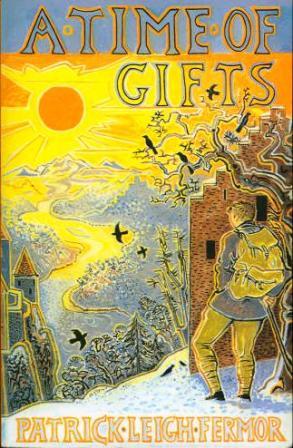
A Time of Gifts, 1977
Leigh Fermor at last had a permanent home, all his books in one place and uninterrupted solitude. His next subject was the one he had waited half a lifetime to write – the story of his great walk to Constantinople. “Shanks’s Europe”, as he called it, was worth the wait. A Time of Gifts appeared in 1977, and Between the Woods and the Water, the second volume in a proposed trilogy, in 1986. Together they present a snapshot of old Europe just before the joint cataclysms of war and Communism swept them away for ever. Every paragraph reflects the loss of a way of life still linked to its soil and its history, while celebrating the joy and enthusiasm of a young man discovering the riches of a continent. The reviews hailed him as the best travel writer of his time – and reader reviews on Amazon show him being rediscovered.
Unfortunately, the clamour for him to finish the last volume ushered in an ice age of writer’s block. In 1988 and 1990 he revisited his old haunts in Bulgaria and Romania, hoping to kick-start the creative process. Shocked by the all-obliterating change, he found his own memories fading. In an effort to get him over it Jock Murray commissioned another book about a journey to Peru, which appeared as Three Letters from the Andes (1991). He wrote articles, introductions, obituaries, reviews, and even translated a story by PG Wodehouse into Greek – but the pen-paralysis persisted. The two people he most relied on for moral support died: Murray in 1993, and his wife Joan 10 years later. Leigh Fermor was knighted on his 90th birthday, but his eyesight was beginning to deteriorate. He carried on writing in longhand for as long as he could, but the final volume of his trilogy remains unfinished.
He will be remembered by his friends as someone who lived and talked as well as he wrote, whose leventeia was irrepressible, his conversation unforgettable. He could launch into a monologue that turned into a one-man show, a verbal rollercoaster that ranged from the Pyrenees to the Carpathians or chased mythical beasts through primeval forests, tribal customs, Guatemalan bus tickets, German heraldry and Napoleonic uniforms – leaving the company breathless with laughter and exhilaration.
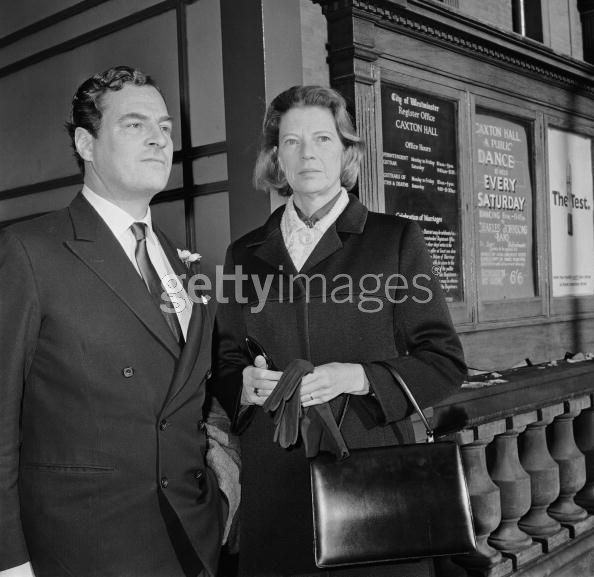
British soldier and travel writer Patrick Leigh Fermor with Joan Rayner after their wedding at Caxton Hall, Westminster, London, 17th January 1968. (Photo by Evening Standard/Hulton Archive/Getty Images)
Patrick Michael Leigh Fermor, writer and soldier: born London 11 February 1915; OBE (military) 1943; DSO 1944; Kt 2004; married 1968 Hon Joan Eyres-Monsell (died 2003); died 10 June 2011.
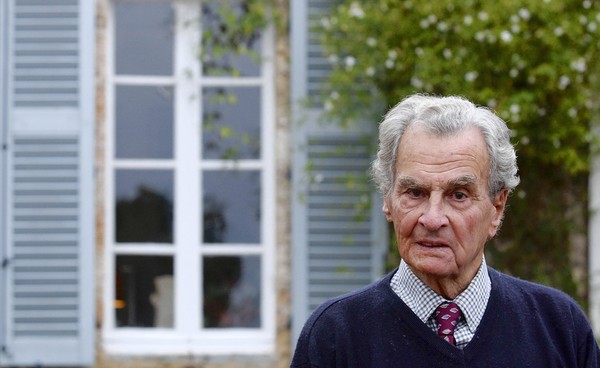
British travel writer Sir Patrick Leigh Fermor spent most of his time in southern Greece, near the town of Kardamyli. He returned to Britain the day before he died, according to his publisher. (Thanassis Stavrakis / Associated Press)
As a young man he walked from Holland to Constantinople, providing fodder for two of his acclaimed books. As an army major during WWII, he led a team that captured a German general in Nazi-occupied Crete.
First published in the Los Angeles Times, 11 June 2011
British travel writer Sir Patrick Michael Leigh Fermor, who tramped across Europe in his teens and captured a German general in Nazi-occupied Crete during World War II, died in Britain on Friday. He was 96.
Leigh Fermor had arrived in Britain on Thursday, a day before his death, said his publishing house, John Murray. The author lived most of the year in Greece, near the southern village of Kardamyli.
Leigh Fermor combined a love of adventure with the erudition of an older age and an eclectic inquisitiveness. His elegant prose, with baroque digressions into the arcana of history and folklore, furnished more than half a dozen books and earned a host of literary awards.
At 18, after a disastrous career at a succession of schools, he decided to walk from Holland to Constantinople, now Istanbul.
It was 1933, the year Adolf Hitler came to power.
As a British army major 11 years later, Leigh Fermor headed a team of British special operations officers and Greek resistance fighters that captured the German military commander of Crete, Gen. Karl Kreipe. Eluding a furious manhunt, the small band spirited the disgruntled Kreipe over the island’s snow-topped mountains to a southern cove, from which he was shipped to Egypt.
The action, for which Leigh Fermor was awarded the Distinguished Service Order, reportedly prompted the infamous Nazi order to execute captured Allied commandos. With a price on his head, he returned to Crete to coordinate covert operations.
The escapade was recorded by Leigh Fermor’s fellow officer William Stanley Moss in his book “Ill Met by Moonlight,” later turned into a film starring Dirk Bogarde.
Leigh Fermor was born Feb. 11, 1915, of English and Irish descent. His father was the India-based geologist Sir Lewis Leigh Fermor.
The author’s two-year rambles through the twilight of old Europe — equipped with the Oxford Book of English Verse, a volume of Horace and an old army greatcoat — provided the material for “A Time of Gifts” (1977) and, nine years later, “Between the Woods and the Water.”
Leigh Fermor won the Heinemann Foundation Prize in 1950 with his first book, “The Traveler’s Tree,” about the West Indies. Later came “A Time to Keep Silence” and the Greek travel books “Mani” and “Roumeli.”
His writings are studded with gems of obscure knowledge, a fine sense of place and character, and surreal anecdotes. In Missolonghi, Greece, he tracked down a pair of slippers that had belonged to Lord Byron. He rode with a Greek cavalry unit during a rebellion in the 1930s before peeling off to visit a camp of Sarakatsan nomads. He swam the Hellespont, capped Latin verses unexpectedly quoted by his captive general and had an affair with a Romanian princess.
His books inspired generations of travel writers. As author Michael Joseph Gross noted in a 2007 Times article, “When they grow up, travel writers want to be Fermor the way foreign correspondents want to be Ryszard Kapuscinski.”
Leigh Fermor also matched the ideal of a certain model of Englishman: a charming, polyglot scholar — albeit self-taught — and gentleman who had a good war, consorted with aristocracy and lived in foreign parts, worshipped by the locals.
He was knighted in 2004 — accepting an honor he had declined in 1991.
His wife, Joan Leigh Fermor, died in 2003. The couple had no children.
Don’t forget to visit the Paddy Thoughts page to leave a comment. Let’s all hear your thoughts and tributes to Paddy.
He brought so much joy into our lives and the lives of others, let’s say what we think!

Your Paddy Thoughts - click the image

Thanassis Stavrakis/Associated Press: Patrick Leigh Fermor in Greece in 2001. He had worked undercover there for the British military during World War II.
Patrick Leigh Fermor, the British writer whose erudite, high-spirited accounts of his adventures in prewar Europe, southern Greece and the Caribbean are widely regarded as classics of travel literature, died on Friday at his home in Worcestershire, England. He was 96.
by Richard B Woodward
First published in The New York Times, 11 June 2011
Patrick Leigh Fermor in Greece in 2001. He had worked undercover there for the British military during World War II.
Roland Philipps, Mr. Leigh Fermor’s editor at John Murray Publishers in Britain, confirmed his death.
Mr. Leigh Fermor was regarded by many as the finest travel writer alive on the strength of two autobiographical volumes, “A Time of Gifts” (1977) and “Between the Woods and the Water” (1986), which both recalled his walk across Europe in the 1930s, begun when he was a teenager and lasting more than three years.
Reviewing “Between the Woods and the Water” for The New York Times, John Gross wrote that it was not primarily for the “information it contains that his book deserves to be read (though he packs in a great deal), but for its sumptuous coloring, the acuteness of his responses, the loving precision with which he conjures up people and places.”
Once described by the BBC as “a cross between Indiana Jones, James Bond and Graham Greene,” Mr. Leigh Fermor was as renowned for his feats of derring-do as for his opulent prose.
After joining the Irish Guards during World War II, he was judged to be promising officer material for the Special Operations Executive, the unit created by Winston Churchill to wage war by unconventional means. Mr. Leigh Fermor’s superiors deemed his fluency in modern Greek useful in leading resistance to German occupation in the Aegean.
For 18 months he lived disguised as a shepherd in Crete, emerging from the mountains with a team that in 1944 kidnapped Gen. Heinrich Kreipe, the island’s German commander. The operation provoked brutal reprisals toward the local population. It earned Mr. Leigh Fermor the Distinguished Service Order and later became the basis for the 1957 English film “Ill Met by Moonlight,” directed by Michael Powell and starring Dirk Bogarde.
By the time the film was released, Mr. Leigh Fermor had received a measure of attention for his writing. He toured the Caribbean with two friends after the war and in 1950 published “The Traveller’s Tree,” a collection of island-hopping tales. They first revealed the qualities readers would learn to expect from his books: sly humor, curiosity, wide-ranging social connections and sympathies, familiarity with arcane history and a dashing literary style steeped in the ancient writing of Greece and Rome.
“The afternoon was baking and shadowless, and the town seemed only with an effort to remain upright among its thoroughfares of dust,” he wrote of a trip to Guadeloupe. “It was as empty as a sarcophagus.”
The Caribbean was the setting for his only novel, “The Violins of Saint-Jacques,” published in 1953 and turned into an opera in 1966 by the Australian composer Malcolm Williamson. Mr. Leigh Fermor also published in 1953 “A Time to Keep Silence,” a short, reverent study of the monastic life resulting from his stays in a pair of French abbeys and a tour of the rock-carved monasteries in Cappadocia, Turkey.
The warmth of Greece drew him back in the 1950s. He bought a home in Mani, in the southern Peloponnese. He and his wife, the former Joan Eyres Monsell, a photographer, divided their time between Greece and Britain. They married in 1968 after many years of companionship. She died in 2003.
The couple’s tables, in Mani and in Worcestershire, were reputed to be among the liveliest in Europe. Guests, both celebrities and local people, came to dine with them. The journalist and historian Max Hastings called Mr. Leigh Fermor “perhaps the most brilliant conversationalist of his time, wearing his literacy light as wings, brimming over with laughter.”
Mr. Leigh Fermor’s books about life in Greece — “Mani,” in 1958, and “Roumeli,” in 1966 — confirmed him as the armchair traveler’s ideal. (For his decades of writing about Greece, the government in 2007 awarded him its highest honor, the Commander of the Phoenix.)
But it was his earliest wanderings in Europe, undertaken when he was scarcely 18 and reconstructed for publication in adulthood, that earned him international acclaim.
He set off across the English Channel in December 1933 with little more in his backpack than clothes, a copy of Horace’s “Odes,” an automatic pistol and some letters of introduction. His journey did not end until January 1937, when he reached Constantinople (now Istanbul.)
On foot and on horseback, by train and automobile, Mr. Leigh Fermor found hospitality among people alien to most English speakers of the time: Orthodox Jewish woodcutters in Transylvania, Hungarian Gypsies, White Russian exiles, German barons, French-speaking monks in Austria, and Romanian shepherds along the Danube.
At one point he strayed by mistake into a Munich beer hall crowded with Nazis.
“The vaults of the great chamber faded into infinity through blue strata of smoke,” he wrote. “Hobnails grated, mugs clashed and the combined smell of beer and bodies and old clothes and farmyards sprang at the newcomer. I squeezed in at a table of peasants, and was soon lifting one of those masskrugs to my lips. It was heavier than a brace of iron dumbbells, but the blond beer inside was cool and marvelous, a brooding, cylindrical liter of Teutonic myth.”
Patrick Michael Leigh Fermor was born in London on Feb. 11, 1915. His father, Sir Lewis Leigh Fermor, was a geologist in India who became the first president of the Indian National Science Academy. His mother, the former Eileen Ambler, joined her husband on the subcontinent shortly after Patrick’s birth, leaving the boy in the care of a farmer’s family in Northamptonshire. (Reunited in adolescence with his mother and older sister, he continued to regard them as “beautiful strangers.”)
Mr. Leigh Fermor grew up willfully independent, unable to adapt for long to any school’s regimen. His headmaster at King’s School, Canterbury, where he was expelled, reportedly for holding hands with the local greengrocer’s daughter, wrote him up as “a dangerous mix of sophistication and recklessness which makes one anxious about his influence on other boys.”
After he accepted a knighthood in 2004, an honor he had turned down in 1991, he was known as Sir Patrick. But to his many friends he was Paddy, a man who maintained a zest for life, even into his 90s. “If you think you can match him ouzo for ouzo, on a back street in downtown Athens, you’d better think again,” Anthony Lane wrote in an admiring profile in The New Yorker in 2006.
Mr. Leigh Fermor continued working well into his last years, leaving no immediate survivors; he and his wife had no children.
A planned third book about his youthful travels never appeared, but his biographer Artemis Cooper told the British newspaper The Guardian that Mr. Leigh Fermor had completed a draft, and that it would be published.
Asked to confirm the impending publication, Mr. Philipps responded by e-mail, “I am afraid I cannot confirm this, except to say I very hope it is the case.”
In his eagerness to complete his last book, Mr. Leigh Fermor also accomplished something he had long put off: he taught himself to type.